
LEAN Mapping Marc Olano Dan Baker Firaxis Games

LEAN Mapping Marc Olano, Dan Baker Firaxis Games
LEAN Mapping • Linear Efficient Antialiased Normal Mapping • Fast and flexible solution for bump filtering – Shiny bumps are prone to aliasing – Distant bumps should change surface shading – Directional bumps change to anisotropic highlight – Existing solutions are too expensive • Allows blending layers of bumps • Works with existing Blinn-Phong pipeline
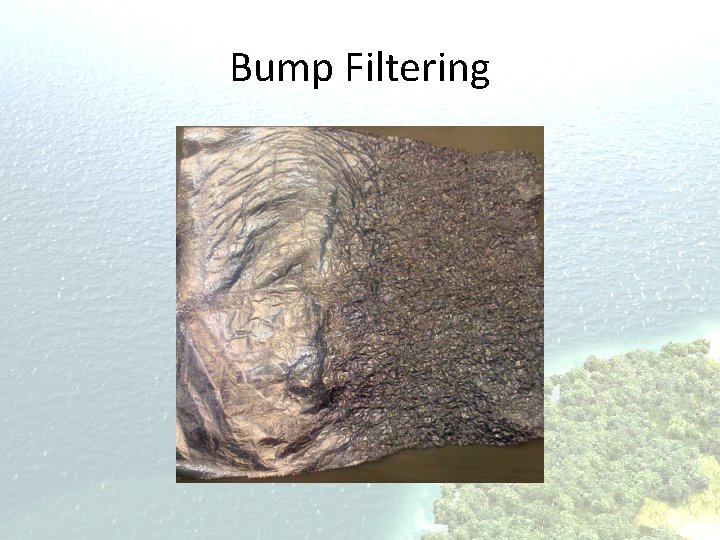
Bump Filtering
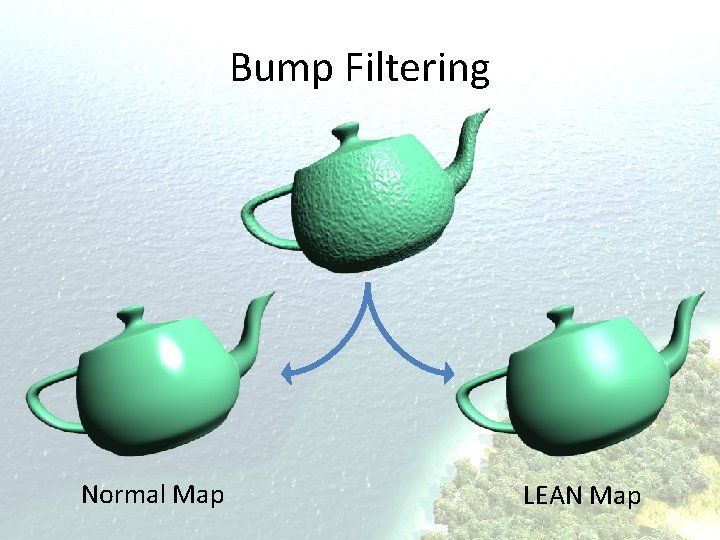
Bump Filtering Normal Map LEAN Map
![Bump & Normal Maps • Bump maps [Blinn 1978] – Height displacement texture –](http://slidetodoc.com/presentation_image/50a57a95c386a80435a74fabfe1c1a38/image-5.jpg "Bump & Normal Maps • Bump maps [Blinn 1978] – Height displacement texture –")
Bump & Normal Maps • Bump maps [Blinn 1978] – Height displacement texture – Run-time partial derivatives • Normal maps [Cohen et al. 1998] – Texture holds normal – Often in surface tangent space
Prior Work • Posed by Kajiya 1985 • Monte-Carlo – Cabral et al. 1987, Westin et al. 1992, Becker & Max 1993 • Multi-lobed distributions – Fournier 1992, Han et al. 2007 • Single Gaussian/Beckmann distribution – Olano & North 1997, Schilling 1997, Toksvig 2005 • Diffuse [Kilgard 2000]
Filtering • Filter is linear combination over kernel • Linear representation → any linear filter – Summed Area, EWA, … – MIP map, Hardware Anisotropic
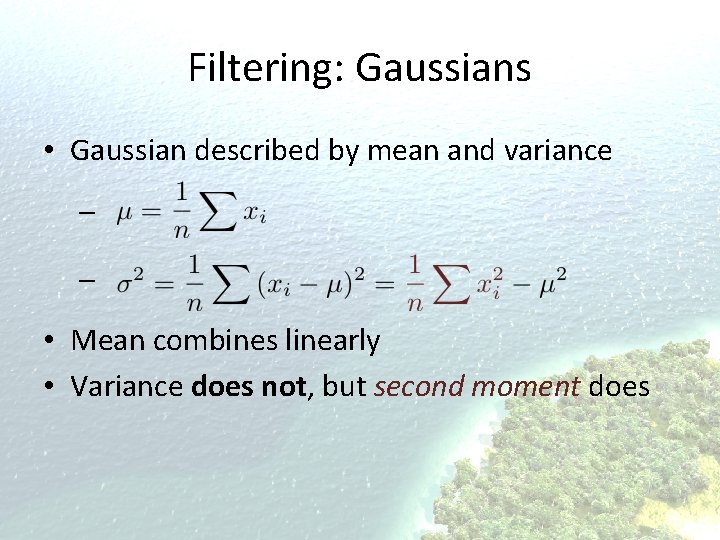
Filtering: Gaussians • Gaussian described by mean and variance – – • Mean combines linearly • Variance does not, but second moment does
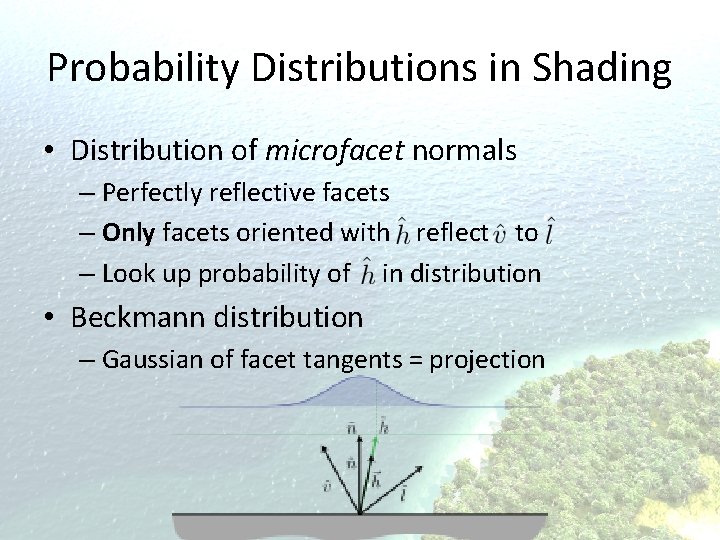
Probability Distributions in Shading • Distribution of microfacet normals – Perfectly reflective facets – Only facets oriented with reflect to – Look up probability of in distribution • Beckmann distribution – Gaussian of facet tangents = projection
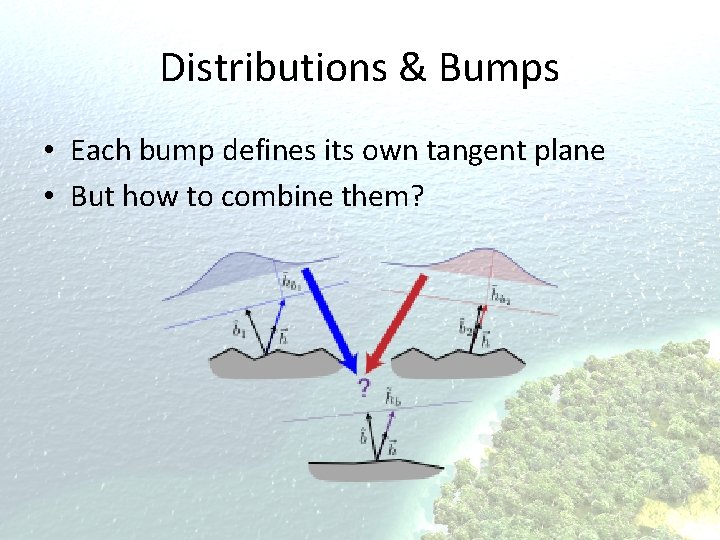
Distributions & Bumps • Each bump defines its own tangent plane • But how to combine them?
![Distribution & Bumps • Per-level nonlinear fit [Fournier 1992] • Fake it – MIP](http://slidetodoc.com/presentation_image/50a57a95c386a80435a74fabfe1c1a38/image-11.jpg "Distribution & Bumps • Per-level nonlinear fit [Fournier 1992] • Fake it – MIP")
Distribution & Bumps • Per-level nonlinear fit [Fournier 1992] • Fake it – MIP variance values [Schilling 1997] • Spherical distribution – 3 D Gaussian | sphere [Olano and North 1997] – Von Mises-Fischer [Han 2007]
LEAN mapping • • Blinn-Phong ↔ Beckmann Filtering Bumps Sub-facet shading Layers of bumps
![Blinn-Phong ↔ Beckmann • Blinn-Phong approximates Gaussian [Lyon 1993] • Better fit as increases](http://slidetodoc.com/presentation_image/50a57a95c386a80435a74fabfe1c1a38/image-13.jpg "Blinn-Phong ↔ Beckmann • Blinn-Phong approximates Gaussian [Lyon 1993] • Better fit as increases")
Blinn-Phong ↔ Beckmann • Blinn-Phong approximates Gaussian [Lyon 1993] • Better fit as increases • Variance , normalize with
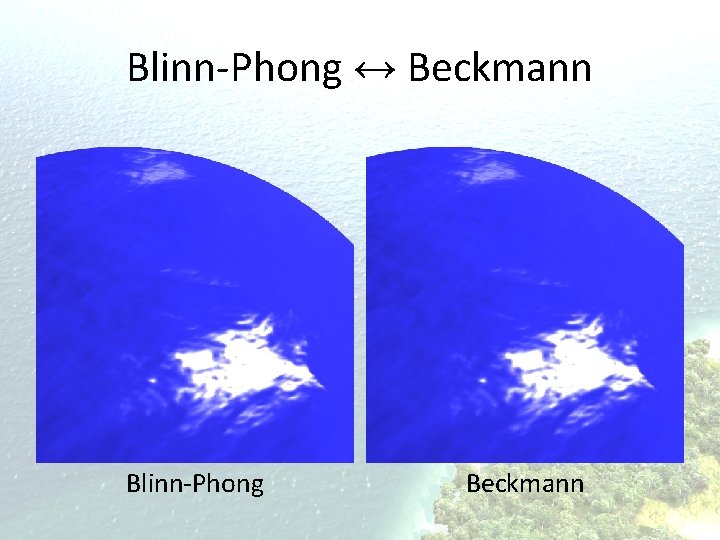
Blinn-Phong ↔ Beckmann Blinn-Phong Beckmann
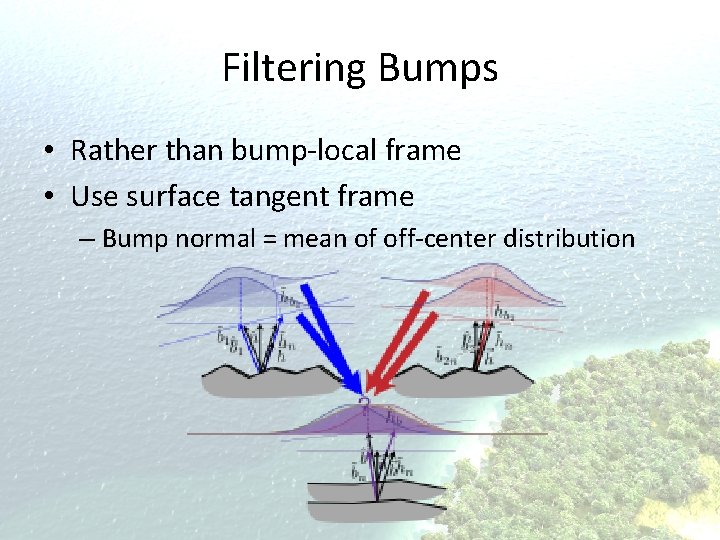
Filtering Bumps • Rather than bump-local frame • Use surface tangent frame – Bump normal = mean of off-center distribution
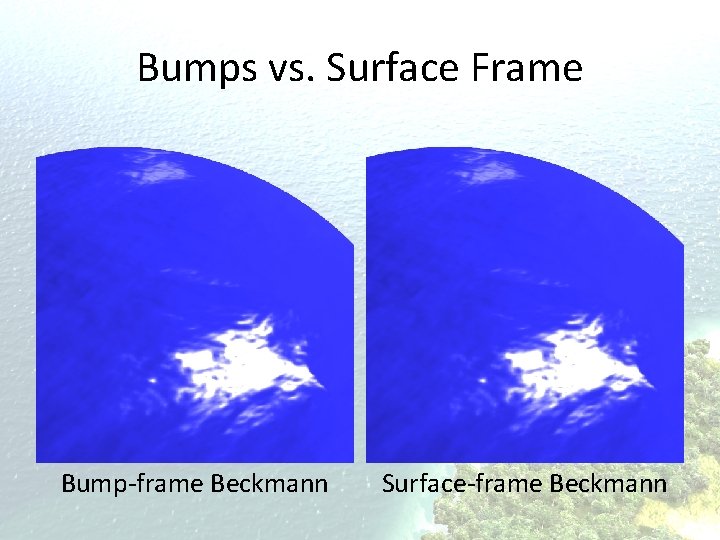
Bumps vs. Surface Frame Bump-frame Beckmann Surface-frame Beckmann
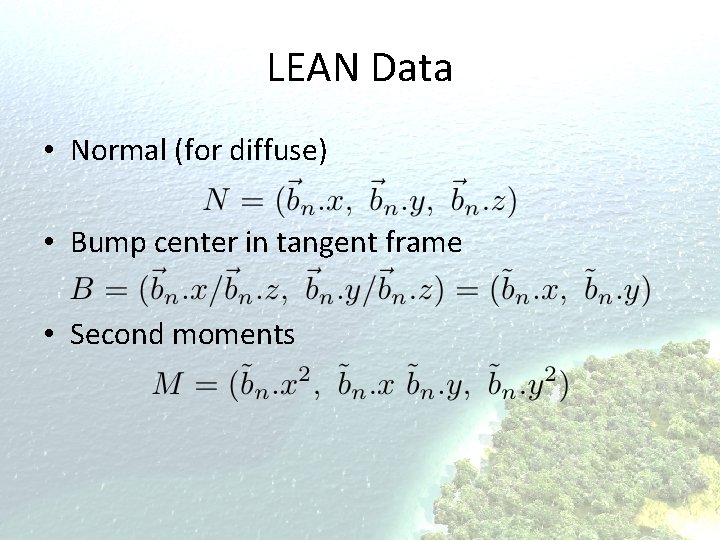
LEAN Data • Normal (for diffuse) • Bump center in tangent frame • Second moments
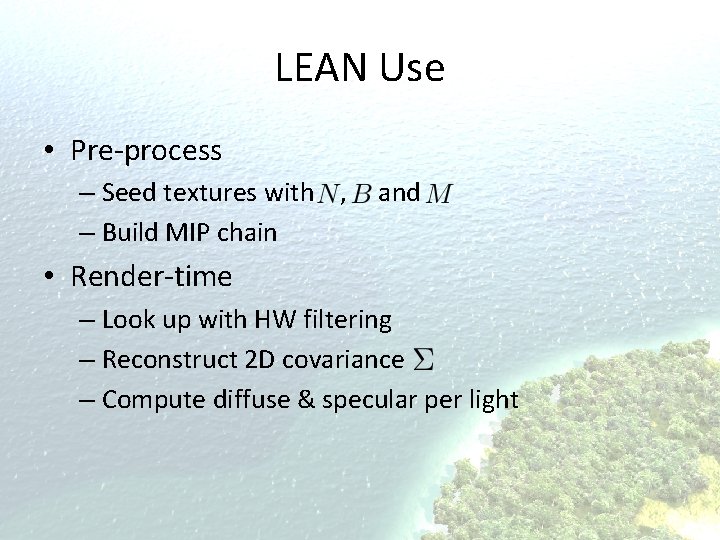
LEAN Use • Pre-process – Seed textures with , – Build MIP chain and • Render-time – Look up with HW filtering – Reconstruct 2 D covariance – Compute diffuse & specular per light
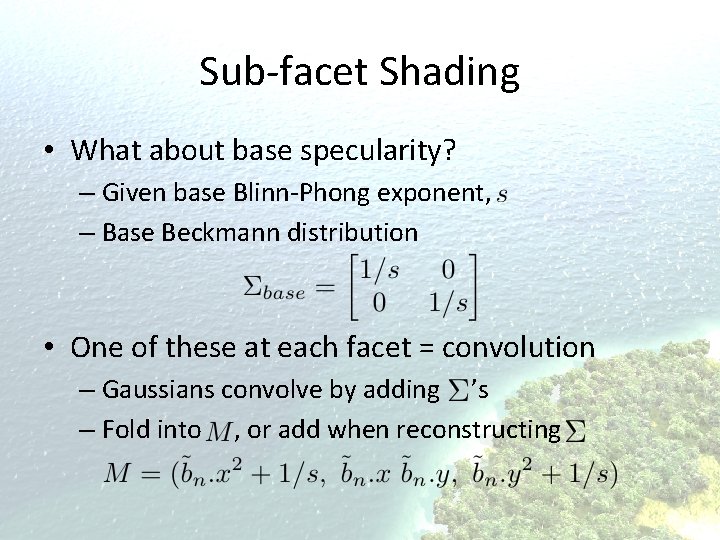
Sub-facet Shading • What about base specularity? – Given base Blinn-Phong exponent, – Base Beckmann distribution • One of these at each facet = convolution – Gaussians convolve by adding ’s – Fold into , or add when reconstructing
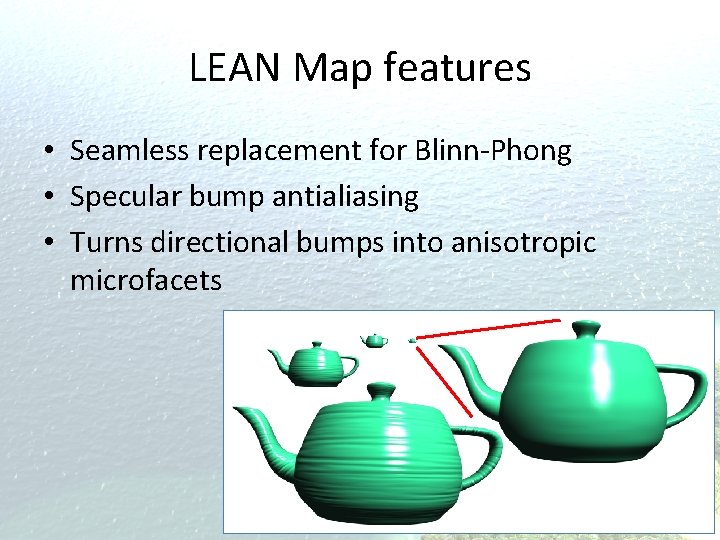
LEAN Map features • Seamless replacement for Blinn-Phong • Specular bump antialiasing • Turns directional bumps into anisotropic microfacets
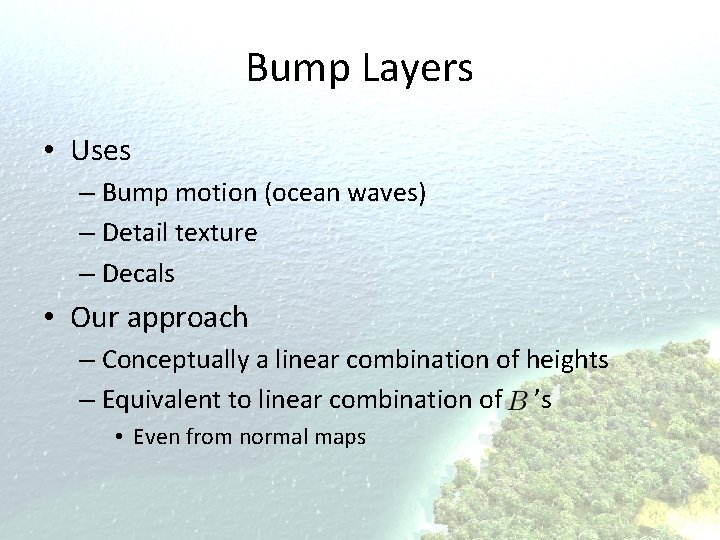
Bump Layers • Uses – Bump motion (ocean waves) – Detail texture – Decals • Our approach – Conceptually a linear combination of heights – Equivalent to linear combination of ’s • Even from normal maps
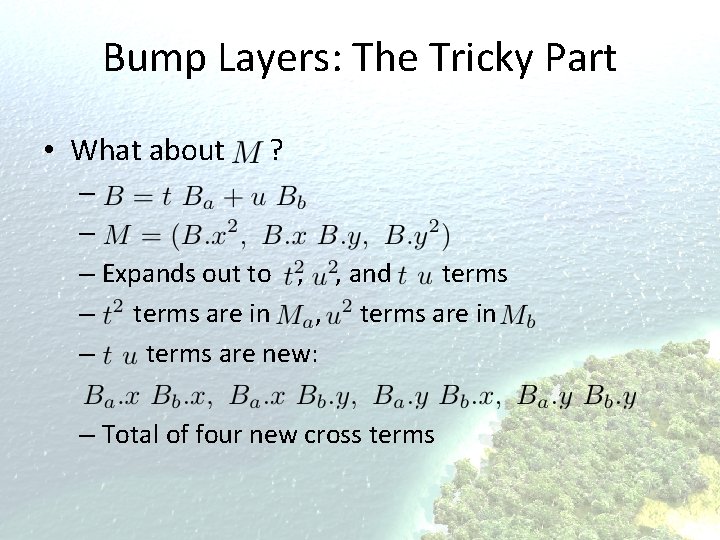
Bump Layers: The Tricky Part • What about ? – – – Expands out to , , and terms – terms are in , terms are in – terms are new: – Total of four new cross terms
Layering Options 1. Generate single combined LEAN map – Mix actual heights, or use mixing equations – Time varying: need to generate per-frame – Decal or detail: need high-res LEAN map 2. Generate mixing texture – One per pair of layers – Decal or detail: need high-res LEAN mixture maps 3. Approximate cross terms – Use rather than a filtered mixing texture
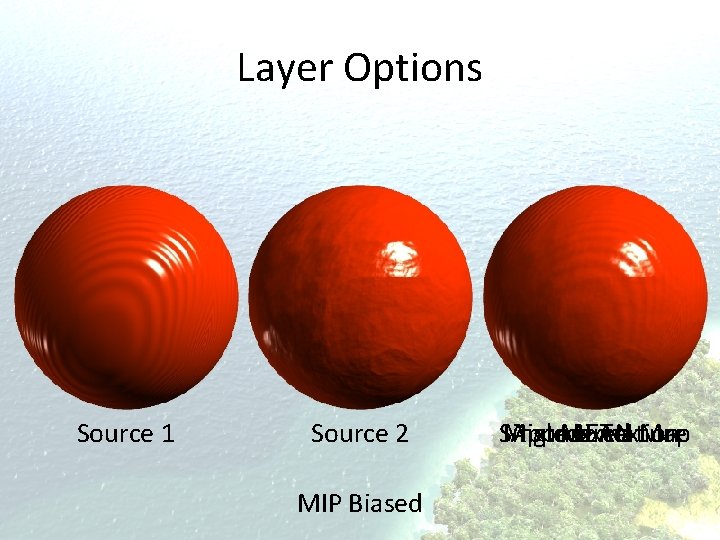
Layer Options Source 1 Source 2 MIP Biased Single Mixture Approximation Mixed LEAN Texture Map
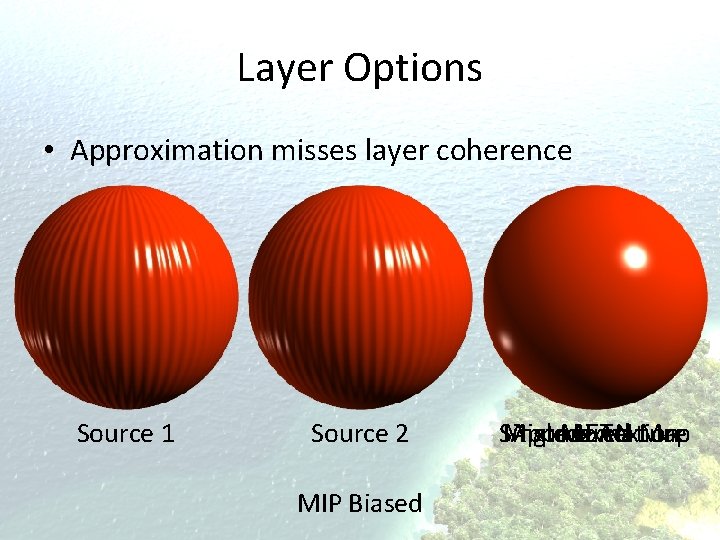
Layer Options • Approximation misses layer coherence Source 1 Source 2 MIP Biased Single Mixture Approximation Mixed LEAN Texture Map
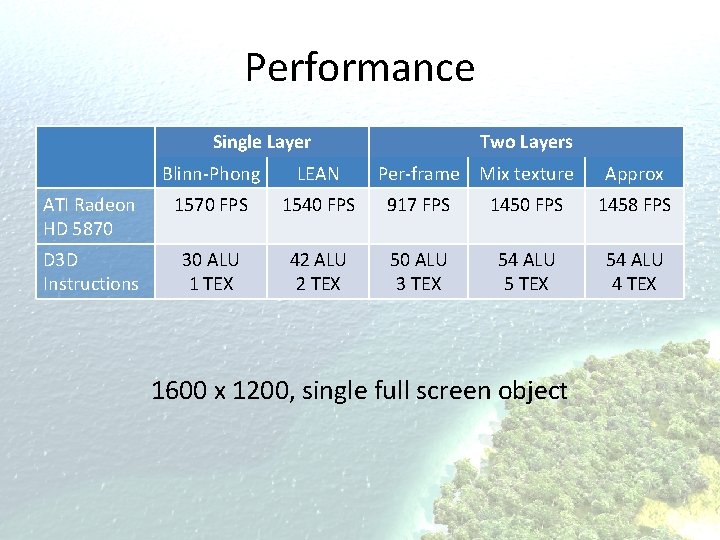
Performance Single Layer Two Layers Blinn-Phong LEAN Per-frame Mix texture ATI Radeon HD 5870 1570 FPS 1540 FPS 917 FPS 1450 FPS 1458 FPS D 3 D Instructions 30 ALU 1 TEX 42 ALU 2 TEX 50 ALU 3 TEX 54 ALU 5 TEX 54 ALU 4 TEX 1600 x 1200, single full screen object Approx
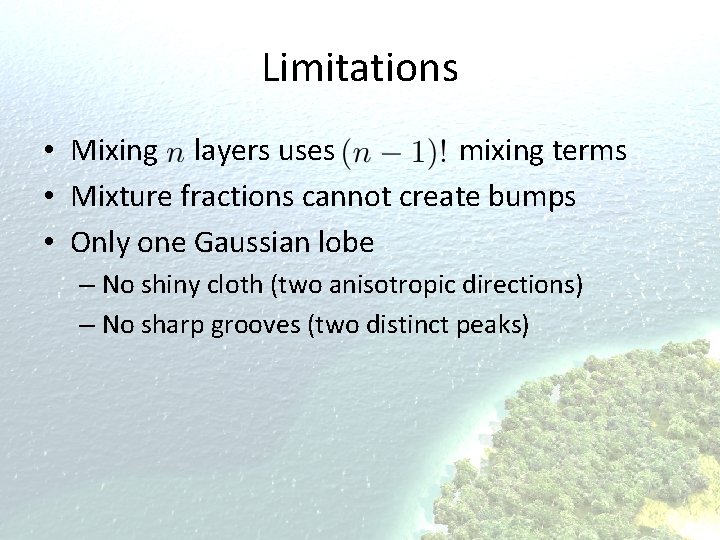
Limitations • Mixing layers uses mixing terms • Mixture fractions cannot create bumps • Only one Gaussian lobe – No shiny cloth (two anisotropic directions) – No sharp grooves (two distinct peaks)
Conclusions • Linear – Linear texture filtering – Linear combination of layers • Efficient – One extra texture access – Small number of extra instructions • Antialiased – Works with hardware MIP and anisotropic filtering • Normal Mapping – Height map or normal map source – Compatible with existing Blinn-Phong assets and pipeline
- Slides: 28