
lean manufacturing training week 4 line balance adjusting
![[ lean manufacturing training week 4 ]](https://slidetodoc.com/presentation_image/1f1e432c7ed8a5f1457d83b1ef722c5e/image-1.jpg "[ lean manufacturing training week 4 ]")
[ lean manufacturing training week 4 ]
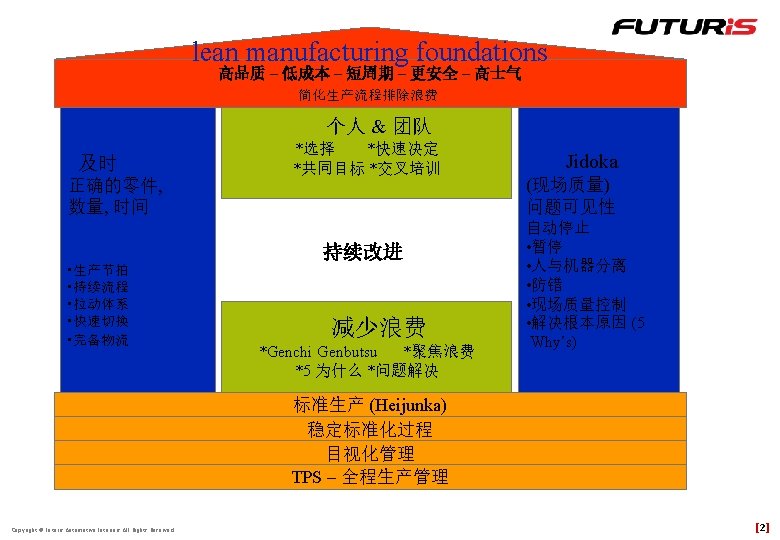
line balance • adjusting the spread of work evenly between operators to the rate of customer demand remember: TAKT time – available work time/customer demand cycle time – actual time to complete the tasks Copyright © Futuris Automotive Interiors All Rights Reserved [3]
line balance benefits: • improve throughput of assembly line • encourage one-piece flow • increase labour utilisation • reduce cost Copyright © Futuris Automotive Interiors All Rights Reserved [4]
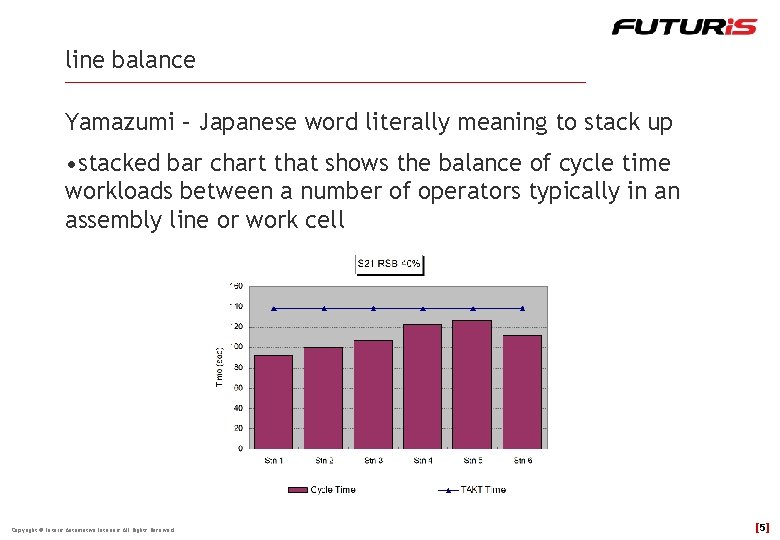
line balance Yamazumi – Japanese word literally meaning to stack up • stacked bar chart that shows the balance of cycle time workloads between a number of operators typically in an assembly line or work cell Copyright © Futuris Automotive Interiors All Rights Reserved [5]
line balance effects of imbalance • excess inventory • idle equipment • idle people • team dissension • individual frustration Copyright © Futuris Automotive Interiors All Rights Reserved [6]
![line balance Line Balance Exercise Copyright © Futuris Automotive Interiors All Rights Reserved [7]](http://slidetodoc.com/presentation_image/1f1e432c7ed8a5f1457d83b1ef722c5e/image-7.jpg "line balance Line Balance Exercise Copyright © Futuris Automotive Interiors All Rights Reserved [7]")
line balance Line Balance Exercise Copyright © Futuris Automotive Interiors All Rights Reserved [7]
problem solving • within all organisations there an endless supply of problems • the inverse of a problem is an opportunity • problems often classed as failures and thus hidden rather than addressed “every problem is an improvement opportunity” Copyright © Futuris Automotive Interiors All Rights Reserved [8]
problem solving traditional method of correcting problems • correct problems off – line in rework areas/bays • added layers of inspection • reluctance to identify problems & solutions not explored • problems continue, added cost to correct later • application of 6 sigma and SPC to solve problems Copyright © Futuris Automotive Interiors All Rights Reserved [9]
problem solving new approach – stopping line to fix problems (Jidoka) • principle “get quality right the first time” • stop to fix problems • do not allow defects to pass through to next process • urgency to fix problems – challenges people to think • Andon, Jidoka, Poke Yoke, Standard Work, Problem Solving, Training • motivation to identify and solve problems Copyright © Futuris Automotive Interiors All Rights Reserved [10]
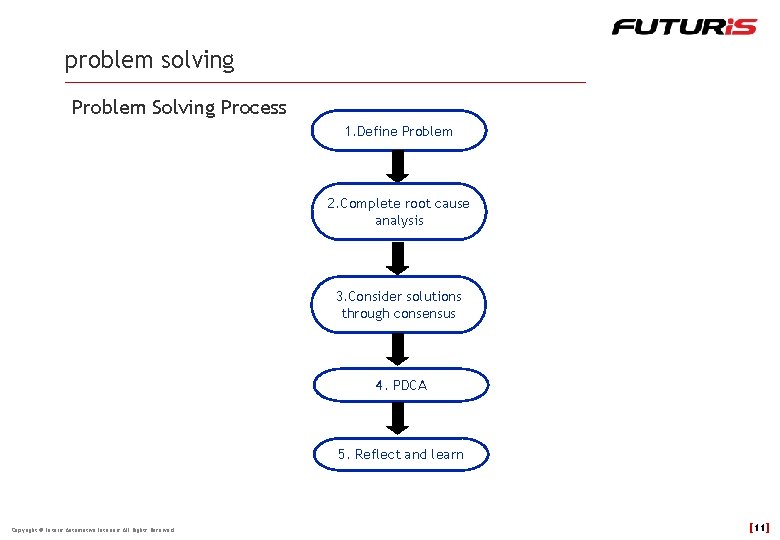
problem solving Problem Solving Process 1. Define Problem 2. Complete root cause analysis 3. Consider solutions through consensus 4. PDCA 5. Reflect and learn Copyright © Futuris Automotive Interiors All Rights Reserved [11]
problem solving 1. Define the problem • go to where the problem is and observe the situation without preconception • compare the actual situation to the standard • use Pareto Analysis to prioritise a number of different problems • set targets for improvement “Carefully aim before firing” Copyright © Futuris Automotive Interiors All Rights Reserved [12]
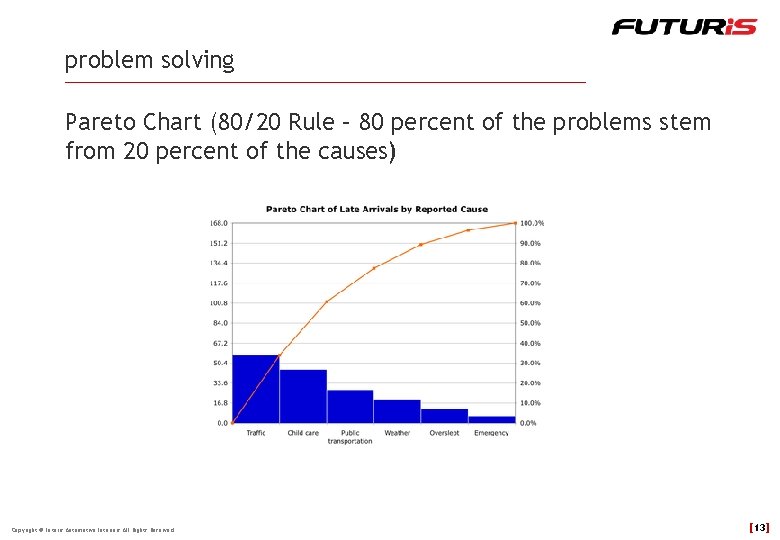
problem solving Pareto Chart (80/20 Rule – 80 percent of the problems stem from 20 percent of the causes) Copyright © Futuris Automotive Interiors All Rights Reserved [13]
problem solving 2. Complete root cause analysis • Analysis not clouded – no preconceived ideas of source of problem • Analysis continued until true “root” cause of problem are discovered • Multiple causes for problems – complete comprehensive analysis • Various problem solving tools available Copyright © Futuris Automotive Interiors All Rights Reserved [14]
problem solving 5 why’s – ask “why? ” five times example: WHY is the press leaking? There is a crack in the oil filter WHY is the filter cracked? Because it gets too hot during use WHY does it get hot? Because cooling system not working WHY doesn’t the cooling system work? Too much dust on coils WHY is there too much dust on coils? The air intake filter is missing! SOLUTION: Replace air intake filter Copyright © Futuris Automotive Interiors All Rights Reserved [15]
problem solving Cause and effect (aka Fishbone diagram) • Generate a comprehensive list of possible causes • Lead to greater understanding of the problem • 4 M’s – Man, Machine, Materials, Methods (additional M’s include M-environment and Measurement) – easier identification and analysis Copyright © Futuris Automotive Interiors All Rights Reserved [16]
![problem solving Copyright © Futuris Automotive Interiors All Rights Reserved [17]](http://slidetodoc.com/presentation_image/1f1e432c7ed8a5f1457d83b1ef722c5e/image-17.jpg "problem solving Copyright © Futuris Automotive Interiors All Rights Reserved [17]")
problem solving Copyright © Futuris Automotive Interiors All Rights Reserved [17]
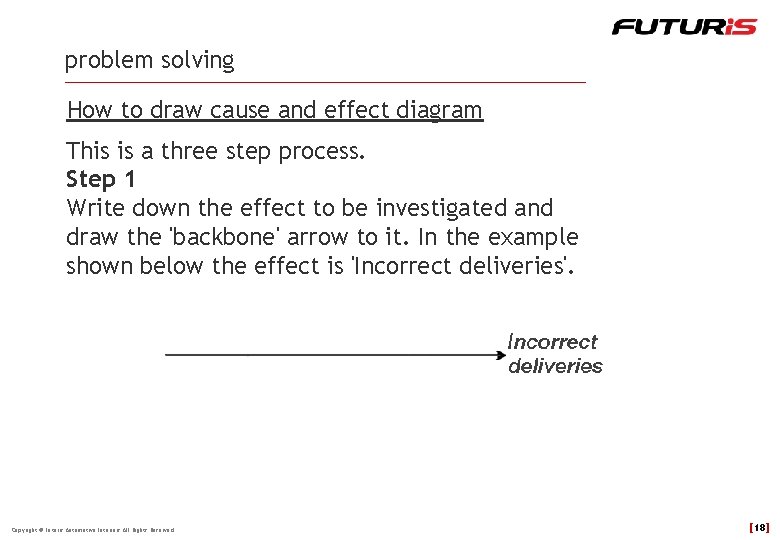
problem solving How to draw cause and effect diagram This is a three step process. Step 1 Write down the effect to be investigated and draw the 'backbone' arrow to it. In the example shown below the effect is 'Incorrect deliveries'. Copyright © Futuris Automotive Interiors All Rights Reserved [18]
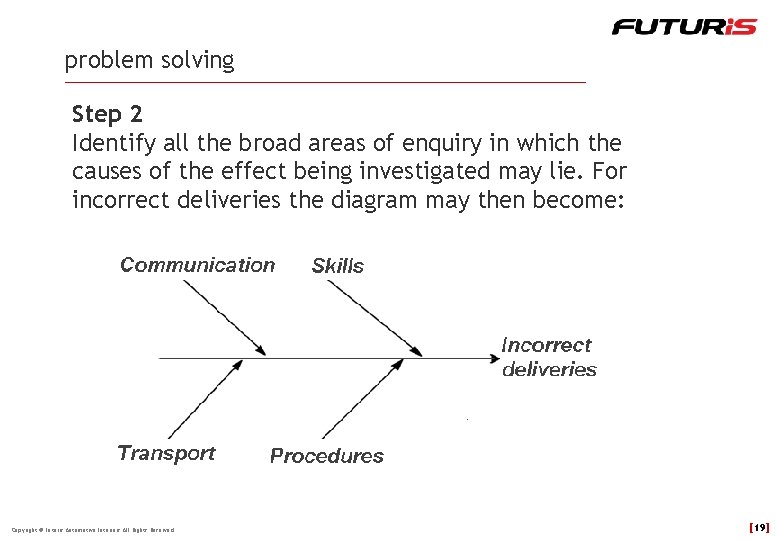
problem solving Step 2 Identify all the broad areas of enquiry in which the causes of the effect being investigated may lie. For incorrect deliveries the diagram may then become: Copyright © Futuris Automotive Interiors All Rights Reserved [19]
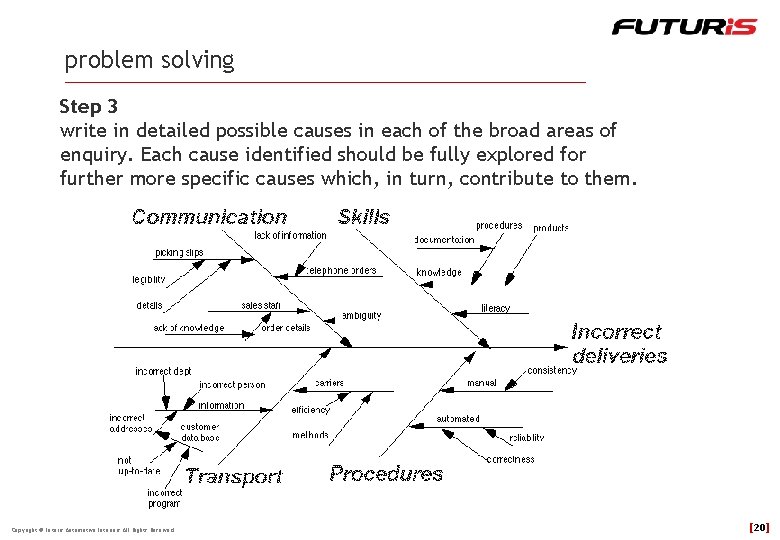
problem solving Step 3 write in detailed possible causes in each of the broad areas of enquiry. Each cause identified should be fully explored for further more specific causes which, in turn, contribute to them. Copyright © Futuris Automotive Interiors All Rights Reserved [20]
problem solving Brainstorming • a group creativity technique to generate a large number of ideas for the solution of a problem • break out of stale, established patterns of thinking to develop new ways of looking at things Copyright © Futuris Automotive Interiors All Rights Reserved [21]
problem solving 3. Consider solutions through consensus Step 1. Broadly consider all possibilities Step 2. Narrow list by eliminating impractical solutions Step 3. Evaluate based on simplicity, cost, quality and ability to implement quickly Step 4. Develop consensus on the proposed solution Consensus through cross-functional team – supervisor, operator, quality, manufacturing engineering, logistics, design engineering etc Copyright © Futuris Automotive Interiors All Rights Reserved [22]
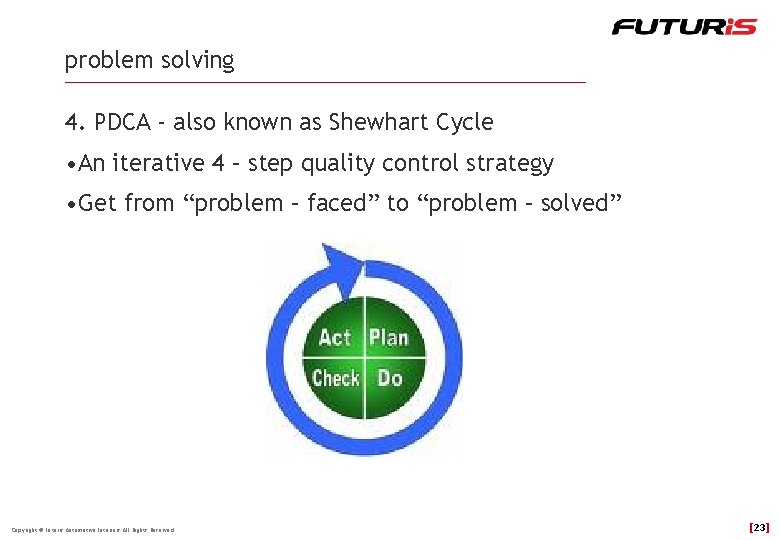
problem solving 4. PDCA - also known as Shewhart Cycle • An iterative 4 – step quality control strategy • Get from “problem – faced” to “problem – solved” Copyright © Futuris Automotive Interiors All Rights Reserved [23]
problem solving P-Plan Develop action plan to deliver required results D-Do Implement solutions rapidly C-Check Verify the result A-Act Make necessary adjustments to solutions and action plan and determine future steps Copyright © Futuris Automotive Interiors All Rights Reserved [24]
problem solving 5. Reflect & learn from process Become a learning organization through relentless reflection and continuous improvement (kaizen) Copyright © Futuris Automotive Interiors All Rights Reserved [25]
A 3 report Telling the story using an A 3 report • communication process used as part of problem solving process • document key information and decisions at each step to share with others for evaluation • assist with arriving at consensus Why A 3? – Size large enough to display information clearly and concisely and little time needed to share message Waste elimination extends to all activities of the organisation Copyright © Futuris Automotive Interiors All Rights Reserved [26]
A 3 report A 3 problem solving story format Copyright © Futuris Automotive Interiors All Rights Reserved [27]
![A 3 report example Copyright © Futuris Automotive Interiors All Rights Reserved [28]](http://slidetodoc.com/presentation_image/1f1e432c7ed8a5f1457d83b1ef722c5e/image-28.jpg "A 3 report example Copyright © Futuris Automotive Interiors All Rights Reserved [28]")
A 3 report example Copyright © Futuris Automotive Interiors All Rights Reserved [28]
- Slides: 28