
Lean Manufacturing Chapter 5 Perfection The Incremental Path

- Slides: 26
Lean Manufacturing Chapter 5 Perfection
The Incremental Path l Joe Day began to introduce Lean Thinking in 1992. l No matter how many times his employees improved a given activity to make it leaner, they could always find more ways to remove Muda by eliminating effort, time, space, and errors. “Manpower is something that is beyond measurement. Capabilities can be extended indefinitely when everyone begins to think. ” - Taiichi Ohno 2
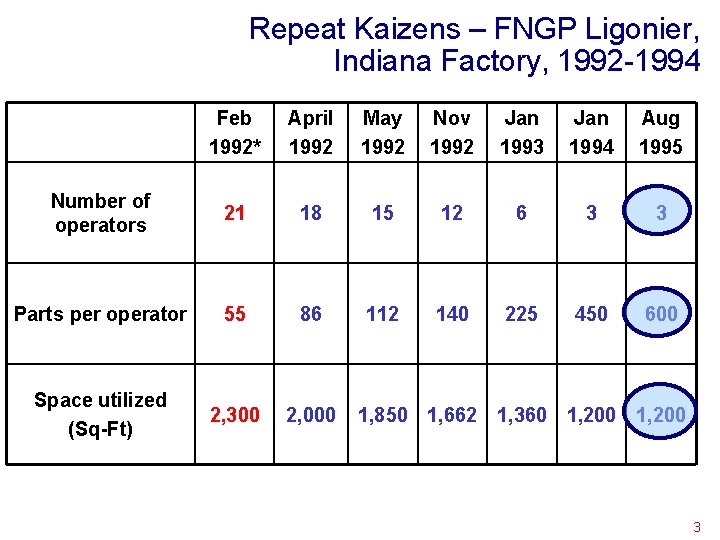
Repeat Kaizens – FNGP Ligonier, Indiana Factory, 1992 -1994 Feb 1992* April 1992 May 1992 Nov 1992 Jan 1993 Jan 1994 Aug 1995 Number of operators 21 18 15 12 6 3 3 Parts per operator 55 86 112 140 225 450 600 Space utilized (Sq-Ft) 2, 300 2, 000 1, 850 1, 662 1, 360 1, 200 3
Kaizen 改善 l 改 Kai = To Break l 善 Zen = For the Better l Kaizen – Origination A tool developed by Toyota, as part Toyota Production System (TPS) to enable continued improvement l Manufacturing staff solved quality issues within a structured team framework, using specific tools l Adapted by many firms around the world as a way of accelerating improvements 4
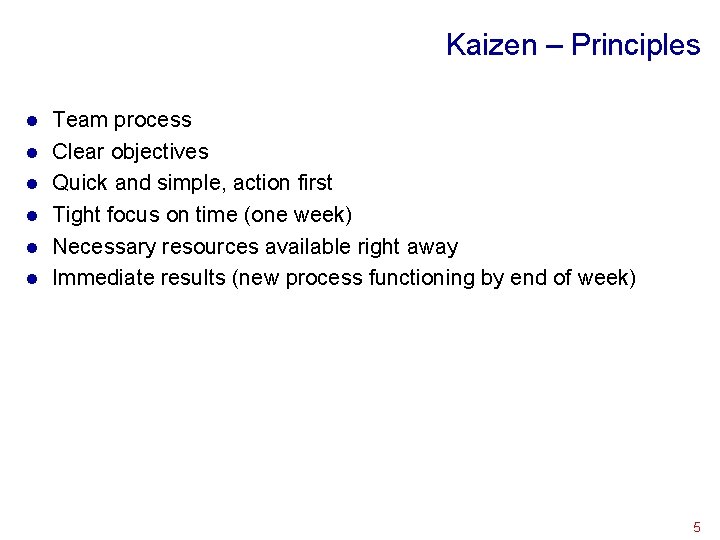
Kaizen – Principles l l l Team process Clear objectives Quick and simple, action first Tight focus on time (one week) Necessary resources available right away Immediate results (new process functioning by end of week) 5
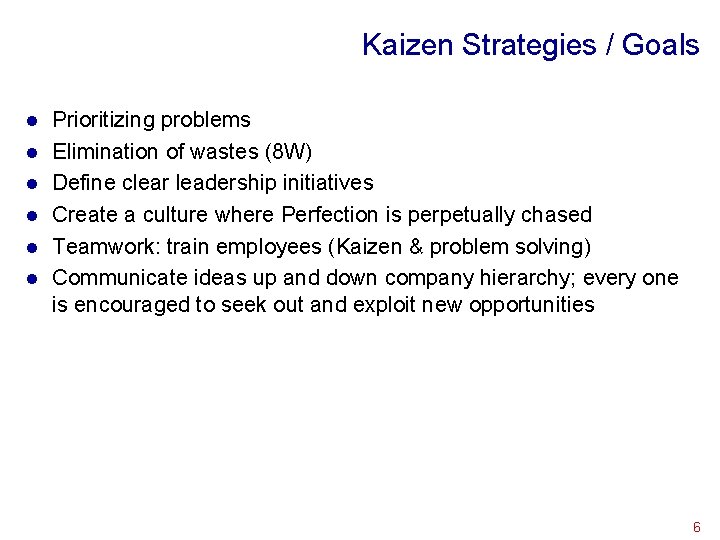
Kaizen Strategies / Goals l l l Prioritizing problems Elimination of wastes (8 W) Define clear leadership initiatives Create a culture where Perfection is perpetually chased Teamwork: train employees (Kaizen & problem solving) Communicate ideas up and down company hierarchy; every one is encouraged to seek out and exploit new opportunities 6
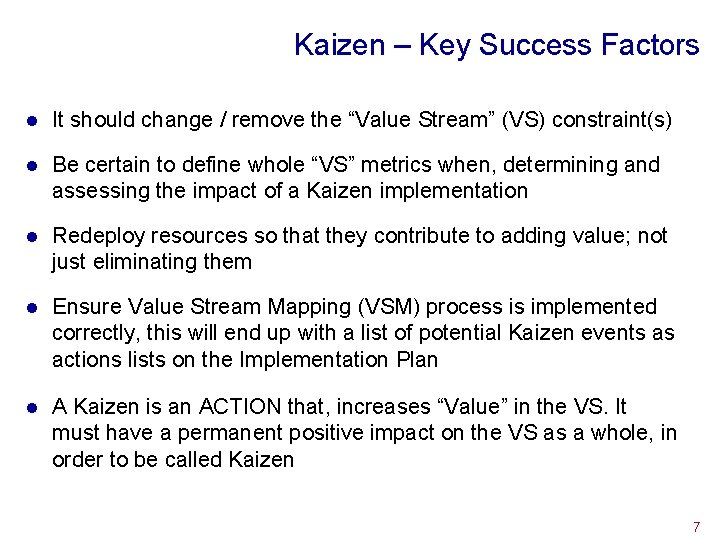
Kaizen – Key Success Factors l It should change / remove the “Value Stream” (VS) constraint(s) l Be certain to define whole “VS” metrics when, determining and assessing the impact of a Kaizen implementation l Redeploy resources so that they contribute to adding value; not just eliminating them l Ensure Value Stream Mapping (VSM) process is implemented correctly, this will end up with a list of potential Kaizen events as actions lists on the Implementation Plan l A Kaizen is an ACTION that, increases “Value” in the VS. It must have a permanent positive impact on the VS as a whole, in order to be called Kaizen 7
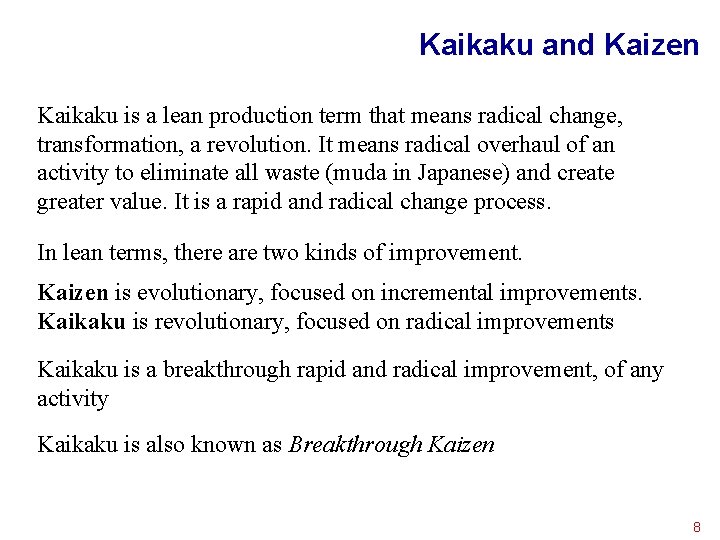
Kaikaku and Kaizen Kaikaku is a lean production term that means radical change, transformation, a revolution. It means radical overhaul of an activity to eliminate all waste (muda in Japanese) and create greater value. It is a rapid and radical change process. In lean terms, there are two kinds of improvement. Kaizen is evolutionary, focused on incremental improvements. Kaikaku is revolutionary, focused on radical improvements Kaikaku is a breakthrough rapid and radical improvement, of any activity Kaikaku is also known as Breakthrough Kaizen 8
Kaikaku and Kaizen… Kaizen is based on all employees involvement and individual activities generally reach an improvement of less than 20%. A cross between Kaikaku and Kaizen is Kaizen Blitz (or Kaizen Events), which implies a radical improvement in a limited area, such as a production cell, during an intense week. 9
Kaikaku means that an entire business is changed radically, normally always in the form of a project. Kaikaku is most often initiated by management, since the change as such and the result will significantly impact business. Kaiakaku is about introducing new knowledge, new strategies, new approaches, new production techniques or new equipment. Kaikaku can be initiated by external factors, e. g. new technology or market conditions. 10
Kaikaku can also be initiated when management see that ongoing Kaizen work is beginning to stagnate and no longer provides adequate results in relation to the effort. Kaikaku projects often result in improvements in the range of 30 -50% and a new base level for continued Kaizen. Kaikaku may also be called System Kaizen. 11
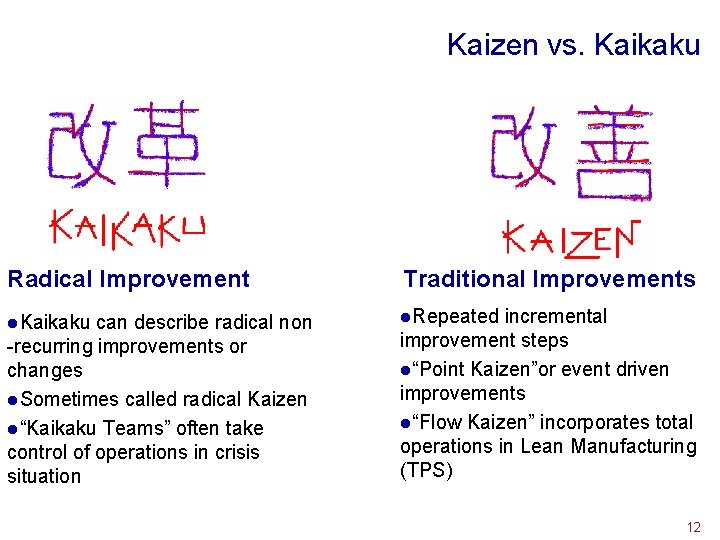
Kaizen vs. Kaikaku Radical Improvement Traditional Improvements l. Kaikaku l. Repeated can describe radical non -recurring improvements or changes l. Sometimes called radical Kaizen l“Kaikaku Teams” often take control of operations in crisis situation incremental improvement steps l“Point Kaizen”or event driven improvements l“Flow Kaizen” incorporates total operations in Lean Manufacturing (TPS) 12
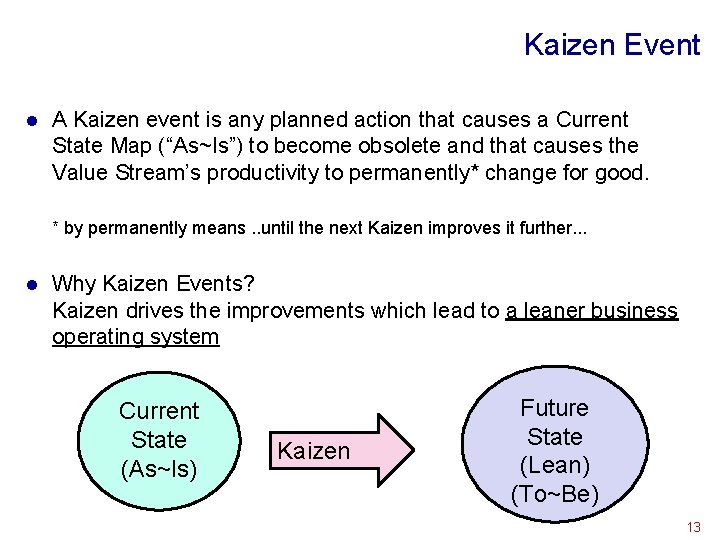
Kaizen Event l A Kaizen event is any planned action that causes a Current State Map (“As~Is”) to become obsolete and that causes the Value Stream’s productivity to permanently* change for good. * by permanently means. . until the next Kaizen improves it further. . . l Why Kaizen Events? Kaizen drives the improvements which lead to a leaner business operating system Current State (As~Is) Kaizen Future State (Lean) (To~Be) 13
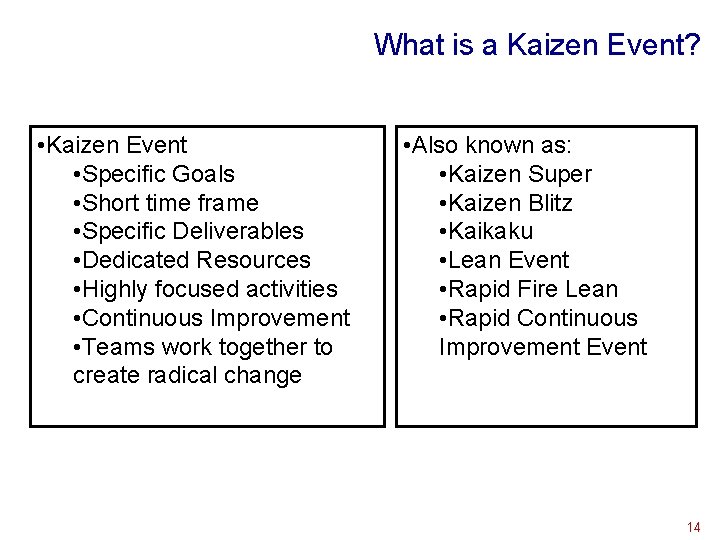
What is a Kaizen Event? • Kaizen Event • Specific Goals • Short time frame • Specific Deliverables • Dedicated Resources • Highly focused activities • Continuous Improvement • Teams work together to create radical change • Also known as: • Kaizen Super • Kaizen Blitz • Kaikaku • Lean Event • Rapid Fire Lean • Rapid Continuous Improvement Event 14
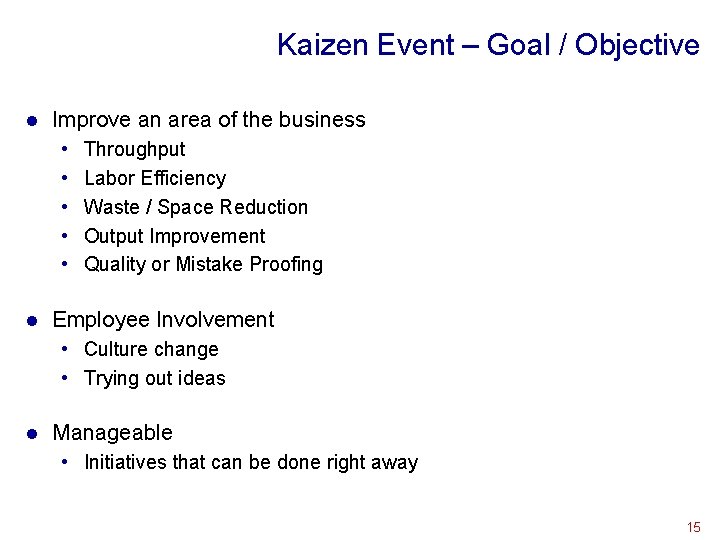
Kaizen Event – Goal / Objective l Improve an area of the business • • • l Throughput Labor Efficiency Waste / Space Reduction Output Improvement Quality or Mistake Proofing Employee Involvement • Culture change • Trying out ideas l Manageable • Initiatives that can be done right away 15
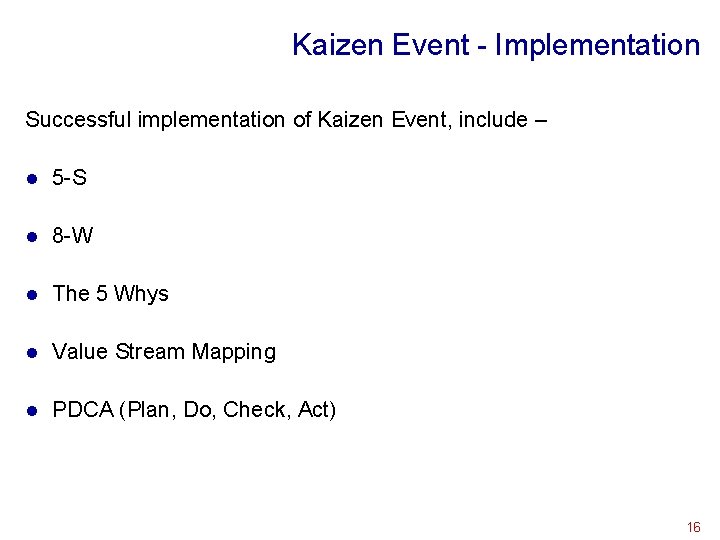
Kaizen Event - Implementation Successful implementation of Kaizen Event, include – l 5 -S l 8 -W l The 5 Whys l Value Stream Mapping l PDCA (Plan, Do, Check, Act) 16
The Incremental Path Improvements as seen in FNGP seem to defy all logic! l Kaizen activities are not free, and perfection- the complete elimination of muda – is surely impossible. So… l Should managers manage the steady state, keeping the “normal” performance? l Two common opinions of senior managers from around the world: l Steady state management – management of variances l Planning to do something, asking, “why did FNGP didn’t get the job done the first time instead of wasting three years before getting it “right”? l Both reactions show traditional management fails to grasp the concept of perfection through l Endless steps is the fundamental principle of lean thinking! 17
The Radical Path The alternative to incremental changes via kaizen events is a radical change in the path to perfection – kaikaku l A total value stream Kaikaku involves all the steps from start to finish. l 18
Continuous Radical and Incremental Improvement To pursue perfection, every organization needs to use both kaizen and kaikaku. l Every step in the value stream can be improved in isolation to good effect. l If you are spending significant amounts of capital to improve specific activities, you are usually pursuing perfection the wrong way… l To effectively pursue both incremental and radical improvement, two final lean techniques are needed to be used by value stream managers: • Apply the four lean principles of: value specification, value identification, flow, and pull. • Decide which forms of muda to attack first 19
The Picture of Perfection l Managers have to learn to see: • See the value stream • See the flow of value • See value being pulled by the customer l The final form of seeing is to bring perfection into clear view so the objective of improvement is visible and real to the whole organization. l Toyota certainly had a picture of perfection derived from its mastery of lean principles: • Japanese service parts business in 1982 • Same concepts in North America in 1989 20
The Picture of Perfection No picture of perfection can be perfect… l As changes and improvements are being made to a value stream, the picture of perfection is changing… l However, the effort to envision the picture of perfection provides inspiration and direction essential to making progress along the path… One of the most important things to envision is the type of product designs and operating technologies needed to take the next steps along the path to excellence. l The knowledge that products must be manufactured more flexibly in smaller volumes in continuous flow provides guidance to technologies in the functions developing generic designs and tools. l 21
Focusing Energy to Banish Muda l Organizations which never started down the path of continuous improvement because of lack of vision obviously failed. l Sadly, other firms set off full of vision, energy, and high hopes, but make very little progress due to lack of direction and resources along the path. l What’s needed instead is to form a vision, select the two or three most important steps to set you there, and defer to other steps until later. 22
Policy deployment l Policy deployment is the last lean technique needed to be done by top management agreement on: • Few simple goals for transitioning from mass to lean • Few projects to achieve these goals • Designate people and resources for getting the projects done • Establish numerical improvement targets to be achieved by a given point in time. 23
Focusing Energy to Banish Muda l If a firm adopt a goal of converting the entire organization to continuous flow with all internal order management by means of a pull system, the projects required to do this might include: 1. Reorganizing the product families such that product teams take many on many of the jobs of traditional functions 2. Creating a “lean function” to assemble the expertise to assist the product teams in the conversion 3. Commencing a systematic set of improvement activities to convert batches and rework into continuous flow. 24
Focusing Energy to Banish Muda… l Numerical improvement goals and timeframes may be: 1. 2. 3. 4. Convert into production teams within 6 months Conduct improvement activities on six major activities per month Reduce on hand inventory by 25% in the first year Reduce number of defects by 50% in the first year 25
Smashing Inertia to Get Started l We now reviewed the basic lean principles, the five powerful ideas in the lean tool kit needed to convert firms and value streams from areas full of MUDA to fast-flowing value, defined and then pulled by the customer. l Transparency in everything is a key principle. l Policy deployment operates as an open process to align people and resources with improvement tasks. l Massive and continuing amounts of problem solving are conducted by teams of employees who historically have not even talked to each other, much less treated each other as equals. l Yet the catalytic force moving firms from batch-and-queue into value streams is generally an outsider – the change agent. 26