
Lean Manufacturing Chapter 3 Flow Flow Definition l
- Slides: 45
Lean Manufacturing Chapter 3 Flow
Flow - Definition l l l The production system Henry Ford introduced at his Highland Park, Michigan plant in 1913. The objective of flow production was to drastically reduce product throughput time and human effort through a series of innovations. Consistently interchangeable parts so that cycle times could be stable for every job along an extended line The line itself The reconfiguration of part fabrication tasks so that machines were lined up in process sequence with parts flowing quickly and smoothly from machine to machine Production control system insuring that the production rate in parts fabrication matched the consumption rate of parts in final assembly.
The World of Batch-and-Queue l What happens when you go to your doctor? • • • Make appointment days ahead Arrive on time and wait in waiting room Doctor behind schedule Referral to a specialist Laboratory tests Wait for results Treatment or medication given Trip to pharmacy or to specialist Hospitalization – whole new disconnected processes and waiting What happens when you take a flight? l What happens when you build a custom home? l • As the customer, you pay for all the waiting and rework l The creation, ordering, and provision of any good or any service can be made to flow.
How to Obtain Flow? l Think about ways to: • • • Line up all of the essential steps needed to get a job done Obtain a steady, continuous flow No wasted motions No interruptions No batches No queues
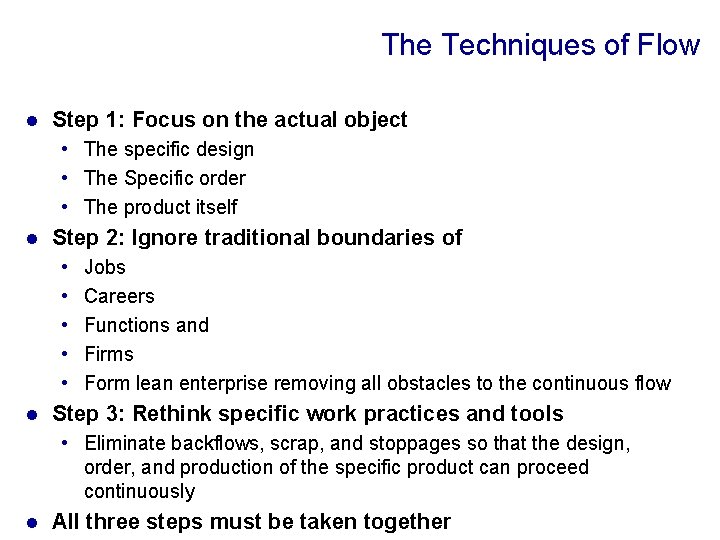
The Techniques of Flow l Step 1: Focus on the actual object • The specific design • The Specific order • The product itself l Step 2: Ignore traditional boundaries of • • • l Jobs Careers Functions and Firms Form lean enterprise removing all obstacles to the continuous flow Step 3: Rethink specific work practices and tools • Eliminate backflows, scrap, and stoppages so that the design, order, and production of the specific product can proceed continuously l All three steps must be taken together
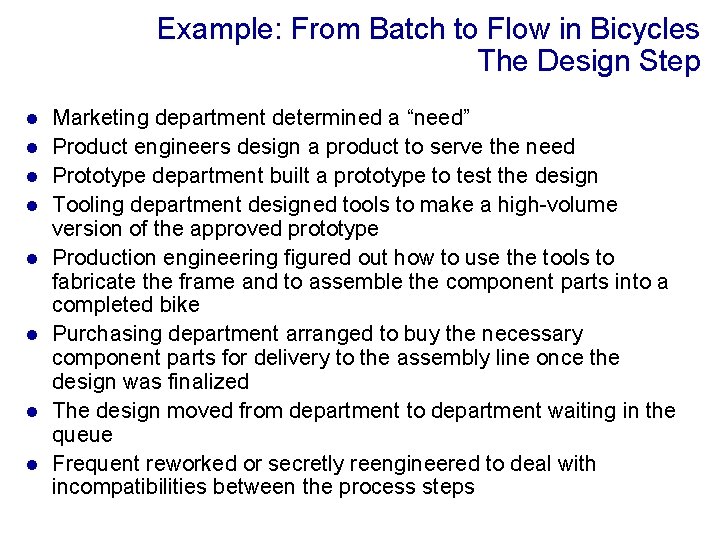
Example: From Batch to Flow in Bicycles The Design Step l l l l Marketing department determined a “need” Product engineers design a product to serve the need Prototype department built a prototype to test the design Tooling department designed tools to make a high-volume version of the approved prototype Production engineering figured out how to use the tools to fabricate the frame and to assemble the component parts into a completed bike Purchasing department arranged to buy the necessary component parts for delivery to the assembly line once the design was finalized The design moved from department to department waiting in the queue Frequent reworked or secretly reengineered to deal with incompatibilities between the process steps
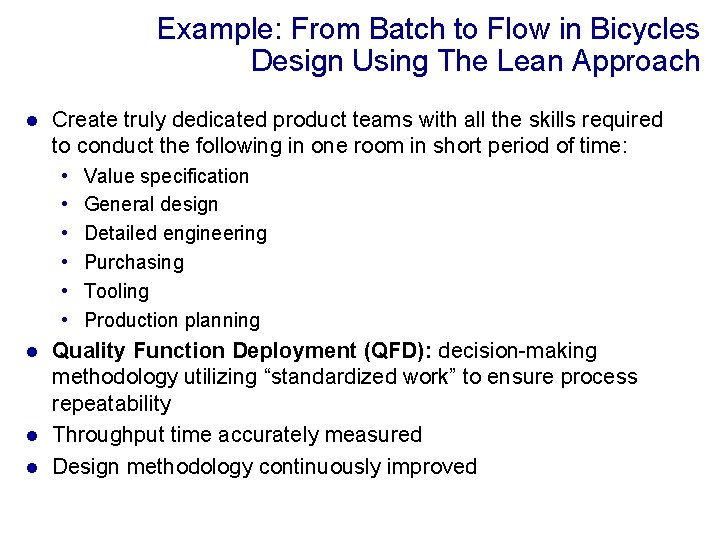
Example: From Batch to Flow in Bicycles Design Using The Lean Approach l Create truly dedicated product teams with all the skills required to conduct the following in one room in short period of time: • • • Value specification General design Detailed engineering Purchasing Tooling Production planning Quality Function Deployment (QFD): decision-making methodology utilizing “standardized work” to ensure process repeatability l Throughput time accurately measured l Design methodology continuously improved l
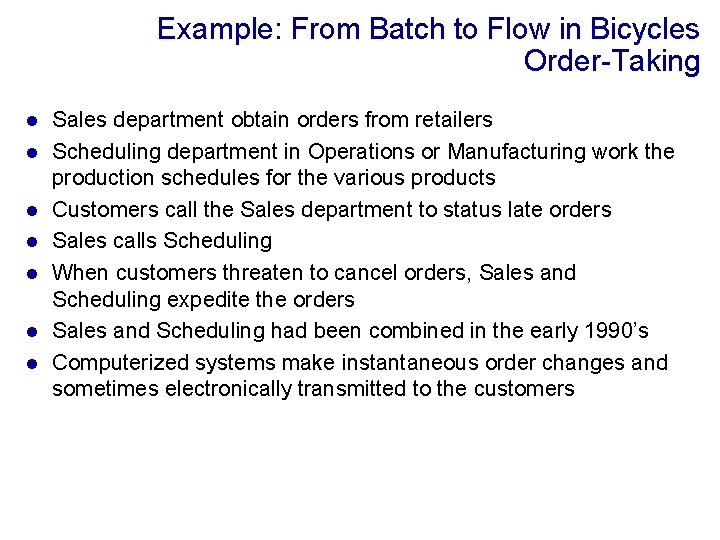
Example: From Batch to Flow in Bicycles Order-Taking l l l l Sales department obtain orders from retailers Scheduling department in Operations or Manufacturing work the production schedules for the various products Customers call the Sales department to status late orders Sales calls Scheduling When customers threaten to cancel orders, Sales and Scheduling expedite the orders Sales and Scheduling had been combined in the early 1990’s Computerized systems make instantaneous order changes and sometimes electronically transmitted to the customers
Example: From Batch to Flow in Bicycles Order-Taking Using the Lean Approach l l l l Sales and Production Scheduling are core members of the product team In a position to plan the sales campaign as the product design is being developed Sale with a clear eye to the capabilities of the production system so that both orders and the product can flow smoothly from sale to delivery No stoppages in the production system Products are built to order Only few hours elapse between the first operation on raw materials and shipment of the finished item Orders can be sought and accepted with clear and precise knowledge of the system’s capabilities There is no expediting!
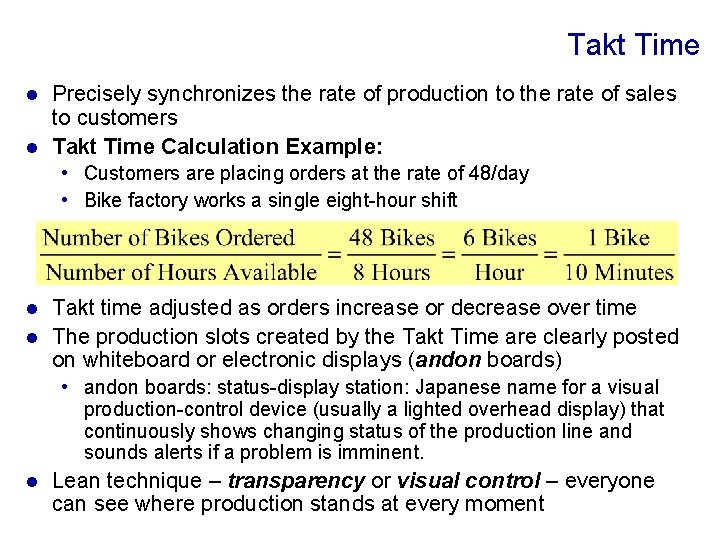
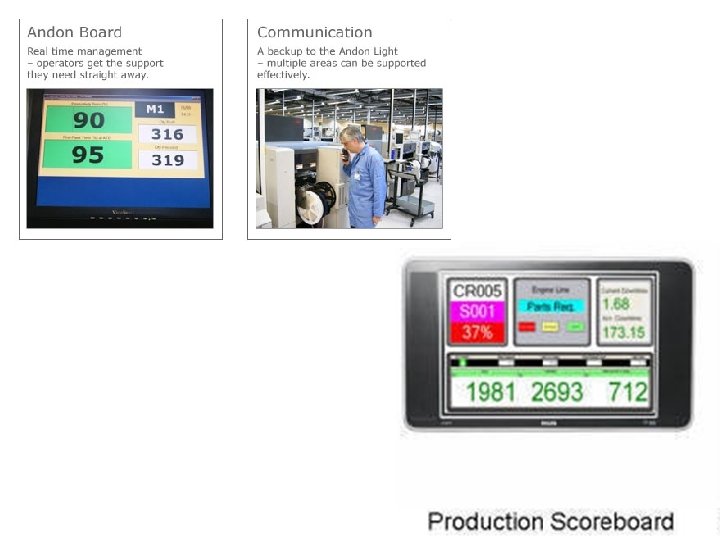
Takt Time Precisely synchronizes the rate of production to the rate of sales to customers l Takt Time Calculation Example: l • Customers are placing orders at the rate of 48/day • Bike factory works a single eight-hour shift Takt time adjusted as orders increase or decrease over time l The production slots created by the Takt Time are clearly posted on whiteboard or electronic displays (andon boards) l • andon boards: status-display station: Japanese name for a visual production-control device (usually a lighted overhead display) that continuously shows changing status of the production line and sounds alerts if a problem is imminent. l Lean technique – transparency or visual control – everyone can see where production stands at every moment
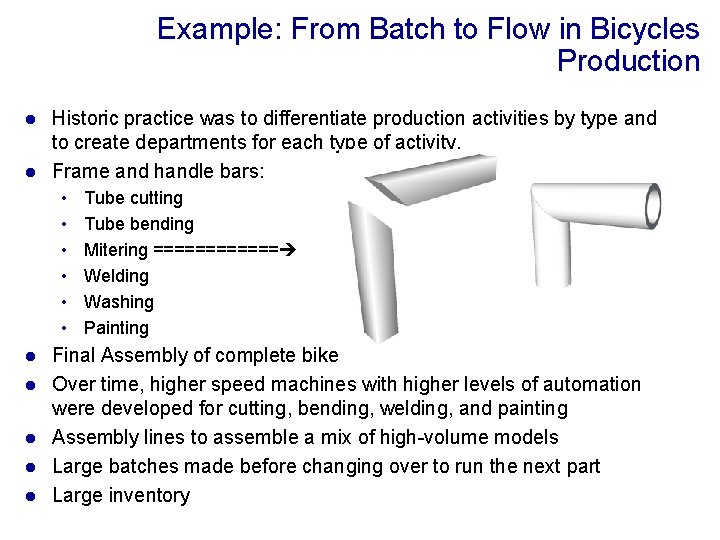
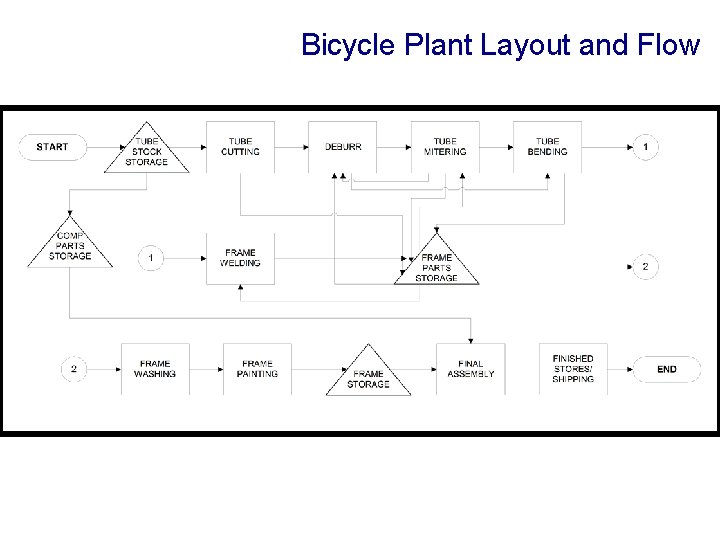
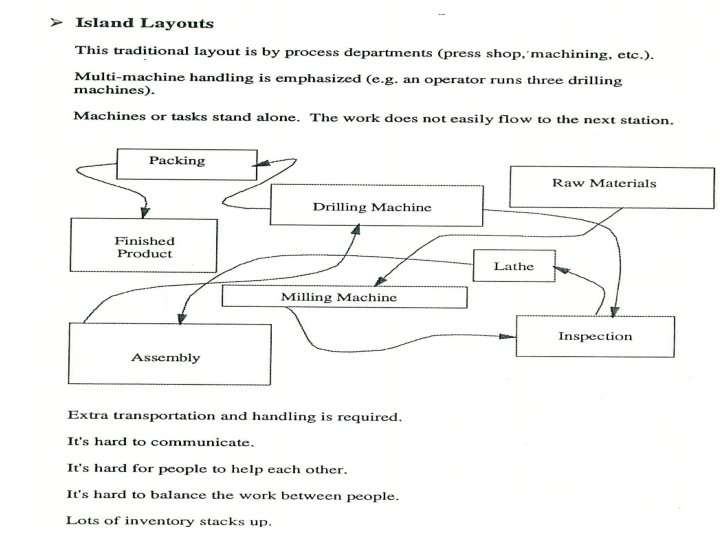
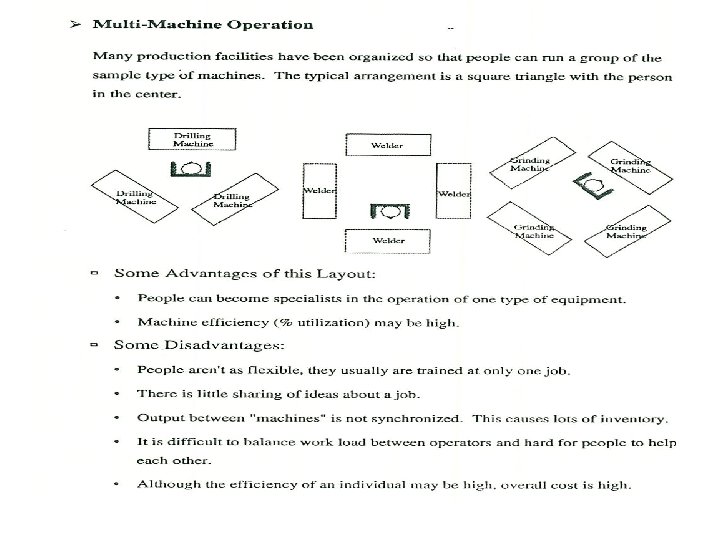
Example: From Batch to Flow in Bicycles Production Historic practice was to differentiate production activities by type and to create departments for each type of activity. l Frame and handle bars: l • • • l l l Tube cutting Tube bending Mitering ====== Welding Washing Painting Final Assembly of complete bike Over time, higher speed machines with higher levels of automation were developed for cutting, bending, welding, and painting Assembly lines to assemble a mix of high-volume models Large batches made before changing over to run the next part Large inventory
Bicycle Plant Layout and Flow
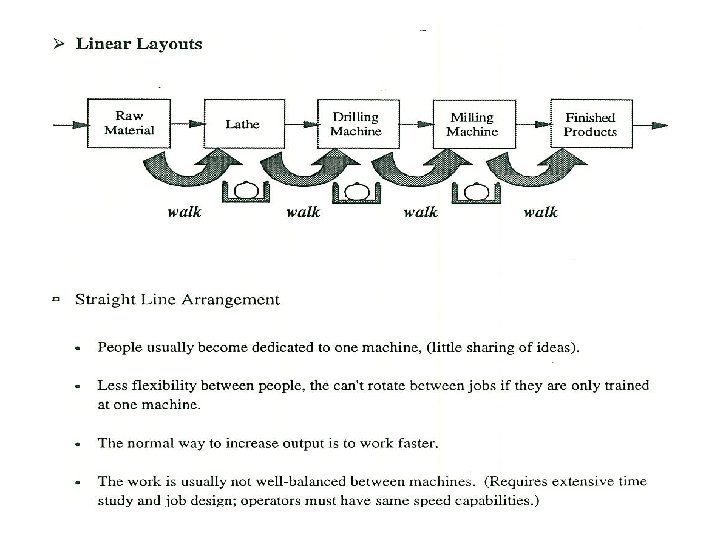
Continuous Flow Factory
Continuous Flow Production Remember! • • • Make It Flow Feed the Flow Link the Flow
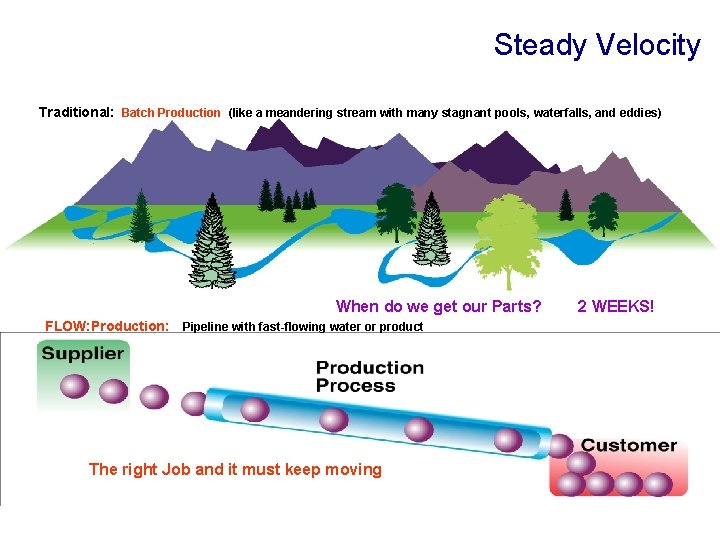
Continuous Flow Production Definition • Flow of products in a level manner through the production operations. The ideal situation is one piece flow at and between processes. • The intent of flow production is to increase the velocity of products and make the production cycle predictable.
Steady Velocity Traditional: Batch Production (like a meandering stream with many stagnant pools, waterfalls, and eddies) When do we get our Parts? FLOW: Production: Pipeline with fast-flowing water or product The right Job and it must keep moving 2 WEEKS!
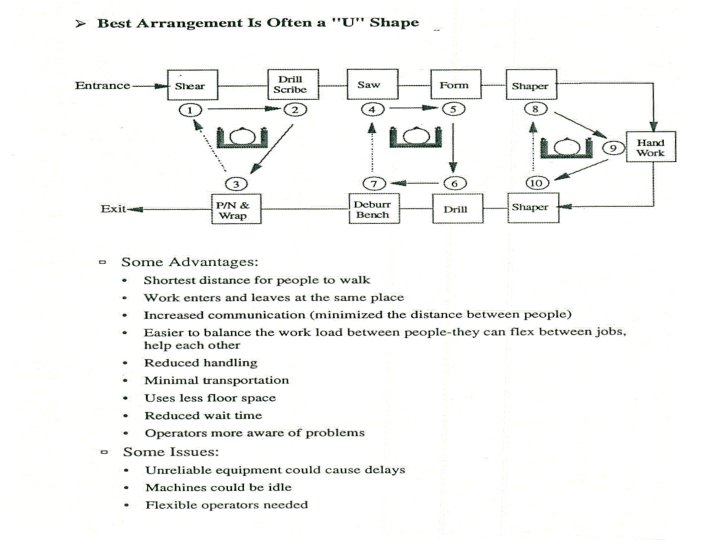
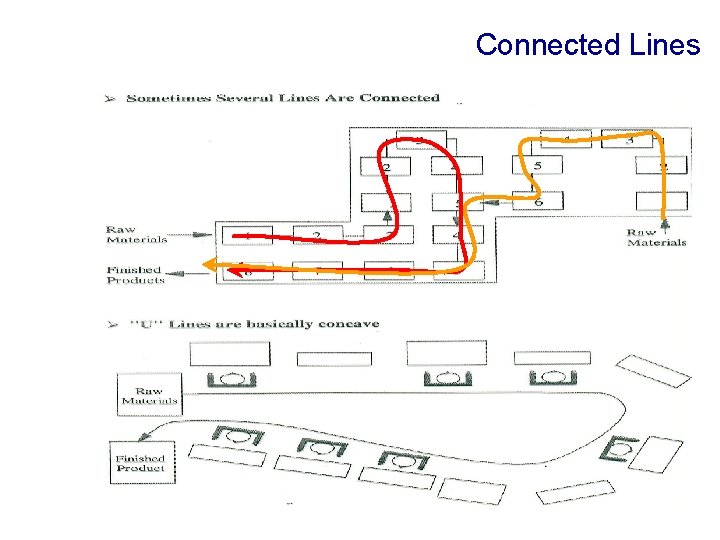
Connected Lines
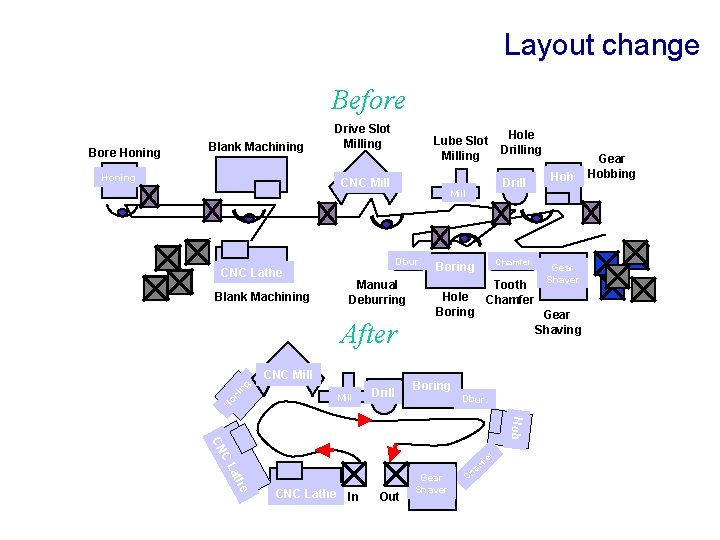
Layout change Before Bore Honing Blank Machining Honing Drive Slot Milling CNC Lathe CNC Blank Machining Manual Deburring After ni ng CNC Mill Ho Drill Mill Dbur. Mill Hole Drilling Lube Slot Milling CNC Mill Drill Chamfer Boring Dbur. Hob CN e ath CL Out Hob Gear Shaver Tooth Hole Chamfer Boring Gear Shaving r CNC Lathe In Gear Hobbing Gear Shaver C fe m ha Gear Hobbing
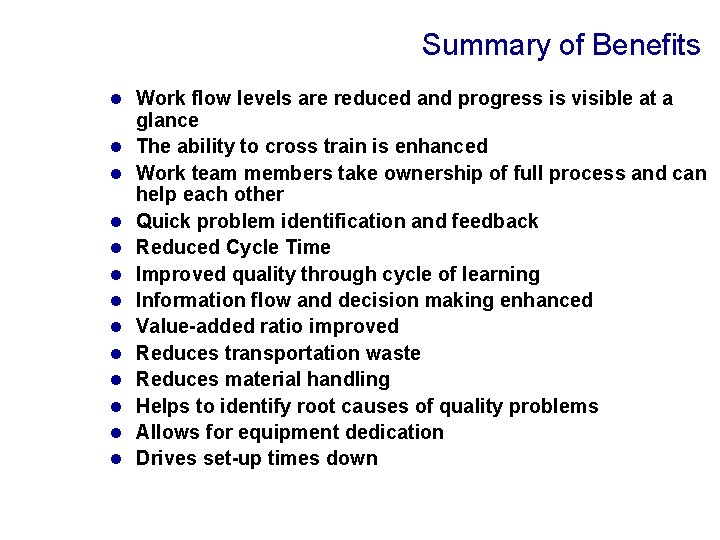
Summary of Benefits l Work flow levels are reduced and progress is visible at a l l l glance The ability to cross train is enhanced Work team members take ownership of full process and can help each other Quick problem identification and feedback Reduced Cycle Time Improved quality through cycle of learning Information flow and decision making enhanced Value-added ratio improved Reduces transportation waste Reduces material handling Helps to identify root causes of quality problems Allows for equipment dedication Drives set-up times down
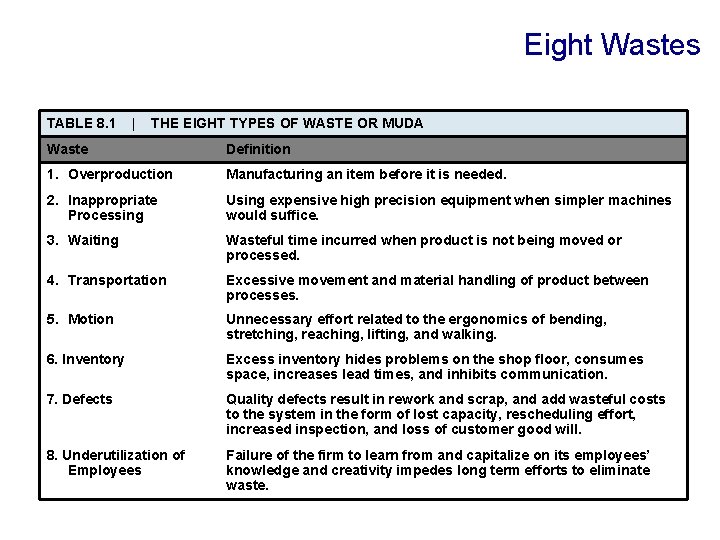
Eight Wastes TABLE 8. 1 | THE EIGHT TYPES OF WASTE OR MUDA Waste Definition 1. Overproduction Manufacturing an item before it is needed. 2. Inappropriate Processing Using expensive high precision equipment when simpler machines would suffice. 3. Waiting Wasteful time incurred when product is not being moved or processed. 4. Transportation Excessive movement and material handling of product between processes. 5. Motion Unnecessary effort related to the ergonomics of bending, stretching, reaching, lifting, and walking. 6. Inventory Excess inventory hides problems on the shop floor, consumes space, increases lead times, and inhibits communication. 7. Defects Quality defects result in rework and scrap, and add wasteful costs to the system in the form of lost capacity, rescheduling effort, increased inspection, and loss of customer good will. 8. Underutilization of Employees Failure of the firm to learn from and capitalize on its employees’ knowledge and creativity impedes long term efforts to eliminate waste.
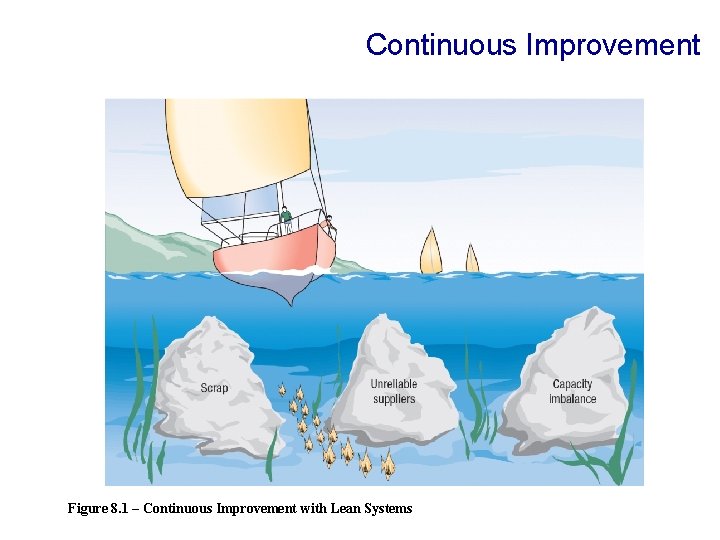
Continuous Improvement Figure 8. 1 – Continuous Improvement with Lean Systems
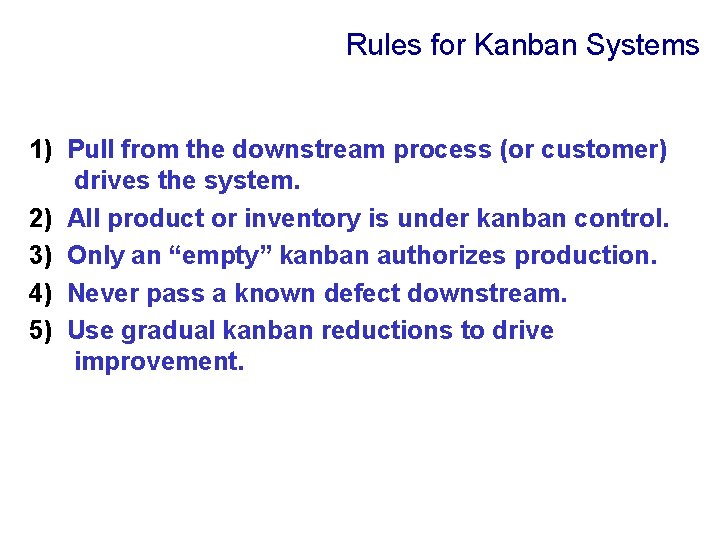
Rules for Kanban Systems 1) Pull from the downstream process (or customer) drives the system. 2) All product or inventory is under kanban control. 3) Only an “empty” kanban authorizes production. 4) Never pass a known defect downstream. 5) Use gradual kanban reductions to drive improvement.
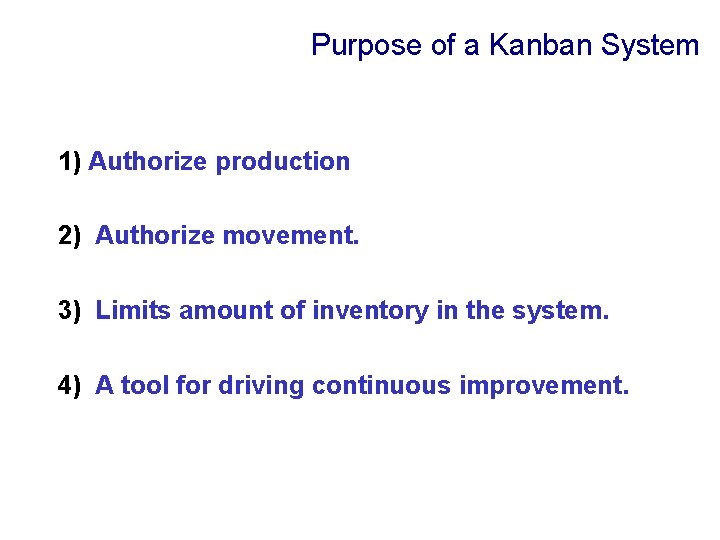
Purpose of a Kanban System 1) Authorize production 2) Authorize movement. 3) Limits amount of inventory in the system. 4) A tool for driving continuous improvement.
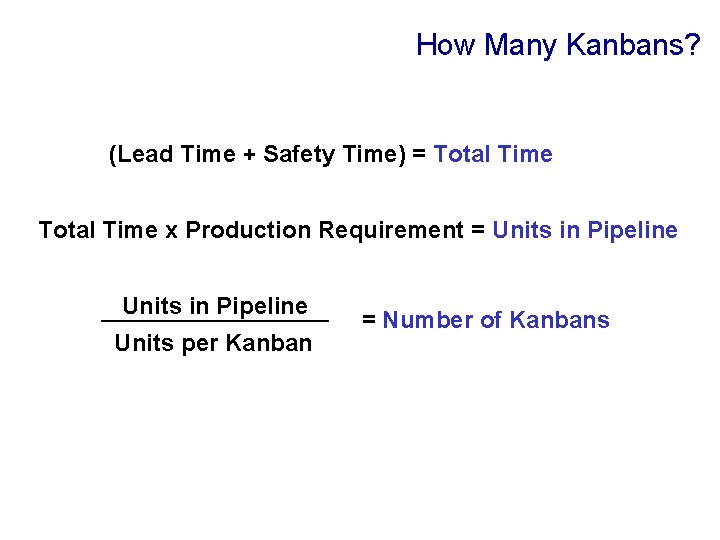
How Many Kanbans? (Lead Time + Safety Time) = Total Time x Production Requirement = Units in Pipeline Units per Kanban = Number of Kanbans
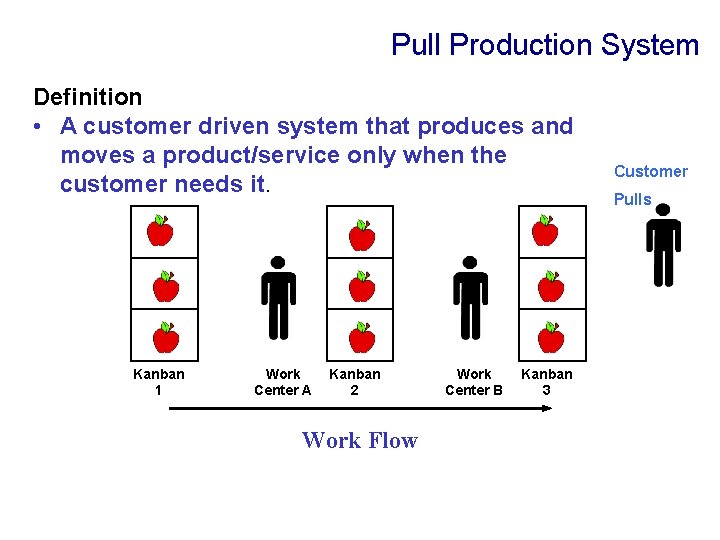
Pull Production System Definition • A customer driven system that produces and moves a product/service only when the customer needs it. Kanban 1 Work Center A Kanban 2 Work Flow Work Center B Kanban 3 Customer Pulls
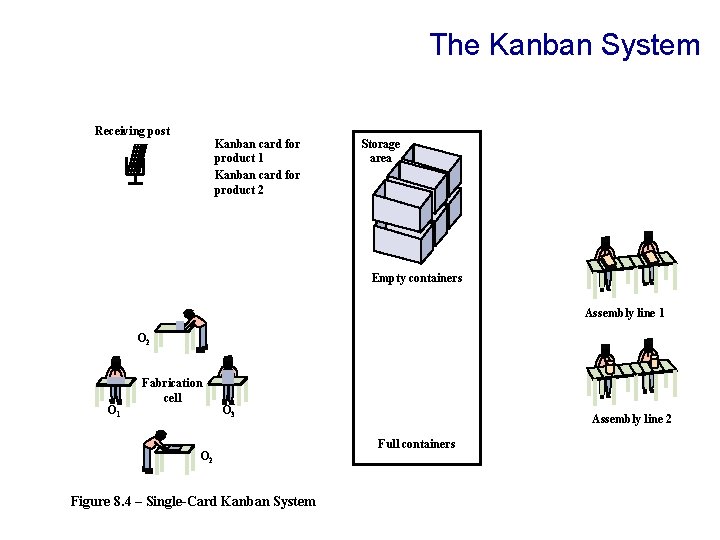
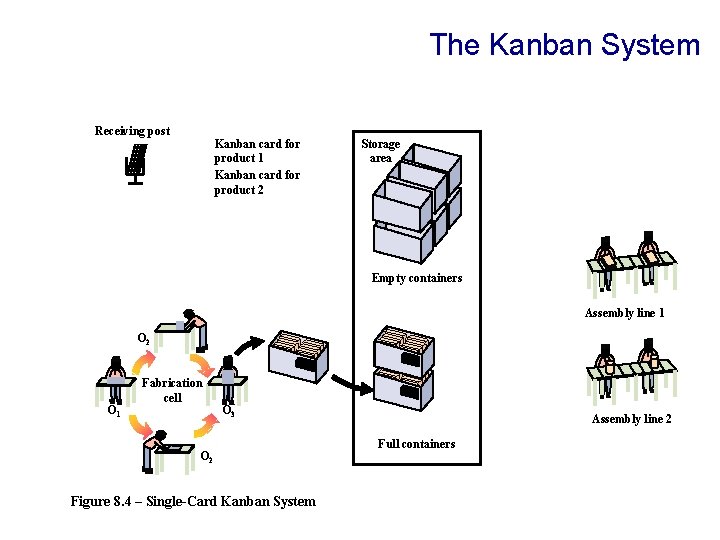
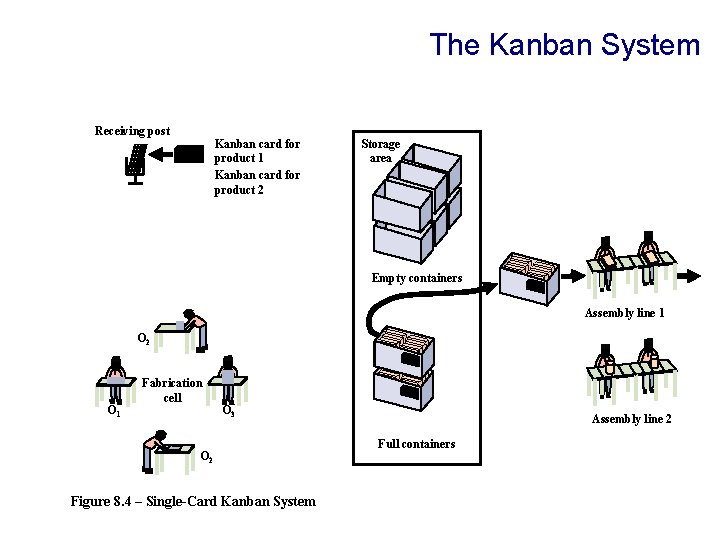
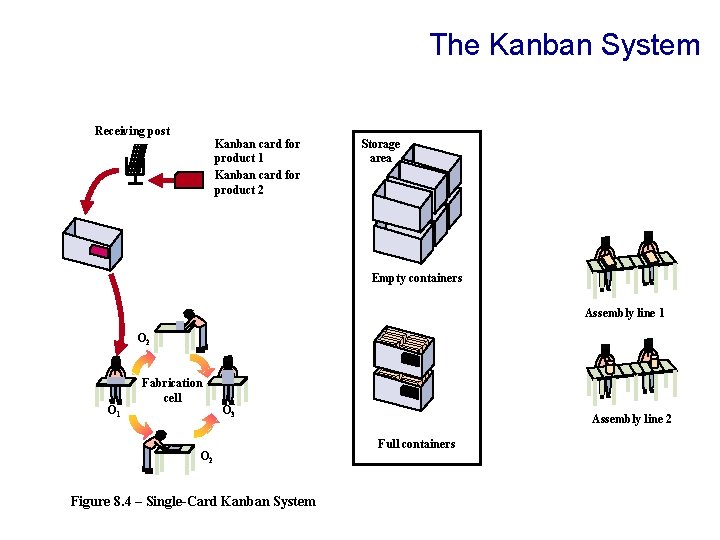
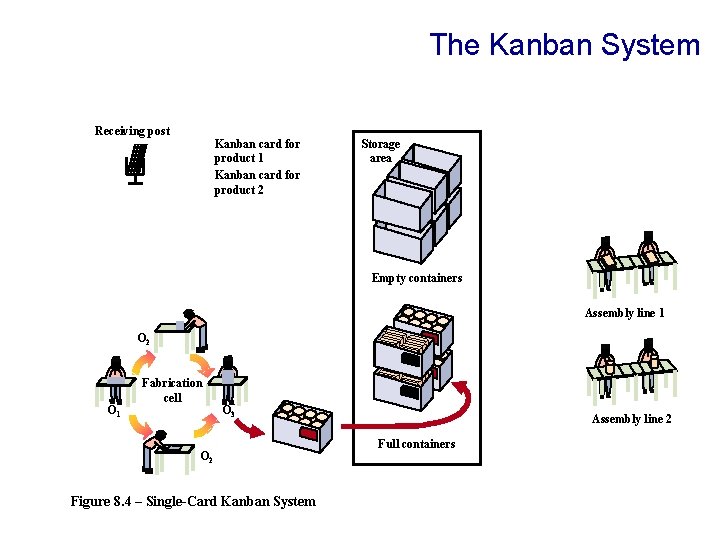
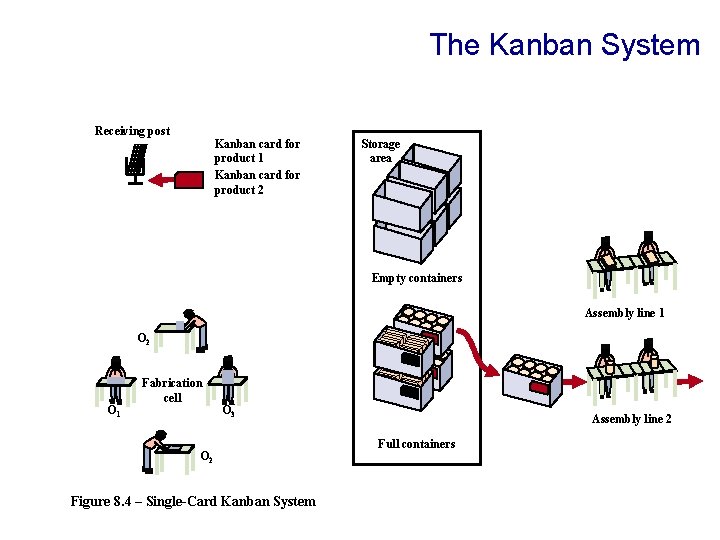
The Kanban System Receiving post Kanban card for product 1 Kanban card for product 2 Storage area Empty containers Assembly line 1 O 2 O 1 Fabrication cell O 3 O 2 Figure 8. 4 – Single-Card Kanban System Assembly line 2 Full containers
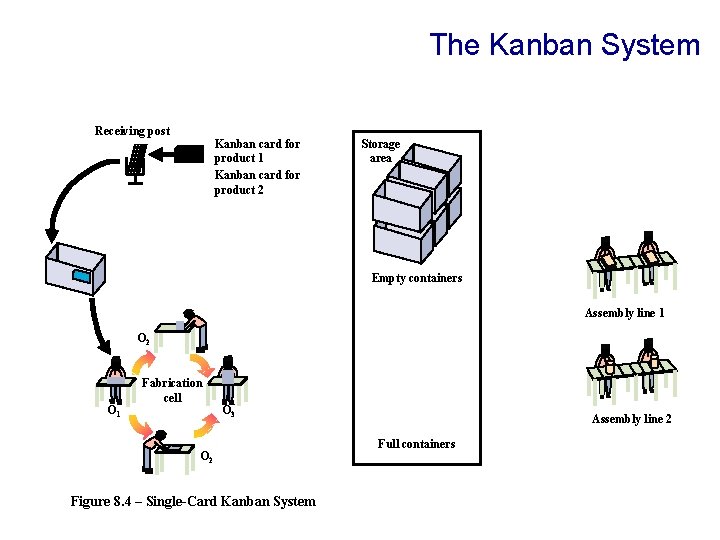
The Kanban System Receiving post Kanban card for product 1 Kanban card for product 2 Storage area Empty containers Assembly line 1 O 2 O 1 Fabrication cell O 3 O 2 Figure 8. 4 – Single-Card Kanban System Assembly line 2 Full containers
The Kanban System Receiving post Kanban card for product 1 Kanban card for product 2 Storage area Empty containers Assembly line 1 O 2 O 1 Fabrication cell O 3 O 2 Figure 8. 4 – Single-Card Kanban System Assembly line 2 Full containers
The Kanban System Receiving post Kanban card for product 1 Kanban card for product 2 Storage area Empty containers Assembly line 1 O 2 O 1 Fabrication cell O 3 O 2 Figure 8. 4 – Single-Card Kanban System Assembly line 2 Full containers
The Kanban System Receiving post Kanban card for product 1 Kanban card for product 2 Storage area Empty containers Assembly line 1 O 2 O 1 Fabrication cell O 3 O 2 Figure 8. 4 – Single-Card Kanban System Assembly line 2 Full containers
The Kanban System Receiving post Kanban card for product 1 Kanban card for product 2 Storage area Empty containers Assembly line 1 O 2 O 1 Fabrication cell O 3 O 2 Figure 8. 4 – Single-Card Kanban System Assembly line 2 Full containers
The Kanban System Receiving post Kanban card for product 1 Kanban card for product 2 Storage area Empty containers Assembly line 1 O 2 O 1 Fabrication cell O 3 O 2 Figure 8. 4 – Single-Card Kanban System Assembly line 2 Full containers
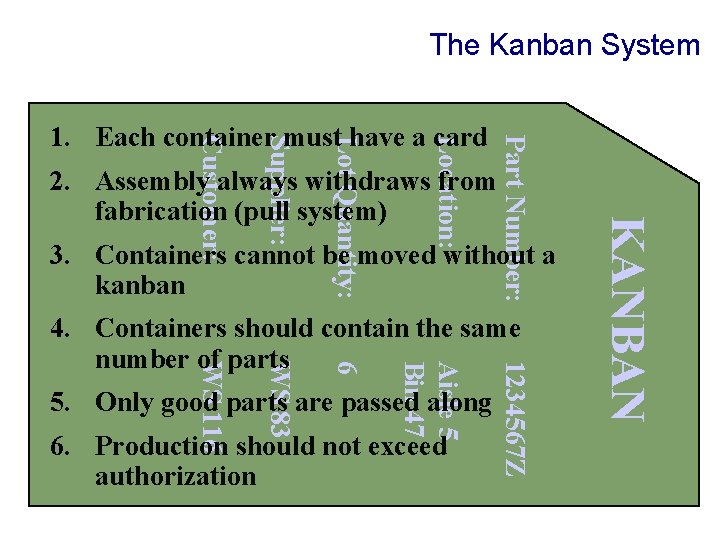
The Kanban System 3. Containers cannot be moved without a kanban 5. Only good parts are passed along 6. Production should not exceed authorization 1234567 Z Aisle 5 Bin 47 6 WS 83 WS 116 4. Containers should contain the same number of parts KANBAN 2. Assembly always withdraws from fabrication (pull system) Part Number: Location: Lot Quantity: Supplier: Customer: 1. Each container must have a card
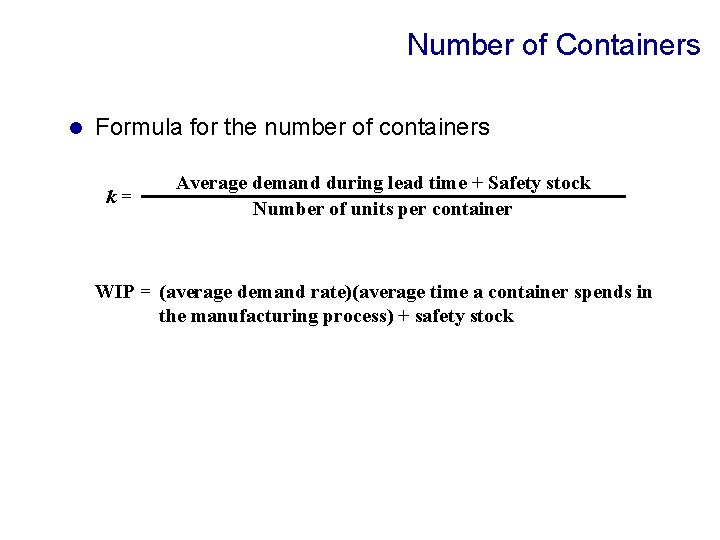
Number of Containers Two determinations l Number of units to be held by each container l u Determines lot size l Number of containers u Estimate the average lead time needed to produce a container of parts l Little’s law u Average work-in-process inventory equals the average demand rate multiplied by the average time a unit spends in the manufacturing process
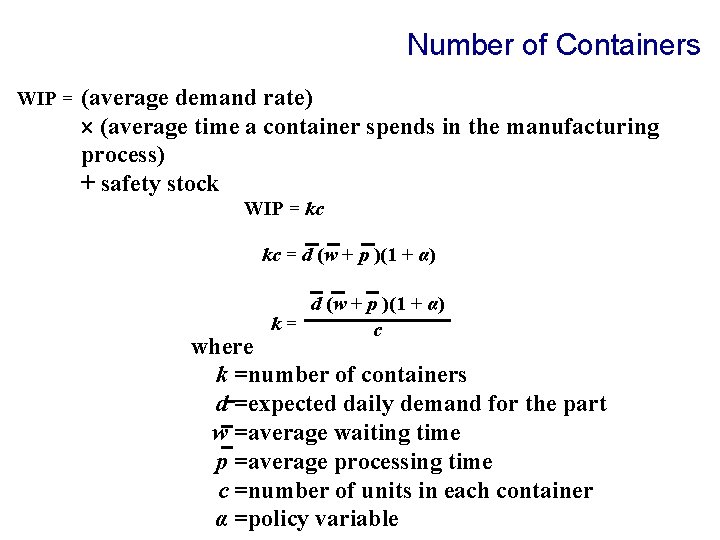
Number of Containers WIP = (average demand rate) (average time a container spends in the manufacturing process) + safety stock WIP = kc kc = d (w + p )(1 + α) k= c where k =number of containers d =expected daily demand for the part w =average waiting time p =average processing time c =number of units in each container α =policy variable
Number of Containers l Formula for the number of containers k= Average demand during lead time + Safety stock Number of units per container WIP = (average demand rate)(average time a container spends in the manufacturing process) + safety stock
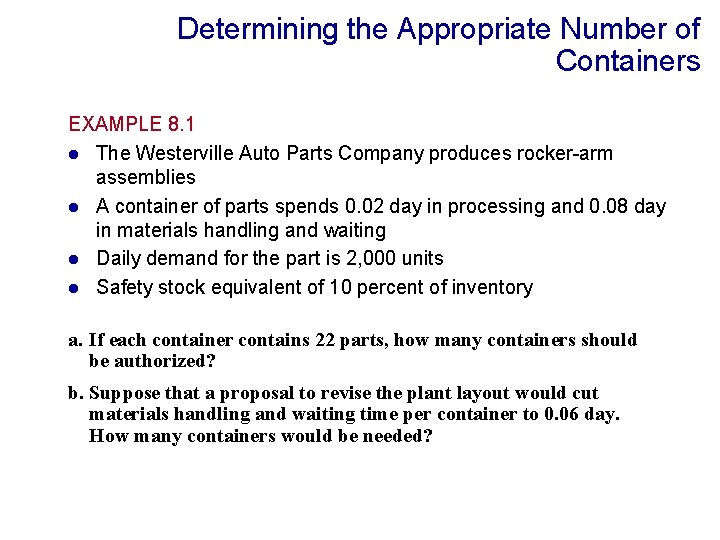
Determining the Appropriate Number of Containers EXAMPLE 8. 1 l The Westerville Auto Parts Company produces rocker-arm assemblies l A container of parts spends 0. 02 day in processing and 0. 08 day in materials handling and waiting l Daily demand for the part is 2, 000 units l Safety stock equivalent of 10 percent of inventory a. If each container contains 22 parts, how many containers should be authorized? b. Suppose that a proposal to revise the plant layout would cut materials handling and waiting time per container to 0. 06 day. How many containers would be needed?
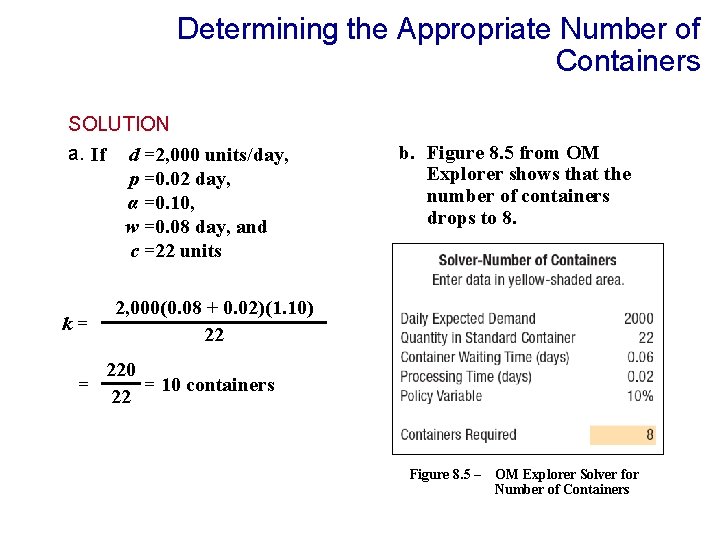
Determining the Appropriate Number of Containers SOLUTION a. If d =2, 000 units/day, p =0. 02 day, α =0. 10, w =0. 08 day, and c =22 units k= b. Figure 8. 5 from OM Explorer shows that the number of containers drops to 8. 2, 000(0. 08 + 0. 02)(1. 10) 22 220 = = 10 containers 22 Figure 8. 5 – OM Explorer Solver for Number of Containers
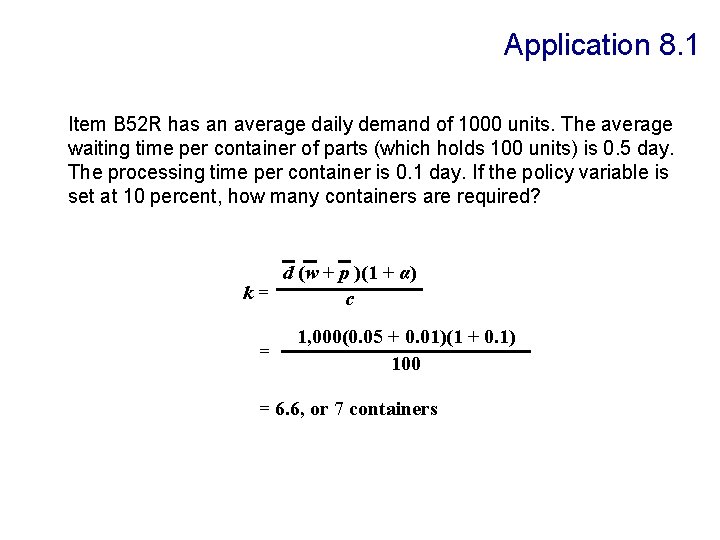
Application 8. 1 Item B 52 R has an average daily demand of 1000 units. The average waiting time per container of parts (which holds 100 units) is 0. 5 day. The processing time per container is 0. 1 day. If the policy variable is set at 10 percent, how many containers are required? d (w + p )(1 + α) k= c = 1, 000(0. 05 + 0. 01)(1 + 0. 1) 100 = 6. 6, or 7 containers
Kanban Light (More Work)