
Lean Construction School CITB LCIUK Project overview The
Lean Construction School CITB / LCI-UK Project overview
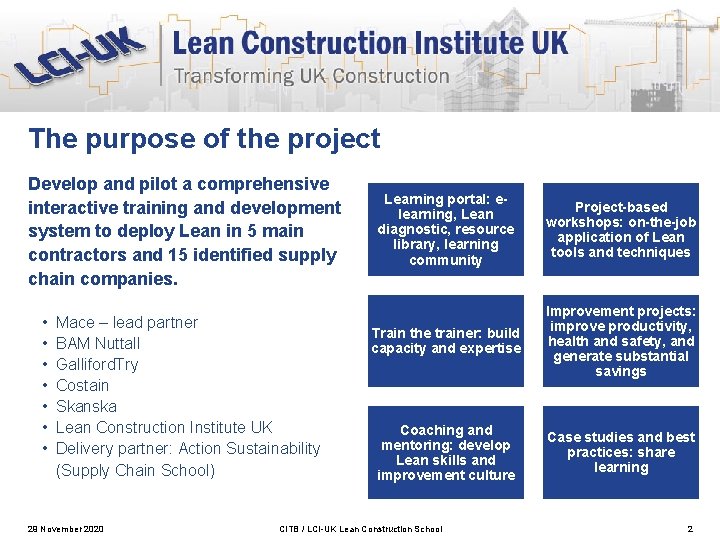
The purpose of the project Develop and pilot a comprehensive interactive training and development system to deploy Lean in 5 main contractors and 15 identified supply chain companies. • • Mace – lead partner BAM Nuttall Galliford. Try Costain Skanska Lean Construction Institute UK Delivery partner: Action Sustainability (Supply Chain School) 29 November 2020 Learning portal: elearning, Lean diagnostic, resource library, learning community Project-based workshops: on-the-job application of Lean tools and techniques Train the trainer: build capacity and expertise Improvement projects: improve productivity, health and safety, and generate substantial savings Coaching and mentoring: develop Lean skills and improvement culture Case studies and best practices: share learning CITB / LCI-UK Lean Construction School 2
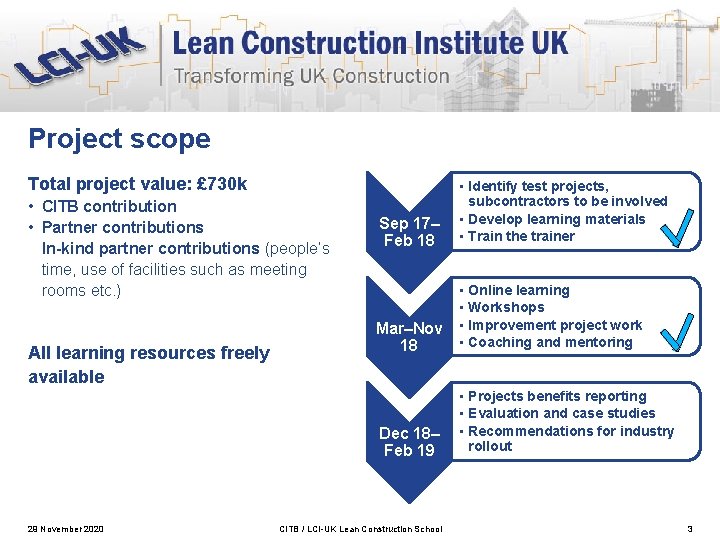
Project scope Total project value: £ 730 k • CITB contribution • Partner contributions In-kind partner contributions (people’s time, use of facilities such as meeting rooms etc. ) All learning resources freely available 29 November 2020 Sep 17– Feb 18 • Identify test projects, subcontractors to be involved • Develop learning materials • Train the trainer Mar–Nov 18 • Online learning • Workshops • Improvement project work • Coaching and mentoring Dec 18– Feb 19 • Projects benefits reporting • Evaluation and case studies • Recommendations for industry rollout CITB / LCI-UK Lean Construction School 3
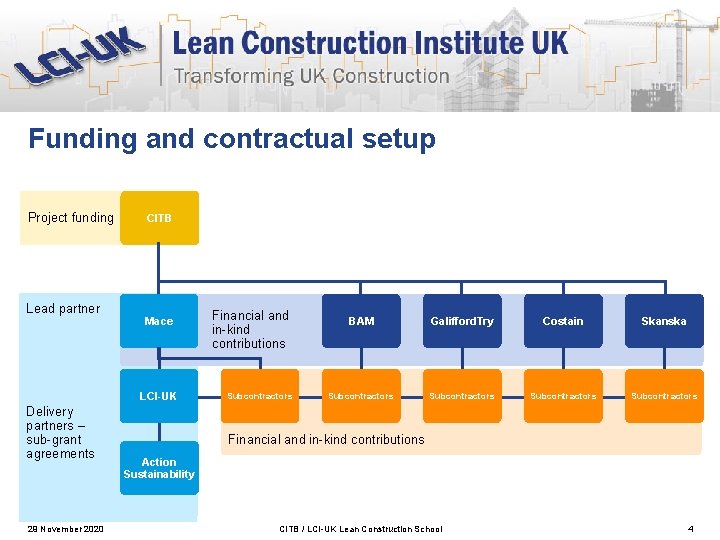
Funding and contractual setup Project funding Lead partner CITB Mace LCI-UK Delivery partners – sub-grant agreements 29 November 2020 Financial and in-kind contributions Subcontractors BAM Galifford. Try Costain Skanska Subcontractors Financial and in-kind contributions Action Sustainability CITB / LCI-UK Lean Construction School 4
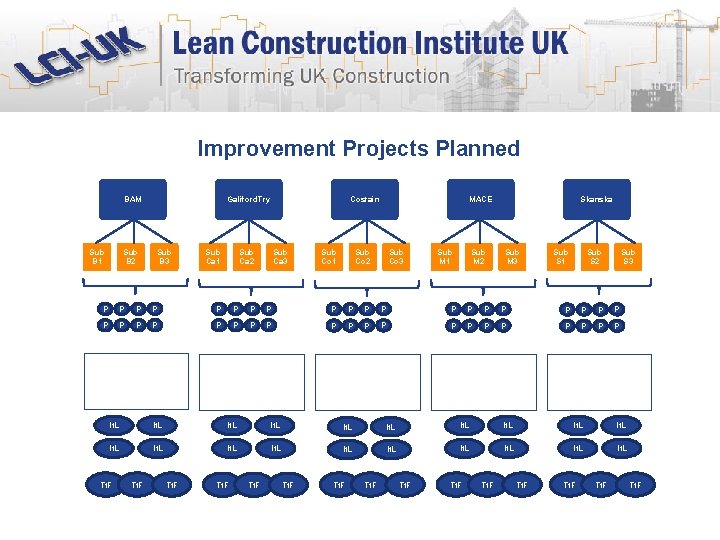
Improvement Projects Planned BAM Sub B 1 Sub B 2 Galiford. Try Sub B 3 Sub Ca 1 Costain Sub Ca 2 Sub Ca 3 Sub Co 1 MACE Sub Co 2 Sub Co 3 Sub M 1 Sub M 2 Skanska Sub M 3 Sub S 1 Sub S 2 Sub S 3 P P P P P P P P P P 8 Lean improvement projects x 2 improvement project workshops = 16 workshops 8 Lean improvement projects x 2 improvement project workshops = 16 workshops It. L It. L Tt. F Tt. F
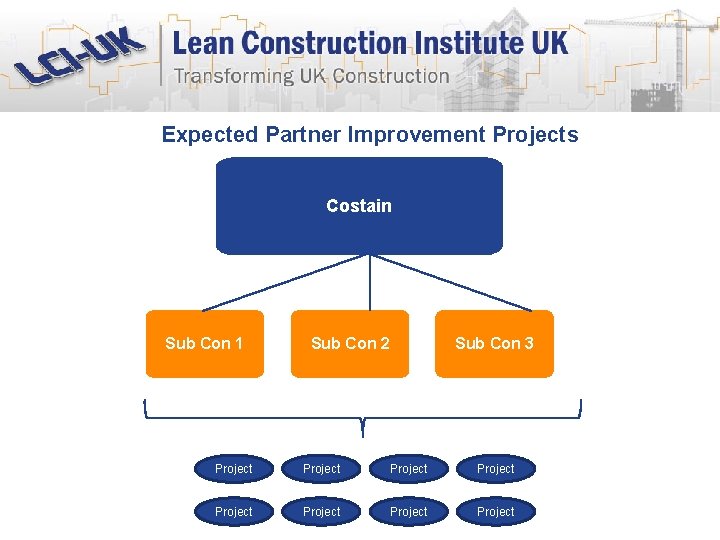
Expected Partner Improvement Projects Costain Sub Con 1 Sub Con 2 Sub Con 3 Project Project
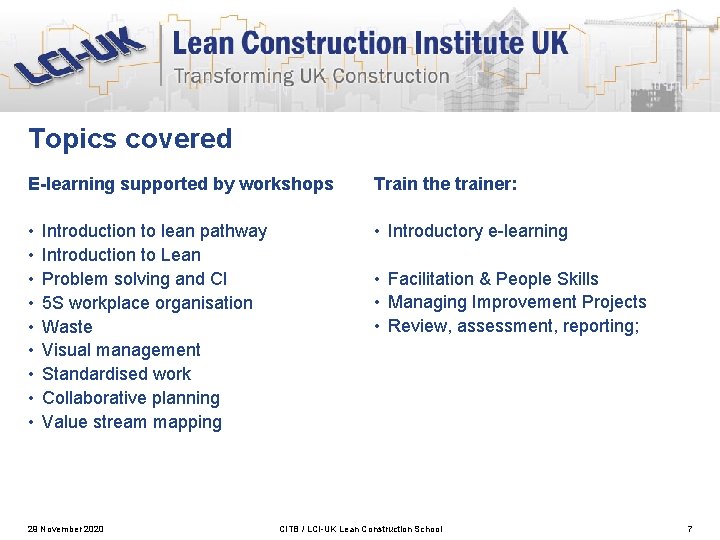
Topics covered E-learning supported by workshops Train the trainer: • • • Introductory e-learning Introduction to lean pathway Introduction to Lean Problem solving and CI 5 S workplace organisation Waste Visual management Standardised work Collaborative planning Value stream mapping 29 November 2020 • Facilitation & People Skills • Managing Improvement Projects • Review, assessment, reporting; CITB / LCI-UK Lean Construction School 7
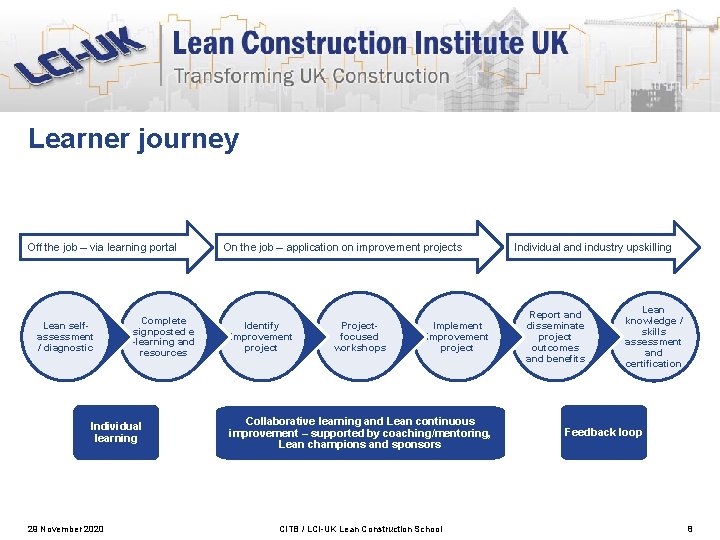
Learner journey Off the job – via learning portal Lean selfassessment / diagnostic Complete signposted e -learning and resources Individual learning 29 November 2020 On the job – application on improvement projects Identify improvement project Projectfocused workshops Implement improvement project Collaborative learning and Lean continuous improvement – supported by coaching/mentoring, Lean champions and sponsors CITB / LCI-UK Lean Construction School Individual and industry upskilling Report and disseminate project outcomes and benefits Lean knowledge / skills assessment and certification Feedback loop 8
Governance and operational boards Project governance board Operational board functions • CITB: Pauline Raby, Ben Lever • Mace: Steve Jeffery • Partners: David Anderson, Andy James, Tony Blanch, Gary Peters • LCI-UK: Brian Swain, Stuart Smith, Belinda Heys • Action Sustainability: James Cadman, Ian Heptonstall • Act as project sponsors / champions • Contribute existing Lean materials / resources • Provide subject matter expertise: attend content workshops • Review materials: diagnostic, e-learning, project workshops • Identify construction projects and liaise • Engage subcontractors • Support improvement projects • Appoint learning coordinators to engage individual learners, and to log and track offline training activity? Functions: • Sign off quarterly reports • Provide oversight on the production quality and content and • Ensure financial and ethical governance 29 November 2020 CITB / LCI-UK Lean Construction School 9
Industry development • Individual upskilling – common approach and transferable training blueprint • Company development – Lean diagnostic and action planning tool to improve Lean capability • Company- / project-specific learning groups • CITB involvement and commitment raises profile of Lean in supply chain • Case studies will demonstrate the impact of Lean in construction • Dynamic resource library and platform for discussing and sharing evidencebased best practices 29 November 2020 CITB / LCI-UK Lean Construction School 10
Team BAM LCI-UK Brian Swain (Director & Trustee) Petra Kopp (Learning designer) Martin Jones (Learning designer) Karen Vigar Project Manager 29 November 2020 Action Sustainability David Anderson Stuart Willis Galifrod. Try Ian Heptonstall (Director) Andy James Evan Surman Costain Tony Blanch Andy Fielding James Cadman (Project manager) Mace Ross Primmer (Diagnostic and Website) Stephen Jeffery Stephen Henley Skanska Andrew English Wendy Carwardine (Website) CITB / LCI-UK Lean Construction School 11
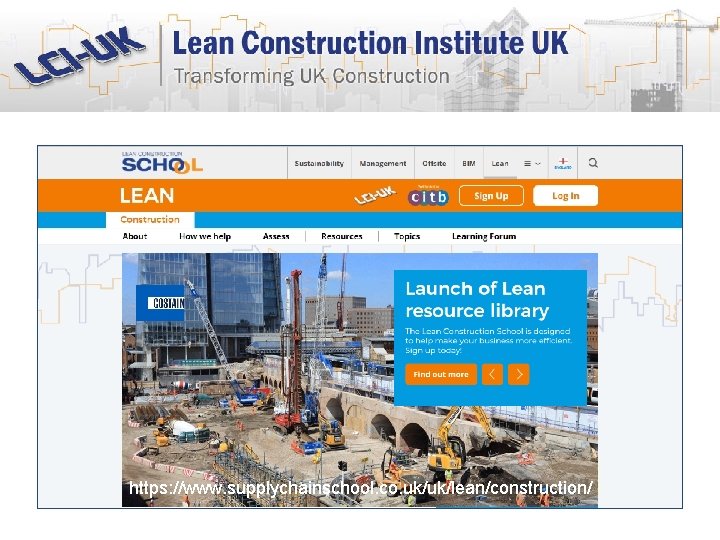
https: //www. supplychainschool. co. uk/uk/lean/construction/
On completion of this workshop you will be able to: • Basic principles • List Lean tools • Apply to existing business processes • Capture initial ideas for potential improvement projects ½ day workshop on how the use of the Lean in the workplace
Agenda 1. 2. 3. 4. 5. 6. 7. 8. 9. Welcome and Introductions Lean Construction School Video Overview of Lean Techniques Lean card game Site walk/Ideas Generation Round up Homework Next Time
Looking for Lean Facilitators! Future Workshops Looking for volunteers from the Partners, Tier 1 and Supply chain to develop and share the lean learning and improvements. Enable projects to become more efficient. Train the Facilitator Tt. F • • • Facilitator Training Managing Improvement Projects Measuring for success
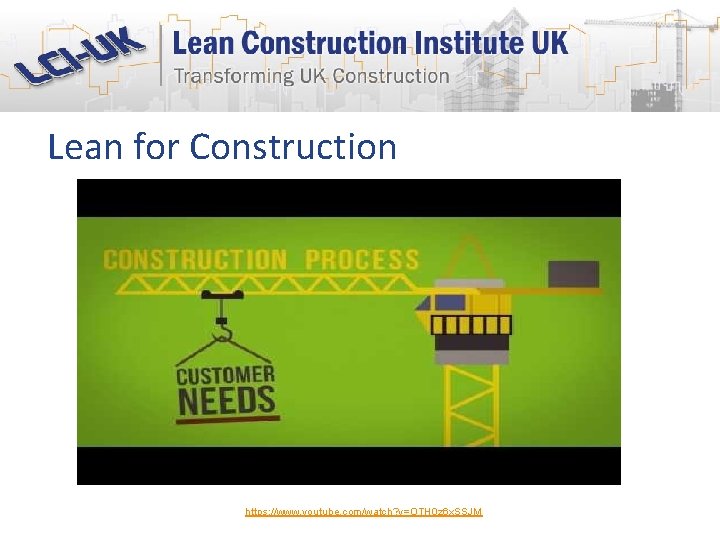
Lean for Construction Video on You. Tube at: https: //www. youtube. com/watch? v=OTH 0 z 6 x. SSJM
7 Aspects of Lean Construction The Lean Construction School covers the following seven key Lean methods: 1. 7 Wastes 2. 5 S Workplace Organisation 3. Collaborative planning 4. Problem solving and continuous improvement 5. Standardised work 6. Visual management 7. Value stream mapping
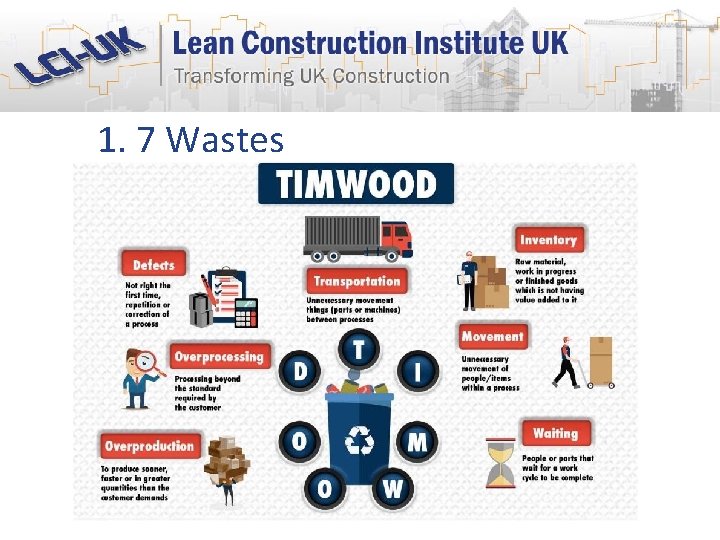
1. 7 Wastes
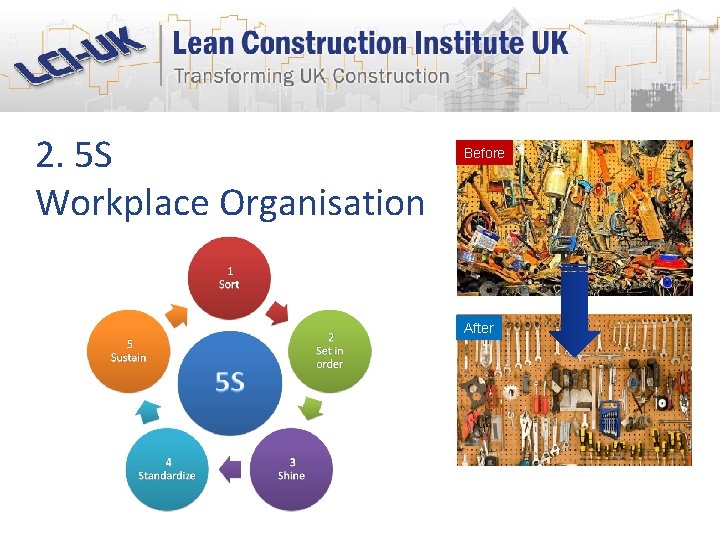
2. 5 S Workplace Organisation Before After
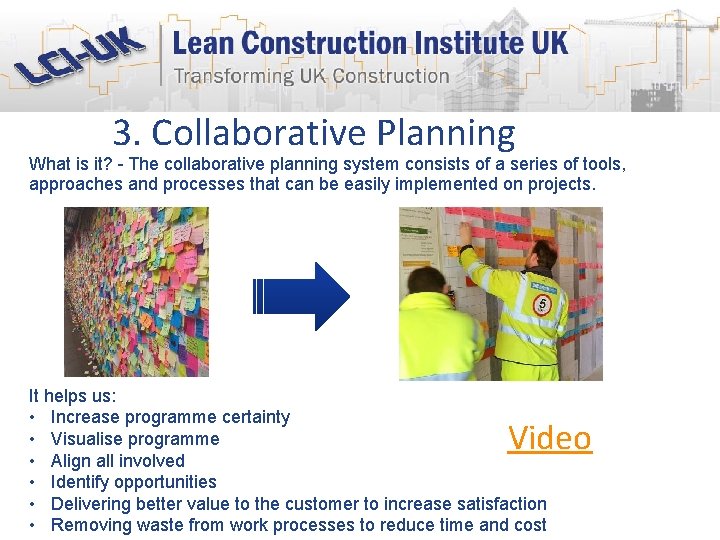
3. Collaborative Planning What is it? - The collaborative planning system consists of a series of tools, approaches and processes that can be easily implemented on projects. It helps us: • Increase programme certainty • Visualise programme • Align all involved • Identify opportunities • Delivering better value to the customer to increase satisfaction • Removing waste from work processes to reduce time and cost Video
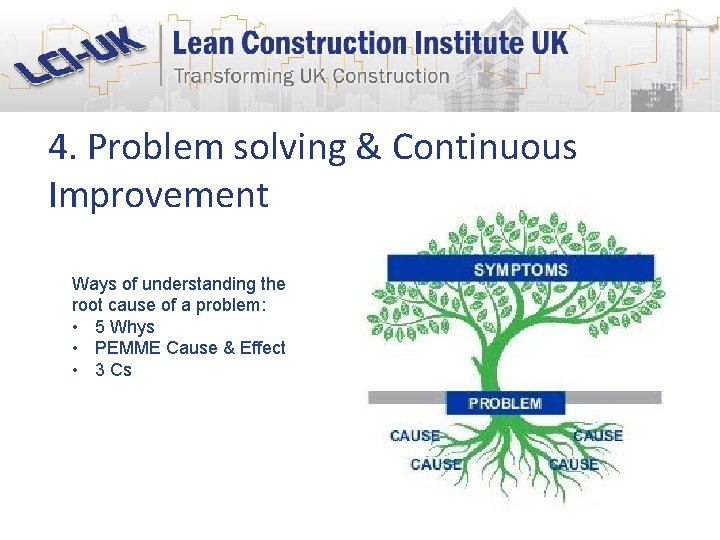
4. Problem solving & Continuous Improvement Ways of understanding the root cause of a problem: • 5 Whys • PEMME Cause & Effect • 3 Cs
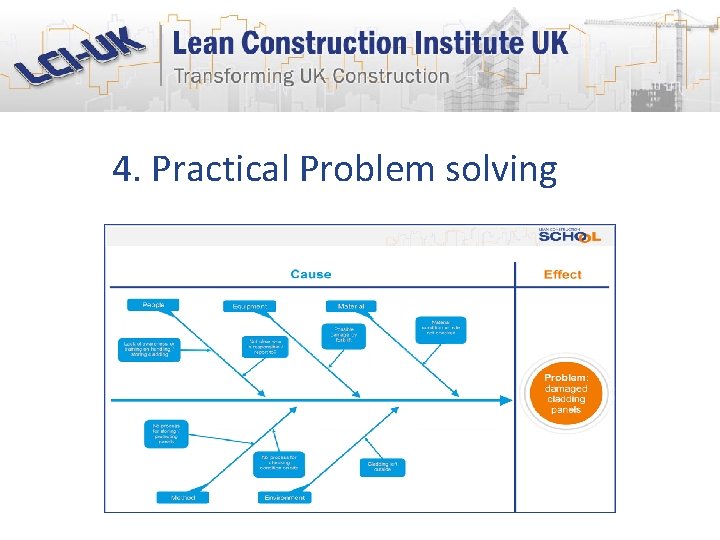
4. Practical Problem solving
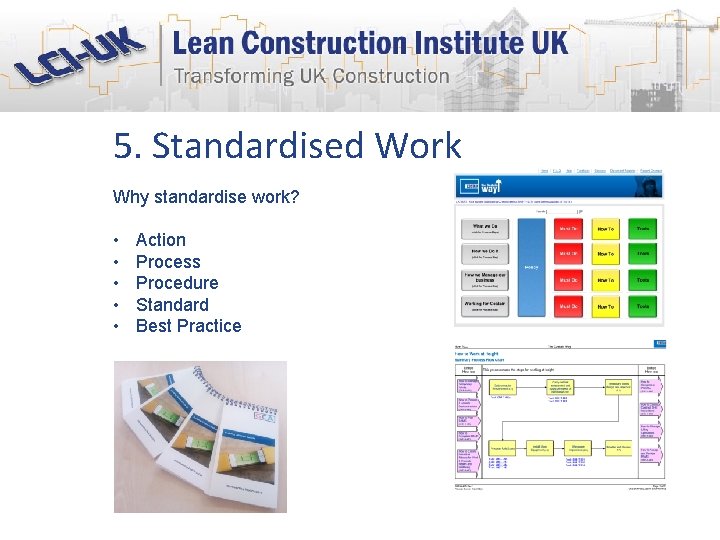
5. Standardised Work Why standardise work? • • • Action Process Procedure Standard Best Practice
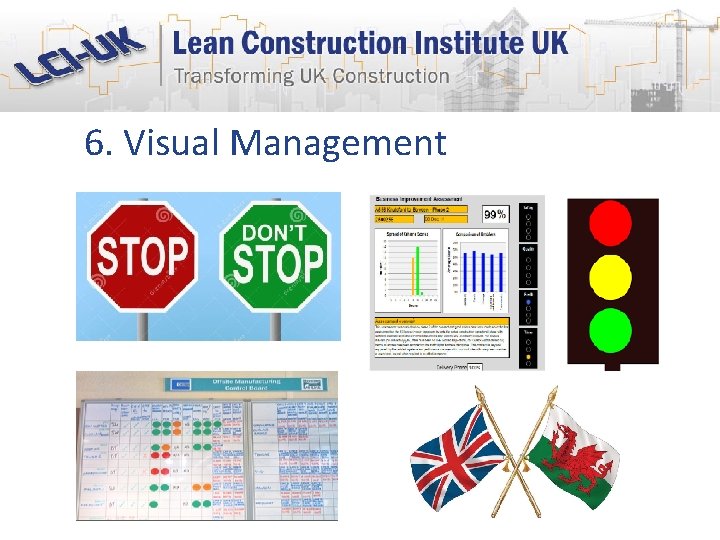
6. Visual Management
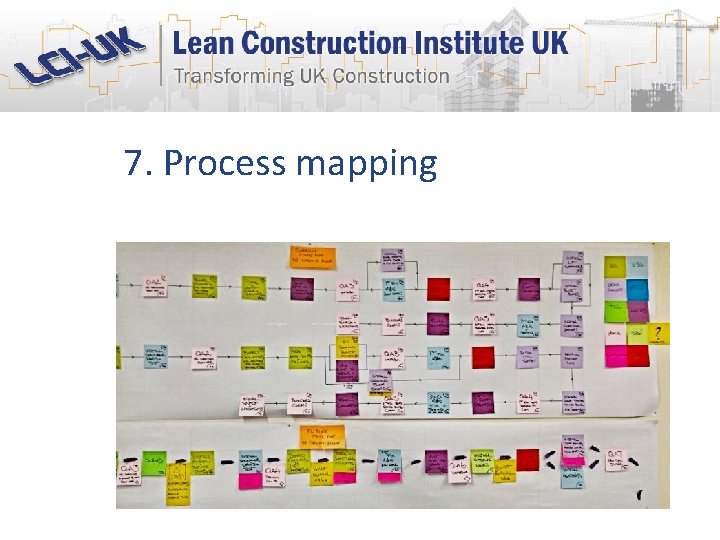
7. Process mapping
Lean Construction Card Game
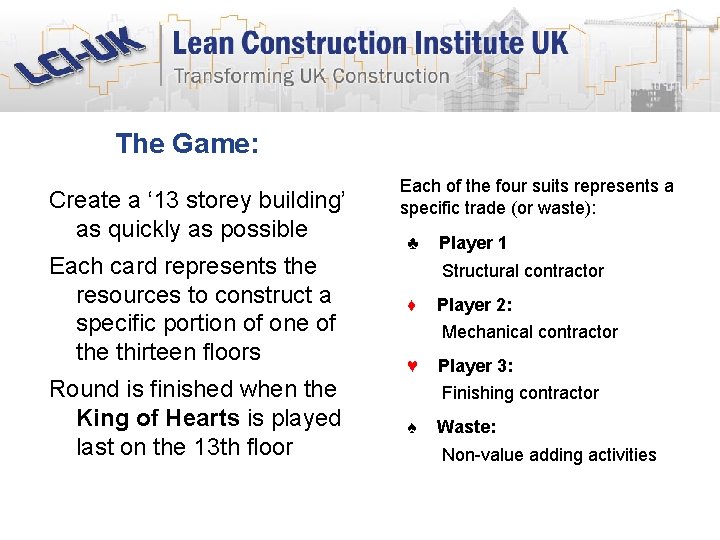
The Game: Create a ‘ 13 storey building’ as quickly as possible Each card represents the resources to construct a specific portion of one of the thirteen floors Round is finished when the King of Hearts is played last on the 13 th floor Each of the four suits represents a specific trade (or waste): ♣ Player 1 Structural contractor ♦ Player 2: Mechanical contractor ♥ Player 3: Finishing contractor ♠ Waste: Non-value adding activities
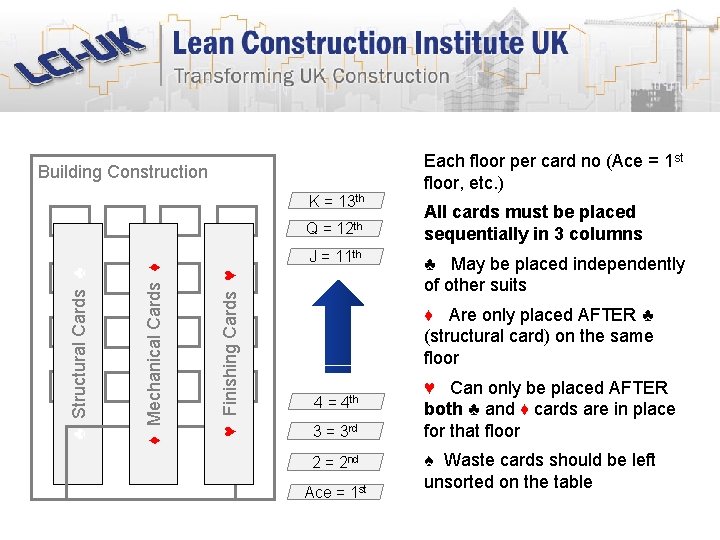
Building Construction K = 13 th J = 11 th ♥ Finishing Cards ♥ ♦ Mechanical Cards ♦ ♣ Structural Cards ♣ Q= 12 th Each floor per card no (Ace = 1 st floor, etc. ) All cards must be placed sequentially in 3 columns ♣ May be placed independently of other suits ♦ Are only placed AFTER ♣ (structural card) on the same floor 4 = 4 th 3 = 3 rd 2 = 2 nd Ace = 1 st ♥ Can only be placed AFTER both ♣ and ♦ cards are in place for that floor ♠ Waste cards should be left unsorted on the table
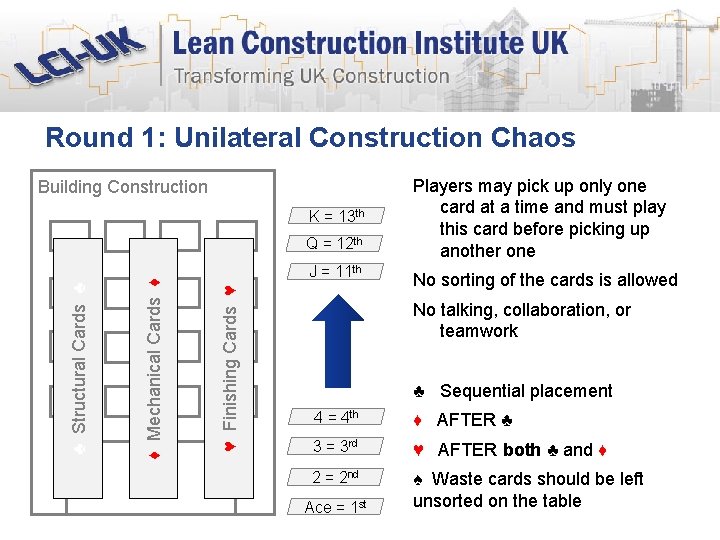
Round 1: Unilateral Construction Chaos Building Construction K = 13 th J = 11 th ♥ Finishing Cards ♥ ♦ Mechanical Cards ♦ ♣ Structural Cards ♣ Q = 12 th Players may pick up only one card at a time and must play this card before picking up another one No sorting of the cards is allowed No talking, collaboration, or teamwork ♣ Sequential placement 4 = 4 th ♦ AFTER ♣ 3 = 3 rd ♥ AFTER both ♣ and ♦ 2 = 2 nd ♠ Waste cards should be left unsorted on the table Ace = 1 st
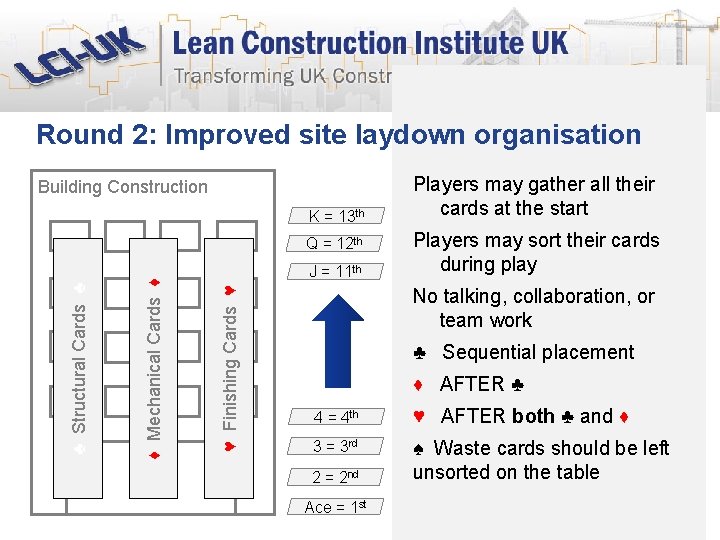
Round 2: Improved site laydown organisation Building Construction K = 13 th J = 11 th ♥ Finishing Cards ♥ ♦ Mechanical Cards ♦ ♣ Structural Cards ♣ Q = 12 th Players may gather all their cards at the start Players may sort their cards during play No talking, collaboration, or team work ♣ Sequential placement ♦ AFTER ♣ 4 = 4 th ♥ AFTER both ♣ and ♦ 3 = 3 rd ♠ Waste cards should be left unsorted on the table 2 = 2 nd Ace = 1 st
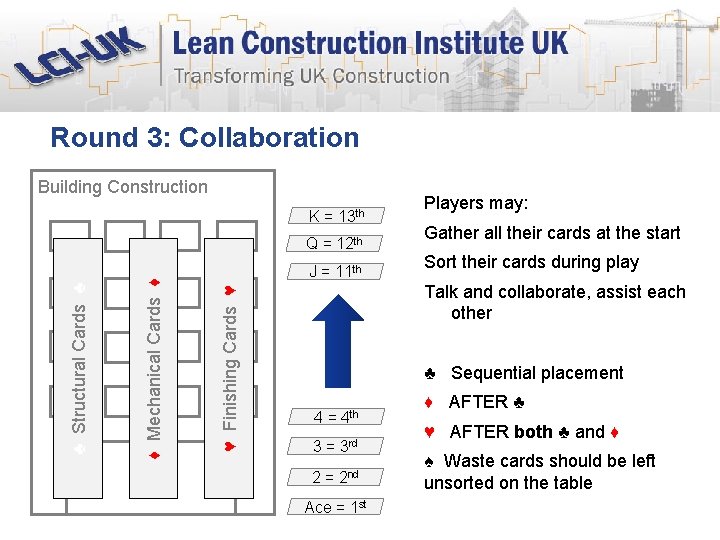
Round 3: Collaboration Building Construction K = 13 th J = 11 th ♥ Finishing Cards ♥ ♦ Mechanical Cards ♦ ♣ Structural Cards ♣ Q = 12 th Players may: Gather all their cards at the start Sort their cards during play Talk and collaborate, assist each other ♣ Sequential placement 4 = 4 th 3 = 3 rd 2= 2 nd Ace = 1 st ♦ AFTER ♣ ♥ AFTER both ♣ and ♦ ♠ Waste cards should be left unsorted on the table
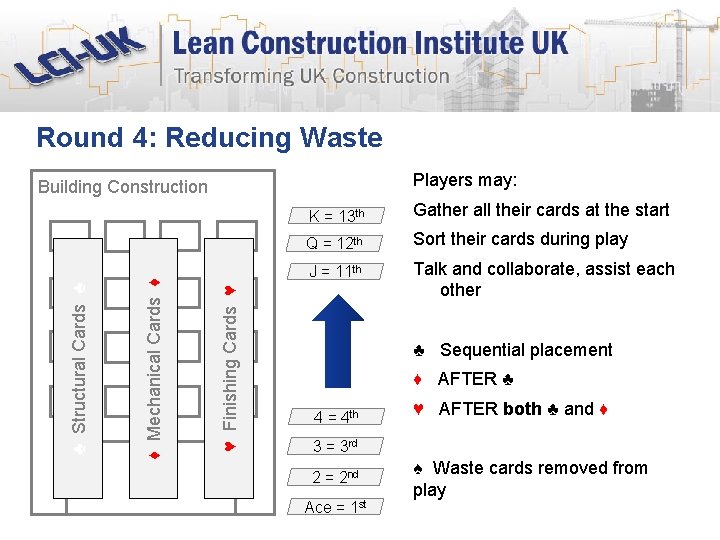
Round 4: Reducing Waste Players may: ♥ Finishing Cards ♥ ♦ Mechanical Cards ♦ ♣ Structural Cards ♣ Building Construction K = 13 th Gather all their cards at the start Q = 12 th Sort their cards during play J = 11 th Talk and collaborate, assist each other ♣ Sequential placement ♦ AFTER ♣ 4 = 4 th ♥ AFTER both ♣ and ♦ 3 = 3 rd 2 = 2 nd Ace = 1 st ♠ Waste cards removed from play
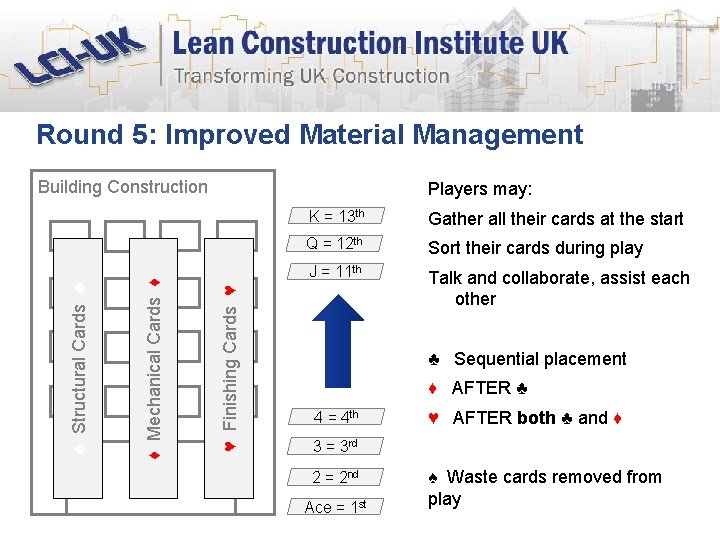
Round 5: Improved Material Management Players may: ♥ Finishing Cards ♥ ♦ Mechanical Cards ♦ ♣ Structural Cards ♣ Building Construction K = 13 th Gather all their cards at the start Q = 12 th Sort their cards during play J = 11 th Talk and collaborate, assist each other ♣ Sequential placement ♦ AFTER ♣ 4 = 4 th ♥ AFTER both ♣ and ♦ 3 = 3 rd 2 = 2 nd Ace = 1 st ♠ Waste cards removed from play
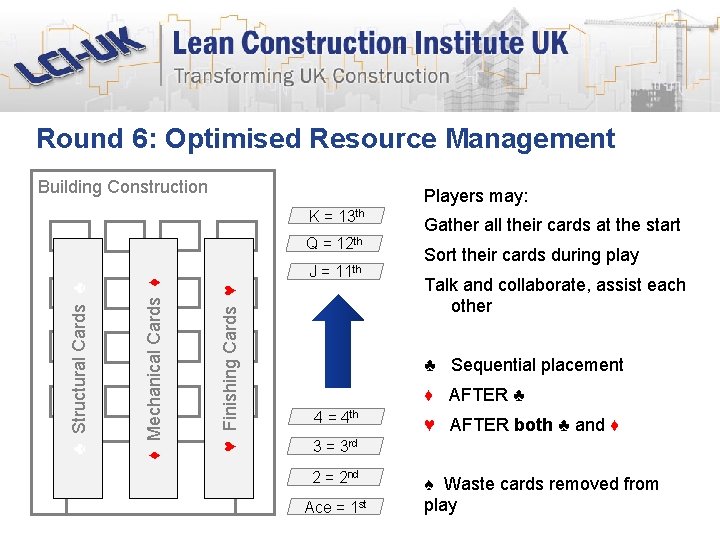
Round 6: Optimised Resource Management Building Construction Players may: K = 13 th J= ♥ Finishing Cards ♥ ♦ Mechanical Cards ♦ ♣ Structural Cards ♣ Q = 12 th 11 th Gather all their cards at the start Sort their cards during play Talk and collaborate, assist each other ♣ Sequential placement ♦ AFTER ♣ 4 = 4 th ♥ AFTER both ♣ and ♦ 3 = 3 rd 2 = 2 nd Ace = 1 st ♠ Waste cards removed from play
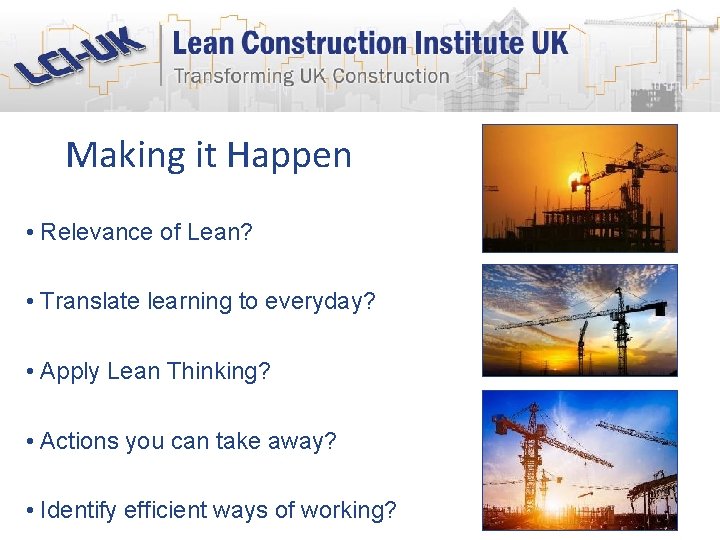
Making it Happen • Relevance of Lean? • Translate learning to everyday? • Apply Lean Thinking? • Actions you can take away? • Identify efficient ways of working?
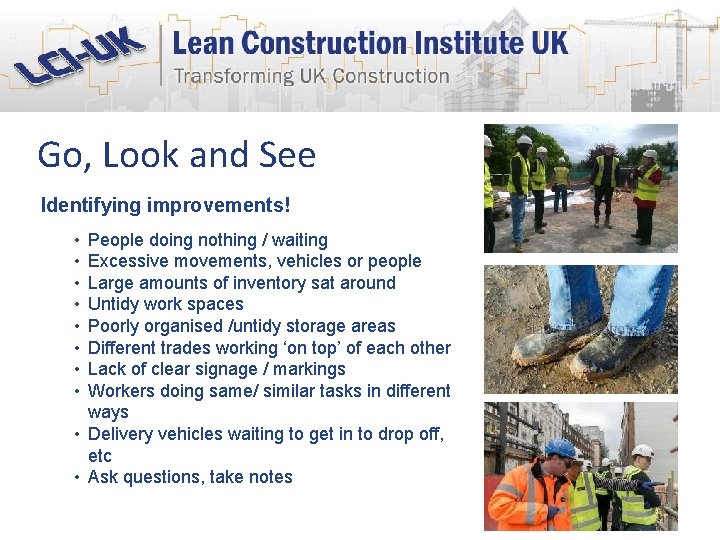
Go, Look and See Identifying improvements! • • People doing nothing / waiting Excessive movements, vehicles or people Large amounts of inventory sat around Untidy work spaces Poorly organised /untidy storage areas Different trades working ‘on top’ of each other Lack of clear signage / markings Workers doing same/ similar tasks in different ways • Delivery vehicles waiting to get in to drop off, etc • Ask questions, take notes
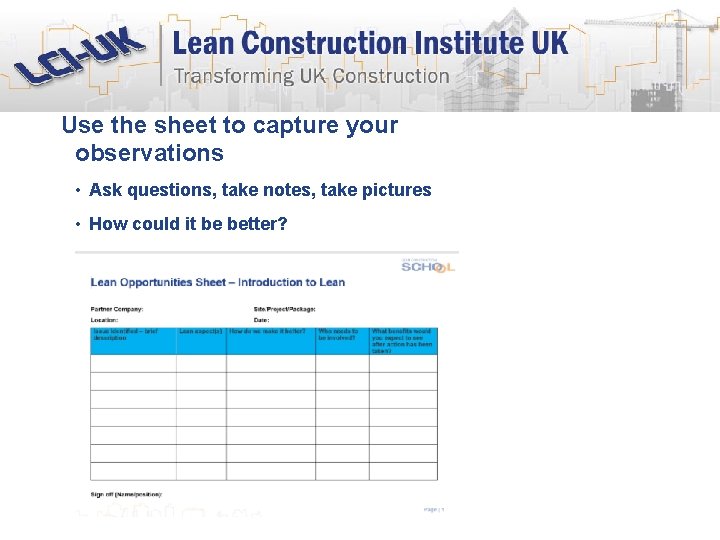
Use the sheet to capture your observations • Ask questions, take notes, take pictures • How could it be better?
• What opportunities have you identified? • Name one thing you’ll do differently as a consequence of today • Identify people for Train the Facilitator sessions, from which organisations / suppliers, as well as workshop dates • Homework • Register for the lean construction school • https: //www. supplychainschool. co. uk/uk/lean/construction/ • Do the online modules (4 of 8 minimum by 14 th June, preferably all) • Decide on the improvement to take forward
Next Time - Day 2 1. 2. 3. 4. 5. 6. 7. Introductions Recap & Overview of day 1 Your Lean Improvement Project Lean Facilitator Training Managing Improvement Project Training Planning your improvement project Agree follow up
• …to provide training to would-be Facilitators on communications skills for: • Presenting; • Listening and Questioning; • Participation and getting involvement; • Dealing with difficult delegates and keeping it positive; • Identifying and Selecting Projects; • Managing improvement projects • By the end of the day you should feel more confident and able to run your own Lean improvement project workshops.

Thanks for Listening
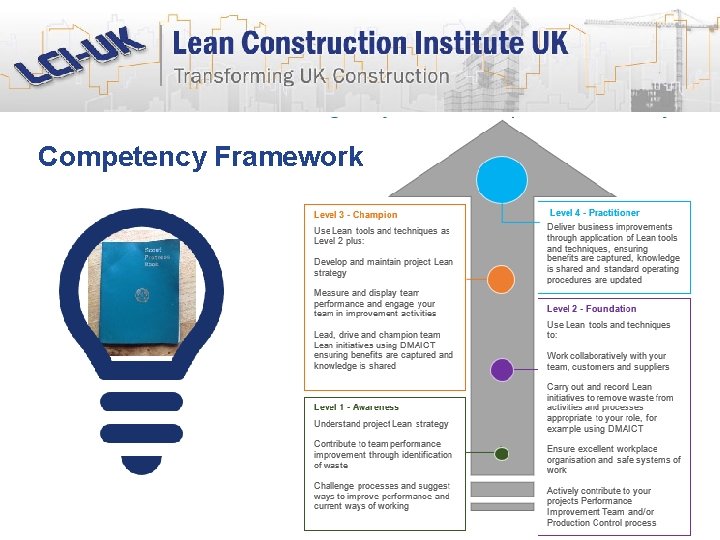
Competency Framework
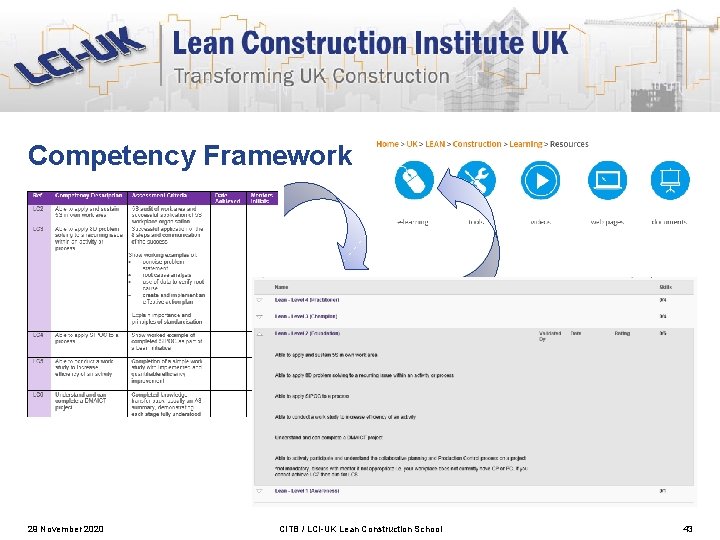
Competency Framework 29 November 2020 CITB / LCI-UK Lean Construction School 43
- Slides: 43