
LEAN BY DESIGN Designing Organizational to be Lean
LEAN BY DESIGN Designing Organizational to be Lean, Agile and Vital
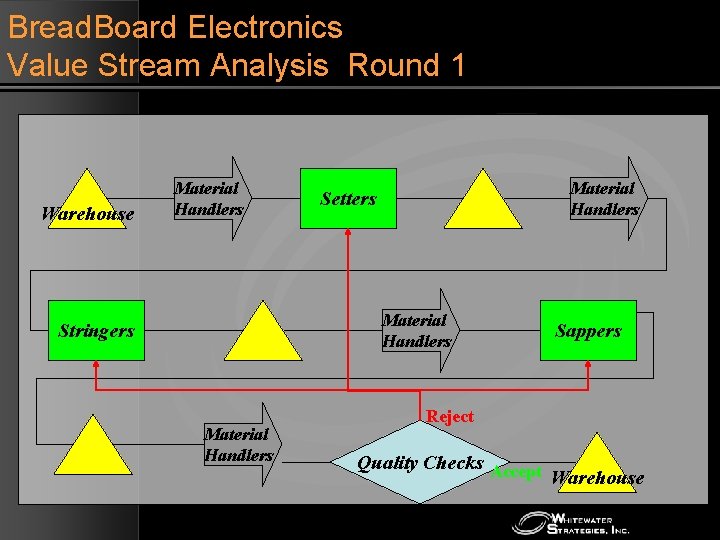
Bread. Board Electronics Value Stream Analysis Round 1 Warehouse Material Handlers Setters Material Handlers Stringers Material Handlers Sappers Reject Quality Checks Accept Warehouse
Defining Lean § Lean is primarily a quest for reducing waste (Muda in Japanese) from your organization and processes. § IS NOT -- simply “Doing more with less!” § IS -- putting an end to doing things which do not add value, waste and strain resources, and consume our valuable energies. § IS -- doing things that add value – develop resources, and grow capability for the future. § IS -- insuring all resources (money, people, equipment, time…) are balanced to optimize the overall organization -not just a part of the organization.
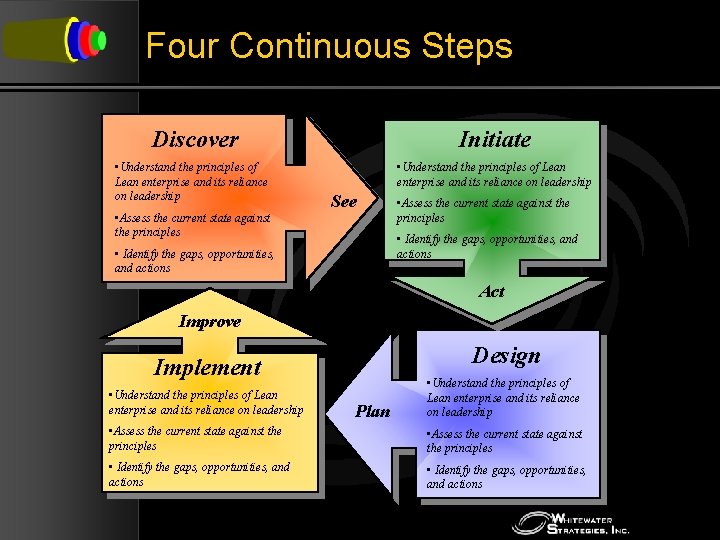
Four Continuous Steps Discover Initiate • Understand the principles of Lean enterprise and its reliance on leadership • Assess the current state against the principles See • Assess the current state against the principles • Identify the gaps, opportunities, and actions Act Improve Design Implement • Understand the principles of Lean enterprise and its reliance on leadership Plan • Understand the principles of Lean enterprise and its reliance on leadership • Assess the current state against the principles • Identify the gaps, opportunities, and actions
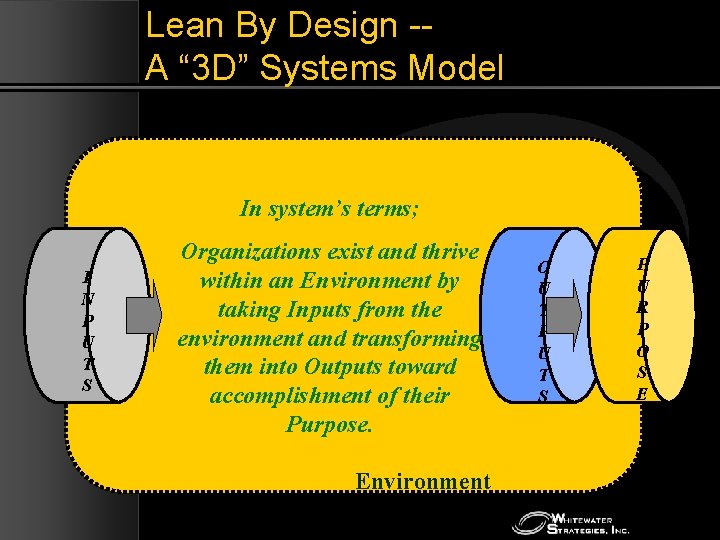
Lean By Design -A “ 3 D” Systems Model In system’s terms; I N P U T S Organizations exist and thrive within an Environment by taking Inputs from the environment and transforming them into Outputs toward accomplishment of their Purpose. Environment O U T P U T S P U R P O S E
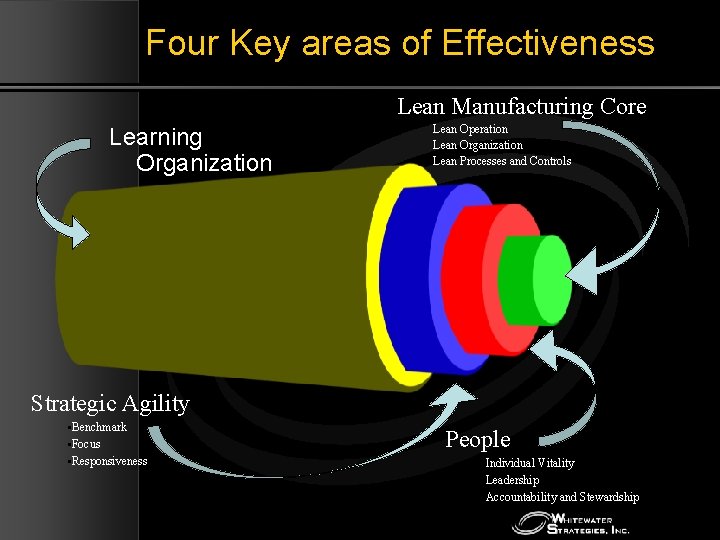
Four Key areas of Effectiveness Lean Manufacturing Core Learning Organization Lean Operation Lean Organization Lean Processes and Controls Strategic Agility §Benchmark §Focus §Responsiveness People §Individual Vitality §Leadership §Accountability and Stewardship
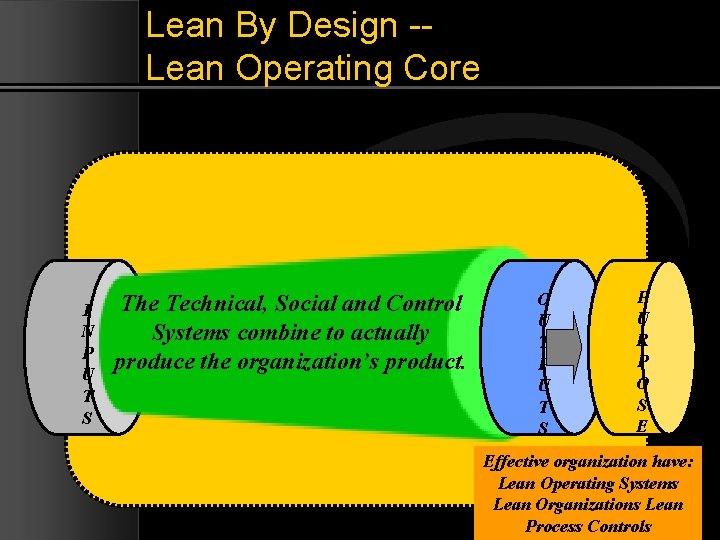
Lean By Design -Lean Operating Core I N P U T S The Technical, Social and Control Systems combine to actually produce the organization’s product. O U T P U T S P U R P O S E Effective organization have: Lean Operating Systems Lean Organizations Lean Process Controls
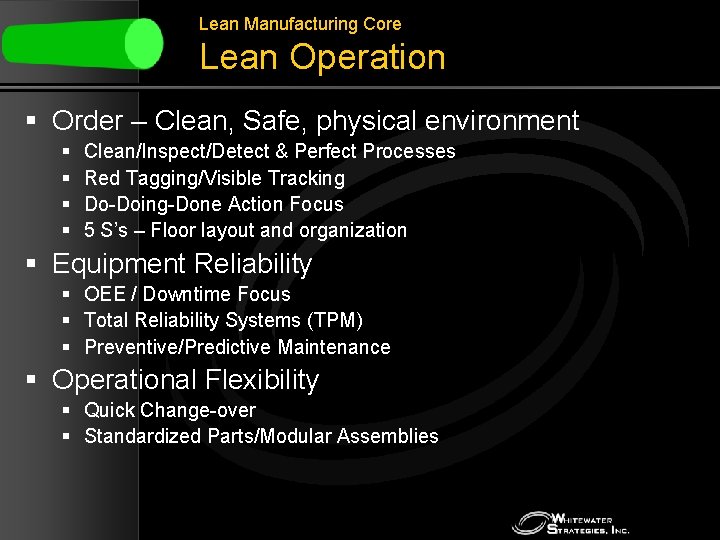
Lean Manufacturing Core Lean Operation § Order – Clean, Safe, physical environment § § Clean/Inspect/Detect & Perfect Processes Red Tagging/Visible Tracking Do-Doing-Done Action Focus 5 S’s – Floor layout and organization § Equipment Reliability § OEE / Downtime Focus § Total Reliability Systems (TPM) § Preventive/Predictive Maintenance § Operational Flexibility § Quick Change-over § Standardized Parts/Modular Assemblies
Lean Manufacturing Core Lean Organization § Team Based/Focused § Clear Goals and a defined Playing Field § Operating roles and Organizational Roles § Limited hierarchy (only value adding positions) § Cross Skilling and Role Sharing § Multi Skilled associates § Responsibility to a “broad role” not a “narrow job. ” § Selecting and Retaining the Best § Team Based selection process § Success Dialogue as the driver in Performance Management § Reward and recognition systems aligned with expectations and values.
Lean Manufacturing Core Lean Processes and Controls § Baselines and Procedures § Visual Factory (controls) § Repeatability, Standardization § 3 M’s (Mark Machinery, Measure Material, Mandate Method) § Cellular/Product Focused Design § Locate the Gate/Bottleneck Analysis § Product Variability Control § Pull system/Kanban Inventory § Level Scheduling § WIP Analysis and Strategy § JIT Parts Inventory Strategy
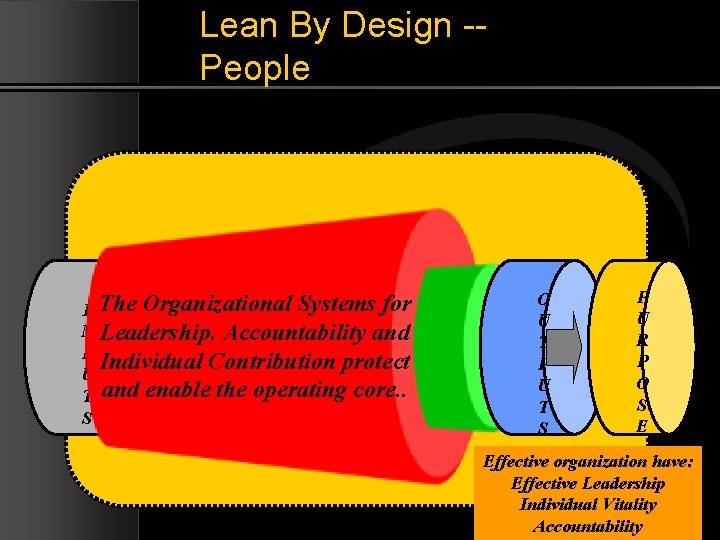
Lean By Design -People I The Organizational Systems for N Leadership, Accountability and P Individual Contribution protect U T and enable the operating core. . S O U T P U T S P U R P O S E Effective organization have: Effective Leadership Individual Vitality Accountability
People Individual Vitality § Commitment and Engagement § Involvement in decision making, system understanding § Clarity of roles, responsibilities and accountabilities § Meaningfulness of role § Performance Management § Managing for results and improvement rather than “paper trail” § Future Focus § Opportunity to advance, grow and develop
People Leadership Competency § Visibility of Leaders § MBWA (Management by Wandering Around) § Immediate Response (never sanction incompetence) § Transformational Leadership Activities § Transfer “Directing and Coordinating” to teams § Learn to “Enable and Allow” § Lead as a “Partner” § Right Way/Right Results Integration § Clarify “What’s” or results expected § Build understanding of Cultural “Hows” or Ways § Walk the Talk
People Accountability and Stewardship § Visual Measures (metrics) § Standardized Control, visual markings § Signals, panels, visible machine works § Regular Accounting § § IT/Lean Aligned Measures Daily Handoff Public, direct and future focused Cross Team Inspections § Action Orientation § Do/Doing/Done § Post Incident Assessment and Local Master planning
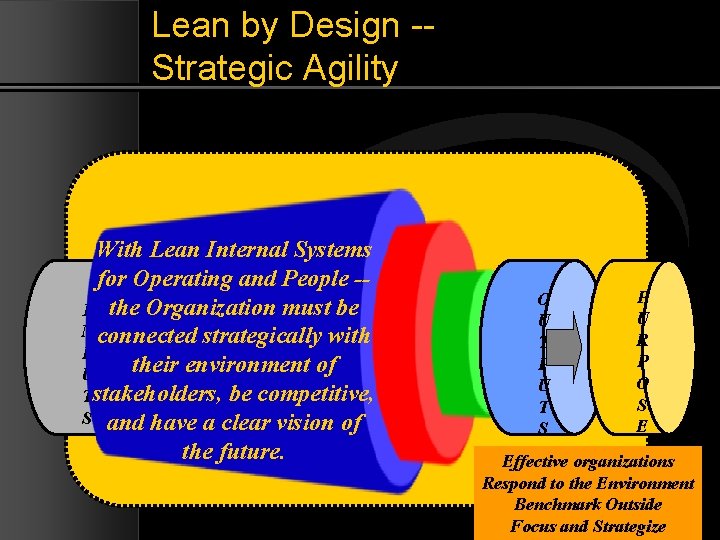
Lean by Design -Strategic Agility With Lean Internal Systems for Operating and People -I the Organization must be N connected strategically with P their environment of U Tstakeholders, be competitive, S and have a clear vision of the future. O U T P U T S P U R P O S E Effective organizations Respond to the Environment Benchmark Outside Focus and Strategize
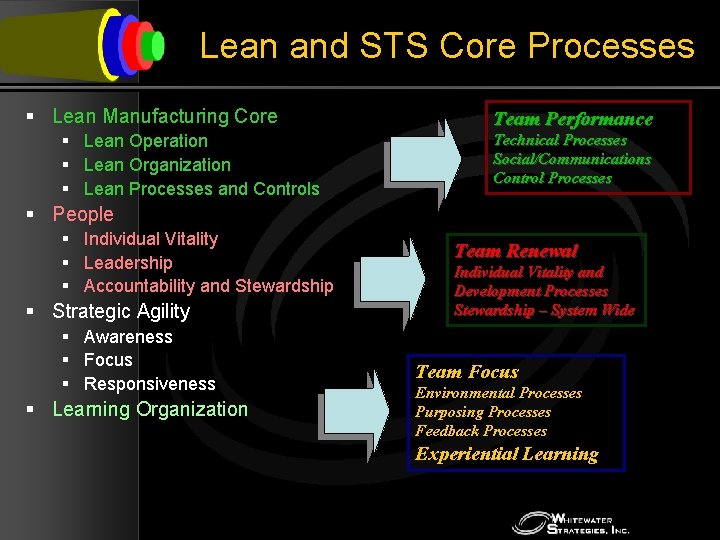
Lean and STS Core Processes § Lean Manufacturing Core § Lean Operation § Lean Organization § Lean Processes and Controls Team Performance Technical Processes Social/Communications Control Processes § People § Individual Vitality § Leadership § Accountability and Stewardship § Strategic Agility § Awareness § Focus § Responsiveness § Learning Organization Team Renewal Individual Vitality and Development Processes Stewardship – System Wide Team Focus Environmental Processes Purposing Processes Feedback Processes Experiential Learning
Strategic Agility Benchmark § Organizational Measurement § Insure that our results measures are “real” and reflect our performance. § Benchmark the Market § Identify “competitive model organizations” which we can use to compare our performance for position within the market. § Identify and understand the trends of the future and the impact it may have on us. § Set the Standard § Continually change and grow organizational processes toward market leadership and dominance. § Strategy, Vision, follow-through
Strategic Agility Focus § Focused Mission § Clear on why we exist and what where the goal really is. § Guiding Principles § Understanding of the Culture we have created and value the best of what “is” § Clarify the values which will drive us toward our Vision and have the courage to hold the course. § Clarity of Vision § Specific, quantify able targets beyond 5 yrs § Strategic planning and follow-through. y
Strategic Agility Responsiveness § Responsive to and interactive with: § Customers § The Larger Organization § Regulatory Agencies and Community § Connecting the Environment to the Associates § Communication of response issues and opportunities § Engagement of Associates with the Environment § Anticipating § Building beyond today’s expectation to take advantage of tomorrow’s opportunityy
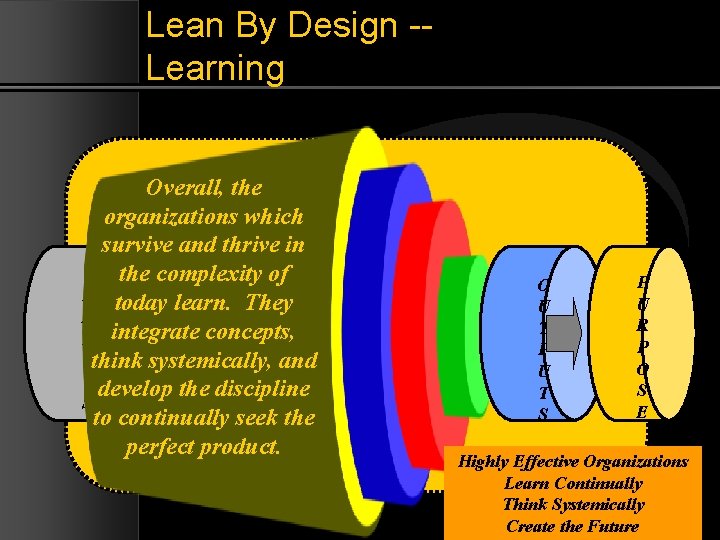
Lean By Design -Learning Overall, the organizations which survive and thrive in the complexity of I today learn. They N P integrate concepts, Uthink systemically, and T develop the discipline S to continually seek the perfect product. O U T P U T S P U R P O S E Highly Effective Organizations Learn Continually Think Systemically Create the Future
Learning Organization § Whitewater Learning Systems § JIT Learning § Learning Moments § Planned “on the job/real situation” learning § Visual Mapping for Understanding § One Point Lessons § Marking & Labeling § Change Readiness § Culture of: {Ready! Fire! Aim!} § Learning Beyond Entitlements
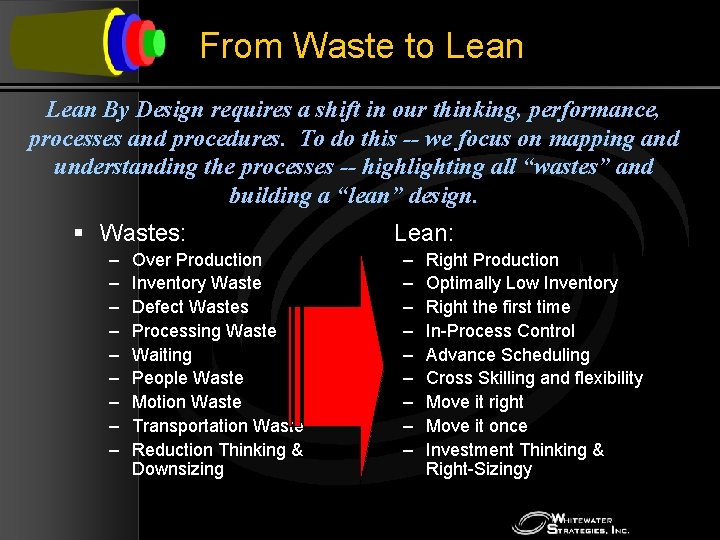
From Waste to Lean By Design requires a shift in our thinking, performance, processes and procedures. To do this -- we focus on mapping and understanding the processes -- highlighting all “wastes” and building a “lean” design. § Wastes: – – – – – Over Production Inventory Waste Defect Wastes Processing Waste Waiting People Waste Motion Waste Transportation Waste Reduction Thinking & Downsizing § Lean: – – – – – Right Production Optimally Low Inventory Right the first time In-Process Control Advance Scheduling Cross Skilling and flexibility Move it right Move it once Investment Thinking & Right-Sizingy
Overproduction • • Producing more product than needed Making product earlier than needed Making product faster than needed Causes – – – – Just-in-Case Logic (You must be prepared…) Desire to Maximize machine output regardless of need Long/Difficult set-up times Over-reliance on in-process inventory cues Unlevel scheduling Over engineered Wrong Metrics and accounting targets
Inventory Waste • In process and after process Inventory beyond what is needed for the immediate schedule. • Causes: – – – Cover inefficiencies in the system Cover Down time Inability to forecast market Unbalances workload Reward and Measurement system Fear of “outages”
Product Defects • Producing products which do not meet specifications and which must be repaired, downgraded, “held, ” or discarded. • Causes – – – Weak process control Poor discipline for quality process by employees Machine defects or cleanliness Product design Poor understanding of Customer needs
Processing Waste • Effort that adds no value to the product or service from the customers’ viewpoint • Causes – Changes in the product without process changes – Just-In-Case logic – Customer requirements not understood or defined – Poor communications
Waiting Waste • In process inventory, staging of materials, or equipment awaiting throughput. • Causes: – Poor material flow – Segmented or staged work flow – Imbalances in equipment processing or product development times – Partial process accounting
People Waste • Having too many people, too many levels, improperly skilled people, decisions made at the wrong level, processes which deny the creativity and ingenuity of the worker. • Causes: – – – Departmentalization and segmentation of work “Craft” vs. “Labor” mentality “Not my job” vs. “get results” focus Lack of multi-skill focus and training Lack of responsibility for overall results
Motion Waste • Ineffective material flow which causes people to move product unproductively, multiple times, non-ergonomically, or arbitrarily. • Causes: – Lack of standardization for work-flow – Lack of discipline to standards – Poor design of material flow – Excessive storage of WIP or other obstructions
Transportation Waste • Ineffective material flow which causes people and machinery to transport and store product unproductively, multiple times, or arbitrarily. • Causes: – Too much inventory – Accounting procedures – Inability to forecast demand
Reduction Thinking & Downsizing • Seeing resources, budgets, and especially people as “burdens” on the system rather than investments and catalysts for the future creates a “scarcity” mentality allowing for a limited win. • Causes: – – Paper-clip counting programs Short Term planning and moment-to-moment accounting Panic and program to program jumping Balancing budgets by head count reductions
Elements for “Designing” Lean § § § § § Cellular/Product Focused Teams and Equipment Layout Team Based/Visual Metrics – System Wide Accounting Cross Skilling Process Development and Control the responsibility of the Team Quality, Safety, Communication, Performance Reviews the responsibility of the Team Pull System “Triggers” to minimize inventories Integration of support functions within Teams Visible / Transformational Leadership Decisions made closest to the work – Leaders as Partners and mentors
Elements for “Working” Lean § § § § § 5 S’s – Order and Constancy Quick Change Over Team Inclusive Scheduling Control Total Reliability Systems/Total Productive Systems Predictive Maintenance Team Based “Process Mapping and Value Analysis” (“Box to Box Analysis”) Visual Metrics Daily “Hand-off” or Huddle Meetings “Stop the line” and fix a problem rather than running it poorly until there is a good time to fix it. The Perfect Attitude – everything must be done right!!!
Example: 5 S’s -Organizing the Best Plays § Sort § When in doubt -- throw it out!!! § Straighten § A place for everything and everything in it’s place!!! § Scrub § The “White Glove” test!!! § Systematize § Practice Makes Permanent!!! § Sustain § Perfect Practice Makes Perfect!!!
Lean Enterprise Assessments § Assessment Team § STS Consultants AND Organizational Associates § Observations and Measures § Interviews § Assessment Profile § Employee Survey § Analysis and Recommendations § Overall Lean Enterprise § Quick Hits – Just Do It!!! § Design Hits – Planning and Implementation § Implementation Support § Regrouping and Continual Improvement
Assessment Focus § The Lean Assessment is designed to: § Evaluate the organization based on the Lean Enterprise Principles. § Create a broad understanding of our successes, struggles and opportunities in the Lean Areas: § Lean Manufacturing Core § Organizational Agility § People § Learning Organization
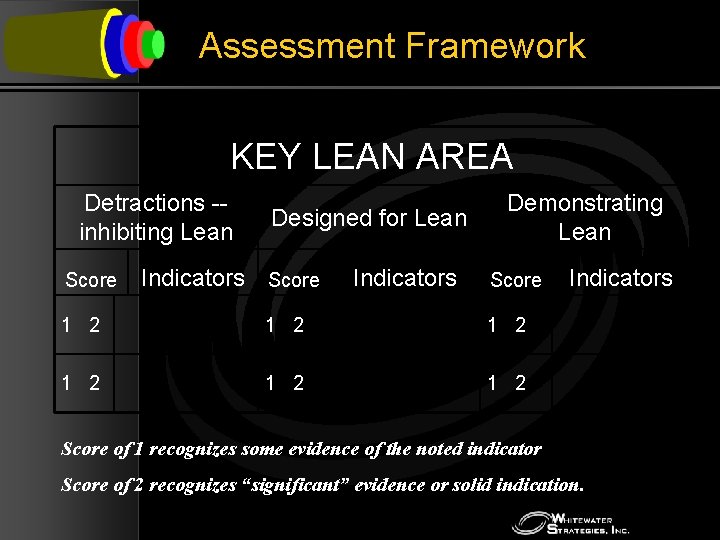
Assessment Framework KEY LEAN AREA Detractions -inhibiting Lean Score Designed for Lean Indicators Score Indicators Demonstrating Lean Score 1 2 1 2 1 2 Indicators Score of 1 recognizes some evidence of the noted indicator Score of 2 recognizes “significant” evidence or solid indication.
Assessment and Scoring Process § The Assessment Team will Score the organization first based on their “Direct Observations” § Measurements, Analysis, Photographic journal § Focused Interviews will provide historical perspective and current impressions by a cross section of the organization. § Written Surveys will help focus in on the depth and degree of observed indicators.
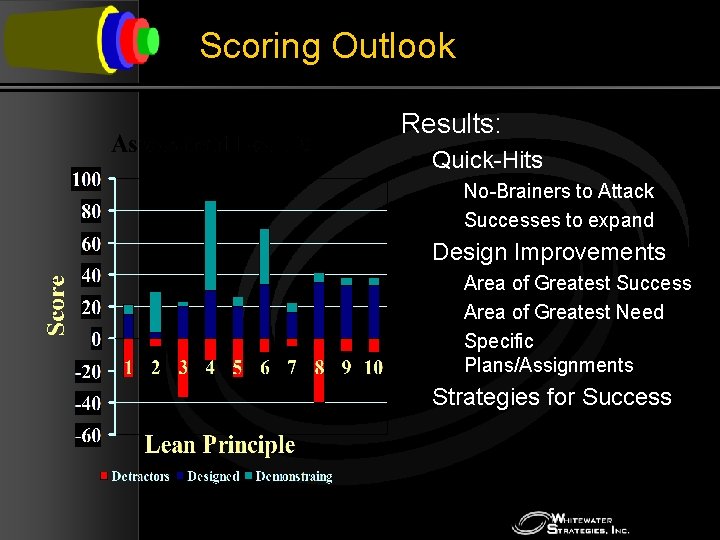
Scoring Outlook § Results: § Quick-Hits § No-Brainers to Attack § Successes to expand § Design Improvements § Area of Greatest Success § Area of Greatest Need § Specific Plans/Assignments § Strategies for Success
Distinctive Methodology § Observed Evidences based rather than perception based. § Cataloging the what is seen § Visual Photos – of what is and the “Bad” replaced only with new photo of “good” § Not “evaluating” where people “feel” they are.
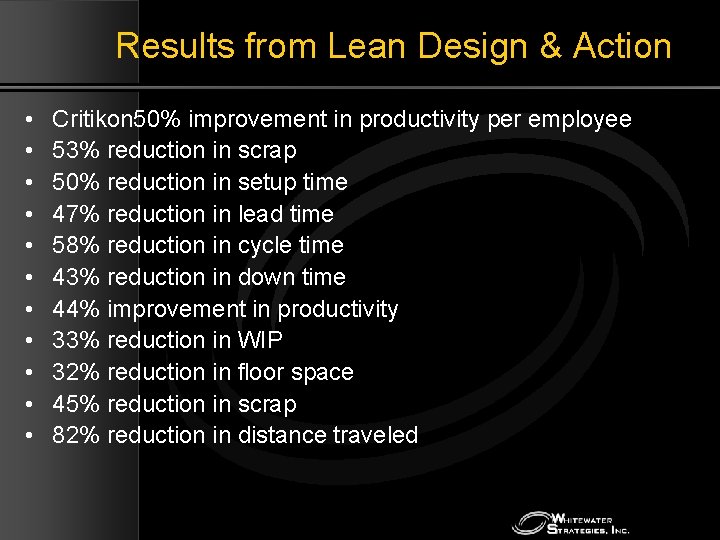
Results from Lean Design & Action • • • Critikon 50% improvement in productivity per employee 53% reduction in scrap 50% reduction in setup time 47% reduction in lead time 58% reduction in cycle time 43% reduction in down time 44% improvement in productivity 33% reduction in WIP 32% reduction in floor space 45% reduction in scrap 82% reduction in distance traveled
- Slides: 41