
Lean Assessment System Introduction to Lean Overview Agenda

- Slides: 34
Lean Assessment System
Introduction to Lean Overview Agenda • What is the Lean Assessment? • Why Assess? • How the results are used • How the Assessment is conducted • Problems with the Assessment process • Areas of Assessment • Departments to be Assessed • Discussion – The Lean Vision
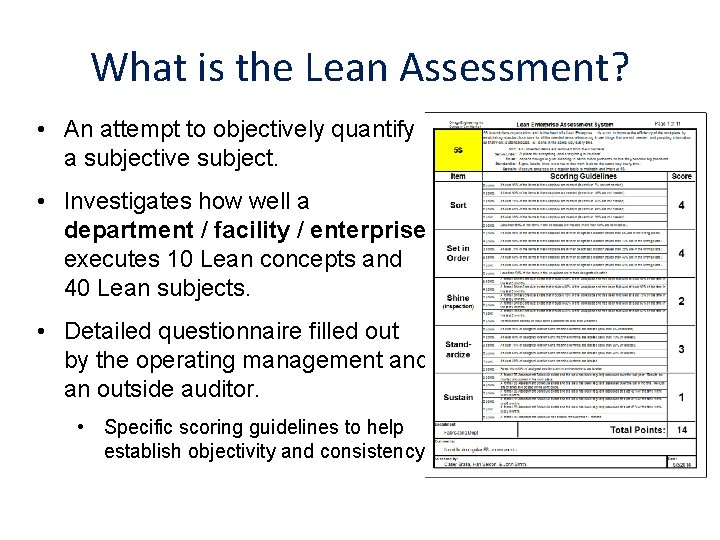
What is the Lean Assessment? • An attempt to objectively quantify a subjective subject. • Investigates how well a department / facility / enterprise executes 10 Lean concepts and 40 Lean subjects. • Detailed questionnaire filled out by the operating management and an outside auditor. • Specific scoring guidelines to help establish objectivity and consistency.
What is the Lean Assessment? • WDGLL? • What Does Good Look Like? • The assessment compares the facility to an ideal Lean operation. • It is very difficult to get a perfect score, since most factories are not completely Lean. A typical score for a good factory is around 40 points.
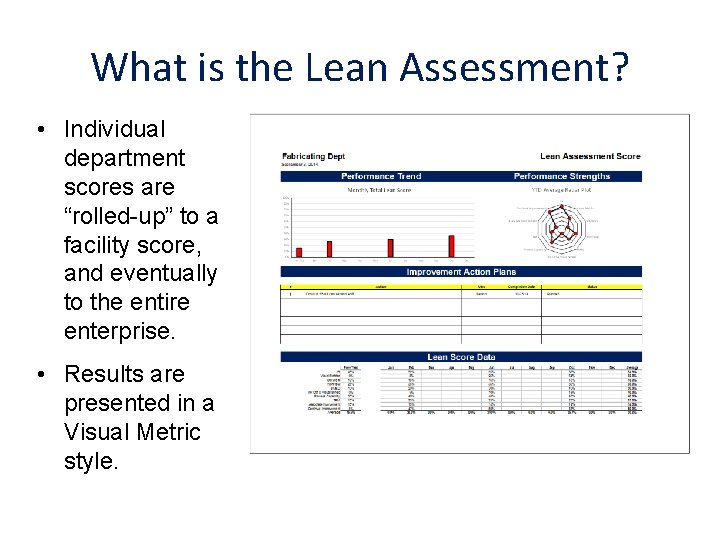
What is the Lean Assessment? • Individual department scores are “rolled-up” to a facility score, and eventually to the entire enterprise. • Results are presented in a Visual Metric style.
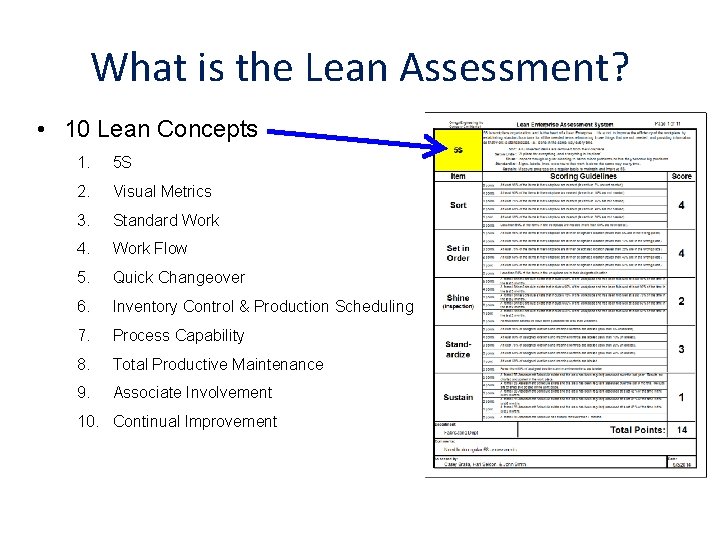
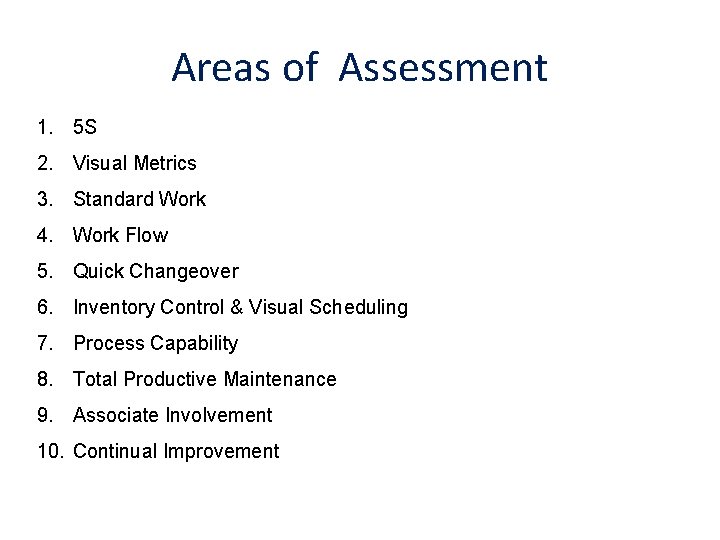
What is the Lean Assessment? • 10 Lean Concepts 1. 5 S 2. Visual Metrics 3. Standard Work 4. Work Flow 5. Quick Changeover 6. Inventory Control & Production Scheduling 7. Process Capability 8. Total Productive Maintenance 9. Associate Involvement 10. Continual Improvement
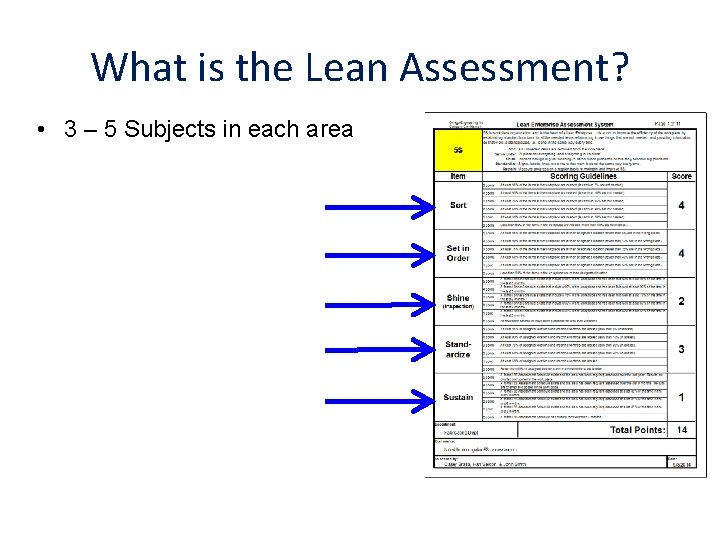
What is the Lean Assessment? • 3 – 5 Subjects in each area
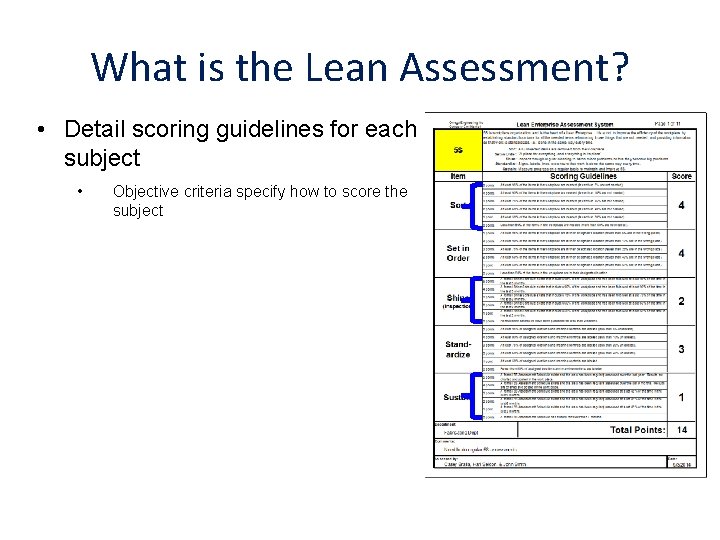
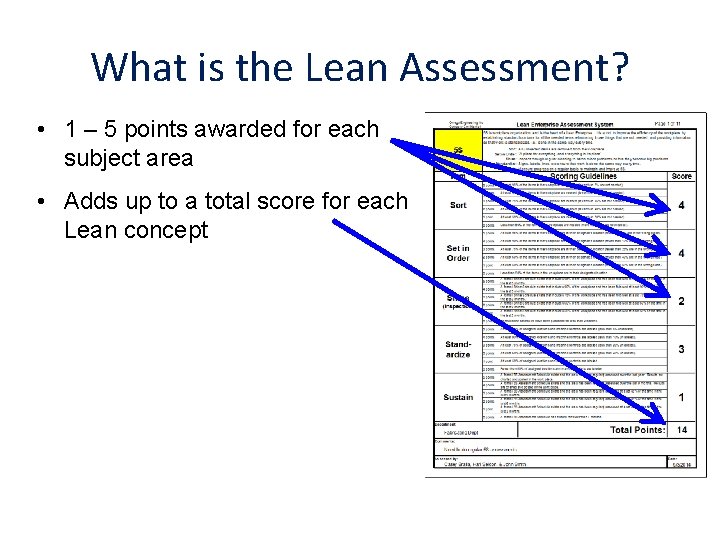
What is the Lean Assessment? • Detail scoring guidelines for each subject • Objective criteria specify how to score the subject
What is the Lean Assessment? • 1 – 5 points awarded for each subject area • Adds up to a total score for each Lean concept
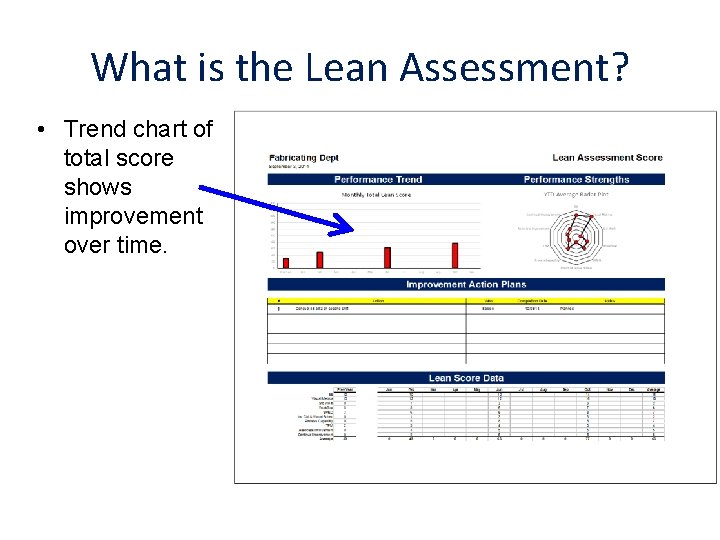
What is the Lean Assessment? • Trend chart of total score shows improvement over time.
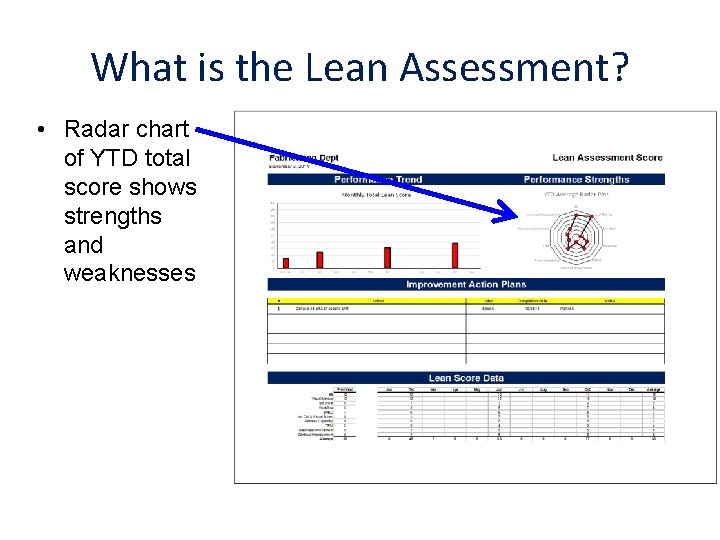
What is the Lean Assessment? • Radar chart of YTD total score shows strengths and weaknesses
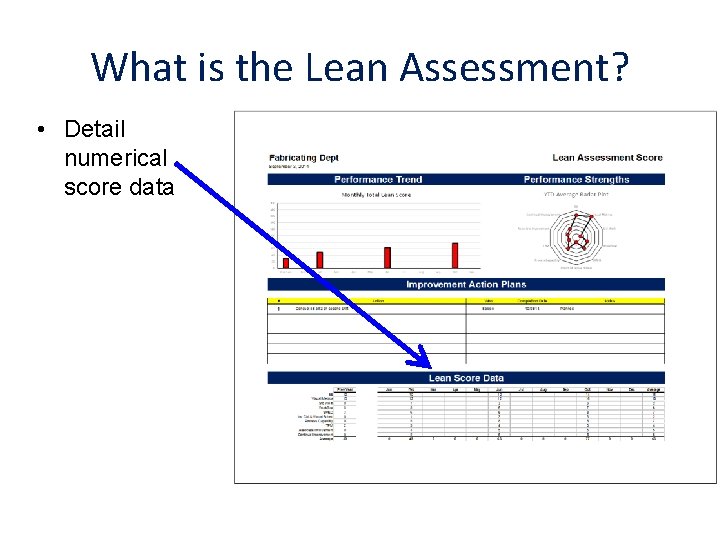
What is the Lean Assessment? • Detail numerical score data
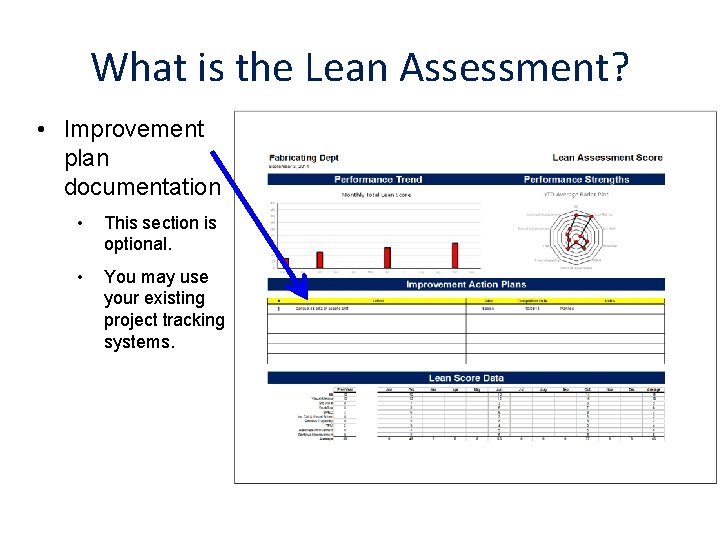
What is the Lean Assessment? • Improvement plan documentation • This section is optional. • You may use your existing project tracking systems.
Why Assess Lean Performance? • “Whatever you measure gets better. ” • Teaches Lean concepts to operating managers. • Drives improvements in a gentle, positive way. • Makes incremental improvements easy to identify and plan. • Provides self-imposed competitive pressure to improve. • Publicizes the need for Lean activities and helps build a Lean culture.
How the Results are Used • Gathered for each manufacturing site. • Posted in a public location, inviting questions and comments from all associates. • Discussed in communication meetings. • Like all Lean communication, the emphasis will be on positive news: • Who improved the most. • Praise for the (expected) continual improvement.
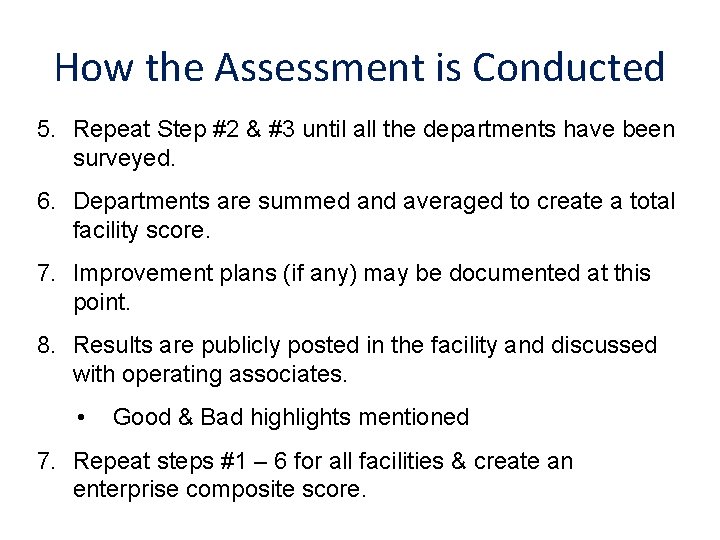
How the Assessment is Conducted 1. Break a facility into its “natural” pieces (usually its departments). 2. Form a Team to conduct the assessment • Local Management • Local Lean Champion • Outside auditor 3. The Team tours the department and reviews: • 5 S • Metrics • Process Flow Controls • etc. 4. Team reads through the scoring guidelines and assigns scores based on the current, observed conditions.
How the Assessment is Conducted 5. Repeat Step #2 & #3 until all the departments have been surveyed. 6. Departments are summed and averaged to create a total facility score. 7. Improvement plans (if any) may be documented at this point. 8. Results are publicly posted in the facility and discussed with operating associates. • Good & Bad highlights mentioned 7. Repeat steps #1 – 6 for all facilities & create an enterprise composite score.
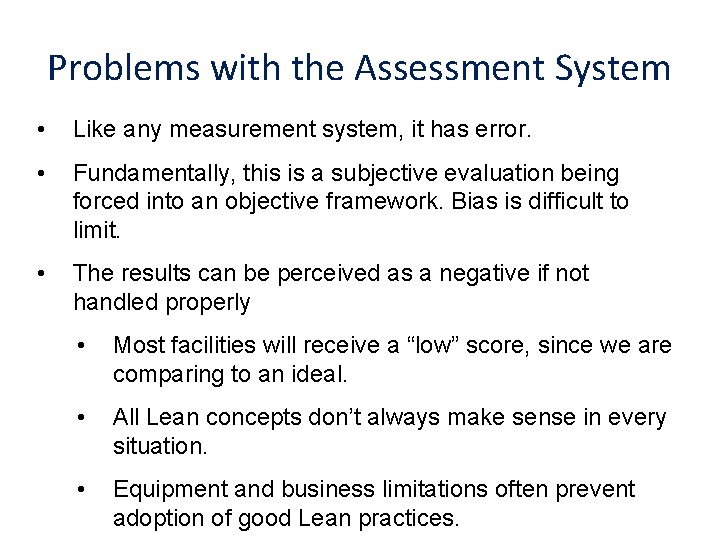
Problems with the Assessment System • Like any measurement system, it has error. • Fundamentally, this is a subjective evaluation being forced into an objective framework. Bias is difficult to limit. • The results can be perceived as a negative if not handled properly • Most facilities will receive a “low” score, since we are comparing to an ideal. • All Lean concepts don’t always make sense in every situation. • Equipment and business limitations often prevent adoption of good Lean practices.
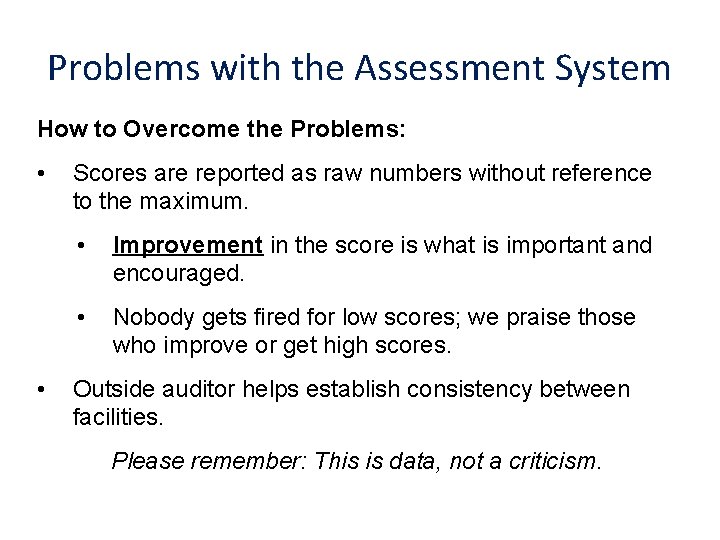
Problems with the Assessment System How to Overcome the Problems: • • Scores are reported as raw numbers without reference to the maximum. • Improvement in the score is what is important and encouraged. • Nobody gets fired for low scores; we praise those who improve or get high scores. Outside auditor helps establish consistency between facilities. Please remember: This is data, not a criticism.
Areas of Assessment 1. 5 S 2. Visual Metrics 3. Standard Work 4. Work Flow 5. Quick Changeover 6. Inventory Control & Visual Scheduling 7. Process Capability 8. Total Productive Maintenance 9. Associate Involvement 10. Continual Improvement
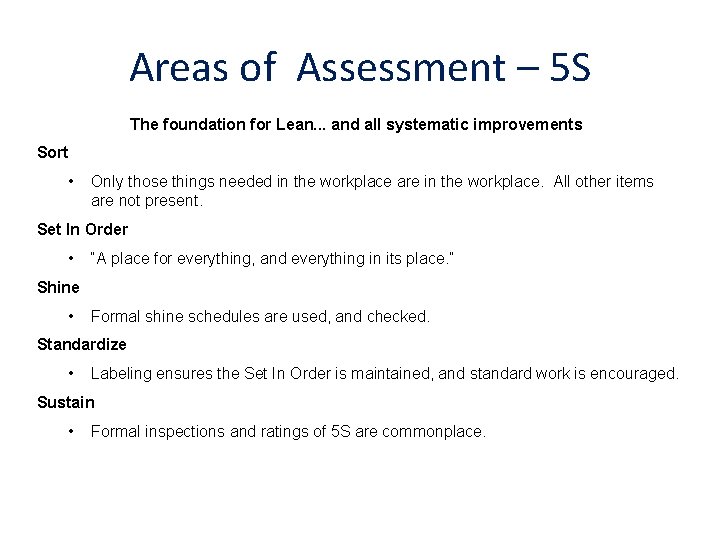
Areas of Assessment – 5 S The foundation for Lean. . . and all systematic improvements Sort • Only those things needed in the workplace are in the workplace. All other items are not present. Set In Order • “A place for everything, and everything in its place. ” Shine • Formal shine schedules are used, and checked. Standardize • Labeling ensures the Set In Order is maintained, and standard work is encouraged. Sustain • Formal inspections and ratings of 5 S are commonplace.
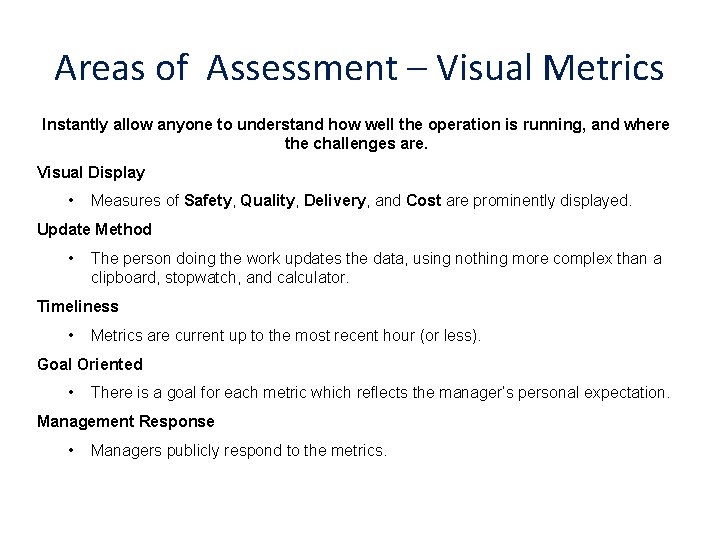
Areas of Assessment – Visual Metrics Instantly allow anyone to understand how well the operation is running, and where the challenges are. Visual Display • Measures of Safety, Quality, Delivery, and Cost are prominently displayed. Update Method • The person doing the work updates the data, using nothing more complex than a clipboard, stopwatch, and calculator. Timeliness • Metrics are current up to the most recent hour (or less). Goal Oriented • There is a goal for each metric which reflects the manager’s personal expectation. Management Response • Managers publicly respond to the metrics.
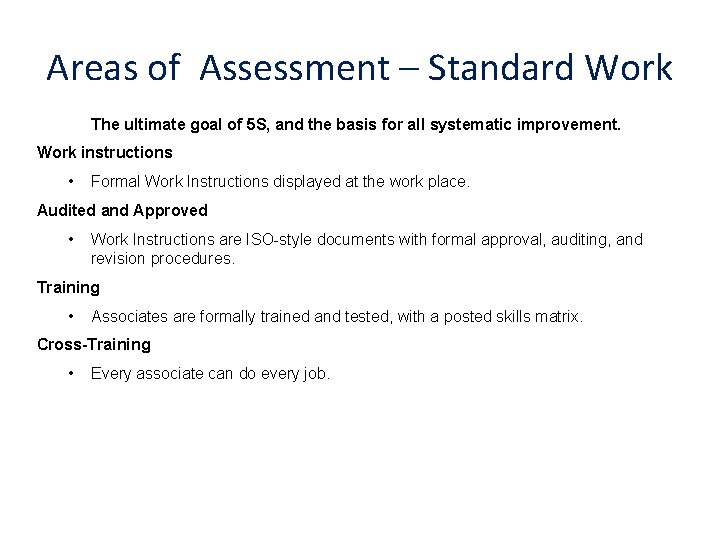
Areas of Assessment – Standard Work The ultimate goal of 5 S, and the basis for all systematic improvement. Work instructions • Formal Work Instructions displayed at the work place. Audited and Approved • Work Instructions are ISO-style documents with formal approval, auditing, and revision procedures. Training • Associates are formally trained and tested, with a posted skills matrix. Cross-Training • Every associate can do every job.
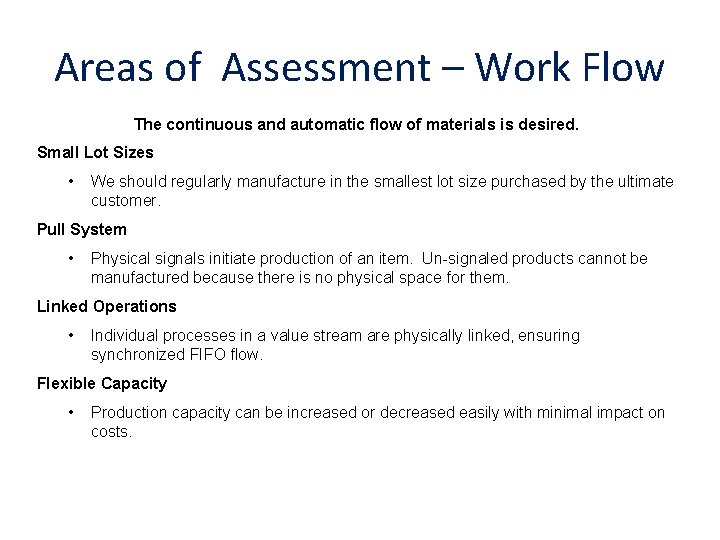
Areas of Assessment – Work Flow The continuous and automatic flow of materials is desired. Small Lot Sizes • We should regularly manufacture in the smallest lot size purchased by the ultimate customer. Pull System • Physical signals initiate production of an item. Un-signaled products cannot be manufactured because there is no physical space for them. Linked Operations • Individual processes in a value stream are physically linked, ensuring synchronized FIFO flow. Flexible Capacity • Production capacity can be increased or decreased easily with minimal impact on costs.
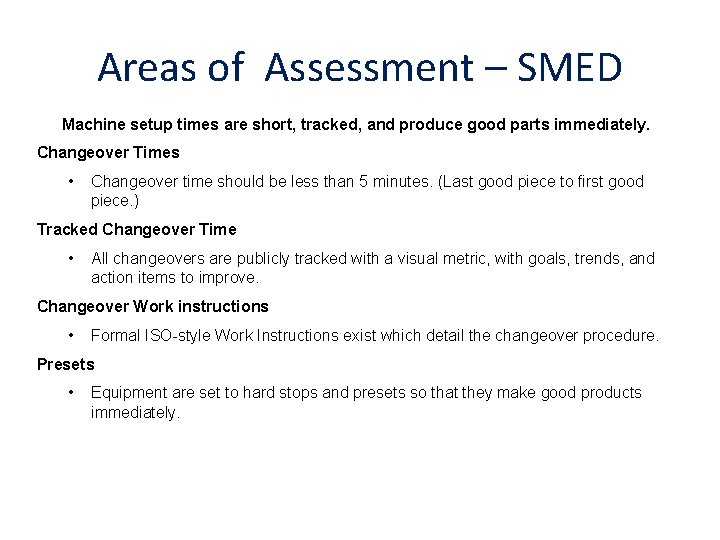
Areas of Assessment – SMED Machine setup times are short, tracked, and produce good parts immediately. Changeover Times • Changeover time should be less than 5 minutes. (Last good piece to first good piece. ) Tracked Changeover Time • All changeovers are publicly tracked with a visual metric, with goals, trends, and action items to improve. Changeover Work instructions • Formal ISO-style Work Instructions exist which detail the changeover procedure. Presets • Equipment are set to hard stops and presets so that they make good products immediately.
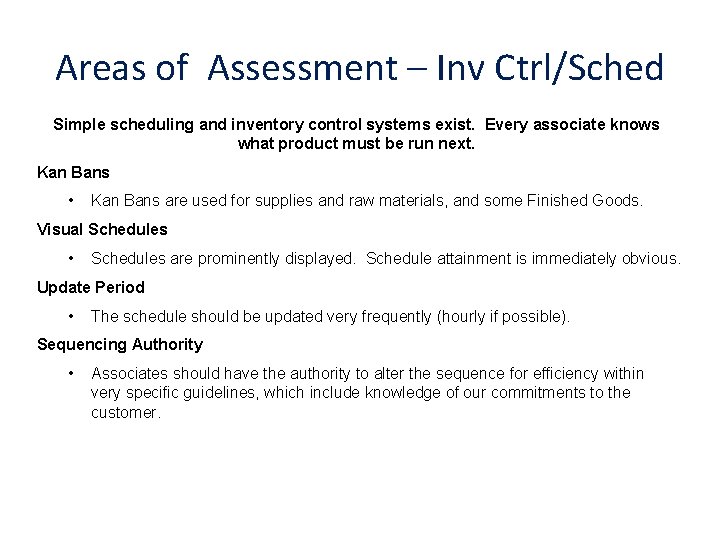
Areas of Assessment – Inv Ctrl/Sched Simple scheduling and inventory control systems exist. Every associate knows what product must be run next. Kan Bans • Kan Bans are used for supplies and raw materials, and some Finished Goods. Visual Schedules • Schedules are prominently displayed. Schedule attainment is immediately obvious. Update Period • The schedule should be updated very frequently (hourly if possible). Sequencing Authority • Associates should have the authority to alter the sequence for efficiency within very specific guidelines, which include knowledge of our commitments to the customer.
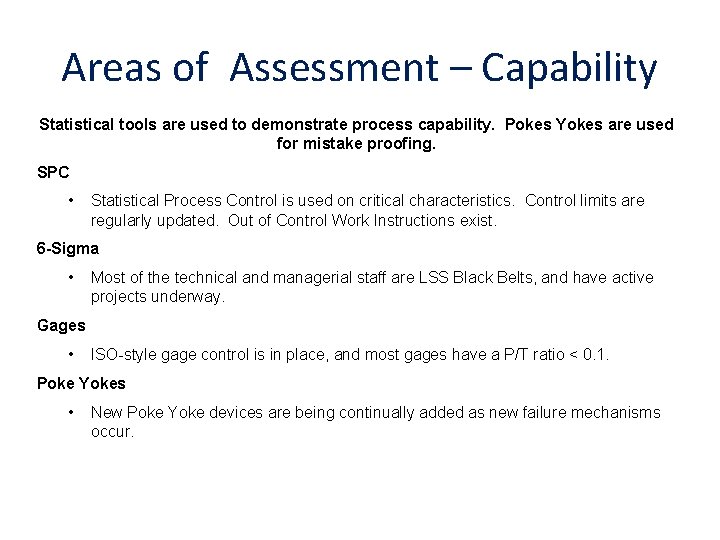
Areas of Assessment – Capability Statistical tools are used to demonstrate process capability. Pokes Yokes are used for mistake proofing. SPC • Statistical Process Control is used on critical characteristics. Control limits are regularly updated. Out of Control Work Instructions exist. 6 -Sigma • Most of the technical and managerial staff are LSS Black Belts, and have active projects underway. Gages • ISO-style gage control is in place, and most gages have a P/T ratio < 0. 1. Poke Yokes • New Poke Yoke devices are being continually added as new failure mechanisms occur.
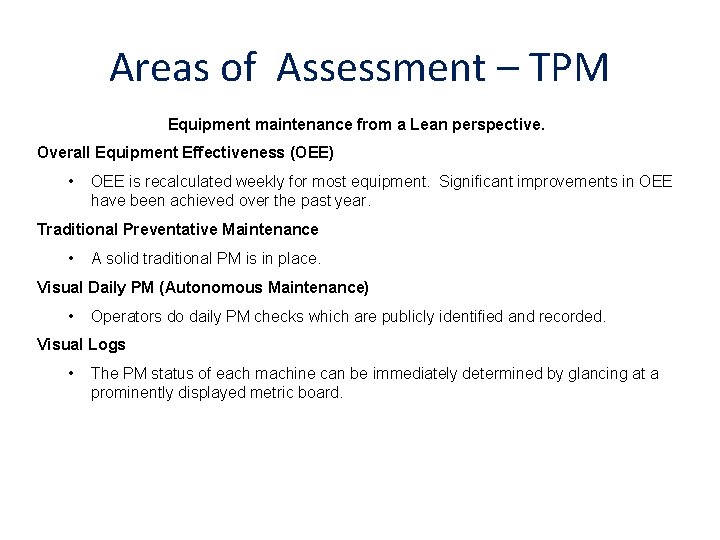
Areas of Assessment – TPM Equipment maintenance from a Lean perspective. Overall Equipment Effectiveness (OEE) • OEE is recalculated weekly for most equipment. Significant improvements in OEE have been achieved over the past year. Traditional Preventative Maintenance • A solid traditional PM is in place. Visual Daily PM (Autonomous Maintenance) • Operators do daily PM checks which are publicly identified and recorded. Visual Logs • The PM status of each machine can be immediately determined by glancing at a prominently displayed metric board.
Areas of Assessment – Involvement We want a “Lean Culture”. Associates are continually and actively working on Lean improvements, with minimal managerial oversight. LSS Training • Extensive formal training has been given to all associates. Kaizen Blitz Events • Blitz events occur regularly, and have included a very large majority of the associates. Improvement Projects • Most associate have completed a Lean project within the last year. These projects are documented and posted on communication boards. Gifts of nominal valued are given to some participants.
Areas of Assessment – Improvement Lean enterprises continually improve in Labor, Quality, and Inventory. This is a catch-all for any improvements not driven by capital investment. Labor Improvements • Significant improvements in Labor effectiveness should have been achieved over the past year. Quality Improvement • Significant improvements in quality should have been achieved over the past year. Inventory Improvements • Significant reductions in total inventory (measured in “days”) should have been achieved over the past year.
Departments to be Assessed Discussion: What departments to assess?
The End Any Questions
The End Thank You!
Discussion The Lean Vision