
Leakage Impedance of Transformer Windings Prof Giorgio Spiazzi
![LF Current Distribution in Windings Pa Sa Sb Pb F=NI Energy density [J/m] Multiple](https://slidetodoc.com/presentation_image_h/de47d48132366d3c576cda9f90a41746/image-13.jpg "LF Current Distribution in Windings Pa Sa Sb Pb F=NI Energy density [J/m] Multiple")
- Slides: 70
Leakage Impedance of Transformer Windings Prof. Giorgio Spiazzi Dept. Of Information Engineering – DEI University of Padova
Leakage Impedance of Transformer Windings Ref. : P. L. Dowell, “Effects of Eddy Currents in Transformer Windings, ” Proc. of IEE, Vol. 13, No. 8, August 1966, pp. 1387 -1394. Outline: • High Frequency induced effects on transformer windings • Qualitative analysis of transformer winding leakage impedance • Quantitative analysis of transformer winding leakage impedance • Dowell curves • Examples
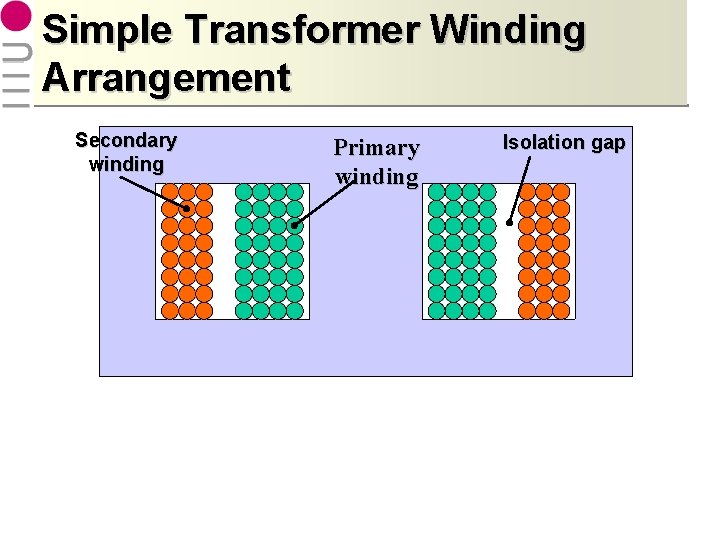
Simple Transformer Winding Arrangement Secondary winding Primary winding Isolation gap
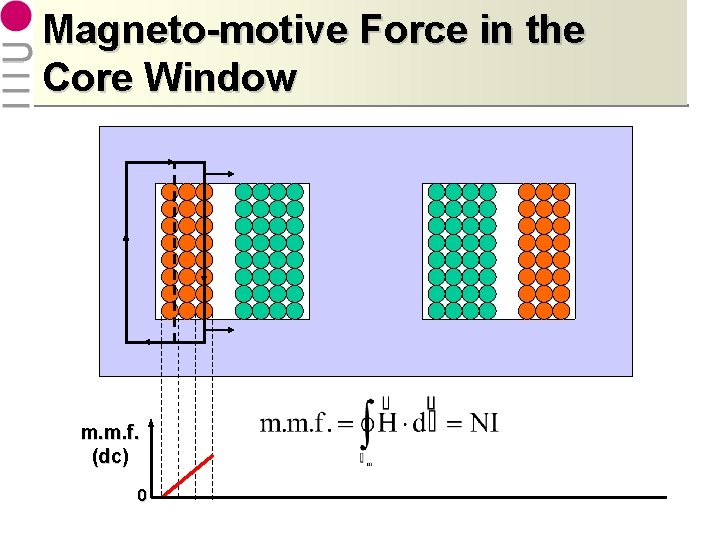
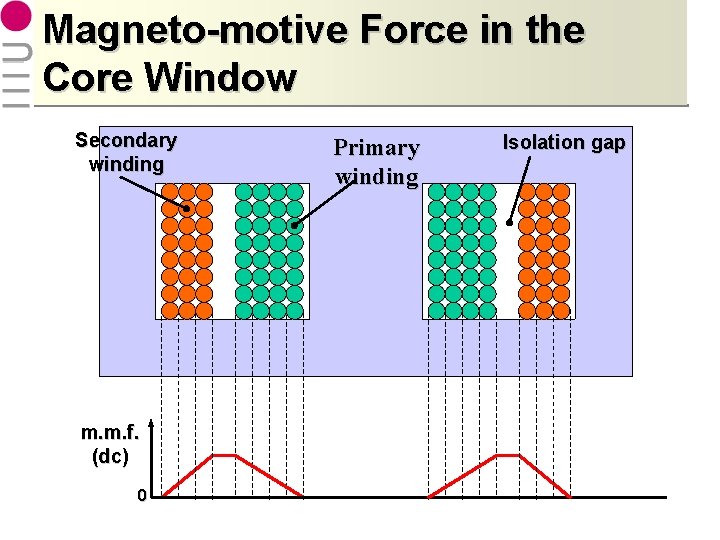
Magneto-motive Force in the Core Window m. m. f. (dc) 0
Magneto-motive Force in the Core Window Secondary winding m. m. f. (dc) 0 Primary winding Isolation gap
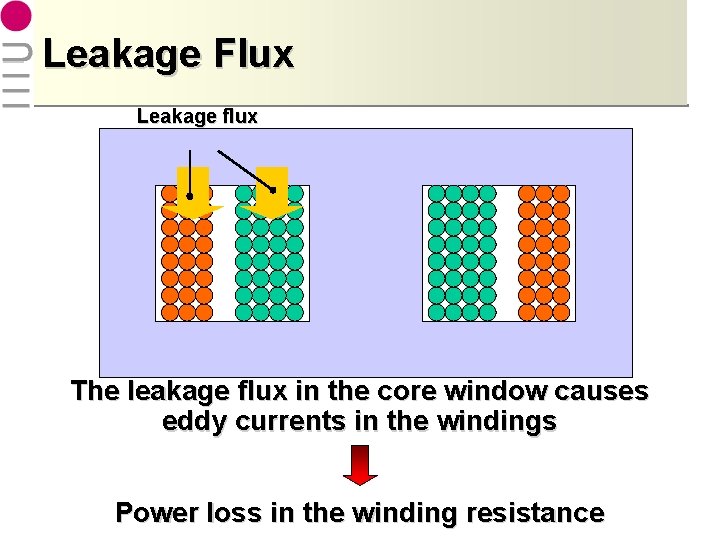
Leakage Flux Leakage flux The leakage flux in the core window causes eddy currents in the windings Power loss in the winding resistance
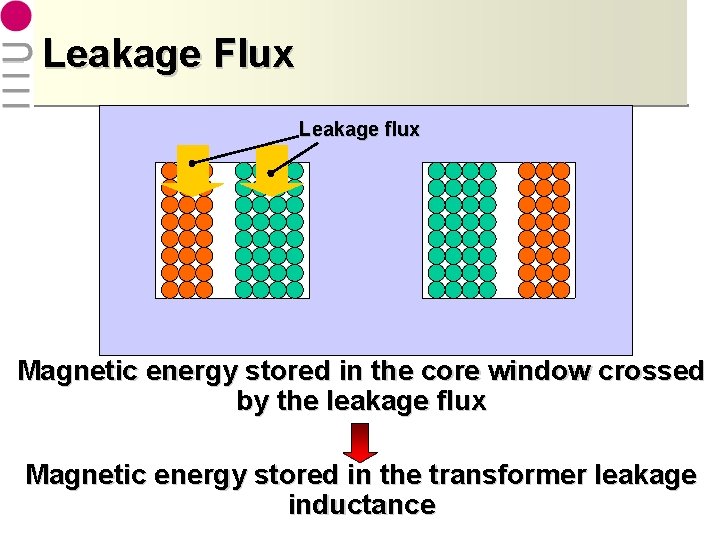
Leakage Flux Leakage flux Magnetic energy stored in the core window crossed by the leakage flux Magnetic energy stored in the transformer leakage inductance
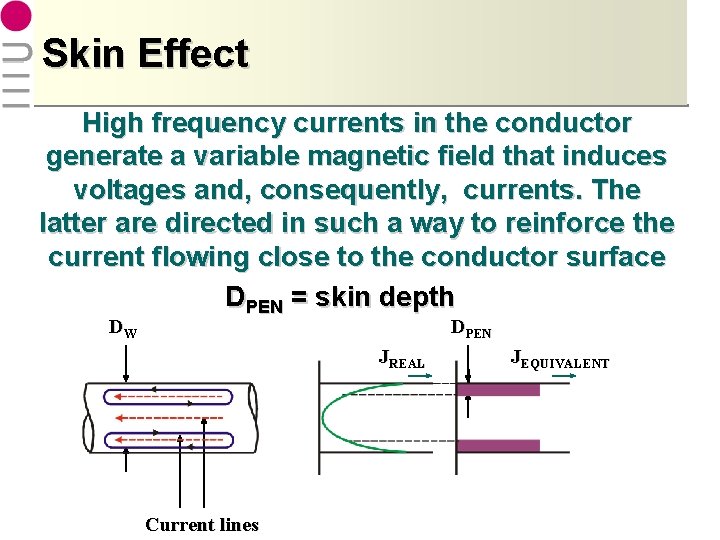
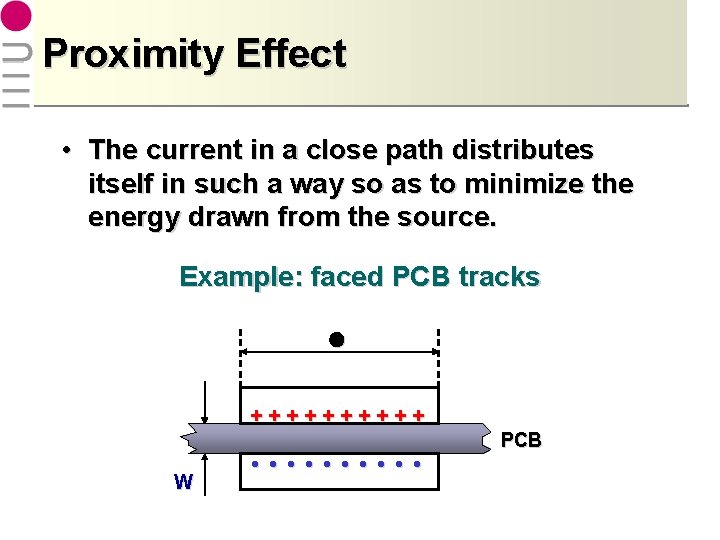
Skin Effect High frequency currents in the conductor generate a variable magnetic field that induces voltages and, consequently, currents. The latter are directed in such a way to reinforce the current flowing close to the conductor surface DPEN = skin depth DW DPEN JREAL Current lines JEQUIVALENT
Proximity Effect • The current in a close path distributes itself in such a way so as to minimize the energy drawn from the source. Example: faced PCB tracks +++++ PCB W • • •
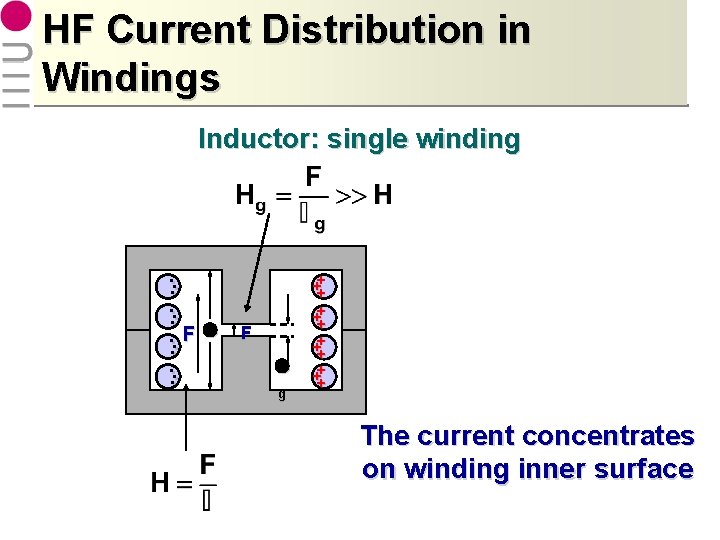
HF Current Distribution in Windings Inductor: single winding . . . F . . F g ++ + The current concentrates on winding inner surface
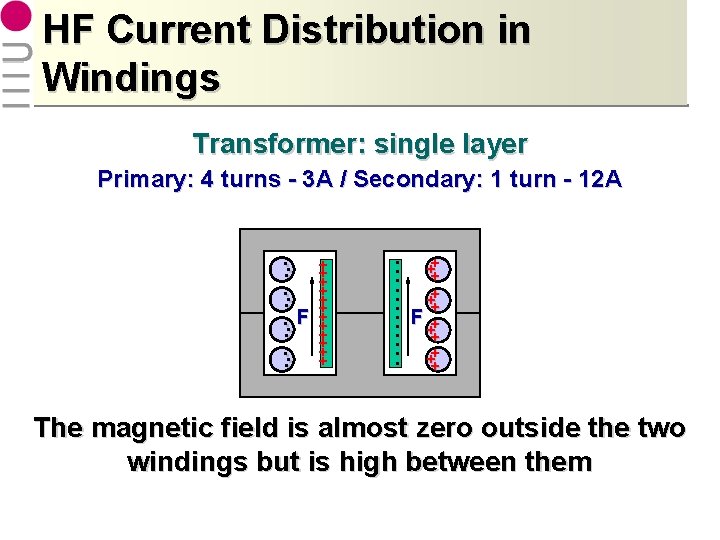
HF Current Distribution in Windings Transformer: single layer Primary: 4 turns - 3 A / Secondary: 1 turn - 12 A . . . F. . + + + . . . . F. . ++ + The magnetic field is almost zero outside the two windings but is high between them
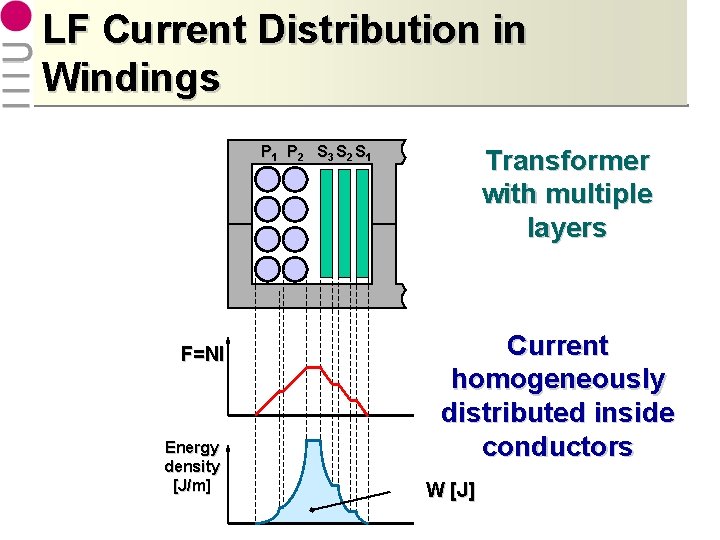
LF Current Distribution in Windings P 1 P 2 S 3 S 2 S 1 F=NI Energy density [J/m] Transformer with multiple layers Current homogeneously distributed inside conductors W [J]
LF Current Distribution in Windings Pa Sa Sb Pb F=NI Energy density [J/m] Multiple winding transformer with interleaved primary/secondary windings Reduced leakage inductance W [J]
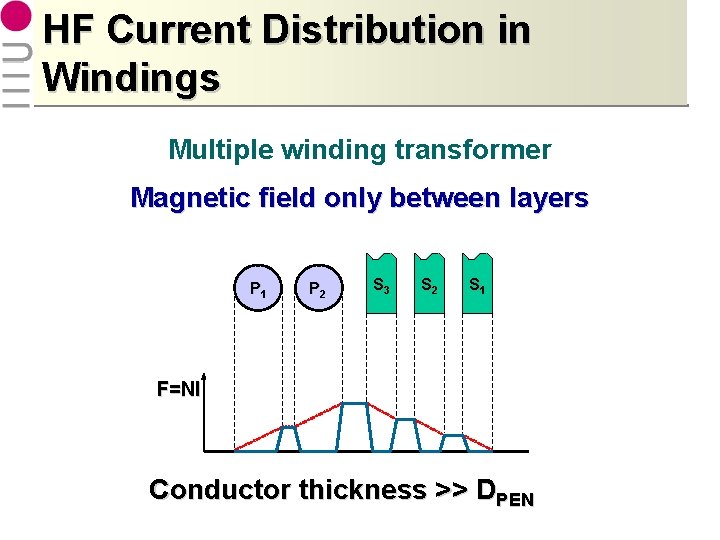
HF Current Distribution in Windings Multiple winding transformer Magnetic field only between layers P 1 P 2 S 3 S 2 S 1 F=NI Conductor thickness >> DPEN
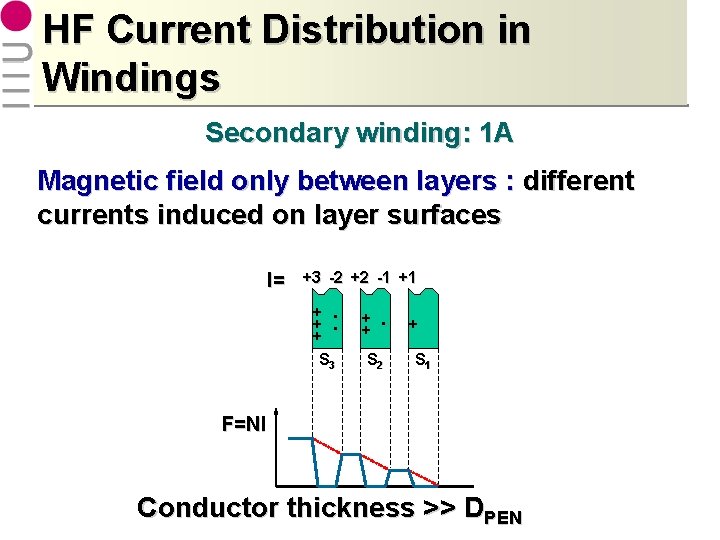
HF Current Distribution in Windings Secondary winding: 1 A Magnetic field only between layers : different currents induced on layer surfaces I= +3 -2 +2 -1 +1 + + + . . . S 3 + + S 2 + S 1 F=NI Conductor thickness >> DPEN
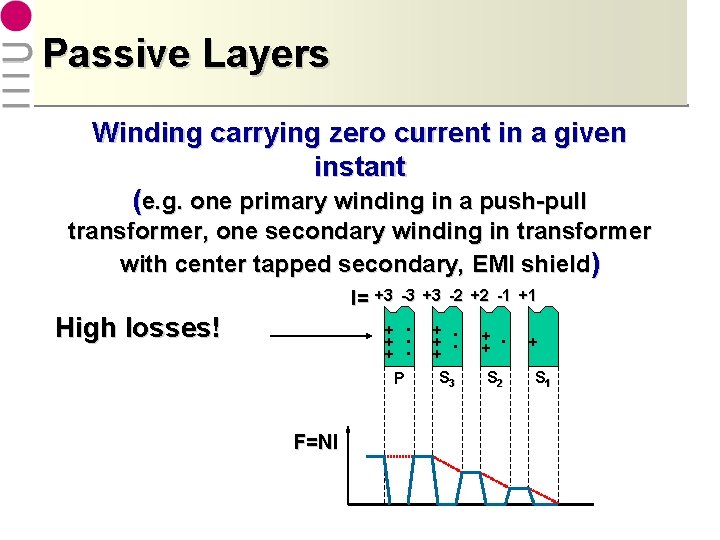
Passive Layers Winding carrying zero current in a given instant (e. g. one primary winding in a push-pull transformer, one secondary winding in transformer with center tapped secondary, EMI shield) I= +3 High losses! + + + -3 +3 -2 +2 -1 +1 . . . P F=NI + + + S 3 + + S 2 + S 1
Leakage Impedance The leakage flux crossing a winding layer determines both its ac leakage resistance and inductance When considering the leakage impedance due to a particular layer, it is necessary to consider the other layers of the windings insofar as they affect the flux in the layer being considered
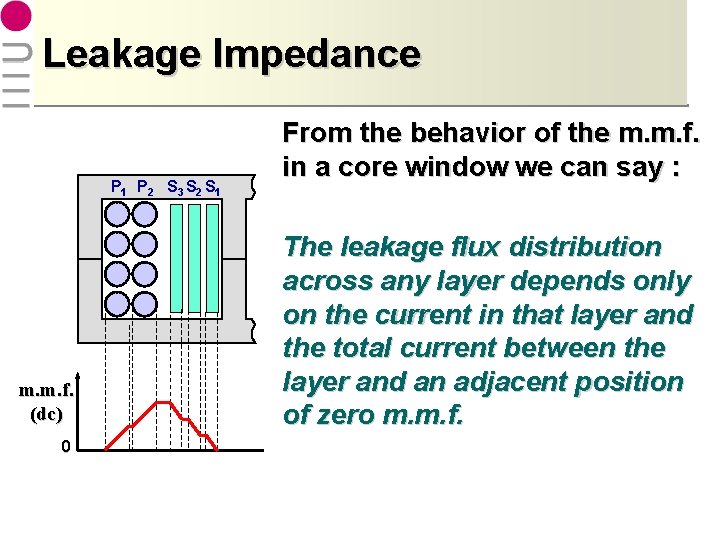
Leakage Impedance P 1 P 2 S 3 S 2 S 1 m. m. f. (dc) 0 From the behavior of the m. m. f. in a core window we can say : The leakage flux distribution across any layer depends only on the current in that layer and the total current between the layer and an adjacent position of zero m. m. f.
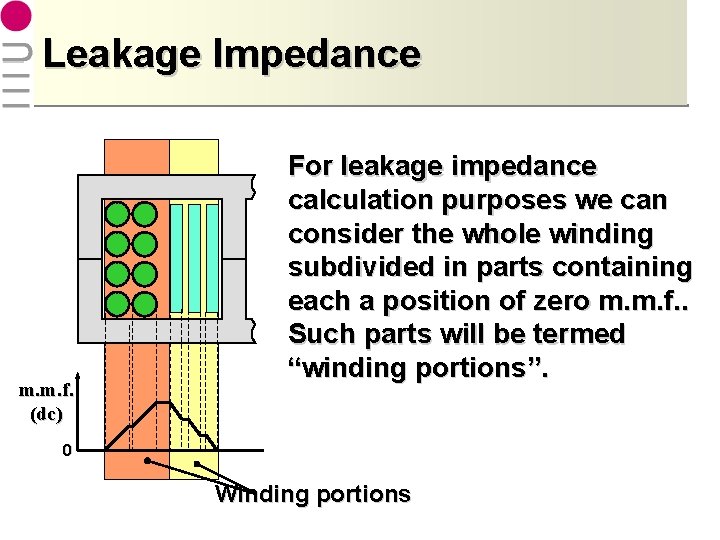
Leakage Impedance m. m. f. (dc) For leakage impedance calculation purposes we can consider the whole winding subdivided in parts containing each a position of zero m. m. f. . Such parts will be termed “winding portions”. 0 Winding portions
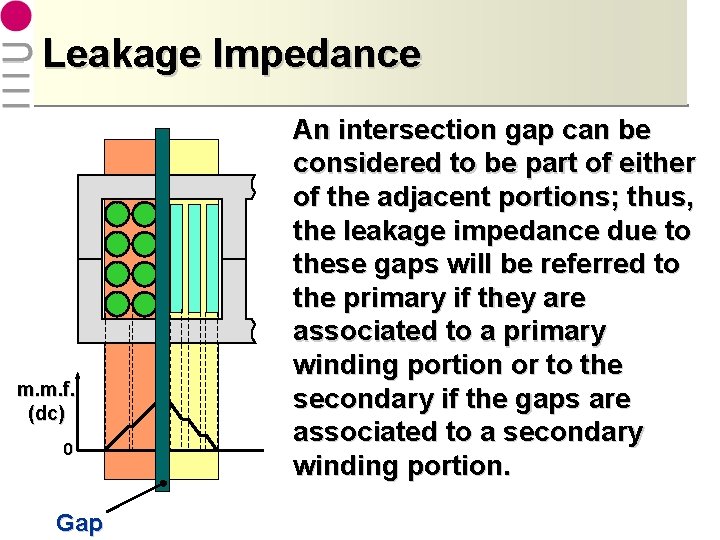
Leakage Impedance m. m. f. (dc) 0 Gap An intersection gap can be considered to be part of either of the adjacent portions; thus, the leakage impedance due to these gaps will be referred to the primary if they are associated to a primary winding portion or to the secondary if the gaps are associated to a secondary winding portion.
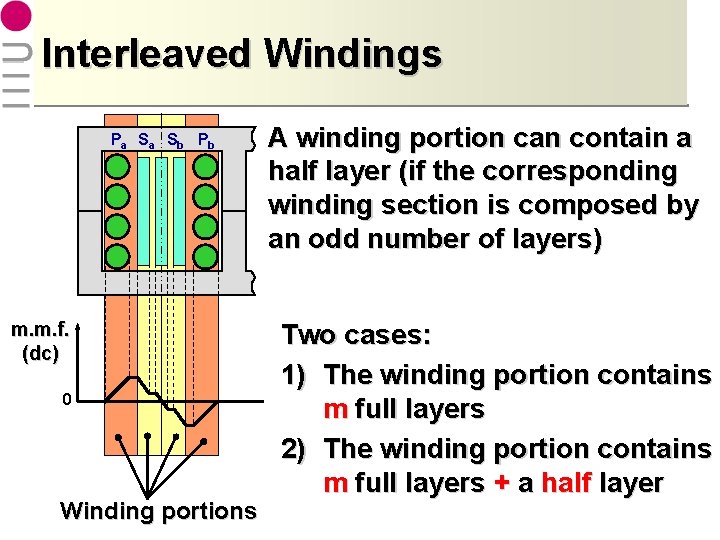
Interleaved Windings Pa Sa Sb Pb m. m. f. (dc) 0 Winding portions A winding portion can contain a half layer (if the corresponding winding section is composed by an odd number of layers) Two cases: 1) The winding portion contains m full layers 2) The winding portion contains m full layers + a half layer
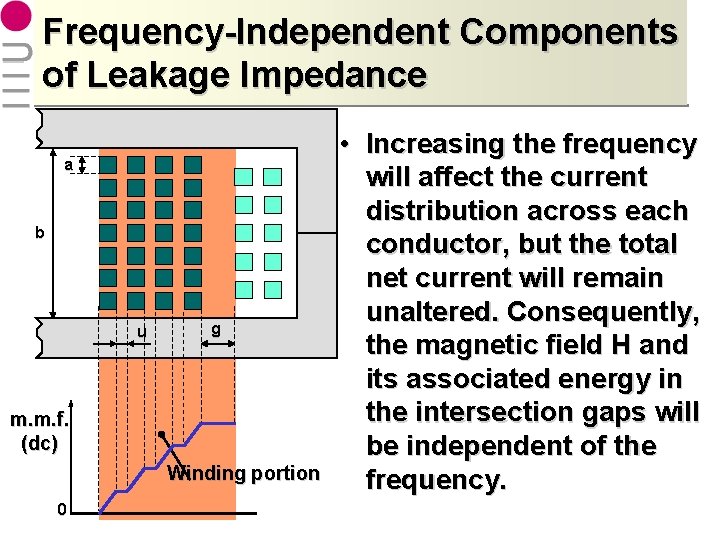
Frequency-Independent Components of Leakage Impedance a b u g m. m. f. (dc) Winding portion 0 • Increasing the frequency will affect the current distribution across each conductor, but the total net current will remain unaltered. Consequently, the magnetic field H and its associated energy in the intersection gaps will be independent of the frequency.
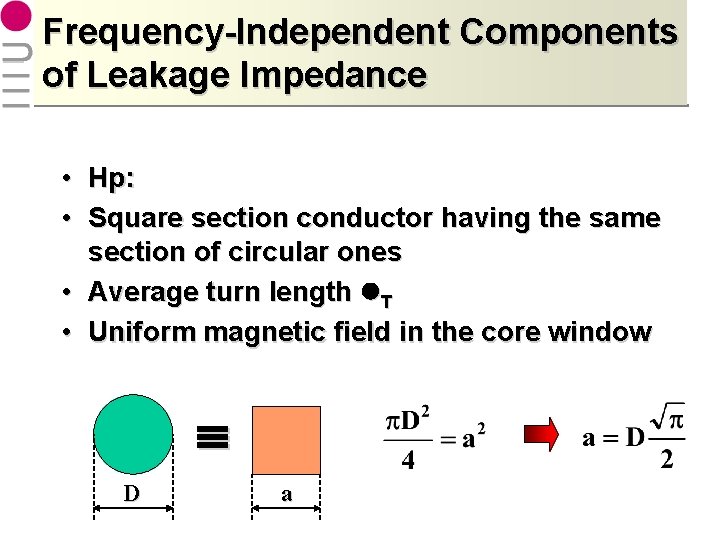
Frequency-Independent Components of Leakage Impedance • Hp: • Square section conductor having the same section of circular ones • Average turn length T • Uniform magnetic field in the core window D a
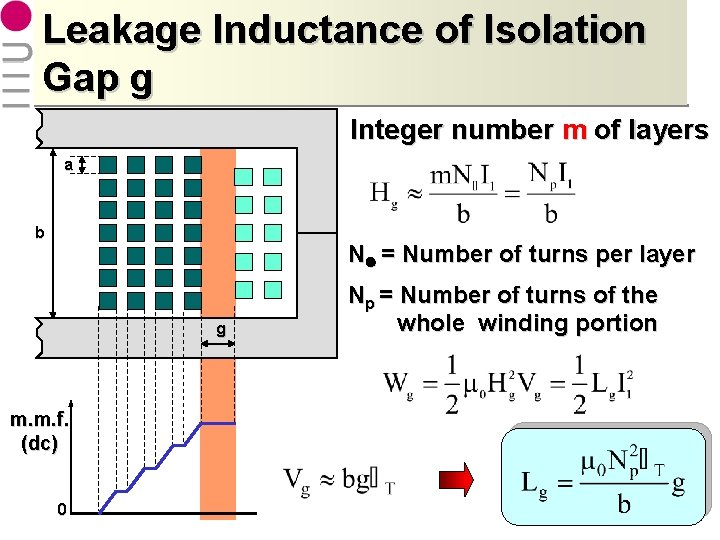
Leakage Inductance of Isolation Gap g Integer number m of layers a b N = Number of turns per layer g m. m. f. (dc) 0 Np = Number of turns of the whole winding portion
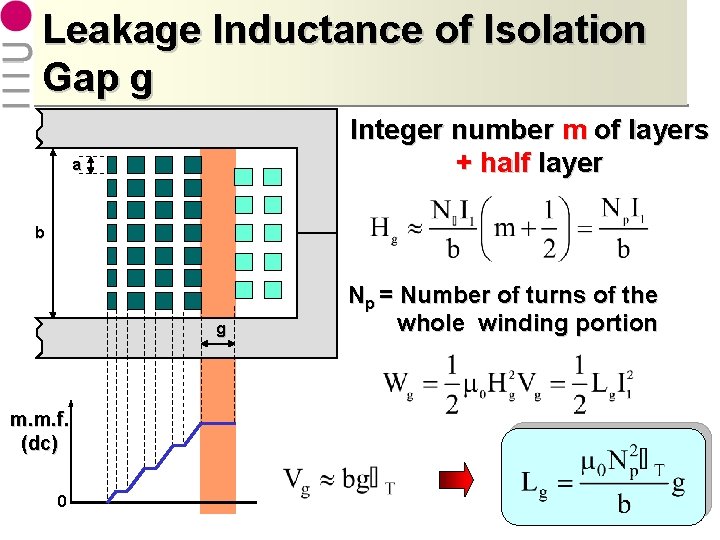
Leakage Inductance of Isolation Gap g Integer number m of layers + half layer a b g m. m. f. (dc) 0 Np = Number of turns of the whole winding portion
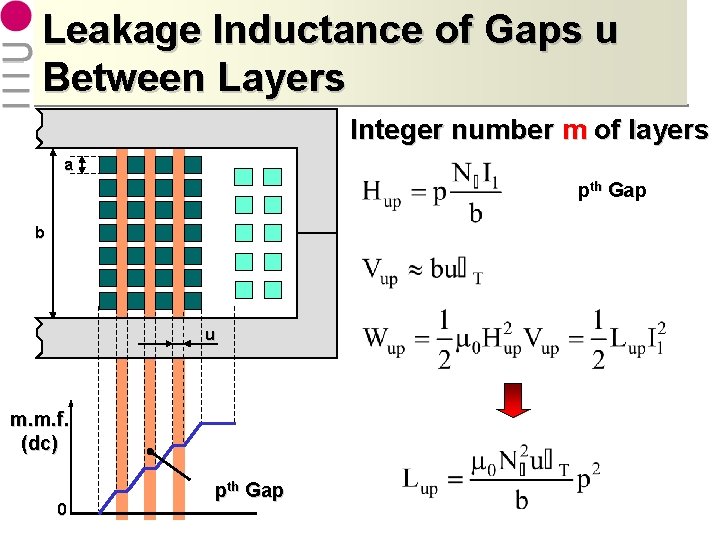
Leakage Inductance of Gaps u Between Layers Integer number m of layers a pth Gap b u m. m. f. (dc) 0 pth Gap
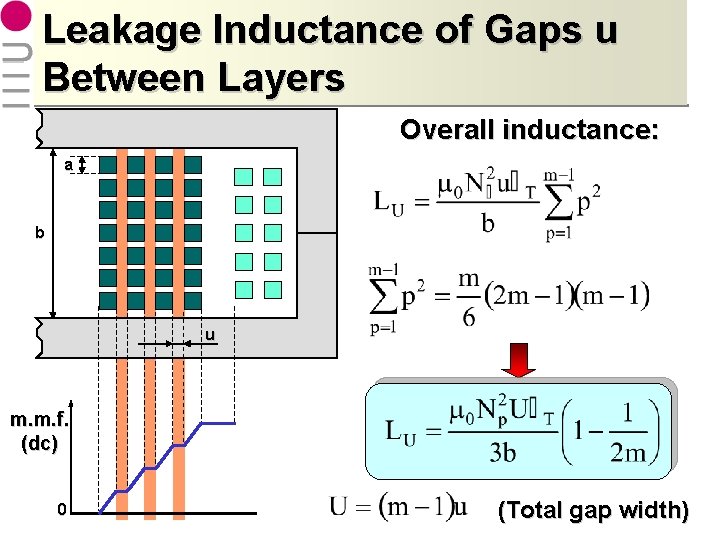
Leakage Inductance of Gaps u Between Layers Overall inductance: a b u m. m. f. (dc) 0 (Total gap width)
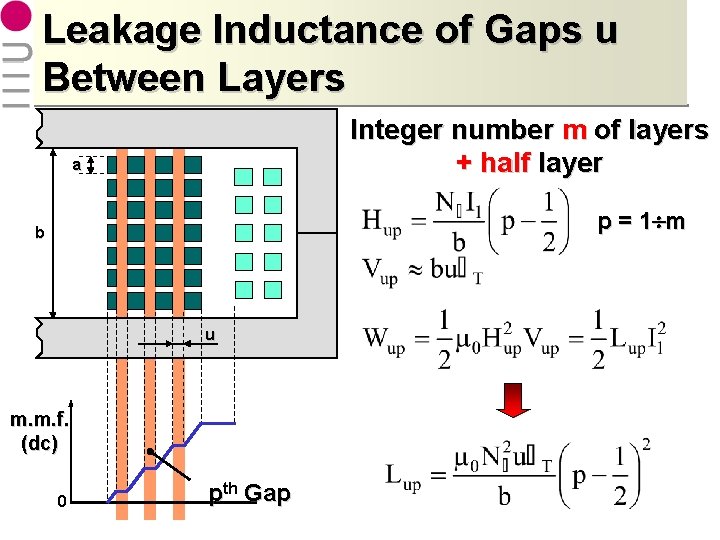
Leakage Inductance of Gaps u Between Layers Integer number m of layers + half layer a p = 1 m b u m. m. f. (dc) 0 pth Gap
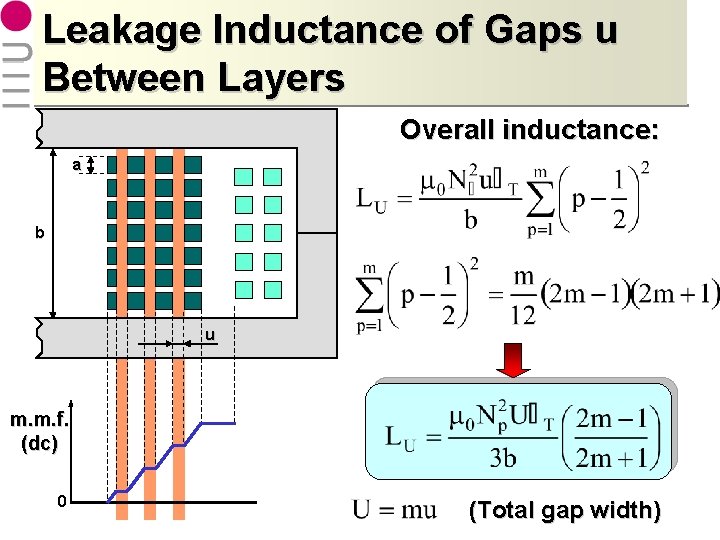
Leakage Inductance of Gaps u Between Layers Overall inductance: a b u m. m. f. (dc) 0 (Total gap width)
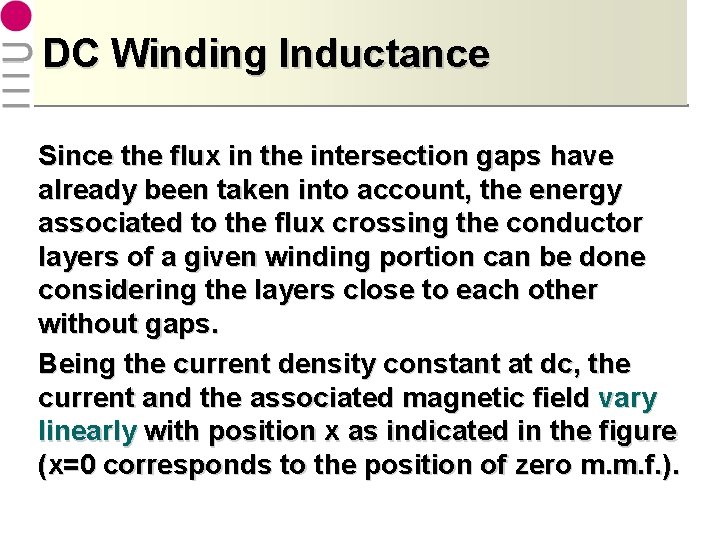
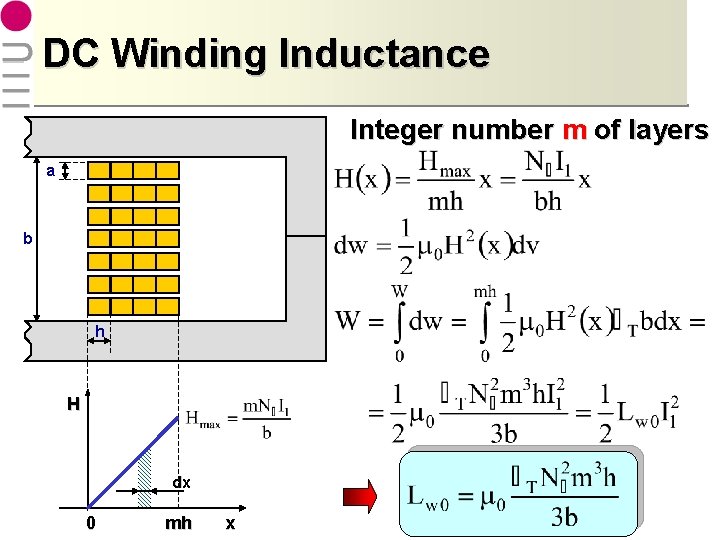
DC Winding Inductance Since the flux in the intersection gaps have already been taken into account, the energy associated to the flux crossing the conductor layers of a given winding portion can be done considering the layers close to each other without gaps. Being the current density constant at dc, the current and the associated magnetic field vary linearly with position x as indicated in the figure (x=0 corresponds to the position of zero m. m. f. ).
DC Winding Inductance Integer number m of layers a b h H dx 0 mh x
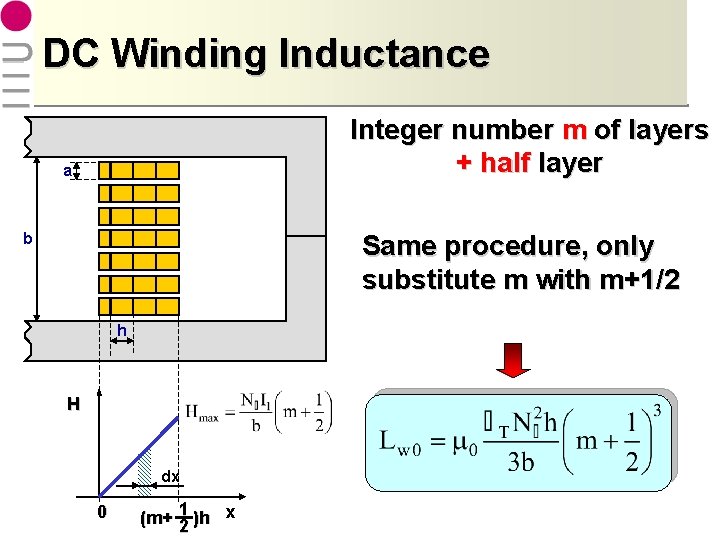
DC Winding Inductance Integer number m of layers + half layer a b Same procedure, only substitute m with m+1/2 h H dx 0 x (m+ 1 )h 2
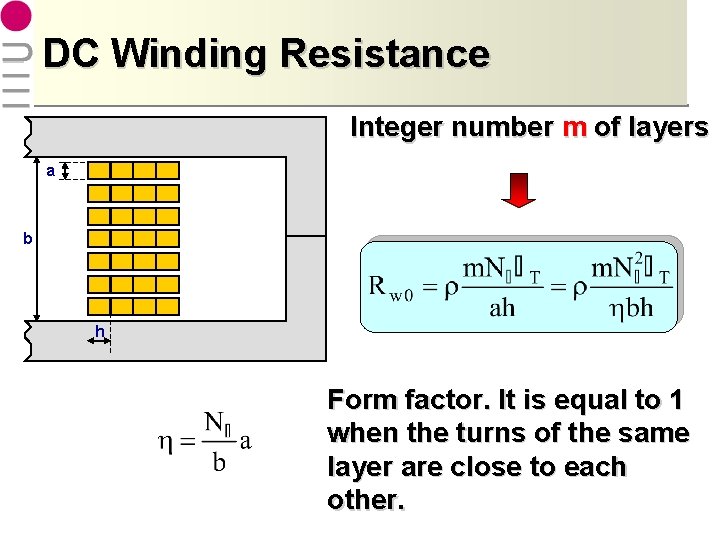
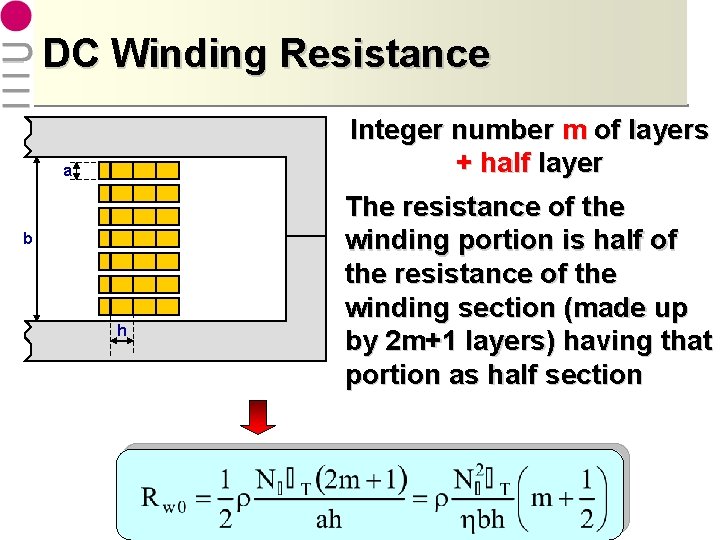
DC Winding Resistance Integer number m of layers a b h Form factor. It is equal to 1 when the turns of the same layer are close to each other.
DC Winding Resistance Integer number m of layers + half layer a b h The resistance of the winding portion is half of the resistance of the winding section (made up by 2 m+1 layers) having that portion as half section
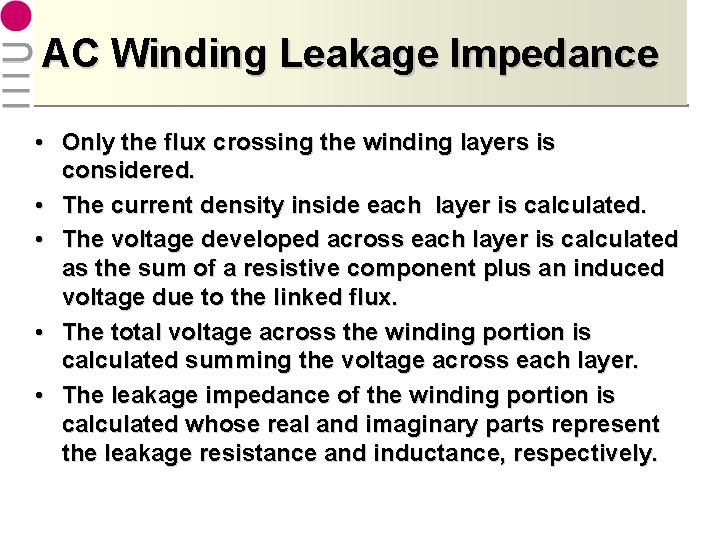
AC Winding Leakage Impedance • Only the flux crossing the winding layers is considered. • The current density inside each layer is calculated. • The voltage developed across each layer is calculated as the sum of a resistive component plus an induced voltage due to the linked flux. • The total voltage across the winding portion is calculated summing the voltage across each layer. • The leakage impedance of the winding portion is calculated whose real and imaginary parts represent the leakage resistance and inductance, respectively.
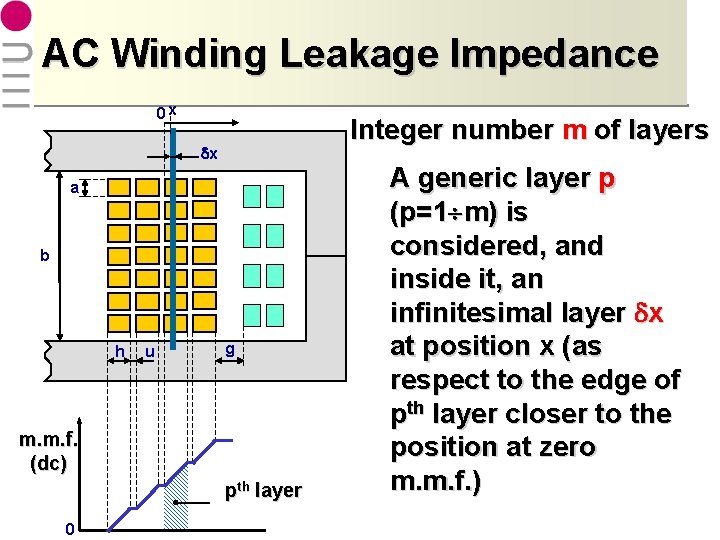
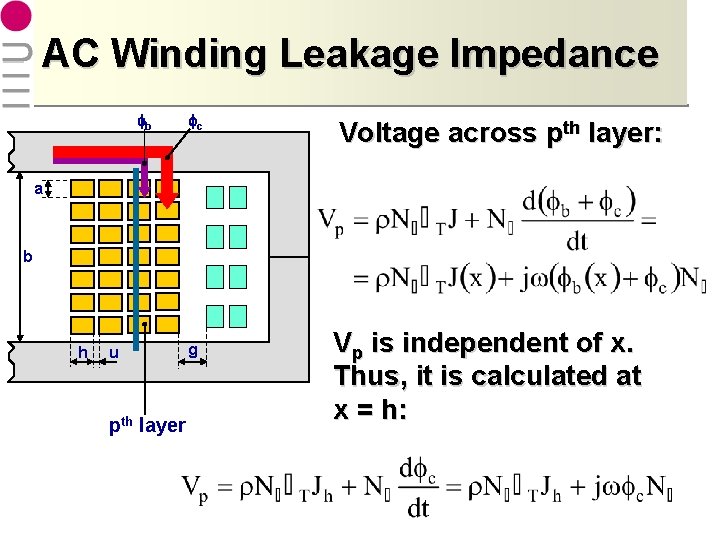
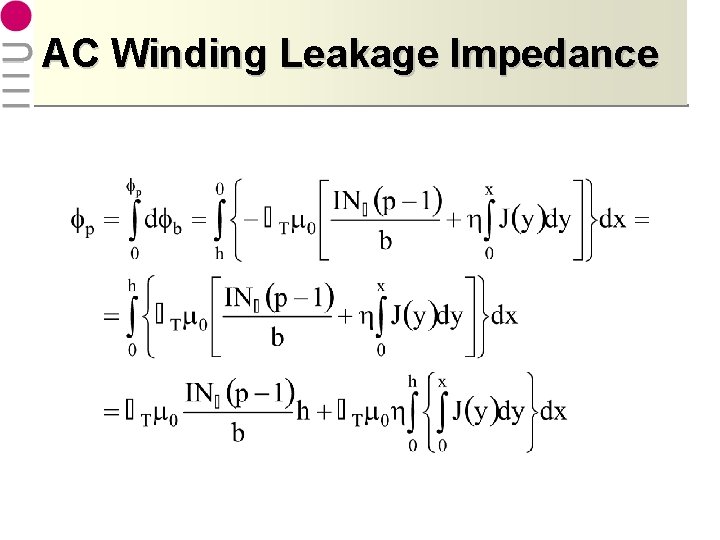
AC Winding Leakage Impedance 0 x Integer number m of layers dx a b h u g m. m. f. (dc) pth layer 0 A generic layer p (p=1 m) is considered, and inside it, an infinitesimal layer dx at position x (as respect to the edge of pth layer closer to the position at zero m. m. f. )
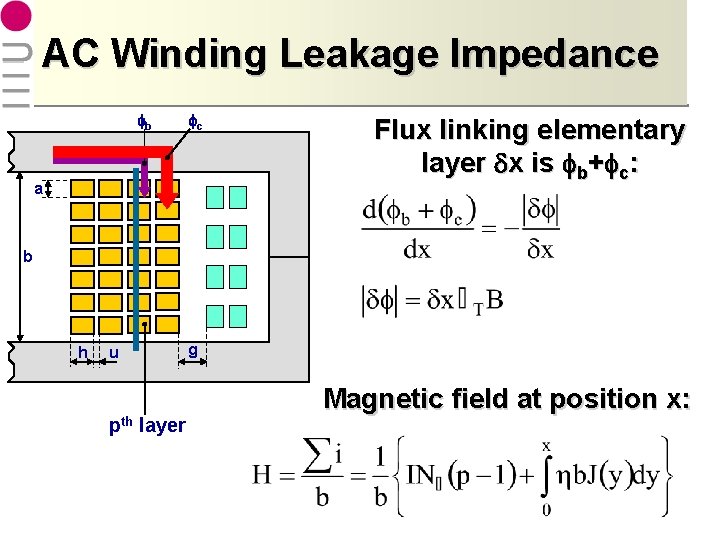
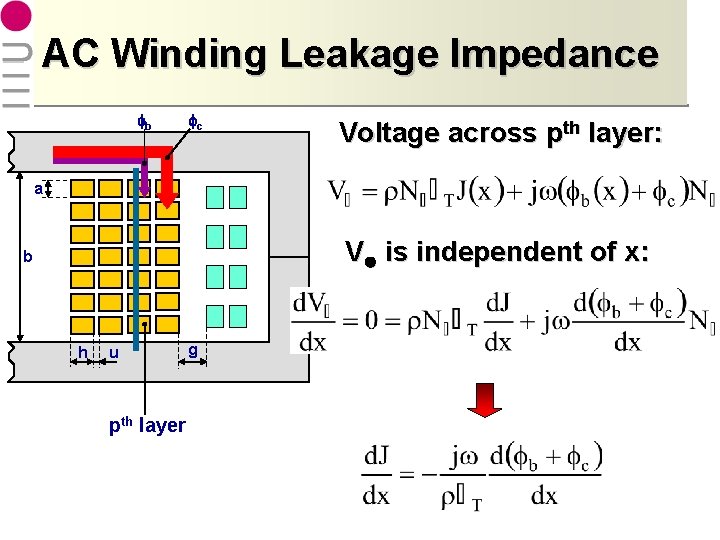
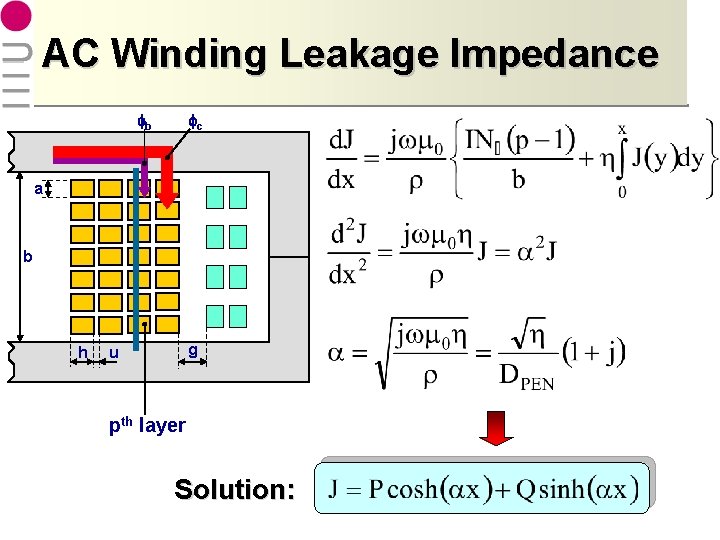
AC Winding Leakage Impedance fb fc a Flux linking elementary layer dx is fb+fc: b h u pth layer g Magnetic field at position x:
AC Winding Leakage Impedance fb fc Voltage across pth layer: a V is independent of x: b h u pth layer g
AC Winding Leakage Impedance fb fc a b h g u pth layer Solution:
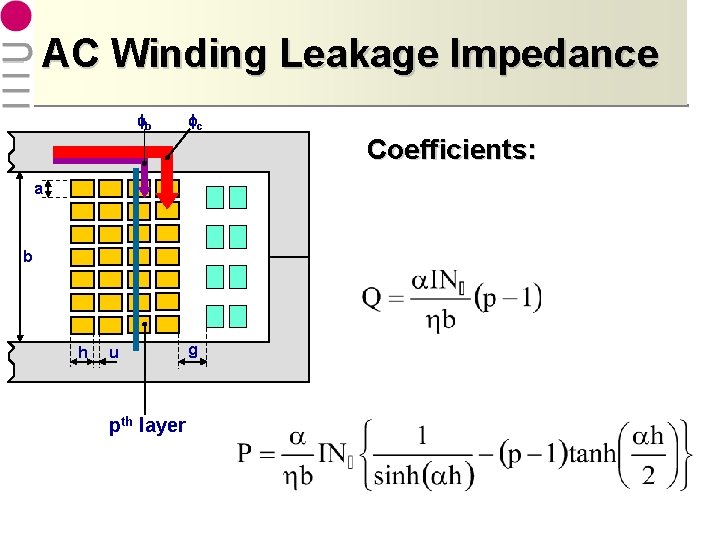
AC Winding Leakage Impedance fb fc Coefficients: a b h u pth layer g
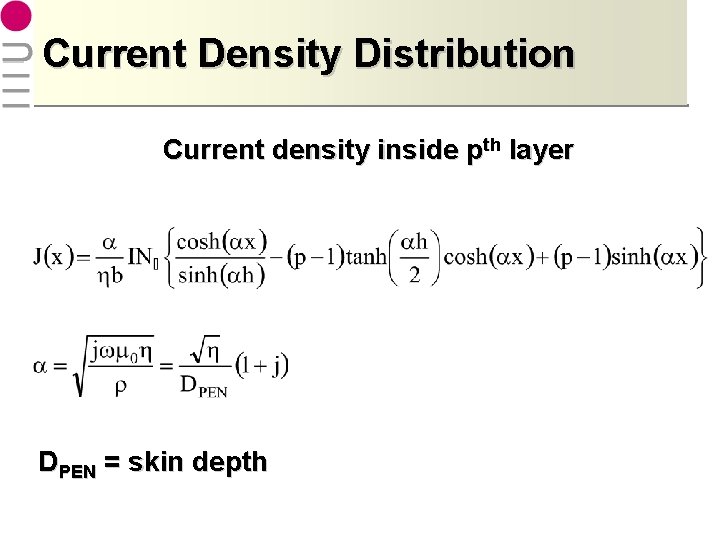
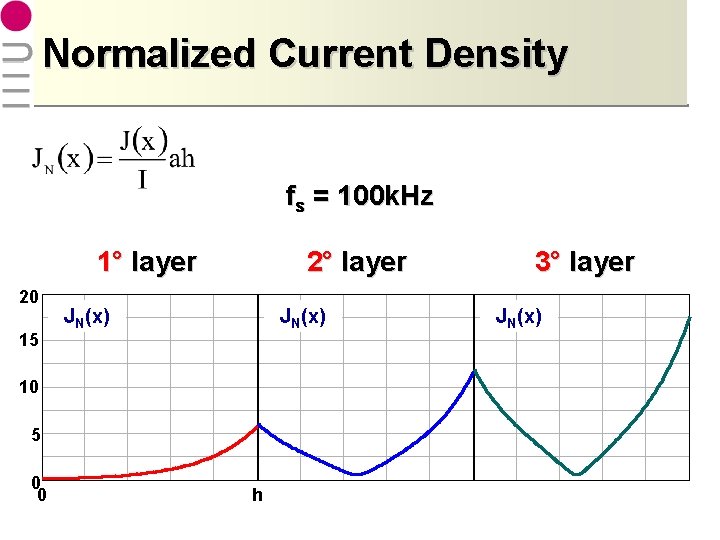
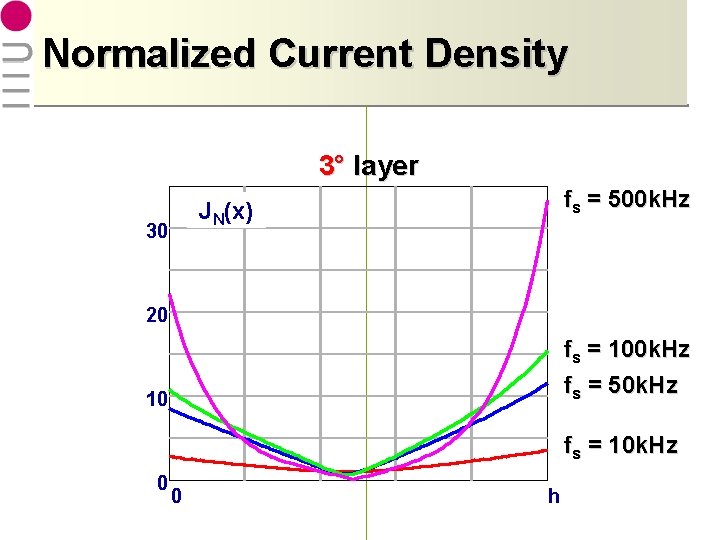
Current Density Distribution Current density inside pth layer DPEN = skin depth
Normalized Current Density fs = 100 k. Hz 1° layer 20 15 2° layer JN(x) 10 5 0 0 h 3° layer JN(x)
Normalized Current Density 3° layer fs = 500 k. Hz JN(x) 30 20 fs = 100 k. Hz fs = 50 k. Hz 10 fs = 10 k. Hz 0 0 h
AC Winding Leakage Impedance fb fc Voltage across pth layer: a b h u pth layer g Vp is independent of x. Thus, it is calculated at x = h:
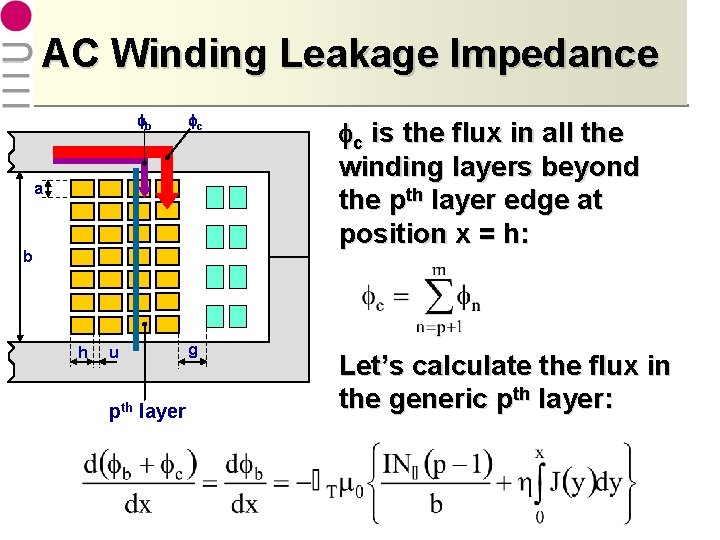
AC Winding Leakage Impedance fb fc a b h u pth layer g fc is the flux in all the winding layers beyond the pth layer edge at position x = h: Let’s calculate the flux in the generic pth layer:
AC Winding Leakage Impedance
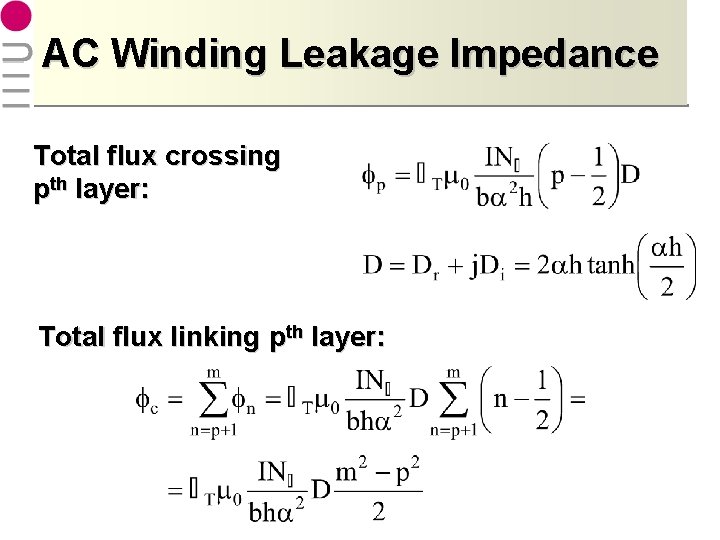
AC Winding Leakage Impedance Total flux crossing pth layer: Total flux linking pth layer:
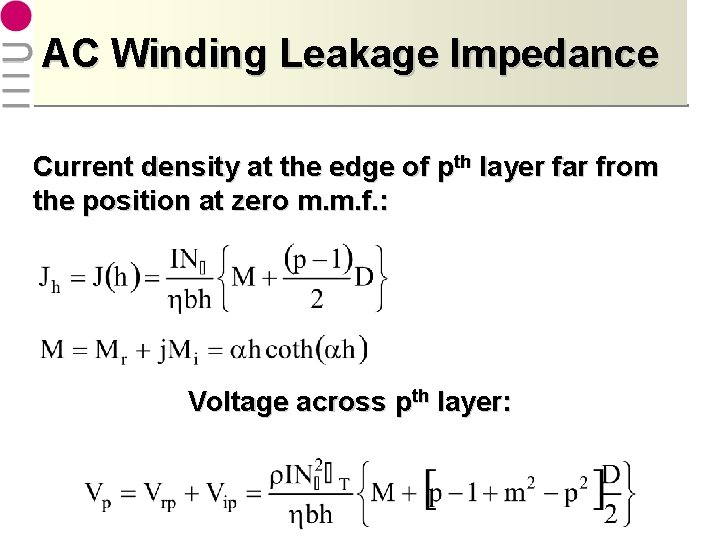
AC Winding Leakage Impedance Current density at the edge of pth layer far from the position at zero m. m. f. : Voltage across pth layer:
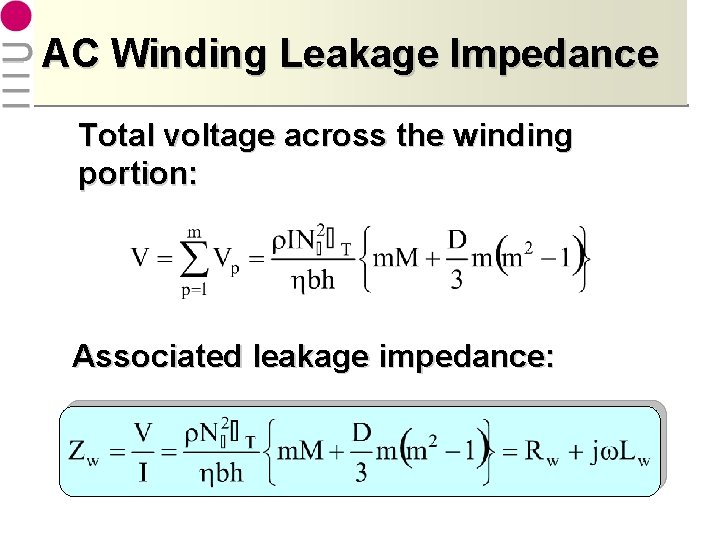
AC Winding Leakage Impedance Total voltage across the winding portion: Associated leakage impedance:
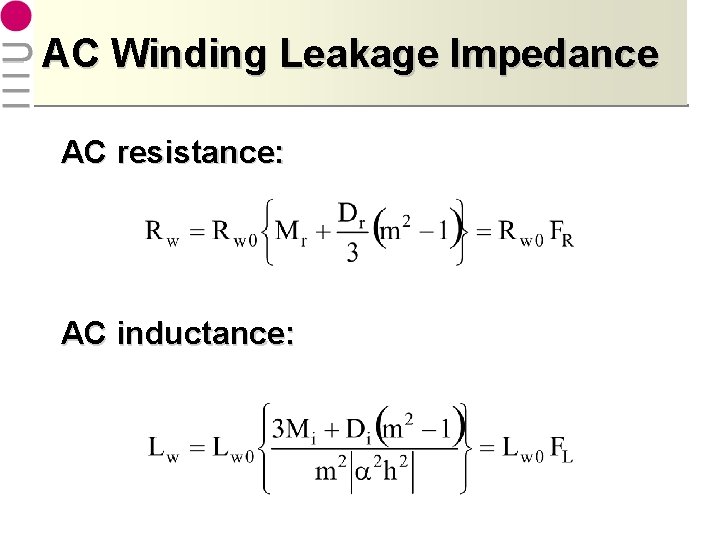
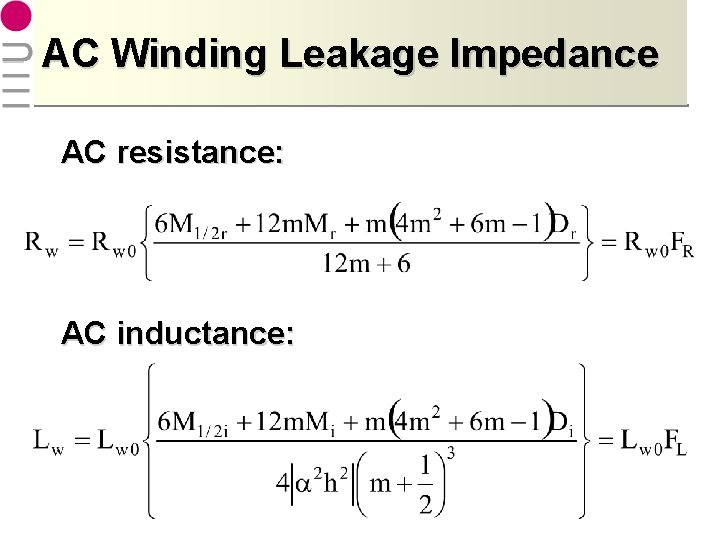
AC Winding Leakage Impedance AC resistance: AC inductance:
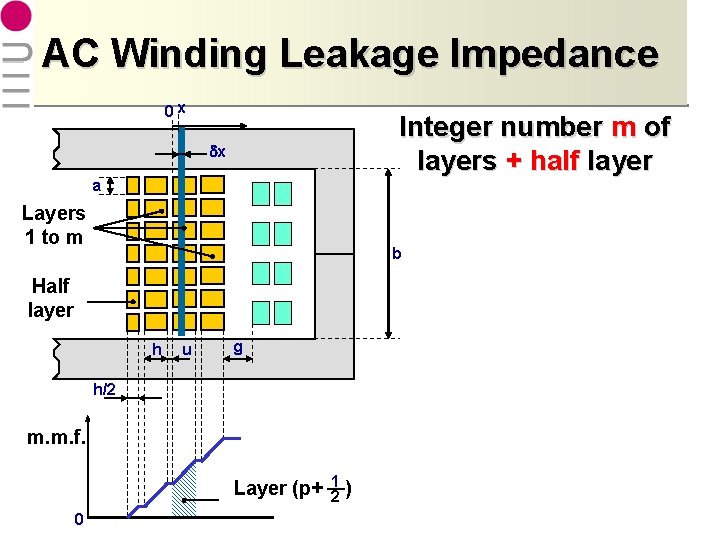
AC Winding Leakage Impedance 0 x Integer number m of layers + half layer dx a Layers 1 to m b Half layer h u g h/2 m. m. f. Layer (p+ 0 1 2 )
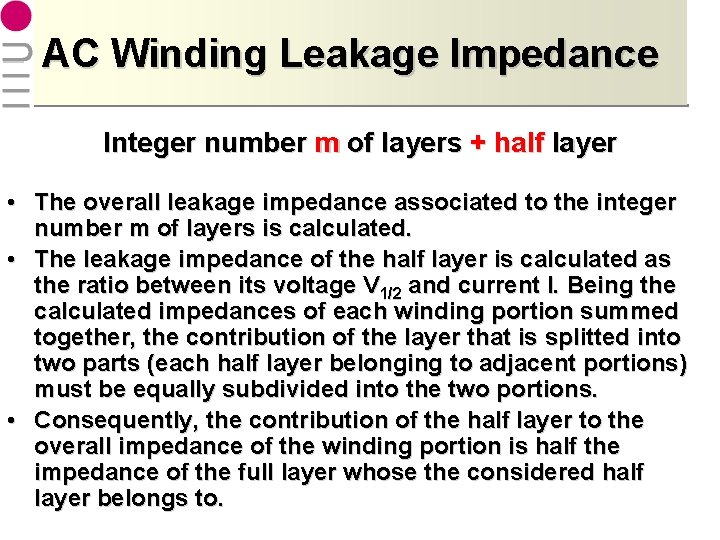
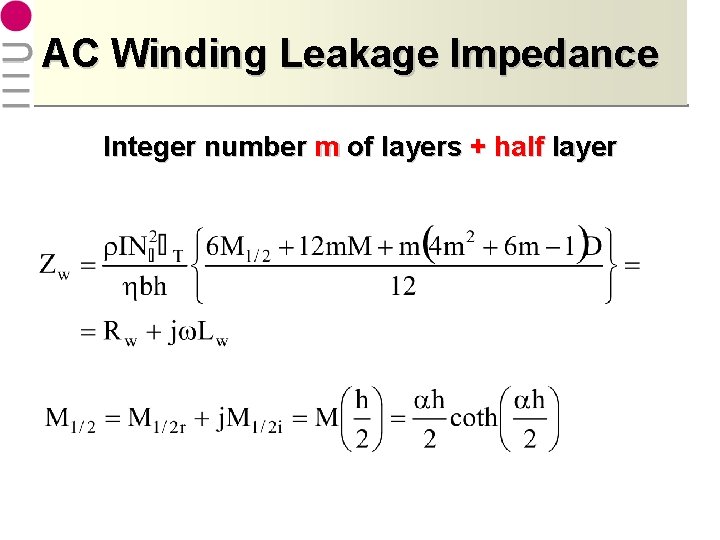
AC Winding Leakage Impedance Integer number m of layers + half layer • The overall leakage impedance associated to the integer number m of layers is calculated. • The leakage impedance of the half layer is calculated as the ratio between its voltage V 1/2 and current I. Being the calculated impedances of each winding portion summed together, the contribution of the layer that is splitted into two parts (each half layer belonging to adjacent portions) must be equally subdivided into the two portions. • Consequently, the contribution of the half layer to the overall impedance of the winding portion is half the impedance of the full layer whose the considered half layer belongs to.
AC Winding Leakage Impedance Integer number m of layers + half layer
AC Winding Leakage Impedance AC resistance: AC inductance:
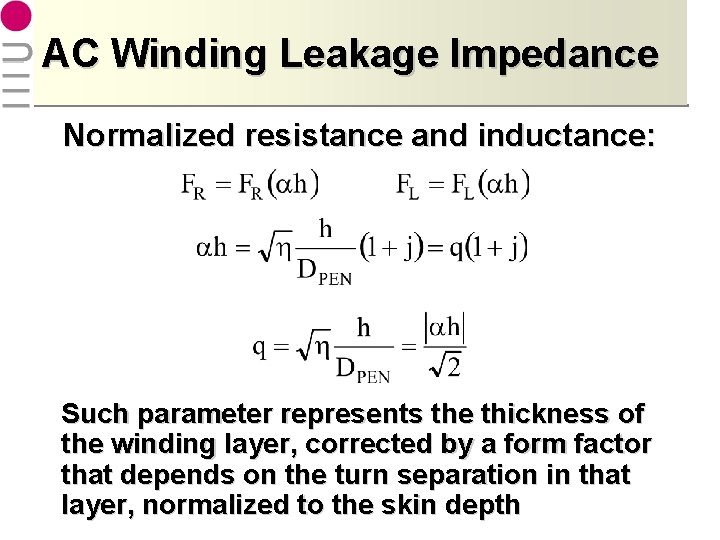
AC Winding Leakage Impedance Normalized resistance and inductance: Such parameter represents the thickness of the winding layer, corrected by a form factor that depends on the turn separation in that layer, normalized to the skin depth
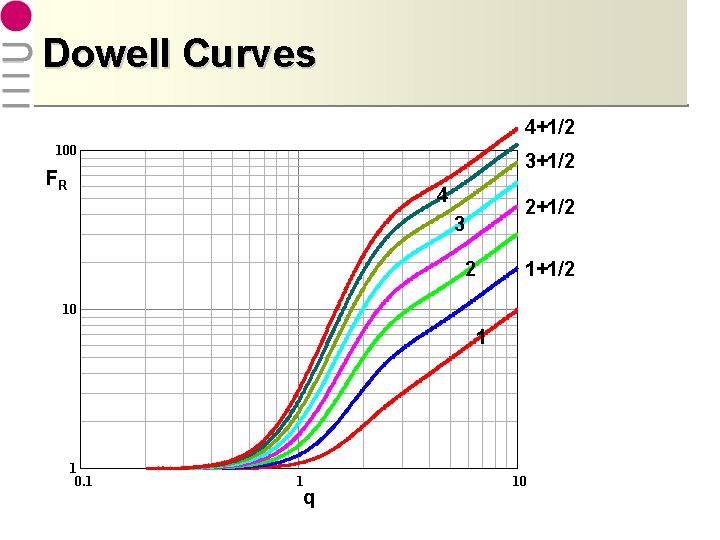
Dowell Curves 4+1/2 100 3+1/2 FR 4 2+1/2 3 2 1+1/2 10 1 1 0. 1 1 q 10
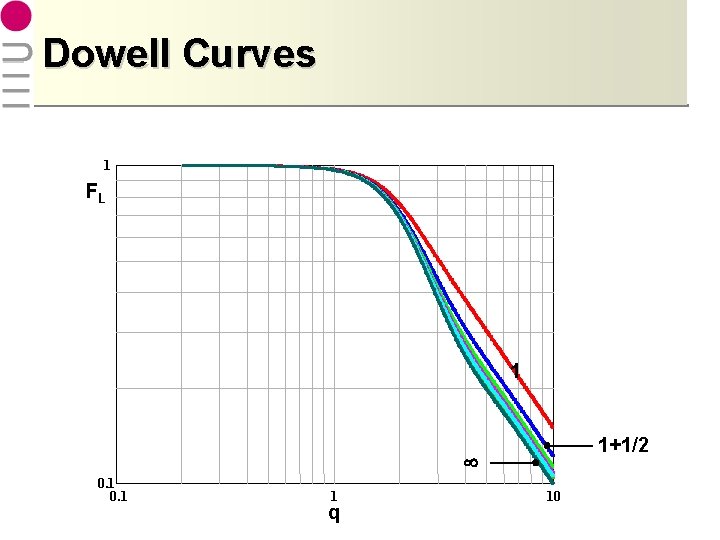
Dowell Curves 1 FL 1 1+1/2 0. 1 1 q 10
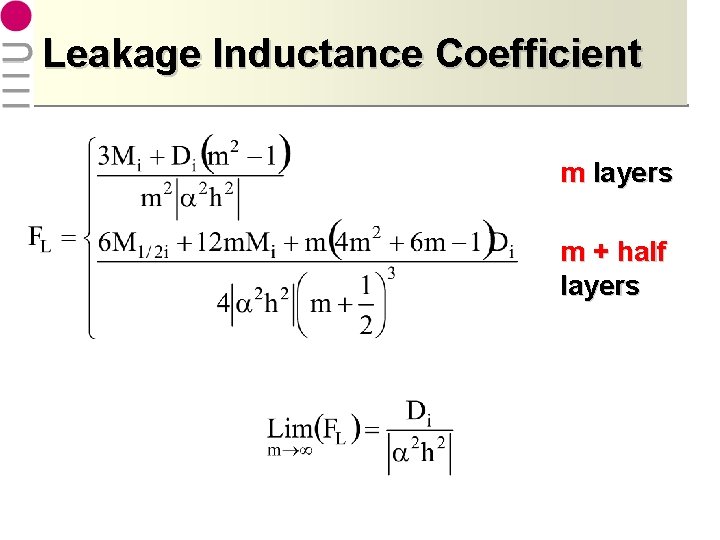
Leakage Inductance Coefficient m layers m + half layers
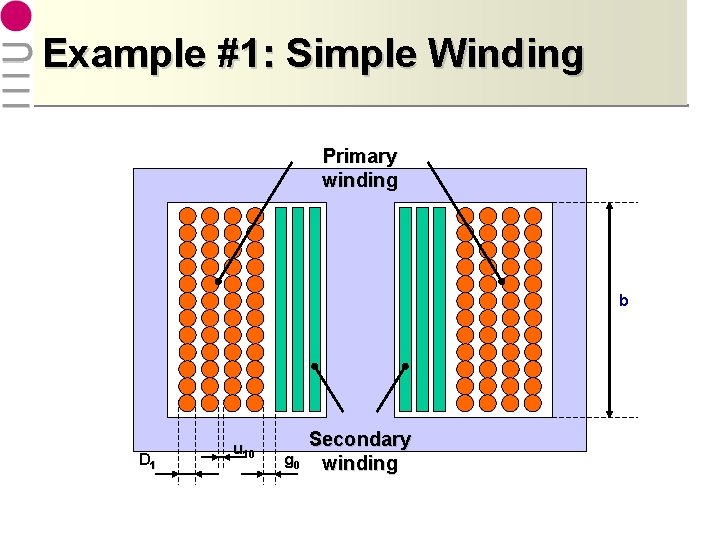
Example #1: Simple Winding Primary winding b D 1 u 10 g 0 Secondary winding
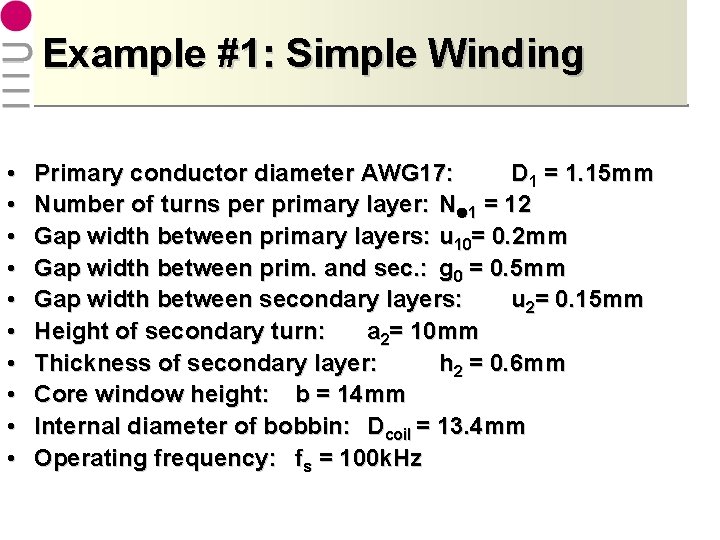
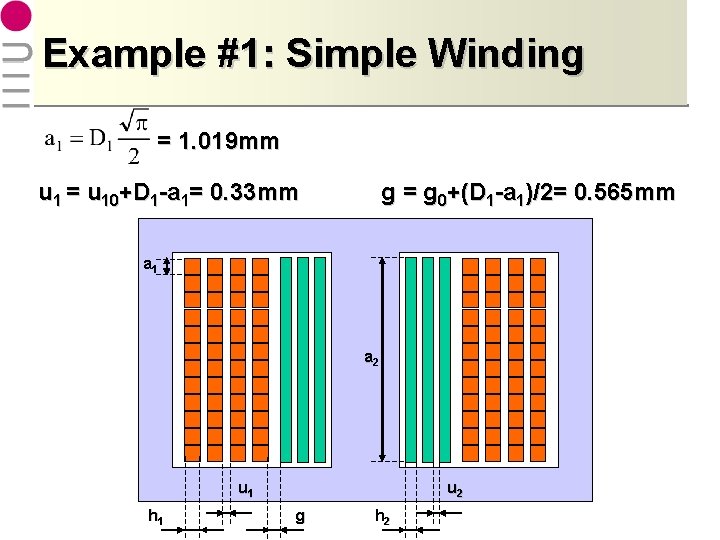
Example #1: Simple Winding • • • Primary conductor diameter AWG 17: D 1 = 1. 15 mm Number of turns per primary layer: N 1 = 12 Gap width between primary layers: u 10= 0. 2 mm Gap width between prim. and sec. : g 0 = 0. 5 mm Gap width between secondary layers: u 2= 0. 15 mm Height of secondary turn: a 2= 10 mm Thickness of secondary layer: h 2 = 0. 6 mm Core window height: b = 14 mm Internal diameter of bobbin: Dcoil = 13. 4 mm Operating frequency: fs = 100 k. Hz
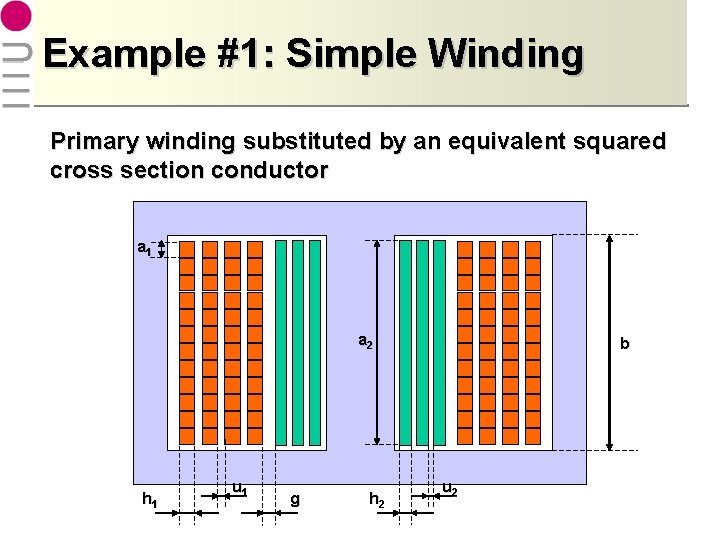
Example #1: Simple Winding Primary winding substituted by an equivalent squared cross section conductor a 1 a 2 h 1 u 1 g h 2 b u 2
Example #1: Simple Winding = 1. 019 mm u 1 = u 10+D 1 -a 1= 0. 33 mm g = g 0+(D 1 -a 1)/2= 0. 565 mm a 1 a 2 u 1 h 1 u 2 g h 2
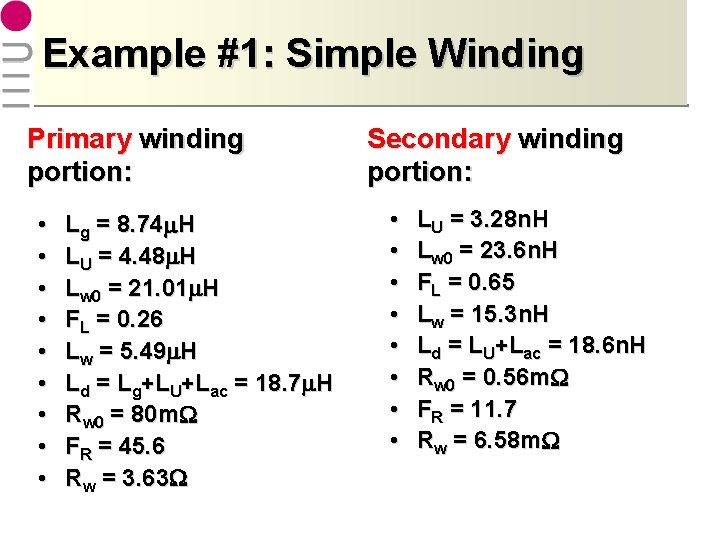
Example #1: Simple Winding Primary winding portion: • • • Lg = 8. 74 m. H LU = 4. 48 m. H Lw 0 = 21. 01 m. H FL = 0. 26 Lw = 5. 49 m. H Ld = Lg+LU+Lac = 18. 7 m. H Rw 0 = 80 m. W FR = 45. 6 Rw = 3. 63 W Secondary winding portion: • • LU = 3. 28 n. H Lw 0 = 23. 6 n. H FL = 0. 65 Lw = 15. 3 n. H Ld = LU+Lac = 18. 6 n. H Rw 0 = 0. 56 m. W FR = 11. 7 Rw = 6. 58 m. W
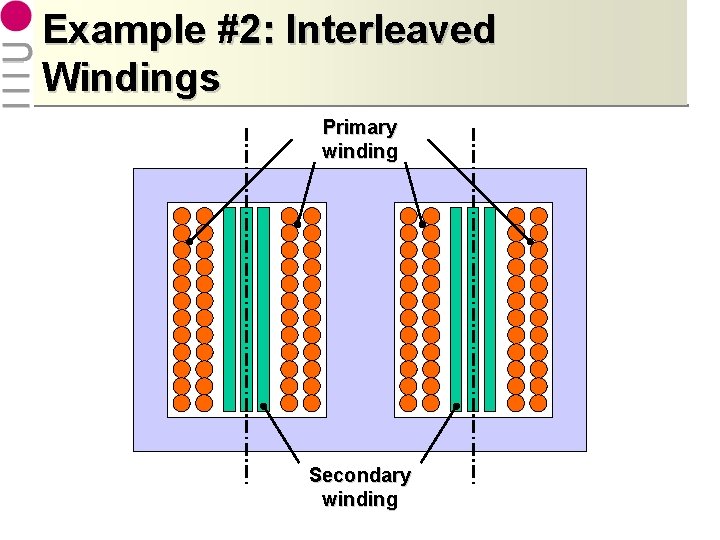
Example #2: Interleaved Windings Primary winding Secondary winding
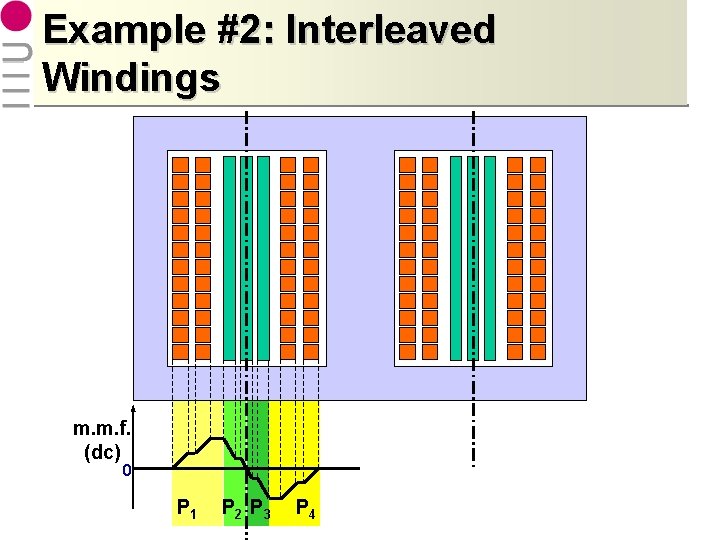
Example #2: Interleaved Windings m. m. f. (dc) 0 P 1 P 2 P 3 P 4
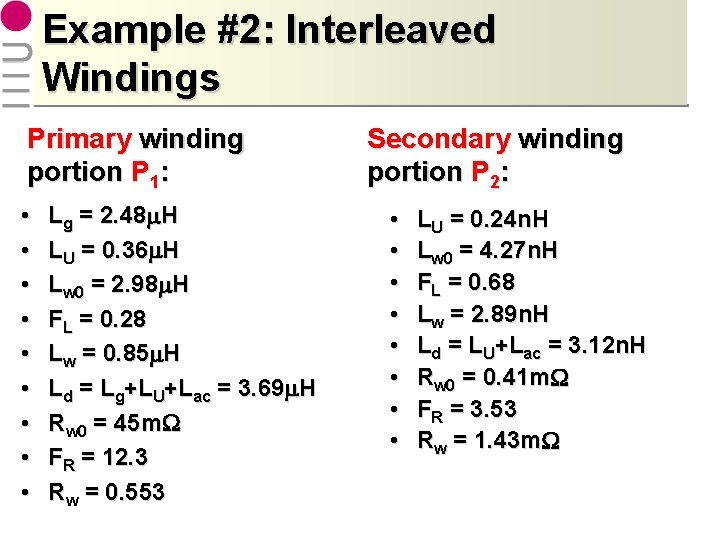
Example #2: Interleaved Windings Primary winding portion P 1: • • • Lg = 2. 48 m. H LU = 0. 36 m. H Lw 0 = 2. 98 m. H FL = 0. 28 Lw = 0. 85 m. H Ld = Lg+LU+Lac = 3. 69 m. H Rw 0 = 45 m. W FR = 12. 3 Rw = 0. 553 Secondary winding portion P 2: • • LU = 0. 24 n. H Lw 0 = 4. 27 n. H FL = 0. 68 Lw = 2. 89 n. H Ld = LU+Lac = 3. 12 n. H Rw 0 = 0. 41 m. W FR = 3. 53 Rw = 1. 43 m. W
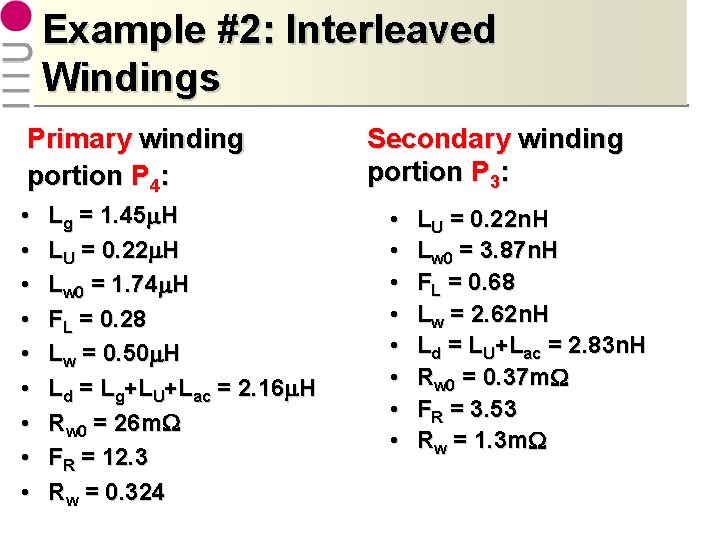
Example #2: Interleaved Windings Primary winding portion P 4: • • • Lg = 1. 45 m. H LU = 0. 22 m. H Lw 0 = 1. 74 m. H FL = 0. 28 Lw = 0. 50 m. H Ld = Lg+LU+Lac = 2. 16 m. H Rw 0 = 26 m. W FR = 12. 3 Rw = 0. 324 Secondary winding portion P 3: • • LU = 0. 22 n. H Lw 0 = 3. 87 n. H FL = 0. 68 Lw = 2. 62 n. H Ld = LU+Lac = 2. 83 n. H Rw 0 = 0. 37 m. W FR = 3. 53 Rw = 1. 3 m. W
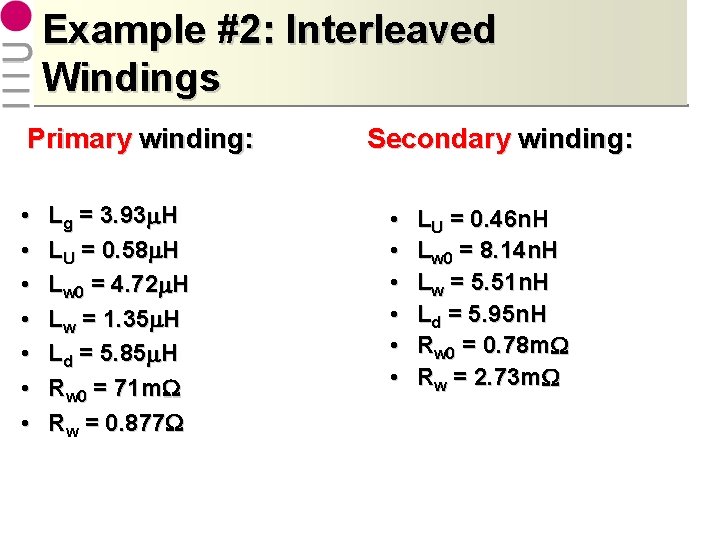
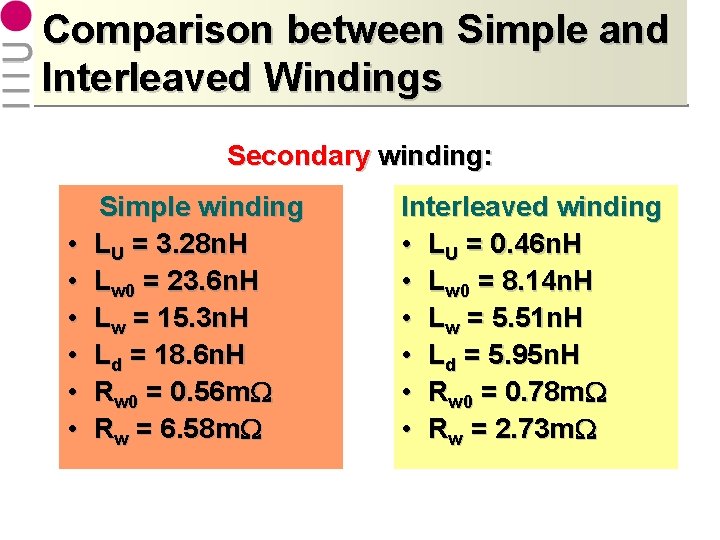
Example #2: Interleaved Windings Primary winding: • • Lg = 3. 93 m. H LU = 0. 58 m. H Lw 0 = 4. 72 m. H Lw = 1. 35 m. H Ld = 5. 85 m. H Rw 0 = 71 m. W Rw = 0. 877 W Secondary winding: • • • LU = 0. 46 n. H Lw 0 = 8. 14 n. H Lw = 5. 51 n. H Ld = 5. 95 n. H Rw 0 = 0. 78 m. W Rw = 2. 73 m. W
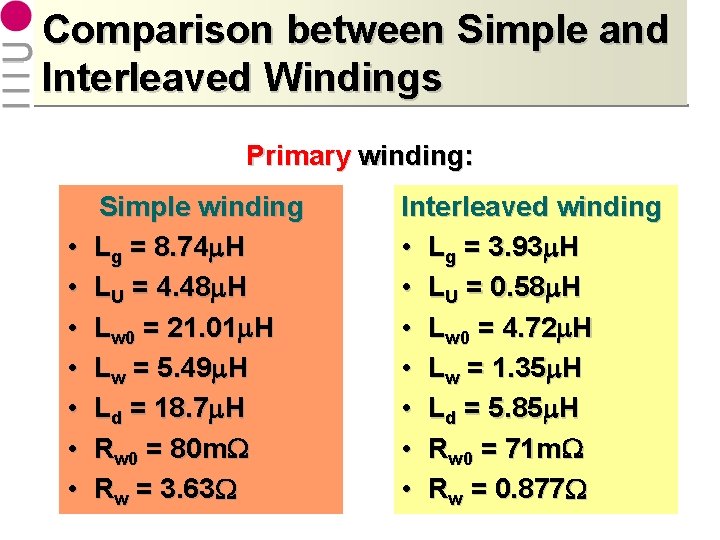
Comparison between Simple and Interleaved Windings Primary winding: • • Simple winding Lg = 8. 74 m. H LU = 4. 48 m. H Lw 0 = 21. 01 m. H Lw = 5. 49 m. H Ld = 18. 7 m. H Rw 0 = 80 m. W Rw = 3. 63 W Interleaved winding • Lg = 3. 93 m. H • LU = 0. 58 m. H • Lw 0 = 4. 72 m. H • Lw = 1. 35 m. H • Ld = 5. 85 m. H • Rw 0 = 71 m. W • Rw = 0. 877 W
Comparison between Simple and Interleaved Windings Secondary winding: • • • Simple winding LU = 3. 28 n. H Lw 0 = 23. 6 n. H Lw = 15. 3 n. H Ld = 18. 6 n. H Rw 0 = 0. 56 m. W Rw = 6. 58 m. W Interleaved winding • LU = 0. 46 n. H • Lw 0 = 8. 14 n. H • Lw = 5. 51 n. H • Ld = 5. 95 n. H • Rw 0 = 0. 78 m. W • Rw = 2. 73 m. W