
Leaf Area Perimeter Ratio Shade Tolerance and Photosynthesis
- Slides: 7
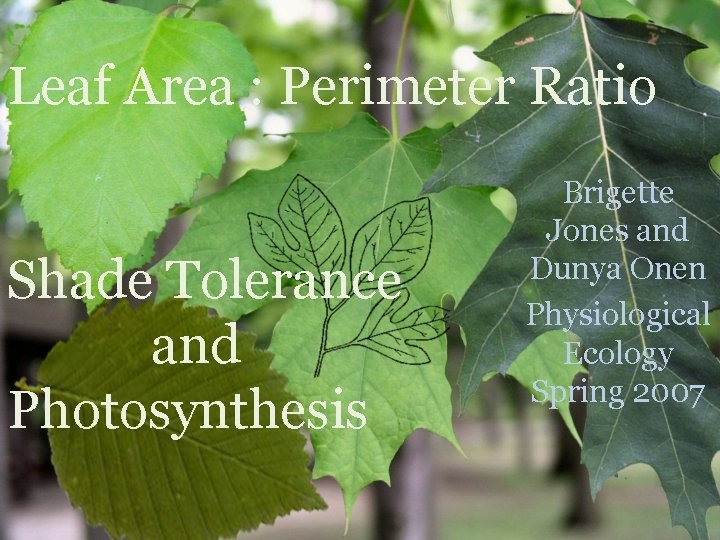
Leaf Area : Perimeter Ratio Shade Tolerance and Photosynthesis Brigette Jones and Dunya Onen Physiological Ecology Spring 2007
Background • One of the simplest questions to ask in plant physiological ecology is “Why are the leaves shaped like that? ” – Leaf morphology is highly variable, and leaf functionality is directly related to plant fitness • Strong selective pressure • Additionally many studies have shown that leaf morphology, rather than biochemistry often governs photosynthesis acclimation – Many factors potentially influence shape, and many measures of shape • Incident radiation determining Ps
Sassafras • In light-limiting environments– Potentially advantageous to extend the leaf in many directions (increase lobbing? ? , decrease area: edge) • Maximize angle and place variety for light interception – Niklas 1988 showed that Sassafras leaves were more strongly, and more frequently lobed on the interior parts of the branches, where light was intermittent and limiting
• Question is mostly unanswered-studies tend to look at other morphological parameters, or don’t connect perimeter to physiological responses, such as photosynthesis – Or are limited to one species, or don’t cover a range of leaf shapes • There must be a function for leaf shape, or such variance would be unlikely-an ideal would have evolved
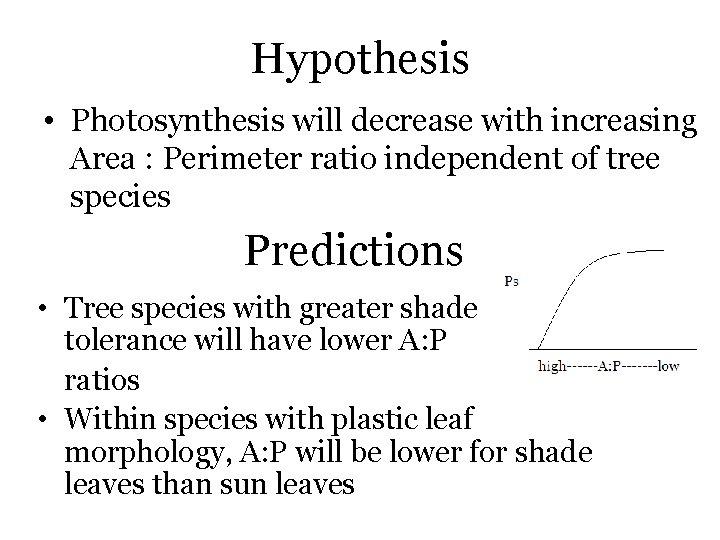
Hypothesis • Photosynthesis will decrease with increasing Area : Perimeter ratio independent of tree species Predictions • Tree species with greater shade tolerance will have lower A: P ratios • Within species with plastic leaf morphology, A: P will be lower for shade leaves than sun leaves
• Study species were chosen from the avaliable local pool to represent a range of shade tolerance and leaf shape
Tree Species • Paper Birch (Betula papyrifera)- low shade tolerance, teardrop shaped leaf • American Elm (Ulmus americana)- moderate shade tolerance, egg-shaped leaf • Northern Red Oak (Quercus rubra)- high shade tolerance, moderately pinnately lobed leaf • Sugar Maple (Acer saccharum)- very high shade tolerance, moderately palmately lobed leaf