
LEAF ANATOMY AND TRANSPIRATION BEGINS Hello there students
LEAF ANATOMY AND TRANSPIRATION BEGINS
Hello there students. I’m Mr. Leaf and I’m here to tell you about how I function to make photosynthesis efficient for plants. First, I must explain the anatomical structures for the leaf cross section. It is your job to memorize the structures on the following slide.

Upper cuticle Upper epidermis Palisade layer Spongy layer Lower epidermis stoma Lower cuticle
You notice that the palisade layer is also called the palisade parenchyma or palisade mesophyll. The spongy layer also is called the spongy parenchyma or the spongy mesophyll. Mesophyll is the Middle layer of the plant leaf. It is found between the upper and lower epidermis and is specialized for photosynthesis. Parenchyma is a type of unspecialized plant tissue found in many plant structures such as potato tuber cells.
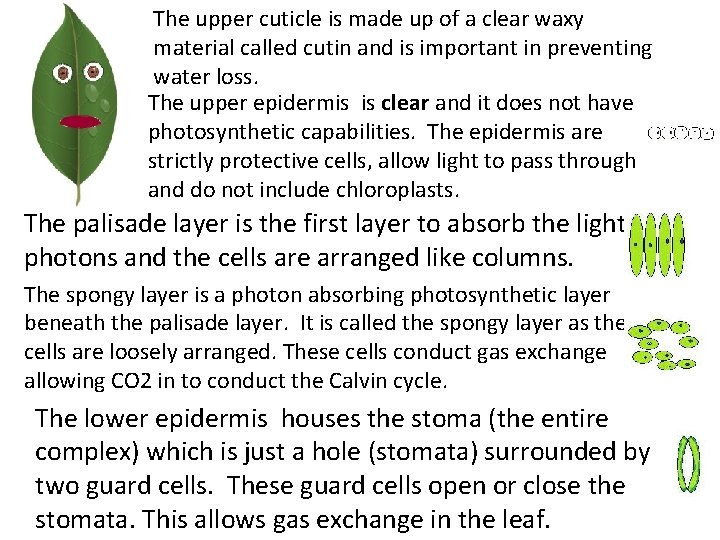
The upper cuticle is made up of a clear waxy material called cutin and is important in preventing water loss. The upper epidermis is clear and it does not have photosynthetic capabilities. The epidermis are strictly protective cells, allow light to pass through and do not include chloroplasts. The palisade layer is the first layer to absorb the light photons and the cells are arranged like columns. The spongy layer is a photon absorbing photosynthetic layer beneath the palisade layer. It is called the spongy layer as the cells are loosely arranged. These cells conduct gas exchange allowing CO 2 in to conduct the Calvin cycle. The lower epidermis houses the stoma (the entire complex) which is just a hole (stomata) surrounded by two guard cells. These guard cells open or close the stomata. This allows gas exchange in the leaf.
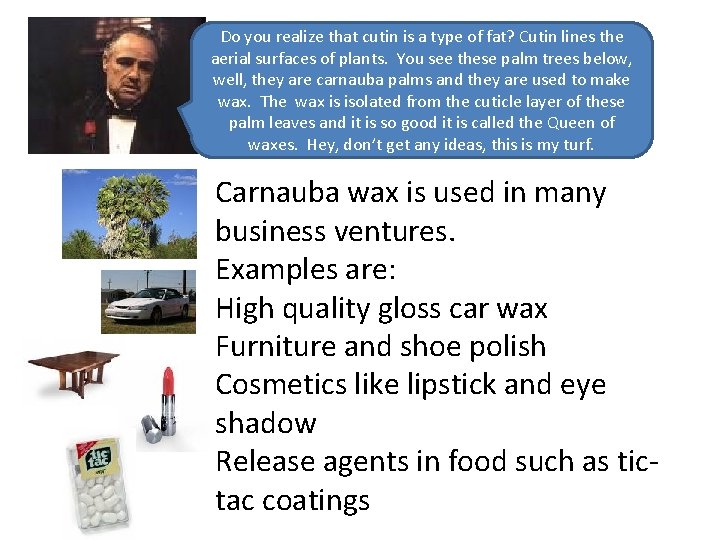
Do you realize that cutin is a type of fat? Cutin lines the aerial surfaces of plants. You see these palm trees below, well, they are carnauba palms and they are used to make wax. The wax is isolated from the cuticle layer of these palm leaves and it is so good it is called the Queen of waxes. Hey, don’t get any ideas, this is my turf. Carnauba wax is used in many business ventures. Examples are: High quality gloss car wax Furniture and shoe polish Cosmetics like lipstick and eye shadow Release agents in food such as tictac coatings
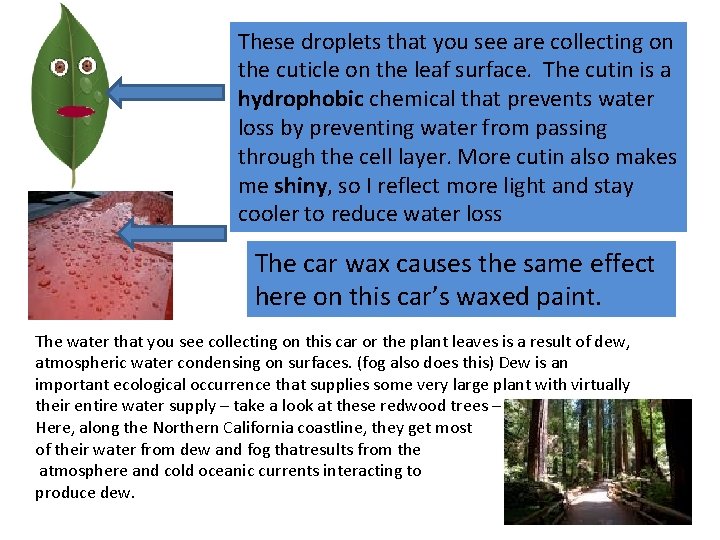
These droplets that you see are collecting on the cuticle on the leaf surface. The cutin is a hydrophobic chemical that prevents water loss by preventing water from passing through the cell layer. More cutin also makes me shiny, so I reflect more light and stay cooler to reduce water loss The car wax causes the same effect here on this car’s waxed paint. The water that you see collecting on this car or the plant leaves is a result of dew, atmospheric water condensing on surfaces. (fog also does this) Dew is an important ecological occurrence that supplies some very large plant with virtually their entire water supply – take a look at these redwood trees – Here, along the Northern California coastline, they get most of their water from dew and fog thatresults from the atmosphere and cold oceanic currents interacting to produce dew.
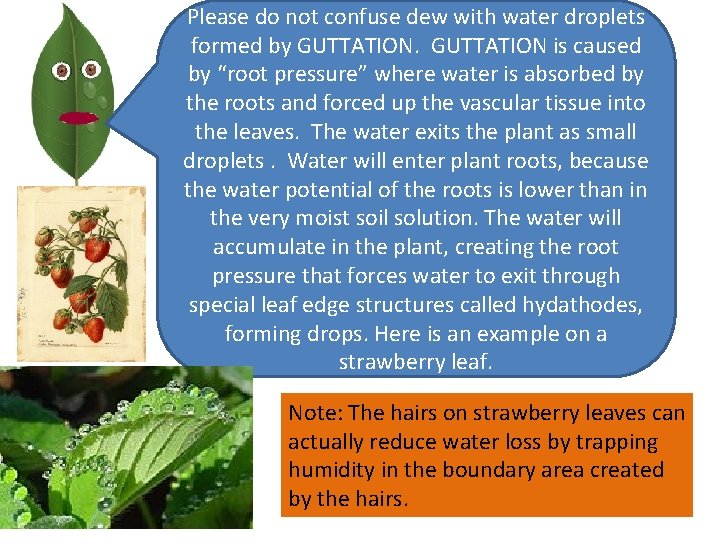
Please do not confuse dew with water droplets formed by GUTTATION is caused by “root pressure” where water is absorbed by the roots and forced up the vascular tissue into the leaves. The water exits the plant as small droplets. Water will enter plant roots, because the water potential of the roots is lower than in the very moist soil solution. The water will accumulate in the plant, creating the root pressure that forces water to exit through special leaf edge structures called hydathodes, forming drops. Here is an example on a strawberry leaf. Note: The hairs on strawberry leaves can actually reduce water loss by trapping humidity in the boundary area created by the hairs.
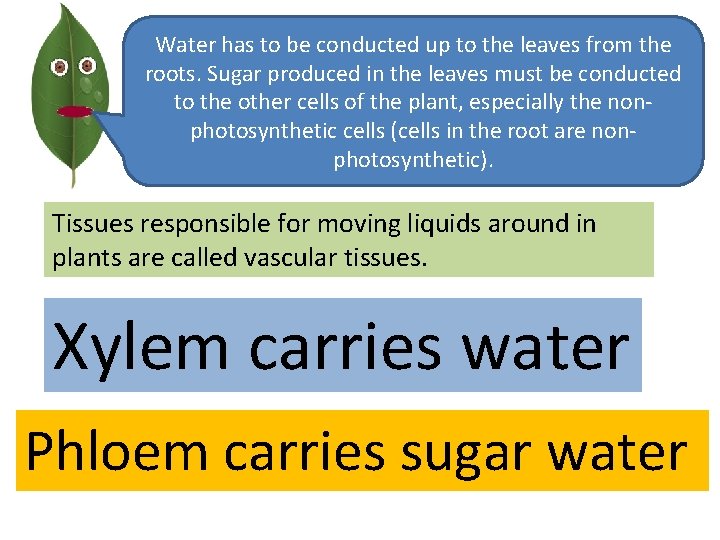
Water has to be conducted up to the leaves from the roots. Sugar produced in the leaves must be conducted to the other cells of the plant, especially the nonphotosynthetic cells (cells in the root are nonphotosynthetic). Tissues responsible for moving liquids around in plants are called vascular tissues. Xylem carries water Phloem carries sugar water
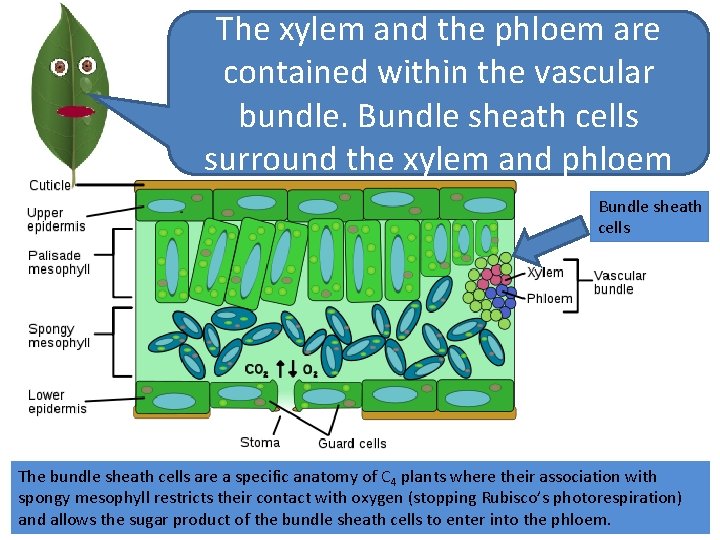
The xylem and the phloem are contained within the vascular bundle. Bundle sheath cells surround the xylem and phloem Bundle sheath cells The bundle sheath cells are a specific anatomy of C 4 plants where their association with spongy mesophyll restricts their contact with oxygen (stopping Rubisco’s photorespiration) and allows the sugar product of the bundle sheath cells to enter into the phloem.
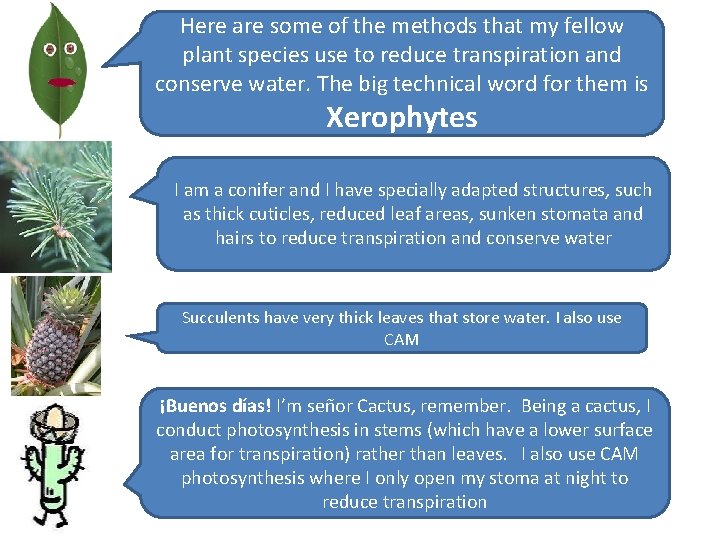
Here are some of the methods that my fellow plant species use to reduce transpiration and conserve water. The big technical word for them is Xerophytes I am a conifer and I have specially adapted structures, such as thick cuticles, reduced leaf areas, sunken stomata and hairs to reduce transpiration and conserve water Succulents have very thick leaves that store water. I also use CAM ¡Buenos días! I’m señor Cactus, remember. Being a cactus, I conduct photosynthesis in stems (which have a lower surface area for transpiration) rather than leaves. I also use CAM photosynthesis where I only open my stoma at night to reduce transpiration
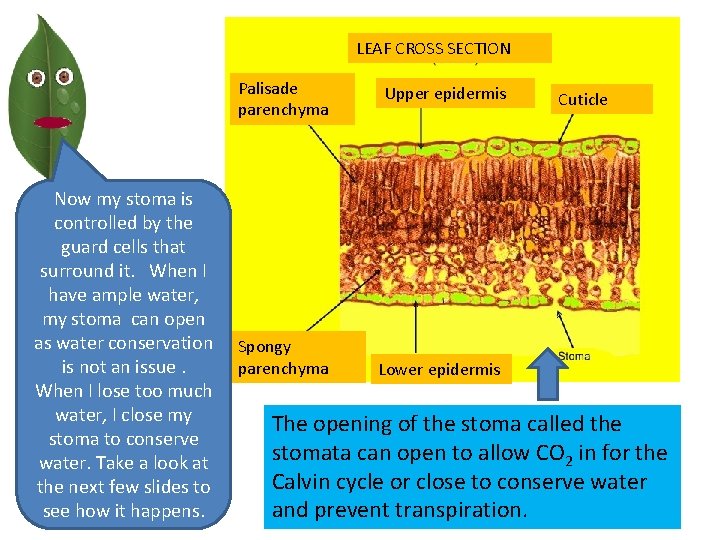
LEAF CROSS SECTION Palisade parenchyma Now my stoma is controlled by the guard cells that surround it. When I have ample water, my stoma can open as water conservation is not an issue. When I lose too much water, I close my stoma to conserve water. Take a look at the next few slides to see how it happens. Spongy parenchyma Upper epidermis Cuticle Lower epidermis The opening of the stoma called the stomata can open to allow CO 2 in for the Calvin cycle or close to conserve water and prevent transpiration.
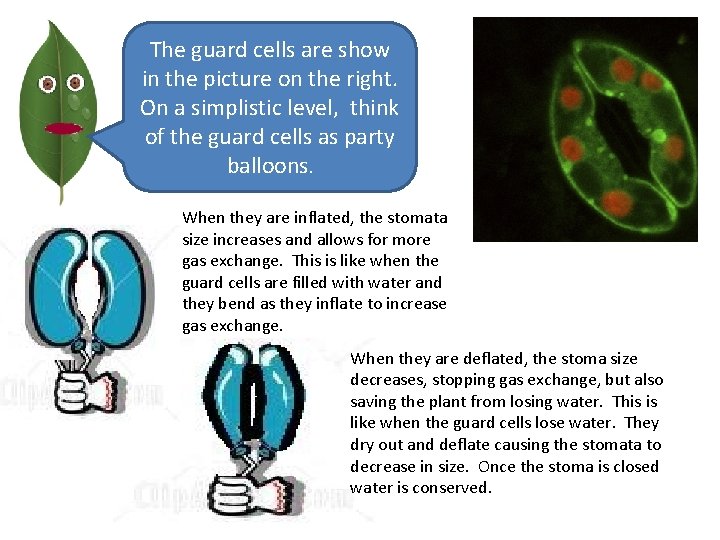
The guard cells are show in the picture on the right. On a simplistic level, think of the guard cells as party balloons. When they are inflated, the stomata size increases and allows for more gas exchange. This is like when the guard cells are filled with water and they bend as they inflate to increase gas exchange. When they are deflated, the stoma size decreases, stopping gas exchange, but also saving the plant from losing water. This is like when the guard cells lose water. They dry out and deflate causing the stomata to decrease in size. Once the stoma is closed water is conserved.
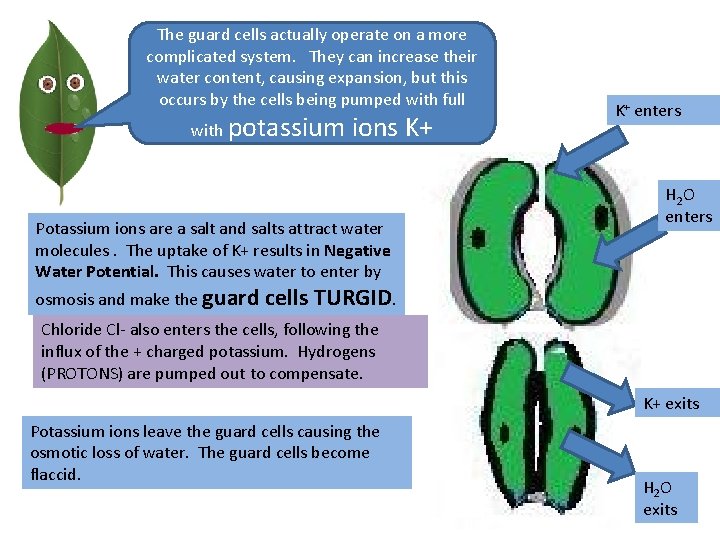
The guard cells actually operate on a more complicated system. They can increase their water content, causing expansion, but this occurs by the cells being pumped with full with potassium ions K+ Potassium ions are a salt and salts attract water molecules. The uptake of K+ results in Negative Water Potential. This causes water to enter by osmosis and make the guard K+ enters H 2 O enters cells TURGID. Chloride Cl- also enters the cells, following the influx of the + charged potassium. Hydrogens (PROTONS) are pumped out to compensate. K+ exits Potassium ions leave the guard cells causing the osmotic loss of water. The guard cells become flaccid. H 2 O exits
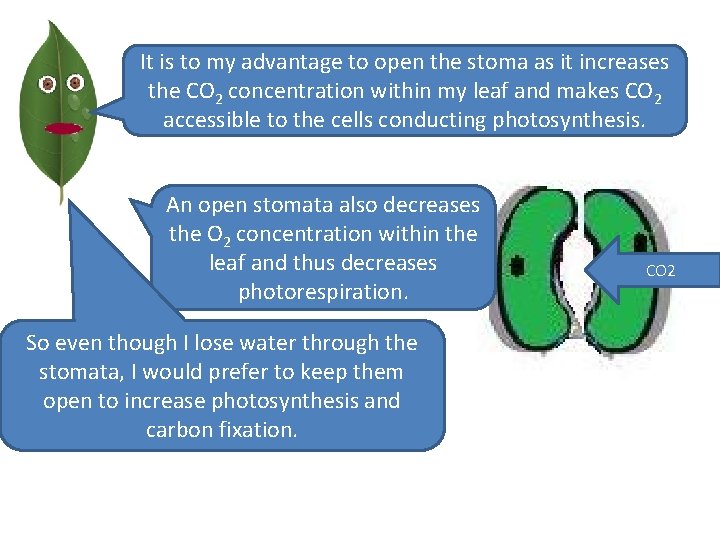
It is to my advantage to open the stoma as it increases the CO 2 concentration within my leaf and makes CO 2 accessible to the cells conducting photosynthesis. An open stomata also decreases the O 2 concentration within the leaf and thus decreases photorespiration. So even though I lose water through the stomata, I would prefer to keep them open to increase photosynthesis and carbon fixation. CO 2

I open my stomata at dawn as photosynthesis begins to produce the products necessary for me to ‘power up’ the Calvin cycle. I, therefore need CO 2 to be able to enter my cells and the guard cells must become turgid to open the stomata. There are three main contributing factors. 1. Light itself triggers the guard cells to accumulate potassium and become turgid. . The light stimulates PHOTOSYSTEM I causing ATP levels to rise. ATP is then available for the active transport of protons. The cell membrane begins pumping out protons using ATP. 2. Depletion of CO 2 within the air spaces due to the Calvin cycle activation as a result of photosynthesis. 3. The internal clock of the guard cells opens and closes the stomata even if there is no light present. Plants in completely dark environments open stomata according to circadian rhythms (24 hour cycles). What a mystery! How do they tell time?
Sometimes I start to lose too much water because of environmental conditions. 1. I close the stomata because the guard cells lose water (become flaccid) due to overall water loss. Dry air high wind etc. . 2. Abscisic acid, the plant hormone, is produced in the mesophyll cells in response to water deficiency and cause the guard cells to become flaccid. The stomata thus close and water is conserved. 3. Hot temperatures and excessive transpiration also seem to cause stomata to close briefly during midday. Control is unknown. All of these actions prevent plant wilting from water loss, but both also decrease photosynthesis, thus decreasing crop yields.
Transpiration rates for some plants are incredible. Transpiration adds water vapour to the air and thus by humidifying the air actually changes the environment. Up to 90% of the water brought up to the leaves of large trees is lost to transpiration. That could mean a daily loss of hundreds of liters for a large tree!! Transpiration causes a localized cooling effect as water turns from liquid to vapour and absorbs heat from its surrounding s in order to do this. Thus temperatures are cooler beneath trees for more reasons than just the provision of shade. Transpiration moisturizes the air making the area beneath the tree more humid and creating an environment more favourable for habitats of other species.
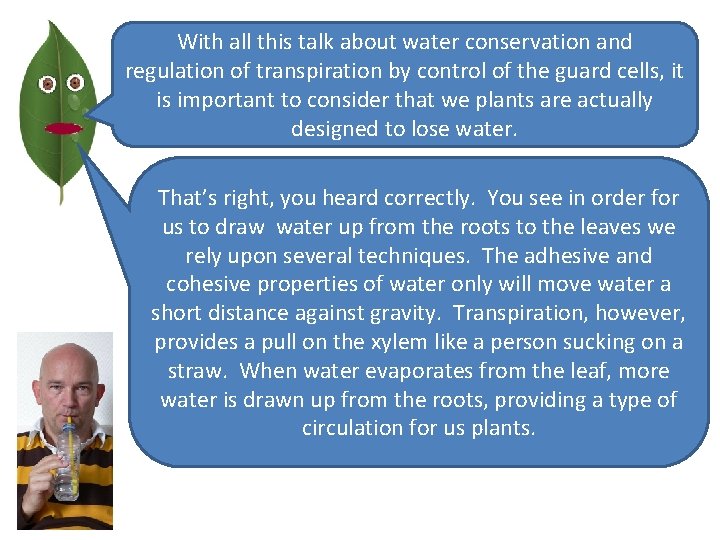
With all this talk about water conservation and regulation of transpiration by control of the guard cells, it is important to consider that we plants are actually designed to lose water. That’s right, you heard correctly. You see in order for us to draw water up from the roots to the leaves we rely upon several techniques. The adhesive and cohesive properties of water only will move water a short distance against gravity. Transpiration, however, provides a pull on the xylem like a person sucking on a straw. When water evaporates from the leaf, more water is drawn up from the roots, providing a type of circulation for us plants.
Well so long. It’s time to make like a tree and leave. LEAVES AND TRANSPIRATION THE END
- Slides: 20