
Leading With Influence Creating Your Personal Leadership Style


- Slides: 37
Leading With Influence Creating Your Personal Leadership Style Clint Schroeder, DGND
Welcome and Agenda Introductions Defining leadership Leading Volunteers Characteristics of great leaders Personal leadership Creating your personal leadership approach Five Fears of Leadership Five Truths of Leadership Parting Thoughts ©Copyright 2009
What is Leadership? Good leadership is difficult to define, but you know it when you see it.
Well Said! “Being in leadership is like being a lady. If you have to tell people you are, then you aren’t. ” -Margaret Thatcher
Definitions of Leadership “The only definition of a leader is someone who has followers. ” ~Peter Drucker “Leadership is influence - nothing more, nothing less. ” ~John C Maxwell “Leadership is ultimately about creating a way for people to contribute to making something extraordinary happen. ” ~Alan Keith “Leadership is a function of knowing yourself, having a vision that is well communicated, building trust among colleagues, and taking effective action to realize your own leadership potential. ” ~Warren Bennis
Characteristics of Good Leaders Honesty/integrity Trustworthy Fair & equitable Positive attitude Strong vision Inspiring Organized “Walk their talk” Listen Respectful Supportive Make things happen Values & ethics Motivate others Created opportunities Safe space
Characteristics of Good Leaders Attributes or personal qualities Are as much about the person’s way of being as they are about what s/he accomplished Demonstrate a belief in something greater Invite others to also contribute to something greater
All Leadership Is Personal Leadership Unique to you Comes from within yourself It is your way of “being” It is the way you “bring yourself” to the situation Begins where behavior and values align Personal leadership has 6 significant parts
Volunteers vs. Paid Employees Is there a difference in required technique? Our organization is no stronger than its leaders. Committed leaders increase value to members. Value increases participation from the members. Participation strengthens the organization from the inside out. For this to happen, there must be leaders who lead. Remember: You can not lead your team any further than you have traveled yourself.
Creating Your Personal Leadership Leading where you are (with what you have) Vision Presence Embodying Values/Modeling the way Enabling others Making contribution
Lead Where You Are What can you do right now in this moment with what you have? What would make a difference right now? What is the small thing that matters?
Vision can be defined as: a vivid mental image; the formation of a mental image of something that is not perceived as real and is not present to the senses; a religious or mystical experience of a supernatural appearance
Vision Your world view The “more” or “greater than” you want to contribute to The thing you want to make “present to the senses” What you want to create
Your Leadership “Presence”? “What you are speaks louder than anything you have to say”. -David Beck Your presence is how people feel when they are around you. This includes how safe they feel, what you bring out of them, how you listen, how and what you share of yourself.
Embodying Values Alignment between beliefs and behaviors “Walking the talk” Modeling the way—demonstrating values through actions not telling (do as I do) “Becoming the change you want to see in the world. ” -Gandhi
Enabling Others “The greatest gift you can give to others is not to show them your greatness, but to reveal to them their own. ” -unknown
Making Contribution How can you combine the small things to make a difference in a bigger way? How can you use your personal leadership/way of being to help others?
30 Day Invitation Pick one leadership trait you want to develop and consciously explore it for the next 30 days. Take 15 minutes at the end of each day, record what you observed and experienced
The Power of Reflection üWhat did you observe about where you embody and where you espouse your values? üWhat actions did you take to bring your values and actions more into alignment? üWhat went well? / What did not go well? üWhat was the impact? üWhat will you do differently next time? üCelebrate what you did well
True Leaders Must Overcome FIVE FEARS
The Unknown Turning the unknown into adventure will give you permission to succeed. 1
Abandonment Humans are pack animals – it is natural to be afraid of being alone. 2
Failure Is it Failure or Defeat? Defeat is when life crumbles around you, and you stay in it but do nothing to climb out. 3 Get knocked down one hundred times – get back up one hundred and one!
Rejection What if they say no? What is the worst that could happen? 4
Success Some people are never actually taught the definition of Success – and how to handle it when it comes our way. 5
If not You? Then Who? Close your eyes… Imagine a world without the generosity of others: In 2011, Americans gave almost $300 B to charitable organizations* (and that was what was big enough to claim!) It is estimated that Americans actually give closer to $450 B per year Bill Gates is only worth $61 B Source: NPS. Gov
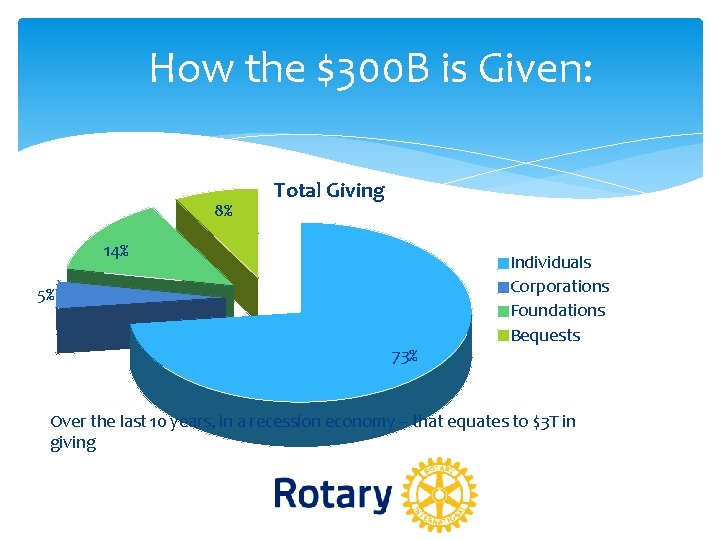
How the $300 B is Given: 8% Total Giving 14% 5% 73% Individuals Corporations Foundations Bequests Over the last 10 years, in a recession economy – that equates to $3 T in giving
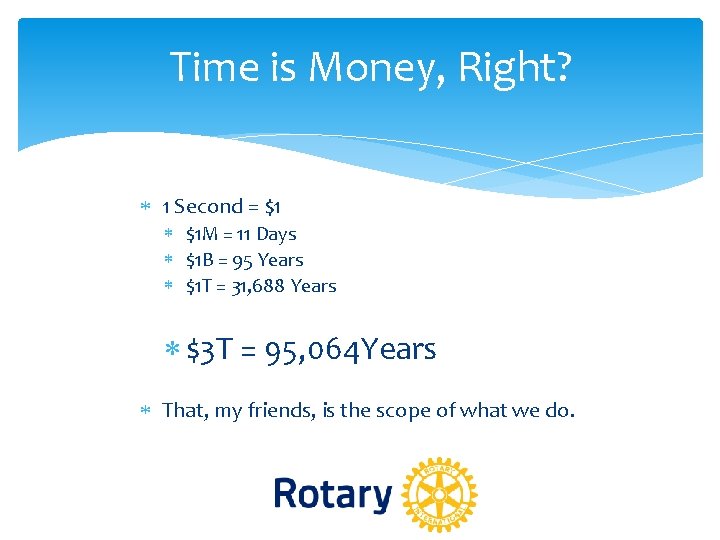
Time is Money, Right? 1 Second = $1 $1 M = 11 Days $1 B = 95 Years $1 T = 31, 688 Years $3 T = 95, 064 Years That, my friends, is the scope of what we do.
True Leaders Must Overcome FIVE TRUTHS
Respect The result of people trusting you, and wanting you to share their journey with them. Nothing better than sharing the same crusade. 1
Reputation Is not created during a relationship. It is created after. It is the feeling that we leave people with after they are directly involved with us. Community service builds perception and awareness. 2
Integrity The result of respect and reputation coming together to create the belief that I can trust who you are and can count on you to do what you say you will do. 3
Accountability A person who has accepted the responsibility to lead, must do it with a passion to improve the organization and not a fear of being disliked. A leader fully accepts accountability. 4
Change Respect the tradition of yesterday, but do not be held hostage by those traditions. You must move forward in the spirit of improvement. 5
Parting Thoughts: Accept volunteers for WHO they are. Recognize what people want to do – and follow through. ASK – then ACT. Lead by example. Be accountable (dashboard, strategy). Maintain the Four Way Test. Maintain integrity. Be a change agent. Be an OPEN communicator. Be a Steward – not a Dictator.
Get involved. Lead.
Contact Information Clint Schroeder, DGND D 5000 rotarydgclint@gmail. com clintonschroeder@me. com 808 -295 -8667