
Leading Projects The Human Side of Project Management


- Slides: 38
Leading Projects: The Human Side of Project Management Behavioral and Trait-based Perspectives on Project Leadership © Peter Dominick, Zvi Aronson 1
Objectives v Define leadership and management in relation to being a project manager v Introduce behavioral frame works for defining effective project leadership v Operationalize behavioral competencies for project managers © Peter Dominick, Zvi Aronson 2
Leadership: Some Definitions v Leadership is primarily a process involving influence, i. e. , changing the behavior of others § § The behavior of an individual when directing the activities of a group toward a shared goal Interpersonal influence exercised in a situation and directed through communication toward a goal or goals © Peter Dominick, Zvi Aronson 3
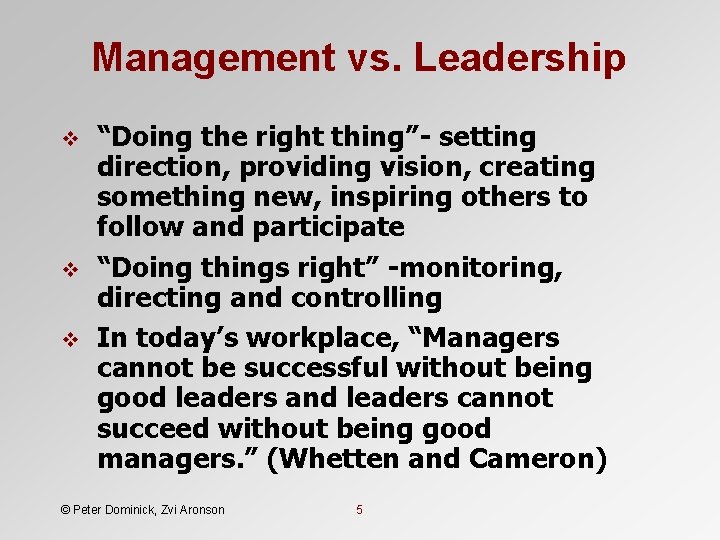
Management vs. Leadership v v v “Doing the right thing”- setting direction, providing vision, creating something new, inspiring others to follow and participate “Doing things right” -monitoring, directing and controlling In today’s workplace, “Managers cannot be successful without being good leaders and leaders cannot succeed without being good managers. ” (Whetten and Cameron) © Peter Dominick, Zvi Aronson 5
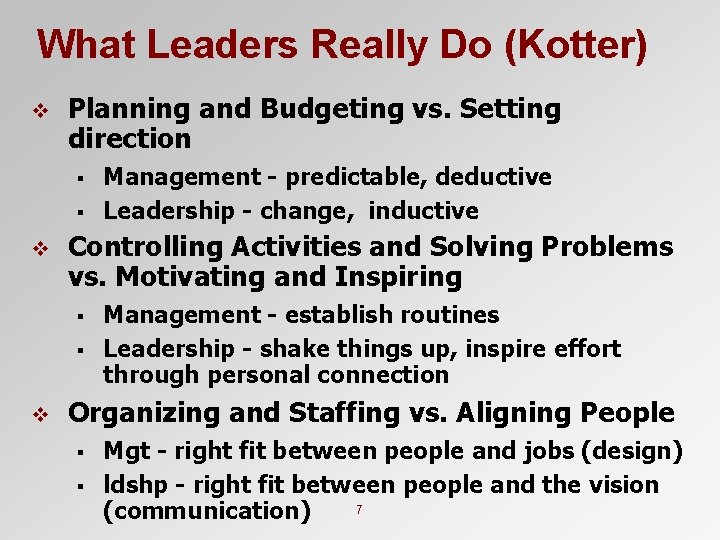
What Leaders Really Do (Kotter) v Planning and Budgeting vs. Setting direction § § v Controlling Activities and Solving Problems vs. Motivating and Inspiring § § v Management - predictable, deductive Leadership - change, inductive Management - establish routines Leadership - shake things up, inspire effort through personal connection Organizing and Staffing vs. Aligning People § § Mgt - right fit between people and jobs (design) ldshp - right fit between people and the vision 7 (communication)
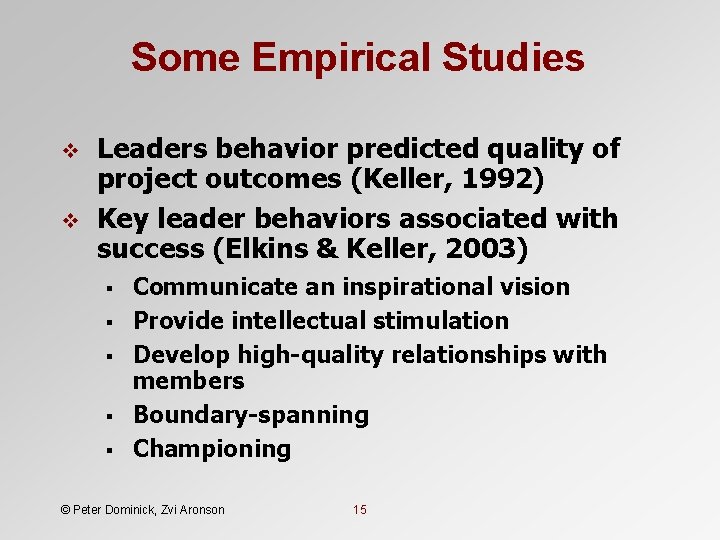
Some Empirical Studies v v Leaders behavior predicted quality of project outcomes (Keller, 1992) Key leader behaviors associated with success (Elkins & Keller, 2003) § § § Communicate an inspirational vision Provide intellectual stimulation Develop high-quality relationships with members Boundary-spanning Championing © Peter Dominick, Zvi Aronson 15
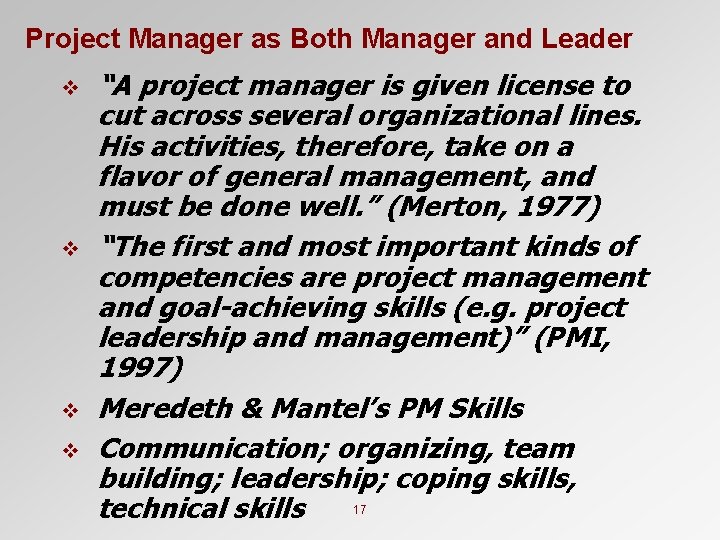
Project Manager as Both Manager and Leader v v “A project manager is given license to cut across several organizational lines. His activities, therefore, take on a flavor of general management, and must be done well. ” (Merton, 1977) “The first and most important kinds of competencies are project management and goal-achieving skills (e. g. project leadership and management)” (PMI, 1997) Meredeth & Mantel’s PM Skills Communication; organizing, team building; leadership; coping skills, 17 technical skills
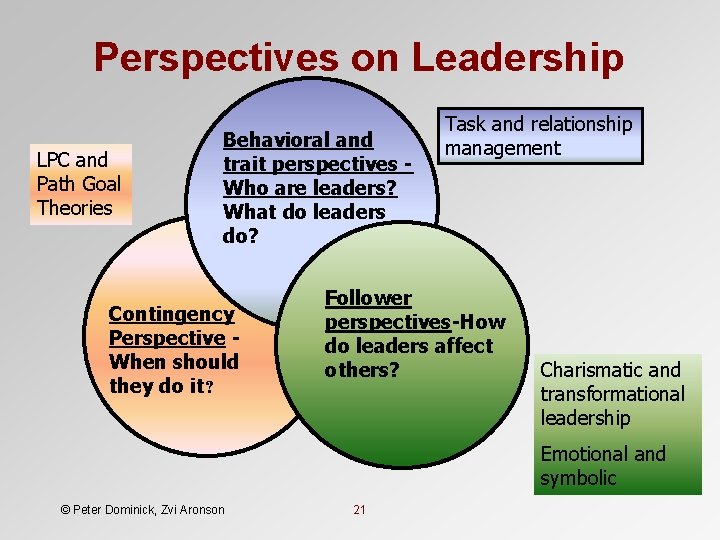
Perspectives on Leadership LPC and Path Goal Theories Behavioral and trait perspectives Who are leaders? What do leaders do? Contingency Perspective When should they do it? Task and relationship management Follower perspectives-How do leaders affect others? Charismatic and transformational leadership Emotional and symbolic © Peter Dominick, Zvi Aronson 21
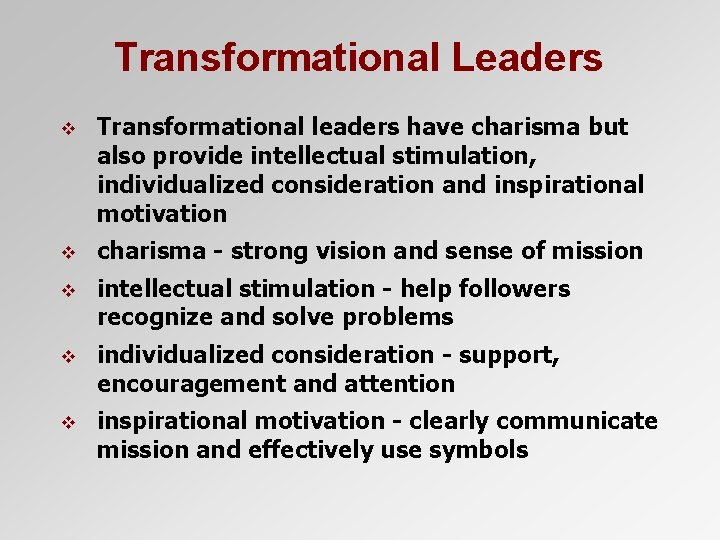
Transformational Leaders v Transformational leaders have charisma but also provide intellectual stimulation, individualized consideration and inspirational motivation v charisma - strong vision and sense of mission v intellectual stimulation - help followers recognize and solve problems v individualized consideration - support, encouragement and attention v inspirational motivation - clearly communicate mission and effectively use symbols
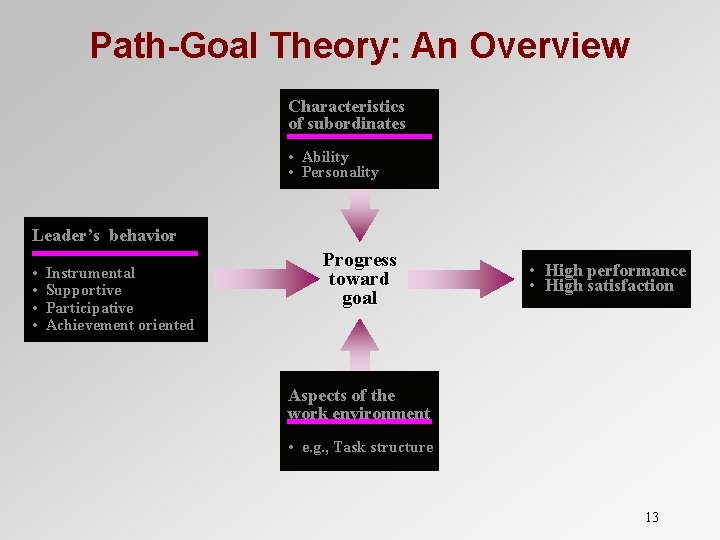
Path-Goal Theory: An Overview Characteristics of subordinates • Ability • Personality Leader’s behavior • • Instrumental Supportive Participative Achievement oriented Progress toward goal • High performance • High satisfaction Aspects of the work environment • e. g. , Task structure 13
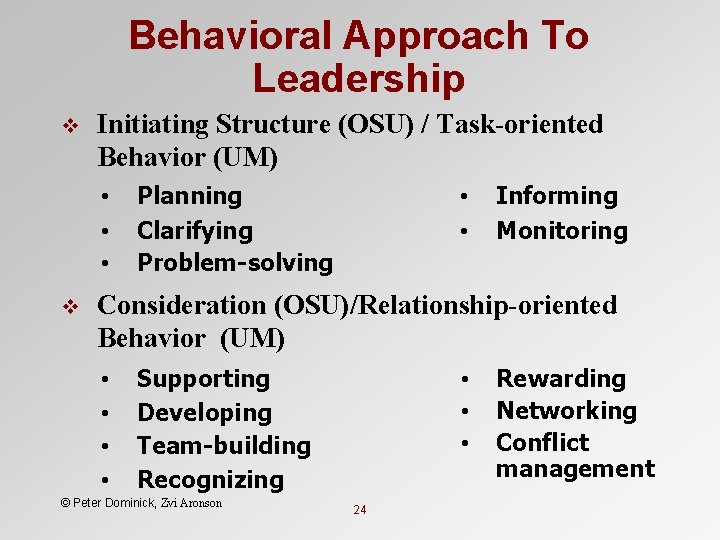
Behavioral Approach To Leadership v Initiating Structure (OSU) / Task-oriented Behavior (UM) • • • v Planning Clarifying Problem-solving • • Informing Monitoring Consideration (OSU)/Relationship-oriented Behavior (UM) • • Supporting Developing Team-building Recognizing © Peter Dominick, Zvi Aronson • • • 24 Rewarding Networking Conflict management
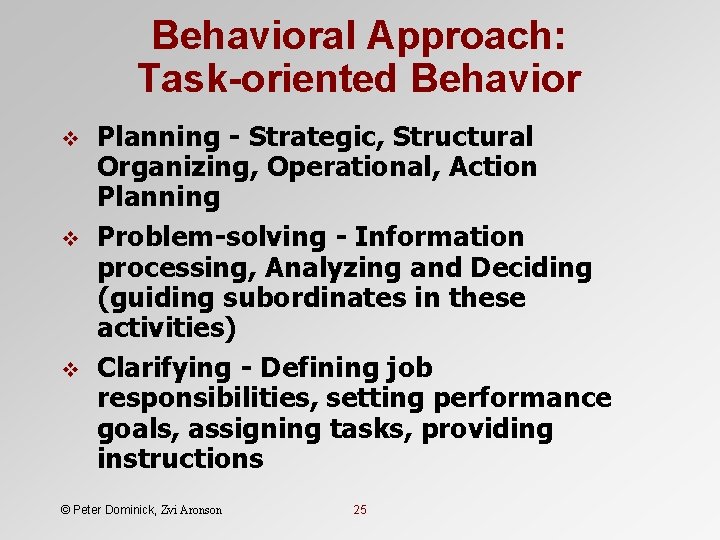
Behavioral Approach: Task-oriented Behavior v v v Planning - Strategic, Structural Organizing, Operational, Action Planning Problem-solving - Information processing, Analyzing and Deciding (guiding subordinates in these activities) Clarifying - Defining job responsibilities, setting performance goals, assigning tasks, providing instructions © Peter Dominick, Zvi Aronson 25
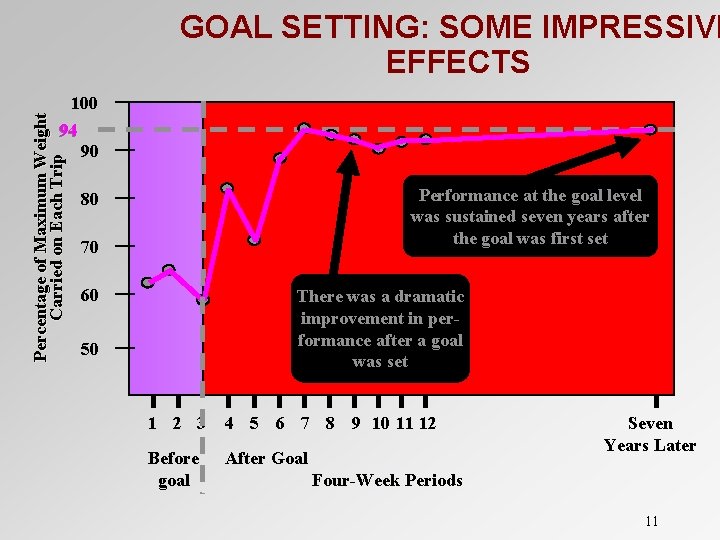
GOAL SETTING: SOME IMPRESSIVE EFFECTS Percentage of Maximum Weight Carried on Each Trip 100 94 90 Performance at the goal level was sustained seven years after the goal was first set 80 70 60 There was a dramatic improvement in performance after a goal was set 50 1 2 3 4 5 6 7 8 9 10 11 12 Before goal After Goal Seven Years Later Four-Week Periods 11
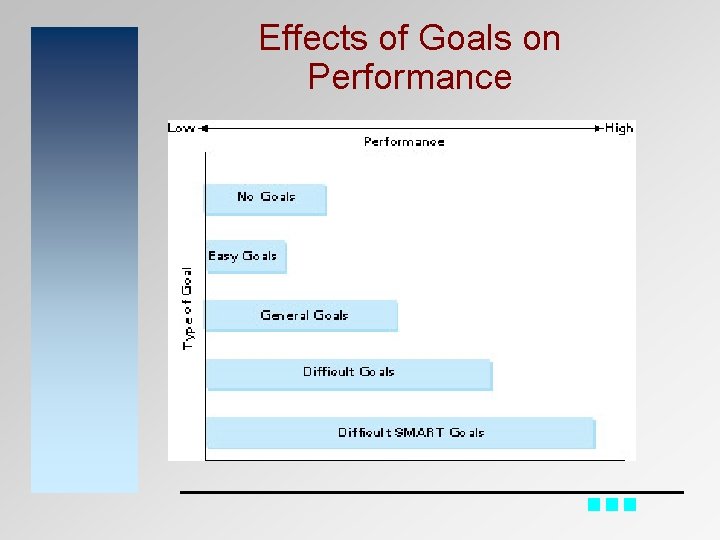
Effects of Goals on Performance Insert figure 9. 3
Behavioral Approach: Task-oriented Behavior v v Informing - Providing information, keeping others up to date (via meetings, phone, email etc, ) upward, lateral, downward, liaison role Monitoring - Observation, reviewing reports and performance data, progress review meetings, customer or market survey data, post-mortem review meetings © Peter Dominick, Zvi Aronson 28
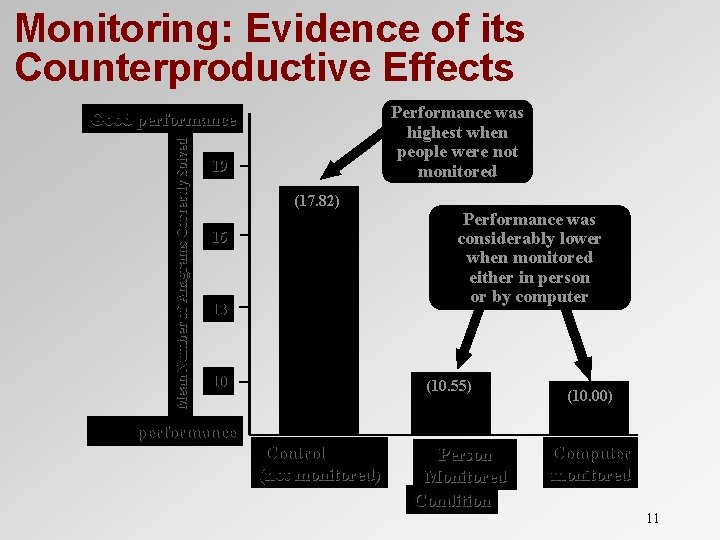
Monitoring: Evidence of its Counterproductive Effects Performance was highest when people were not monitored Mean Number of Anagrams Correctly Solved Good performance 19 (17. 82) 16 13 10 Performance was considerably lower when monitored either in person or by computer (10. 55) (10. 00) Poor performance Control group (not monitored) Person Monitored Condition Computer monitored 11
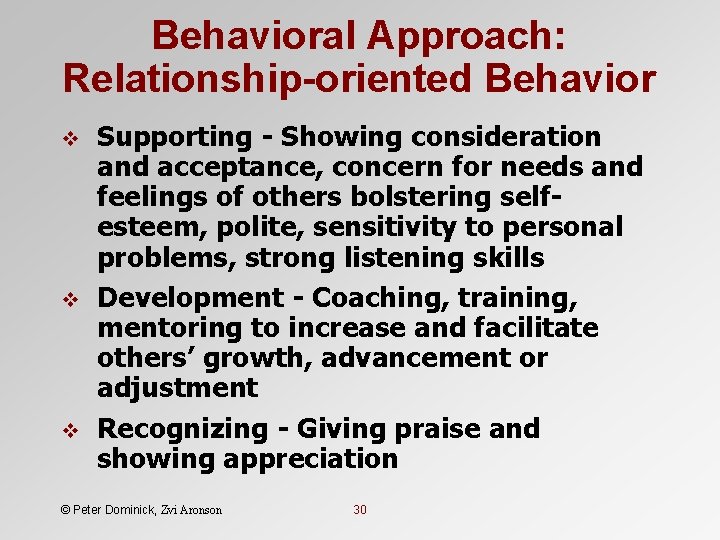
Behavioral Approach: Relationship-oriented Behavior v v v Supporting - Showing consideration and acceptance, concern for needs and feelings of others bolstering selfesteem, polite, sensitivity to personal problems, strong listening skills Development - Coaching, training, mentoring to increase and facilitate others’ growth, advancement or adjustment Recognizing - Giving praise and showing appreciation © Peter Dominick, Zvi Aronson 30
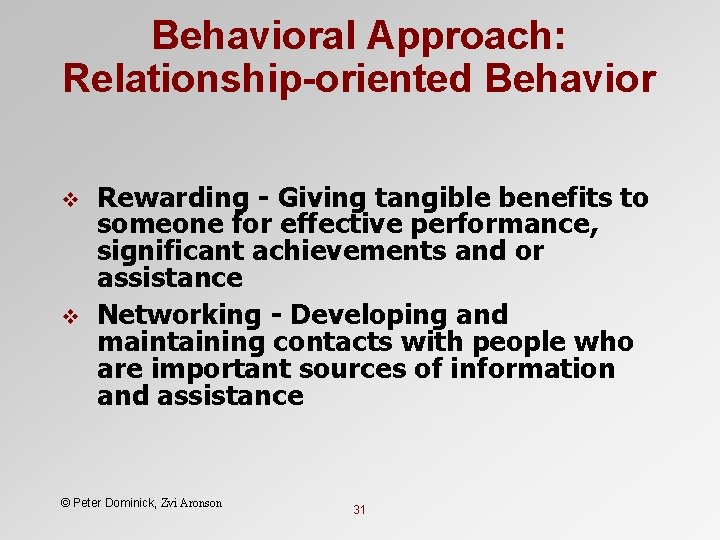
Behavioral Approach: Relationship-oriented Behavior v v Rewarding - Giving tangible benefits to someone for effective performance, significant achievements and or assistance Networking - Developing and maintaining contacts with people who are important sources of information and assistance © Peter Dominick, Zvi Aronson 31
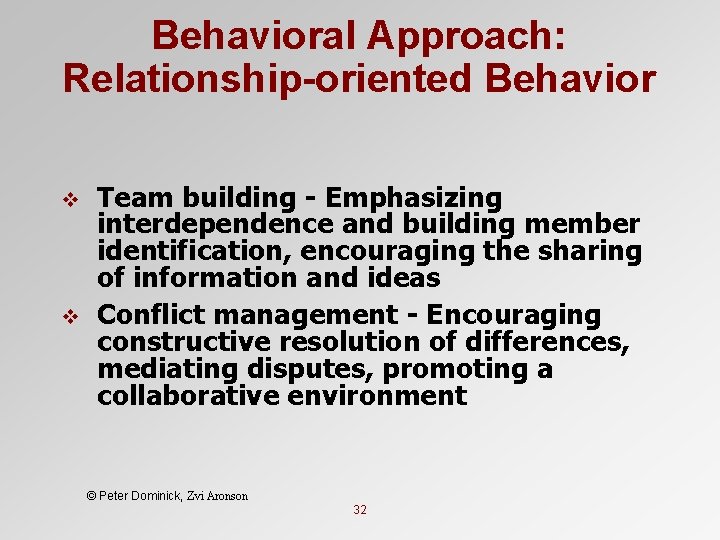
Behavioral Approach: Relationship-oriented Behavior v v Team building - Emphasizing interdependence and building member identification, encouraging the sharing of information and ideas Conflict management - Encouraging constructive resolution of differences, mediating disputes, promoting a collaborative environment © Peter Dominick, Zvi Aronson 32
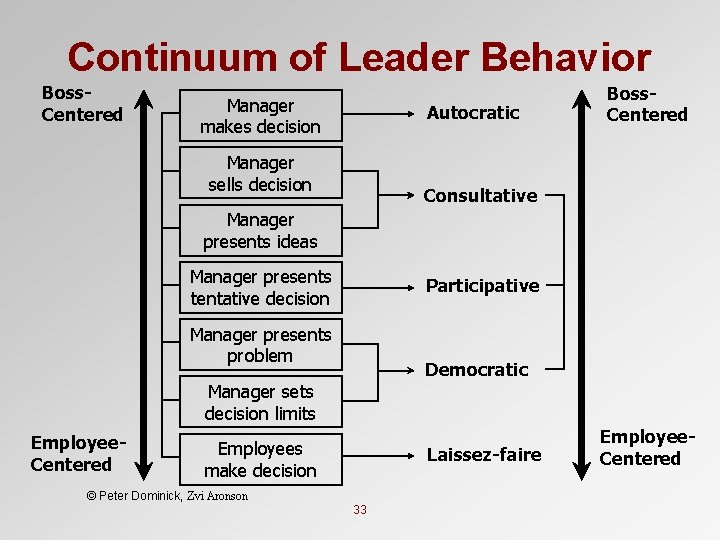
Continuum of Leader Behavior Boss. Centered Manager makes decision Autocratic Manager sells decision Boss. Centered Consultative Manager presents ideas Manager presents tentative decision Participative Manager presents problem Democratic Manager sets decision limits Employee. Centered Employees make decision Laissez-faire © Peter Dominick, Zvi Aronson 33 Employee. Centered
Group Discussion : Air Force Supply Squadron v Air Force Supply Squadron § § § What effective leadership behaviors were exhibited by Colonel Novak What does this case illustrate about effective leadership How does the leadership behavior in this case compare with the leadership behavior in the consolidated Products case © Peter Dominick, Zvi Aronson 34
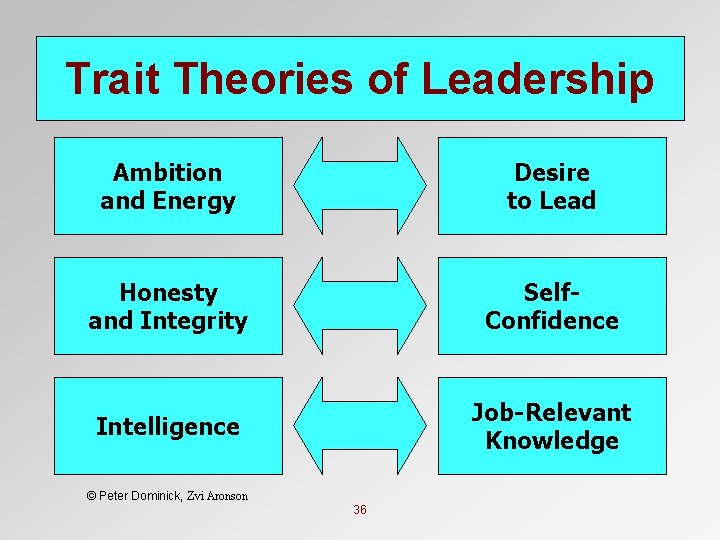
Trait Theories of Leadership Ambition and Energy Desire to Lead Honesty and Integrity Self. Confidence Intelligence Job-Relevant Knowledge © Peter Dominick, Zvi Aronson 36
Mc. Clelland’s Learned Need Theories Motives/needs are learned/acquired by the kinds of events people experience in their culture v Learned needs represent behavioral dispositions that influence the way individuals perceive situations and motivate them to pursue certain goals. v Measured using Thematic Apperception Test (TAT) v Three main needs v § n. Ach, n. Pow, n. Aff © Peter Dominick, Zvi Aronson 37
n. Ach v Competitive behavior with a standard for excellence; n. Ach people: § § § Assume personal responsibility for performing task/finding a solution Choose coworkers based upon competence rather than friendship Set moderately difficult goals and take calculated risks Have a strong desire for performance feedback Tend to view money as a form of recognition for achievement © Peter Dominick, Zvi Aronson 40
n. Pow v n. Pow people: § § Desire to influence and direct others Desire to exercise control over others Seek to maintain leader-follower relationship Make more suggestions, offer more opinions and evaluate more frequently, seek leadership positions © Peter Dominick, Zvi Aronson 41
n. Pow v Two kinds of power § § Personal power - striving to dominate for its own sake Social power - more concerned with the problems of the organization and how to solve them u Social power is a determinant of managerial success © Peter Dominick, Zvi Aronson 42
n. Aff people have: v Desire for approval and reassurance v Tendency to conform to wishes of others whose friendship they value v A sincere interest in feelings of others v Need to seek work with others v Good attendance records v Best performance with personal support and approval & supportive environment © Peter Dominick, Zvi Aronson 43
AT&T Assessment Center Research v Longitudinal study that followed individuals for 20 years. § § § Desire for advancement Dominance (need for power) Interpersonal skills Cognitive skills Administrative skills © Peter Dominick, Zvi Aronson 44
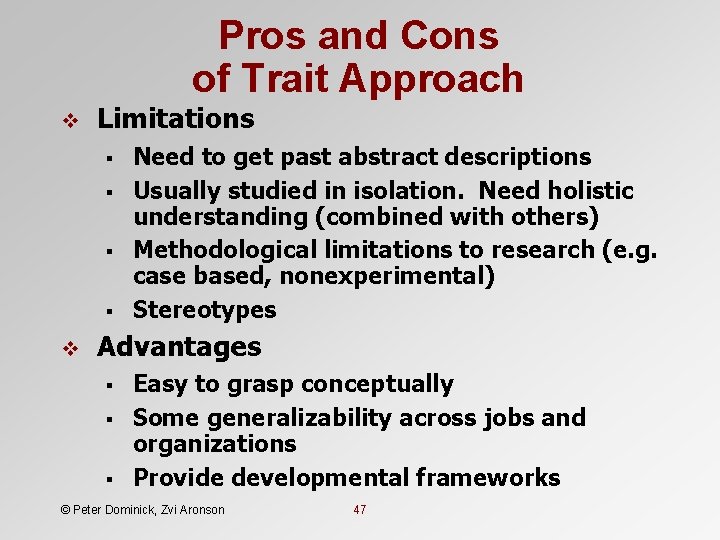
Pros and Cons of Trait Approach v Limitations § § v Need to get past abstract descriptions Usually studied in isolation. Need holistic understanding (combined with others) Methodological limitations to research (e. g. case based, nonexperimental) Stereotypes Advantages § § § Easy to grasp conceptually Some generalizability across jobs and organizations Provide developmental frameworks © Peter Dominick, Zvi Aronson 47
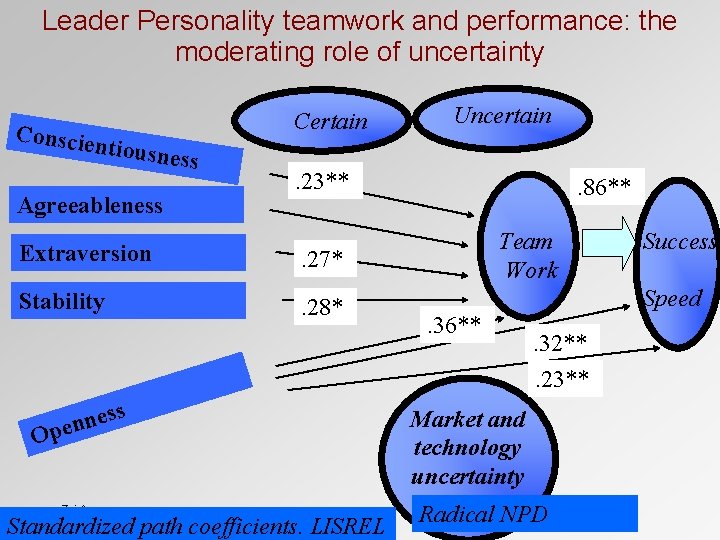
Leader Personality teamwork and performance: the moderating role of uncertainty Conscie ntiousne Agreeableness Certain ss . 23** Extraversion . 27* Stability . 28* s s e n pen O Zvi Aronson Uncertain Standardized path coefficients. LISREL . 86** Team Work. 36** Success Speed . 32**. 23** Market and technology uncertainty Radical NPD
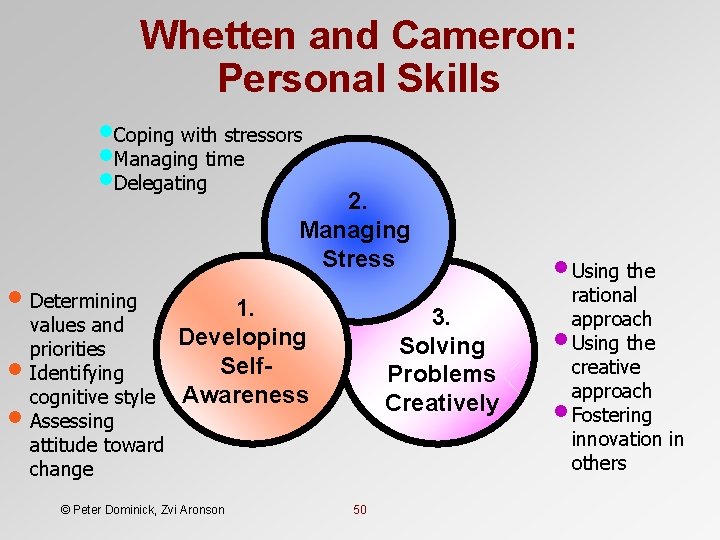
Whetten and Cameron: Personal Skills • Coping with stressors • Managing time • Delegating 2. Managing Stress • Determining 1. values and Developing priorities Self • Identifying cognitive style Awareness 3. Solving Problems Creatively • Assessing attitude toward change © Peter Dominick, Zvi Aronson 50 • Using the • • rational approach Using the creative approach Fostering innovation in others
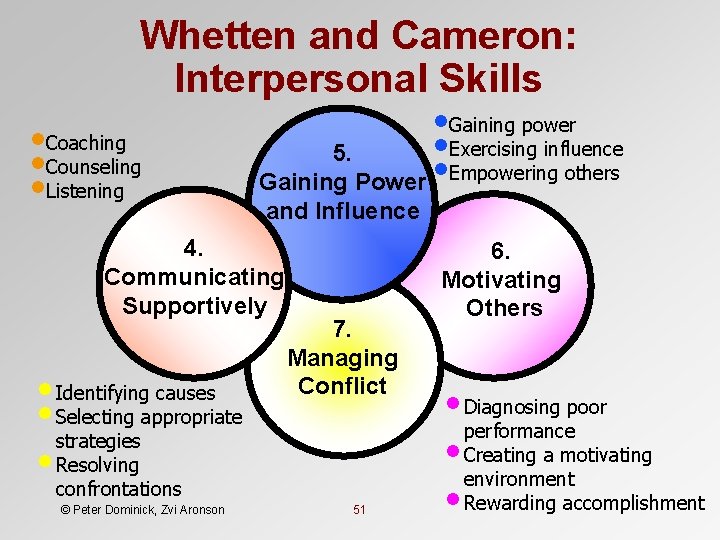
Whetten and Cameron: Interpersonal Skills • Coaching • Counseling • Listening • Gaining power • Exercising influence 5. Gaining Power • Empowering others and Influence 4. Communicating Supportively • Identifying causes • Selecting appropriate strategies • Resolving 7. Managing Conflict confrontations © Peter Dominick, Zvi Aronson 51 6. Motivating Others • Diagnosing poor performance • Creating a motivating environment • Rewarding accomplishment
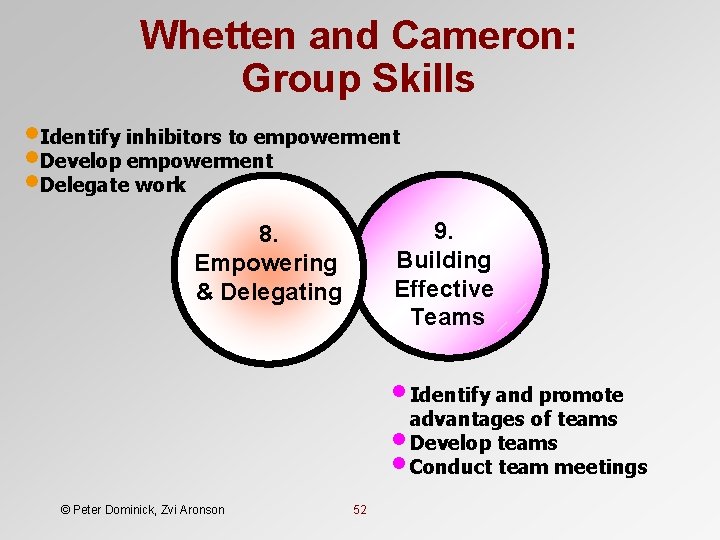
Whetten and Cameron: Group Skills • Identify inhibitors to empowerment • Develop empowerment • Delegate work 9. Building Effective Teams 8. Empowering & Delegating • Identify and promote advantages of teams • Develop teams • Conduct team meetings © Peter Dominick, Zvi Aronson 52
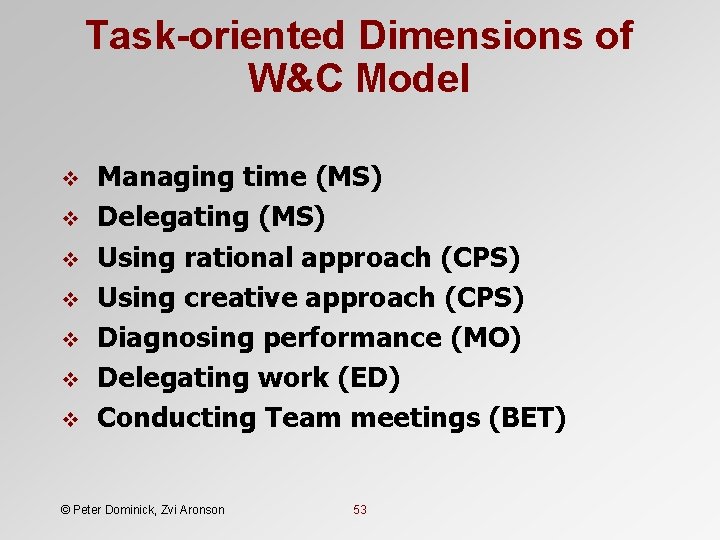
Task-oriented Dimensions of W&C Model v v v v Managing time (MS) Delegating (MS) Using rational approach (CPS) Using creative approach (CPS) Diagnosing performance (MO) Delegating work (ED) Conducting Team meetings (BET) © Peter Dominick, Zvi Aronson 53
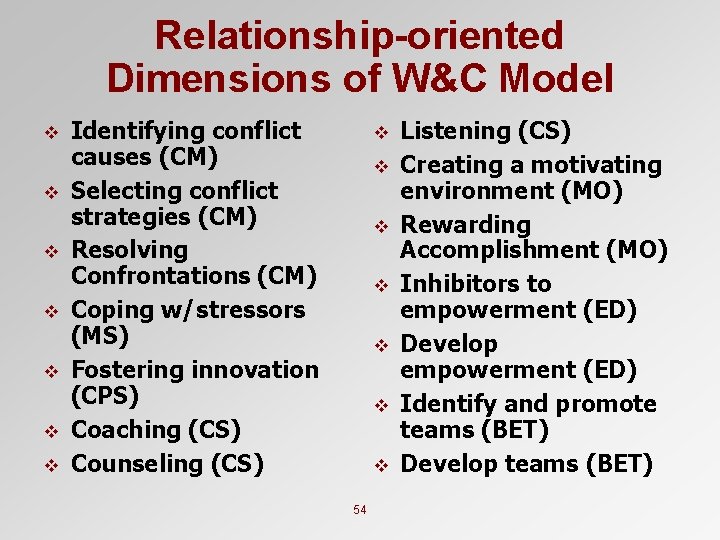
Relationship-oriented Dimensions of W&C Model v v v v Identifying conflict causes (CM) Selecting conflict strategies (CM) Resolving Confrontations (CM) Coping w/stressors (MS) Fostering innovation (CPS) Coaching (CS) Counseling (CS) v v v v 54 Listening (CS) Creating a motivating environment (MO) Rewarding Accomplishment (MO) Inhibitors to empowerment (ED) Develop empowerment (ED) Identify and promote teams (BET) Develop teams (BET)
Assignment Reminder ! v v Continue reading and working with the texts Following items due § § MSQ – next week SSS-Software In-Basket – next week