
LEADING HIGHER EDUCATION AS AND FOR PUBLIC GOOD

LEADING HIGHER EDUCATION AS AND FOR PUBLIC GOOD: REKINDLING EDUCATION AS PRAXIS Presentation at research seminar for Utbildning och Demokrati, 20 May 2021 14. 15 -15. 15 Molly Sutphen, Tone Dyrdal Solbrekke, Tomas Englund, and Ciaran Sugure
Formation & Competence Building of University Academic Developers • Participating Universities (2015 -2020/21): Oslo Tromsø Uppsala Örebro UCD UNC-CH • http: //www. uv. uio. no/iped/english/research/project s/solbrekke-formation-and-competence-building/

What can we study in higher education?
What can we study in higher education?
What can we study in higher education?

Part I: Problem and theoretical perspectives • Ch 1: Leading Higher Education as and for public good: New beginnings • Ch 2. Leading Higher Education: Putting education centre stage • Ch 3. Higher education as and for public good: Past, present and possible futures • Ch 4. Leading in a web of commitments: negotiating legitimate compromises • Ch 5. Leading higher education: Deliberative communication as praxis and research
Part II: Intervention studies Ch 6. Intellectual virtues for leading higher education Ch 7. Deliberative Communication: Stimulating collective learning? Ch 8. Deliberative leadership: Moving beyond dialogue Ch 9. Deliberative communication as pedagogical leadership: Promoting public good? Ch 10. Nurturing pedagogical praxis through deliberative communication Ch 11. Rekindling education as praxis: The promise of deliberative leadership
Part III: Reconceptualisation of deliberative communication for deliberative leadership Ch. 11: Rekindling education as praxis: The promise of deliberative leadership
Methods to study ourselves • Insider—outsider research • Abductive, iterative approach • Researchers consisted of: – Critical friends – Academic developers (ADs) • What we studied: Deliberative communciation as ADs used when they taught courses to academics
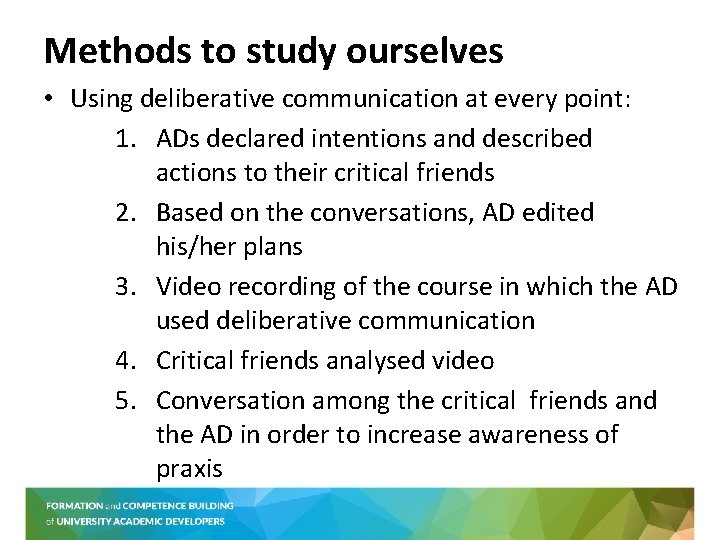
Methods to study ourselves • Using deliberative communication at every point: 1. ADs declared intentions and described actions to their critical friends 2. Based on the conversations, AD edited his/her plans 3. Video recording of the course in which the AD used deliberative communication 4. Critical friends analysed video 5. Conversation among the critical friends and the AD in order to increase awareness of praxis
Concepts we studied • As we studied ourselves, we drew on established concepts: – Public good – Deliberative communication – Web of commitments • And developed a new one: – Deliberative leadership
The ongoing shift from public good to private good • Consequences for higher education / universities: commercialization, commodification, competition and classification (Nixon) • Entrepreneurial and bureaucratic rationality of universities developing to a mixed, instrumental rationality for private good, but a weakened interest for communicative reason (Barnett, Habermas) • Proposing a communicative rationality as leading for the universities’ moral direction and strive for the public good
Deliberative communication • Stands for communication in which different opinions and values can be set against each other. It implies an endeavor by each individual to develop his or her view by listening, deliberating, seeking arguments and valuing, coupled to a collective and cooperative endeavor to find values and norms which everyone can accept, at the same time as pluralism is acknowledged
Deliberative communication 1. Different views are confronted with one another and arguments for these different views are given time and space to be articulated and presented 2. There is tolerance and respect for the concrete other and participants learn to listen to the other person’s argument 3. Elements of collective will-formation are present, i. e. an endeavor to reach consensus or at least temporary agreements or to draw attention to differences; 4. Authorities or traditional views can be questioned, and there are opportunities to challenge one’s own tradition and 5. There is also scope for students to communicate and deliberate without teacher control, i. e. for argumentative discussions between students with the aim of solving problems or shedding light on them from different points of view

Deliberative leadership • From individual to collective agency • Reconceptualise the principles of deliberative communication, to a new theory of leadership by starting with: – Higher education’s purpose as and for public good – ‘Distributed leadership’ – collective endeavor: Leading is teaching – teaching is leading – Acknowledgement of the multiple and diverse ‘web of commitments’ – A need of ‘brokering’
Some questions • How do you define the parameters of your webs of commitments? • How do you use reflective practices such as deliberative communication? • How is your teaching a form of leading? • How does your local institution support spaces for deliberative leadership?
- Slides: 18