
Leading for Impact Decision criteria for new opportunities
- Slides: 17
Leading for Impact: Decision criteria for new opportunities Collaborating to accelerate social impact
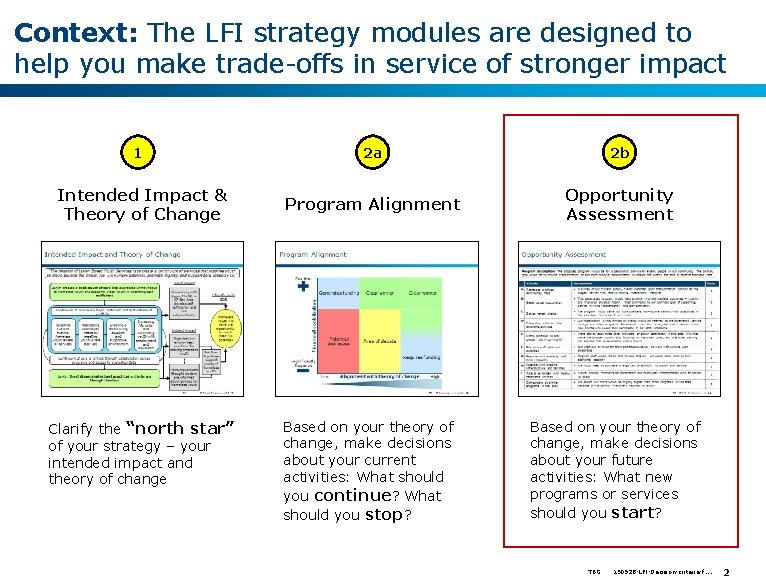
Context: The LFI strategy modules are designed to help you make trade-offs in service of stronger impact 1 Intended Impact & Theory of Change Clarify the “north star” of your strategy – your intended impact and theory of change 2 a 2 b Program Alignment Opportunity Assessment Based on your theory of change, make decisions about your current activities: What should you continue? What should you stop? Based on your theory of change, make decisions about your future activities: What new programs or services should you start? TBG 150928 -LFI-Decision-criteria-f. . . 2
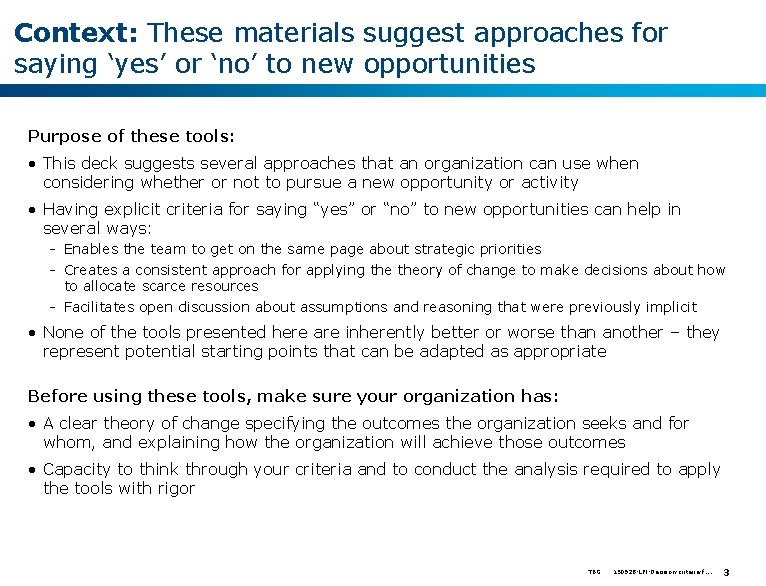
Context: These materials suggest approaches for saying ‘yes’ or ‘no’ to new opportunities Purpose of these tools: • This deck suggests several approaches that an organization can use when considering whether or not to pursue a new opportunity or activity • Having explicit criteria for saying “yes” or “no” to new opportunities can help in several ways: - Enables the team to get on the same page about strategic priorities - Creates a consistent approach for applying theory of change to make decisions about how to allocate scarce resources - Facilitates open discussion about assumptions and reasoning that were previously implicit • None of the tools presented here are inherently better or worse than another – they represent potential starting points that can be adapted as appropriate Before using these tools, make sure your organization has: • A clear theory of change specifying the outcomes the organization seeks and for whom, and explaining how the organization will achieve those outcomes • Capacity to think through your criteria and to conduct the analysis required to apply the tools with rigor TBG 150928 -LFI-Decision-criteria-f. . . 3
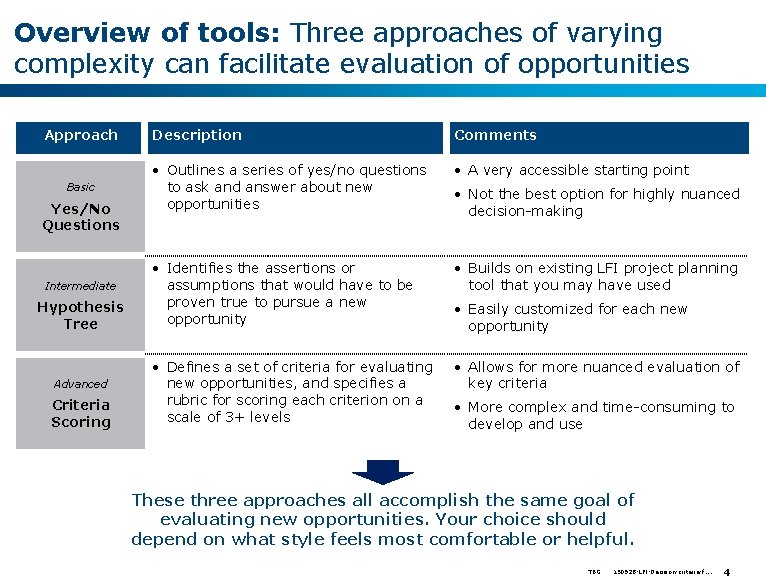
Overview of tools: Three approaches of varying complexity can facilitate evaluation of opportunities Approach Basic Yes/No Questions Intermediate Hypothesis Tree Advanced Criteria Scoring Description Comments • Outlines a series of yes/no questions to ask and answer about new opportunities • A very accessible starting point • Identifies the assertions or assumptions that would have to be proven true to pursue a new opportunity • Builds on existing LFI project planning tool that you may have used • Defines a set of criteria for evaluating new opportunities, and specifies a rubric for scoring each criterion on a scale of 3+ levels • Allows for more nuanced evaluation of key criteria • Not the best option for highly nuanced decision-making • Easily customized for each new opportunity • More complex and time-consuming to develop and use These three approaches all accomplish the same goal of evaluating new opportunities. Your choice should depend on what style feels most comfortable or helpful. TBG 150928 -LFI-Decision-criteria-f. . . 4
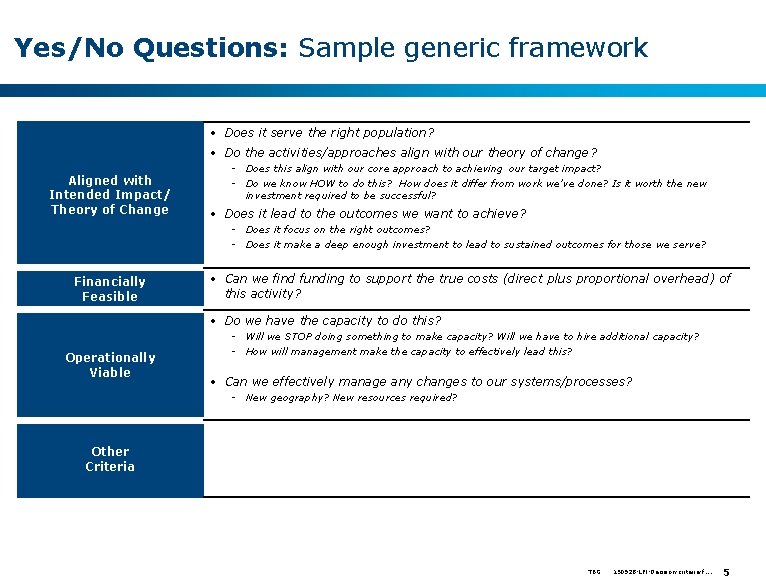
Yes/No Questions: Sample generic framework • Does it serve the right population? • Do the activities/approaches align with our theory of change? Aligned with Intended Impact/ Theory of Change - Does this align with our core approach to achieving our target impact? - Do we know HOW to do this? How does it differ from work we’ve done? Is it worth the new investment required to be successful? • Does it lead to the outcomes we want to achieve? - Does it focus on the right outcomes? - Does it make a deep enough investment to lead to sustained outcomes for those we serve? Financially Feasible • Can we find funding to support the true costs (direct plus proportional overhead) of this activity? • Do we have the capacity to do this? Operationally Viable - Will we STOP doing something to make capacity? Will we have to hire additional capacity? - How will management make the capacity to effectively lead this? • Can we effectively manage any changes to our systems/processes? - New geography? New resources required? Other Criteria TBG 150928 -LFI-Decision-criteria-f. . . 5
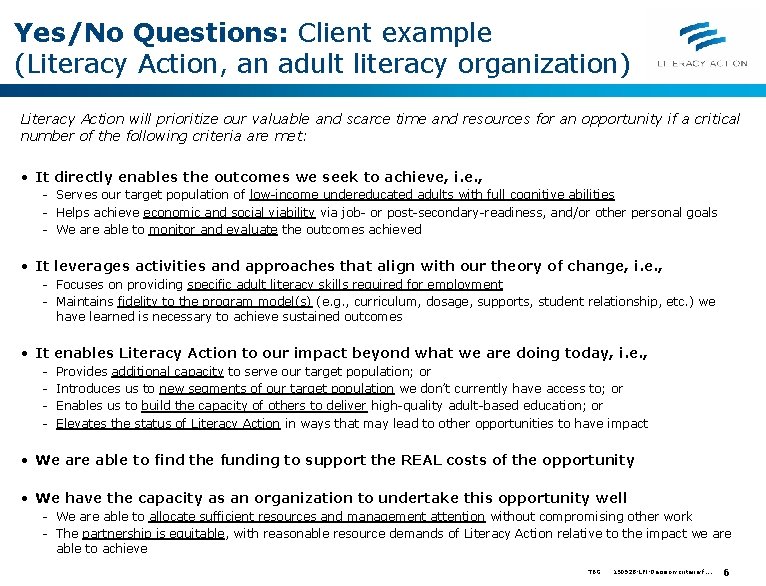
Yes/No Questions: Client example (Literacy Action, an adult literacy organization) Literacy Action will prioritize our valuable and scarce time and resources for an opportunity if a critical number of the following criteria are met: • It directly enables the outcomes we seek to achieve, i. e. , - Serves our target population of low-income undereducated adults with full cognitive abilities - Helps achieve economic and social viability via job- or post-secondary-readiness, and/or other personal goals - We are able to monitor and evaluate the outcomes achieved • It leverages activities and approaches that align with our theory of change, i. e. , - Focuses on providing specific adult literacy skills required for employment - Maintains fidelity to the program model(s) (e. g. , curriculum, dosage, supports, student relationship, etc. ) we have learned is necessary to achieve sustained outcomes • It enables Literacy Action to our impact beyond what we are doing today, i. e. , - Provides additional capacity to serve our target population; or Introduces us to new segments of our target population we don’t currently have access to; or Enables us to build the capacity of others to deliver high-quality adult-based education; or Elevates the status of Literacy Action in ways that may lead to other opportunities to have impact • We are able to find the funding to support the REAL costs of the opportunity • We have the capacity as an organization to undertake this opportunity well - We are able to allocate sufficient resources and management attention without compromising other work - The partnership is equitable, with reasonable resource demands of Literacy Action relative to the impact we are able to achieve TBG 150928 -LFI-Decision-criteria-f. . . 6
Yes/No Questions: Worksheet • xx Aligned with Intended Impact/ Theory of Change • xx Financially Feasible • xx Operationally Viable • xx Other Criteria TBG 150928 -LFI-Decision-criteria-f. . . 7
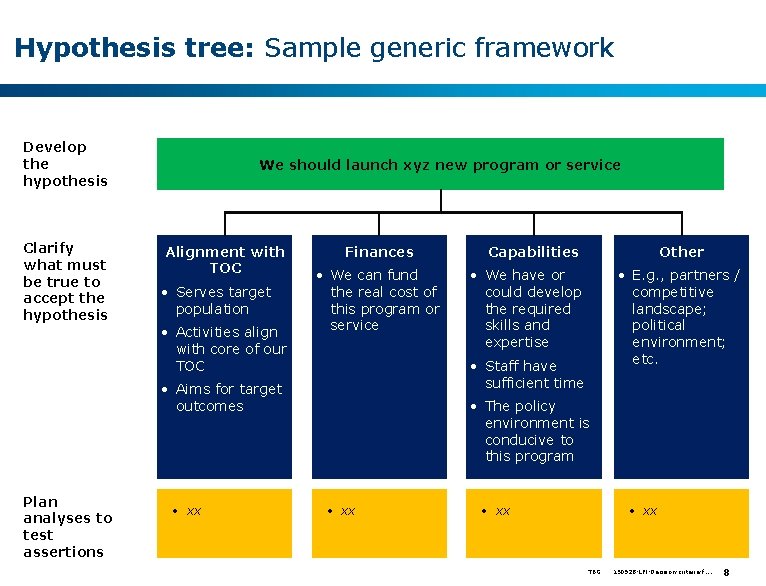
Hypothesis tree: Sample generic framework Develop the hypothesis Clarify what must be true to accept the hypothesis We should launch xyz new program or service Alignment with TOC • Serves target population • Activities align with core of our TOC Finances • We can fund the real cost of this program or service • xx Other • We have or could develop the required skills and expertise • E. g. , partners / competitive landscape; political environment; etc. • Staff have sufficient time • Aims for target outcomes Plan analyses to test assertions Capabilities • The policy environment is conducive to this program • xx TBG 150928 -LFI-Decision-criteria-f. . . 8
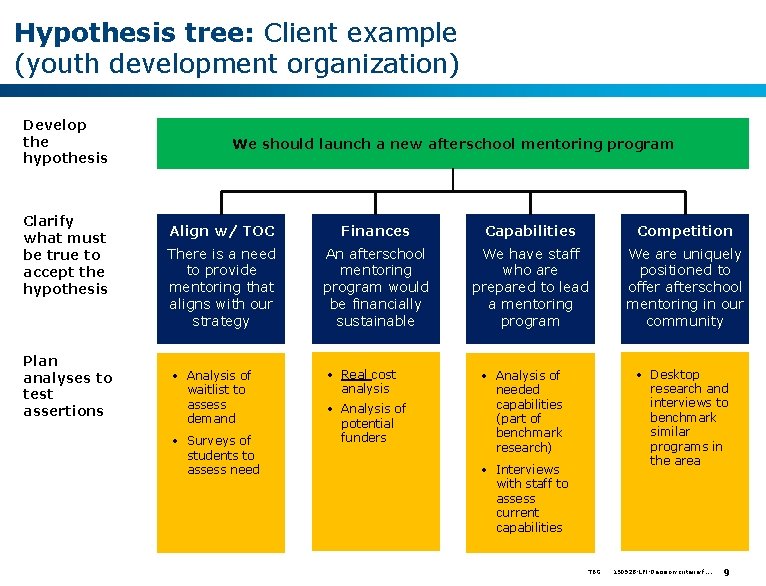
Hypothesis tree: Client example (youth development organization) Develop the hypothesis Clarify what must be true to accept the hypothesis Plan analyses to test assertions We should launch a new afterschool mentoring program Align w/ TOC Finances Capabilities Competition There is a need to provide mentoring that aligns with our strategy An afterschool mentoring program would be financially sustainable We have staff who are prepared to lead a mentoring program We are uniquely positioned to offer afterschool mentoring in our community • Analysis of waitlist to assess demand • Surveys of students to assess need • Real cost analysis • Analysis of potential funders • Desktop research and interviews to benchmark similar programs in the area • Analysis of needed capabilities (part of benchmark research) • Interviews with staff to assess current capabilities TBG 150928 -LFI-Decision-criteria-f. . . 9
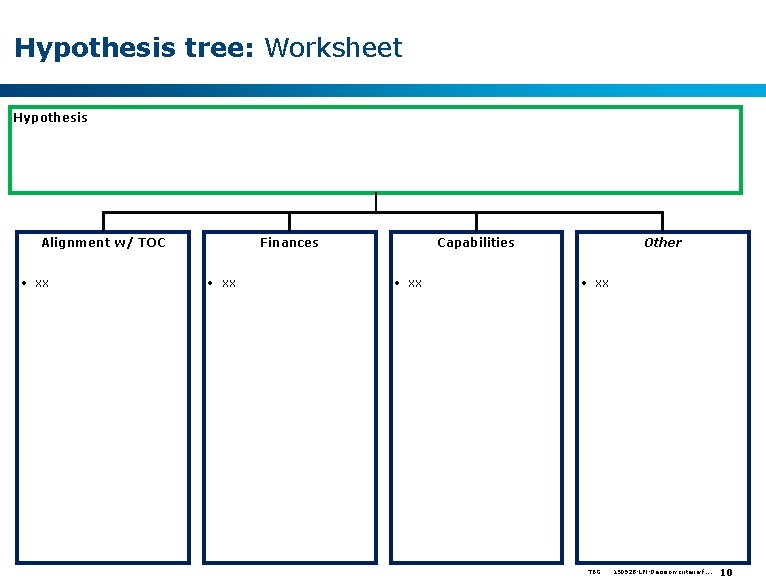
Hypothesis tree: Worksheet Hypothesis Alignment w/ TOC • xx Finances • xx Capabilities • xx Other • xx TBG 150928 -LFI-Decision-criteria-f. . . 10
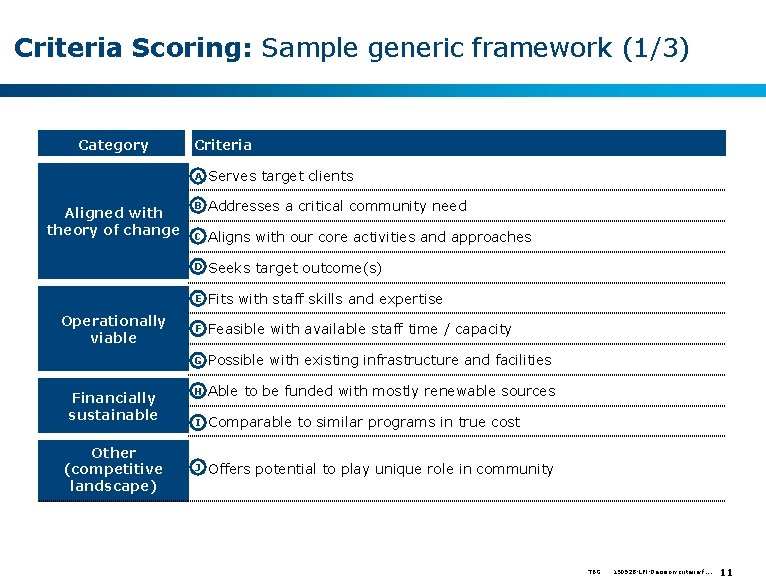
Criteria Scoring: Sample generic framework (1/3) Category Criteria A Serves target clients • B Addresses a critical community need • Aligned with theory of change • C Aligns with our core activities and approaches D Seeks target outcome(s) • • E Fits with staff skills and expertise Operationally viable • F Feasible with available staff time / capacity G Possible with existing infrastructure and facilities • Financially sustainable Other (competitive landscape) H Able to be funded with mostly renewable sources • • I Comparable to similar programs in true cost • J Offers potential to play unique role in community TBG 150928 -LFI-Decision-criteria-f. . . 11
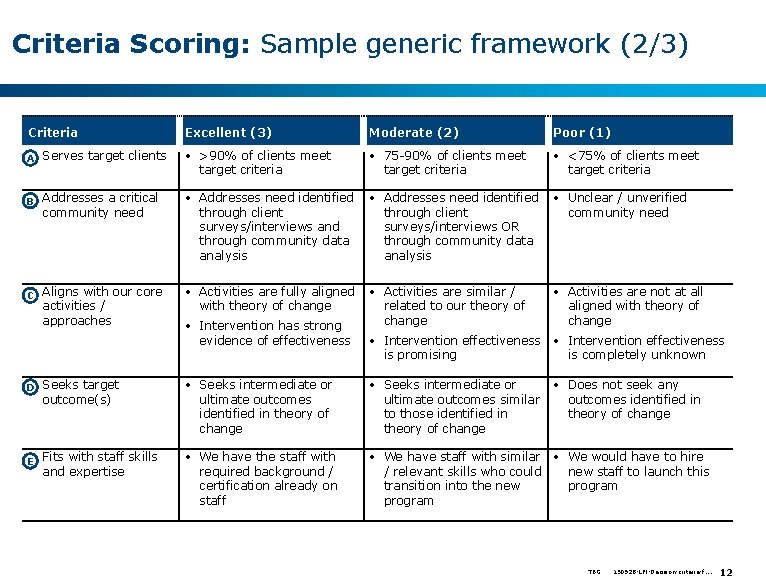
Criteria Scoring: Sample generic framework (2/3) Criteria Excellent (3) Moderate (2) Poor (1) • A Serves target clients • >90% of clients meet target criteria • 75 -90% of clients meet target criteria • <75% of clients meet target criteria • B Addresses a critical community need • Addresses need identified through client surveys/interviews and through community data analysis • Addresses need identified through client surveys/interviews OR through community data analysis • Unclear / unverified community need • C Aligns with our core activities / approaches • Activities are fully aligned with theory of change • Activities are similar / related to our theory of change • Activities are not at all aligned with theory of change • Intervention effectiveness is promising • Intervention effectiveness is completely unknown • Does not seek any outcomes identified in theory of change • Intervention has strong evidence of effectiveness • D Seeks target outcome(s) • Seeks intermediate or ultimate outcomes identified in theory of change • Seeks intermediate or ultimate outcomes similar to those identified in theory of change • E Fits with staff skills and expertise • We have the staff with required background / certification already on staff • We have staff with similar • We would have to hire / relevant skills who could new staff to launch this transition into the new program TBG 150928 -LFI-Decision-criteria-f. . . 12
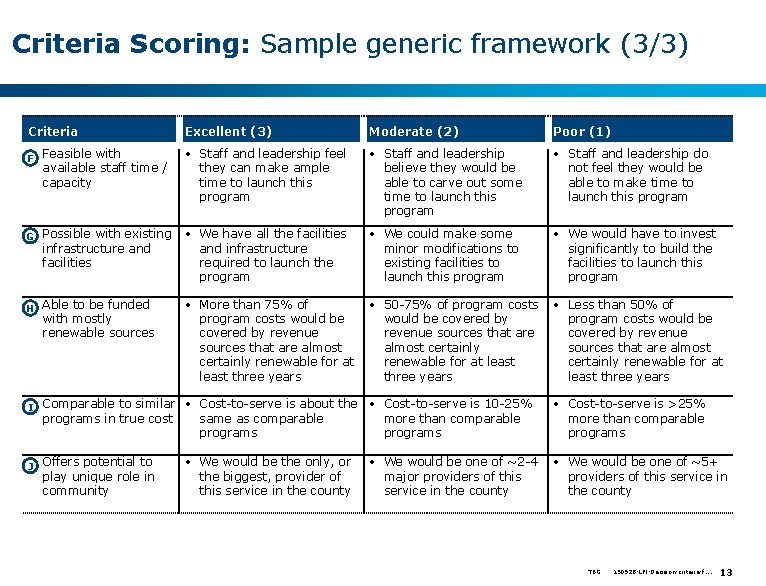
Criteria Scoring: Sample generic framework (3/3) Criteria Excellent (3) Moderate (2) Poor (1) • F Feasible with available staff time / capacity • Staff and leadership feel they can make ample time to launch this program • Staff and leadership believe they would be able to carve out some time to launch this program • Staff and leadership do not feel they would be able to make time to launch this program • G Possible with existing infrastructure and facilities • We have all the facilities and infrastructure required to launch the program • We could make some minor modifications to existing facilities to launch this program • We would have to invest significantly to build the facilities to launch this program • H Able to be funded with mostly renewable sources • More than 75% of program costs would be covered by revenue sources that are almost certainly renewable for at least three years • 50 -75% of program costs would be covered by revenue sources that are almost certainly renewable for at least three years • Less than 50% of program costs would be covered by revenue sources that are almost certainly renewable for at least three years I • Comparable to similar • Cost-to-serve is about the • Cost-to-serve is 10 -25% programs in true cost same as comparable more than comparable programs J • Offers potential to play unique role in community • We would be the only, or the biggest, provider of this service in the county • We would be one of ~2 -4 major providers of this service in the county • Cost-to-serve is >25% more than comparable programs • We would be one of ~5+ providers of this service in the county TBG 150928 -LFI-Decision-criteria-f. . . 13
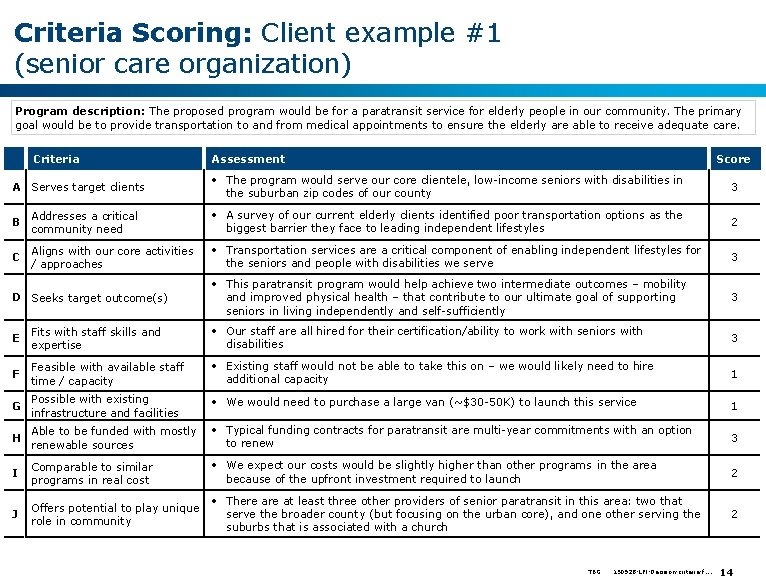
Criteria Scoring: Client example #1 (senior care organization) Program description: The proposed program would be for a paratransit service for elderly people in our community. The primary goal would be to provide transportation to and from medical appointments to ensure the elderly are able to receive adequate care. Criteria A Serves target clients Assessment Score • The program would serve our core clientele, low-income seniors with disabilities in the suburban zip codes of our county 3 B Addresses a critical community need • A survey of our current elderly clients identified poor transportation options as the biggest barrier they face to leading independent lifestyles 2 C Aligns with our core activities / approaches • Transportation services are a critical component of enabling independent lifestyles for the seniors and people with disabilities we serve 3 • This paratransit program would help achieve two intermediate outcomes – mobility and improved physical health – that contribute to our ultimate goal of supporting seniors in living independently and self-sufficiently 3 D Seeks target outcome(s) E Fits with staff skills and expertise • Our staff are all hired for their certification/ability to work with seniors with disabilities 3 F Feasible with available staff time / capacity • Existing staff would not be able to take this on – we would likely need to hire additional capacity 1 G Possible with existing infrastructure and facilities • We would need to purchase a large van (~$30 -50 K) to launch this service 1 H Able to be funded with mostly renewable sources • Typical funding contracts for paratransit are multi-year commitments with an option to renew 3 I Comparable to similar programs in real cost • We expect our costs would be slightly higher than other programs in the area because of the upfront investment required to launch 2 J Offers potential to play unique role in community • There at least three other providers of senior paratransit in this area: two that serve the broader county (but focusing on the urban core), and one other serving the suburbs that is associated with a church 2 TBG 150928 -LFI-Decision-criteria-f. . . 14
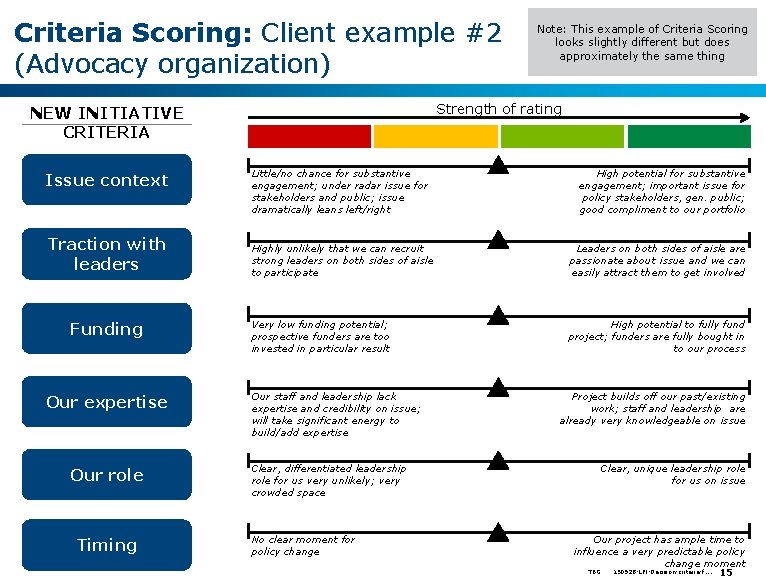
Criteria Scoring: Client example #2 (Advocacy organization) Strength of rating NEW INITIATIVE CRITERIA Issue context Traction with leaders Funding Our expertise Our role Timing Note: This example of Criteria Scoring looks slightly different but does approximately the same thing Little/no chance for substantive engagement; under radar issue for stakeholders and public; issue dramatically leans left/right High potential for substantive engagement; important issue for policy stakeholders, gen. public; good compliment to our portfolio Highly unlikely that we can recruit strong leaders on both sides of aisle to participate Leaders on both sides of aisle are passionate about issue and we can easily attract them to get involved Very low funding potential; prospective funders are too invested in particular result High potential to fully fund project; funders are fully bought in to our process Our staff and leadership lack expertise and credibility on issue; will take significant energy to build/add expertise Clear, differentiated leadership role for us very unlikely; very crowded space No clear moment for policy change Project builds off our past/existing work; staff and leadership are already very knowledgeable on issue Clear, unique leadership role for us on issue Our project has ample time to influence a very predictable policy change moment TBG 150928 -LFI-Decision-criteria-f. . . 15
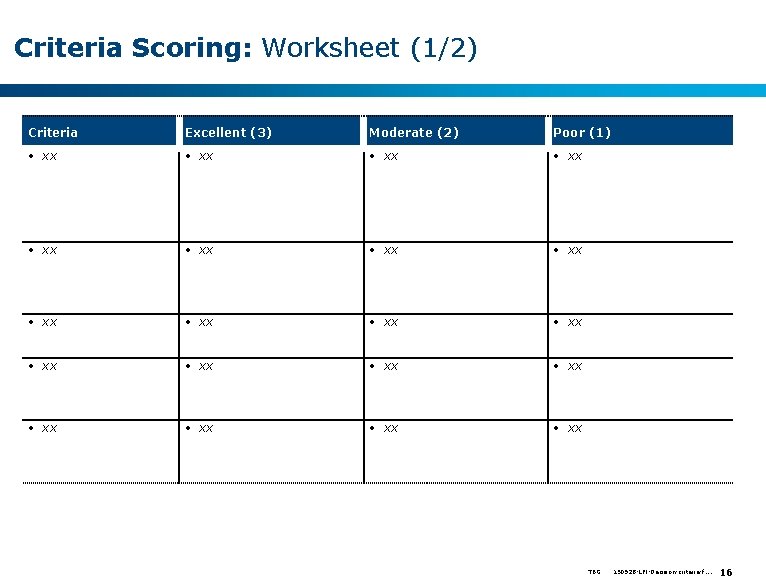
Criteria Scoring: Worksheet (1/2) Criteria Excellent (3) Moderate (2) Poor (1) • xx • xx • xx • xx • xx TBG 150928 -LFI-Decision-criteria-f. . . 16
Criteria Scoring: Worksheet (2/2) Program description: Criteria A xx Assessment Score • xx B xx C xx • xx D xx • xx E xx F G xx xx • xx H xx • xx I • xx J xx xx • xx TBG 150928 -LFI-Decision-criteria-f. . . 17