
Leading Edge Teaching edge Your totem goes here
- Slides: 46
Leading Edge™ / Teaching edge™ Your totem goes here, you may use a build if you desire Your name goes here Your course position goes here NE-II-177
Learning Objectives At the conclusion of this presentation, you should be able to: describe the four leadership behaviors included in the Leading EDGETM, and explain which behavior is most appropriate for each stage of team development. describe the four skills instruction behaviors TM included in the Teaching EDGE , and explain which behavior is most appropriate for each stage of skills development. NE-II-177 2
Effective Leadership More than one style of leadership to match the people and the situation. To choose the right style use… The Leading EDGE NE-II-177 3 TM
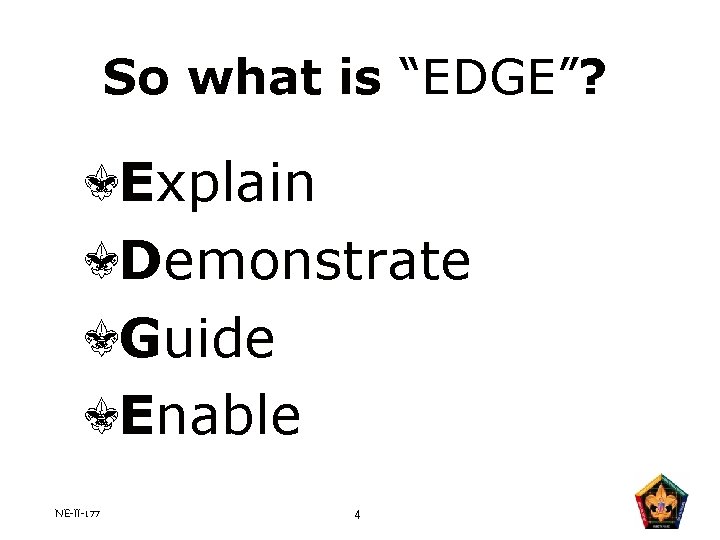
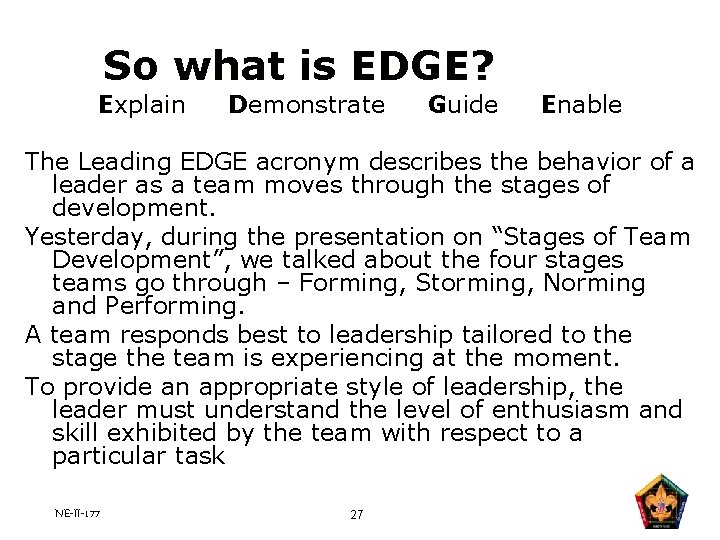
So what is “EDGE”? Explain Demonstrate Guide Enable NE-II-177 4
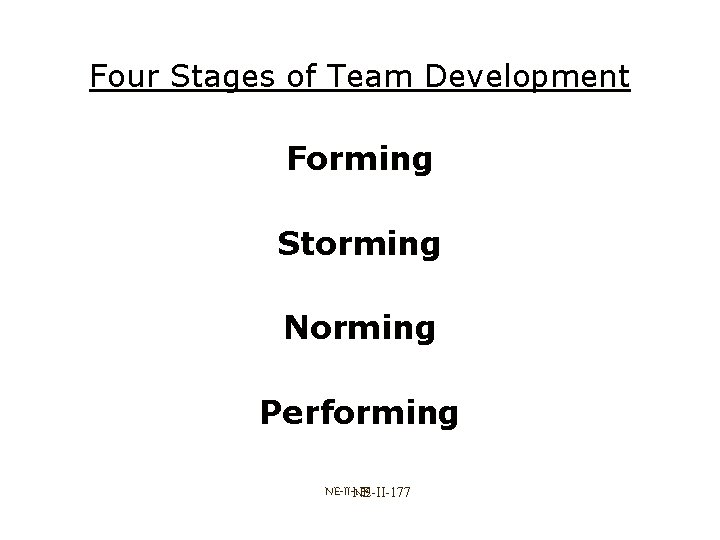
Four Stages of Team Development Forming Storming Norming Performing NE-II-159 NE-II-177
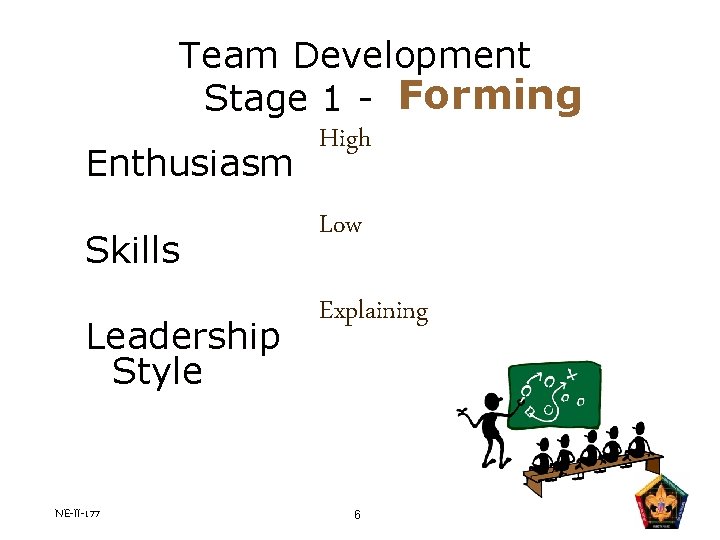
Team Development Stage 1 - Forming High Enthusiasm Skills Leadership Style NE-II-177 Low Explaining 6
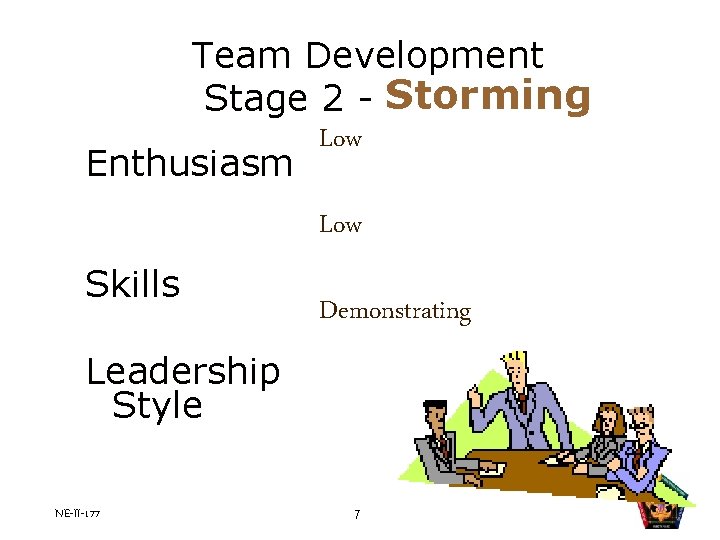
Team Development Stage 2 - Storming Low Enthusiasm Low Skills Demonstrating Leadership Style NE-II-177 7
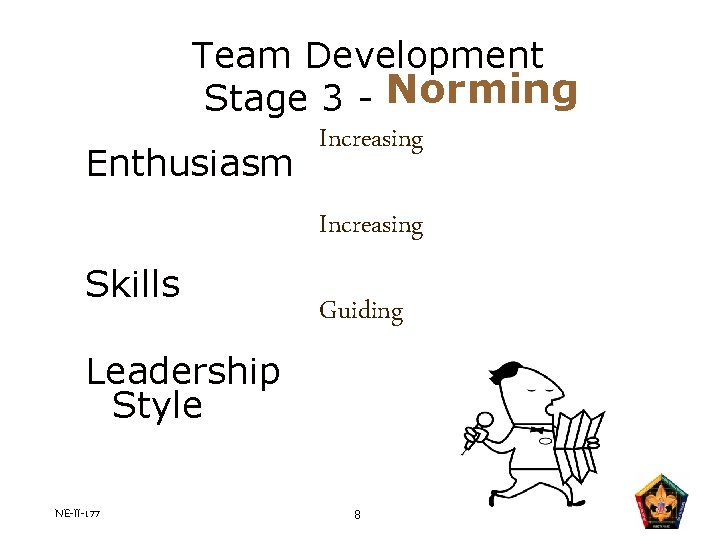
Team Development Stage 3 - Norming Increasing Enthusiasm Increasing Skills Guiding Leadership Style NE-II-177 8
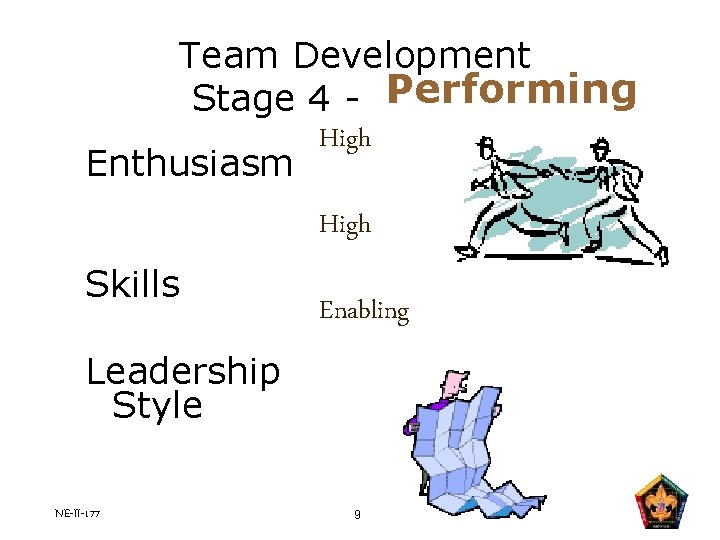
Team Development Stage 4 - Performing High Enthusiasm High Skills Enabling Leadership Style NE-II-177 9
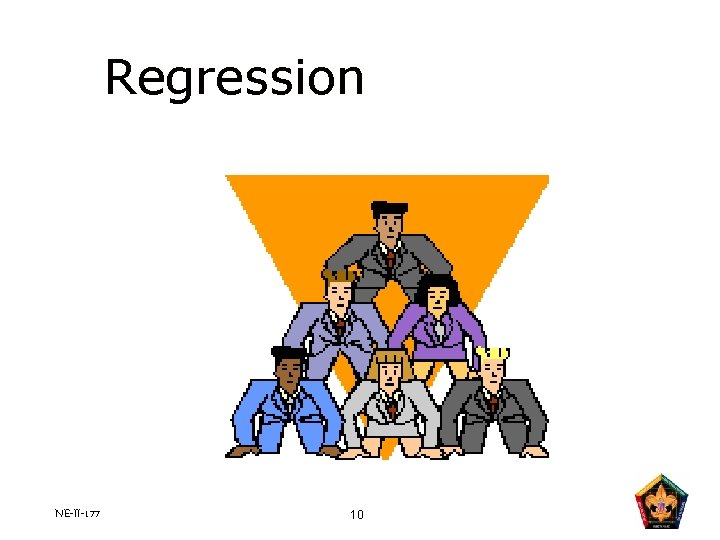
Regression NE-II-177 10
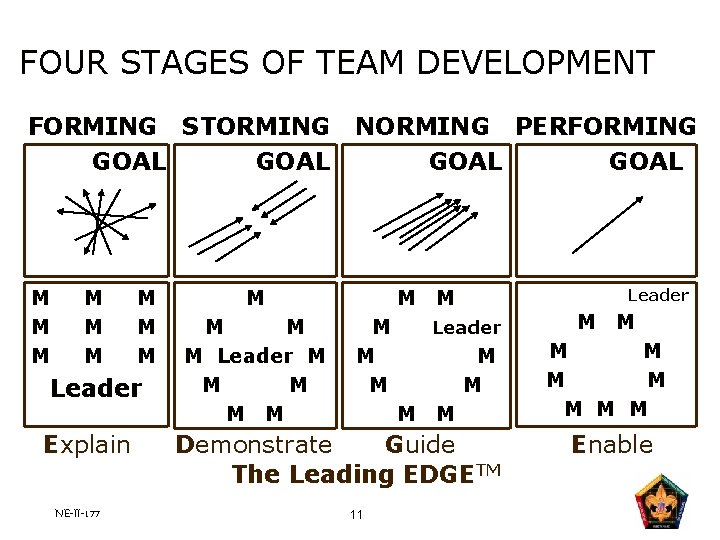
FOUR STAGES OF TEAM DEVELOPMENT FORMING STORMING GOAL M M M M M Leader Explain NE-II-177 NORMING PERFORMING GOAL M M Leader M M M M M Leader M M Demonstrate Guide The Leading EDGETM 11 M M M M M Enable
Four Stages of Skill Development Forming Storming Norming Performing NE-II-159
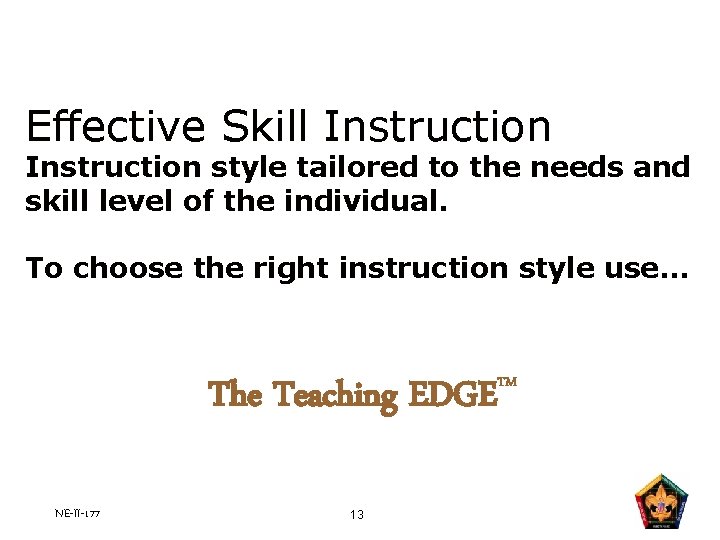
Effective Skill Instruction style tailored to the needs and skill level of the individual. To choose the right instruction style use… The Teaching EDGE NE-II-177 13 TM
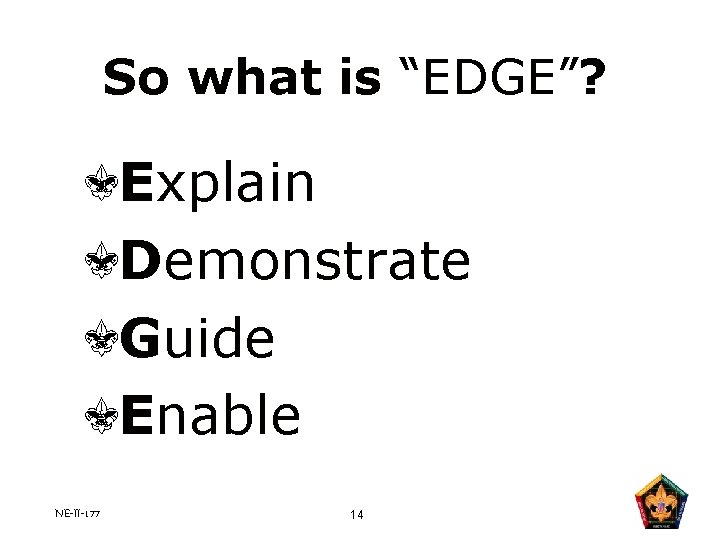
So what is “EDGE”? Explain Demonstrate Guide Enable NE-II-177 14
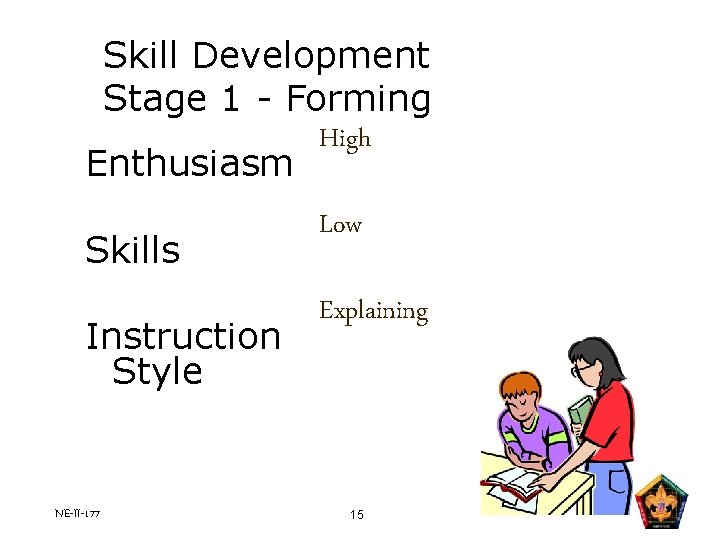
Skill Development Stage 1 - Forming High Enthusiasm Skills Instruction Style NE-II-177 Low Explaining 15
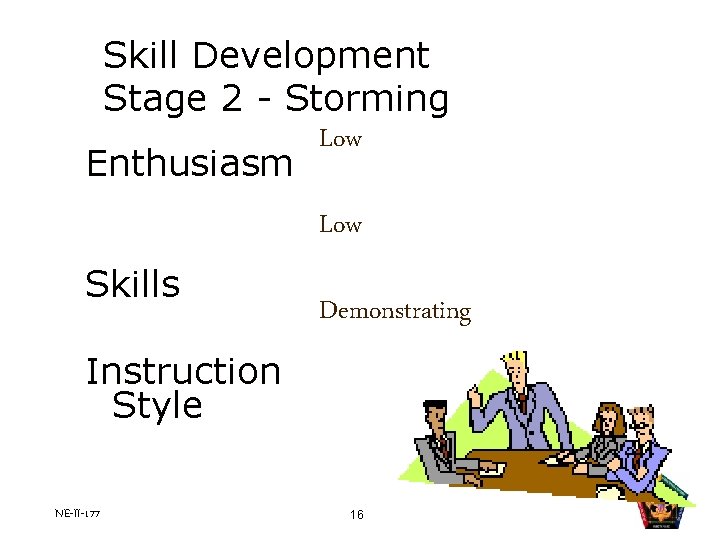
Skill Development Stage 2 - Storming Low Enthusiasm Low Skills Demonstrating Instruction Style NE-II-177 16
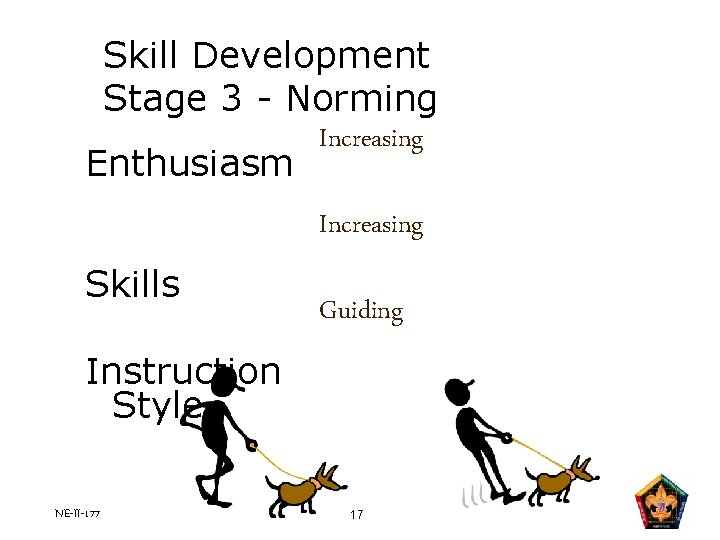
Skill Development Stage 3 - Norming Increasing Enthusiasm Increasing Skills Guiding Instruction Style NE-II-177 17
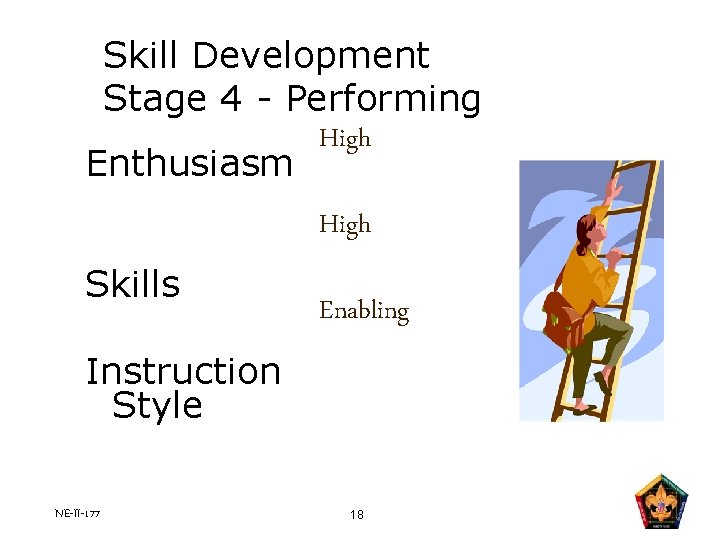
Skill Development Stage 4 - Performing High Enthusiasm High Skills Enabling Instruction Style NE-II-177 18
NE-II-177 19
Summary A team responds best to leadership tailored to the stage the team is experiencing at the moment. The Leading EDGETM acronym describes the behavior of a leader as the team moves through the stages of development. NE-II-177 20
Summary A learner responds best to skill instruction tailored to the stage of skill development the individual is experiencing at the moment. The Teaching EDGE acronym describes the behavior of a skills instructor as the learner moves through the stages of development. TM NE-II-177 21
Learning Objectives Describe the four leadership behaviors TM included in the Leading EDGE , and explain which behavior is most appropriate for each stage of team development. Describe the four skills instruction behaviors included in the Teaching EDGETM, and explain which behavior is most appropriate for each stage of skills development. NE-II-177 22
References § Blanchard, Ken, Donald Carew, and Eunice Parisi-Carew, The One Minute Manager Builds High Performing Teams, William Morrow and Co. , 2000. R § Hersey, P. , K. Blanchard, and D. Johnson, Management of Organizational Behavior: Leading Human Resources, Prentice Hall, 2001. § National Youth Leadership Training, No. 34490 A NE-II-177 23
TM The Leading EDGE / TM The Teaching EDGE Provide ground rules: Distribute handout Encourage note taking Feel free to ask questions at any time NE-II-177 24
Learning Objectives At the conclusion of this presentation, you should be able to: describe the four leadership behaviors included in the Leading EDGETM, and explain which behavior is most appropriate for each stage of team development. describe the four skills instruction behaviors included in the Teaching EDGETM, and explain which behavior is most appropriate for each stage of skills development. NE-II-177 25
Effective Leadership Effective leaders usually have more that one leadership style. A key to good leadership is to match the style of leadership to the people and the situation. A powerful tool for choosing the right leadership style is The Leading EDGETM. NE-II-177 26
So what is EDGE? Explain Demonstrate Guide Enable The Leading EDGE acronym describes the behavior of a leader as a team moves through the stages of development. Yesterday, during the presentation on “Stages of Team Development”, we talked about the four stages teams go through – Forming, Storming, Norming and Performing. A team responds best to leadership tailored to the stage the team is experiencing at the moment. To provide an appropriate style of leadership, the leader must understand the level of enthusiasm and skill exhibited by the team with respect to a particular task NE-II-177 27
Four Stages of Team Development I mentioned the Four Stages of Team Development and now I would like to review them with you and discuss what kind of leadership style works best for each stage. The primary function of team leadership is to help move the team through the stages of team development. NE-II-177 28
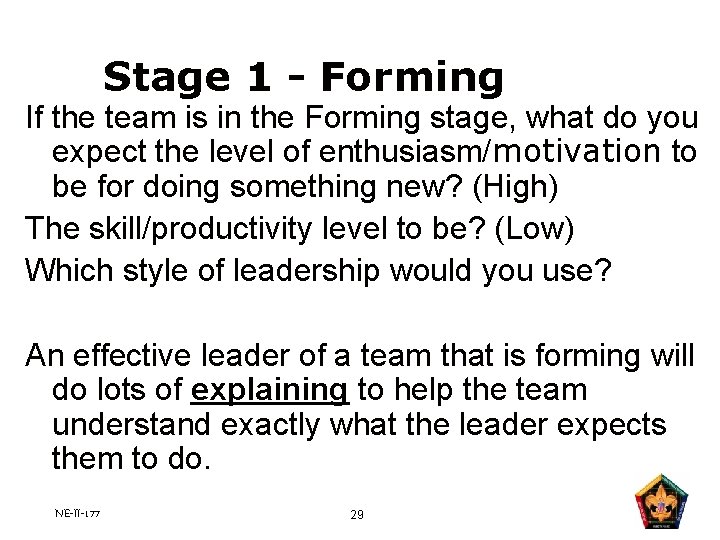
Stage 1 - Forming If the team is in the Forming stage, what do you expect the level of enthusiasm/motivation to be for doing something new? (High) The skill/productivity level to be? (Low) Which style of leadership would you use? An effective leader of a team that is forming will do lots of explaining to help the team understand exactly what the leader expects them to do. NE-II-177 29
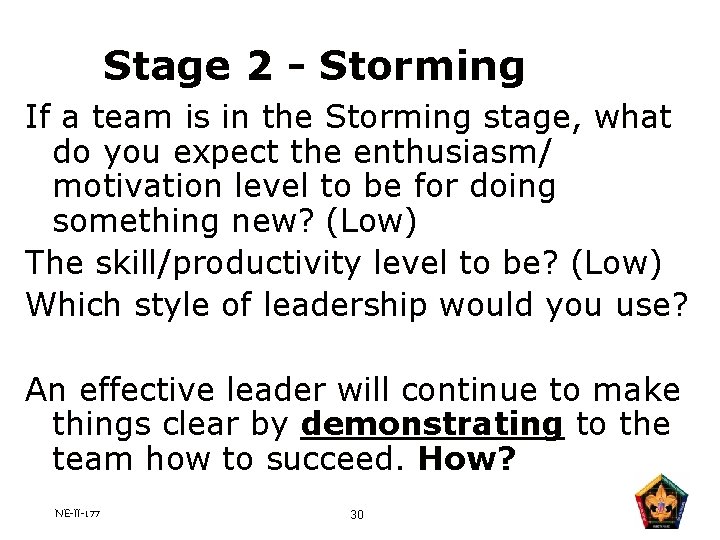
Stage 2 - Storming If a team is in the Storming stage, what do you expect the enthusiasm/ motivation level to be for doing something new? (Low) The skill/productivity level to be? (Low) Which style of leadership would you use? An effective leader will continue to make things clear by demonstrating to the team how to succeed. How? NE-II-177 30
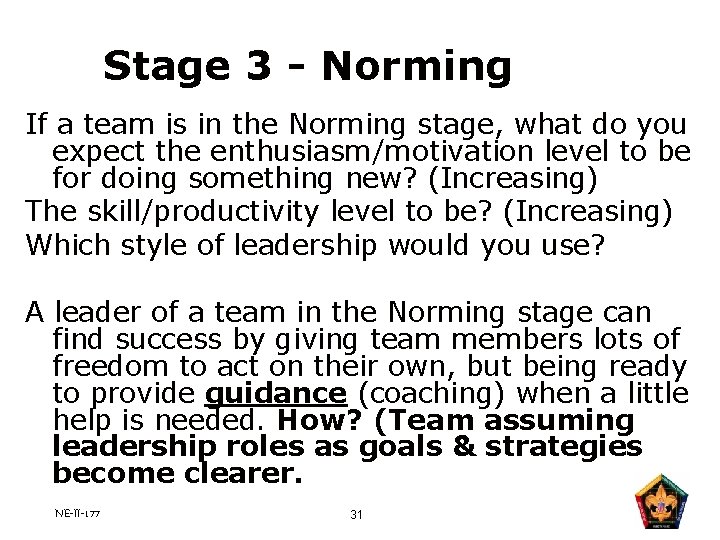
Stage 3 - Norming If a team is in the Norming stage, what do you expect the enthusiasm/motivation level to be for doing something new? (Increasing) The skill/productivity level to be? (Increasing) Which style of leadership would you use? A leader of a team in the Norming stage can find success by giving team members lots of freedom to act on their own, but being ready to provide guidance (coaching) when a little help is needed. How? (Team assuming leadership roles as goals & strategies become clearer. NE-II-177 31
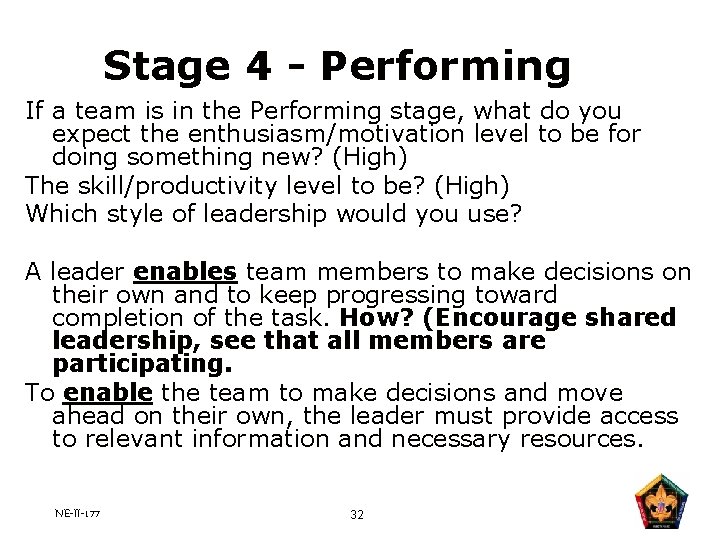
Stage 4 - Performing If a team is in the Performing stage, what do you expect the enthusiasm/motivation level to be for doing something new? (High) The skill/productivity level to be? (High) Which style of leadership would you use? A leader enables team members to make decisions on their own and to keep progressing toward completion of the task. How? (Encourage shared leadership, see that all members are participating. To enable the team to make decisions and move ahead on their own, the leader must provide access to relevant information and necessary resources. NE-II-177 32
Regression Going backwards!! What happens if I remove one of the members of this team? As it develops, a team does not always move smoothly from one stage to the next. It also does not always move forward, and will sometimes find itself back at an earlier stage of development. Experienced team – sets new goals or starts a new skill – back to Forming. Unanticipated roadblocks – slips back one or two stages. New members – Re. Forming, Storming, Norming before Performing. NE-II-177 33
Graphical Representation Together, the stages of team development and The Leading EDGETM provide a framework for matching each stage of team development with an appropriate leadership style. Remember, when serving as a team leader, identify the current stage of team development by accessing the team’s level of enthusiasm and skill, and select an appropriate leadership style to use. NE-II-177 34
The Teaching EDGE TM The ability of a team to succeed at a particular task often depends upon the need for team members to individually or collectively learn new skills. It is the leader’s responsibility to provide skills instruction when the need is recognized. The leader may serve as instructor if he or she has mastered the requisite skills, or arrange for an instructor. NE-II-177 35
Four Stages of Skill Development Just as teams experience stages of development with respect to the completion of a particular task, individuals go through the same stages when learning a skill. Forming - High enthusiasm – Low skill Excited about possibilities, can’t perform skill. Storming – Enthusiasm fades – Low skill While working the skill, discouraged by difficulty Norming – Enthusiasm rises as skill level rises. With work, will advance as learning takes place Performing – High enthusiasm – Skill mastered He will make the skill his own and will know it so well that he can teach it to others. Why would it be helpful for an instructor to know the skill development stage of learners? When you know, you can adjust your teaching methods to match that person’s needs NE-II-177
The Teaching EDGE TM A learner responds best to skills instruction tailored to the stage of skills development the individual is experiencing at the moment. To provide an appropriate style of skills instruction, the instructor must access the level of enthusiasm and skill demonstrated by the learner. A powerful tool for choosing the right instruction style is the Teaching EDGETM. Once again the letters EDGE stand for: Explain Demonstrate Guide Enable This acronym is used to describe the behavior of an instructor as a learner goes through the stages of learning a skill. NE-II-177 37
Skill Development Stage 1 - Forming A person is enthused about something new and motivated to learn, but has a low level of skill. An instructor will need to do lots of careful (explaining) Telling the learner exactly what to do and how to do it. Explaining is important because it clarifies the subject for the learner and the instructor. NE-II-177 38
Skill Development Stage 2 - Storming A person has been at it long enough to realize that mastering a skill may not be easy and that lots of work remains to be done. As a result, his enthusiasm and motivation are low. Skills are still low, too. An instructor must (demonstrate) the new skill to the learner, clearly showing him what to do and how to do it. Demonstrating is important because it allows learners to see as well as hear how something is done. They can follow the process from beginning to end. NE-II-177 39
Skill Development Stage 3 - Norming As a learner keeps at it, his level of skill will rise. He realizes he is making progress, and so motivation and enthusiasm will rise also. An instructor will need to (guide) the person – giving him more freedom to figure out things on his own, supporting him with encouragement, and helping hime move closer to the goal. Guiding is important because it allows learners to learn by doing. It allows the instructor to see how well learners are grasping the skill. NE-II-177 40
Skill Development Stage 4 - Performing Skills are high and so is enthusiasm and motivation. A learner has reached the point where he can act independently and be productive. An instructor will need to (enable) the person – offer him plenty of freedom to make decisions on his own and keep moving ahead. Enabling is important because it allows learners to use skills themselves. It also encourages repetition – an important aspect of mastering a skill. However in the end!!!! NE-II-177 41
Learning Objectives Describe the four leadership behaviors TM included in the Leading EDGE , and explain which behavior is most appropriate for each stage of team development. Describe the four skills instruction behaviors included in the Teaching TM EDGE , and explain which behavior is most appropriate for each stage of skills development. NE-II-177 42
Summary A team responds best to leadership tailored to the stage the team is experiencing at the moment. The Leading EDGETM acronym describes the behavior of a leader as the team moves through the stages of development. A learner responds best to skill instruction tailored to the stage of skill development the individual is experiencing at the moment. The Teaching EDGETM acronym describes the behavior of a skills instructor as the learner moves through the stages of development. NE-II-177 43
References § Blanchard, Ken, Donald Carew, and Eunice Parisi-Carew, The One Minute Manager Builds High Performing Teams, William Morrow and Co. , 2000. R § Hersey, P. , K. Blanchard, and D. Johnson, Management of Organizational Behavior: Leading Human Resources, Prentice Hall, 2001. § National Youth Leadership Training, No. 34490 A NE-II-177 44
NE-II-177 45
Thank You! Your totem goes here, you may use a build if you desire NE-II-177 46