
Leading Delegating and Collaborating NRSB 312 LPNtoBSN Transition
Leading, Delegating, and Collaborating NRSB 312 LPN-to-BSN Transition Week 12
Decision-Making and Problem Solving • Decision-making process • • • Defining objectives Identifying options Identifying the advantages and disadvantages of each option Selecting an option Implementing the option Evaluating the result
Decision-Making and Problem Solving • Effective decision-making and problem-solving process • • Gather data from many sources. • • Perform research to increase your knowledge base. Learn different approaches to problem situations. Observe positive role models in action. Talk to a colleague or superior who is an effective problem solver and decision maker. Take risks using new approaches to problem solving.

Delegation • Principles of delegation • Assessment, planning, evaluation, and nursing judgment cannot be delegated. • The decision of whether or not to delegate or assign is based on the RN’s judgment. • The RN delegates only those tasks that the health care worker has the knowledge and skill to perform. • The RN delegates the right task, under the right circumstances, to the right person, with the right direction and communication, and with the right supervision.
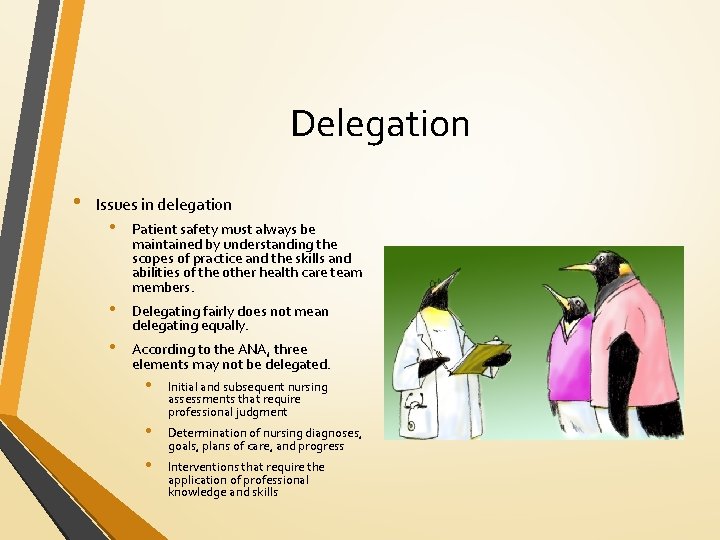
Delegation • Issues in delegation • • • Patient safety must always be maintained by understanding the scopes of practice and the skills and abilities of the other health care team members. Delegating fairly does not mean delegating equally. According to the ANA, three elements may not be delegated. • Initial and subsequent nursing assessments that require professional judgment • Determination of nursing diagnoses, goals, plans of care, and progress • Interventions that require the application of professional knowledge and skills
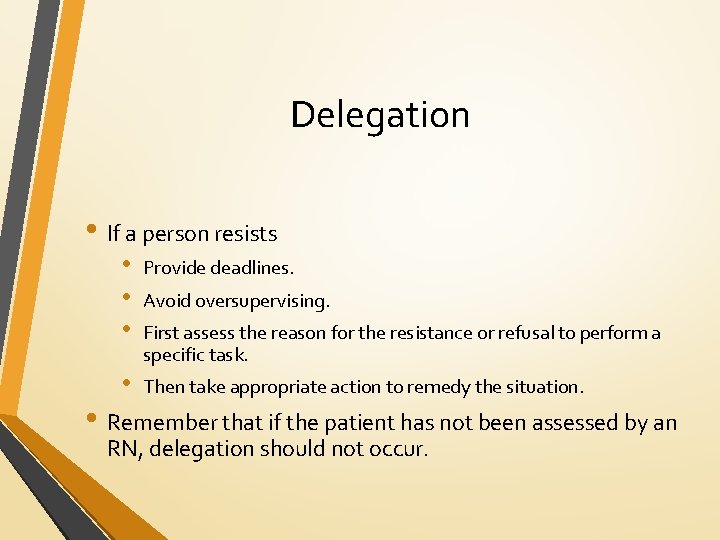
Delegation • If a person resists • • • Provide deadlines. • Then take appropriate action to remedy the situation. Avoid oversupervising. First assess the reason for the resistance or refusal to perform a specific task. • Remember that if the patient has not been assessed by an RN, delegation should not occur.

Background: US Army Aviation • Army aviation crew coordination failures in mid-80 s contributed to 147 aviation fatalities and cost more than $290 million • The vast majority involved highly experienced aviators • Failures were attributed largely to crew communication, workload management, and task prioritization
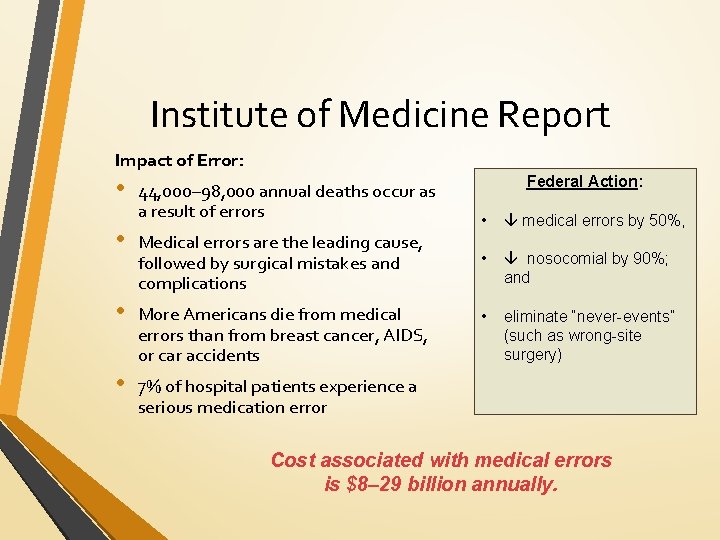
Institute of Medicine Report Impact of Error: • 44, 000– 98, 000 annual deaths occur as a result of errors • Medical errors are the leading cause, followed by surgical mistakes and complications • More Americans die from medical errors than from breast cancer, AIDS, or car accidents • 7% of hospital patients experience a serious medication error Federal Action: • medical errors by 50%, • nosocomial by 90%; and • eliminate “never-events” (such as wrong-site surgery) Cost associated with medical errors is $8– 29 billion annually.
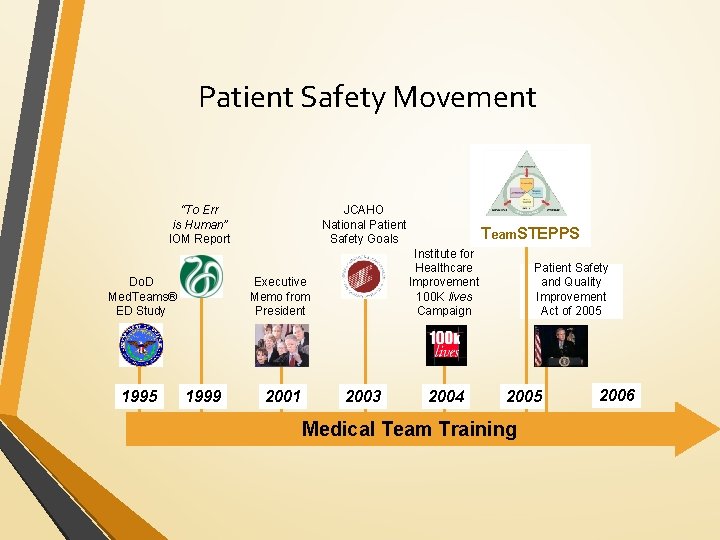
Patient Safety Movement “To Err is Human” IOM Report Do. D Med. Teams® ED Study 1995 JCAHO National Patient Safety Goals Institute for Healthcare Improvement 100 K lives Campaign Executive Memo from President 1999 2001 Team. STEPPS 2003 2004 Patient Safety and Quality Improvement Act of 2005 Medical Team Training 2006
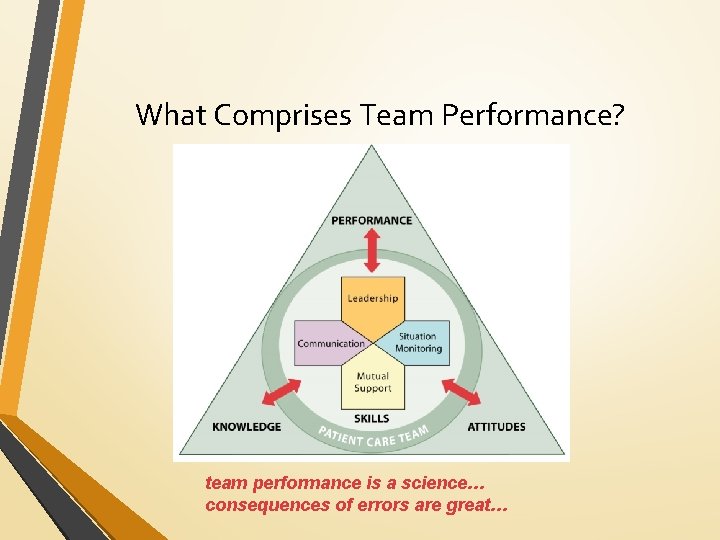
What Comprises Team Performance? team performance is a science… consequences of errors are great…
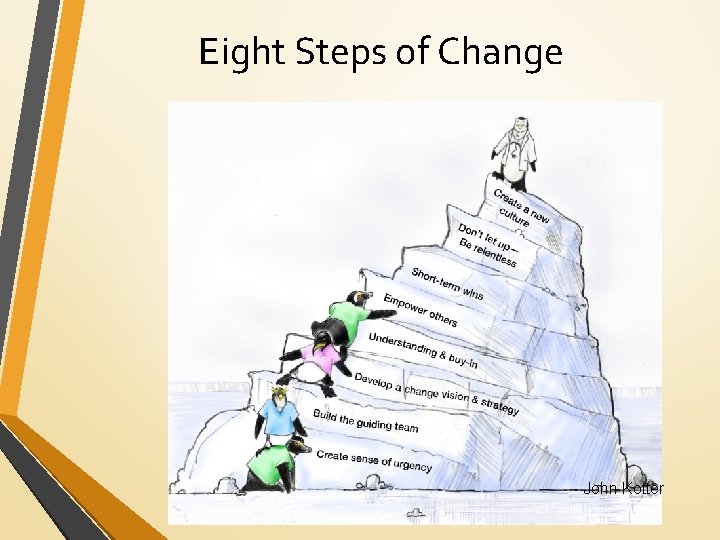
Eight Steps of Change John Kotter
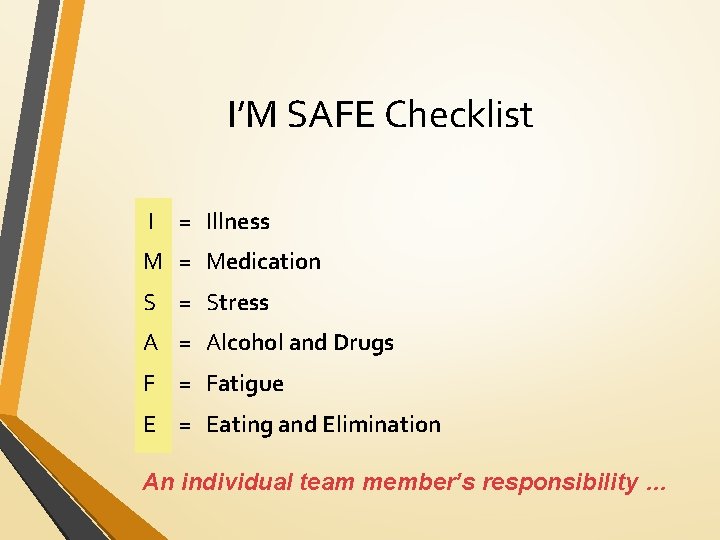
I’M SAFE Checklist I = Illness M = Medication S = Stress A = Alcohol and Drugs F = Fatigue E = Eating and Elimination An individual team member’s responsibility …
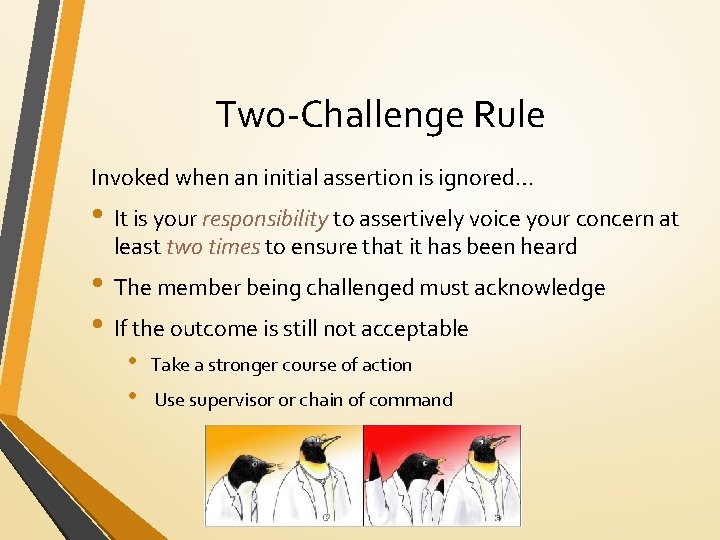
Two-Challenge Rule Invoked when an initial assertion is ignored… • It is your responsibility to assertively voice your concern at least two times to ensure that it has been heard • The member being challenged must acknowledge • If the outcome is still not acceptable • • Take a stronger course of action Use supervisor or chain of command
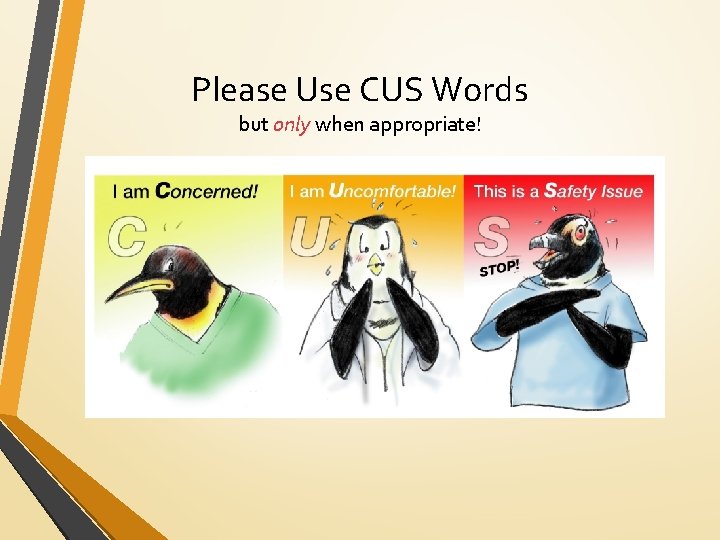
Please Use CUS Words but only when appropriate!

DESC-It A constructive approach • for managing and resolving conflict • D—Describe the specific situation • E—Express your concerns about the action S—Suggest other alternatives C—Consequences should be stated • • • Have timely discussion Frame problem in terms of your own experience Use “I” statements to minimize defensiveness Avoid blaming statements Critique is not criticism Focus on what is right, not who is right
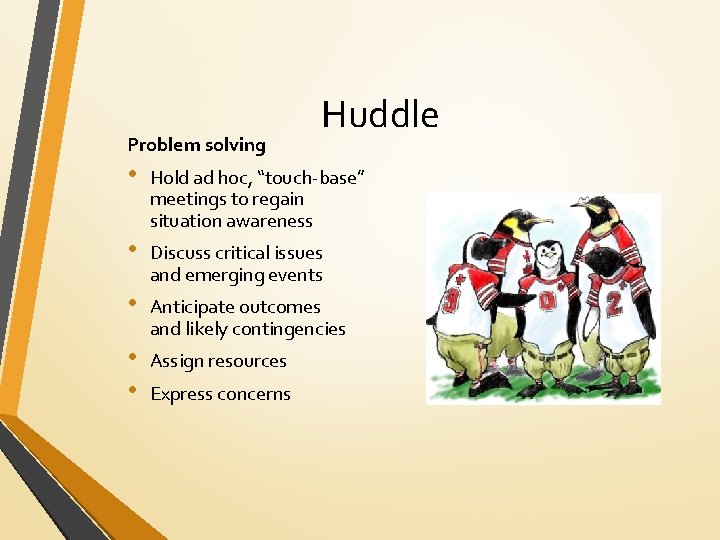
Problem solving Huddle • Hold ad hoc, “touch-base” meetings to regain situation awareness • Discuss critical issues and emerging events • Anticipate outcomes and likely contingencies • • Assign resources Express concerns
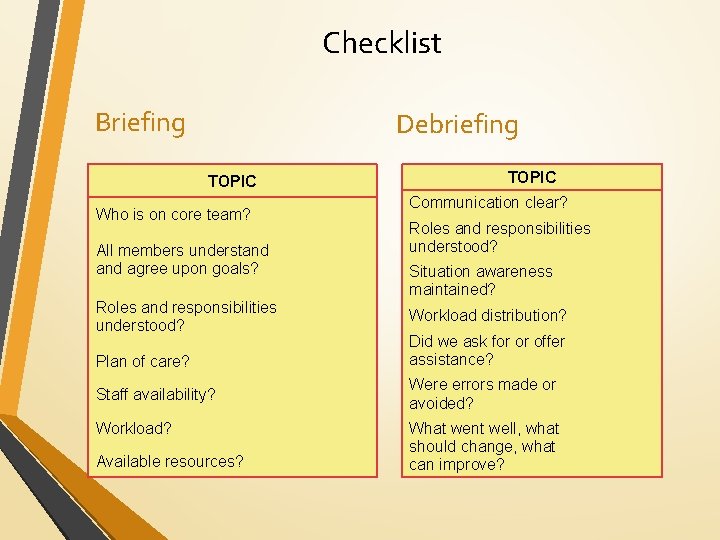
Checklist Briefing Debriefing TOPIC Who is on core team? All members understand agree upon goals? Roles and responsibilities understood? Plan of care? Staff availability? Workload? Available resources? TOPIC Communication clear? Roles and responsibilities understood? Situation awareness maintained? Workload distribution? Did we ask for or offer assistance? Were errors made or avoided? What went well, what should change, what can improve?
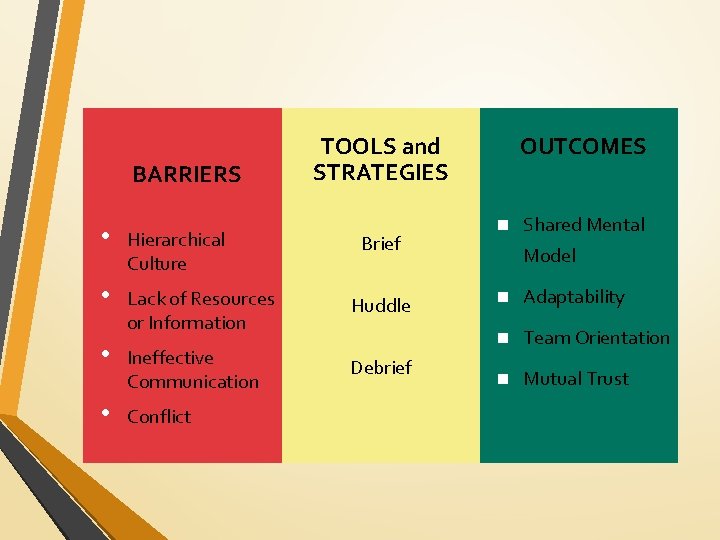
BARRIERS TOOLS and STRATEGIES • Hierarchical Culture • Lack of Resources or Information Huddle • Ineffective Communication Debrief • Conflict Brief OUTCOMES n Shared Mental Model n Adaptability n Team Orientation n Mutual Trust
- Slides: 18