
Leading Change September 2018 Learning Objectives In todays
Leading Change September 2018
Learning Objectives In today’s session you will learn: • • • Key reasons for having an organized approach to change management that focuses on the people element of change How people adapt to change, why they resist it, and how to respond to resistance An organized, sequential approach to change management How applying the UMMS Competencies is critical to your role in leading change management The central role communication plays in successful change efforts A checklist to monitor and evaluate your progress
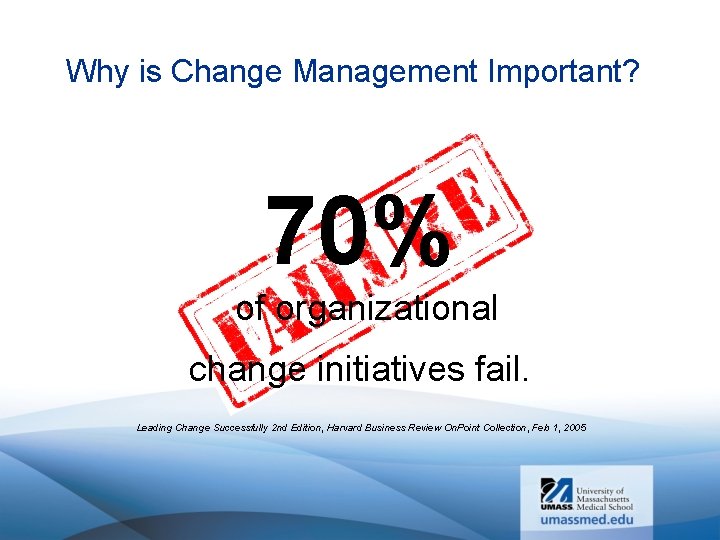
Why is Change Management Important? 70% of organizational change initiatives fail. Leading Change Successfully 2 nd Edition, Harvard Business Review On. Point Collection, Feb 1, 2005
Major Change Challenges The most significant challenges when implementing change projects are people-oriented. • Changing mindsets and attitudes = 58% • Corporate culture = 49% • Complexity is underestimated = 35% *Adapted from IBM, “Making Change Work”, page 14.
Exercise #1 - Approach to Change Think of an example of when you, as a manager, had to support a significant work change (e. g. , process, roles, staffing) Questions: • • • As a manager, what role did you take on to lead the change and help your staff adapt? How was the change communicated? Did you face resistance? If so, why? How did you deal with resistance? What did you learn? What worked/didn’t work? Your thoughts:
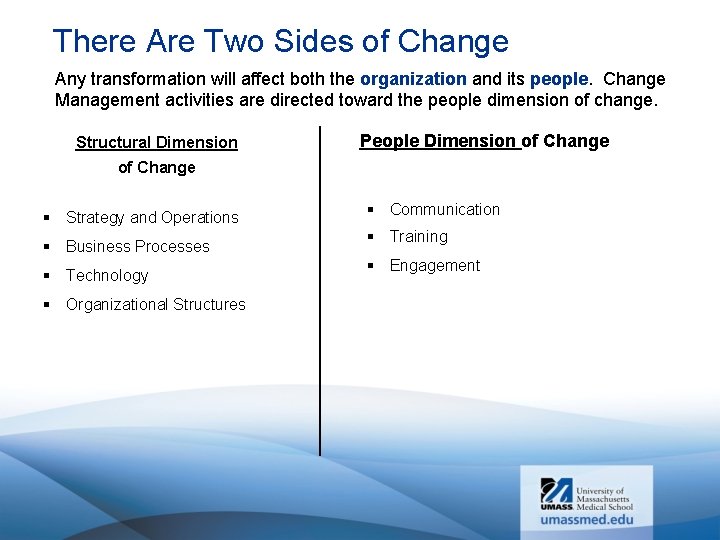
There Are Two Sides of Change Any transformation will affect both the organization and its people. Change Management activities are directed toward the people dimension of change. Structural Dimension People Dimension of Change § Strategy and Operations § Business Processes § Technology § Organizational Structures § Communication § Training § Engagement
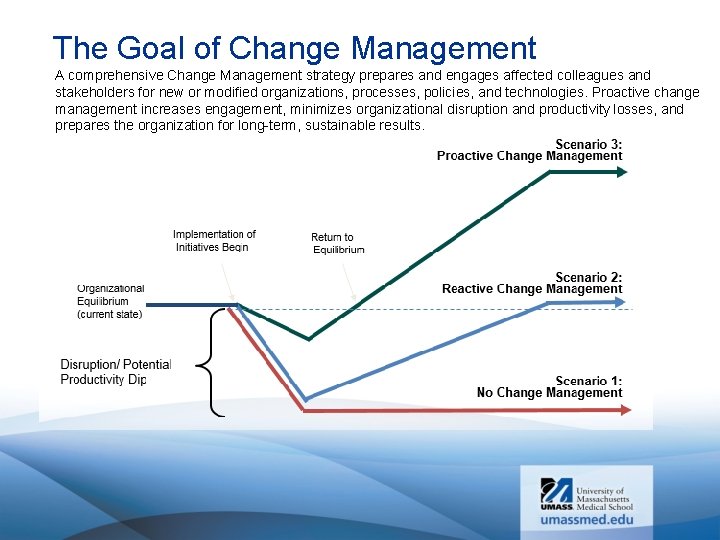
The Goal of Change Management A comprehensive Change Management strategy prepares and engages affected colleagues and stakeholders for new or modified organizations, processes, policies, and technologies. Proactive change management increases engagement, minimizes organizational disruption and productivity losses, and prepares the organization for long-term, sustainable results.
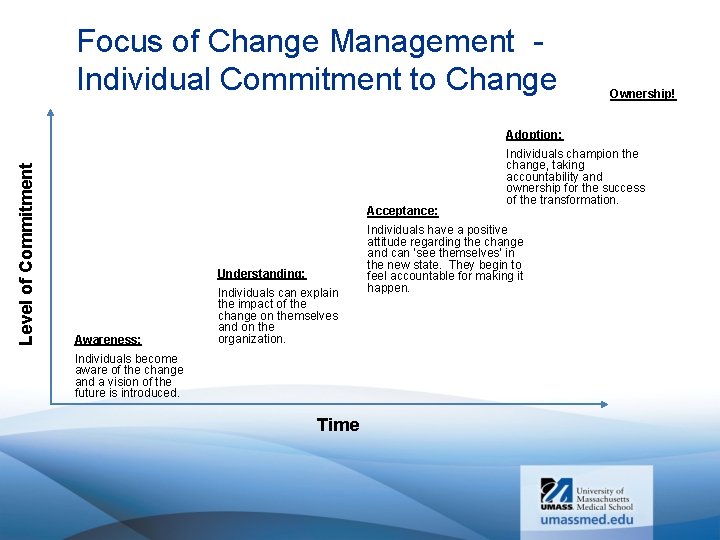
Focus of Change Management Individual Commitment to Change Ownership! Level of Commitment Adoption: Acceptance: Understanding: Awareness: Individuals can explain the impact of the change on themselves and on the organization. Individuals become aware of the change and a vision of the future is introduced. Time Individuals champion the change, taking accountability and ownership for the success of the transformation. Individuals have a positive attitude regarding the change and can ‘see themselves’ in the new state. They begin to feel accountable for making it happen.

Common Reactions to Change
Exercise #2 - Reacting to Change Think about a change that you have experienced at work and answer the questions below. Question: • • What was the change? How far did you progress in accepting the change? What helped you to accept the change? Was the long-term effect of the change positive or negative? Answer:
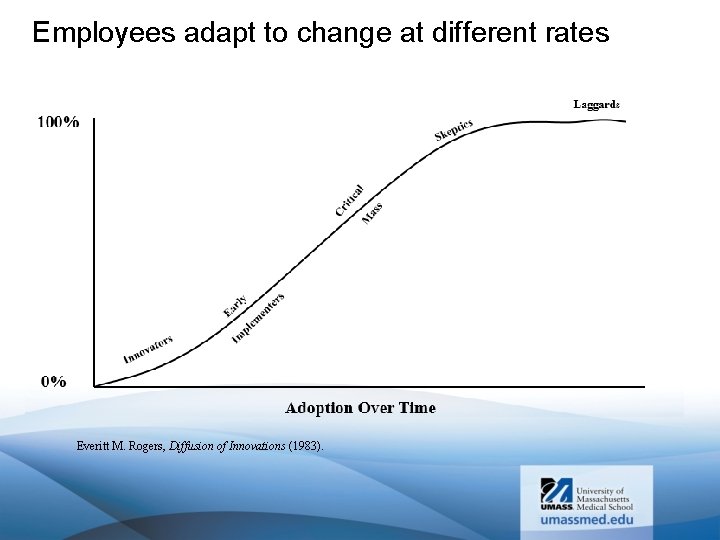
Employees adapt to change at different rates Everitt M. Rogers, Diffusion of Innovations (1983).
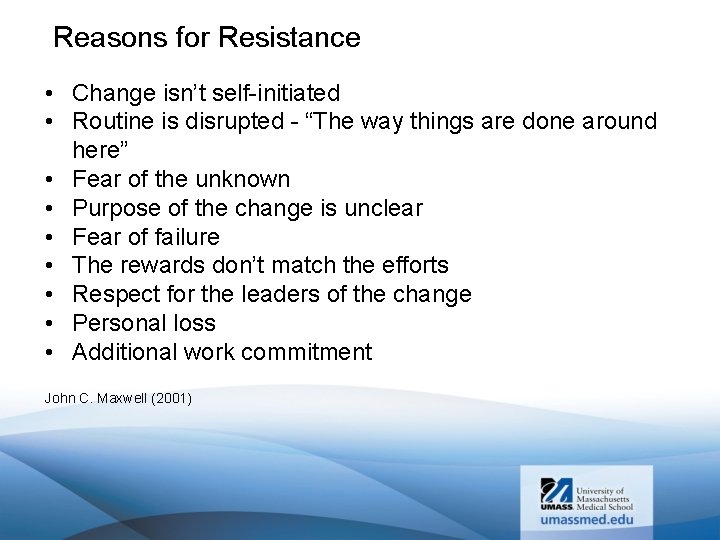
Reasons for Resistance • Change isn’t self-initiated • Routine is disrupted - “The way things are done around here” • Fear of the unknown • Purpose of the change is unclear • Fear of failure • The rewards don’t match the efforts • Respect for the leaders of the change • Personal loss • Additional work commitment John C. Maxwell (2001)
Dealing with Resistance • Don’t avoid addressing it! • Bring it out into the open. • Identify the assumptions, fears, feelings behind it. • Take a learning/exploratory stance towards it. Ask questions! • Reinforce the necessity of change and help people get there!
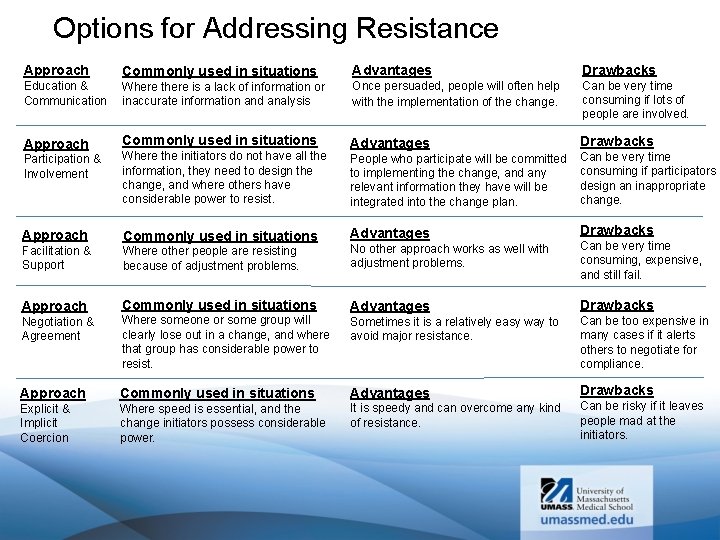
Options for Addressing Resistance Approach Commonly used in situations Advantages Drawbacks Education & Communication Where there is a lack of information or inaccurate information and analysis Once persuaded, people will often help with the implementation of the change. Can be very time consuming if lots of people are involved. Approach Commonly used in situations Advantages Drawbacks Participation & Involvement Where the initiators do not have all the information, they need to design the change, and where others have considerable power to resist. Approach Commonly used in situations Facilitation & Support Where other people are resisting because of adjustment problems. No other approach works as well with adjustment problems. Can be very time consuming, expensive, and still fail. Approach Commonly used in situations Advantages Drawbacks Negotiation & Agreement Where someone or some group will clearly lose out in a change, and where that group has considerable power to resist. Approach Explicit & Implicit Coercion People who participate will be committed to implementing the change, and any relevant information they have will be integrated into the change plan. Can be very time consuming if participators design an inappropriate change. Advantages Drawbacks Sometimes it is a relatively easy way to avoid major resistance. Can be too expensive in many cases if it alerts others to negotiate for compliance. Commonly used in situations Advantages Drawbacks Where speed is essential, and the change initiators possess considerable power. It is speedy and can overcome any kind of resistance. Can be risky if it leaves people mad at the initiators.
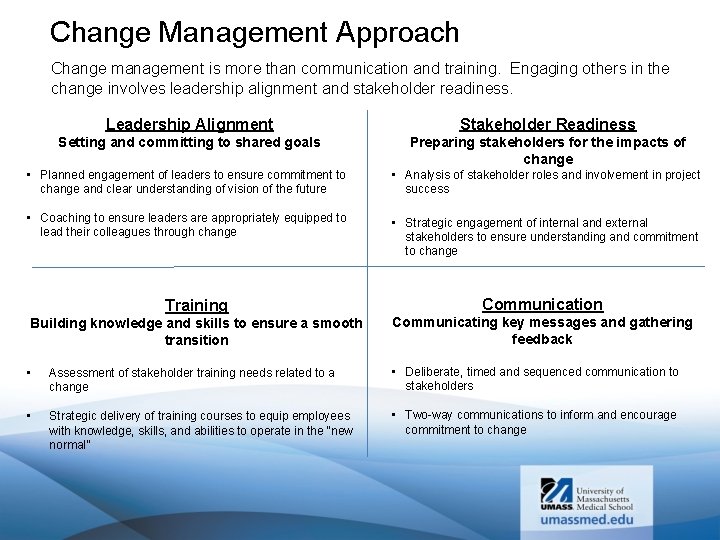
Change Management Approach Change management is more than communication and training. Engaging others in the change involves leadership alignment and stakeholder readiness. Leadership Alignment Stakeholder Readiness Setting and committing to shared goals Preparing stakeholders for the impacts of change • Planned engagement of leaders to ensure commitment to change and clear understanding of vision of the future • Analysis of stakeholder roles and involvement in project success • Coaching to ensure leaders are appropriately equipped to lead their colleagues through change • Strategic engagement of internal and external stakeholders to ensure understanding and commitment to change Training Communication Building knowledge and skills to ensure a smooth transition Communicating key messages and gathering feedback • Assessment of stakeholder training needs related to a change • Deliberate, timed and sequenced communication to stakeholders • Strategic delivery of training courses to equip employees with knowledge, skills, and abilities to operate in the “new normal” • Two-way communications to inform and encourage commitment to change
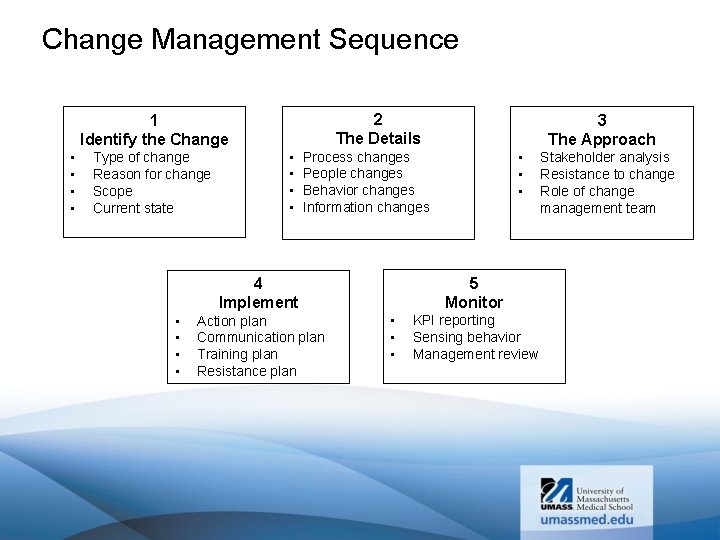
Change Management Sequence 2 The Details 1 Identify the Change • • Type of change Reason for change Scope Current state • • Process changes People changes Behavior changes Information changes Action plan Communication plan Training plan Resistance plan • • • 5 Monitor 4 Implement • • 3 The Approach • • • KPI reporting Sensing behavior Management review Stakeholder analysis Resistance to change Role of change management team
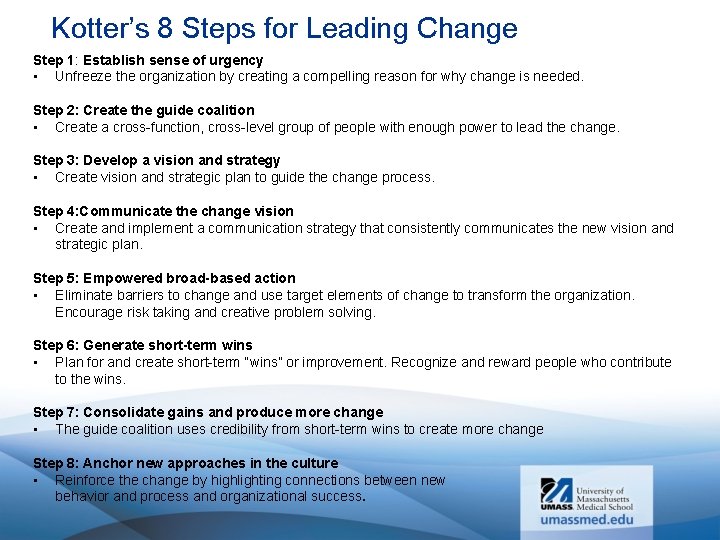
Kotter’s 8 Steps for Leading Change Step 1: Establish sense of urgency • Unfreeze the organization by creating a compelling reason for why change is needed. Step 2: Create the guide coalition • Create a cross-function, cross-level group of people with enough power to lead the change. Step 3: Develop a vision and strategy • Create vision and strategic plan to guide the change process. Step 4: Communicate the change vision • Create and implement a communication strategy that consistently communicates the new vision and strategic plan. Step 5: Empowered broad-based action • Eliminate barriers to change and use target elements of change to transform the organization. Encourage risk taking and creative problem solving. Step 6: Generate short-term wins • Plan for and create short-term “wins” or improvement. Recognize and reward people who contribute to the wins. Step 7: Consolidate gains and produce more change • The guide coalition uses credibility from short-term wins to create more change Step 8: Anchor new approaches in the culture • Reinforce the change by highlighting connections between new behavior and process and organizational success.
Your Role in Leading Change • • • Building relationships Working on trust Showing the way Coaching vs. controlling Setting the example Being visionary, inspiring, enthusiastic and focused
UMMS Competencies for Managers Critical for leading change management • • Sets clear priorities, goals and expectations and provides timely, constructive, and balanced feedback in holding staff members accountable Delegates effectively and empowers team members and flexes style when faced with diverse teams understanding and effectively managing complex group dynamics and diverse perspectives Manages performance problems and team conflicts skillfully Demonstrates effective mentoring, developing and motivating skills Inspires and fosters team commitment, spirit, pride and trust and is attentive to the well-being of her/his staff Takes a long-term view building a shared vision with staff in planning, decision making, and process improvement Acts as a positive role model Ensures that diverse, talented employees are appropriately recruited, selected, oriented, and acclimated to the organization
Exercise #3 - Applying the UMMS Competencies for Managers Provide an example of when you may have demonstrated one or more of the UMMS leadership and management competency elements to help lead a change at work. Competency Element: Your Action:
Communicate, Communicate! • • Use every vehicle/forum—formal and informal Establish a communication plan Lead by example Establish two-way communication Keep focus positive Keep message simple Explain seeming inconsistencies Encourage differences of opinion Key Associates, 2008
9 Tactics for Communicating I Stories. When you tell a good story, you give life to a vision. The telling of stories creates trust, captures hearts and minds, and serves as a reminder of the vision. Plus, people find it easier to repeat a story than talk about a vision statement. The elevator speech. Every leader needs to be able to communicate the vision in a clear, brief way. What compelling vision can you describe in the amount of time you have during a typical elevator ride? Be prepared to reinforce the vision in line at the cafeteria, when you visit other departments, and even walking through the parking lot at the end of the day. Multiple media. The more channels of communication you use, the better your chance of creating an organization that "gets" the vision. Use meetings, memos, lunches, podcasts, e-mail, an internal web site, and whatever else you can think of (Twitter, anyone? ) that will keep the message in circulation. Talk to me. Individualize the vision by engaging others in one-on-one conversations. Personal connections give leaders opportunities to transmit information, receive feedback, build support and create energy around the vision. Center for Creative Leadership, February 2009
9 Tactics for Communicating II Draw a crowd. Identify key players, communicators, stakeholders and supporters throughout the organization who will motivate others to reflect on and be engaged with the vision. Go outside. Communicate to external customers, partners and vendors with advertising and public relations campaigns, catalogs, announcements and other statements. Make memories. Create metaphors, figures of speech and slogans and find creative ways to use them. Write a theme song or a memorable motto. Guide the expedition. Use visual aids and updates to keep everyone aware of the progress you are making toward your vision. Create a vision GPS, but don’t just give out maps. Travel alongside, stay out in front, offer directions and point out guideposts. Back it up. If you’re talking it up, be sure to back it up with actions and behaviors. If people see one thing and hear another, your credibility is shot and your vision is dead. Center for Creative Leadership, February 2009
Opportunities for Communicating q. Coaching q. E-mails q. Handoffs q. Huddles q. Informal conversations q. Newsletters q. Orientation and on-boarding q. Performance reviews q. Posters, decorations q. Reward and recognition q. Selection of new employees q. Signs and posters q. Slogans, sayings, logos q. Staff meetings
Change Management Checklist ü Understand the resistance but lead ü those willing to move ahead(20%) ü Cultivate a climate for change ü ü Use the energy of change ü ü Find the learning opportunity ü ü Focus people on what they can control ü Seek wide participation ü ü Communicate so that people have access to information ü ü Free up thinking ü ü Celebrate the gains ü Become fierce opponents of waste and non-value-added work Establish social support mechanisms Replenish people’s reserves Remind people of the purpose and values of your organization Enliven the vision: bold aims, ambitious deadlines Connect with your customers Lead and let everyone lead Move forward M. K. Key, Managing Change in Healthcare: Innovative Solutions for People-based Organizations, (1999)
- Slides: 25