
Leaderships Role in Building an Informatics Roadmap John
Leadership’s Role in Building an Informatics Roadmap John Wiesman Kathy Lofy Washington State Department of Health July 14, 2016
Question for the audience What are some challenges your organization might address with an informatics strategy? Respond now using the question/chat box!
Why invest in informatics? • “Age of information” – Public expects real-time information – Desire to use real-time data for decision making • Surveillance and assessment is a foundational public health service • Resources insufficient to maintain numerous silo -ed systems

Current State • Historically, IT systems built in silos – Program requested new IT system IT team implemented system – Very little coordination between programs • Our IT team is facing many challenges: – Maintaining 378 existing applications /services/components and developing 15 more – consumes 80% of resources – Very limited depth in IT expertise per system – 33 new projects in queue

Our Informatics Journey Established Informatics Program Established IT Governance Completed Informatics Assessment July 2014 Oct 2014 Sept 2015 Completed Informatics Roadmap Implement Informatics Roadmap Develop Longterm Vision for IT Systems Jan 2016 Jun 2016
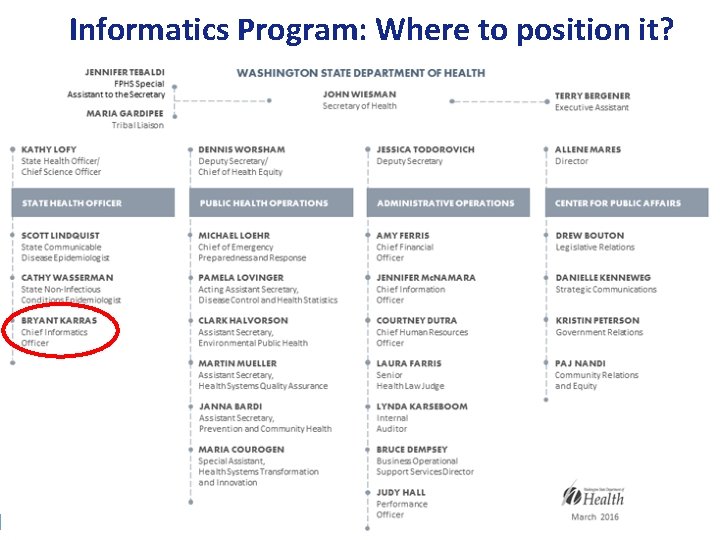
Informatics Program: Where to position it? Organizational Chart
IT Governance • Established an agency IT Governance group with representation from across the agency • Purpose of this group – – Assure that the use of information and technology generate business value – Prioritize IT resources – Oversee management’s performance – Mitigate the risks associated with using information and technology • Different than Information/Data Governance
Why assess informatics capability?
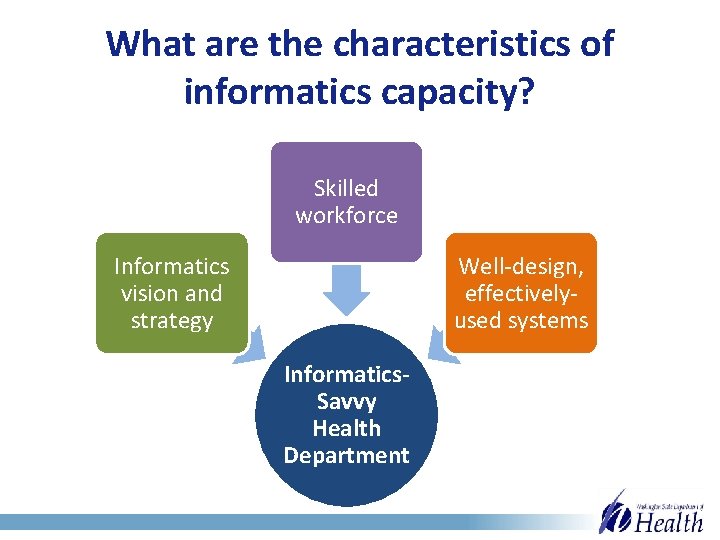
What are the characteristics of informatics capacity? Skilled workforce Informatics vision and strategy Well-design, effectivelyused systems Informatics. Savvy Health Department
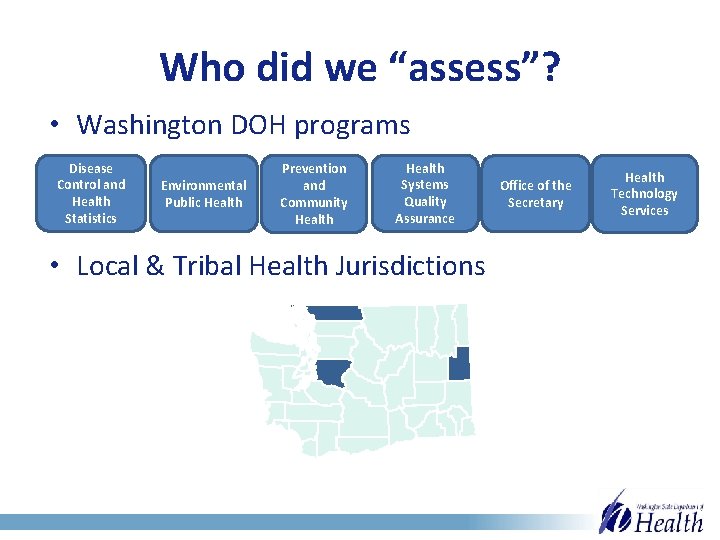
Who did we “assess”? • Washington DOH programs Disease Control and Health Statistics Environmental Public Health Prevention and Community Health Systems Quality Assurance • Local & Tribal Health Jurisdictions Office of the Secretary Health Technology Services
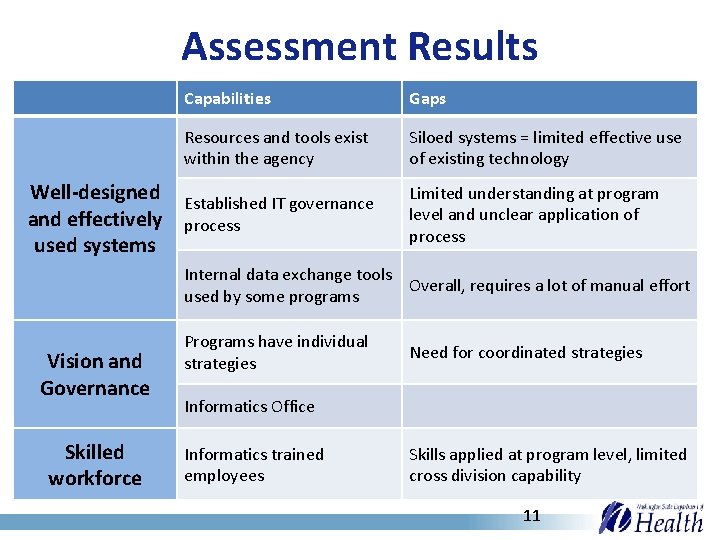
Assessment Results Capabilities Gaps Resources and tools exist within the agency Siloed systems = limited effective use of existing technology Well-designed Established IT governance and effectively process used systems Limited understanding at program level and unclear application of process Internal data exchange tools Overall, requires a lot of manual effort used by some programs Vision and Governance Skilled workforce Programs have individual strategies Need for coordinated strategies Informatics Office Informatics trained employees Skills applied at program level, limited cross division capability 11
Question for the audience How would you rate your organization’s informatics capacity? Respond via the Poll in just a moment!
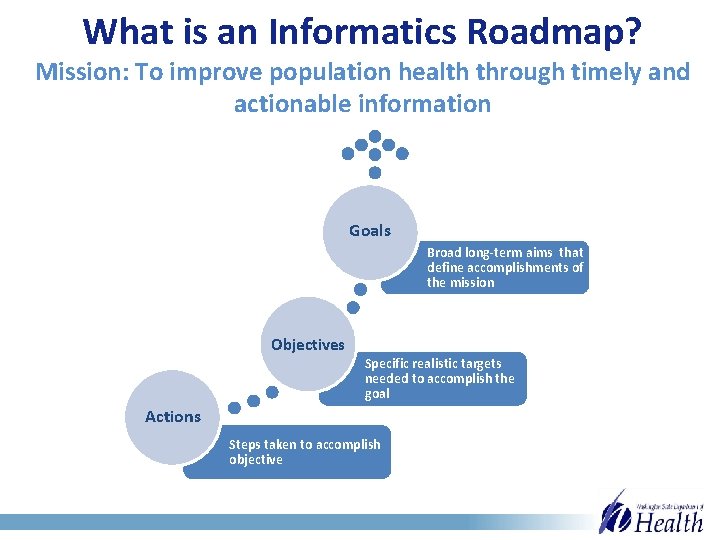
What is an Informatics Roadmap? Mission: To improve population health through timely and actionable information Goals Broad long-term aims that define accomplishments of the mission Objectives Specific realistic targets needed to accomplish the goal Actions Steps taken to accomplish objective
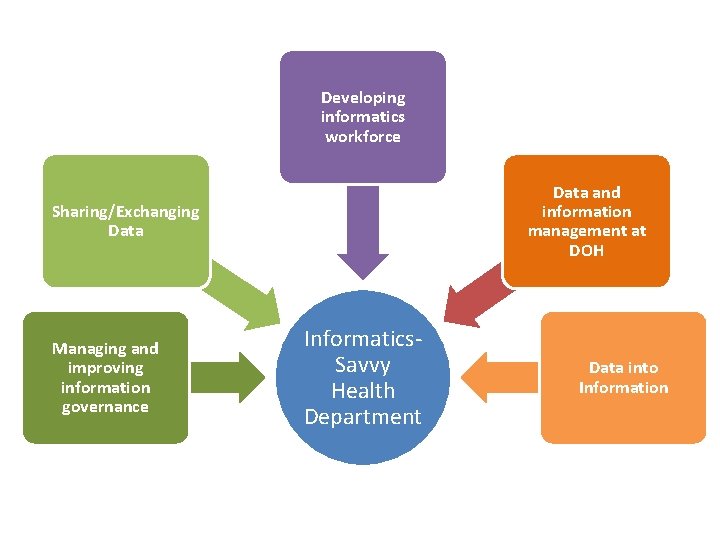
Developing informatics workforce Data and information management at DOH Sharing/Exchanging Data Managing and improving information governance Informatics. Savvy Health Department Data into Information
Create an Information Governance framework that addresses multi-disciplinary information management • Establish internal and external Information Governance processes • Establish clear standards, policies Informatics vision and (rules), and practices related to strategy privacy, confidentiality, ethics, and security • Utilize collaborative agency decision making to support the use of agency data and visualization tools for internal use, partners (LHJs), tribes, and public Skilled workforce Well-design, effectivelyused systems Informatics. Savvy Health Department
Improve efficiency of intra/interpartner data exchange and effective use of data • Streamline and automate the flow of data in and out of DOH information systems • Establish state HIE as preferred method • Improve internal data exchange • Look for opportunities to leverage MPI efforts Skilled workforce Informatics vision and strategy Well-design, effectivelyused systems Informatics. Savvy Health Department
Develop Informatics Trained and/or experienced leadership and workforce • SHINE Fellowship – 3 SHINE Fellows at DOH • Establish a workforce strategy describing the needed informatics capabilities and/or positions • Provide training opportunities in PH Informatics (e. g. , Informatics – Training in Place Program) Skilled workforce Informatics vision and strategy Well-design, effectivelyused systems Informatics. Savvy Health Department
Analyze and disseminate data and information in a timely, ethical, open and transparent way • Increase availability of record level data to partners • Improve efficiency of routine descriptive and trend analyses for internal and external use • Manage information and report needs from DOH programs, ACHs, LHJs, tribes, and customers Skilled workforce Informatics vision and strategy Well-design, effectivelyused systems Informatics. Savvy Health Department
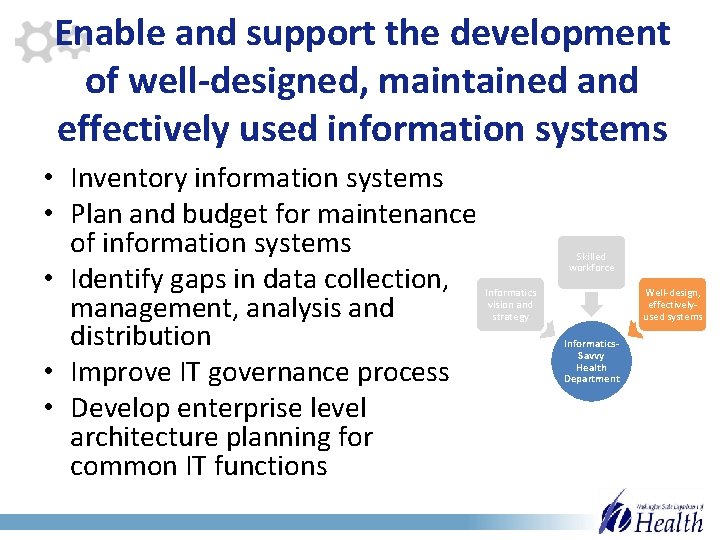
Enable and support the development of well-designed, maintained and effectively used information systems • Inventory information systems • Plan and budget for maintenance of information systems • Identify gaps in data collection, management, analysis and distribution • Improve IT governance process • Develop enterprise level architecture planning for common IT functions Skilled workforce Informatics vision and strategy Well-design, effectivelyused systems Informatics. Savvy Health Department
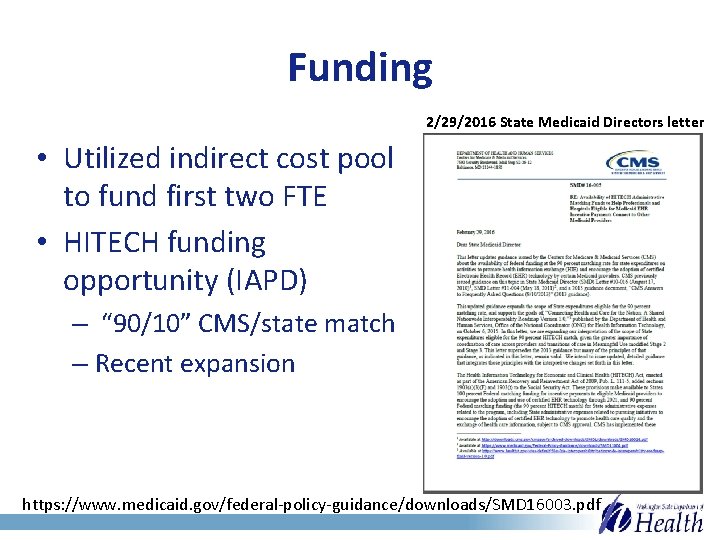
Funding 2/29/2016 State Medicaid Directors letter • Utilized indirect cost pool to fund first two FTE • HITECH funding opportunity (IAPD) – “ 90/10” CMS/state match – Recent expansion https: //www. medicaid. gov/federal-policy-guidance/downloads/SMD 16003. pdf
How do we define success? • Improved timeliness of receiving data • Gained efficiencies – For program staff (e. g. , minimal faxing/data entry) – For IT staff (e. g. , fewer applications to maintain) • Increased use of data/information for decision making • Increased data sharing with partners and the public • Financially sustainable
Benefits • Systematic, coordinated efforts allowed our agency to be a stronger player in Health Systems Transformation • Generated agency buy-in for shared platforms to reduce complexity
Lessons Learned / Recommendations • Becoming an informatics savvy agency takes time so be patient! – Full agency support needed – Transformation of processes and culture in agency – Tools exist to help you • Importance of close working relationships between informatics, state epi(s) and IT leaders • Importance of close working relationship with state Medicaid agency
Questions Amy Ferris, CFO Bryant thomas Karras, MD, Travis Kushner, Meaningful Use Coordinator
Additional slides
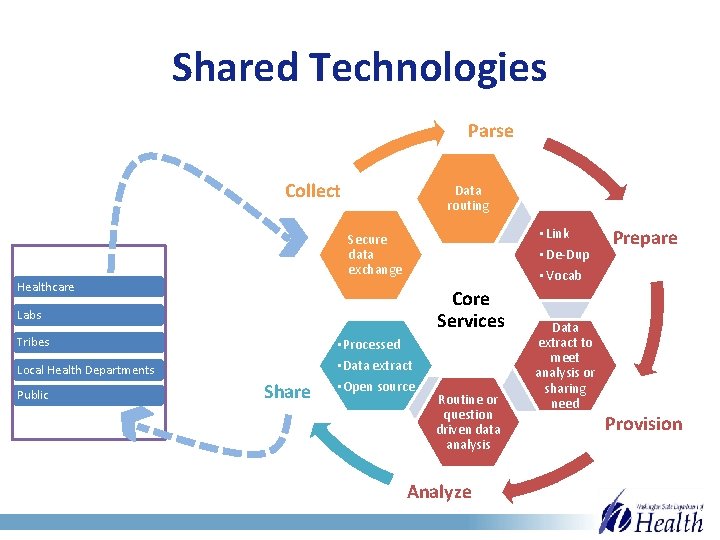
Shared Technologies Parse Collect Data routing • Link • De-Dup • Vocab Secure data exchange Healthcare Core Services Labs Tribes Local Health Departments Public Share • Processed • Data extract • Open source Routine or question driven data analysis Analyze Data extract to meet analysis or sharing need Prepare Provision
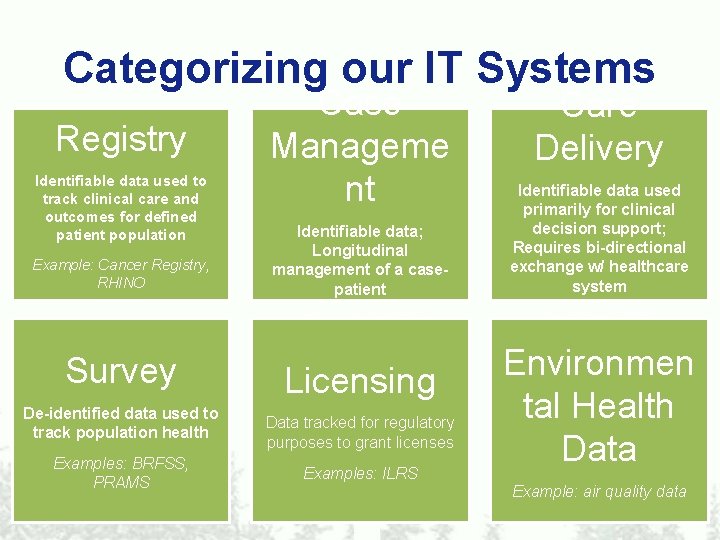
Categorizing our IT Systems Registry Identifiable data used to track clinical care and outcomes for defined patient population Example: Cancer Registry, RHINO Survey De-identified data used to track population health Examples: BRFSS, PRAMS Case Manageme nt Care Delivery Identifiable data; Longitudinal management of a casepatient Identifiable data used primarily for clinical decision support; Requires bi-directional exchange w/ healthcare system Example: WDRS Example: PMP Licensing Data tracked for regulatory purposes to grant licenses Examples: ILRS Environmen tal Health Data Example: air quality data 27
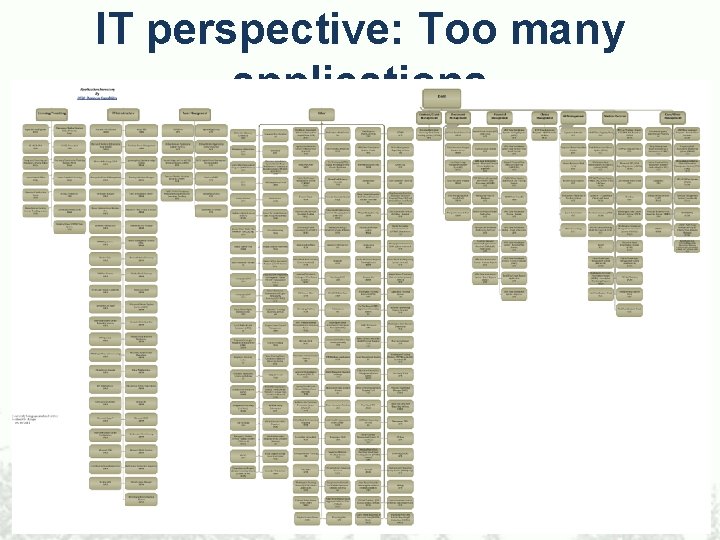
IT perspective: Too many applications 28
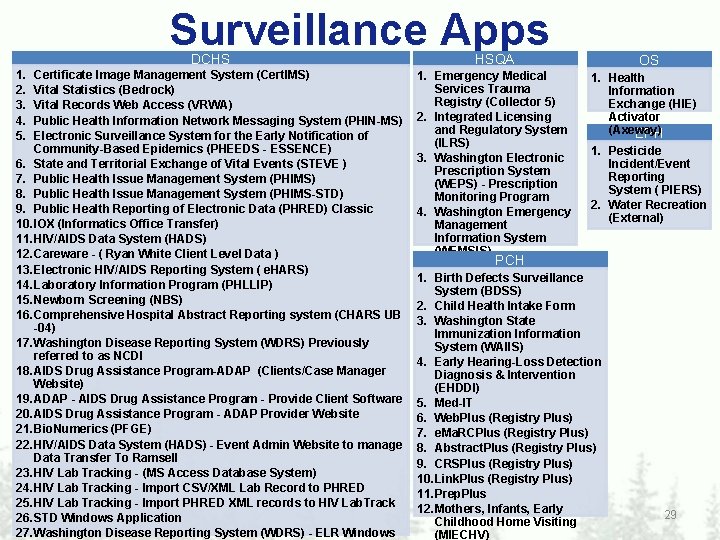
Surveillance Apps DCHS 1. 2. 3. 4. 5. Certificate Image Management System (Cert. IMS) Vital Statistics (Bedrock) Vital Records Web Access (VRWA) Public Health Information Network Messaging System (PHIN-MS) Electronic Surveillance System for the Early Notification of Community-Based Epidemics (PHEEDS - ESSENCE) 6. State and Territorial Exchange of Vital Events (STEVE ) 7. Public Health Issue Management System (PHIMS) 8. Public Health Issue Management System (PHIMS-STD) 9. Public Health Reporting of Electronic Data (PHRED) Classic 10. IOX (Informatics Office Transfer) 11. HIV/AIDS Data System (HADS) 12. Careware - ( Ryan White Client Level Data ) 13. Electronic HIV/AIDS Reporting System ( e. HARS) 14. Laboratory Information Program (PHLLIP) 15. Newborn Screening (NBS) 16. Comprehensive Hospital Abstract Reporting system (CHARS UB -04) 17. Washington Disease Reporting System (WDRS) Previously referred to as NCDI 18. AIDS Drug Assistance Program-ADAP (Clients/Case Manager Website) 19. ADAP - AIDS Drug Assistance Program - Provide Client Software 20. AIDS Drug Assistance Program - ADAP Provider Website 21. Bio. Numerics (PFGE) 22. HIV/AIDS Data System (HADS) - Event Admin Website to manage Data Transfer To Ramsell 23. HIV Lab Tracking - (MS Access Database System) 24. HIV Lab Tracking - Import CSV/XML Lab Record to PHRED 25. HIV Lab Tracking - Import PHRED XML records to HIV Lab. Track 26. STD Windows Application 27. Washington Disease Reporting System (WDRS) - ELR Windows HSQA 1. Emergency Medical 1. Services Trauma Registry (Collector 5) 2. Integrated Licensing and Regulatory System (ILRS) 1. 3. Washington Electronic Prescription System (WEPS) - Prescription Monitoring Program 2. 4. Washington Emergency Management Information System (WEMSIS) PCH Site 5. Trauma Central 1. Birth Defects Surveillance System (BDSS) 2. Child Health Intake Form 3. Washington State Immunization Information System (WAIIS) 4. Early Hearing-Loss Detection Diagnosis & Intervention (EHDDI) 5. Med-IT 6. Web. Plus (Registry Plus) 7. e. Ma. RCPlus (Registry Plus) 8. Abstract. Plus (Registry Plus) 9. CRSPlus (Registry Plus) 10. Link. Plus (Registry Plus) 11. Prep. Plus 12. Mothers, Infants, Early Childhood Home Visiting (MIECHV) OS Health Information Exchange (HIE) Activator (Axeway) EPH Pesticide Incident/Event Reporting System ( PIERS) Water Recreation (External) 29
- Slides: 29