
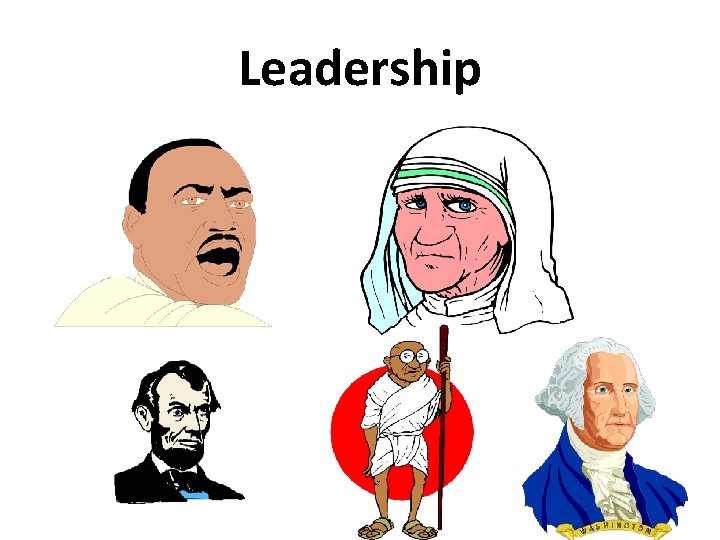
Leadership What is leadership Leading people Influencing people
- Slides: 27
Leadership
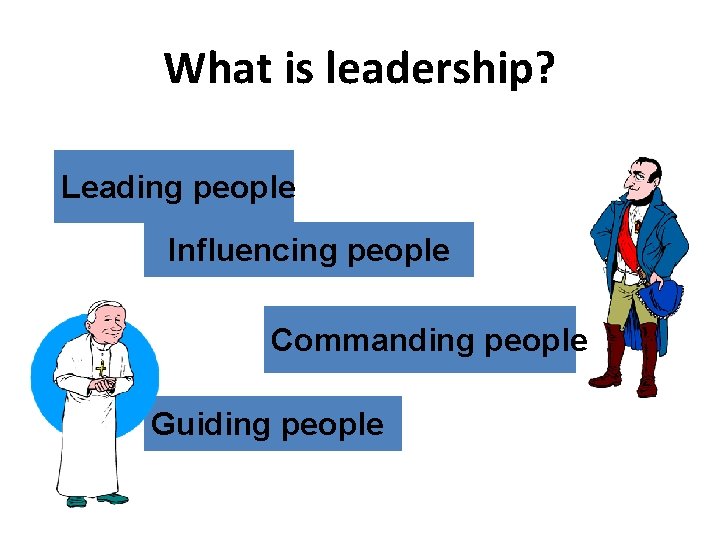
What is leadership? Leading people Influencing people Commanding people Guiding people
Leadership The process of directing and influencing the task related activities of group members
Implications • People (employees and followers) • Power (unequal distribution) • Influence (any actions or examples of behavior that cause a change in attitude or behavior of any other person or group) • Values (leaderships are all about values)
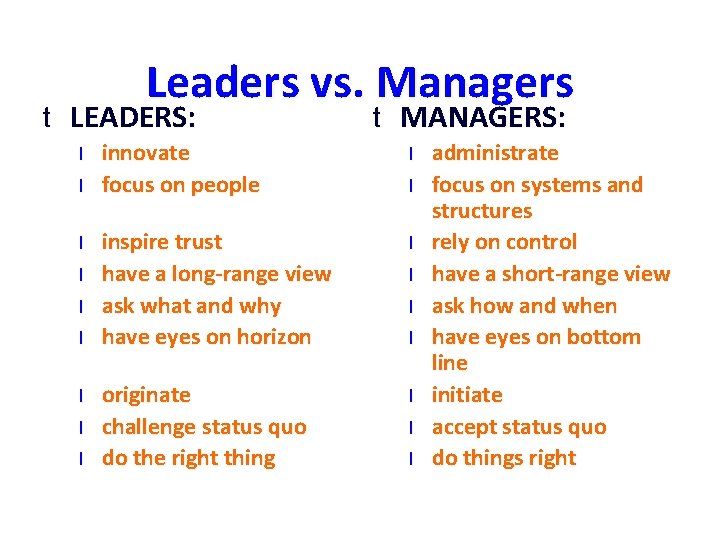
Leaders vs. Managers t LEADERS: l l l l l t MANAGERS: innovate focus on people l inspire trust have a long-range view ask what and why have eyes on horizon l originate challenge status quo do the right thing l l l l administrate focus on systems and structures rely on control have a short-range view ask how and when have eyes on bottom line initiate accept status quo do things right
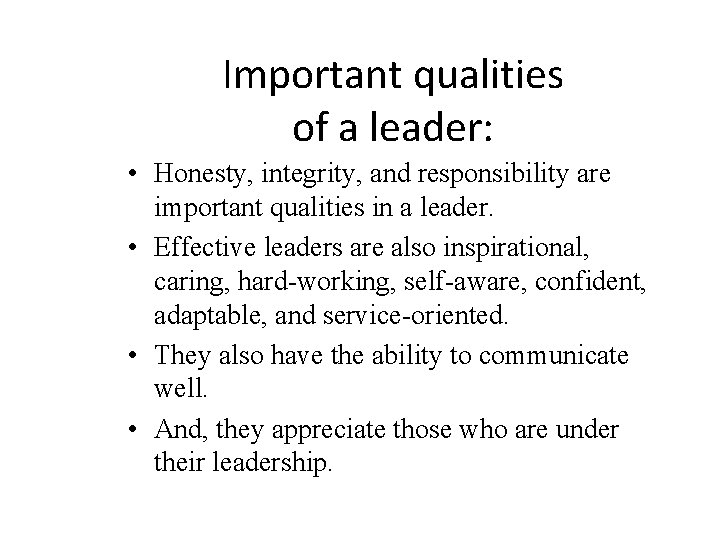
Important qualities of a leader: • Honesty, integrity, and responsibility are important qualities in a leader. • Effective leaders are also inspirational, caring, hard-working, self-aware, confident, adaptable, and service-oriented. • They also have the ability to communicate well. • And, they appreciate those who are under their leadership.
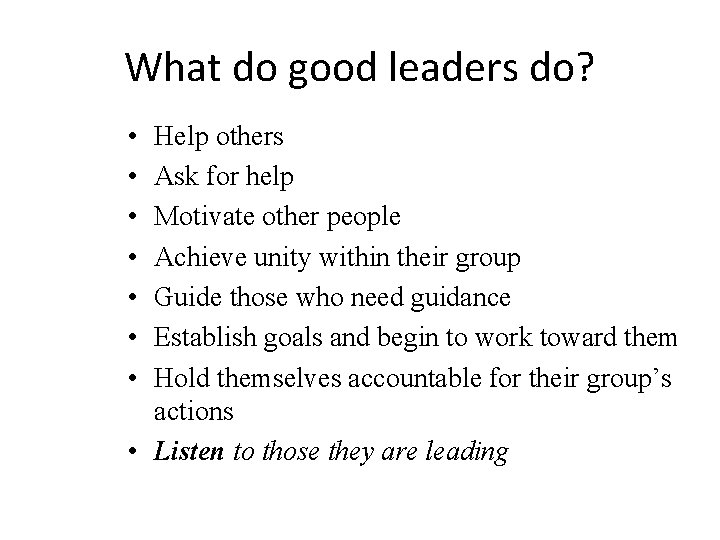
What do good leaders do? • • Help others Ask for help Motivate other people Achieve unity within their group Guide those who need guidance Establish goals and begin to work toward them Hold themselves accountable for their group’s actions • Listen to those they are leading
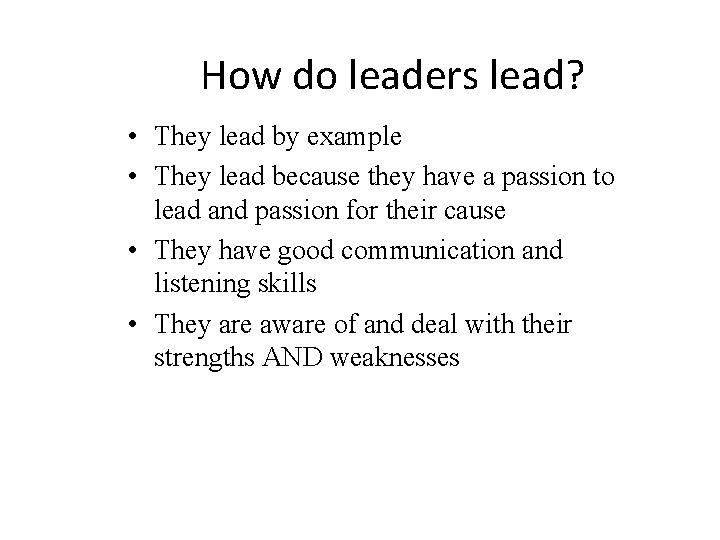
How do leaders lead? • They lead by example • They lead because they have a passion to lead and passion for their cause • They have good communication and listening skills • They are aware of and deal with their strengths AND weaknesses
How do leaders learn? • Listen to those they work with. • Step back from each experience to appreciate the lesson learned. • Are open to change and improvements whether from peers or supervisors. • Seek guidance and advice from a community or program leader.
How a leader motivates others: • Utilize an individual’s natural talents when assigning tasks. • Understand that everyone does not have the same strengths. • Make people feel as though they are contributing something unique to the group. • Make people feel as though their time and efforts are valued. • Make people feel appreciated for the job they have done.
Ways to develop Leadership Qualities ? Learn to think more critically ? Do more to enthuse your team ? Make your goals and future vision attractive and attainable ? Learn to communicate clearly ? Improve your speaking skills ? Organize and allocate workflow ? Make sure work is done correctly and on time ? Find better ways to do things ? Encourage progress and recognize efforts ? Try to match individual skills and work ? Build team spirit ? Encourage people to work cooperatively ? Recognize success and learn from failure ? Trust your subordinates
Effective leaders motivate by: • Making suggestions, not demands. • Making sure everyone is contributing. • Making sure others understand all viewpoints and the details of what is being said.
How important is a leader? • In most cases, people will perform at about 60% of their potential with no leadership at all • Thus, an additional 40% can be realized if effective leadership is available
Trait Approaches • • Leaders are born, not made Two approach Leader and Non leader Effective and ineffective (effective leaderships does not depend on a particular set of traits, but rather on how well the leader’s traits match the requirement of the situation. )
Behavioral Approach • What effective leader do? How they delegate task? How they communicate with and try to motivate their followers. • Behaviors, unlike traits, can be learned. • Leadership function • Leadership styles
Continuum of Leadership Behavior • Use of Authority by the Manager “Boss Centered Leadership” • Area of Freedom for subordinates “Subordinate centered leadership”
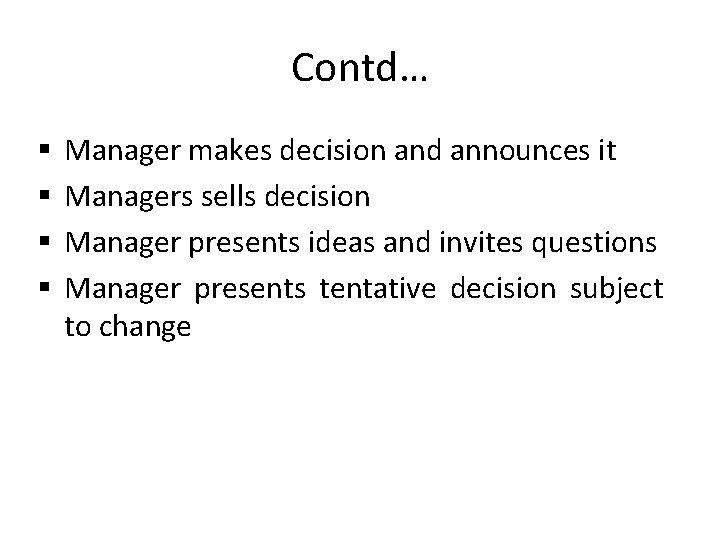
Contd… § § Manager makes decision and announces it Managers sells decision Manager presents ideas and invites questions Manager presents tentative decision subject to change
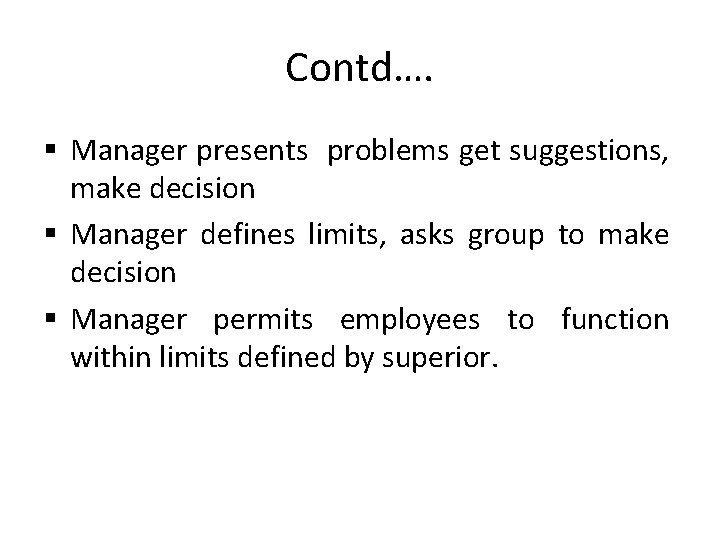
Contd…. § Manager presents problems get suggestions, make decision § Manager defines limits, asks group to make decision § Manager permits employees to function within limits defined by superior.
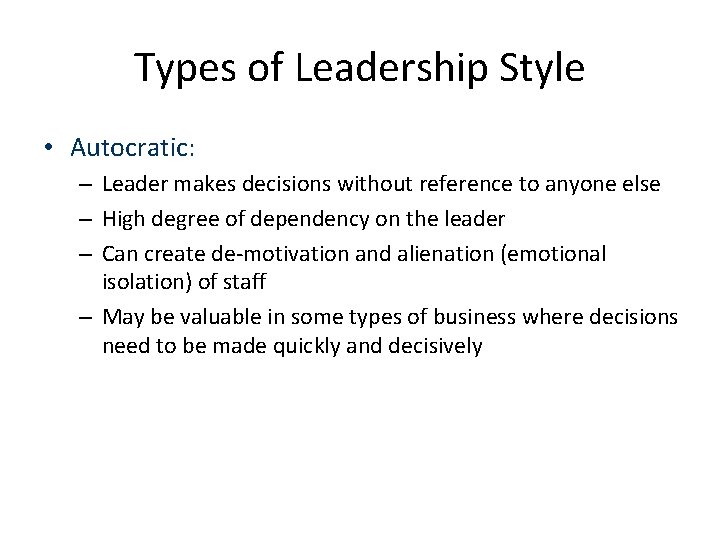
Types of Leadership Style • Autocratic: – Leader makes decisions without reference to anyone else – High degree of dependency on the leader – Can create de-motivation and alienation (emotional isolation) of staff – May be valuable in some types of business where decisions need to be made quickly and decisively
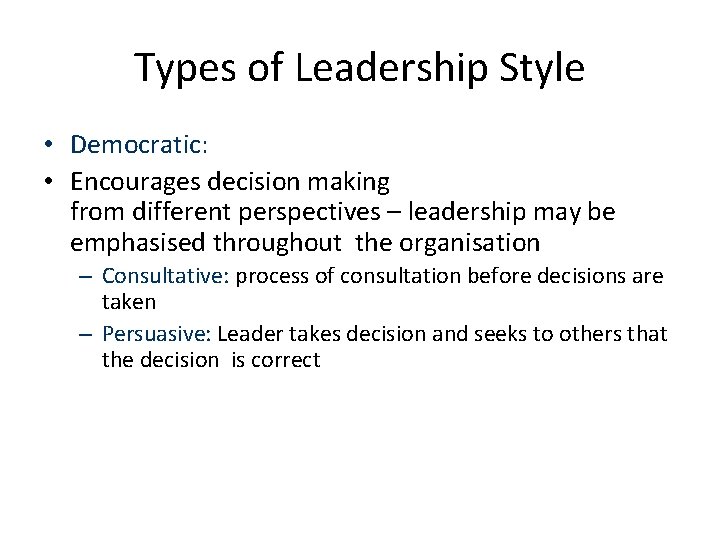
Types of Leadership Style • Democratic: • Encourages decision making from different perspectives – leadership may be emphasised throughout the organisation – Consultative: process of consultation before decisions are taken – Persuasive: Leader takes decision and seeks to others that the decision is correct
Types of Leadership Style • Democratic: – May help motivation and involvement – Workers feel ownership of the firm and its ideas – Improves the sharing of ideas and experiences within the business – Can delay decision making
Types of Leadership Style • Laissez-Faire: – ‘Let it be’ – the leadership responsibilities are shared by all – Can be very useful in businesses where creative ideas are important – Can be highly motivational, as people have control over their working life – Can make coordination and decision making time-consuming and lacking in overall direction – Relies on good team work – Relies on good interpersonal relations
Managerial Grid • The Managerial Grid, developed by Robert Blake and Jane Mouton to help measure a manager’s relative concern for people and production. • Both task orientation and employee orientation are not possible, but could be crucial to superior performance.
Contd… • Style 1, 1 (Low concern for people and production) • Style 1, 9 (High concern for people and Low concern for production) • Style 9, 1 (Low concern for people and High concern production)
Contd… • Style 5, 5 (concern for people and production) • Style 9, 9 (High concern for people and production)
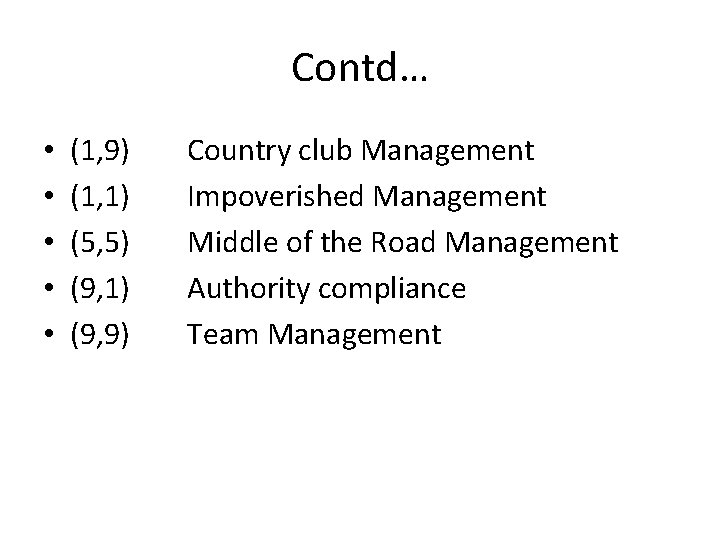
Contd… • • • (1, 9) (1, 1) (5, 5) (9, 1) (9, 9) Country club Management Impoverished Management Middle of the Road Management Authority compliance Team Management
Future of Leadership Theory • Transactional leaders • Leaders who determine what subordinates need to do to achieve objectives, classify those requirements, and help subordinates become confident they can reach their objectives • Transformational • Leaders who, through their personal vision and energy, inspire followers and have a major impact on their organizations; also called charismatic leaders