
Leadership vs Management Chapter 4 Define Management is

- Slides: 25
Leadership vs Management Chapter 4
Define Management is the process of leading and working with people to accomplish organizational goals and objectives using available resources efficiently and effectively. Organization is any type of business (small, large, entrepreneurial, or professional), nonprofit entity, or governmental office
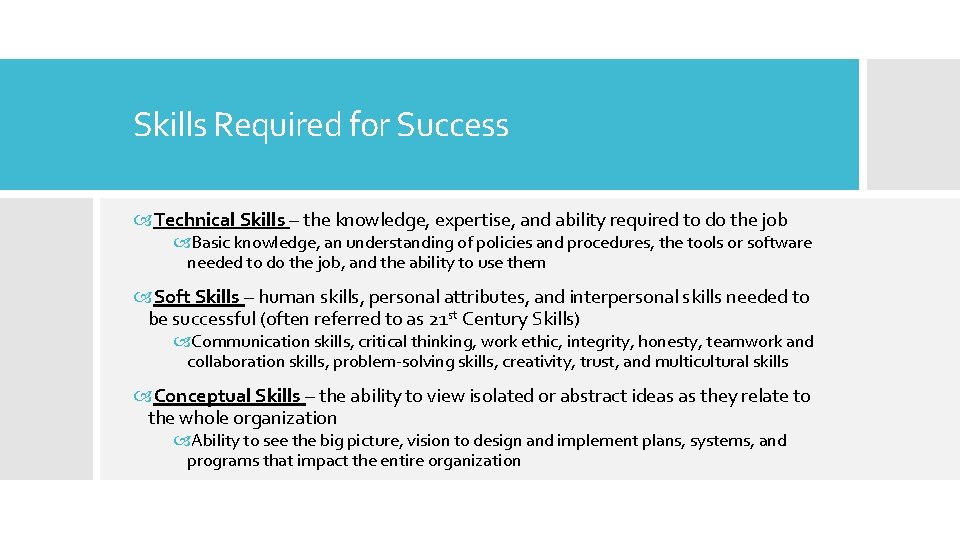
Skills Required for Success Technical Skills – the knowledge, expertise, and ability required to do the job Basic knowledge, an understanding of policies and procedures, the tools or software needed to do the job, and the ability to use them Soft Skills – human skills, personal attributes, and interpersonal skills needed to be successful (often referred to as 21 st Century Skills) Communication skills, critical thinking, work ethic, integrity, honesty, teamwork and collaboration skills, problem-solving skills, creativity, trust, and multicultural skills Conceptual Skills – the ability to view isolated or abstract ideas as they relate to the whole organization Ability to see the big picture, vision to design and implement plans, systems, and programs that impact the entire organization
What is leadership? Leadership is the process of inspiring, influencing, directing, and guiding others to participate in common effort. Developing leadership takes time, commitment, and the ability to learn from your mistakes. Leading effectively is learned by doing.
Leadership vs Management According to Warren Bennis, professor at University of Southern California, there is a profound difference between management and leadership. To “manage” means ”to bring about, to accomplish, to have charge of or responsibility for, to conduct. ” “Leading” is “influencing, guiding in direction, and action. ”
Developing People Managers will frequently assess employee skills and prepare an action plan or professional development plan as part of the employee’s annual performance evaluation. As a manager you must be patient as you work to develop your people into more effective employees and potentially future managers and leaders.
Basic Leadership Theories and Models Trait Theory, Behavioral Styles Theories, Situational Theories and Models
Trait Theory is leadership theory that contends effective leaders have similar personality or behavioral characteristics that ineffective leaders lack Developed in the early 20 th Century Belief that specific traits help leaders acquire necessary skills for leadership
Six Key Leadership Traits Drive – a broad terms that includes achievement, motivation, ambition, energy, tenacity, and initiative Trait Theory Leadership motivation – the desire to lead but not seek power for its own sake Honesty and integrity – essential qualities for building credibility and trust Cognitive ability – good judgement and strong analytical abilities Knowledge of business – a high level of knowledge that also encompasses the industry and technical matters
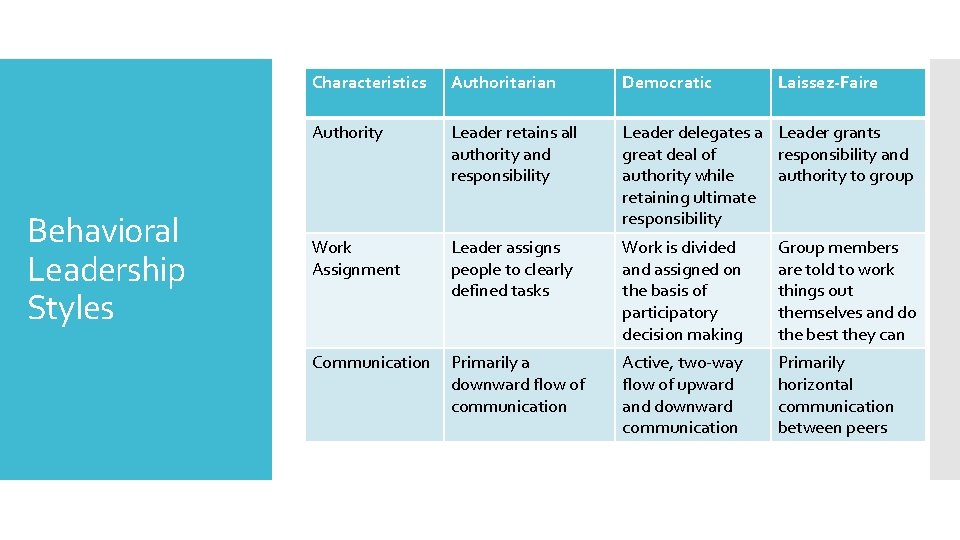
Behavioral leadership styles are patterns of leadership behavior. Behavioral Styles Theory Three classic styles: Authoritarian Leader Democratic Leader Laissez-faire Leader
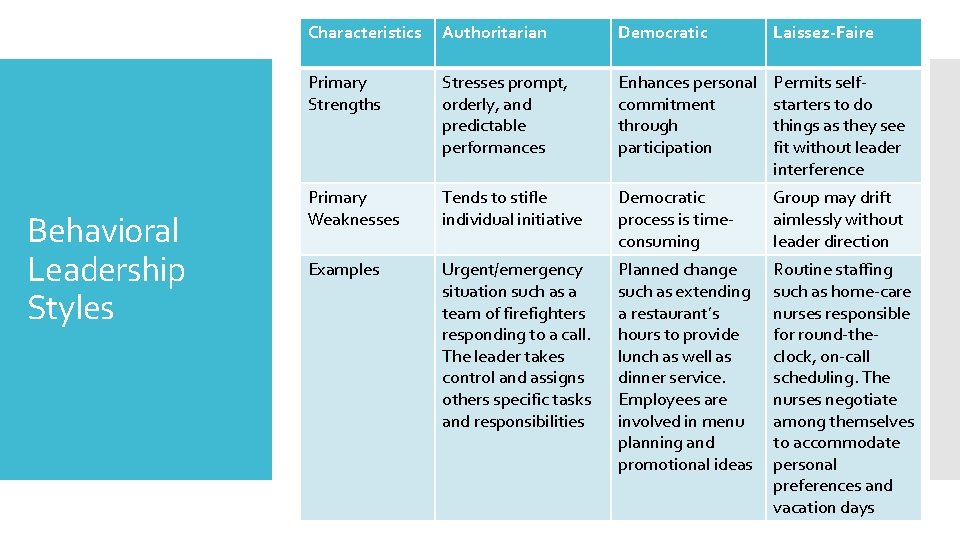
Authoritarian Leader is one who retains all authority and responsibility. Behavioral Styles Theory They assign people to clearly defined tasks There is primarily a downward flow of communication Leadership style tends to stress prompt, orderly , and predictable performance Can stifle individual initiative and breed resentment
Democratic Leader is one who delegates authority while retaining ultimate responsibility Behavioral Styles Theory Work is divided and assigned on the basis of participatory decision making An active two-way flow of upward and downward communication Typically enhances personal commitment through participation This approach can be very time-consuming
Behavioral Styles Theory Laissez-Faire Leader is one who grants responsibility and authority to a group of individuals, who are told to work problems out themselves Communication is primarily horizontal among peers Approach permits self-starters to do what they think is appropriate without interference or direction from their leader Downfall is without direction and guidance from their leader, groups may become unfocused and drift aimlessly
Behavioral Leadership Styles Characteristics Authoritarian Democratic Laissez-Faire Authority Leader retains all authority and responsibility Leader delegates a Leader grants great deal of responsibility and authority while authority to group retaining ultimate responsibility Work Assignment Leader assigns people to clearly defined tasks Work is divided and assigned on the basis of participatory decision making Group members are told to work things out themselves and do the best they can Communication Primarily a downward flow of communication Active, two-way flow of upward and downward communication Primarily horizontal communication between peers
Behavioral Leadership Styles Characteristics Authoritarian Democratic Laissez-Faire Primary Strengths Stresses prompt, orderly, and predictable performances Enhances personal commitment through participation Permits selfstarters to do things as they see fit without leader interference Primary Weaknesses Tends to stifle individual initiative Democratic process is timeconsuming Group may drift aimlessly without leader direction Examples Urgent/emergency situation such as a team of firefighters responding to a call. The leader takes control and assigns others specific tasks and responsibilities Planned change such as extending a restaurant’s hours to provide lunch as well as dinner service. Employees are involved in menu planning and promotional ideas Routine staffing such as home-care nurses responsible for round-theclock, on-call scheduling. The nurses negotiate among themselves to accommodate personal preferences and vacation days
How would you handle this? Imagine you are the office manager of an internal medicine group. The building loses power during a sudden storm, and you do not have a full-building generator. A leading expert in your field is conducting a seminar for physicians on the latest treatments available in your specialty, and a number of patients are in the building. Which behavioral leadership style would be the best for this situation? Explain your answer After the crisis is resolved, the partners ask that you create an emergency plan to address a power outage. Which behavioral leadership style will you use when preparing the plan/ Explain why.
Situational Theories and Models Situational Leadership is the concept that successful leadership occurs when the leader’s style matches the situation Three approaches to situational leadership Ken Blanchard and Paul Hersey’s Model Fred E. Fiedler’s Contingency Theory The Path-Goal Theory
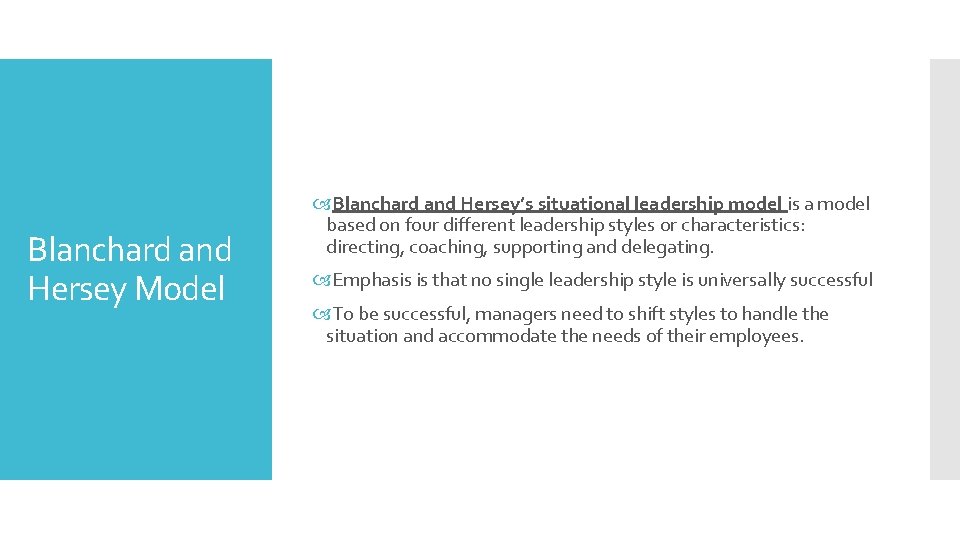
Blanchard and Hersey Model Blanchard and Hersey’s situational leadership model is a model based on four different leadership styles or characteristics: directing, coaching, supporting and delegating. Emphasis is that no single leadership style is universally successful To be successful, managers need to shift styles to handle the situation and accommodate the needs of their employees.
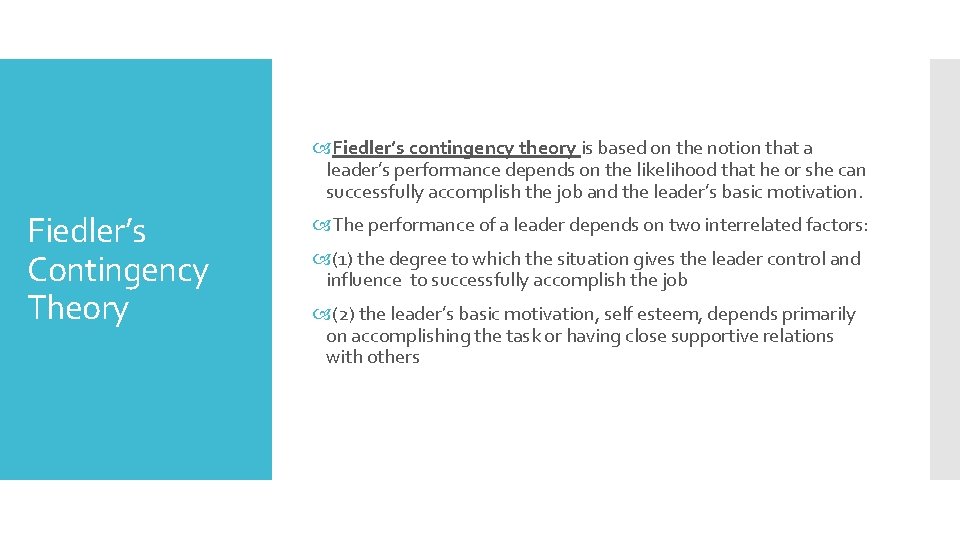
Fiedler’s contingency theory is based on the notion that a leader’s performance depends on the likelihood that he or she can successfully accomplish the job and the leader’s basic motivation. Fiedler’s Contingency Theory The performance of a leader depends on two interrelated factors: (1) the degree to which the situation gives the leader control and influence to successfully accomplish the job (2) the leader’s basic motivation, self esteem, depends primarily on accomplishing the task or having close supportive relations with others
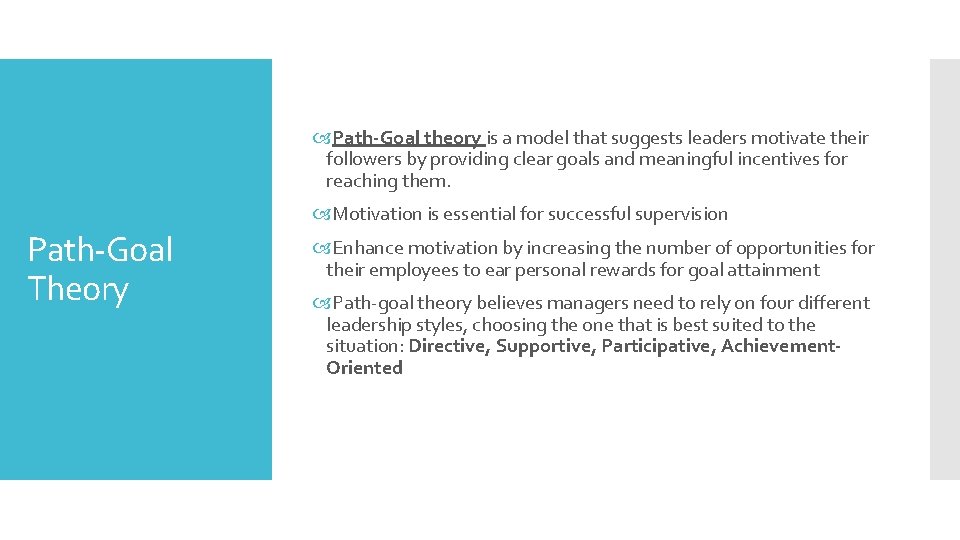
Path-Goal theory is a model that suggests leaders motivate their followers by providing clear goals and meaningful incentives for reaching them. Motivation is essential for successful supervision Path-Goal Theory Enhance motivation by increasing the number of opportunities for their employees to ear personal rewards for goal attainment Path-goal theory believes managers need to rely on four different leadership styles, choosing the one that is best suited to the situation: Directive, Supportive, Participative, Achievement. Oriented
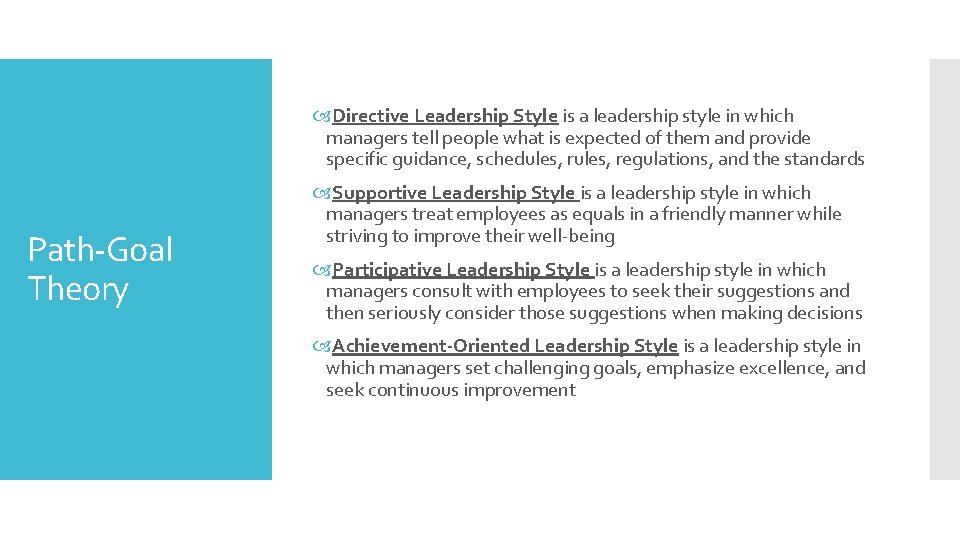
Directive Leadership Style is a leadership style in which managers tell people what is expected of them and provide specific guidance, schedules, regulations, and the standards Path-Goal Theory Supportive Leadership Style is a leadership style in which managers treat employees as equals in a friendly manner while striving to improve their well-being Participative Leadership Style is a leadership style in which managers consult with employees to seek their suggestions and then seriously consider those suggestions when making decisions Achievement-Oriented Leadership Style is a leadership style in which managers set challenging goals, emphasize excellence, and seek continuous improvement
Situation Select a situation from your job or an extracurricular group you are involved with. Choose a situation that will ultimately lead to change, such as a new sales campaign, fundraiser, or a recruitment drive. Describe the situation. Which situational leadership style do you think would be most effective in the scenario that you described above? Explain why. What variables did you consider when selecting a leadership style?
Transformational and Servant Leadership
Transformational Leadership is a leadership that inspires followers to share a vision, motivates and empowers them to achieve vision, and provides coaching and support to develop their potential. 4 Characteristics of transformational leaders Transformational Leadership 1. Influence their employees in a positive wat so that employees trust them and consider them role models. 2. Motivate and inspire their employees to understand the importance of their jobs and to work together to achieve the vision and goals of the organization, not just their own. 3. Encourage their employees to use their intellectual abilities to solve problems in creative ways and to explore new ways to do things. 4. Coach and develop individual employees to help them reach their potential for personal growth as well as for the benefit of the organization
Servant Leadership is an ethical leadership that focuses on employees and meeting their needs first rather than the organization’s needs Servant Leadership Based on the idea that leaders should think of their employees first and be concerned about serving their needs rather than their own needs or their organization’s needs Leaders and employees are on the same level of the organizational pyramid Goal is to develop the employees so that they all become servant leaders and everybody in the work group serves and is responsible for each other