
Leadership training Lae District PLANNING Developing a Purpose
- Slides: 53
Leadership training – Lae District
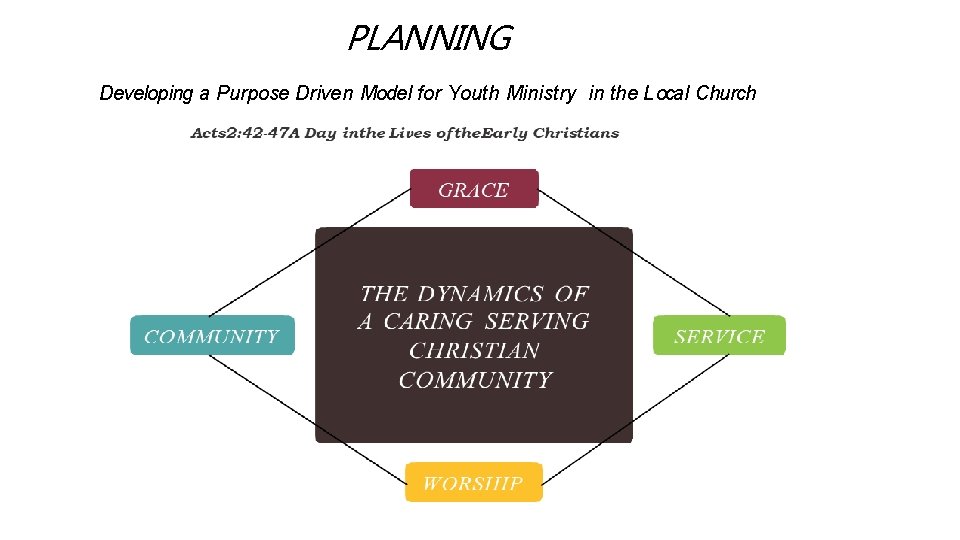
PLANNING Developing a Purpose Driven Model for Youth Ministry in the Local Church
The four dynamic forces were grace, service, worship, and community. These four forces are clearly seen in the life of the early church and under-girded the rapid growth of the New Testament church community. Grace—the free gift of eternal life through Jesus Christ to sinners, who don’t deserve it. Gane stresses that Adventist Youth Ministry must include an intentional focus on God’s saving acts in history in such a way as to meet the needs of the young people at their stage of development. Youth ministry built on this model seeks to meet young people where they are, and through love and spiritual care, lead them into a saving relationship that recognizes and fully accepts the astonishing, free gift of God’s grace to them personally.
Worship— the celebration of God’s gift in praises to Him in formal church services, small groups, and individual daily lifestyle. This is carried out through prayer, singing, praise, and thanksgiving. These practices build a rich spiritual life which goes with the young person far beyond weekly worship services or AY meetings. They learn that while following Jesus today does not literally mean to be with Him in the same way as His first disciples could, the priorities and intentions, the heart and inner attitudes of modern disciples are forever the same. A disciple wants to be like the Master and the disciple reorders the priorities of life in order to make discipleship possible. Jesus says that the Scriptures testify of Him and no discipleship is possible without spending time with Him through the meditation upon His Word. The Word, made alive by the Holy Spirit, will shape and transform the heart and life of the disciple to be like the master (Psalm 1: 1 -3). The whole life will become worship.
Community— relationships bonded together in an atmosphere of warmth, love, and acceptance, where self is laid aside for the good of others. As, in the early church, believers were nurtured through the Word and teachings of the apostles. So here, young believers are welcomed into a community that reflects love, support, and unity as a window on the kingdom of God. In this community, no one is left out and everyone is cared for. In this community, there will be people at all levels on their journey with God. Some might be totally committed to Him, others might have no interest in spiritual things at all. Our task is to journey with all of them and to minister to them wherever they find themselves on the spectrum of faith. This will lead our youth to do the same as they grow in faith.
Service—the early church was intentional about expanding the kingdom of Jesus and extending the good news of a life in Christ and the grace He gives to everyone, everywhere, all the time. In the same way, service and mission are the heartbeat of your youth group/small group. Your outreach methods and activities will depend on your circumstances, the needs of the community, the resources that you and your youth group have, the spiritual gifts of your team, and the empowerment of the Holy Spirit. Whatever shape or form your service/mission takes, it should always represent the ultimate objective for the existence of your ministry. Bear in mind the prophetic counsel given to us through inspiration: “Christ’s method alone will give true success in reaching the people. The Savior mingled with men as one who desired their good. He showed His sympathy for them, ministered to their needs, and won their confidence. Then He bade them, “Follow Me” (Ministry of Healing, p. 143).
These four dynamic forces (GCSYMH, p. 29) need to become the foundation of youth programming
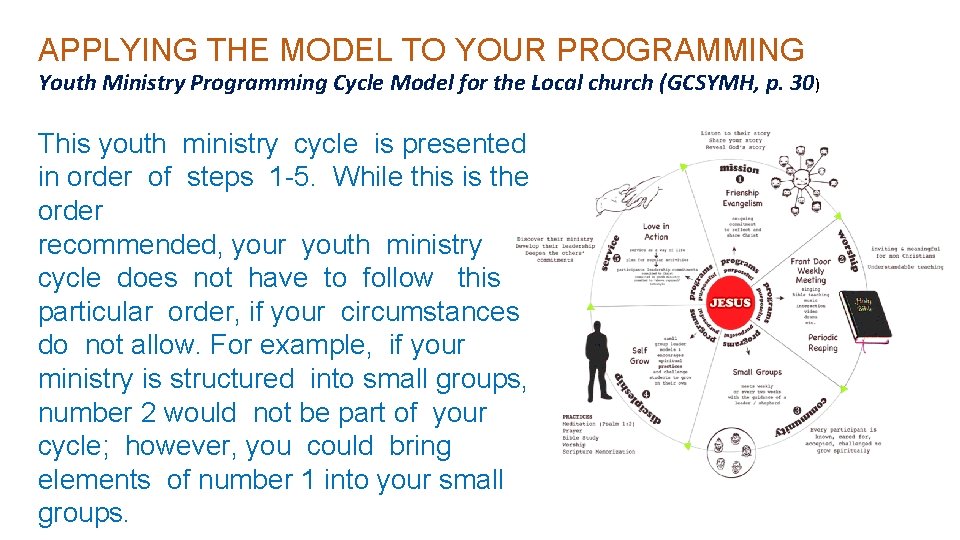
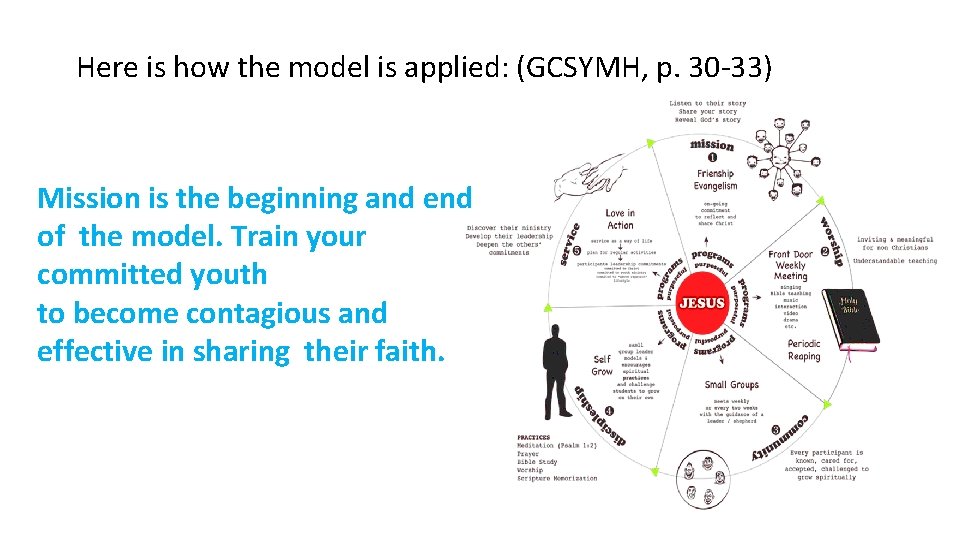
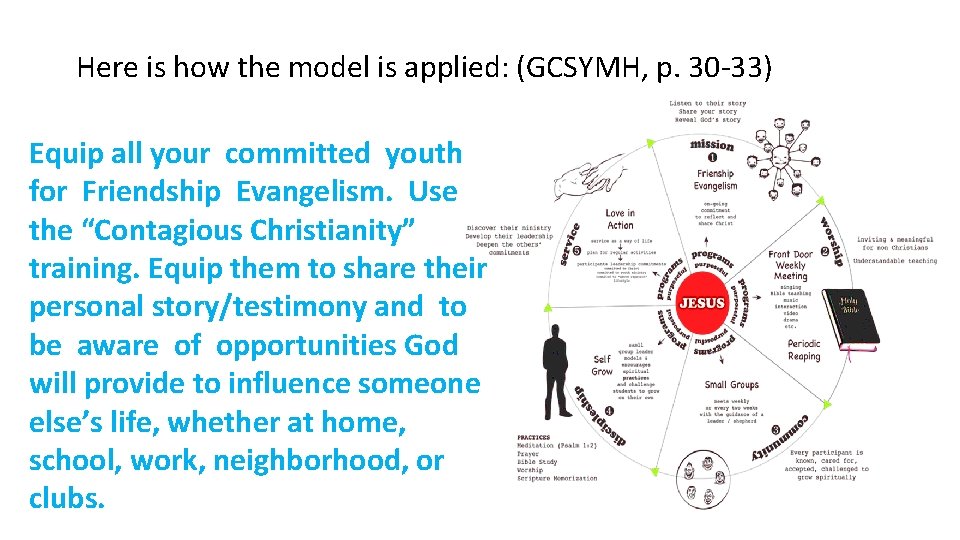
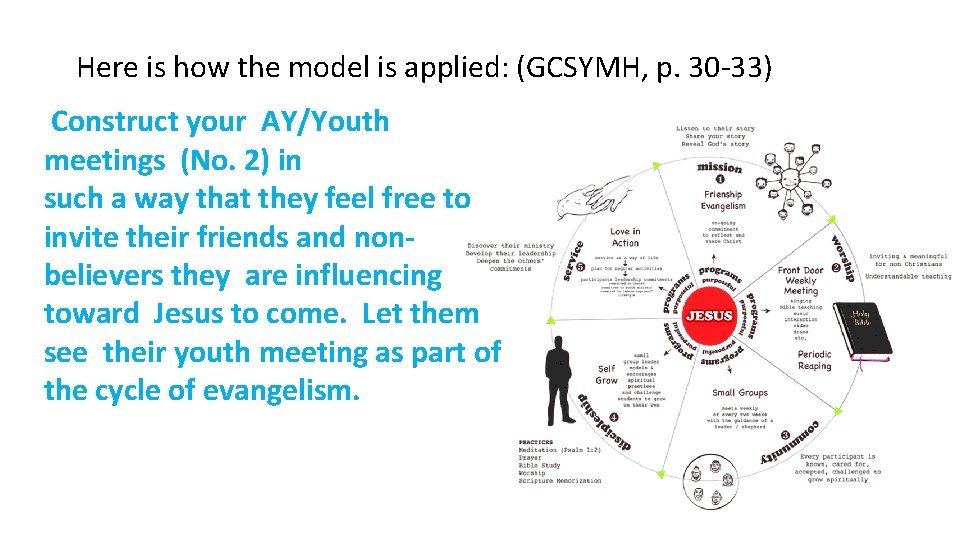
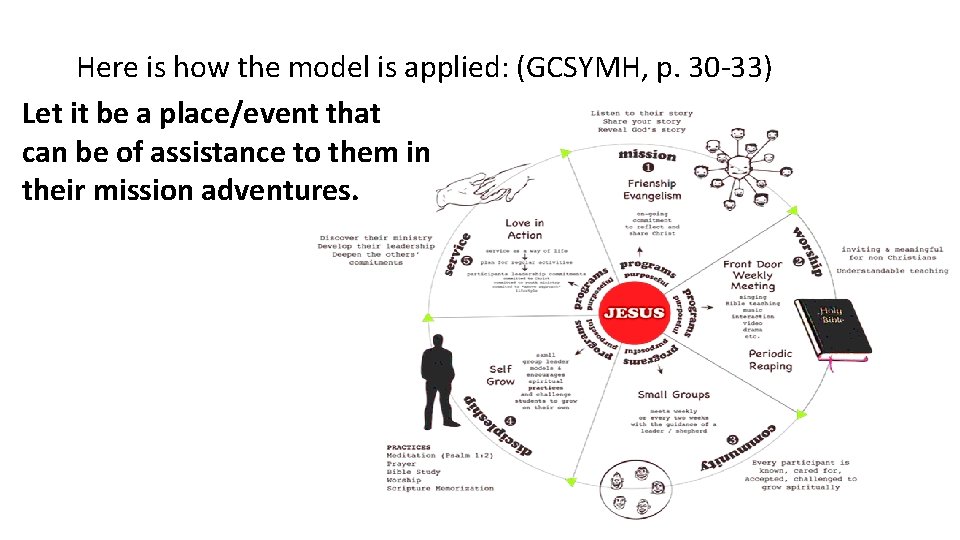
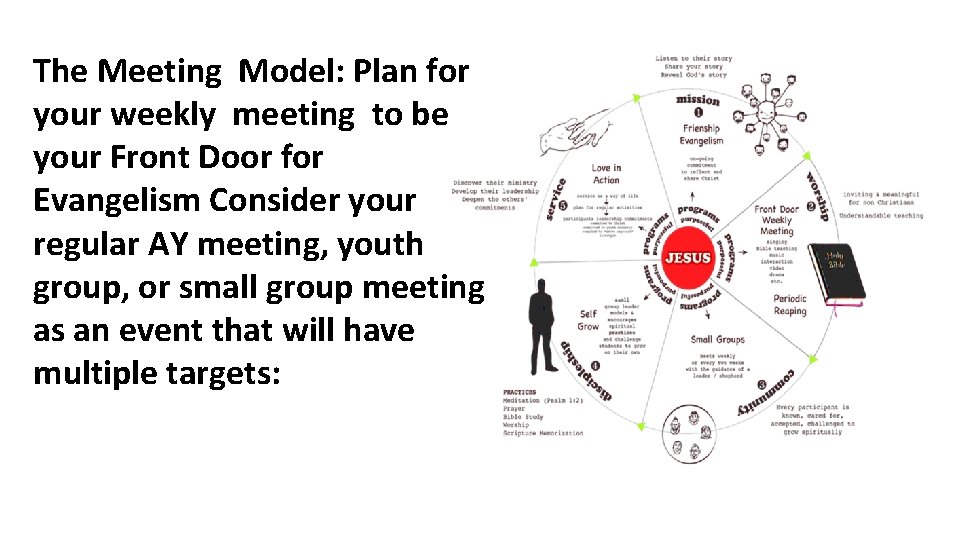
APPLYING THE MODEL TO YOUR PROGRAMMING Youth Ministry Programming Cycle Model for the Local church (GCSYMH, p. 30) This youth ministry cycle is presented in order of steps 1 -5. While this is the order recommended, your youth ministry cycle does not have to follow this particular order, if your circumstances do not allow. For example, if your ministry is structured into small groups, number 2 would not be part of your cycle; however, you could bring elements of number 1 into your small groups.
Here is how the model is applied: (GCSYMH, p. 30 -33) Mission is the beginning and end of the model. Train your committed youth to become contagious and effective in sharing their faith.
Here is how the model is applied: (GCSYMH, p. 30 -33) Equip all your committed youth for Friendship Evangelism. Use the “Contagious Christianity” training. Equip them to share their personal story/testimony and to be aware of opportunities God will provide to influence someone else’s life, whether at home, school, work, neighborhood, or clubs.
Here is how the model is applied: (GCSYMH, p. 30 -33) Construct your AY/Youth meetings (No. 2) in such a way that they feel free to invite their friends and nonbelievers they are influencing toward Jesus to come. Let them see their youth meeting as part of the cycle of evangelism.
Here is how the model is applied: (GCSYMH, p. 30 -33) Let it be a place/event that can be of assistance to them in their mission adventures.
Resources: “Becoming a Contagious Christian” training and other training tools are available at youth. adventist. org
The Meeting Model: Plan for your weekly meeting to be your Front Door for Evangelism Consider your regular AY meeting, youth group, or small group meeting as an event that will have multiple targets:
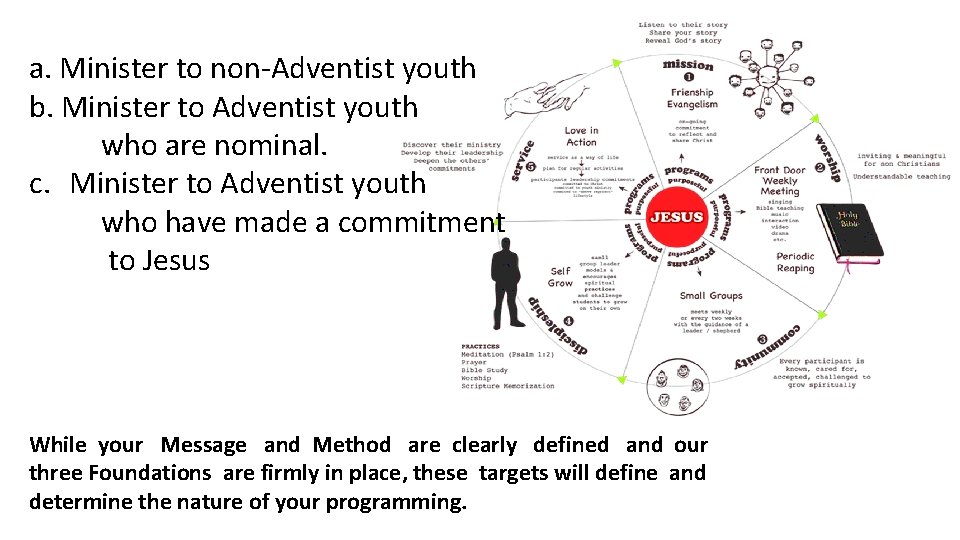
a. Minister to non-Adventist youth b. Minister to Adventist youth who are nominal. c. Minister to Adventist youth who have made a commitment to Jesus While your Message and Method are clearly defined and our three Foundations are firmly in place, these targets will define and determine the nature of your programming.
Know the SIX Fundamental AYM Objectives The six key fundamental youth objectives as outlined by M. E. Kern, the first appointed youth director in 1907, and endorsed by E. G. White is still the fundamental objectives of the AYM that needs to be implemented into the yearly programs: - 1. 2. 3. 4. 5. 6. To raise the level of the devotional life of the youth. To lift the standard of attainment of the youth. To educate and train youth for service. To provide opportunities for outreach and service. To teach the principles of stewardship. To lead youth to discover their individual worth develop and discover their spiritual gifts. and
Elements of the meetings: 1. 2. 3. 4. 5. Creative and not repetitive Relationally based and warm Grounded in practical Bible teaching relevant to theme of the day Based on involvement and interaction Anointed in prayer Meetings are generally constructed around a THEME and contain a number of elements that include welcome, prayer, songs, ice breakers, quiz, interaction, role, etc. ; however, there is a main segment that can be presented in a number of different ways, such as:
a. Formal presentation by someone who has some insights on theme. b. Debate on theme c. Theme presented to be discussed in a small group followed by reporting and summing up d. A musical meeting based on a theme (different songs to be presented and discussed) e. A theme to be role-played by different groups followed by discussions f. A presentation of a drama Please Note Provide periodical alternatives to your youth meetings; they do not always have to be conducted on the church premises. Here are some possibilities:
a. Meeting in nature - in a park or simply go for a purposeful nature walk. b. Visitation of a hospital/nursing home / prison / orphanage / shutins /friends who do not attend. It would be wise to dedicate a series of meetings at specific times of the year that could take the form of a reaping campaign, when you can challenge participants to cross the line for Jesus. Resources: For ideas for youth meetings and Voice of Youth/ reaping campaigns, go to youth. adventist. org. Look for “Face Time” and “The One, ” among others.
3. Developing community: an essential foundation of your youth ministry Consider small group ministry to be an indispensable part of your ministry weekly or once every two weeks. This is a place of belonging for every participant, where they are known personally, cared for, accepted, and 4. Growing into Deeper Spirituality: Discipleship Our vision is to challenged to youth grow from spiritually. is the place where you will transition our simple. This membership to authentic discipleship. lead your Youth and small group leaders are encouraged to embrace ‘seeker’ for that further investigation of the faith. spiritualfriends practices develop their character and help them grow into the likeness of Jesus, the Master Teacher. They should challenge all participants to grow, whether it is in the context of the small group or individually.
Repeat: Youth Ministry begins and ends with Service and Mission Youth ministry has developed a reputation of service as something we do overseas or at home a few times a year; however, it is God’s plan for us to develop service as a way of life. It is on the journey of service that young people come to find their unique place in ministry; this is what brings meaning and purpose in their spiritual journey.
We consider the following elements as essential as part of our Service/ Mission tool kit: 1. My Story: the readiness and ability to share your personal testimony/story. 2. His Story: the ability to simply explain the essence of the gospel. 3. Our Story: a clear understanding and the ability to articulate the unique contribution of the Adventist Message. 4. Regular involvement in acts of compassion, justice and mercy. 5. Proclamation of the Word through regular evangelistic series
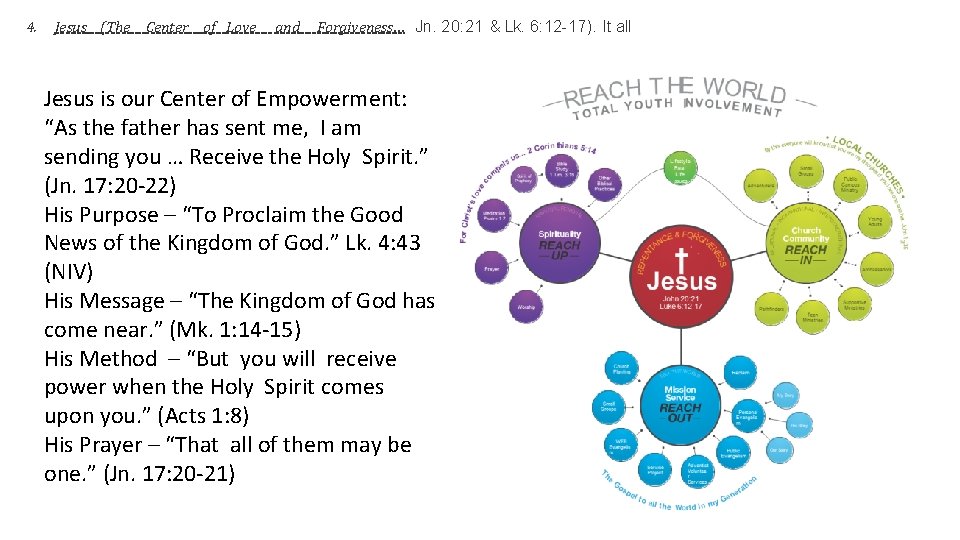
6. TOTAL YOUTH INVOLVEMENT GC /AYM Quinquennium Theme – “Pass it On” Refer to Pass It On Booklet (GC, 2016) In keeping with the General Conference Youth Ministry Quinquennium Theme of “Pass it On, ” the youth leader additionally needs to purposefully incorporate three key elements of this initiative (Reach Up, Reach In, Reach Across) into their weekly programs, so that all three components are experienced at least once per quarter. This need not be seen as something to add; it is clearly present in all the dynamic elements of life and growth that we have seen already.
Reach Up (“For the love of Christ compels us. ” 2 Cor. 5: 14) Spiritual Renewal through 1. Worship 2. Prayer 3. Meditation (Ps. 1: 2) 4. Spirit of Prophecy 5. Bible study (1 Tim. 3: 16) 6. Other Bible Practices
Reach In (“By this everyone shall know that you are My disciples if we loveone another” Jn. 13: 35). Church Community through 1. Small Groups 2. Adventurers 3. Pathfinders 4. Ambassadors 5. Teen Ministries 6. Supportive Groups 7. Public Campus Ministries 8. Young Adults 9. (Involving Relational/Incarnational/Intergenerational
Reach Out (The Gospel to all the World in my Generation… tell the World). Mission Service through: 1. Public Evangelism 2. Small Groups 3. Personal Evangelism (My Story/His Story/Our Story) 4. Reclaim 5. Adventist Volunteer Services 6. Service Projects 7. Church Planting
4. Jesus (The Center of Love and Forgiveness… Jn. 20: 21 & Lk. 6: 12 -17). It all Jesus is our Center of Empowerment: “As the father has sent me, I am sending you … Receive the Holy Spirit. ” (Jn. 17: 20 -22) His Purpose – “To Proclaim the Good News of the Kingdom of God. ” Lk. 4: 43 (NIV) His Message – “The Kingdom of God has come near. ” (Mk. 1: 14 -15) His Method – “But you will receive power when the Holy Spirit comes upon you. ” (Acts 1: 8) His Prayer – “That all of them may be one. ” (Jn. 17: 20 -21)
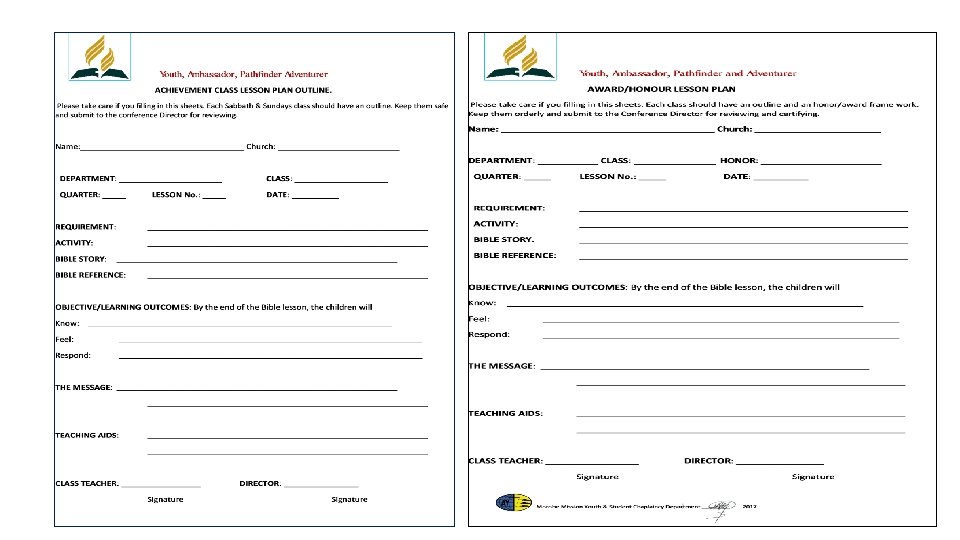
Teaching/Lesson Plan A lesson plan is usually prepared by the teacher who conducts a lesson for students to make sure a lesson meets its objectives and learning takes place effectively. A unit consists of many lessons and takes a longer time period. This is the key difference between unit plan and lesson plan. A lesson plan elaborates, basically, on objectives of a particular lesson and how teaching is planned in a way to achieve those objectives. A unit plan, on the other hand, covers a wider area; a unit that can include many lessons.
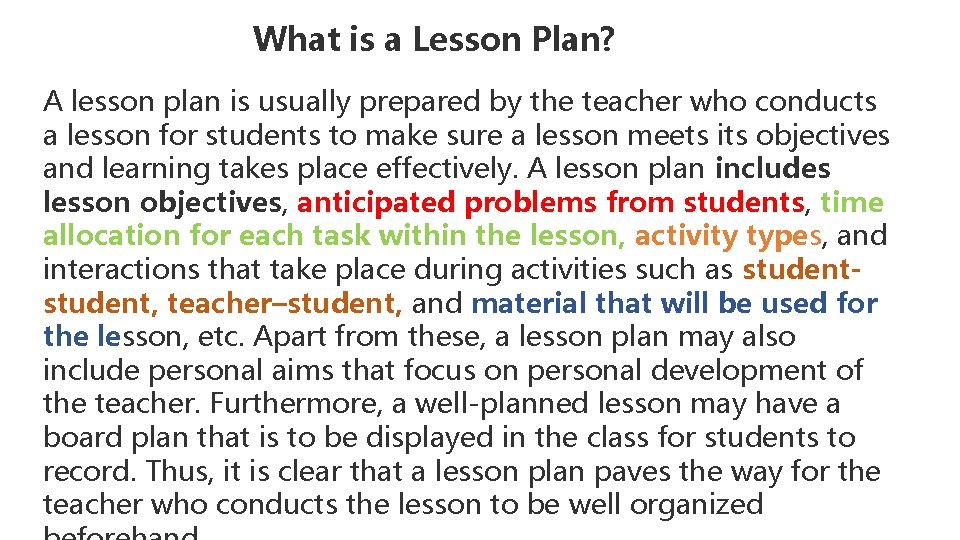
What is a Lesson Plan? A lesson plan is usually prepared by the teacher who conducts a lesson for students to make sure a lesson meets its objectives and learning takes place effectively. A lesson plan includes lesson objectives, anticipated problems from students, time allocation for each task within the lesson, activity types, and interactions that take place during activities such as student, teacher–student, and material that will be used for the lesson, etc. Apart from these, a lesson plan may also include personal aims that focus on personal development of the teacher. Furthermore, a well-planned lesson may have a board plan that is to be displayed in the class for students to record. Thus, it is clear that a lesson plan paves the way for the teacher who conducts the lesson to be well organized
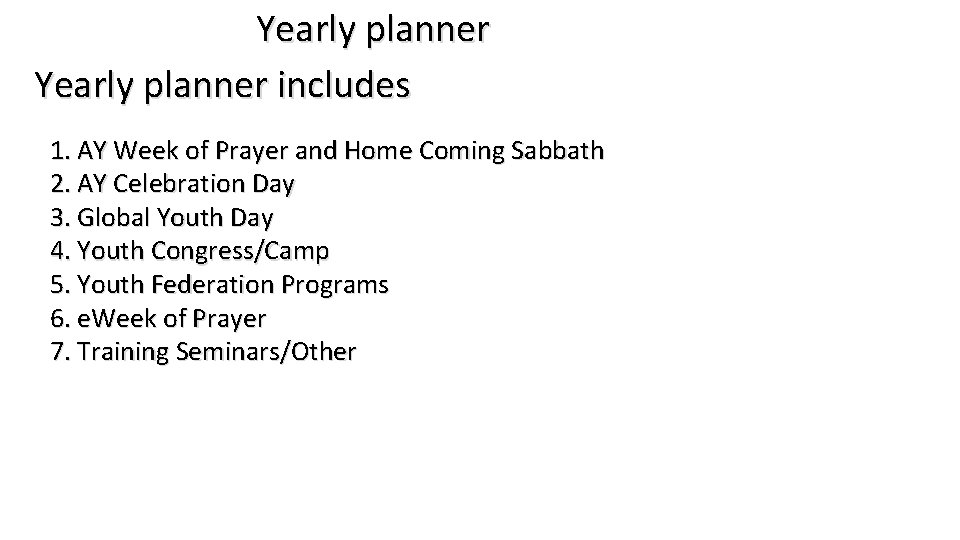
Yearly planner includes 1. AY Week of Prayer and Home Coming Sabbath 2. AY Celebration Day 3. Global Youth Day 4. Youth Congress/Camp 5. Youth Federation Programs 6. e. Week of Prayer 7. Training Seminars/Other
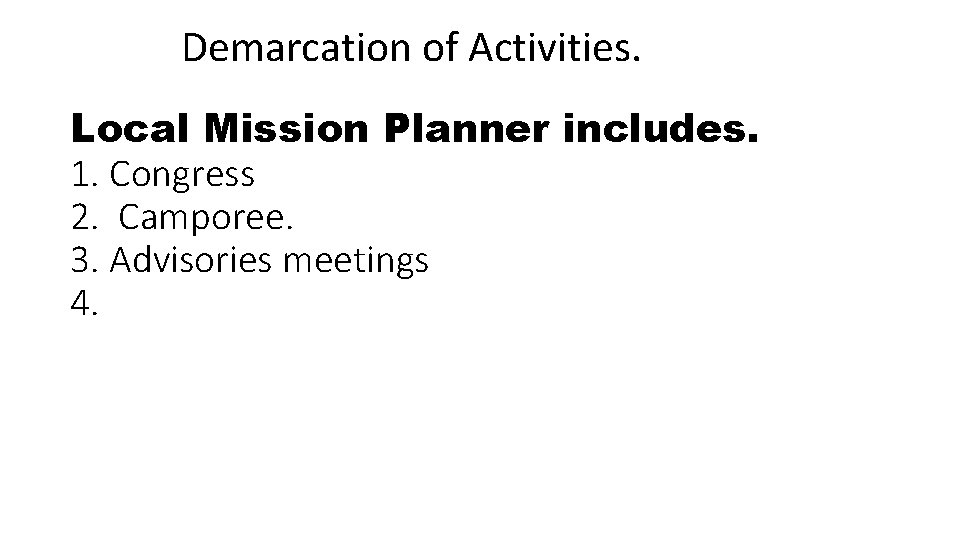
Demarcation of Activities. Local Mission Planner includes. 1. Congress 2. Camporee. 3. Advisories meetings 4.
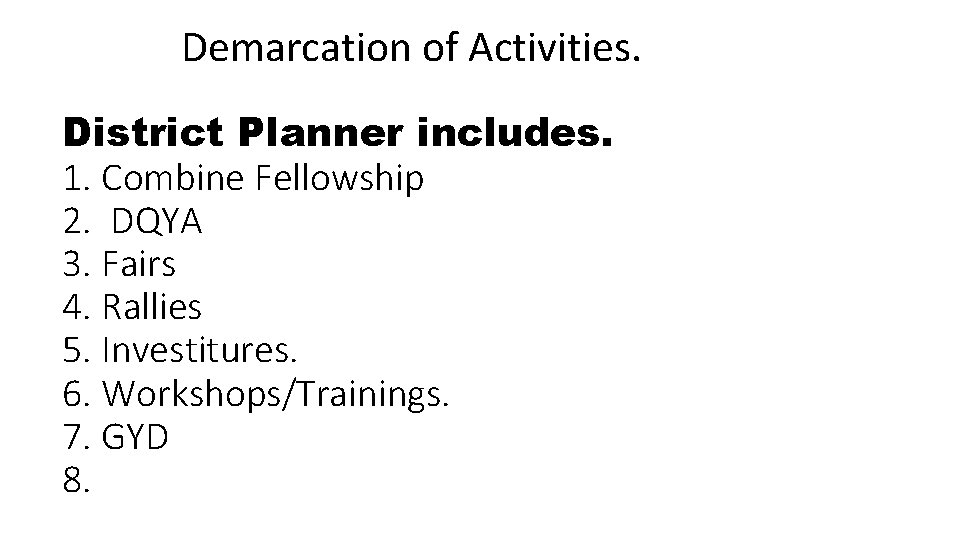
Demarcation of Activities. District Planner includes. 1. Combine Fellowship 2. DQYA 3. Fairs 4. Rallies 5. Investitures. 6. Workshops/Trainings. 7. GYD 8.
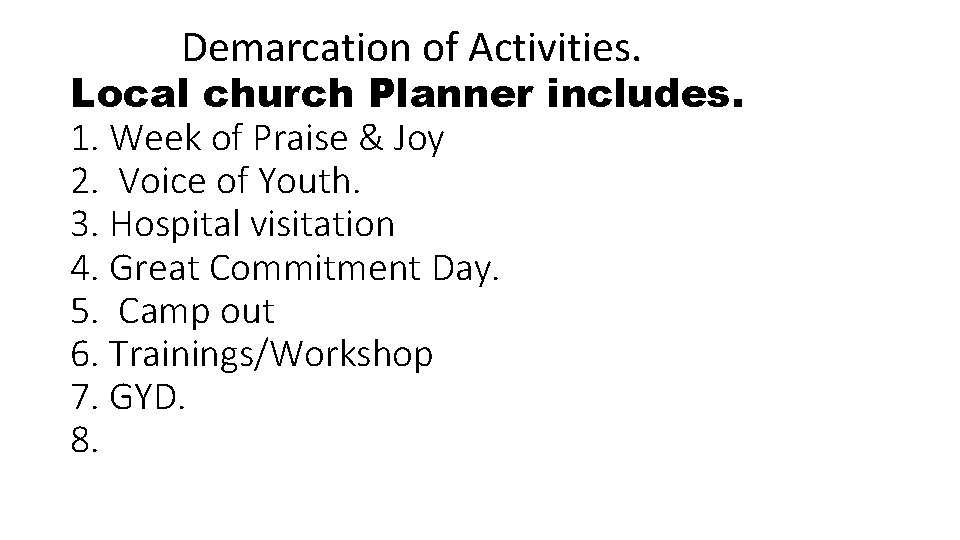
Demarcation of Activities. Local church Planner includes. 1. Week of Praise & Joy 2. Voice of Youth. 3. Hospital visitation 4. Great Commitment Day. 5. Camp out 6. Trainings/Workshop 7. GYD. 8.
Sample church plan.
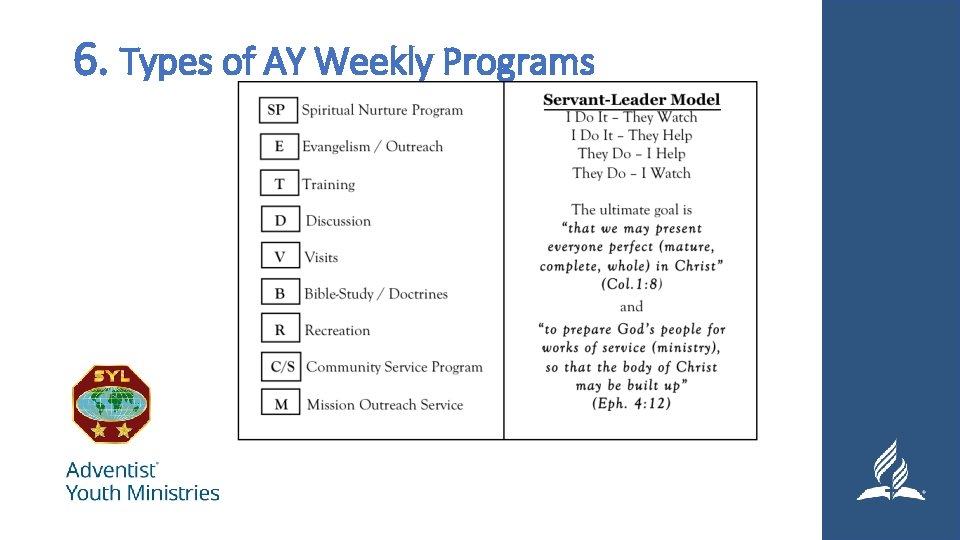
CREATING YOUTH PROGRAMMING The youth leader at the beginning of the year will gain much success by using the Servant Leadership Style model to train their youth to effectively reach a stage where they are competent enough to stand alone and conduct the program with the leader as a supervisor. The youth leader and their youth need to consult together to find the best style of conducting any given program that will incorporate variety, interest, and a strong biblical foundation. Each week a different box/theme should be conducted using different persons so that throughout the year, all the youth of your group would have had the experience of conducting a program.
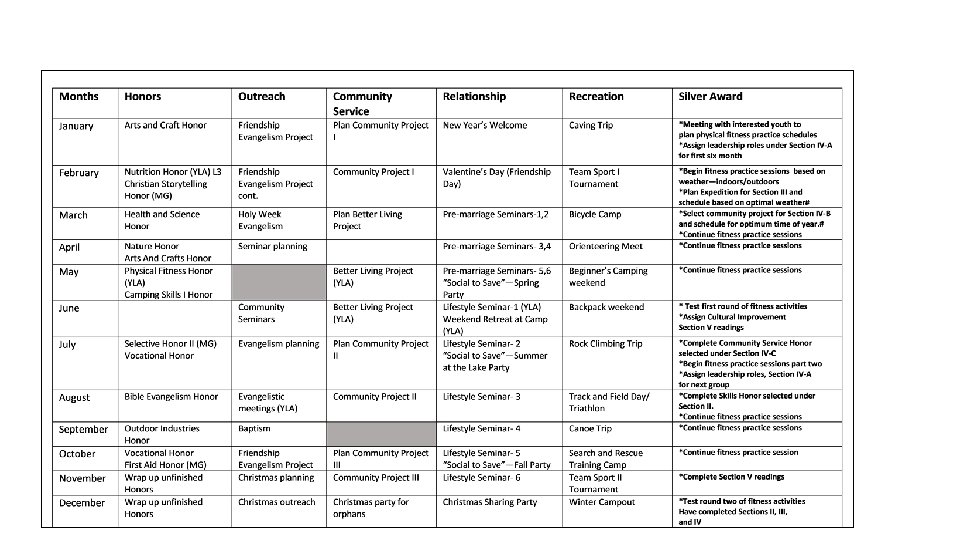
A SIX-STEP AY PROGRAMMING AID 1. Have an outline sheet of the AY Quarterly Yearly Calendar, with the four or five Sabbaths in the month. 2. Meet with your AY Society Council and selected youth, to plan the yearly calendar.
A SIX-STEP AY PROGRAMMING AID 3. Fill in the major Division/Union/Conference events for the year. For example: • • • AY Week of Prayer and Home Coming Sabbath AY Celebration Day Global Youth Day Youth Congress/Camp Youth Federation Programs Bible Bowl Dates Health and Temperance Events AY Evangelistic Effort Conference Camp meeting e. Week of Prayer Training Seminars/Other
A SIX-STEP AY PROGRAMMING AID 4. Proceed to fill in your Local Church Calendar Events. (Remember to invite those dept. heads of your local church to make a presentation to the youth. ) 5. Fill the dates, venue, and type of Social/Recreation events in the AY Quarterly calendar. Remember to include the AYM Yearly Theme into each program
6. Types of AY Weekly Programs
A SIX-STEP AY PROGRAMMING AID Once you have filled in all the types of meetings you intend to use in a given quarter, you can brainstorm creative ways to fulfill these objectives, in ways that will interest and please your particular youth.
A SIX-STEP AY PROGRAMMING AID 1. Be sure to plan your quarterly AY Program around the Six Fundamental AY Objectives of the AY department. 2. You may choose three to four Fundamental Objectives of the AYM each quarter to fulfill. Remember to include the AYM Yearly Theme into each program. 3. Seek to plan in detail at least a quarter at a time, filling in all Sabbaths for that quarter. Let your young people help you brainstorm creative and exciting ways to fill in these programs. 4. Then post your three-month program on the church notice board.
A SIX-STEP AY PROGRAMMING AID 5. Be aware, of course, that life can intervene. It may be that some things will change from the original plan, but if this happens, it is a lot less upsetting than if you had no plan at all. If you know where you want to go, you can roll with the waves that occur on your way there. 6. Remember to seek approval from the church board, especially for new efforts or things which will cost money, at the beginning of each quarter. Try at least one thing per quarter that you’ve never tried before, and be sure to evaluate together afterward! Make a note of which things worked well, and which did not. Determine if you could do something differently and try again, or if this particular method isn’t a good fit for your group. Either is okay.
Church Plan: Identify a one program to involve the whole church effort
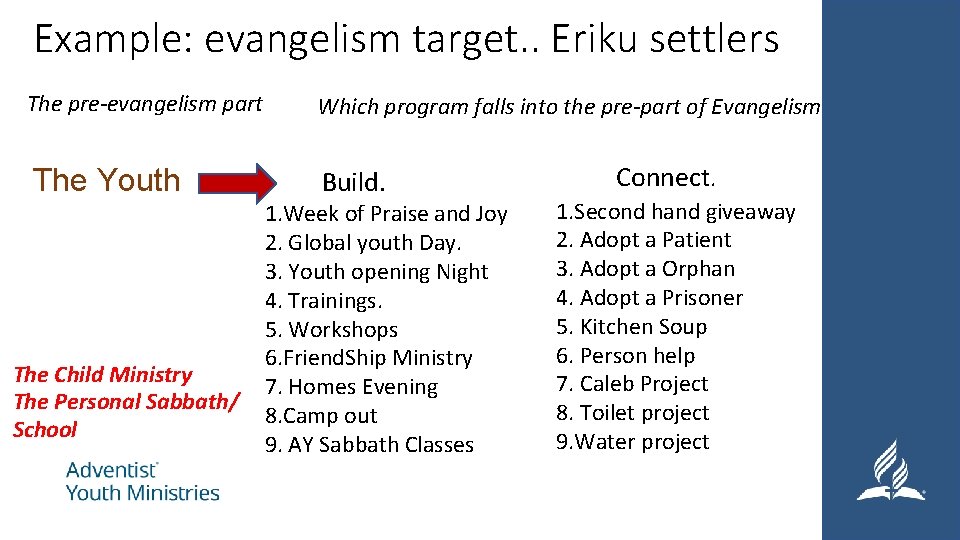
Example: evangelism target. . Eriku settlers The pre-evangelism part Which program falls into the pre-part of Evangelism The Youth Build. The Child Ministry The Personal Sabbath/ School 1. Week of Praise and Joy 2. Global youth Day. 3. Youth opening Night 4. Trainings. 5. Workshops 6. Friend. Ship Ministry 7. Homes Evening 8. Camp out 9. AY Sabbath Classes Connect. 1. Second hand giveaway 2. Adopt a Patient 3. Adopt a Orphan 4. Adopt a Prisoner 5. Kitchen Soup 6. Person help 7. Caleb Project 8. Toilet project 9. Water project
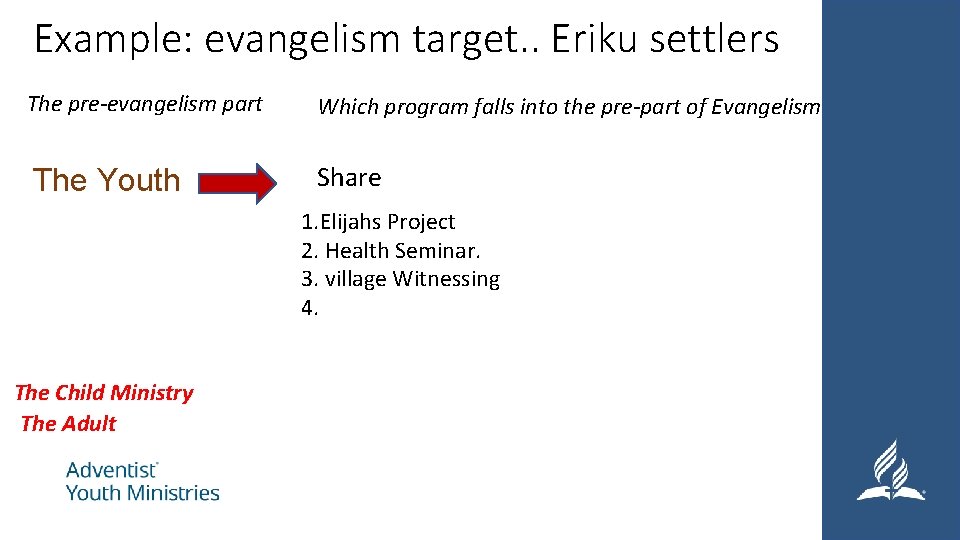
Example: evangelism target. . Eriku settlers The pre-evangelism part Which program falls into the pre-part of Evangelism The Youth Share 1. Elijahs Project 2. Health Seminar. 3. village Witnessing 4. The Child Ministry The Adult
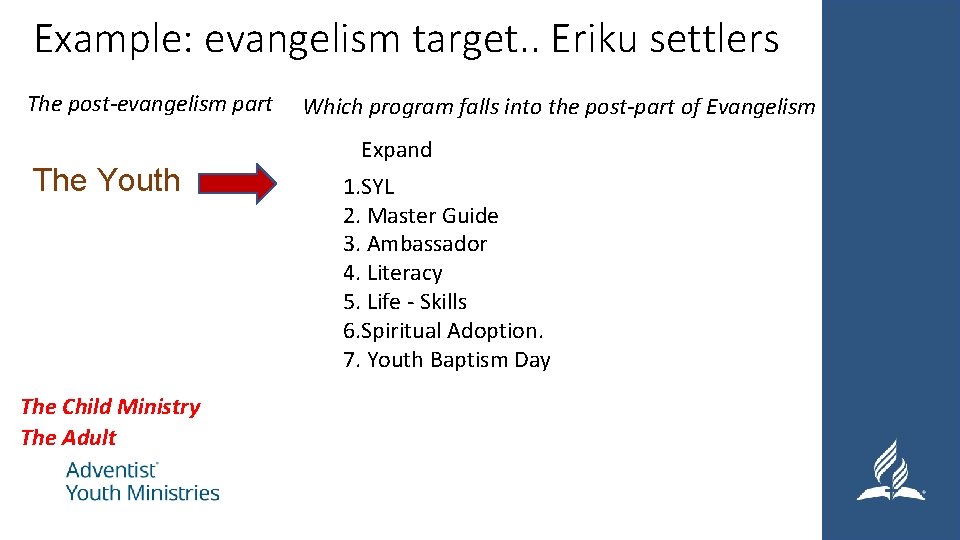
Example: evangelism target. . Eriku settlers The post-evangelism part The Youth The Child Ministry The Adult Which program falls into the post-part of Evangelism Expand 1. SYL 2. Master Guide 3. Ambassador 4. Literacy 5. Life - Skills 6. Spiritual Adoption. 7. Youth Baptism Day
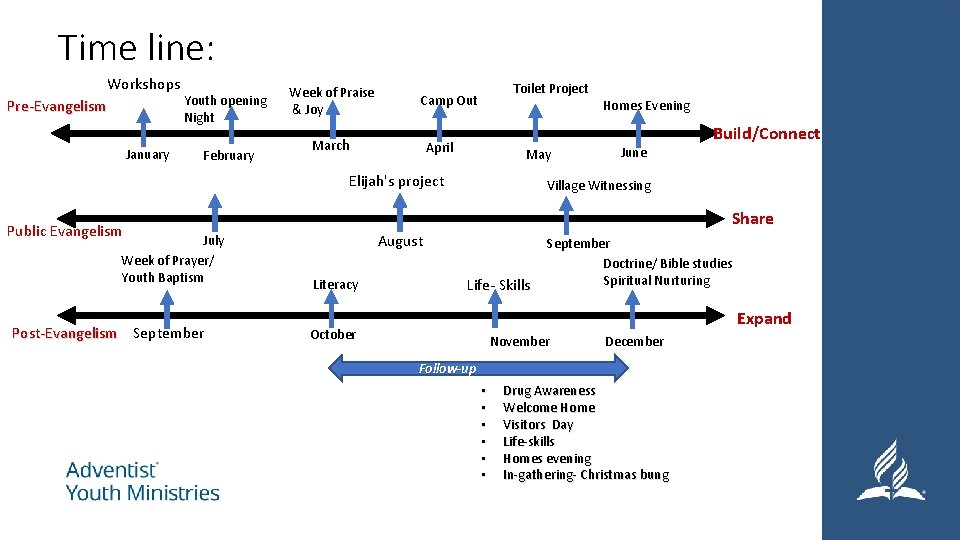
Time line: Workshops Youth opening Pre-Evangelism Night January February Week of Praise & Joy Toilet Project Camp Out March Homes Evening Build/Connect April May Elijah's project Post-Evangelism September Village Witnessing Share Public Evangelism July Week of Prayer/ Youth Baptism June August Literacy Life- Skills September Doctrine/ Bible studies Spiritual Nurturing Expand October November December Follow-up • • • Drug Awareness Welcome Home Visitors Day Life-skills Homes evening In-gathering- Christmas bung
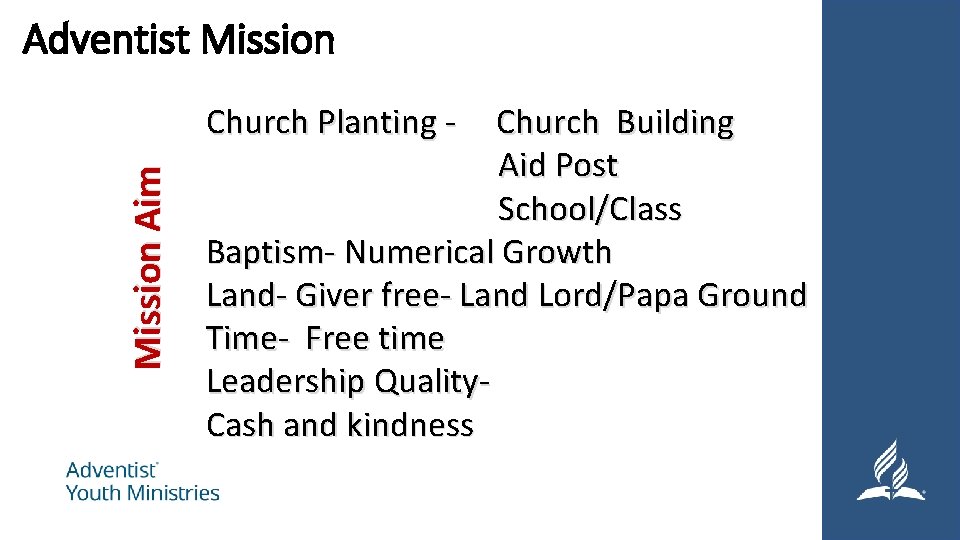
Adventist Mission Aim Church Planting - Church Building Aid Post School/Class Baptism- Numerical Growth Land- Giver free- Land Lord/Papa Ground Time- Free time Leadership Quality. Cash and kindness
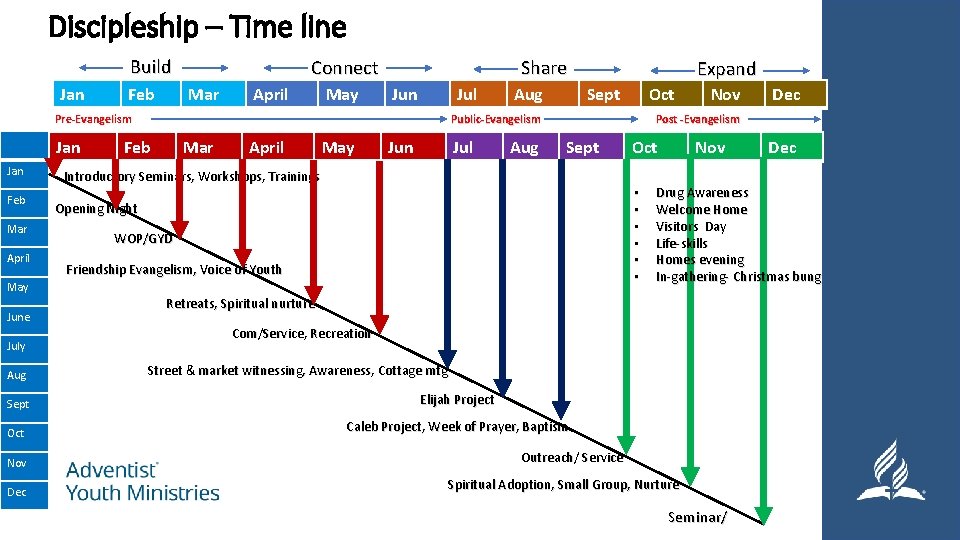
Discipleship – Time line Build Jan Feb Connect Mar April May Share Jun Jul Pre-Evangelism Jan Feb Mar April Aug Expand Sept Public-Evangelism Feb Mar April May Jun Jul Aug July Aug Sept Introductory Seminars, Workshops, Trainings Opening Night WOP/GYD Friendship Evangelism, Voice of Youth Nov Dec Com/Service, Recreation Street & market witnessing, Awareness, Cottage mtg Oct Caleb Project, Week of Prayer, Baptism Dec Drug Awareness Welcome Home Visitors Day Life-skills Homes evening In-gathering- Christmas bung Retreats, Spiritual nurture Elijah Project Dec Oct • • • Sept Nov Post -Evangelism May June Oct Outreach/ Service Spiritual Adoption, Small Group, Nurture Seminar/
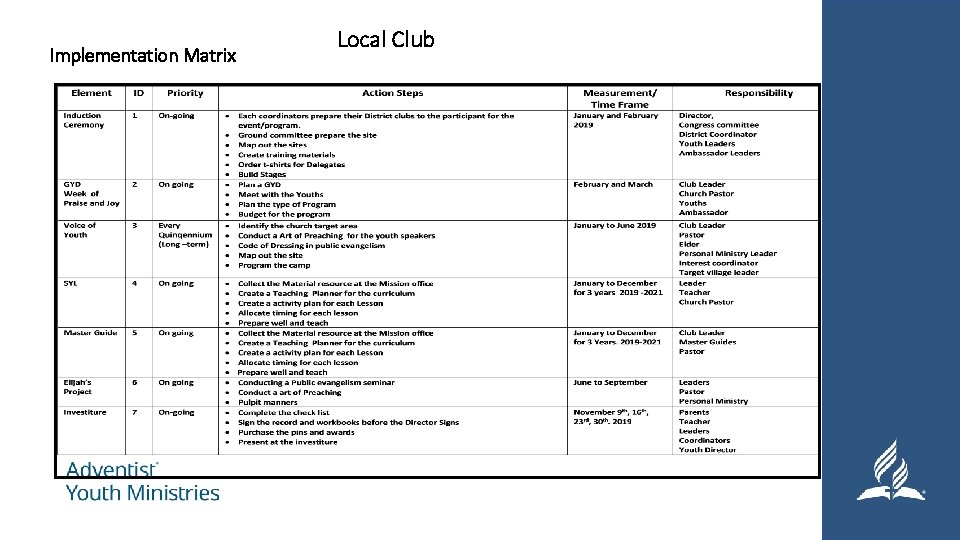
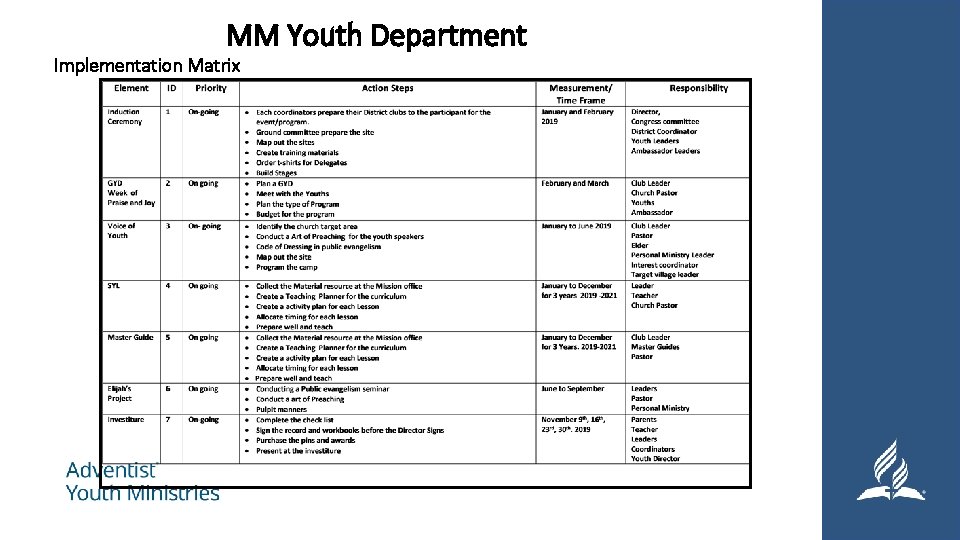
Implementation Matrix Local Club
MM Youth Department Implementation Matrix