
Leadership through the Use of Drill and Ceremonies
- Slides: 32
Leadership through the Use of Drill and Ceremonies LESSON 2: Lesson 1: Stationary Movements ROLES OF LEADERS AND FOLLOWERS IN DRILL Chapter 2: Leading Others Using Drill
Leadership through the Use of Drill and Ceremonies Lesson 1: Stationary Movements Think about the commands and responses you practiced in earlier lessons. Chapter 1: Leadership Skills
Leadership through the Use of Drill and Ceremonies Lesson 1: Stationary Movements (U 2 C 2 L 4: Q 2) You are practicing drill with your squad one afternoon. You put your squad at "rest" and are discussing suggestions for improving one of the movements in squad drill. Just then, a Major from your local National Guard unit walks by your squad. What should you do? A) Call the squad to attention and order them to "present, ARMS. " B) Salute the Major as you continue your discussion. C) Continue to do what you were doing. D) Call your squad to attention, but only you salute the Major. Click to see the correct answer Chapter 1: Leadership Skills
Leadership through the Use of Drill and Ceremonies Lesson 1: Stationary Movements Learning Objectives: • Describe the position of attention • Describe how to respond to positions of rest commands • Describe how to respond to facing commands • Describe the correct way to salute in a variety of situations • Define key words: at ease, attention, facing, parade rest, saluting Chapter 1: Leadership Skills
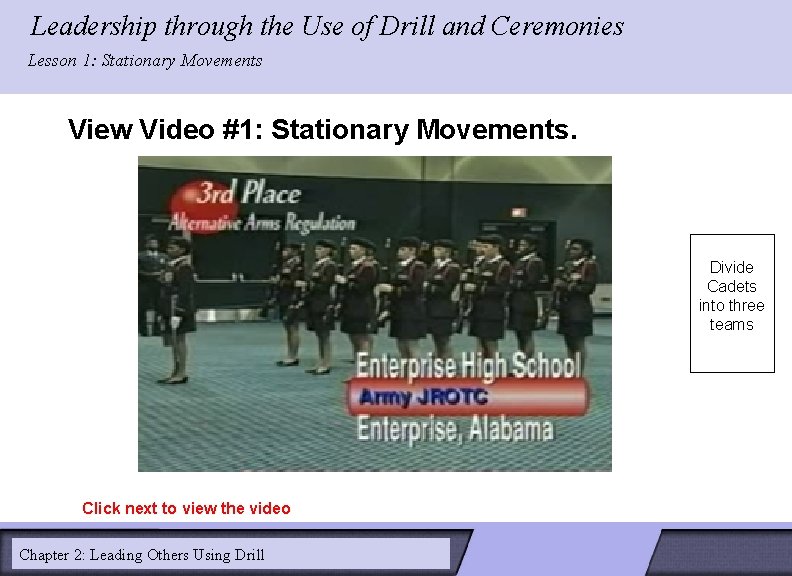
Leadership through the Use of Drill and Ceremonies LESSON 2: Lesson 1: Stationary Movements ROLES OF LEADERS AND FOLLOWERS IN DRILL View Video #1: Stationary Movements. Divide Cadets into three teams Click next to view the video Chapter 2: Leading Others Using Drill
Leadership through the Use of Drill and Ceremonies LESSON 2: Lesson 1: Stationary Movements ROLES OF LEADERS AND FOLLOWERS IN DRILL Chapter 2: Leading Others Using Drill
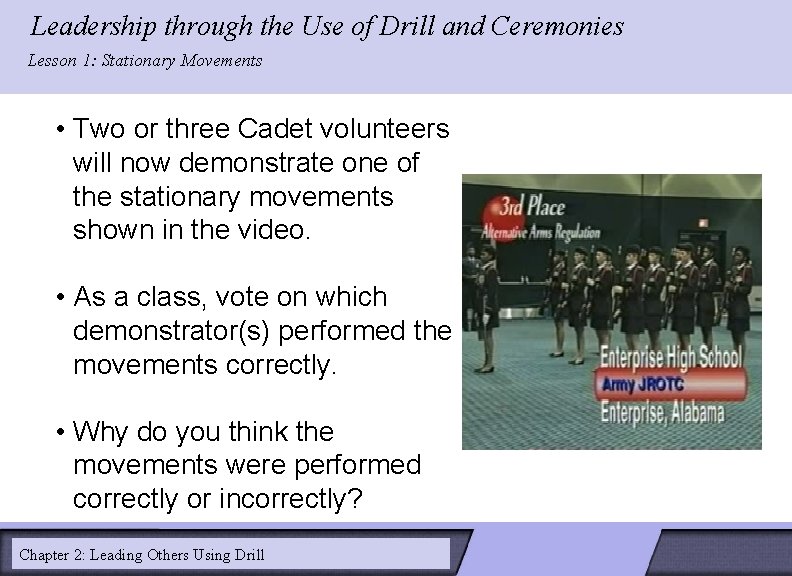
Leadership through the Use of Drill and Ceremonies LESSON 2: Lesson 1: Stationary Movements ROLES OF LEADERS AND FOLLOWERS IN DRILL • Two or three Cadet volunteers will now demonstrate one of the stationary movements shown in the video. • As a class, vote on which demonstrator(s) performed the movements correctly. • Why do you think the movements were performed correctly or incorrectly? Chapter 2: Leading Others Using Drill
Leadership through the Use of Drill and Ceremonies LESSON 2: Lesson 1: Stationary Movements ROLES OF LEADERS AND FOLLOWERS IN DRILL Reflection: • What does our class know about stationary movements? • What do you need to know in order to perform precise stationary movements? Chapter 2: Leading Others Using Drill
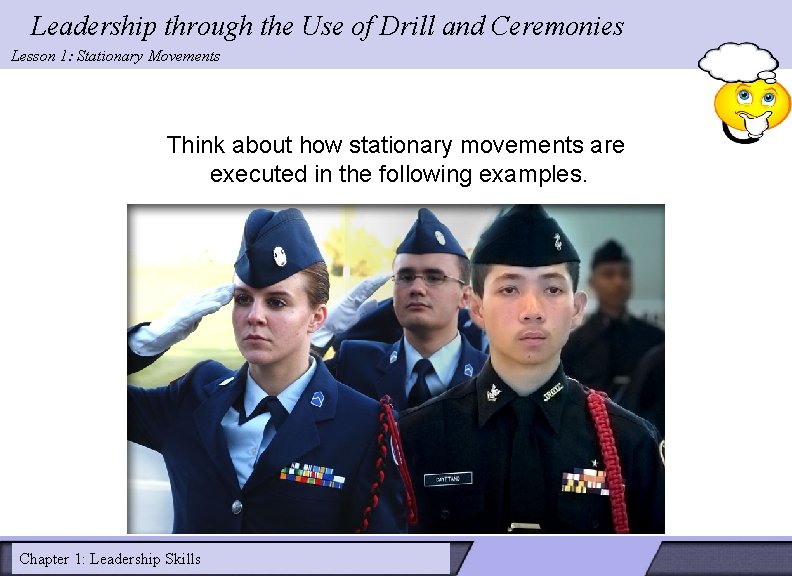
Leadership through the Use of Drill and Ceremonies Lesson 1: Stationary Movements Think about how stationary movements are executed in the following examples. Chapter 1: Leadership Skills
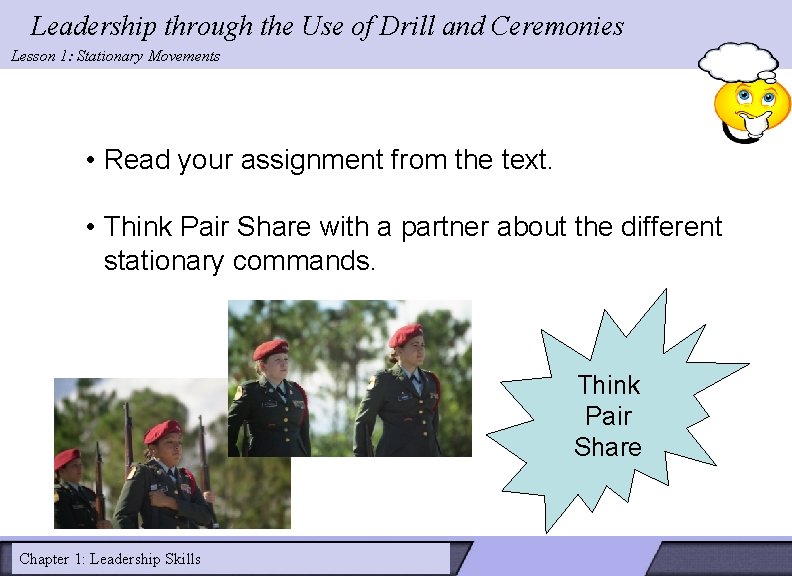
Leadership through the Use of Drill and Ceremonies Lesson 1: Stationary Movements • Read your assignment from the text. • Think Pair Share with a partner about the different stationary commands. Think Pair Share Chapter 1: Leadership Skills
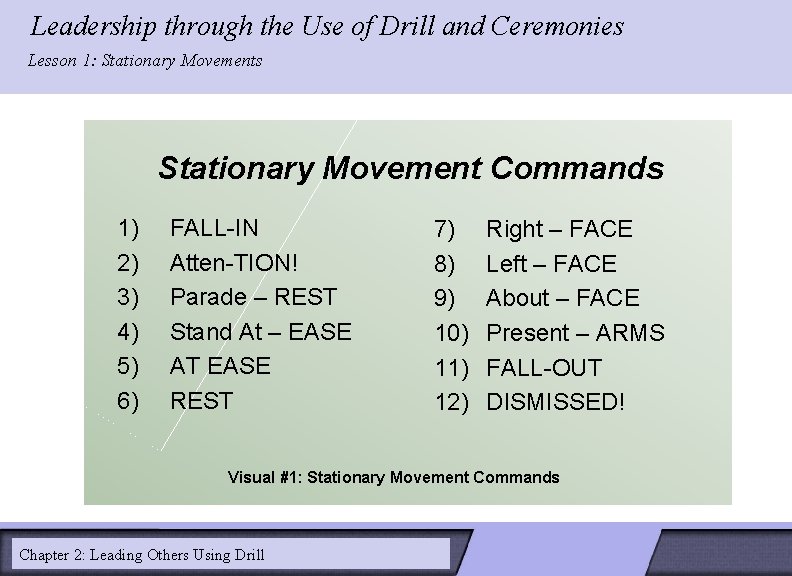
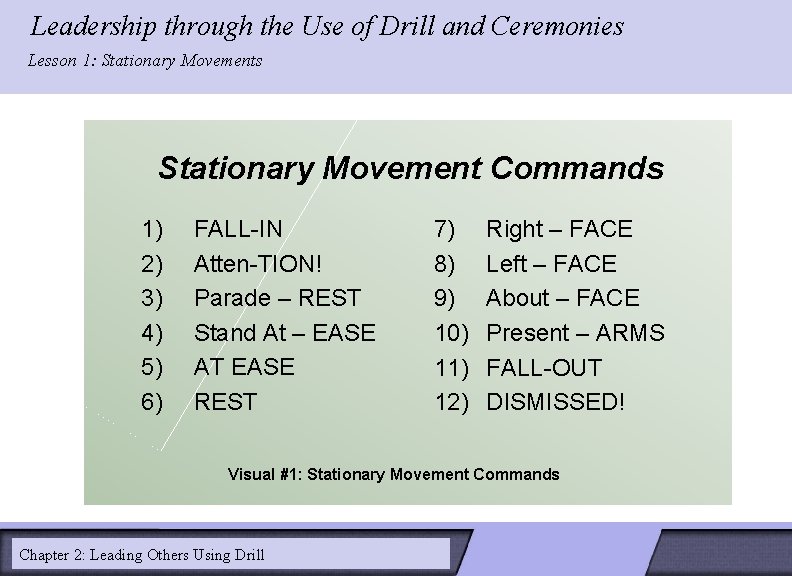
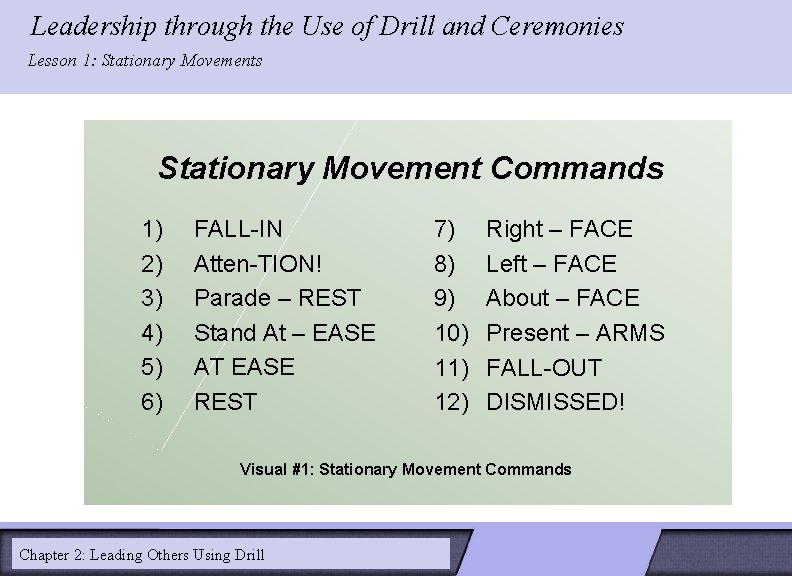
Leadership through the Use of Drill and Ceremonies LESSON 2: Lesson 1: Stationary Movements ROLES OF LEADERS AND FOLLOWERS IN DRILL Stationary Movement Commands 1) 2) 3) 4) 5) 6) FALL-IN Atten-TION! Parade – REST Stand At – EASE AT EASE REST 7) 8) 9) 10) 11) 12) Right – FACE Left – FACE About – FACE Present – ARMS FALL-OUT DISMISSED! Visual #1: Stationary Movement Commands Chapter 2: Leading Others Using Drill
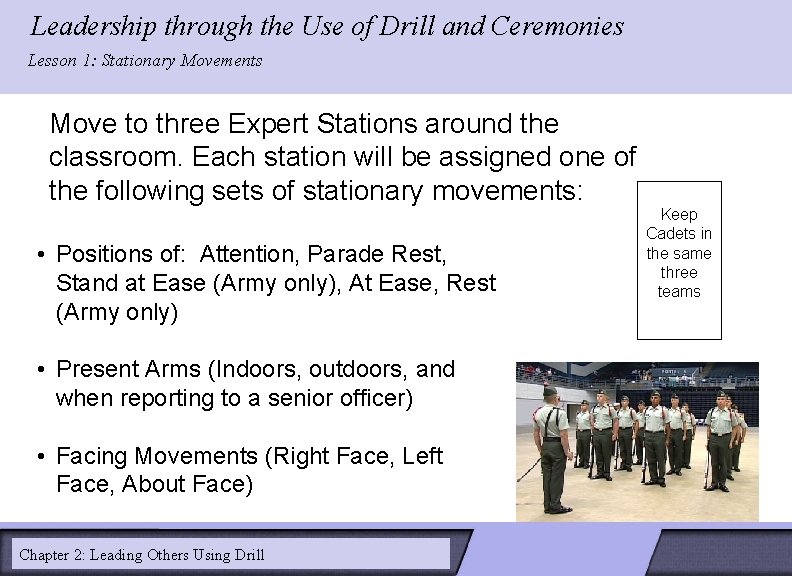
Leadership through the Use of Drill and Ceremonies LESSON 2: Lesson 1: Stationary Movements ROLES OF LEADERS AND FOLLOWERS IN DRILL Move to three Expert Stations around the classroom. Each station will be assigned one of the following sets of stationary movements: • Positions of: Attention, Parade Rest, Stand at Ease (Army only), At Ease, Rest (Army only) • Present Arms (Indoors, outdoors, and when reporting to a senior officer) • Facing Movements (Right Face, Left Face, About Face) Chapter 2: Leading Others Using Drill Keep Cadets in the same three teams
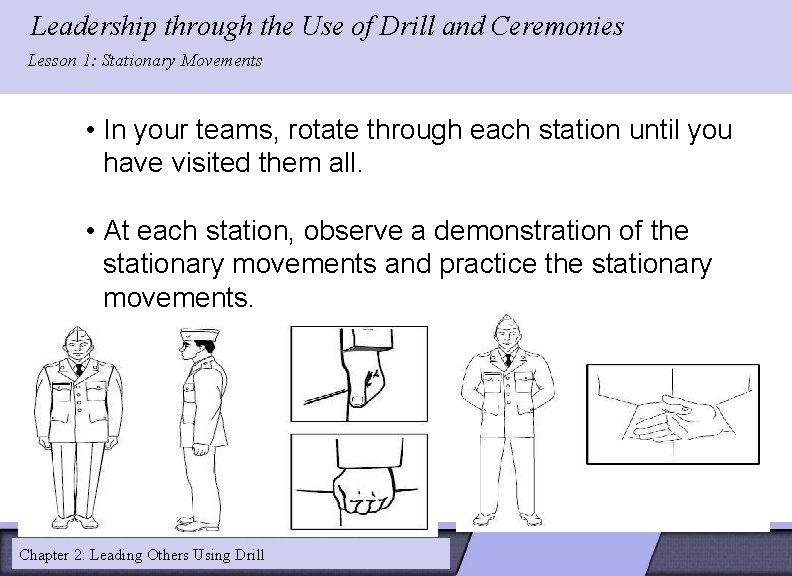
Leadership through the Use of Drill and Ceremonies LESSON 2: Lesson 1: Stationary Movements ROLES OF LEADERS AND FOLLOWERS IN DRILL • In your teams, rotate through each station until you have visited them all. • At each station, observe a demonstration of the stationary movements and practice the stationary movements. Chapter 2: Leading Others Using Drill
Leadership through the Use of Drill and Ceremonies LESSON 2: Lesson 1: Stationary Movements ROLES OF LEADERS AND FOLLOWERS IN DRILL Reflection: • What additional information did you learn or relearn? • What is the function of stationary movements during drill? Chapter 2: Leading Others Using Drill
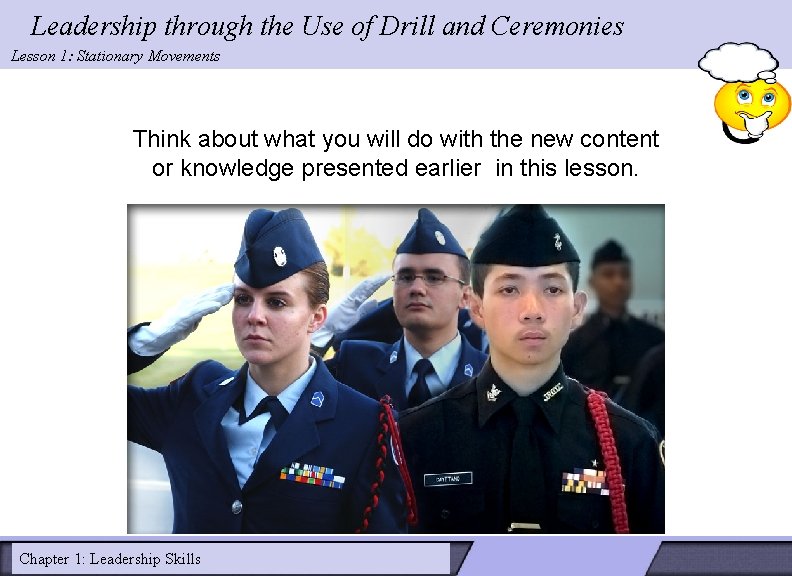
Leadership through the Use of Drill and Ceremonies Lesson 1: Stationary Movements Think about what you will do with the new content or knowledge presented earlier in this lesson. Chapter 1: Leadership Skills
Leadership through the Use of Drill and Ceremonies Lesson 1: Stationary Movements Your platoon is marching in a parade. While waiting for the parade to begin, you find out that it will be starting 30 minutes late. Your platoon is at the position of attention, but because of the wait, you want them to relax and talk for a while. Which commands do you give them? A) "Parade, Rest" B) "Parade, Rest, " and "At ease" C) "Parade, Rest, " and "Rest" D) "Rest" Click to see the correct answer Chapter 1: Leadership Skills
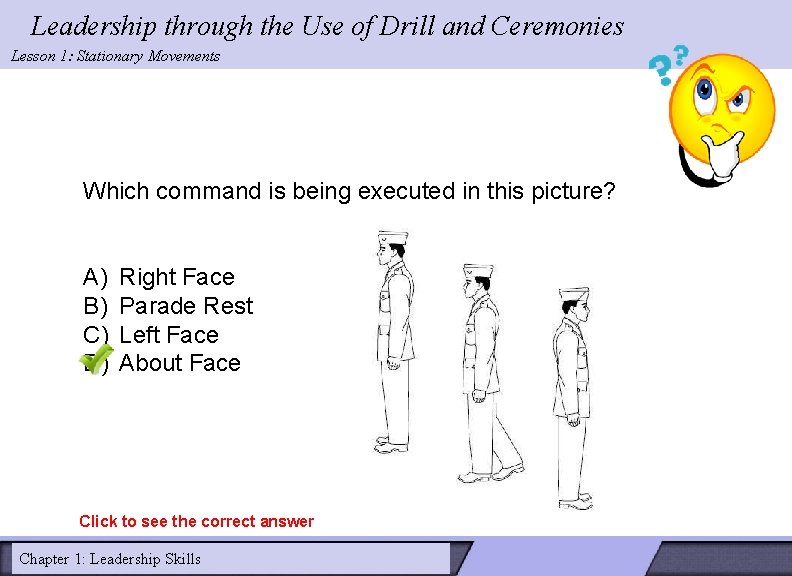
Leadership through the Use of Drill and Ceremonies Lesson 1: Stationary Movements Which command is being executed in this picture? A) B) C) D) Right Face Parade Rest Left Face About Face Click to see the correct answer Chapter 1: Leadership Skills
Leadership through the Use of Drill and Ceremonies Lesson 1: Stationary Movements Major General Winslow spoke to your JROTC class yesterday about the importance of staying physically fit. You were motivated enough to get up early this morning and go for a run. About halfway through your run you see MG Winslow who is also out for a run. What should you do when you cross paths? A) Salute as you are passing and continue your run. B) Slow to a quick-time and salute, and then continue your run. C) Say "Good morning" and continue your run. D) Stop, stand off to the side, and salute as the MG Winslow passes, then continue your run. Click to see the correct answer Chapter 1: Leadership Skills
Leadership through the Use of Drill and Ceremonies LESSON 2: Lesson 1: Stationary Movements ROLES OF LEADERS AND FOLLOWERS IN DRILL Stationary Movement Commands 1) 2) 3) 4) 5) 6) FALL-IN Atten-TION! Parade – REST Stand At – EASE AT EASE REST 7) 8) 9) 10) 11) 12) Right – FACE Left – FACE About – FACE Present – ARMS FALL-OUT DISMISSED! Visual #1: Stationary Movement Commands Chapter 2: Leading Others Using Drill
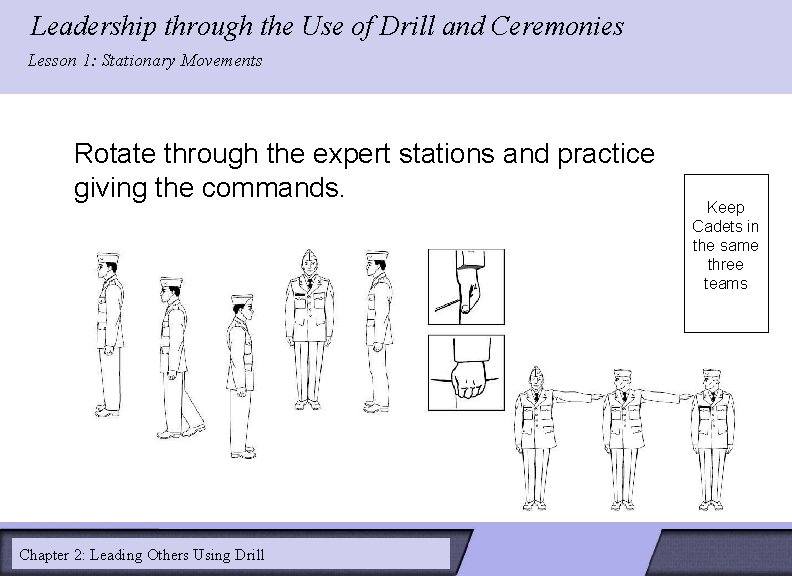
Leadership through the Use of Drill and Ceremonies LESSON 2: Lesson 1: Stationary Movements ROLES OF LEADERS AND FOLLOWERS IN DRILL Rotate through the expert stations and practice giving the commands. Chapter 2: Leading Others Using Drill Keep Cadets in the same three teams
Leadership through the Use of Drill and Ceremonies LESSON 2: Lesson 1: Stationary Movements ROLES OF LEADERS AND FOLLOWERS IN DRILL Reflection: • Were you surprised at the level of detail required in executing stationary commands? If so, why? • How do you think a squad becomes proficient in executing stationary movements? Chapter 2: Leading Others Using Drill
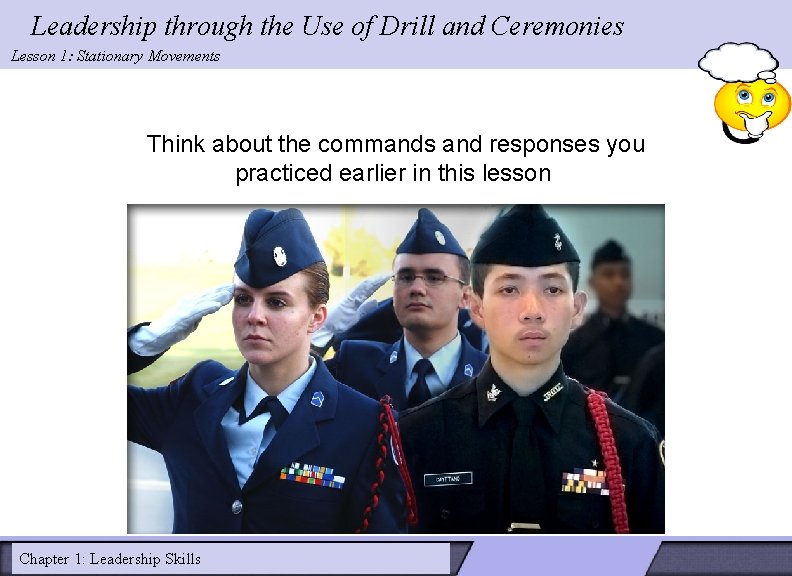
Leadership through the Use of Drill and Ceremonies Lesson 1: Stationary Movements Think about the commands and responses you practiced earlier in this lesson. Chapter 1: Leadership Skills
Leadership through the Use of Drill and Ceremonies LESSON 2: Lesson 1: Stationary Movements ROLES OF LEADERS AND FOLLOWERS IN DRILL • Playing “Knock Out”, each team will compete for a team winner of the Stationary Movements • Team winners will compete against each other for a champion Keep Cadets in the same three teams View Stationary Movements on next page to use as a reference. Chapter 2: Leading Others Using Drill Energizer
Leadership through the Use of Drill and Ceremonies LESSON 2: Lesson 1: Stationary Movements ROLES OF LEADERS AND FOLLOWERS IN DRILL Stationary Movement Commands 1) 2) 3) 4) 5) 6) FALL-IN Atten-TION! Parade – REST Stand At – EASE AT EASE REST 7) 8) 9) 10) 11) 12) Right – FACE Left – FACE About – FACE Present – ARMS FALL-OUT DISMISSED! Visual #1: Stationary Movement Commands Chapter 2: Leading Others Using Drill
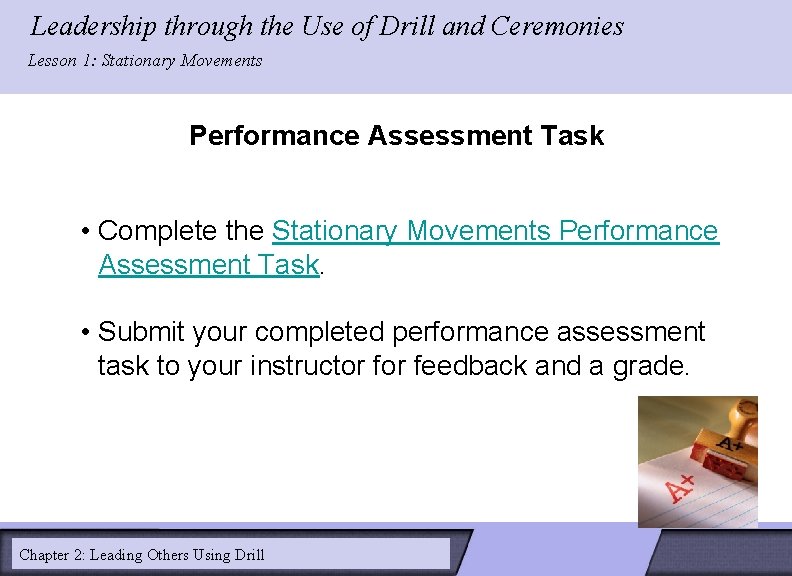
Leadership through the Use of Drill and Ceremonies LESSON 2: Lesson 1: Stationary Movements ROLES OF LEADERS AND FOLLOWERS IN DRILL Performance Assessment Task • Complete the Stationary Movements Performance Assessment Task. • Submit your completed performance assessment task to your instructor feedback and a grade. Chapter 2: Leading Others Using Drill
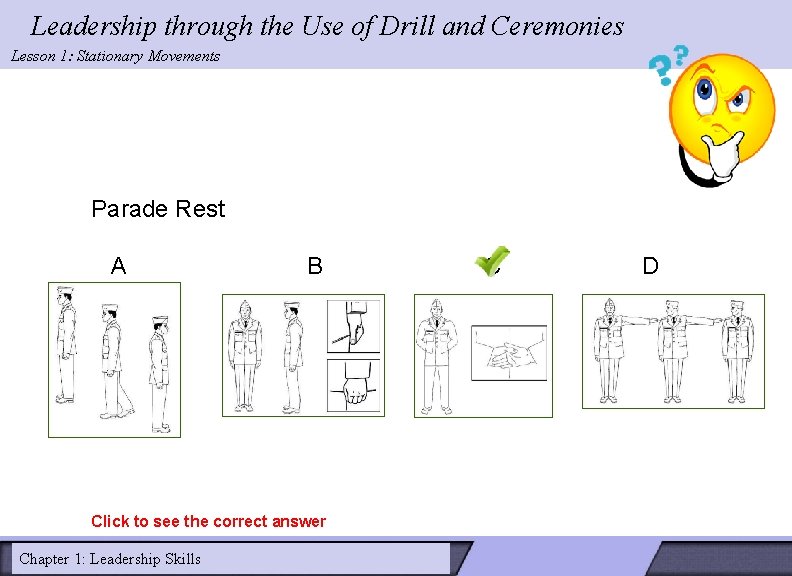
Leadership through the Use of Drill and Ceremonies Lesson 1: Stationary Movements Parade Rest A B Click to see the correct answer Chapter 1: Leadership Skills C D
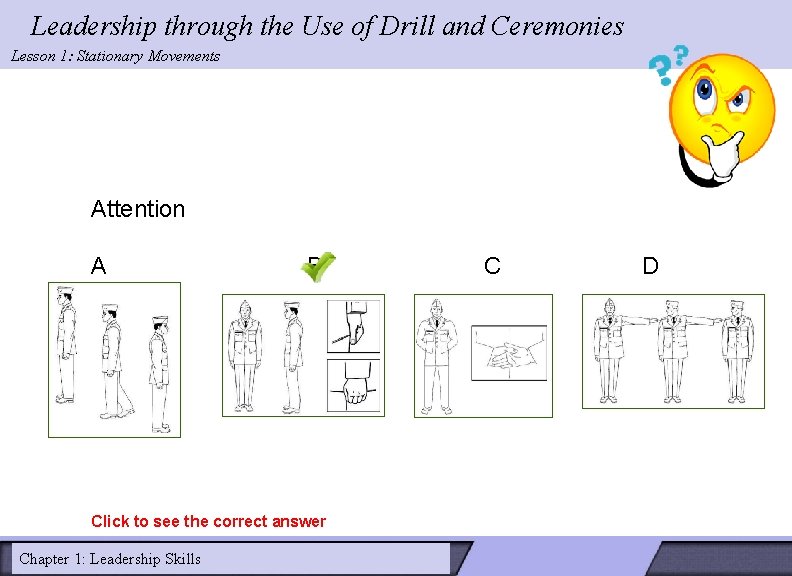
Leadership through the Use of Drill and Ceremonies Lesson 1: Stationary Movements Attention A B Click to see the correct answer Chapter 1: Leadership Skills C D
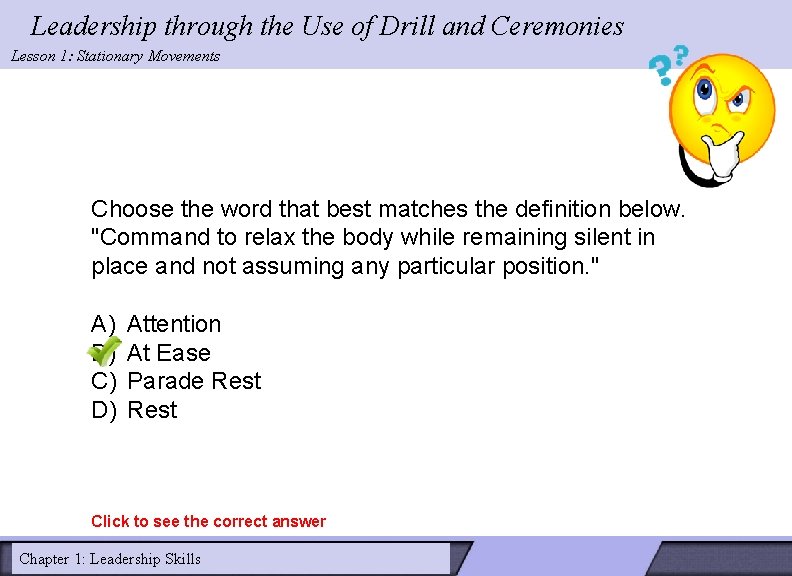
Leadership through the Use of Drill and Ceremonies Lesson 1: Stationary Movements Choose the word that best matches the definition below. "Command to relax the body while remaining silent in place and not assuming any particular position. " A) Attention B) At Ease C) Parade Rest D) Rest Click to see the correct answer Chapter 1: Leadership Skills
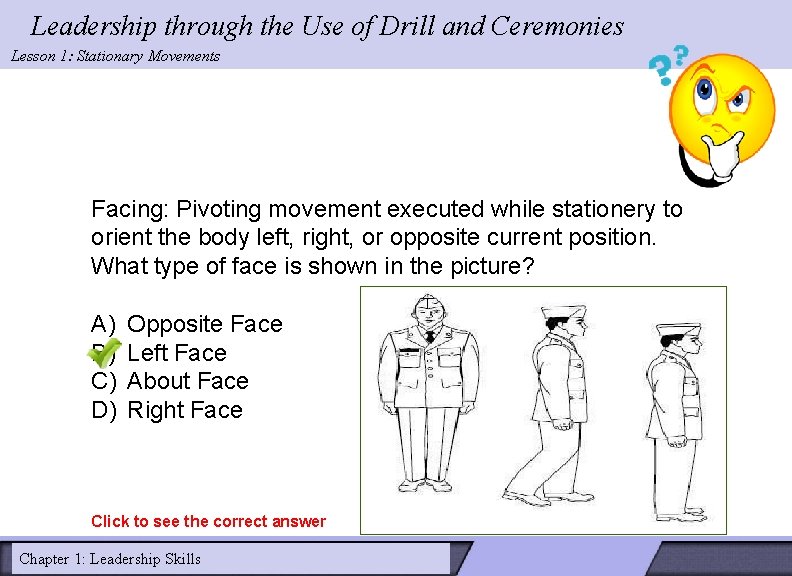
Leadership through the Use of Drill and Ceremonies Lesson 1: Stationary Movements Facing: Pivoting movement executed while stationery to orient the body left, right, or opposite current position. What type of face is shown in the picture? A) Opposite Face B) Left Face C) About Face D) Right Face Click to see the correct answer Chapter 1: Leadership Skills
Leadership through the Use of Drill and Ceremonies Lesson 1: Stationary Movements Choose the word that best matches the definition below. "A position where you remain standing with your right foot in place; in certain situations, you may move or talk in this position unless otherwise directed. " A) Salute B) Rest C) At Ease D) Attention Click to see the correct answer Chapter 1: Leadership Skills
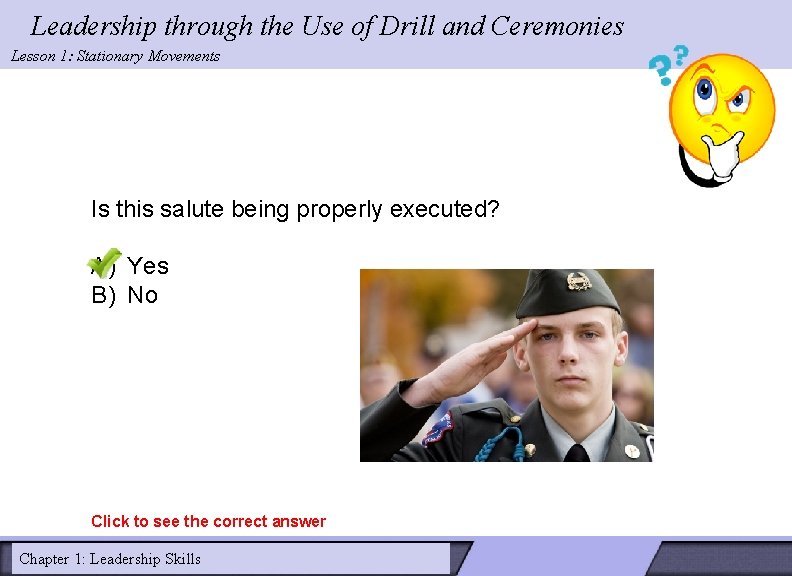
Leadership through the Use of Drill and Ceremonies Lesson 1: Stationary Movements Is this salute being properly executed? A) Yes B) No Click to see the correct answer Chapter 1: Leadership Skills
Leadership through the Use of Drill and Ceremonies LESSON 2: Lesson 1: Stationary Movements ROLES OF LEADERS AND FOLLOWERS IN DRILL Reflection: • What did you learn about being an effective drill member today? Chapter 2: Leading Others Using Drill