
Leadership Theories Leadership Behaviour Contiuum SubordinateCentered Leadership BossCentered
Leadership Theories

Leadership Behaviour Contiuum Subordinate-Centered Leadership Boss-Centered Leadership Use of Authority by the Manager Area of Freedom for Subordinates Administrator makes a decision and announces it Administrator presents ideas and invites questions Administrator presents problem, gets suggestions, makes decision Administrator permits subordinates to function within limits defined by superior
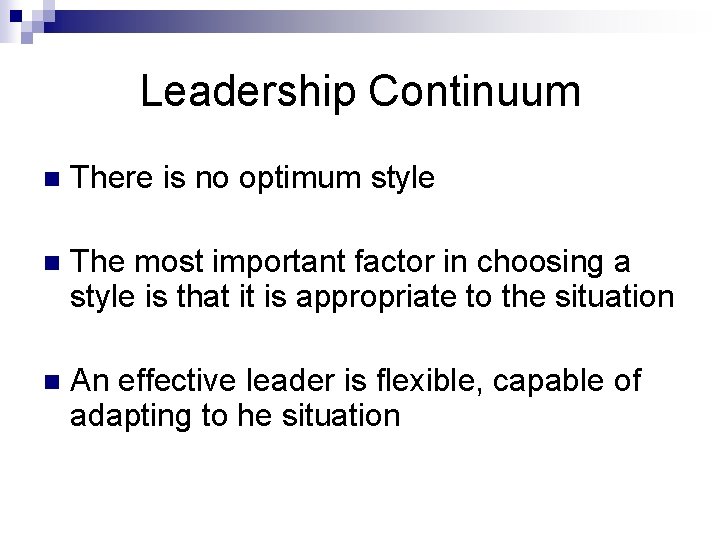
Leadership Continuum n There is no optimum style n The most important factor in choosing a style is that it is appropriate to the situation n An effective leader is flexible, capable of adapting to he situation

Life Cycle Theory of Leadership Relationship Behaviour High Low High Relationships & Low Task Low High Relationships & High Task Low Relationships & High Task Behaviour Mature Immature
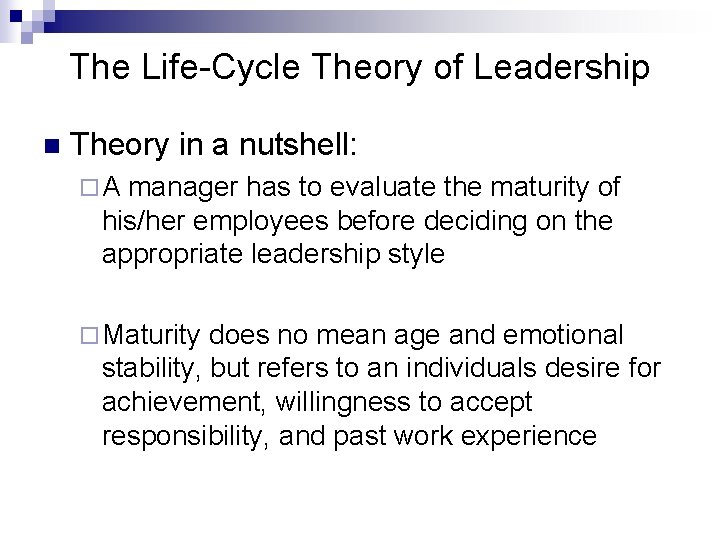
The Life-Cycle Theory of Leadership n Theory in a nutshell: ¨A manager has to evaluate the maturity of his/her employees before deciding on the appropriate leadership style ¨ Maturity does no mean age and emotional stability, but refers to an individuals desire for achievement, willingness to accept responsibility, and past work experience
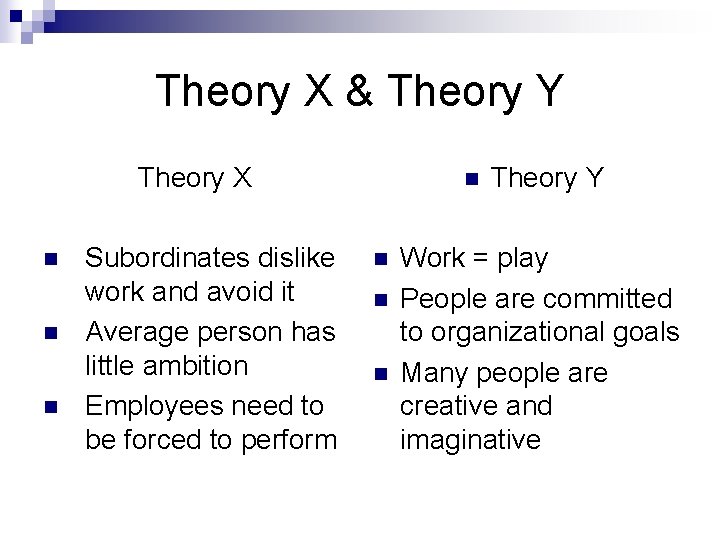
Theory X & Theory Y Theory X n n n Subordinates dislike work and avoid it Average person has little ambition Employees need to be forced to perform n n Theory Y Work = play People are committed to organizational goals Many people are creative and imaginative
Theory X & Theory Y n Theory by Douglas Mc. Gregor – wanted to get managers to shift their thinking and assumptions from Theory X to Theory Y n He believed that if someone held either X or Y that you would have a self-fulfilling prophecy
Theory X & Theory Y n Self-Fulfilling Prophecy ¨ Occurs when a person acts in ways that confirm another’s expectations
- Slides: 8