
Leadership The act of influencing others to act
- Slides: 37
Leadership The act of influencing others to act toward the achievement of a goal n Process of providing direction, energizing, others, and obtaining commitment to the leaders cause n Leadership involves informal power rather than formal power n
Power Ability to influence others ideas, thoughts, or behaviors n Types of power n ¨ Legitimate ¨ Reward ¨ Coercive ¨ Referent ¨ Expert
Legitimate Power A result of formal position within an organization n Access to resources, information, and key individuals in the organization n Authority-right to command decide based upon position n Outcomes? n
Reward Power Influence that results from leader’s ability to satisfy needs n I behave in a certain way because I feel that the leader will provide me with some reward (money, benefits, praise, promotion, etc. ) n
Coercive Power Influence through fear and punishment n Demotions, firing, pay-cuts n Outcomes? ? n How do you train your dog? n
Referent Power Influence resulting from respect of the leader n Result of reputation, admiration, charisma, or personal identification n Outcomes? ? n
Expert Power Influence based on the possession of specialized knowledge, skills, or expertise n People who possess information about your projects may exert expert power over you. n Outcomes? ? n
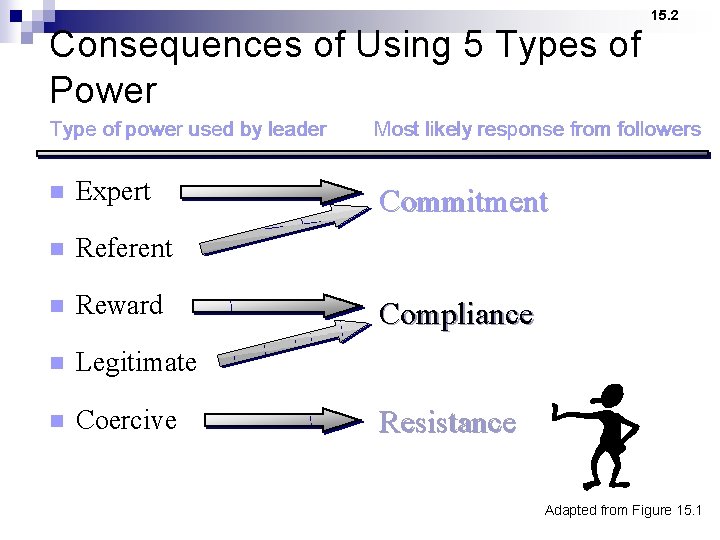
15. 2 Consequences of Using 5 Types of Power Type of power used by leader n Expert n Referent n Reward n Legitimate n Coercive Most likely response from followers Commitment Compliance Resistance Adapted from Figure 15. 1
Leadership Models Trait models-focus on what characteristics make for good leaders n Behavioral models-what behaviors do good leaders demonstrate n Contingency models-matching of the followers with the right type of leader n
Trait Models Physical-young middle aged, good appearance JFK n Social Background-right stock, education n Personality-adaptable, achievement and power needs, Type A, self confident, and charismatic n You either got ‘em or ya don’t n
Behavior Models Look at the actions of effective and ineffective leaders n Delegation skills n Communication skills n How roles of leadership are handled and balanced n The right ways can be taught and learned n
Mc. Gregor’s Theory X and Y n Theory X ¨ People are economic beings ¨ Generally lazy, and unmotivated ¨ People need a directive style of leadership n Theory Y ¨ People are internally motivated ¨ Generally work hard, cooperate ¨ Work best with participative leadership style
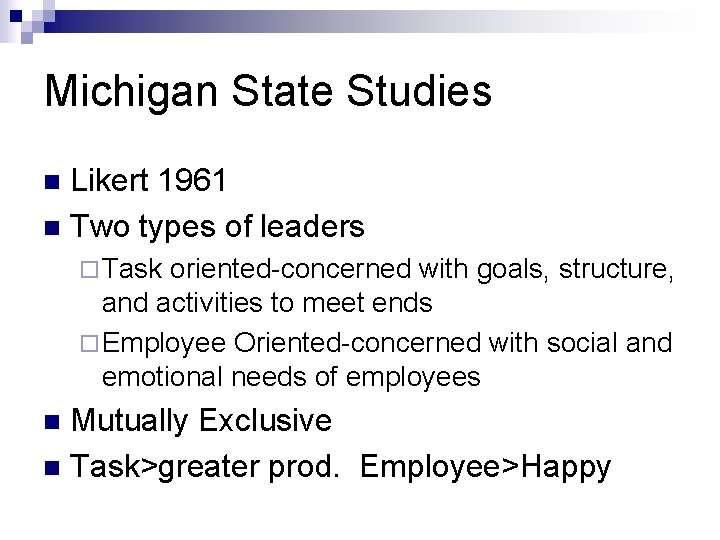
Michigan State Studies Likert 1961 n Two types of leaders n ¨ Task oriented-concerned with goals, structure, and activities to meet ends ¨ Employee Oriented-concerned with social and emotional needs of employees Mutually Exclusive n Task>greater prod. Employee>Happy n
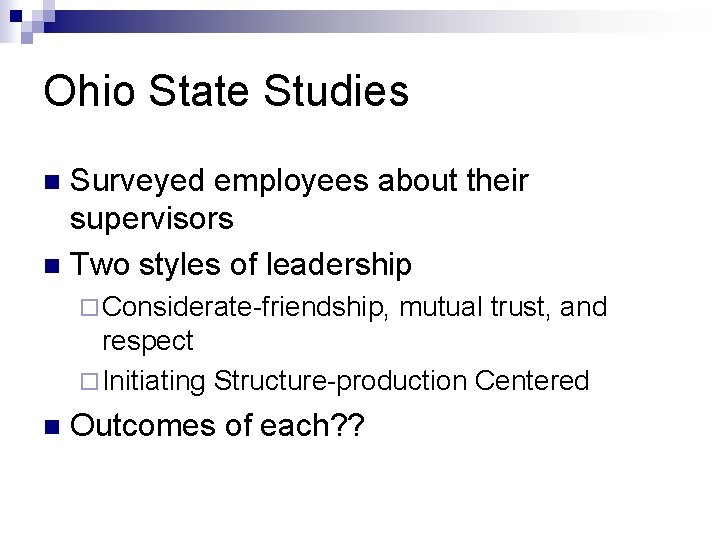
Ohio State Studies Surveyed employees about their supervisors n Two styles of leadership n ¨ Considerate-friendship, mutual trust, and respect ¨ Initiating Structure-production Centered n Outcomes of each? ?
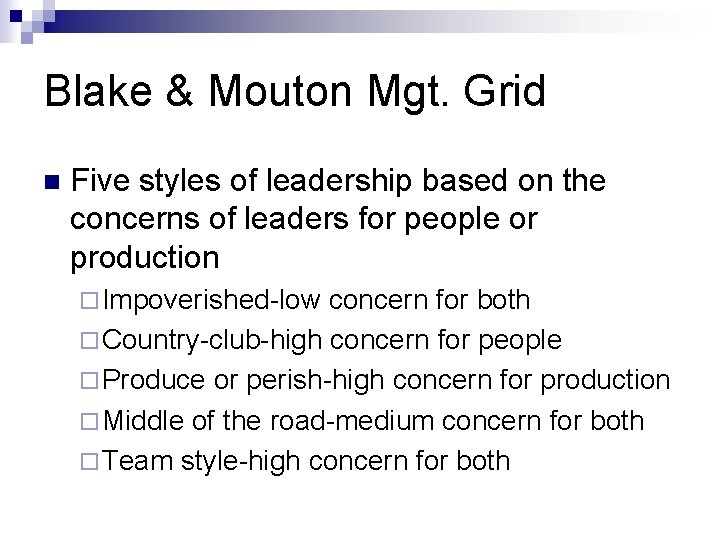
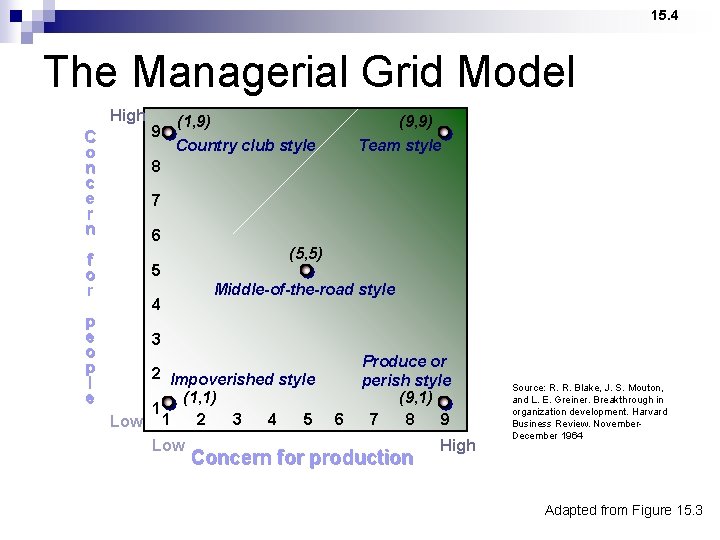
Blake & Mouton Mgt. Grid n Five styles of leadership based on the concerns of leaders for people or production ¨ Impoverished-low concern for both ¨ Country-club-high concern for people ¨ Produce or perish-high concern for production ¨ Middle of the road-medium concern for both ¨ Team style-high concern for both
15. 4 The Managerial Grid Model High C o n c e r n f o r p e o p l e 9 (1, 9) (9, 9) Country club style Team style 8 7 6 5 4 (5, 5) Middle-of-the-road style 3 2 Impoverished style (1, 1) 1 2 3 4 5 Low 1 Low 6 Produce or perish style (9, 1) 7 8 9 Concern for production High Source: R. R. Blake, J. S. Mouton, and L. E. Greiner. Breakthrough in organization development. Harvard Business Review. November. December 1964 Adapted from Figure 15. 3
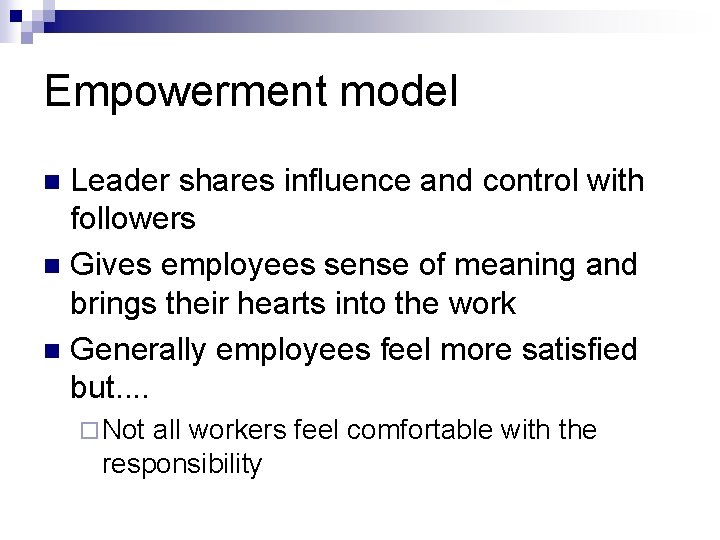
Empowerment model Leader shares influence and control with followers n Gives employees sense of meaning and brings their hearts into the work n Generally employees feel more satisfied but. . n ¨ Not all workers feel comfortable with the responsibility
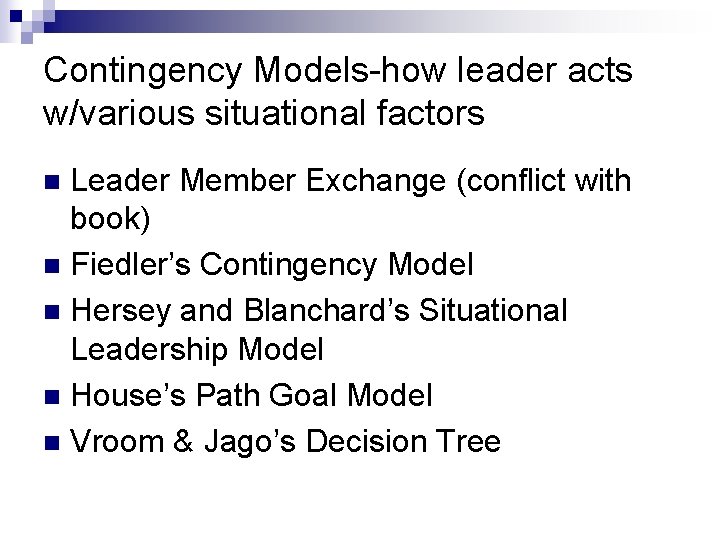
Contingency Models-how leader acts w/various situational factors Leader Member Exchange (conflict with book) n Fiedler’s Contingency Model n Hersey and Blanchard’s Situational Leadership Model n House’s Path Goal Model n Vroom & Jago’s Decision Tree n
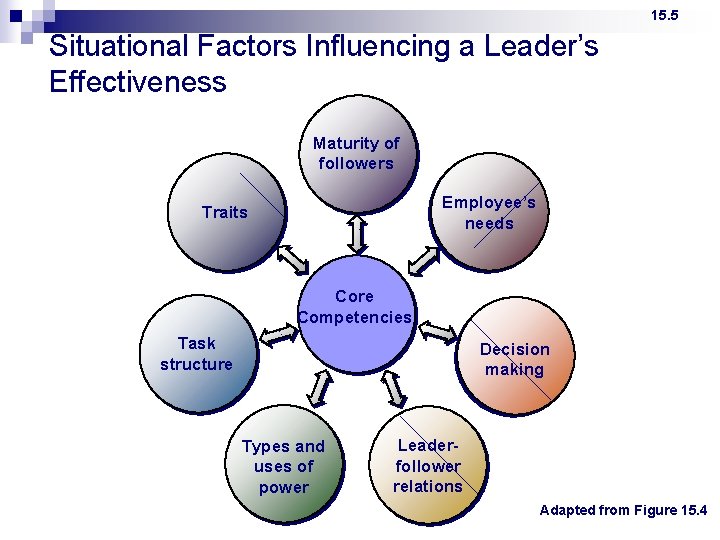
15. 5 Situational Factors Influencing a Leader’s Effectiveness Maturity of followers Employee’s needs Traits Core Competencies Task structure Decision making Types and uses of power Leaderfollower relations Adapted from Figure 15. 4
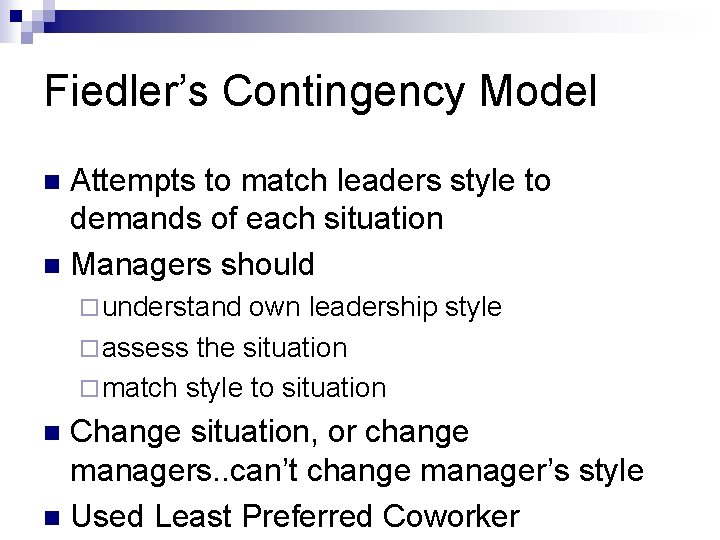
Fiedler’s Contingency Model Attempts to match leaders style to demands of each situation n Managers should n ¨ understand own leadership style ¨ assess the situation ¨ match style to situation Change situation, or change managers. . can’t change manager’s style n Used Least Preferred Coworker n
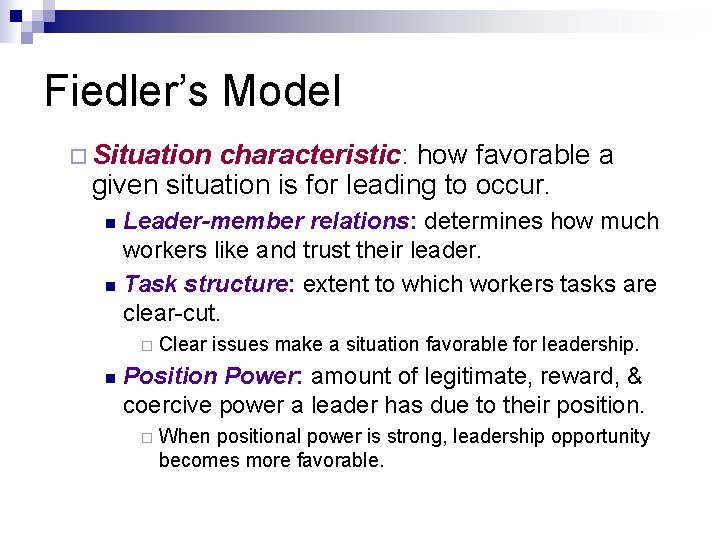
Fiedler’s Model ¨ Situation characteristic: how favorable a given situation is for leading to occur. Leader-member relations: determines how much workers like and trust their leader. n Task structure: extent to which workers tasks are clear-cut. n ¨ n Clear issues make a situation favorable for leadership. Position Power: amount of legitimate, reward, & coercive power a leader has due to their position. ¨ When positional power is strong, leadership opportunity becomes more favorable.
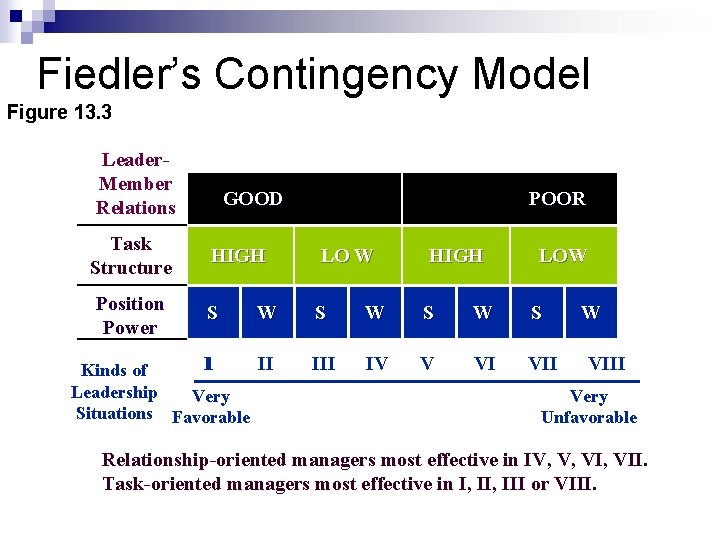
Fiedler’s Contingency Model Figure 13. 3 Leader. Member Relations GOOD POOR Task Structure HIGH LO W HIGH Position Power S S W S III IV V VI VII W 1 I II Kinds of Leadership Very Situations Favorable LOW W VIII Very Unfavorable Relationship-oriented managers most effective in IV, V, VII. Task-oriented managers most effective in I, III or VIII.
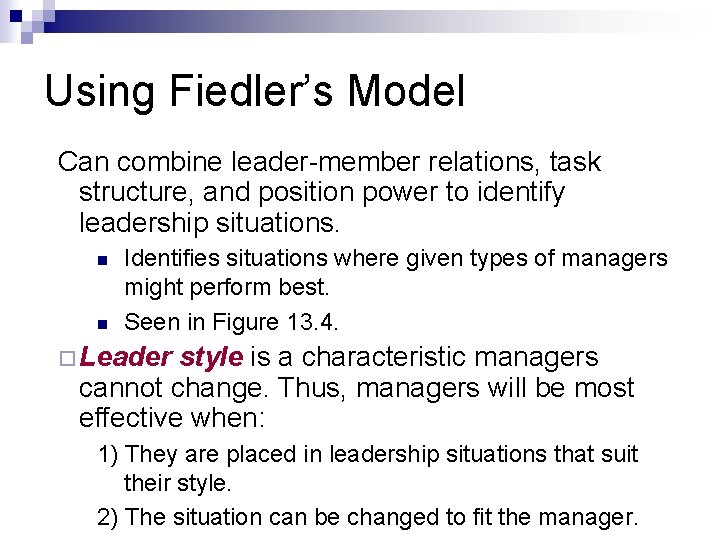
Using Fiedler’s Model Can combine leader-member relations, task structure, and position power to identify leadership situations. n n Identifies situations where given types of managers might perform best. Seen in Figure 13. 4. ¨ Leader style is a characteristic managers cannot change. Thus, managers will be most effective when: 1) They are placed in leadership situations that suit their style. 2) The situation can be changed to fit the manager.
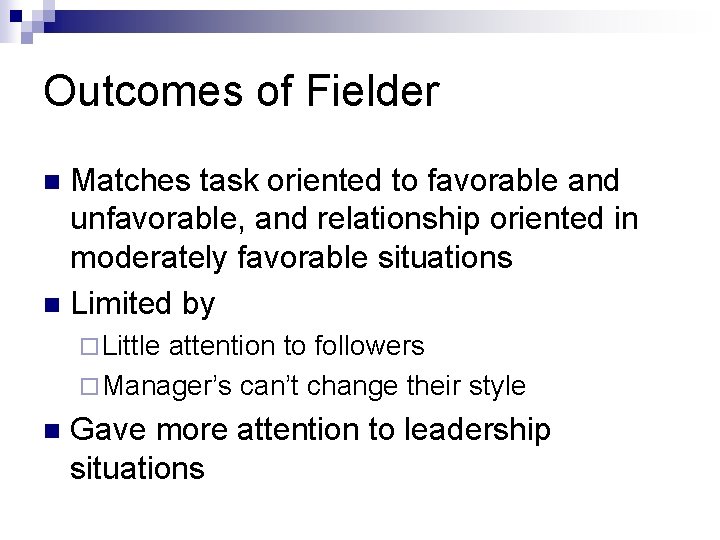
Outcomes of Fielder Matches task oriented to favorable and unfavorable, and relationship oriented in moderately favorable situations n Limited by n ¨ Little attention to followers ¨ Manager’s can’t change their style n Gave more attention to leadership situations
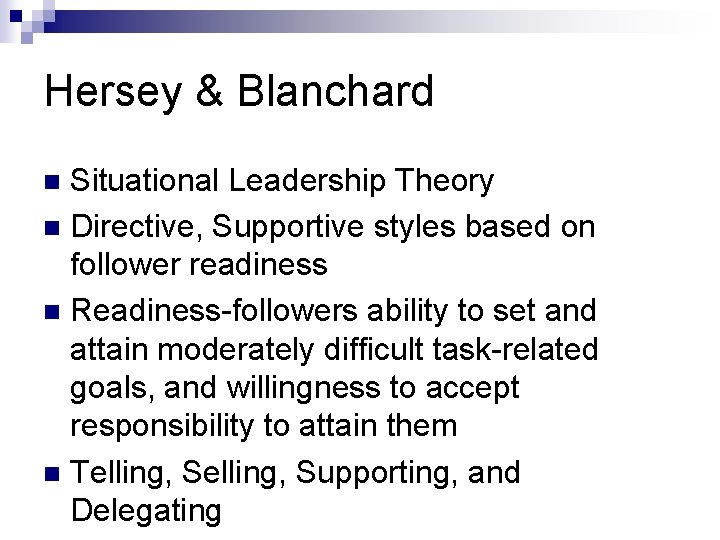
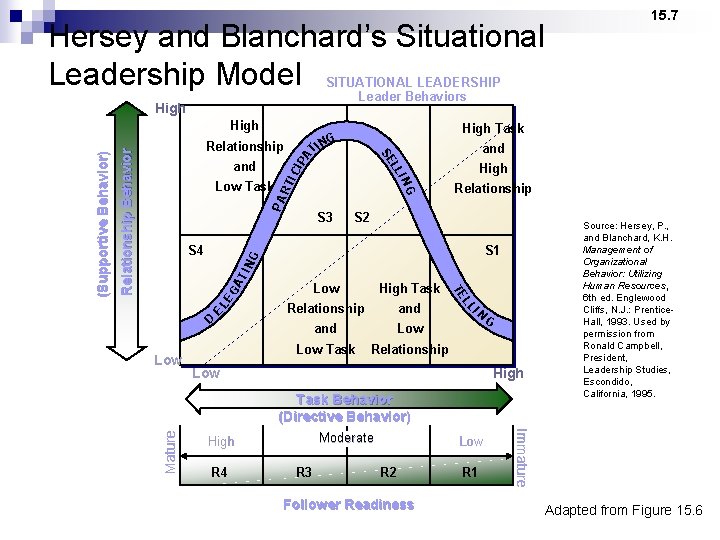
Hersey & Blanchard Situational Leadership Theory n Directive, Supportive styles based on follower readiness n Readiness-followers ability to set and attain moderately difficult task-related goals, and willingness to accept responsibility to attain them n Telling, Supporting, and Delegating n
Hersey and Blanchard’s Situational Leadership Model SITUATIONAL LEADERSHIP Leader Behaviors 15. 7 High CI P AT PA Low Task RT I and S 3 High Relationship S 2 S 1 GA TI LE E High Task Relationship and Low Task Relationship D Low I LL TE Low and NG S 4 NG Relationship Behavior Relationship High Task G IN I LL SE N Low G High Task Behavior (Directive Behavior) Moderate High R 4 R 3 Low R 2 Follower Readiness R 1 Source: Hersey, P. , and Blanchard, K. H. Management of Organizational Behavior: Utilizing Human Resources, 6 th ed. Englewood Cliffs, N. J. : Prentice. Hall, 1993. Used by permission from Ronald Campbell, President, Leadership Studies, Escondido, California, 1995. Immature Mature (Supportive Behavior) High Adapted from Figure 15. 6
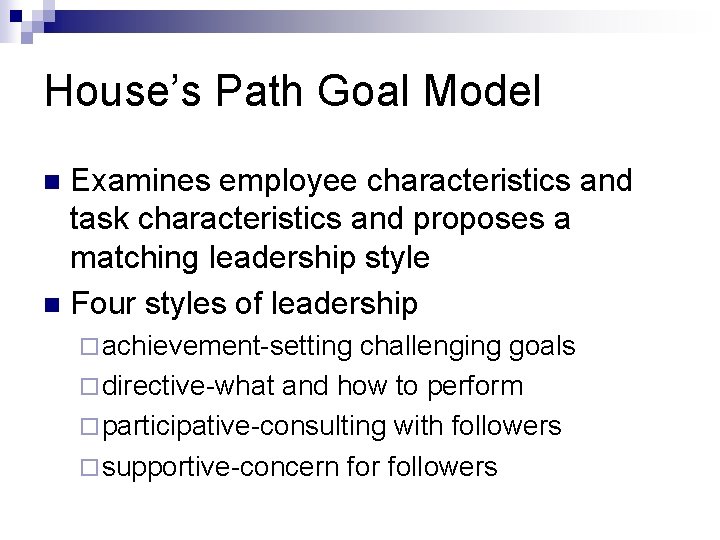
House’s Path Goal Model Examines employee characteristics and task characteristics and proposes a matching leadership style n Four styles of leadership n ¨ achievement-setting challenging goals ¨ directive-what and how to perform ¨ participative-consulting with followers ¨ supportive-concern for followers
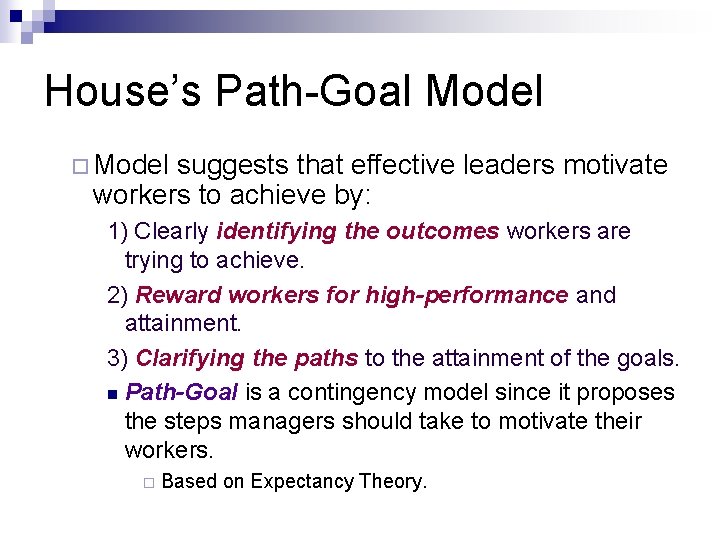
House’s Path-Goal Model ¨ Model suggests that effective leaders motivate workers to achieve by: 1) Clearly identifying the outcomes workers are trying to achieve. 2) Reward workers for high-performance and attainment. 3) Clarifying the paths to the attainment of the goals. n Path-Goal is a contingency model since it proposes the steps managers should take to motivate their workers. ¨ Based on Expectancy Theory.
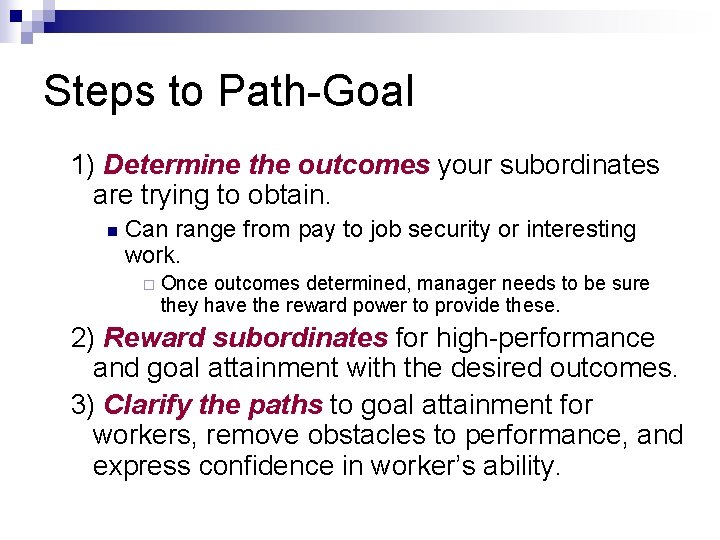
Steps to Path-Goal 1) Determine the outcomes your subordinates are trying to obtain. n Can range from pay to job security or interesting work. ¨ Once outcomes determined, manager needs to be sure they have the reward power to provide these. 2) Reward subordinates for high-performance and goal attainment with the desired outcomes. 3) Clarify the paths to goal attainment for workers, remove obstacles to performance, and express confidence in worker’s ability.
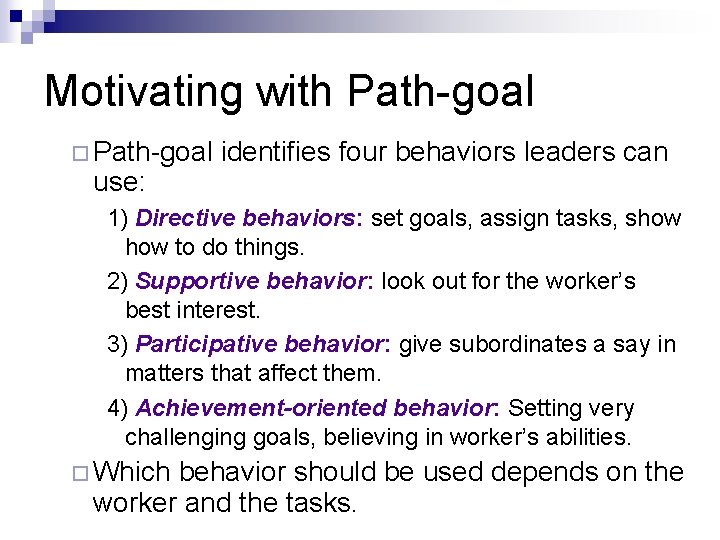
Motivating with Path-goal ¨ Path-goal use: identifies four behaviors leaders can 1) Directive behaviors: set goals, assign tasks, show to do things. 2) Supportive behavior: look out for the worker’s best interest. 3) Participative behavior: give subordinates a say in matters that affect them. 4) Achievement-oriented behavior: Setting very challenging goals, believing in worker’s abilities. ¨ Which behavior should be used depends on the worker and the tasks.
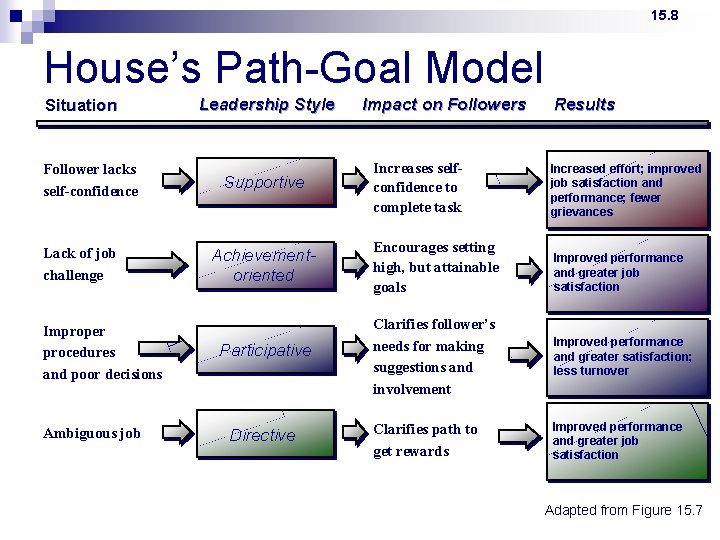
15. 8 House’s Path-Goal Model Situation Follower lacks self-confidence Lack of job challenge Improper procedures and poor decisions Ambiguous job Leadership Style Impact on Followers Results Increases selfconfidence to complete task Increased effort; improved job satisfaction and performance; fewer grievances Achievementoriented Encourages setting high, but attainable goals Improved performance and greater job satisfaction Participative Clarifies follower’s needs for making suggestions and involvement Improved performance and greater satisfaction; less turnover Clarifies path to get rewards Improved performance and greater job satisfaction Supportive Directive Adapted from Figure 15. 7
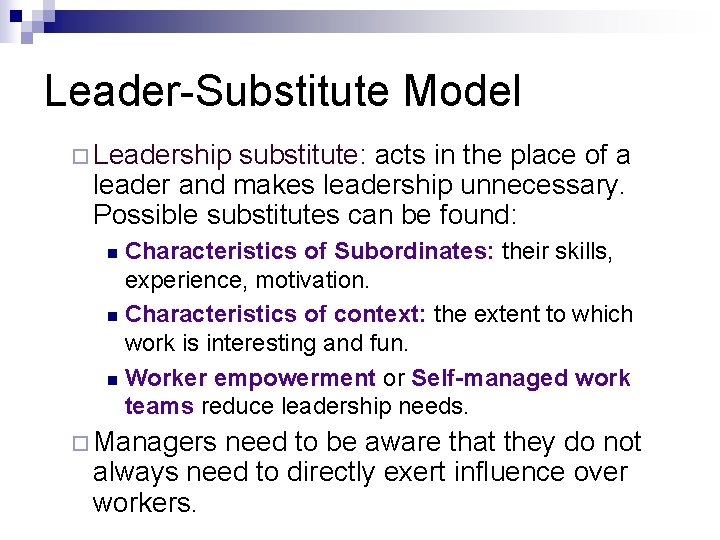
Leader-Substitute Model ¨ Leadership substitute: acts in the place of a leader and makes leadership unnecessary. Possible substitutes can be found: Characteristics of Subordinates: their skills, experience, motivation. n Characteristics of context: the extent to which work is interesting and fun. n Worker empowerment or Self-managed work teams reduce leadership needs. n ¨ Managers need to be aware that they do not always need to directly exert influence over workers.
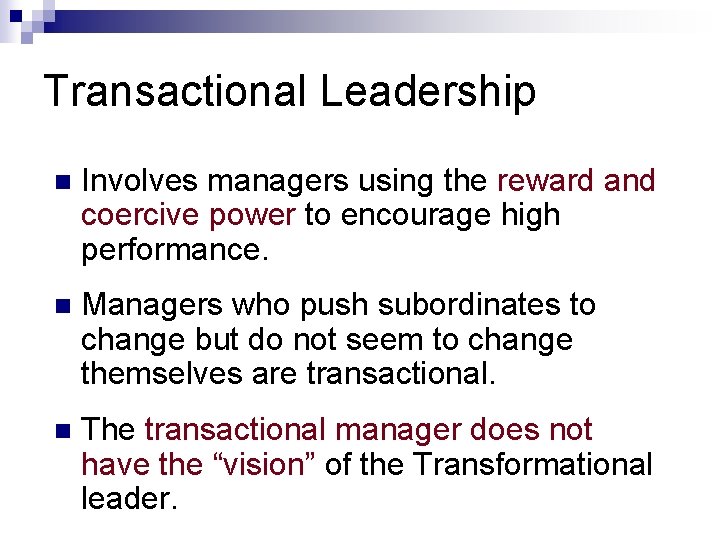
Transactional Leadership n Involves managers using the reward and coercive power to encourage high performance. n Managers who push subordinates to change but do not seem to change themselves are transactional. n The transactional manager does not have the “vision” of the Transformational leader.
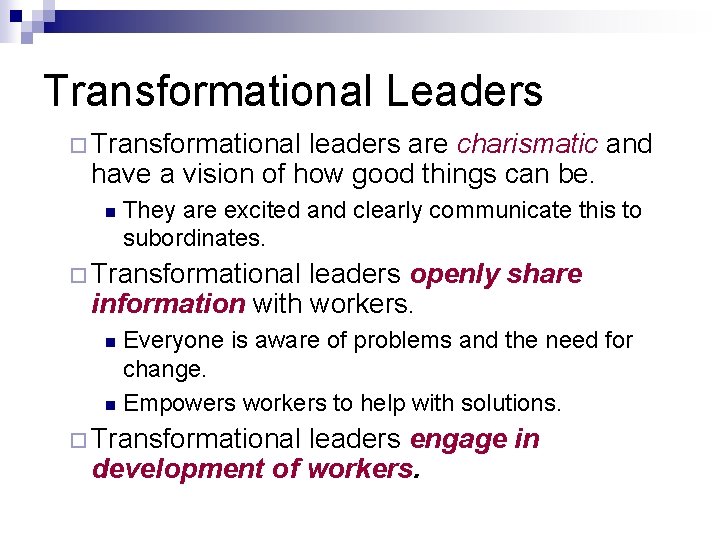
Transformational Leaders ¨ Transformational leaders are charismatic and have a vision of how good things can be. n They are excited and clearly communicate this to subordinates. ¨ Transformational leaders openly share information with workers. Everyone is aware of problems and the need for change. n Empowers workers to help with solutions. n ¨ Transformational leaders engage in development of workers.
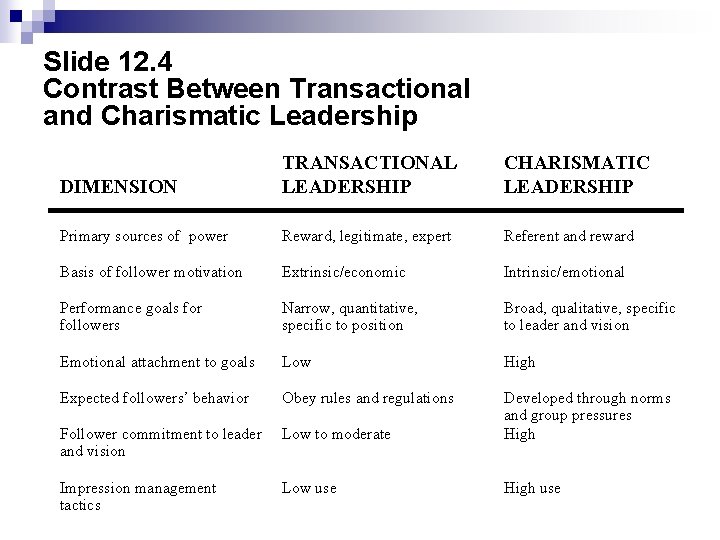
Slide 12. 4 Contrast Between Transactional and Charismatic Leadership DIMENSION TRANSACTIONAL LEADERSHIP CHARISMATIC LEADERSHIP Primary sources of power Reward, legitimate, expert Referent and reward Basis of follower motivation Extrinsic/economic Intrinsic/emotional Performance goals for followers Narrow, quantitative, specific to position Broad, qualitative, specific to leader and vision Emotional attachment to goals Low High Expected followers’ behavior Obey rules and regulations Follower commitment to leader and vision Low to moderate Developed through norms and group pressures High Impression management tactics Low use High use
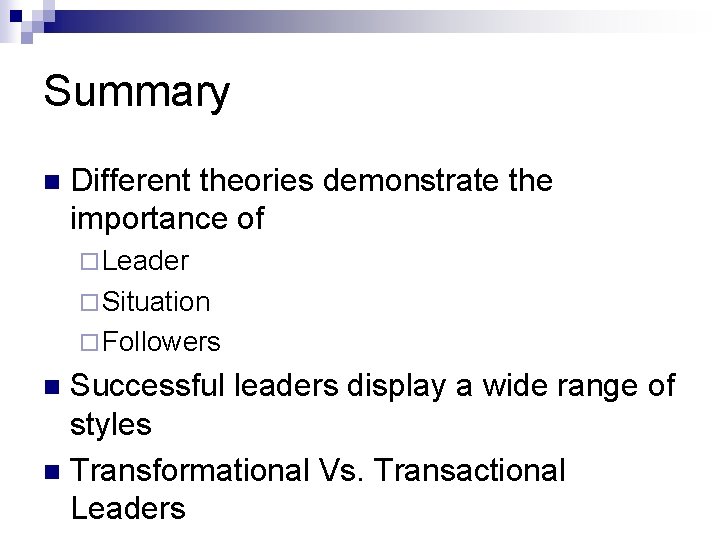
Summary n Different theories demonstrate the importance of ¨ Leader ¨ Situation ¨ Followers Successful leaders display a wide range of styles n Transformational Vs. Transactional Leaders n
Do Leaders Matter? n Leadership Irrelevance ¨ Leadership may be irrelevant for many organizational outcomes. n Leadership Substitutes ¨ Leader success depends on the characteristics of the followers, team, situation, and organization. Each can act as a substitute for leader behavior.