
Leadership Teamwork Engaging Peoples Strengths Group Members Abdullah
Leadership & Teamwork Engaging People’s Strengths Group Members: • Abdullah Al. Matar (201403346). • Saeed Al. Ghamdi (201601008). • Faisal Alqahtani (201403807). Course: • Leadership & Teamwork. Section 112 Instructor: • Dr. Jevdet Rexhepi Spring Semester 2017/2018 Chapter 3
Outline Ø Introduction. Ø Historical Background. Ø Identifying and Measuring Strengths. Ø VIA Classification. Ø Realize. Ø Approaches. Ø Discover The Strength Ø Developing The Strengths Ø Recognizing and Engaging The strengths of Others. Ø Fostering a Positive Strengths-Based Environment. Ø Case Study. Ø Summary.
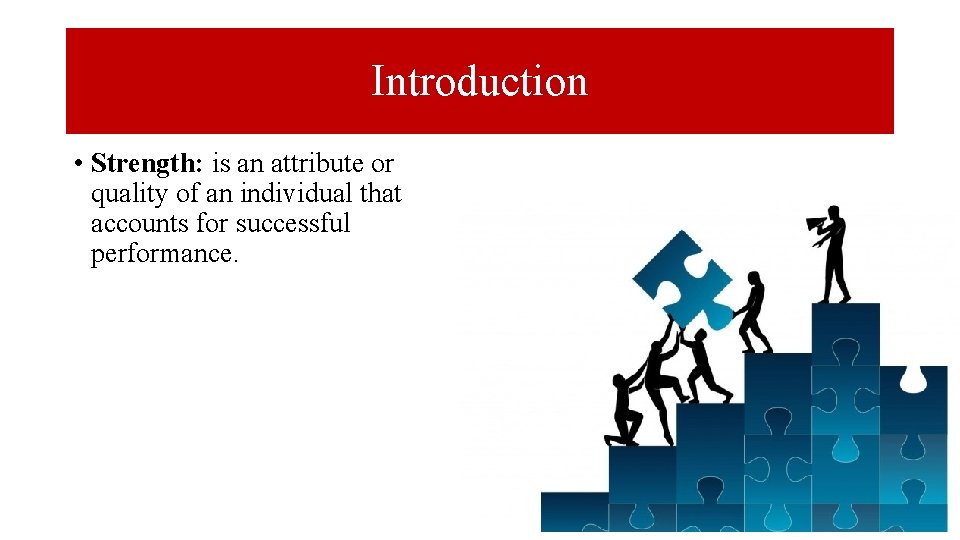
Introduction • Strength: is an attribute or quality of an individual that accounts for successful performance.
Historical Background 1. Gallup Organization: a public opinion research organization that conducts political polling. 2. Positive Psychology: Is a study of what makes life worth living.

Identifying and Measuring Strengths 1. Gallup and the Strengths finder profile: Themes of human talent. A. B. C. D. Executing Influencing Relationship Buildings Strategic Thinking
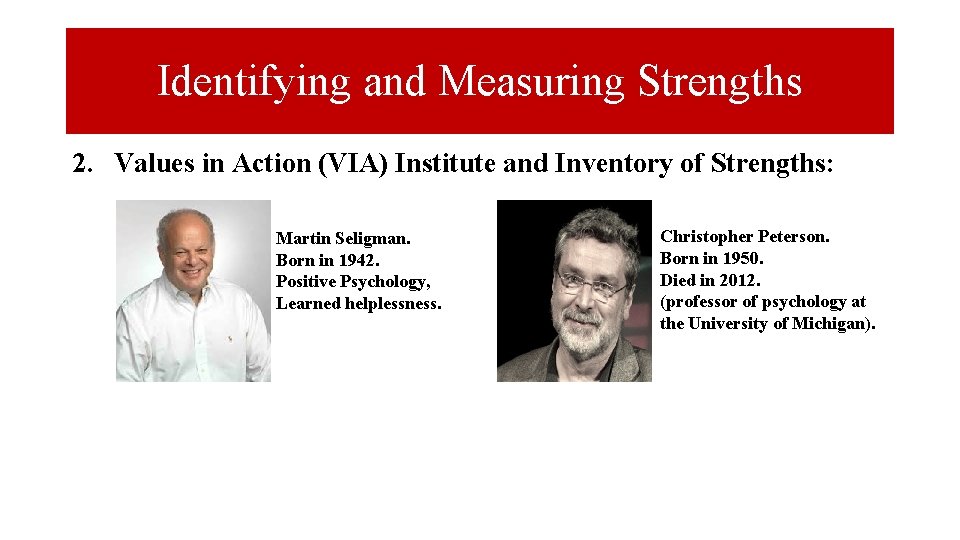
Identifying and Measuring Strengths 2. Values in Action (VIA) Institute and Inventory of Strengths: Martin Seligman. Born in 1942. Positive Psychology, Learned helplessness. Christopher Peterson. Born in 1950. Died in 2012. (professor of psychology at the University of Michigan).
VIA Classification: (identify and measuring strength) • Wisdom • Courage • Humanity • Justice • Temperance • Transcendence
Realize • Unrealized Strengths: 1. Perform Well. 2. Energising. 3. Lower use.
Realize • Realized Strength: 1. Perform well. 2. Energising. 3. Higher use.
Realize • Weaknesses: 1. Perform poorly. 2. De-energising. 3. Variable use.
Realize • Learned Behaviours: 1. Perform well. 2. De-energising. 3. Variable use.
Realize • Unrealized strengths: less visible (example: creativity) • Learned Behaviours: What we learn through our life (example: drive) • Weaknesses: (example: leading)
Approaches • Strengths of competence Gallup • Value in action(VIA-IS) • fully realized
Discover Your Strength 1. Watch for signs of excitement 2. Break away from job titles. 3. Notice what you do differently than everyone else.
Developing Your Strengths 1. 2. 3. 4. Don’t compare yourself with others. Don’t concentrate on weaknesses. Eliminate your weaknesses by partnering with others. Use failure as motivation.
Recognizing and Engaging The strengths of Others • In addition to employing their own strengths, leader need to recognize and engage the strengths of their followers. • Leaders need to determine what followers are good at doing and help them to do it. • People feel comfortable in group when they can contribute to the group from their strengths. • While recognizing strengths sound simple, it is not uncommon for leaders to overlook followers' strengths. • It is important to note that others strengths may not always be directly recognizable.
Fostering a Positive Strengths-Based Environment • A final way to practice strengths-based leadership is to create and promote a positive work environment in which peoples strengths play an integral role. • In short, people feel better and work better than when the climate in which they work is positive. • Leaders who want to create a positive work environment should attend to four areas: climate, relationships, communication and meaning. • Fostering a positive strengths-based organizational environment is embraced by a multitude of organizations.
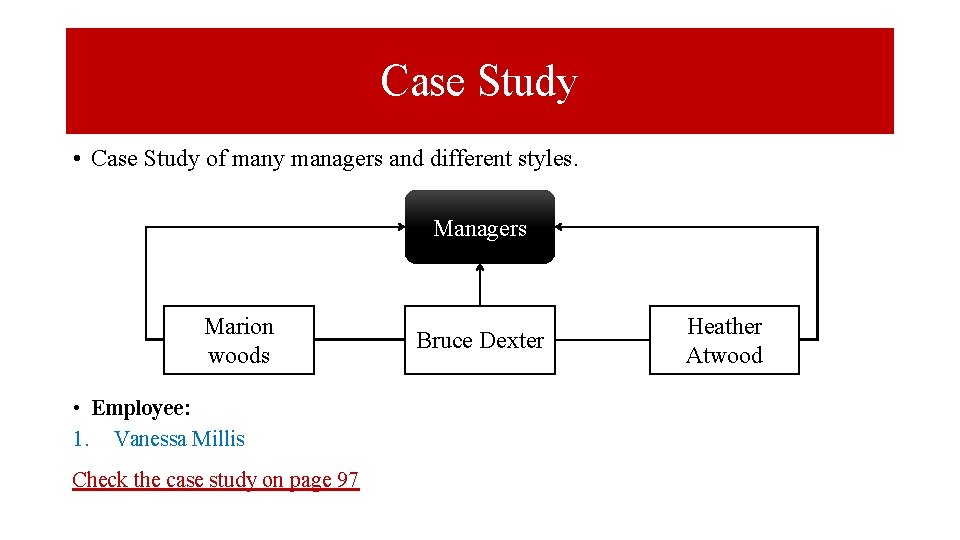
Case Study • Case Study of many managers and different styles. Managers Marion woods • Employee: 1. Vanessa Millis Check the case study on page 97 Bruce Dexter Heather Atwood
Case Study 1. How would you describe each manager’s philosophy and style of leadership ? 2. Which leadership style would be most effective for the bank to meet its goal ? 3. What advice would you give to each of the managers ? 4. What do you think Venessa can do ?
Summary ØThere are different style of leadership. ØRealizing is one of the strong point of leadership. ØEvery leader most have a positive psychology. Ø Recognizing and Engaging The strengths of Others builds our leadership. ØOnce we discover our strengths, we can develop our leadership. ØValue in action is one of the approaches of strengths.
Thanks For Listening
- Slides: 21