
Leadership Styles Why choose Tailoring your leadership style
- Slides: 16
Leadership Styles: Why choose? Tailoring your leadership style to a custom fit for you and your organization Jill Dixon- Director of Public Services Nancy Abashian- Head of Reader Services & Resource Sharing
Discussion Agenda: • Leadership a la carte • Leadership frameworks • Four Frames • Primal Leadership • Identifying your framework • Know thyself • Know thy framework • Practice and application • Planning and implementing • Lasting motivation for change • Leadership in Libraries • Further Discussion
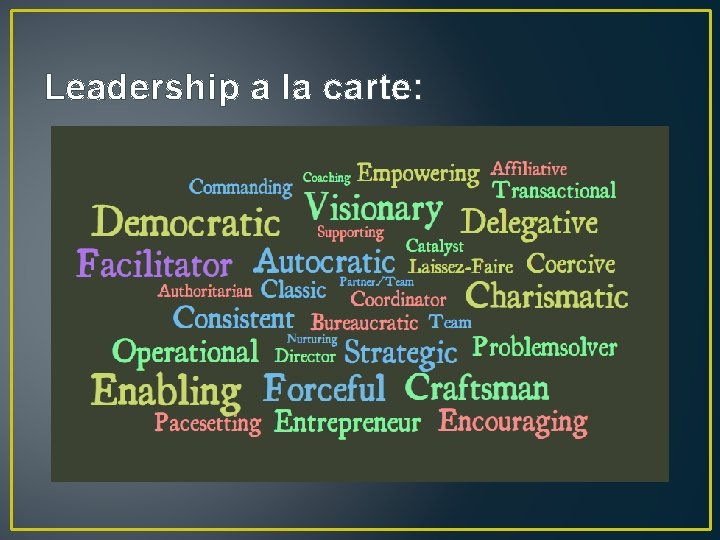
Leadership a la carte:
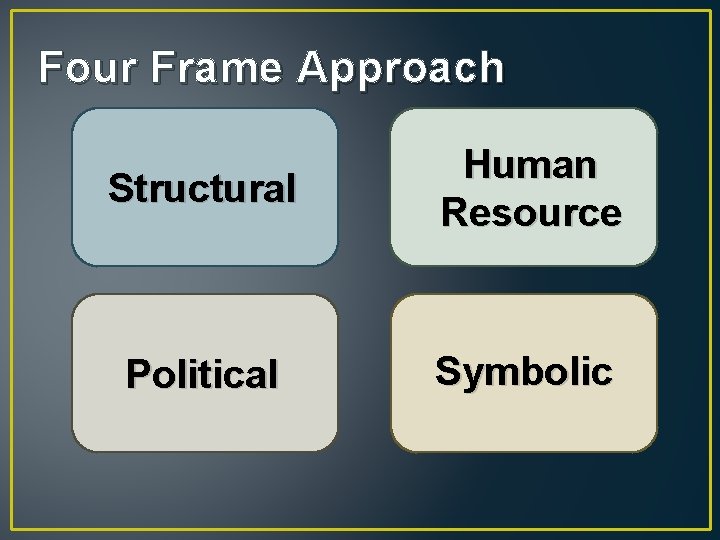
Four Frame Approach Structural Human Resource Political Symbolic
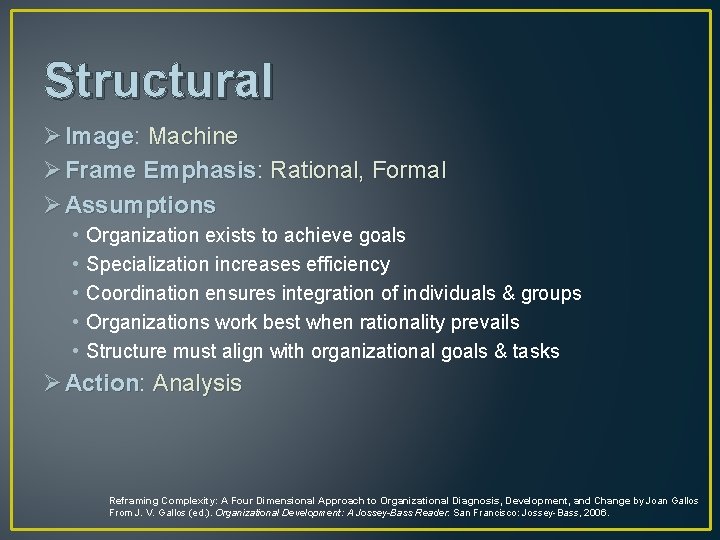
Structural Ø Image: Image Machine Ø Frame Emphasis: Frame Emphasis Rational, Formal Ø Assumptions • • • Organization exists to achieve goals Specialization increases efficiency Coordination ensures integration of individuals & groups Organizations work best when rationality prevails Structure must align with organizational goals & tasks Ø Action: Action Analysis Reframing Complexity: A Four Dimensional Approach to Organizational Diagnosis, Development, and Change by Joan Gallos From J. V. Gallos (ed. ). Organizational Development: A Jossey-Bass Reader. San Francisco: Jossey-Bass, 2006.
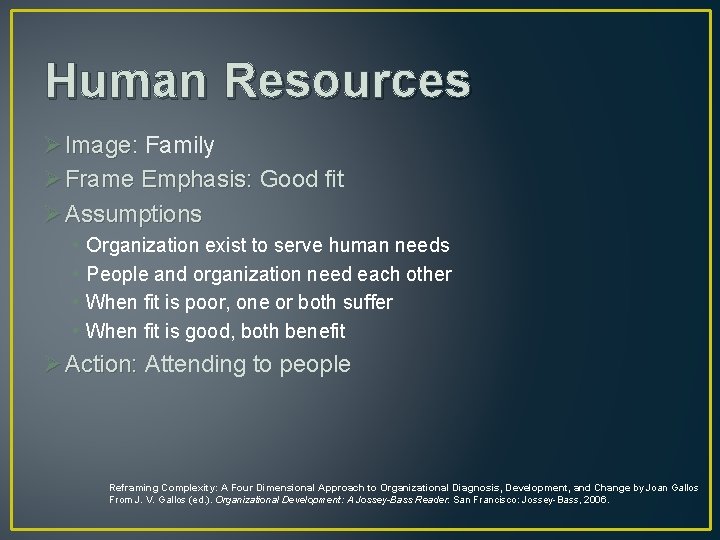
Human Resources Ø Image: Family : Ø Frame Emphasis: Good fit Frame Emphasis: Ø Assumptions • • Organization exist to serve human needs People and organization need each other When fit is poor, one or both suffer When fit is good, both benefit Ø Action: Attending to people Reframing Complexity: A Four Dimensional Approach to Organizational Diagnosis, Development, and Change by Joan Gallos From J. V. Gallos (ed. ). Organizational Development: A Jossey-Bass Reader. San Francisco: Jossey-Bass, 2006.
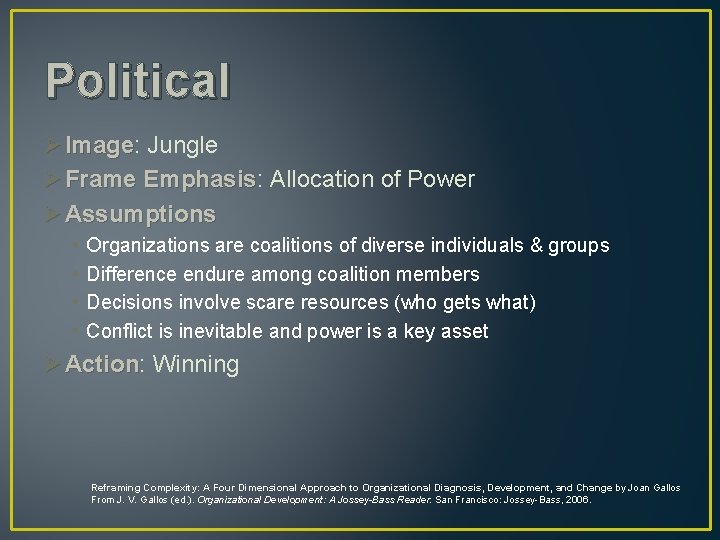
Political Ø Image: Jungle Image Ø Frame Emphasis: Allocation of Power Frame Emphasis Ø Assumptions • • Organizations are coalitions of diverse individuals & groups Difference endure among coalition members Decisions involve scare resources (who gets what) Conflict is inevitable and power is a key asset Ø Action: Winning Action Reframing Complexity: A Four Dimensional Approach to Organizational Diagnosis, Development, and Change by Joan Gallos From J. V. Gallos (ed. ). Organizational Development: A Jossey-Bass Reader. San Francisco: Jossey-Bass, 2006.
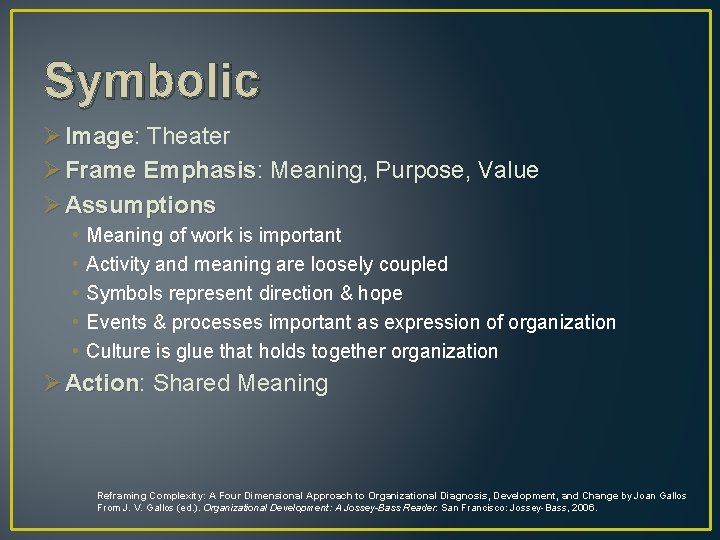
Symbolic Ø Image: Theater Image Ø Frame Emphasis: Meaning, Purpose, Value Frame Emphasis Ø Assumptions • • • Meaning of work is important Activity and meaning are loosely coupled Symbols represent direction & hope Events & processes important as expression of organization Culture is glue that holds together organization Ø Action: Shared Meaning Action Reframing Complexity: A Four Dimensional Approach to Organizational Diagnosis, Development, and Change by Joan Gallos From J. V. Gallos (ed. ). Organizational Development: A Jossey-Bass Reader. San Francisco: Jossey-Bass, 2006.
What is your leadership orientation?
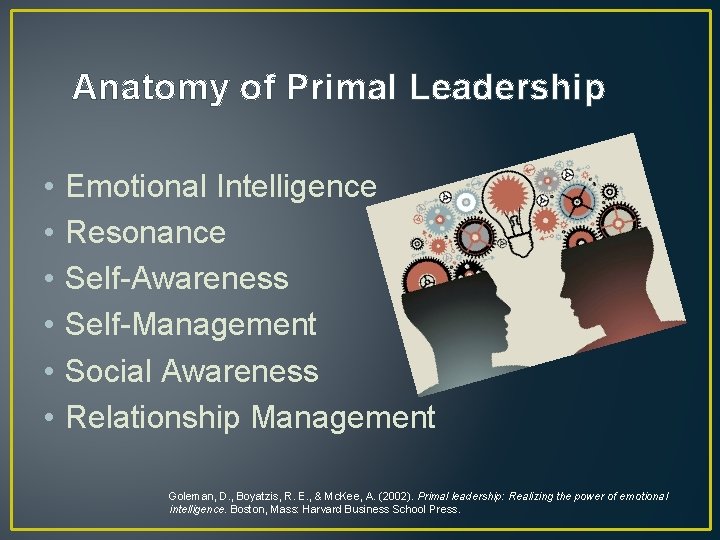
Anatomy of Primal Leadership • • • Emotional Intelligence Resonance Self-Awareness Self-Management Social Awareness Relationship Management Goleman, D. , Boyatzis, R. E. , & Mc. Kee, A. (2002). Primal leadership: Realizing the power of emotional intelligence. Boston, Mass: Harvard Business School Press.
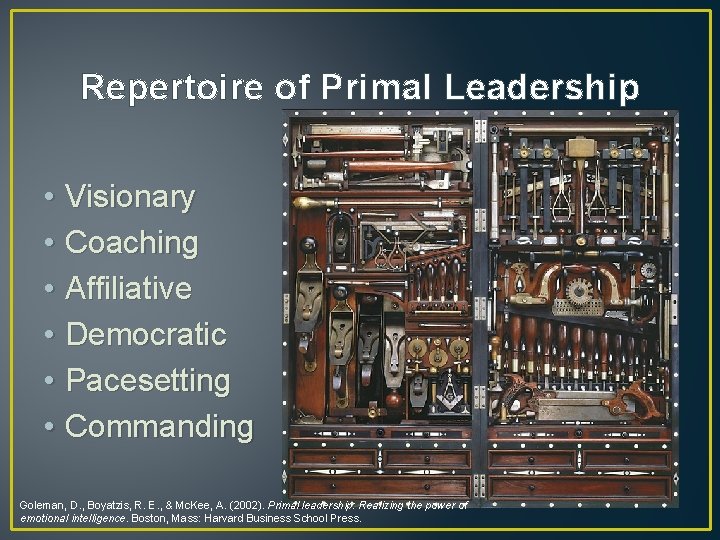
Repertoire of Primal Leadership • Visionary • Coaching • Affiliative • Democratic • Pacesetting • Commanding Goleman, D. , Boyatzis, R. E. , & Mc. Kee, A. (2002). Primal leadership: Realizing the power of emotional intelligence. Boston, Mass: Harvard Business School Press.
Resonance finding what works • Can you identify your style(s)? • What style resonates with your work environment? • Is that style resonate or dissonant with your own style? • What leadership framework resonates with you as an individual? • What aspects of the framework don’t? Goleman, D. , Boyatzis, R. E. , & Mc. Kee, A. (2002). Primal leadership: Realizing the power of emotional intelligence. Boston, Mass: Harvard Business School Press.
Other frameworks to consider • Transformational • Situational • Organizational • Transactional • Behavioral • To name only a few….
Becoming a leader: Self Discovery & Creating Change • Who do I want to be? • What are my strengths and gaps? • How can I build on my strengths while reducing my gaps? • Practice new behaviors, thoughts and feelings to the point of mastery • Develop supportive and trusting relationships that make change possible Goleman, D. , Boyatzis, R. E. , & Mc. Kee, A. (2002). Primal leadership: Realizing the power of emotional intelligence. Boston, Mass: Harvard Business School Press.
Library Leadership • Reluctant leadership-Don’t want to be the captain? What Reluctant other roles need leadership in the organization? • For tenure, leadership is often required-what can you do? tenure • Lack of promotional/organizational opportunity-where do opportunity you look? • Leading “up”- influencing those around & above you by influencing knowing your style.
Works Cited & Resources • Goleman, D. , Boyatzis, R. E. , & Mc. Kee, A. (2002). Primal leadership: Realizing the power of emotional intelligence. Boston, Mass: Harvard Business School Press. • Boyatzis, R. E. , & Mc. Kee, A. (2006). Intentional Change. Journal of Organizational Excellence, Summer, pp. 49 -60. doi: 10. 1002/joe • Gallos, J. V. (2006). Reframing complexity: A four dimensional approach to organizational diagnosis, development, and change. In J. V. Gallos (Ed. ), Organizational Development: A Jossey-Bass Reader. Retrieved from http: //www. joangallos. com/wp-content/uploads/2007/08/reframingcomplexity-a-four-dimensional-approach. doc • Lee Bolman - http: //www. leebolman. com/index. html • Joan V. Gallos - http: //www. joangallos. com/