
LEADERSHIP PRACTICES INVENTORY LPI A leadership development program









- Slides: 71
LEADERSHIP PRACTICES INVENTORY: LPI A leadership development program for acute care nurse managers
SEGMENT 1 Welcome and Introductions Leadership Practices Inventory (LPI) 4/e Facilitator’s Guide. Copyright © 2013 by James M. Kouzes and Barry Z. Posner. Reproduced by permission of Pfeiffer, an Imprint of Wiley. www. pfeiffer. com.
WELCOME TO THE LPI FEEDBACK SESSION Our common purpose is increasing the quality of nurse leaders in this organization and in our larger community. Leadership Practices Inventory (LPI) 4/e Facilitator’s Guide. Copyright © 2013 by James M. Kouzes and Barry Z. Posner. Reproduced by permission of Pfeiffer, an Imprint of Wiley. www. pfeiffer. com. 1 -1
“It is impossible in a book to teach a person in charge of the sick how to manage, as it is to teach her how to nurse. ” Florence Nightingale, 1860 Leadership Practices Inventory (LPI) 4/e Facilitator’s Guide. Copyright © 2013 by James M. Kouzes and Barry Z. Posner. Reproduced by permission of Pfeiffer, an Imprint of Wiley. www. pfeiffer. com.
LITERATURE REVIEW AND BACKGROUND Leadership Practices Inventory (LPI) 4/e Facilitator’s Guide. Copyright © 2013 by James M. Kouzes and Barry Z. Posner. Reproduced by permission of Pfeiffer, an Imprint of Wiley. www. pfeiffer. com.
OBJECTIVES • Define transformational leadership • Explore the attributes of TL in nursing • Describe opportunities to improve TL of nurse leaders • Explain the findings in the literature to support this leadership development program Leadership Practices Inventory (LPI) 4/e Facilitator’s Guide. Copyright © 2013 by James M. Kouzes and Barry Z. Posner. Reproduced by permission of Pfeiffer, an Imprint of Wiley. www. pfeiffer. com.
BACKGROUND • Transformational Leadership • Vision • Charisma • Risk taking • Out of the box thinking • Aptitude for motivating others • Role model • Mentor Investing and committing to producing prepared, capable and effective leaders in the nursing units are paramount to contributing to the mission and bottom line of a hospital (Casida & Parker, 2011) Leadership Practices Inventory (LPI) 4/e Facilitator’s Guide. Copyright © 2013 by James M. Kouzes and Barry Z. Posner. Reproduced by permission of Pfeiffer, an Imprint of Wiley. www. pfeiffer. com.
WHY FOCUS ON NURSING LEADERSHIP • The transformational leader must lead people to where they need to be in order to meet the demands of the future (ANCC, 2013) • Nurse Managers (NM) have a direct impact on both clinical and organizational outcomes (Zori, Nosek, & Musil, 2010) • Leadership ability, lack of support, guidance and engagement issues with the NM impact RN satisfaction. (Fenimore & Wolf, 2011) Leadership Practices Inventory (LPI) 4/e Facilitator’s Guide. Copyright © 2013 by James M. Kouzes and Barry Z. Posner. Reproduced by permission of Pfeiffer, an Imprint of Wiley. www. pfeiffer. com.
INSTITUTE OF MEDICINE REPORT (IOM) • Institute of Medicine imperative to prepare nurses for leadership (IOM, 2010) • Future of nursing depends upon educating and supporting all levels of nurse leaders • International Council of Nursing (ICN) believes that nurse leaders have the opportunity to lead reform • Recommendation for nurse residency program Leadership Practices Inventory (LPI) 4/e Facilitator’s Guide. Copyright © 2013 by James M. Kouzes and Barry Z. Posner. Reproduced by permission of Pfeiffer, an Imprint of Wiley. www. pfeiffer. com.
TRANSFORMATIONAL LEADERSHIP DEVELOPMENT • Impacts job satisfaction • Influences empowerment of both leader and manager • Shapes a nursing unit culture • Manifests trust and collaboration with staff • Fosters autonomy and shared governance • Organizational commitment • Staff nurses are empowered to meet the mission of the hospital and meet the mission of the hospital (Casida & Pinto-Zipp, 2008) Leadership Practices Inventory (LPI) 4/e Facilitator’s Guide. Copyright © 2013 by James M. Kouzes and Barry Z. Posner. Reproduced by permission of Pfeiffer, an Imprint of Wiley. www. pfeiffer. com.
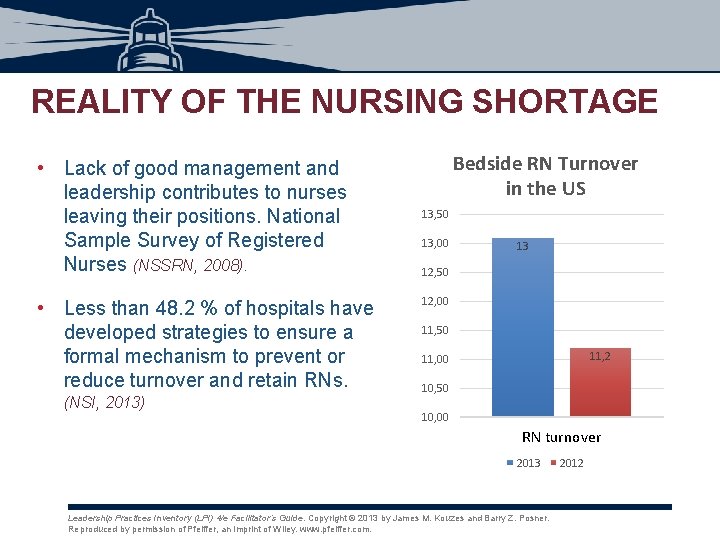
REALITY OF THE NURSING SHORTAGE • Lack of good management and leadership contributes to nurses leaving their positions. National Sample Survey of Registered Nurses (NSSRN, 2008). • Less than 48. 2 % of hospitals have developed strategies to ensure a formal mechanism to prevent or reduce turnover and retain RNs. (NSI, 2013) Bedside RN Turnover in the US 13, 50 13, 00 13 12, 50 12, 00 11, 50 11, 2 11, 00 10, 50 10, 00 RN turnover 2013 Leadership Practices Inventory (LPI) 4/e Facilitator’s Guide. Copyright © 2013 by James M. Kouzes and Barry Z. Posner. Reproduced by permission of Pfeiffer, an Imprint of Wiley. www. pfeiffer. com. 2012
TRADITIONAL NM DEVELOPMENT • Many nurses become leaders without formal education or on the job education needed to succeed in their role (Kerfoot, 2008) • Trial and error development often equates to failure for NL (Swearingen, 2009) • Lack of connection to leadership development theories • Lack of evidence for types of content and delivery best sited to specific populations • Continuing education available for leadership specific content • Ability and time for NM to attend conferences Leadership Practices Inventory (LPI) 4/e Facilitator’s Guide. Copyright © 2013 by James M. Kouzes and Barry Z. Posner. Reproduced by permission of Pfeiffer, an Imprint of Wiley. www. pfeiffer. com.
NURSE MANAGER DEVELOPMENT • Nurse’s don’t often assume the role of NM by choice • Few receive structured development beyond initial orientation (Sherman, Bishop, Eggenberger, & Karden, 2007) • Continuing education is usually the route NM take to increase knowledge and skills (Sherman, Bishop, Eggenberger, & Karden, 2007) • The NM have the responsibility for leading unit activities which empower and engage clinicians accountable for care and patient outcomes (Carthart, Greenspan, & Quin, 2010) Leadership Practices Inventory (LPI) 4/e Facilitator’s Guide. Copyright © 2013 by James M. Kouzes and Barry Z. Posner. Reproduced by permission of Pfeiffer, an Imprint of Wiley. www. pfeiffer. com.
NM DEVELOPMENT CONTINUED… Many nurses become leaders without formal education or on the job education needed to succeed in their role (Kerfoot, 2008) Trial and error development often equates to failure for nurse leaders/managers (Swearingen, 2003) Many nursing leadership programs lack connection to leadership development theories and conceptual frameworks (Galuska, 2013) Leadership Practices Inventory (LPI) 4/e Facilitator’s Guide. Copyright © 2013 by James M. Kouzes and Barry Z. Posner. Reproduced by permission of Pfeiffer, an Imprint of Wiley. www. pfeiffer. com.
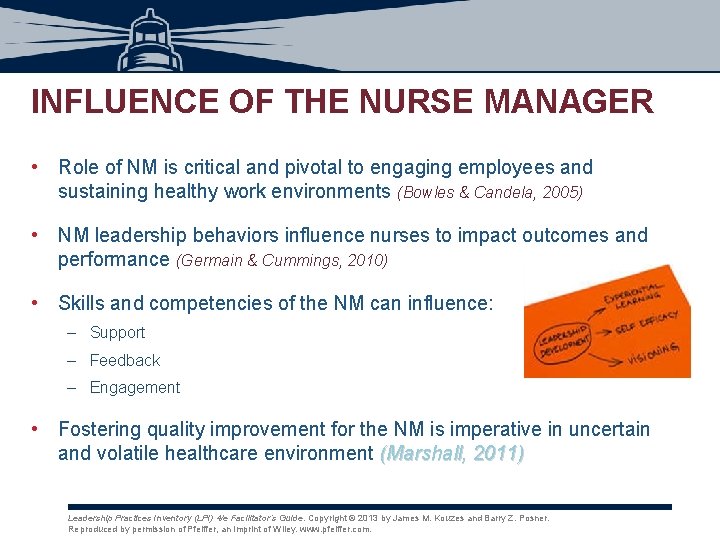
INFLUENCE OF THE NURSE MANAGER • Role of NM is critical and pivotal to engaging employees and sustaining healthy work environments (Bowles & Candela, 2005) • NM leadership behaviors influence nurses to impact outcomes and performance (Germain & Cummings, 2010) • Skills and competencies of the NM can influence: – Support – Feedback – Engagement • Fostering quality improvement for the NM is imperative in uncertain and volatile healthcare environment (Marshall, 2011) Leadership Practices Inventory (LPI) 4/e Facilitator’s Guide. Copyright © 2013 by James M. Kouzes and Barry Z. Posner. Reproduced by permission of Pfeiffer, an Imprint of Wiley. www. pfeiffer. com.
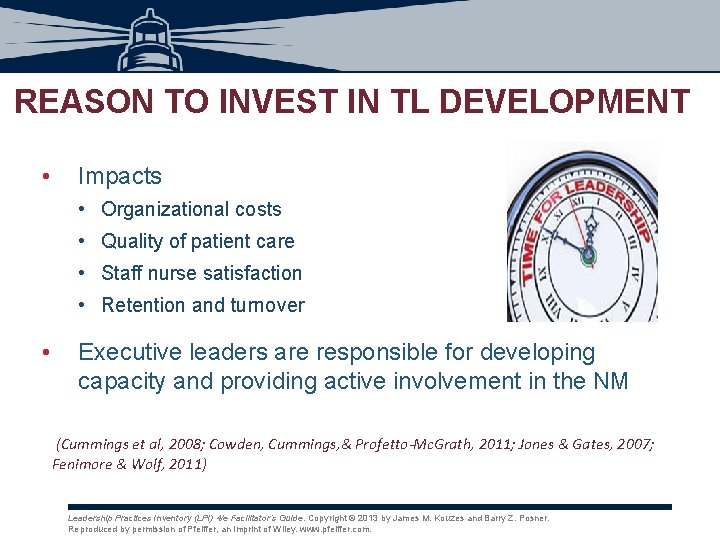
REASON TO INVEST IN TL DEVELOPMENT • Impacts • Organizational costs • Quality of patient care • Staff nurse satisfaction • Retention and turnover • Executive leaders are responsible for developing capacity and providing active involvement in the NM (Cummings et al, 2008; Cowden, Cummings, & Profetto-Mc. Grath, 2011; Jones & Gates, 2007; Fenimore & Wolf, 2011) Leadership Practices Inventory (LPI) 4/e Facilitator’s Guide. Copyright © 2013 by James M. Kouzes and Barry Z. Posner. Reproduced by permission of Pfeiffer, an Imprint of Wiley. www. pfeiffer. com.
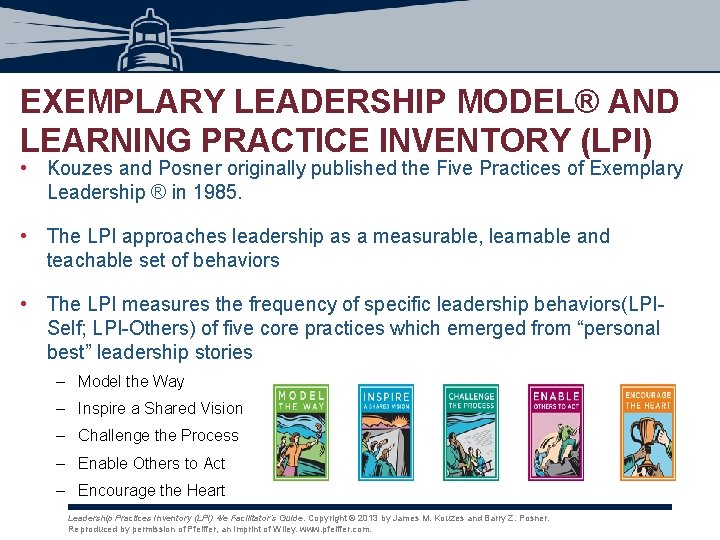
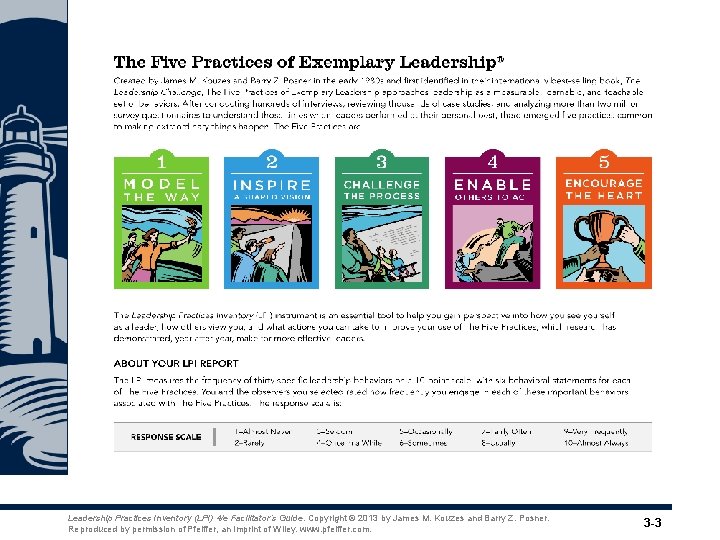
EXEMPLARY LEADERSHIP MODEL® AND LEARNING PRACTICE INVENTORY (LPI) • Kouzes and Posner originally published the Five Practices of Exemplary Leadership ® in 1985. • The LPI approaches leadership as a measurable, learnable and teachable set of behaviors • The LPI measures the frequency of specific leadership behaviors(LPISelf; LPI-Others) of five core practices which emerged from “personal best” leadership stories – Model the Way – Inspire a Shared Vision – Challenge the Process – Enable Others to Act – Encourage the Heart Leadership Practices Inventory (LPI) 4/e Facilitator’s Guide. Copyright © 2013 by James M. Kouzes and Barry Z. Posner. Reproduced by permission of Pfeiffer, an Imprint of Wiley. www. pfeiffer. com.
TRANSFORMATIONAL LEADERSHIP • Twenty eight of the thirty two articles reviewed involved discussion and positive findings of TL related to: • Positive organizational outcomes (Wong, Cummings & Ducharme, 2013) • Impacted a shared vision and challenge the process (LPI) • Improved with leadership development programs (Cummings et. al, 2008; Curtis, Sheerin & de. Vries, 2011; Heuston & Wolf, 2011; Kleinman, 2004) • Achieving effectiveness and leadership outcomes in NM • Relationship between TL nursing leadership and patient outcomes (Wong & Cummings, 2007) Leadership Practices Inventory (LPI) 4/e Facilitator’s Guide. Copyright © 2013 by James M. Kouzes and Barry Z. Posner. Reproduced by permission of Pfeiffer, an Imprint of Wiley. www. pfeiffer. com.
REGISTERED NURSE SATISFACTION • RN’s are influenced by the leadership of their NM • Empowered NM empower their staff who in turn are more satisfied (Mac. Phee, Skelton-Green, Bouthillette, & Suryaprakash, 2011) • Behaviors utilized by NM can make a difference in employee outcomes • Effective TL in NM is essential to creation of work and practice environment (RN Satisfaction) (Pearson et al, 2007) • Investment in NM TL style of informing and encouraging staff will enable outcomes of positive work environment and patient care (Germain & Cummings, 2010) • Therefore if we do not actively seek ways to increase the leadership practices of the NM we may never achieve RN satisfaction or organizational effectiveness that are so critical in todays values based healthcare landscape. Leadership Practices Inventory (LPI) 4/e Facilitator’s Guide. Copyright © 2013 by James M. Kouzes and Barry Z. Posner. Reproduced by permission of Pfeiffer, an Imprint of Wiley. www. pfeiffer. com.
PICO QUESTION? Does a leadership development program for acute care nurse managers using the five practices of exemplary leadership improve RN and patient satisfaction? Leadership Practices Inventory (LPI) 4/e Facilitator’s Guide. Copyright © 2013 by James M. Kouzes and Barry Z. Posner. Reproduced by permission of Pfeiffer, an Imprint of Wiley. www. pfeiffer. com.
LEADERSHIP DEVELOPMENT PROGRAM • Educational activities can foster development of leadership skills • Modeling and Practicing of these skills should also be included • Reflection and master the new thoughts and actions • Action plan items from your results of the LPI-Self assessment will allow you to focus on your opportunities for improvement and strengthen and reinforce your practice of exemplary leadership (Cummings et all, 2008) • Evidence based content, optimized learning strategies are also key components to program curricula (Galuska, 2014) • Theoretical framework which includes a pre-test/post-test to validate leadership learning is important to program success • Each of you completed a LPI-Self assessment September 22 -26, 2014 (PRE) and will repeat this December 10, 2014 (POST) Leadership Practices Inventory (LPI) 4/e Facilitator’s Guide. Copyright © 2013 by James M. Kouzes and Barry Z. Posner. Reproduced by permission of Pfeiffer, an Imprint of Wiley. www. pfeiffer. com.
ABOUT THIS PROGRAM… • Allow for reflection to be able to articulate the leadership practices identified in the LPI-Self assessment as areas of opportunity • Development program for YOU, not another task to improve organizational performance metrics • • However the literature supports that nurse leader development and acumen of TL knowledge, skills, abilities and practices will improve organizational outcomes and registered nurse satisfaction When you focus on developing yourself, chances are according to the literature your unit based outcomes will improve as well Leadership Practices Inventory (LPI) 4/e Facilitator’s Guide. Copyright © 2013 by James M. Kouzes and Barry Z. Posner. Reproduced by permission of Pfeiffer, an Imprint of Wiley. www. pfeiffer. com.
FIVE PRACTICES OF EXEMPLARY LEADERSHIP AND THE LEARNING PRACTICE INVENTORY (LPI-SELF) (1. 0) Leadership Practices Inventory (LPI) 4/e Facilitator’s Guide. Copyright © 2013 by James M. Kouzes and Barry Z. Posner. Reproduced by permission of Pfeiffer, an Imprint of Wiley. www. pfeiffer. com.
OBJECTIVES § Describe The Five Practices of Exemplary Leadership® § Relate how The Five Practices apply to your leadership § Identify your strengths and areas for improvement as a leader § Commit to actions you will take in the next three months to become a better leader § Create a plan for using your LPI feedback and connecting with the project leader about your development plan Leadership Practices Inventory (LPI) 4/e Facilitator’s Guide. Copyright © 2013 by James M. Kouzes and Barry Z. Posner. Reproduced by permission of Pfeiffer, an Imprint of Wiley. www. pfeiffer. com. 1 -2
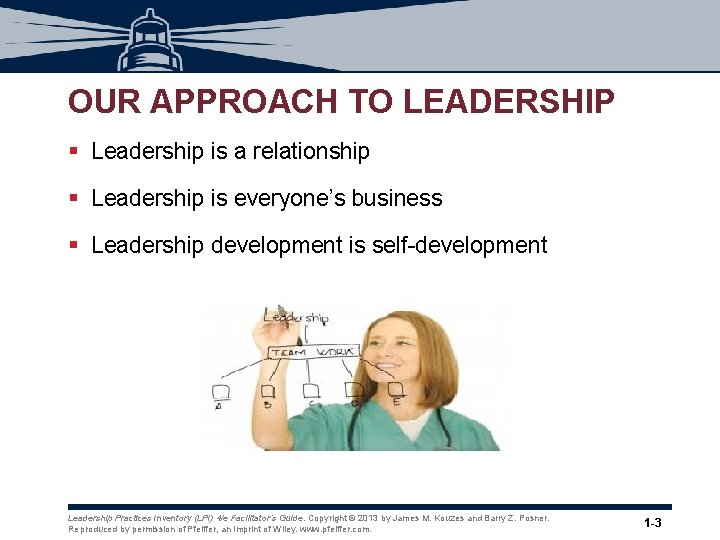
OUR APPROACH TO LEADERSHIP § Leadership is a relationship § Leadership is everyone’s business § Leadership development is self-development Leadership Practices Inventory (LPI) 4/e Facilitator’s Guide. Copyright © 2013 by James M. Kouzes and Barry Z. Posner. Reproduced by permission of Pfeiffer, an Imprint of Wiley. www. pfeiffer. com. 1 -3
NAME THE FOLLOWING: § Five wealthiest people in the world § Last six Time magazine’s people of the year § Five Nobel or Pulitzer Prize winners § Last five Best Picture, Best Actor, or Best Actress Academy Award winners Leadership Practices Inventory (LPI) 4/e Facilitator’s Guide. Copyright © 2013 by James M. Kouzes and Barry Z. Posner. Reproduced by permission of Pfeiffer, an Imprint of Wiley. www. pfeiffer. com. 1 -4
NAME THE FOLLOWING: § Five teachers or coaches who helped you through school § Six friends who helped you through difficult times § Five people who taught you something worthwhile § Five people who made you feel appreciated and special Leadership Practices Inventory (LPI) 4/e Facilitator’s Guide. Copyright © 2013 by James M. Kouzes and Barry Z. Posner. Reproduced by permission of Pfeiffer, an Imprint of Wiley. www. pfeiffer. com. 1 -5
CRITICAL MESSAGES § Leadership is a relationship. § Leadership is everyone’s business. § Leadership development is self-development. Leadership Practices Inventory (LPI) 4/e Facilitator’s Guide. Copyright © 2013 by James M. Kouzes and Barry Z. Posner. Reproduced by permission of Pfeiffer, an Imprint of Wiley. www. pfeiffer. com. 1 -6
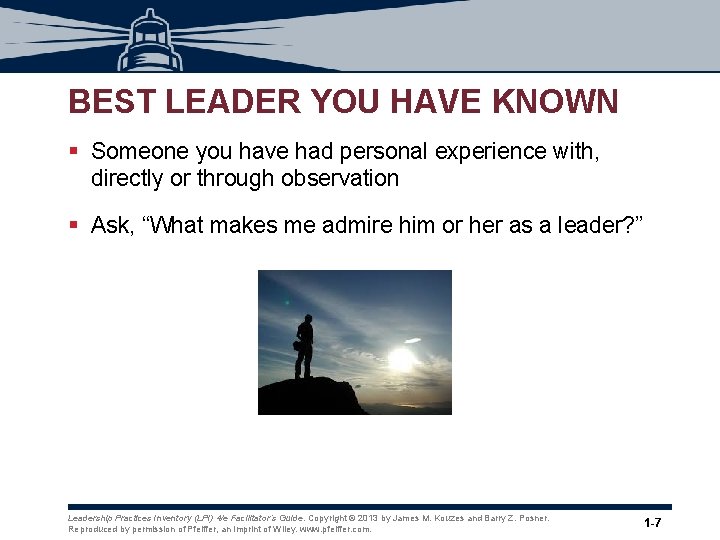
BEST LEADER YOU HAVE KNOWN § Someone you have had personal experience with, directly or through observation § Ask, “What makes me admire him or her as a leader? ” Leadership Practices Inventory (LPI) 4/e Facilitator’s Guide. Copyright © 2013 by James M. Kouzes and Barry Z. Posner. Reproduced by permission of Pfeiffer, an Imprint of Wiley. www. pfeiffer. com. 1 -7
Orienting Participants to The LPI (2. 1) Leadership Practices Inventory (LPI) 4/e Facilitator’s Guide. Copyright © 2013 by James M. Kouzes and Barry Z. Posner. Reproduced by permission of Pfeiffer, an Imprint of Wiley. www. pfeiffer. com.
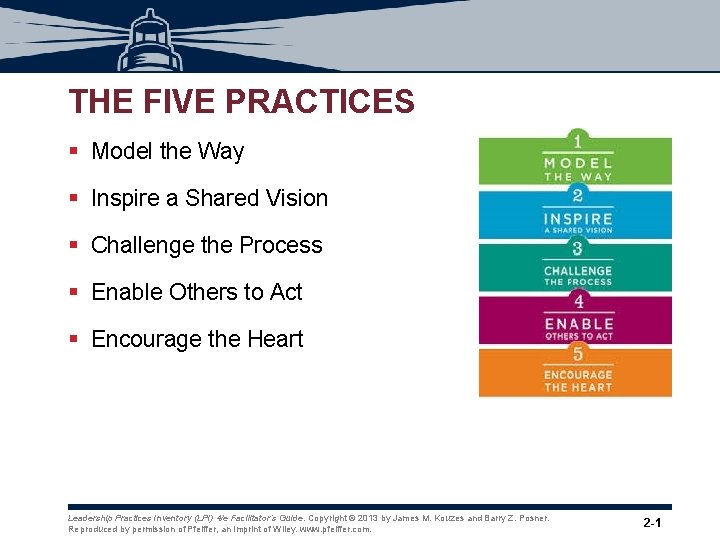
THE FIVE PRACTICES § Model the Way § Inspire a Shared Vision § Challenge the Process § Enable Others to Act § Encourage the Heart Leadership Practices Inventory (LPI) 4/e Facilitator’s Guide. Copyright © 2013 by James M. Kouzes and Barry Z. Posner. Reproduced by permission of Pfeiffer, an Imprint of Wiley. www. pfeiffer. com. 2 -1
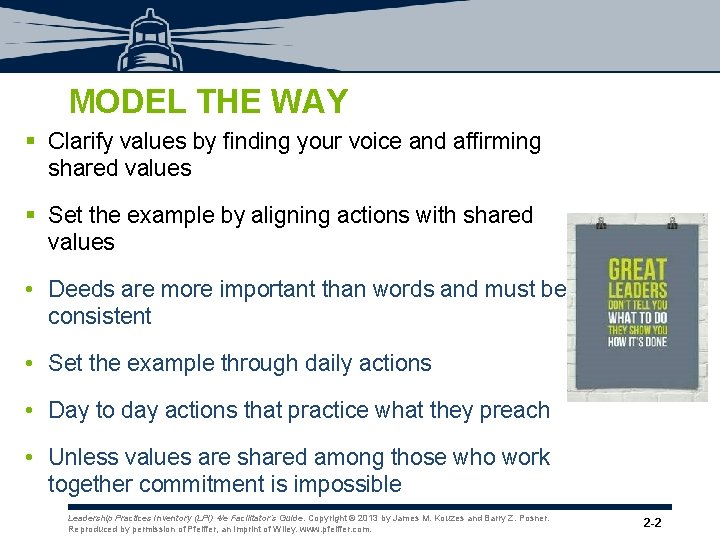
MODEL THE WAY § Clarify values by finding your voice and affirming shared values § Set the example by aligning actions with shared values • Deeds are more important than words and must be consistent • Set the example through daily actions • Day to day actions that practice what they preach • Unless values are shared among those who work together commitment is impossible Leadership Practices Inventory (LPI) 4/e Facilitator’s Guide. Copyright © 2013 by James M. Kouzes and Barry Z. Posner. Reproduced by permission of Pfeiffer, an Imprint of Wiley. www. pfeiffer. com. 2 -2
MODEL THE WAY CONTINUED… • Titles are granted- its your behavior that wins you respect • To model something you must believe in something, beliefs are something to stand up for • Your leadership commitment must be to clarify your values and finding your voice and expressing them in a style that is authentic and your OWN • Set the example: • Working side by side with colleagues • Telling stories that make the values come alive • Being visible Leadership Practices Inventory (LPI) 4/e Facilitator’s Guide. Copyright © 2013 by James M. Kouzes and Barry Z. Posner. Reproduced by permission of Pfeiffer, an Imprint of Wiley. www. pfeiffer. com.
MODEL THE WAY Modeling the way is essentially about earning the right and the respect to lead through direct individual involvement and action. People have to believe in the messenger or they wont pay attention to the message. They first follow the person, then the plan. Leadership Practices Inventory (LPI) 4/e Facilitator’s Guide. Copyright © 2013 by James M. Kouzes and Barry Z. Posner. Reproduced by permission of Pfeiffer, an Imprint of Wiley. www. pfeiffer. com.
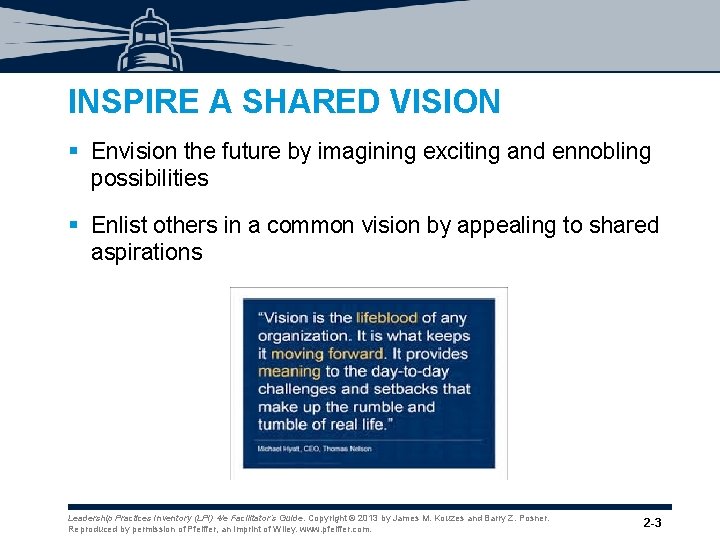
INSPIRE A SHARED VISION § Envision the future by imagining exciting and ennobling possibilities § Enlist others in a common vision by appealing to shared aspirations Leadership Practices Inventory (LPI) 4/e Facilitator’s Guide. Copyright © 2013 by James M. Kouzes and Barry Z. Posner. Reproduced by permission of Pfeiffer, an Imprint of Wiley. www. pfeiffer. com. 2 -3
INSPIRE A SHARED VISION CONTINUED… • Leaders have a desire to make things happen, to change how things are, create something no one else has ever created. • See a picture in your mind of what could be and results to look like • A vision seen only by the leader is insufficient • People do not follow until they accept a vision as their own • Leaders inspire commitment and do NOT command it Leadership Practices Inventory (LPI) 4/e Facilitator’s Guide. Copyright © 2013 by James M. Kouzes and Barry Z. Posner. Reproduced by permission of Pfeiffer, an Imprint of Wiley. www. pfeiffer. com.
INSPIRE A SHARED VISION CONTINUED… People must believe that their leaders understand their needs and have their interests at heart. Only through intimate knowledge of their dreams, hopes, aspirations, visions and values are you able to enlist support. You cannot ignite the flame of passion in others if you cannot express enthusiasm for the compelling vision of the group. Leadership Practices Inventory (LPI) 4/e Facilitator’s Guide. Copyright © 2013 by James M. Kouzes and Barry Z. Posner. Reproduced by permission of Pfeiffer, an Imprint of Wiley. www. pfeiffer. com.
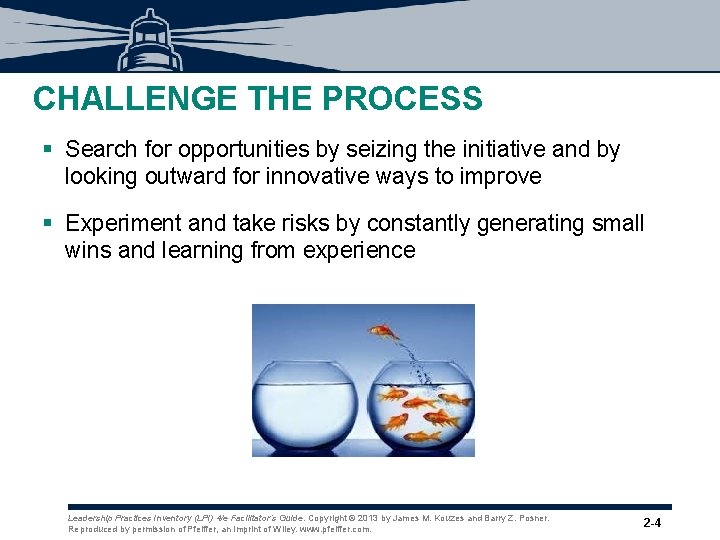
CHALLENGE THE PROCESS § Search for opportunities by seizing the initiative and by looking outward for innovative ways to improve § Experiment and take risks by constantly generating small wins and learning from experience Leadership Practices Inventory (LPI) 4/e Facilitator’s Guide. Copyright © 2013 by James M. Kouzes and Barry Z. Posner. Reproduced by permission of Pfeiffer, an Imprint of Wiley. www. pfeiffer. com. 2 -4
CHALLENGE THE PROCESS • Those who seek and lead other to greatness, seek and accept the challenge • Challenge can involve: • • Developing a new product Cutting edge service Shaping policy and legislation Change from the status quo • Your contribution is in the recognition of good ideas, support of those ideas and willingness to challenge the system • Build support incrementally strengthens commitment for the long term Leadership Practices Inventory (LPI) 4/e Facilitator’s Guide. Copyright © 2013 by James M. Kouzes and Barry Z. Posner. Reproduced by permission of Pfeiffer, an Imprint of Wiley. www. pfeiffer. com.
INSPIRE A SHARED VISION CONTINUED… Risk and experimentation is are always accompanied by mistakes and failure. The key that unlocks the door to opportunity is learning, Great leaders are great learners and must create climate in which people can learn from their failures as well as their successes. Leadership Practices Inventory (LPI) 4/e Facilitator’s Guide. Copyright © 2013 by James M. Kouzes and Barry Z. Posner. Reproduced by permission of Pfeiffer, an Imprint of Wiley. www. pfeiffer. com.
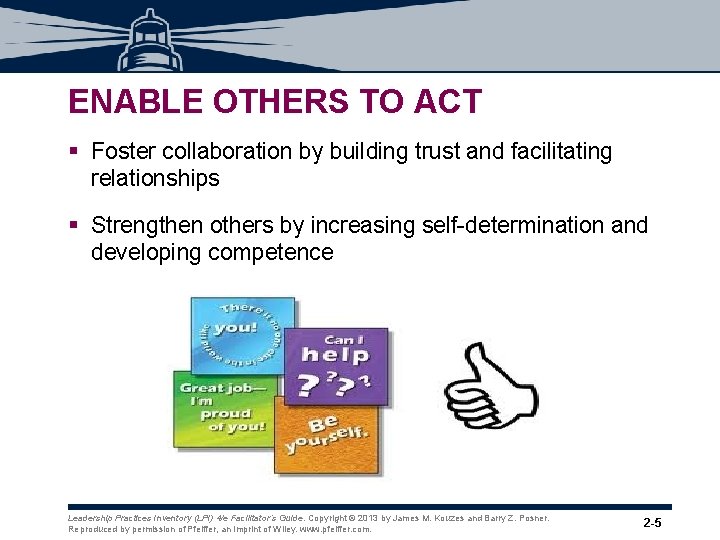
ENABLE OTHERS TO ACT § Foster collaboration by building trust and facilitating relationships § Strengthen others by increasing self-determination and developing competence Leadership Practices Inventory (LPI) 4/e Facilitator’s Guide. Copyright © 2013 by James M. Kouzes and Barry Z. Posner. Reproduced by permission of Pfeiffer, an Imprint of Wiley. www. pfeiffer. com. 2 -5
ENABLE OTHERS TO ACT CONTINUED… • Leadership is a team effort • Leaders get further ahead when the use the word “we” than “I” • Teamwork extends to peers, managers, customers all who have a stake in the vision • Must make it possible for others to do great work • Those expected to deliver results must feel a sense of personal ownership and power Leadership Practices Inventory (LPI) 4/e Facilitator’s Guide. Copyright © 2013 by James M. Kouzes and Barry Z. Posner. Reproduced by permission of Pfeiffer, an Imprint of Wiley. www. pfeiffer. com.
ENABLE OTHERS TO ACT CONTINUED… When you trust others and five them more discretion, authority and information they are much more likely to use their energies to produce extraordinary results. When you make someone feel strong and capable, that person will give all and exceed your own expectations. Leadership Practices Inventory (LPI) 4/e Facilitator’s Guide. Copyright © 2013 by James M. Kouzes and Barry Z. Posner. Reproduced by permission of Pfeiffer, an Imprint of Wiley. www. pfeiffer. com.
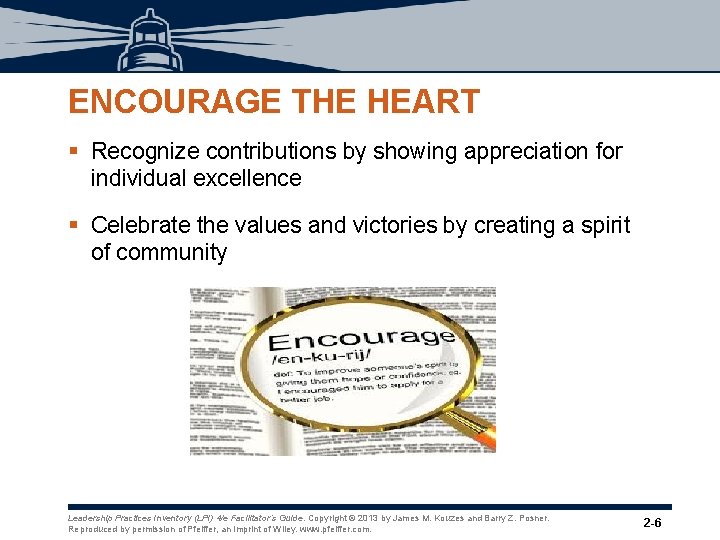
ENCOURAGE THE HEART § Recognize contributions by showing appreciation for individual excellence § Celebrate the values and victories by creating a spirit of community Leadership Practices Inventory (LPI) 4/e Facilitator’s Guide. Copyright © 2013 by James M. Kouzes and Barry Z. Posner. Reproduced by permission of Pfeiffer, an Imprint of Wiley. www. pfeiffer. com. 2 -6
ENCOURAGE THE HEART CONTINUED… • Leaders encourage the heart of their staff to carry on. • Genuine acts of caring uplift the spirits and draw people forward • Recognition can come from dramatic gestures or simple actions • Reward and recognition is how leaders visibly and behaviorally link rewards with performance. Leadership Practices Inventory (LPI) 4/e Facilitator’s Guide. Copyright © 2013 by James M. Kouzes and Barry Z. Posner. Reproduced by permission of Pfeiffer, an Imprint of Wiley. www. pfeiffer. com.
ENCOURAGE THE HEART CONTINUED… When striving to raise quality or make a dramatic change of any kind, leaders make sure people see the benefit of behavior that’s aligned with values, including reminders that success is a function of everyone’s efforts and achieved through working together as a team. Leadership Practices Inventory (LPI) 4/e Facilitator’s Guide. Copyright © 2013 by James M. Kouzes and Barry Z. Posner. Reproduced by permission of Pfeiffer, an Imprint of Wiley. www. pfeiffer. com.
LEADERS WHO USE LPI BEHAVIORS FREQUENTLY: § Create higher-performing teams. § Foster loyalty and organizational commitment. § Enhance motivation and willingness to work hard. § Reduce absenteeism, turnover, and dropouts. § Influence recruitment positively. § More successfully represent their units to management. § Facilitate high patient satisfaction and meet family member needs. Leadership Practices Inventory (LPI) 4/e Facilitator’s Guide. Copyright © 2013 by James M. Kouzes and Barry Z. Posner. Reproduced by permission of Pfeiffer, an Imprint of Wiley. www. pfeiffer. com. 2 -7
Understanding the LPI Feedback Report (3. 0) Leadership Practices Inventory (LPI) 4/e Facilitator’s Guide. Copyright © 2013 by James M. Kouzes and Barry Z. Posner. Reproduced by permission of Pfeiffer, an Imprint of Wiley. www. pfeiffer. com.
OBSERVER CATEGORIES § Self (S) § Manager (M) § Direct reports (D) § Co-workers (C) § Others (O) § For the purposes of my program I have only chosen to have you complete the LPI Self assessment. Leadership Practices Inventory (LPI) 4/e Facilitator’s Guide. Copyright © 2013 by James M. Kouzes and Barry Z. Posner. Reproduced by permission of Pfeiffer, an Imprint of Wiley. www. pfeiffer. com. 3 -1
30 behavioral statements 6 statements for each leadership practice Leadership Practices Inventory (LPI) 4/e Facilitator’s Guide. Copyright © 2013 by James M. Kouzes and Barry Z. Posner. Reproduced by permission of Pfeiffer, an Imprint of Wiley. www. pfeiffer. com. 3 -2
Leadership Practices Inventory (LPI) 4/e Facilitator’s Guide. Copyright © 2013 by James M. Kouzes and Barry Z. Posner. Reproduced by permission of Pfeiffer, an Imprint of Wiley. www. pfeiffer. com. 3 -3
REPORT CONTENTS § The Five Practices model § Summary of test results § Data Summary page—overview § Data Summary Page for each practice § Bar Graph pages § Leadership Behaviors Ranking page § Percentile Ranking page § Open-ended feedback Leadership Practices Inventory (LPI) 4/e Facilitator’s Guide. Copyright © 2013 by James M. Kouzes and Barry Z. Posner. Reproduced by permission of Pfeiffer, an Imprint of Wiley. www. pfeiffer. com. 3 -4
Leadership Practices Inventory (LPI) 4/e Facilitator’s Guide. Copyright © 2013 by James M. Kouzes and Barry Z. Posner. Reproduced by permission of Pfeiffer, an Imprint of Wiley. www. pfeiffer. com. 3 -8
Leadership Practices Inventory (LPI) 4/e Facilitator’s Guide. Copyright © 2013 by James M. Kouzes and Barry Z. Posner. Reproduced by permission of Pfeiffer, an Imprint of Wiley. www. pfeiffer. com. 3 -9
Leadership Practices Inventory (LPI) 4/e Facilitator’s Guide. Copyright © 2013 by James M. Kouzes and Barry Z. Posner. Reproduced by permission of Pfeiffer, an Imprint of Wiley. www. pfeiffer. com. 3 -12
Leadership Practices Inventory (LPI) 4/e Facilitator’s Guide. Copyright © 2013 by James M. Kouzes and Barry Z. Posner. Reproduced by permission of Pfeiffer, an Imprint of Wiley. www. pfeiffer. com. 3 -14
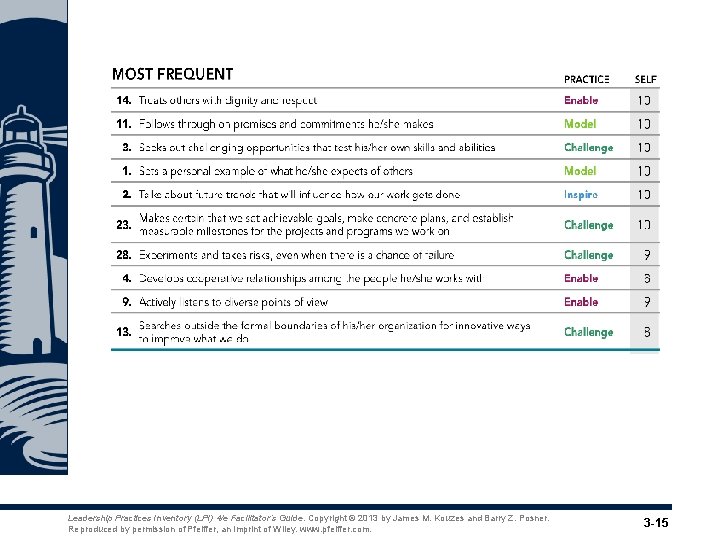
Leadership Practices Inventory (LPI) 4/e Facilitator’s Guide. Copyright © 2013 by James M. Kouzes and Barry Z. Posner. Reproduced by permission of Pfeiffer, an Imprint of Wiley. www. pfeiffer. com. 3 -15
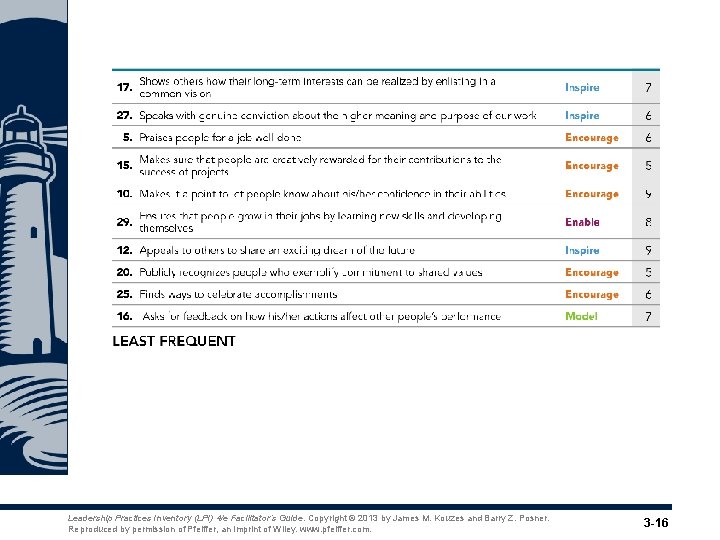
Leadership Practices Inventory (LPI) 4/e Facilitator’s Guide. Copyright © 2013 by James M. Kouzes and Barry Z. Posner. Reproduced by permission of Pfeiffer, an Imprint of Wiley. www. pfeiffer. com. 3 -16
Leadership Practices Inventory (LPI) 4/e Facilitator’s Guide. Copyright © 2013 by James M. Kouzes and Barry Z. Posner. Reproduced by permission of Pfeiffer, an Imprint of Wiley. www. pfeiffer. com. 3 -17
Leadership Practices Inventory (LPI) 4/e Facilitator’s Guide. Copyright © 2013 by James M. Kouzes and Barry Z. Posner. Reproduced by permission of Pfeiffer, an Imprint of Wiley. www. pfeiffer. com. 3 -18
SEGMENT 4 Analyzing Your LPI Feedback Leadership Practices Inventory (LPI) 4/e Facilitator’s Guide. Copyright © 2013 by James M. Kouzes and Barry Z. Posner. Reproduced by permission of Pfeiffer, an Imprint of Wiley. www. pfeiffer. com.
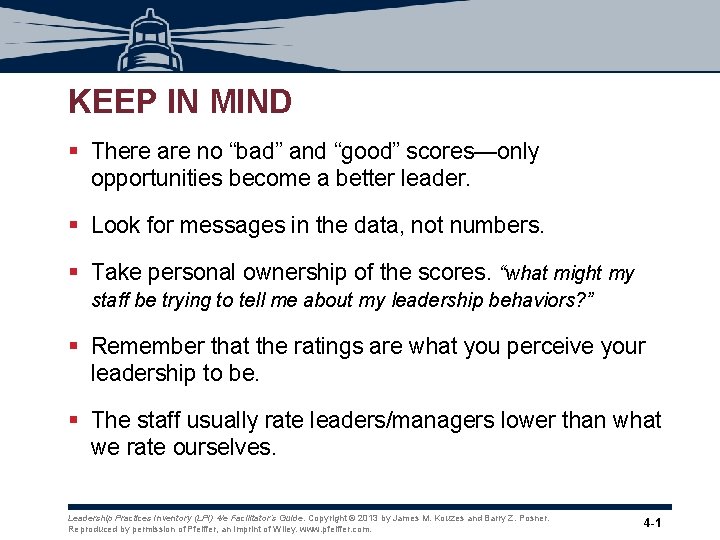
KEEP IN MIND § There are no “bad” and “good” scores—only opportunities become a better leader. § Look for messages in the data, not numbers. § Take personal ownership of the scores. “what might my staff be trying to tell me about my leadership behaviors? ” § Remember that the ratings are what you perceive your leadership to be. § The staff usually rate leaders/managers lower than what we rate ourselves. Leadership Practices Inventory (LPI) 4/e Facilitator’s Guide. Copyright © 2013 by James M. Kouzes and Barry Z. Posner. Reproduced by permission of Pfeiffer, an Imprint of Wiley. www. pfeiffer. com. 4 -1
ANALYZE YOUR FEEDBACK Workbook questions help you. . . § Explore consistency in the ratings—consistency helps build trust. § Identify patterns and messages that can help you focus your developmental efforts. Leadership Practices Inventory (LPI) 4/e Facilitator’s Guide. Copyright © 2013 by James M. Kouzes and Barry Z. Posner. Reproduced by permission of Pfeiffer, an Imprint of Wiley. www. pfeiffer. com. 4 -2
SEGMENT 5 Focusing Your Developmental Efforts Leadership Practices Inventory (LPI) 4/e Facilitator’s Guide. Copyright © 2013 by James M. Kouzes and Barry Z. Posner. Reproduced by permission of Pfeiffer, an Imprint of Wiley. www. pfeiffer. com.
USE WHAT YOU HAVE LEARNED 1. Identify your priorities and set specific goals. 2. Make an action plan. 3. Go public with your plan. 4. Determine how to obtain feedback and support. Leadership Practices Inventory (LPI) 4/e Facilitator’s Guide. Copyright © 2013 by James M. Kouzes and Barry Z. Posner. Reproduced by permission of Pfeiffer, an Imprint of Wiley. www. pfeiffer. com. 5 -1
WHEN SELECTING ACTIONS. . . § Take it one step at a time—small wins create the momentum for change. § Begin by acknowledging that you can be a better leader than you are today. § After this session, use the worksheet on page 21 as a tool for continuing to improve. Leadership Practices Inventory (LPI) 4/e Facilitator’s Guide. Copyright © 2013 by James M. Kouzes and Barry Z. Posner. Reproduced by permission of Pfeiffer, an Imprint of Wiley. www. pfeiffer. com. 5 -2
SHARE WITH YOUR COLLEAGUE. . . § Your two top priorities and why you chose them § Your goals, the benefits of achieving them, the actions you will take, and your timetable § The people who will provide feedback and support as you work Leadership Practices Inventory (LPI) 4/e Facilitator’s Guide. Copyright © 2013 by James M. Kouzes and Barry Z. Posner. Reproduced by permission of Pfeiffer, an Imprint of Wiley. www. pfeiffer. com. 5 -3
SEGMENT 6 What’s Next? Leadership Practices Inventory (LPI) 4/e Facilitator’s Guide. Copyright © 2013 by James M. Kouzes and Barry Z. Posner. Reproduced by permission of Pfeiffer, an Imprint of Wiley. www. pfeiffer. com.
PUT THE FIVE PRACTICES TO WORK § Model the Way by setting an example. § Inspire a Shared Vision by talking about your hopes and dreams. § Challenge the Process by discussing your leadership behavior. § Enable Others to Act by sharing the feedback. § Encourage the Heart by thanking people for the feedback. Leadership Practices Inventory (LPI) 4/e Facilitator’s Guide. Copyright © 2013 by James M. Kouzes and Barry Z. Posner. Reproduced by permission of Pfeiffer, an Imprint of Wiley. www. pfeiffer. com. 6 -1
NEXT STEPS Books The Leadership Challenge Mobile Tool Workbooks Leadership Practices Inventory (LPI) 4/e Facilitator’s Guide. Copyright © 2013 by James M. Kouzes and Barry Z. Posner. Reproduced by permission of Pfeiffer, an Imprint of Wiley. www. pfeiffer. com. 6 -4
Thank you—and keep learning! Leadership Practices Inventory (LPI) 4/e Facilitator’s Guide. Copyright © 2013 by James M. Kouzes and Barry Z. Posner. Reproduced by permission of Pfeiffer, an Imprint of Wiley. www. pfeiffer. com. 6 -5