
Leadership Pathway Coherence in Grades K 5 July


- Slides: 29
Leadership Pathway: Coherence in Grades K– 5 July 2016
COHERENCE IN GRADES K– 5 Coherence Session Objectives: • Participants will be able to describe the Coherence shift both as a logical sequencing of content across grades and as important connections among standards, clusters, and domains within the grade • Participants will be able to identify prerequisite standards for gradelevel standards • Participants will be able to observe and coach the Coherence shift in teacher practice Agenda: 1. Opening and Activator 1. Coherence: What and Why 1. Coherence Across Grades 1. Coherence Within the Grade 1. Observing for Coherence 1. Summary and Reflection
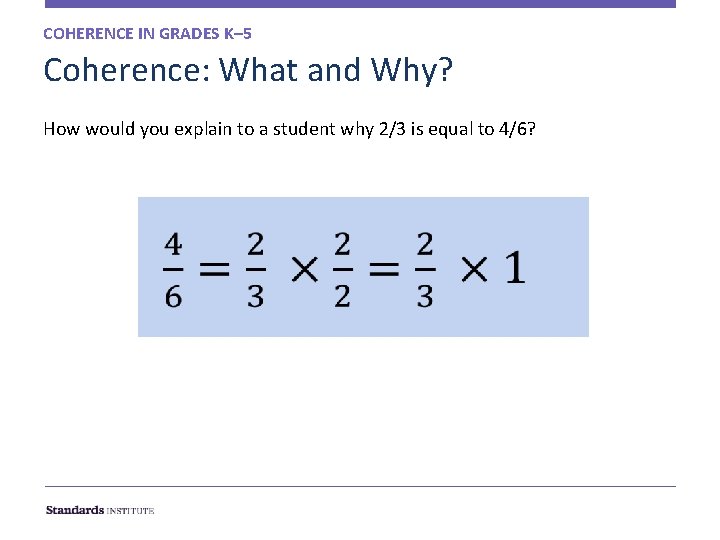
COHERENCE IN GRADES K– 5 Coherence: What and Why? How would you explain to a student why 2/3 is equal to 4/6?
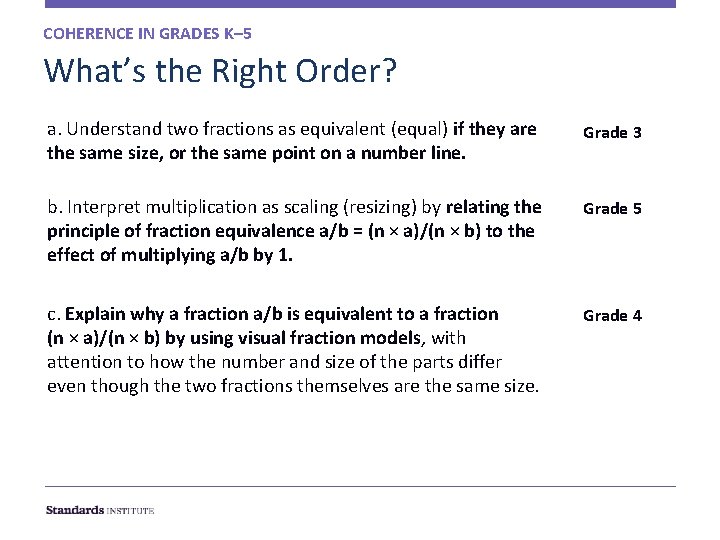
COHERENCE IN GRADES K– 5 What’s the Right Order? a. Understand two fractions as equivalent (equal) if they are the same size, or the same point on a number line. Grade 3 b. Interpret multiplication as scaling (resizing) by relating the principle of fraction equivalence a/b = (n × a)/(n × b) to the effect of multiplying a/b by 1. Grade 5 c. Explain why a fraction a/b is equivalent to a fraction (n × a)/(n × b) by using visual fraction models, with attention to how the number and size of the parts differ even though the two fractions themselves are the same size. Grade 4
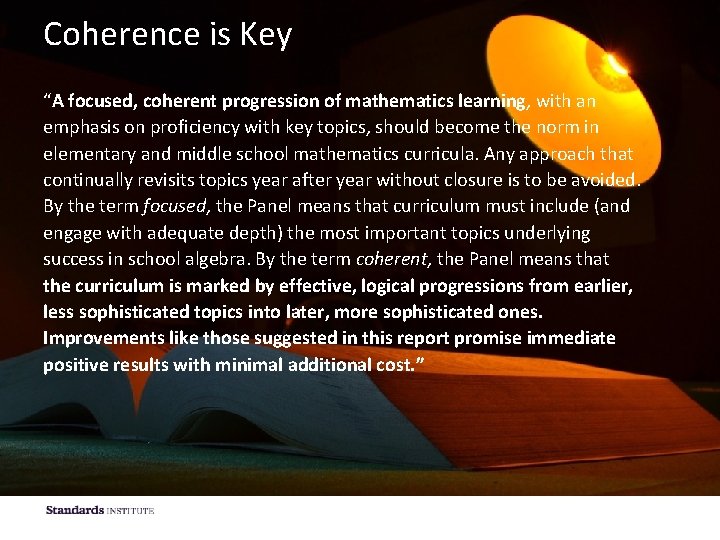
Coherence is Key “A focused, coherent progression of mathematics learning, with an emphasis on proficiency with key topics, should become the norm in elementary and middle school mathematics curricula. Any approach that continually revisits topics year after year without closure is to be avoided. By the term focused, the Panel means that curriculum must include (and engage with adequate depth) the most important topics underlying success in school algebra. By the term coherent, the Panel means that the curriculum is marked by effective, logical progressions from earlier, less sophisticated topics into later, more sophisticated ones. Improvements like those suggested in this report promise immediate positive results with minimal additional cost. ”
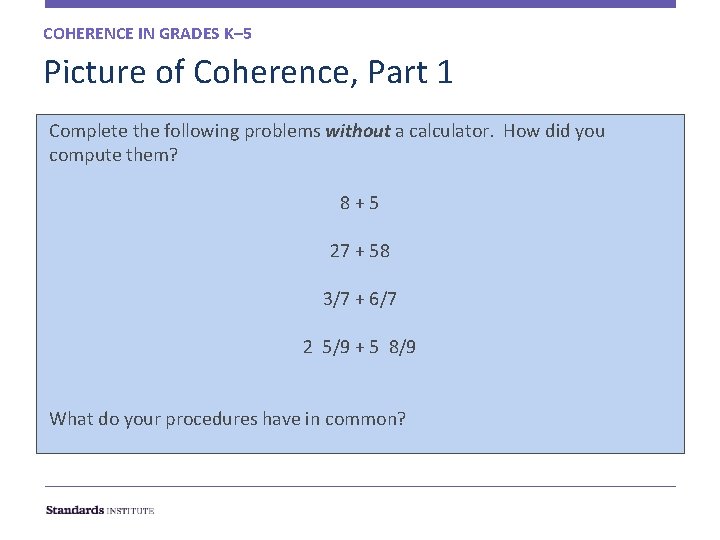
COHERENCE IN GRADES K– 5 Picture of Coherence, Part 1 Complete the following problems without a calculator. How did you compute them? 8+5 27 + 58 3/7 + 6/7 2 5/9 + 5 8/9 What do your procedures have in common?
LEADERSHIP PATHWAY: COHERENCE IN HIGH SCHOOL Coherence ACROSS Grades Learning is carefully connected across grades so that students can build new understanding onto foundations built in previous years. Across Grade Coherence Learning is carefully connected across grades so that students can build new understanding onto foundations built in previous years.
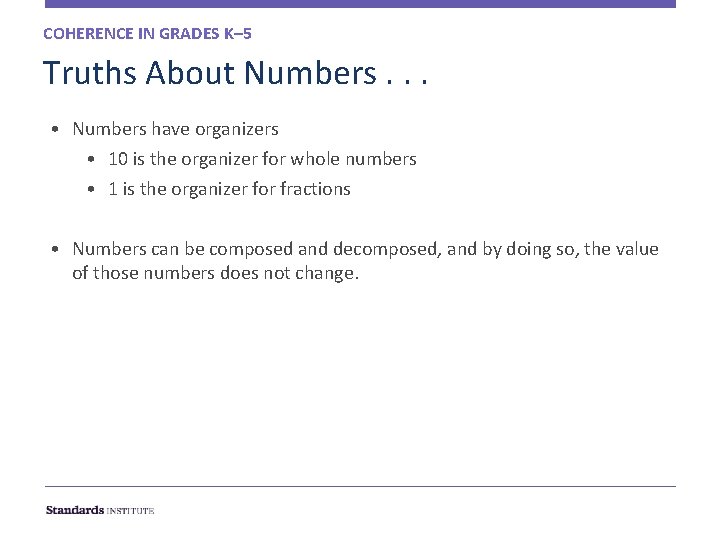
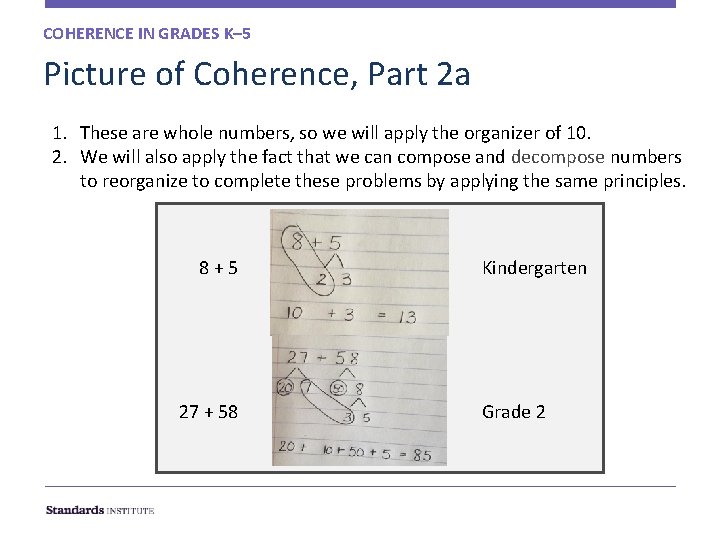
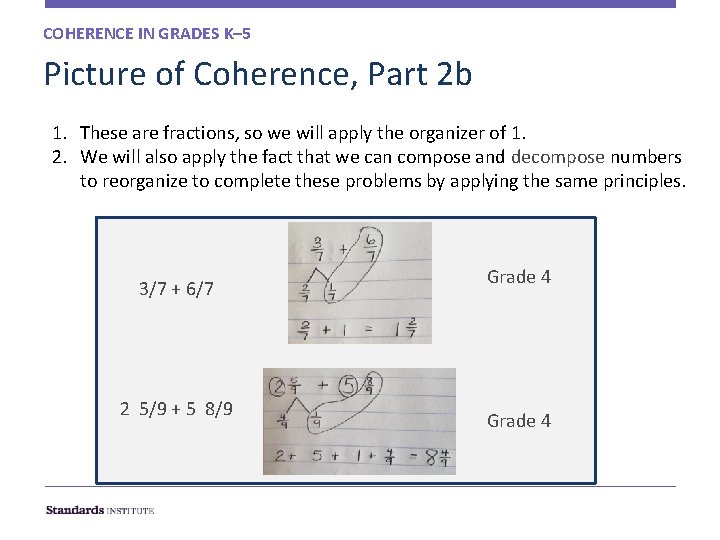
COHERENCE IN GRADES K– 5 Truths About Numbers. . . • Numbers have organizers • 10 is the organizer for whole numbers • 1 is the organizer for fractions • Numbers can be composed and decomposed, and by doing so, the value of those numbers does not change.
COHERENCE IN GRADES K– 5 Picture of Coherence, Part 2 a 1. These are whole numbers, so we will apply the organizer of 10. 2. We will also apply the fact that we can compose and decompose numbers to reorganize to complete these problems by applying the same principles. 8+5 27 + 58 Kindergarten Grade 2
COHERENCE IN GRADES K– 5 Picture of Coherence, Part 2 b 1. These are fractions, so we will apply the organizer of 1. 2. We will also apply the fact that we can compose and decompose numbers to reorganize to complete these problems by applying the same principles. 3/7 + 6/7 2 5/9 + 5 8/9 Grade 4
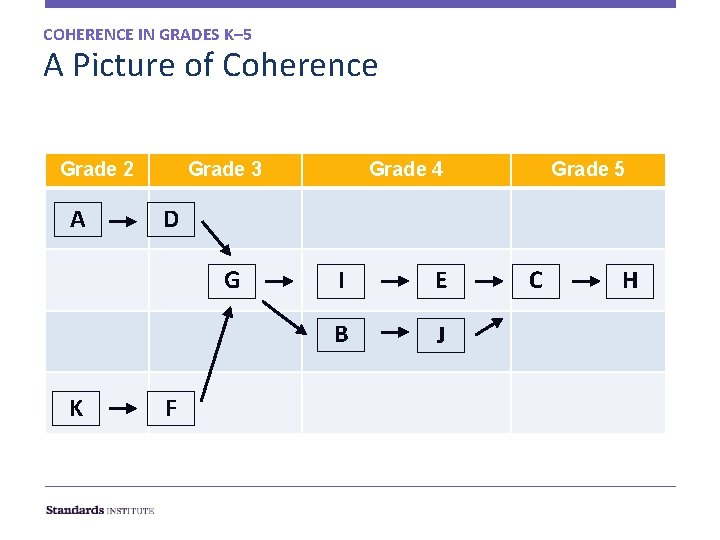
COHERENCE IN GRADES K– 5 Vertical Coherence Challenge • In your groups, you have eleven standards on pieces of paper. Most standards come from the Number and Operations-Fractions domains in Grades 3– 5. • The standards are not labeled! • Determine which standards are prerequisites for other standards. • Note: There is more than one vertical strand. • Bonus: Can you determine which standards belong in which grade?
COHERENCE IN GRADES K– 5 A Picture of Coherence Grade 2 A Grade 3 Grade 5 D G K Grade 4 F I E B J C H
COHERENCE IN GRADES K– 5
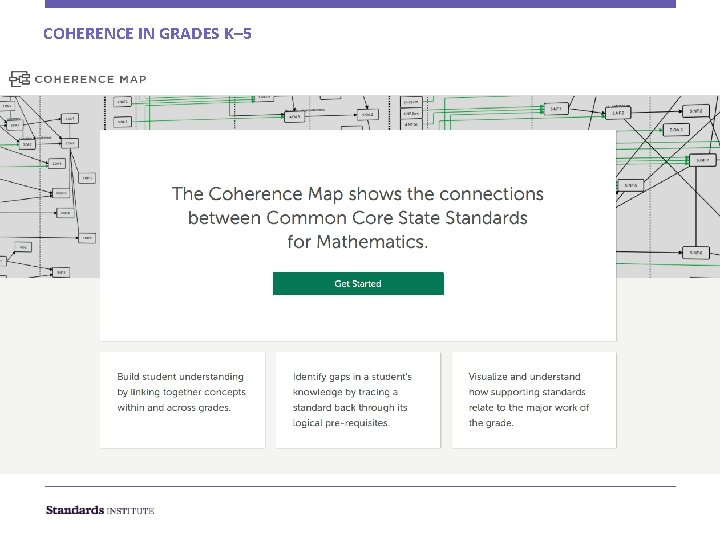
COHERENCE IN GRADES K– 5 Coherence Map 1. Go to http: //achievethecore. org/coherencemap/ 1. Click on 1. Choose a grade level to map out the Operations and Algebraic Thinking (OA) Domain. Use the map to check the accuracy of your Vertical Progression Challenge. 1. Revise as needed. Note which standards belong in which grade.
Table Talk What are the implications of Coherence for students who are struggling mathematically in your schools?
Within Grade Coherence is also built into the standards in how they reinforce a major topic in a grade by utilizing supporting, complementary topics.
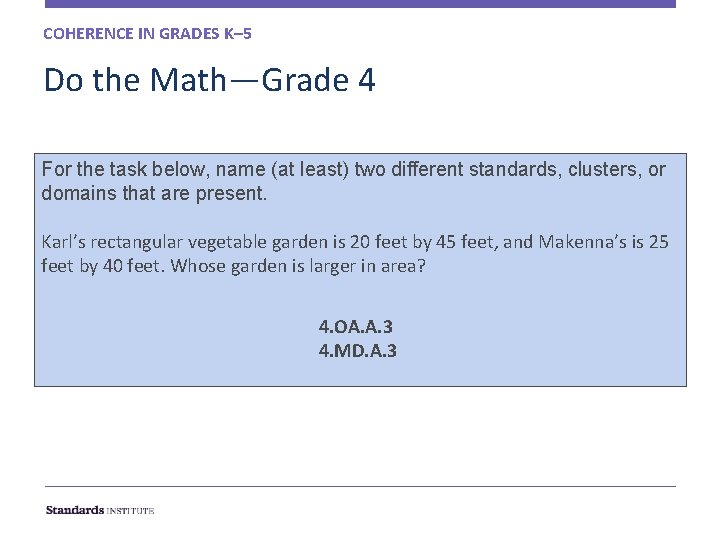
COHERENCE IN GRADES K– 5 Do the Math—Grade 4 For the task below, name (at least) two different standards, clusters, or domains that are present. Karl’s rectangular vegetable garden is 20 feet by 45 feet, and Makenna’s is 25 feet by 40 feet. Whose garden is larger in area? 4. OA. A. 3 4. MD. A. 3
Observing for Coherence 18
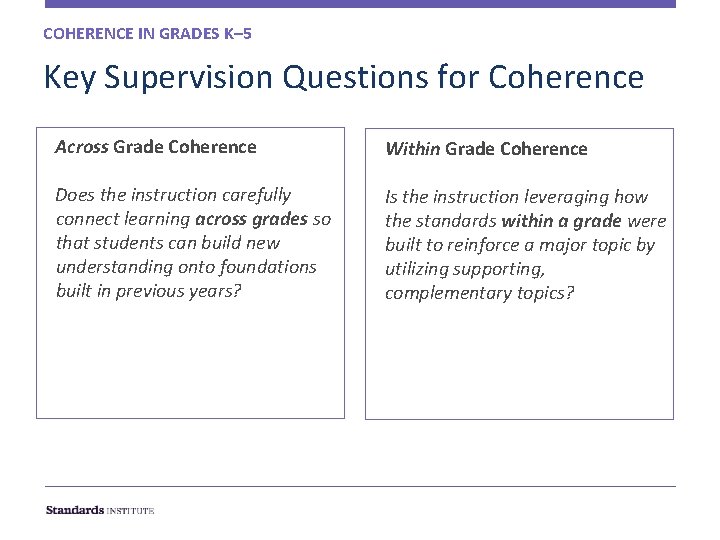
COHERENCE IN GRADES K– 5 Key Supervision Questions for Coherence Across Grade Coherence Within Grade Coherence Does the instruction carefully connect learning across grades so that students can build new understanding onto foundations built in previous years? Is the instruction leveraging how the standards within a grade were built to reinforce a major topic by utilizing supporting, complementary topics?
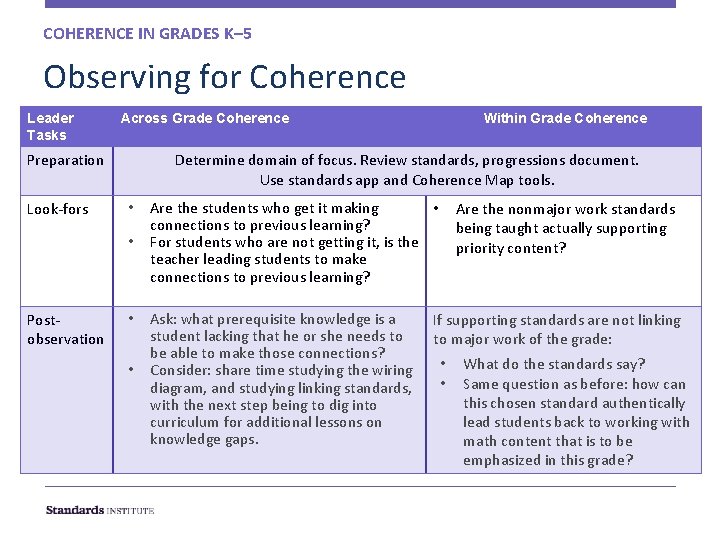
COHERENCE IN GRADES K– 5 Observing for Coherence Leader Tasks Across Grade Coherence Preparation Look-fors Determine domain of focus. Review standards, progressions document. Use standards app and Coherence Map tools. • • Postobservation Within Grade Coherence • • Are the students who get it making • connections to previous learning? For students who are not getting it, is the teacher leading students to make connections to previous learning? Ask: what prerequisite knowledge is a student lacking that he or she needs to be able to make those connections? Consider: share time studying the wiring diagram, and studying linking standards, with the next step being to dig into curriculum for additional lessons on knowledge gaps. Are the nonmajor work standards being taught actually supporting priority content? If supporting standards are not linking to major work of the grade: • • What do the standards say? Same question as before: how can this chosen standard authentically lead students back to working with math content that is to be emphasized in this grade?
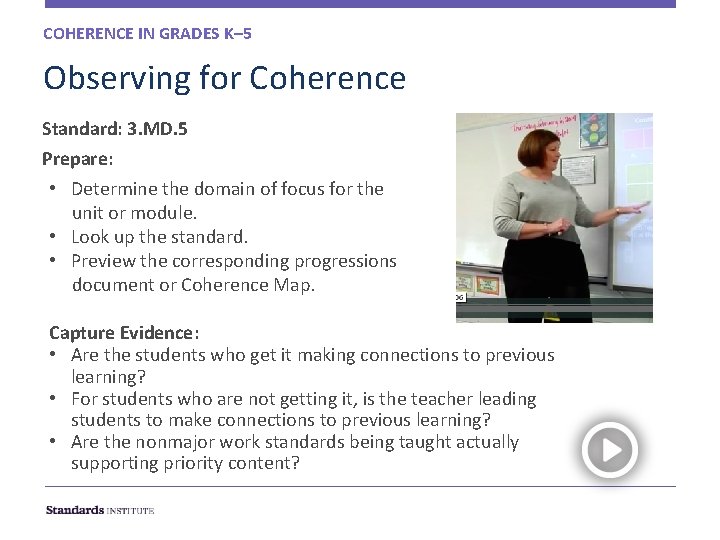
COHERENCE IN GRADES K– 5 Observing for Coherence Standard: 3. MD. 5 Prepare: • Determine the domain of focus for the unit or module. • Look up the standard. • Preview the corresponding progressions document or Coherence Map. Capture Evidence: • Are the students who get it making connections to previous learning? • For students who are not getting it, is the teacher leading students to make connections to previous learning? • Are the nonmajor work standards being taught actually supporting priority content?
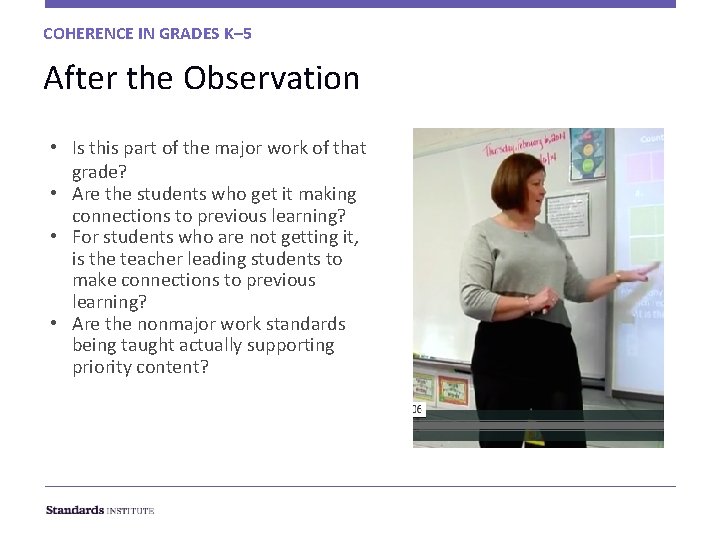
COHERENCE IN GRADES K– 5 After the Observation • Is this part of the major work of that grade? • Are the students who get it making connections to previous learning? • For students who are not getting it, is the teacher leading students to make connections to previous learning? • Are the nonmajor work standards being taught actually supporting priority content?
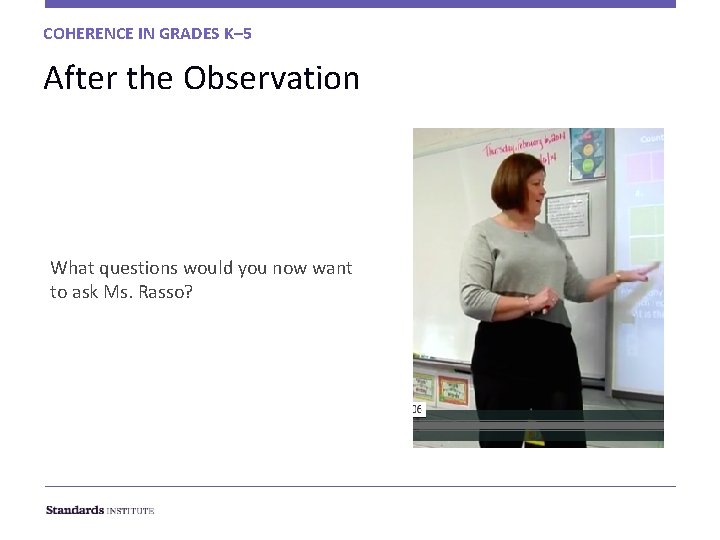
COHERENCE IN GRADES K– 5 After the Observation What questions would you now want to ask Ms. Rasso?
COHERENCE IN GRADES K– 5 Questions that Develop Leading the Conversation • Are the students who get it making connections to previous learning? • For students who are not getting it, is the teacher leading students to make connections to previous learning? • Are the nonmajor work standards being taught actually supporting priority content? If students are still not making connections: • Ask: what prerequisite knowledge is a student lacking that he or she needs to to be able to make those connections? • Consider: share time studying the wiring diagram, and studying linking standards, with the next step being to dig into curriculum for additional lessons on knowledge gaps. If supporting standards are not linking to major work of the grade: • What do the standards say? • Same question as before: how can this chosen standard authentically lead students back to working with math content that is to emphasized in this grade?
COHERENCE IN GRADES K– 5 Reflection: Coherence What is the state of Coherence in curriculum, planning, and professional development in your school or the schools you support? Curriculum • Does your curriculum identify the prerequisite skills needed for a unit or lesson? • Is across grade Coherence evident, helping students deepen understanding by making links between domains and clusters? Planning • Is Coherence a regular consideration in teacher and team lesson planning? How and when are prerequisite skills addressed when students are below grade level? Professional Development • What professional development has occurred for teachers? Do they know Coherence well enough to effectively include it in planning and instruction?
26
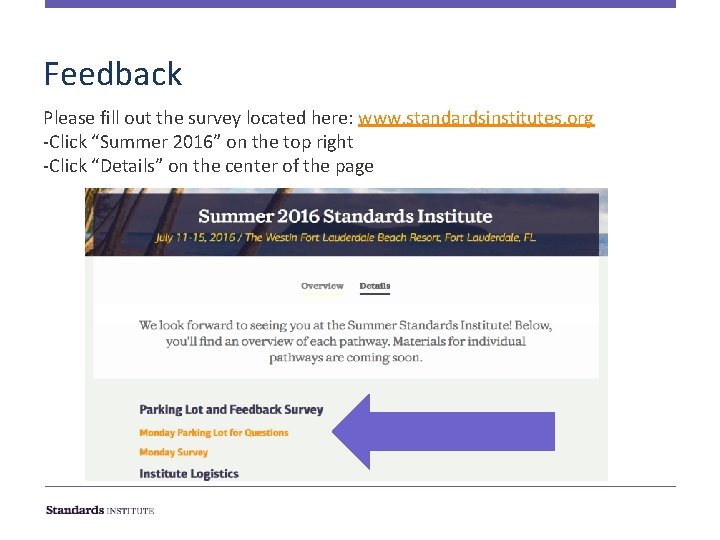
Feedback Please fill out the survey located here: www. standardsinstitutes. org -Click “Summer 2016” on the top right -Click “Details” on the center of the page
COHERENCE IN GRADES K– 5 References Slide Source 5 http: //www 2. ed. gov/about/bdscomm/list/mathpanel/report/final-report. pdf 13 http: //achievethecore. org/coherence-map/ 17 https: //www. illustrativemathematics. org 21 -23 https: //www. engageny. org/resource/grade-3 -math-using-tiles-determine-area
COHERENCE IN GRADES K– 5 Image Credits Slide 5: https: //pixabay. com/en/book-open-book-lamp-light-707387/ Slide 7, 15: https: //pixabay. com/en/torre-cajasol-spain-seville-786180/ Slide 16: https: //farm 7. staticflickr. com/6075/6117433883_de 7 d 1 b 919 d_b. jpg Slide 26: https: //pixabay. com/en/be-behold-being-hands-holding-1362324/