
Leadership ORGANIZATIONAL PSYCHOLOGY LECTURE 9 JOLANTA BABIAK Leadership
Leadership ORGANIZATIONAL PSYCHOLOGY LECTURE 9 JOLANTA BABIAK
Leadership and individual differences Earliest conceptions of leadership focused on individual differences There are critics of trait theories theoretical perspectives that underlie trait approach: evolutionary psychology, behavioral genetics and socioanalytic theory
Leadership and individual differences 1. 2. 3. Evolutionary psychology a) beneficial effects of a trait may change when the context changes b) Traits rarely have pure advantage or disadvantage even at one context at a single point in time c) Effect of traits on leadership outcomes are nonlinear Behavioral genetics a) everything is heritable b) genes cause people to select themselves into different environments c) genes interact with the environment Socioanalytic theory: getting along (communion) and getting ahead (agency) a) People always work in groups b) Groups are always structured in terms of status hierarchies
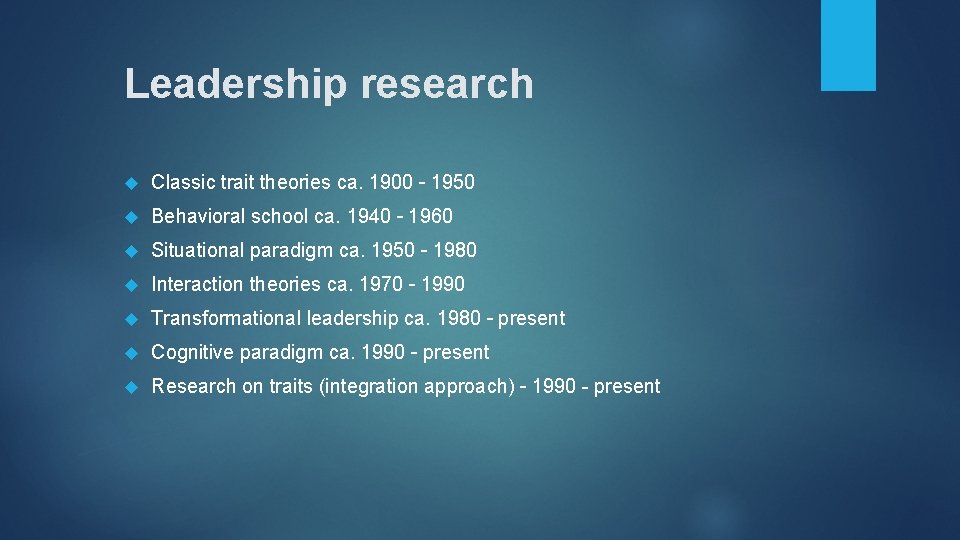
Leadership research Classic trait theories ca. 1900 – 1950 Behavioral school ca. 1940 – 1960 Situational paradigm ca. 1950 – 1980 Interaction theories ca. 1970 – 1990 Transformational leadership ca. 1980 – present Cognitive paradigm ca. 1990 – present Research on traits (integration approach) – 1990 - present

Leadership styles – main research on behavioral profiles Consideration – initiation of structure Employee centered – production centered Directive – participative Relations oriented – task oriented Transformational – transactional Ethical, submissive, moral leadership Charismatic
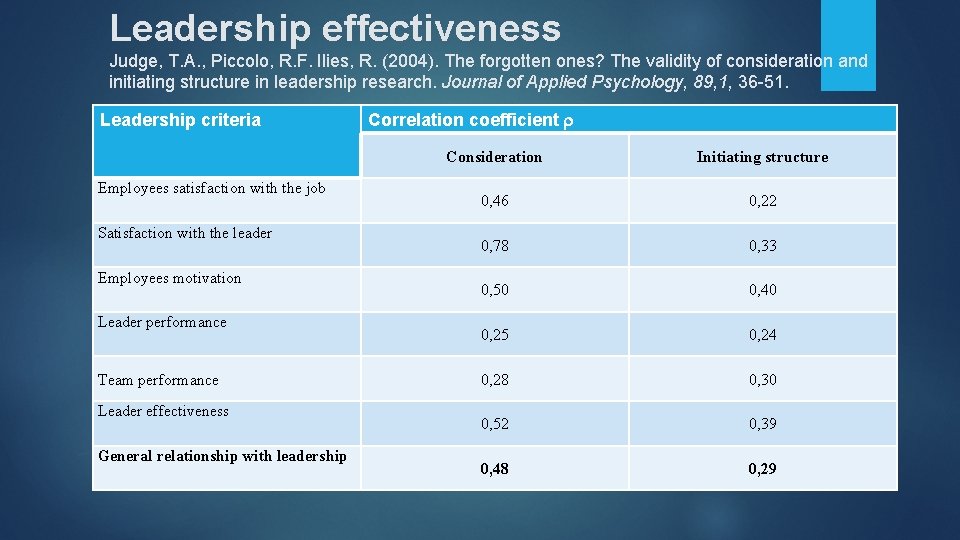
Leadership effectiveness Judge, T. A. , Piccolo, R. F. Ilies, R. (2004). The forgotten ones? The validity of consideration and initiating structure in leadership research. Journal of Applied Psychology, 89, 1, 36 -51. Leadership criteria Employees satisfaction with the job Satisfaction with the leader Employees motivation Leader performance Team performance Leader effectiveness General relationship with leadership Correlation coefficient Consideration Initiating structure 0, 46 0, 22 0, 78 0, 33 0, 50 0, 40 0, 25 0, 24 0, 28 0, 30 0, 52 0, 39 0, 48 0, 29
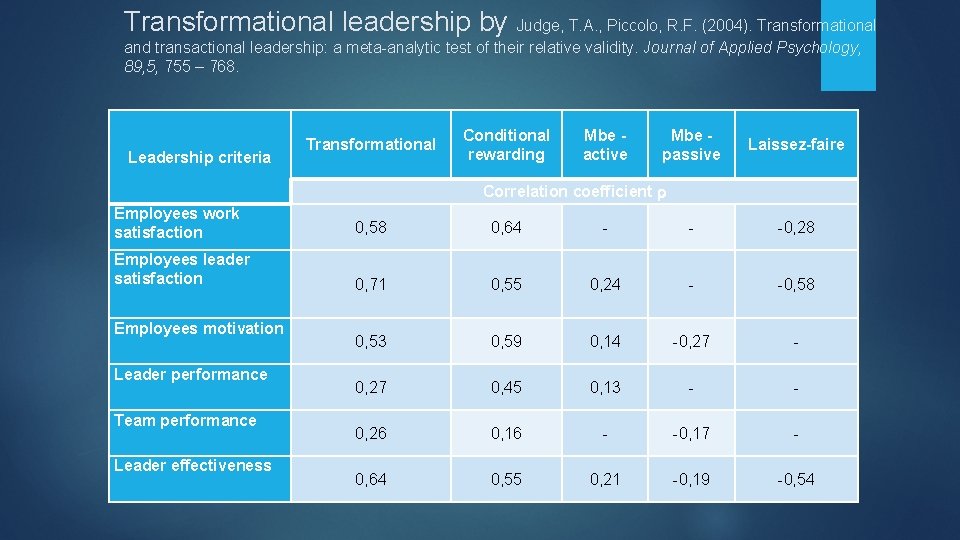
Transformational leadership by Judge, T. A. , Piccolo, R. F. (2004). Transformational and transactional leadership: a meta-analytic test of their relative validity. Journal of Applied Psychology, 89, 5, 755 – 768. Leadership criteria Transformational Conditional rewarding Mbe active Mbe passive Laissez-faire Correlation coefficient Employees work satisfaction 0, 58 0, 64 - - -0, 28 Employees leader satisfaction 0, 71 0, 55 0, 24 - -0, 58 0, 53 0, 59 0, 14 -0, 27 - 0, 27 0, 45 0, 13 - - 0, 26 0, 16 - -0, 17 - 0, 64 0, 55 0, 21 -0, 19 -0, 54 Employees motivation Leader performance Team performance Leader effectiveness

Summary of classical leadership reasearch results Throughout almost 50 years Rensis Likert and his colleagues have conducted ca. 500 reasearch studies on a sample of 20 thousand managers and 200 thousand employees The results of these studies show that democratic system of leading people influences in a positive way many of the indicators for efficiency, effectiveness and followers work One of the important examples is that democratic system of leading in the long run produces lower employment costs
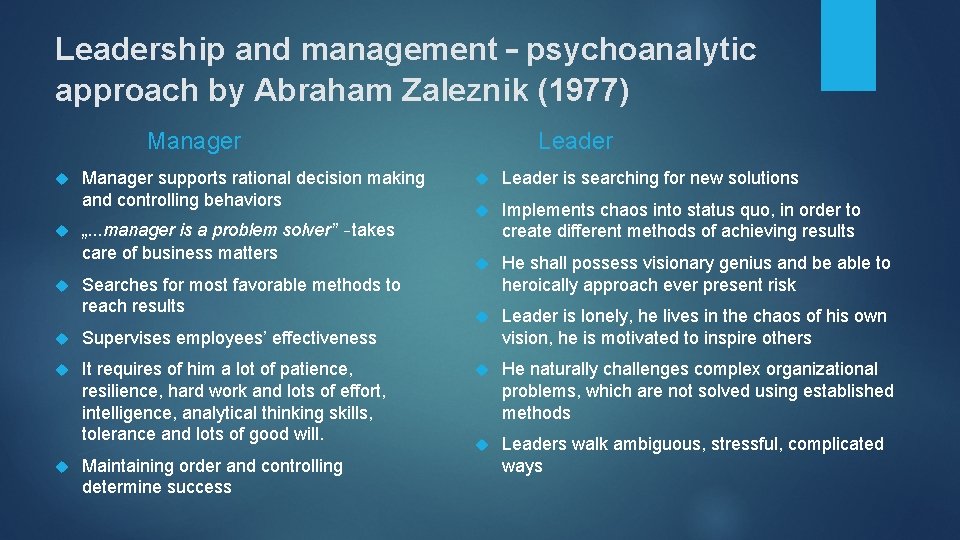
Leadership and management – psychoanalytic approach by Abraham Zaleznik (1977) Manager supports rational decision making and controlling behaviors „. . . manager is a problem solver” – takes care of business matters Searches for most favorable methods to reach results Supervises employees’ effectiveness It requires of him a lot of patience, resilience, hard work and lots of effort, intelligence, analytical thinking skills, tolerance and lots of good will. Maintaining order and controlling determine success Leader is searching for new solutions Implements chaos into status quo, in order to create different methods of achieving results He shall possess visionary genius and be able to heroically approach ever present risk Leader is lonely, he lives in the chaos of his own vision, he is motivated to inspire others He naturally challenges complex organizational problems, which are not solved using established methods Leaders walk ambiguous, stressful, complicated ways
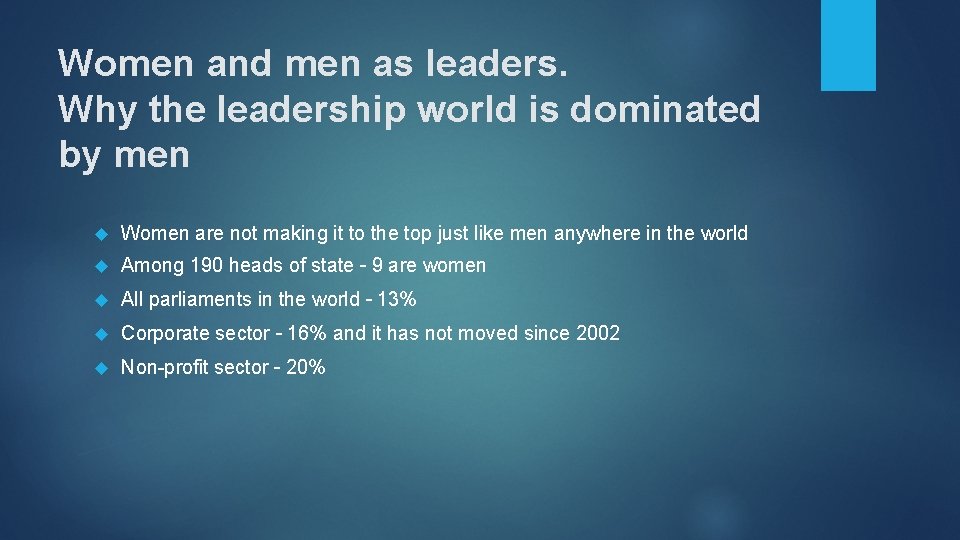
Women and men as leaders. Why the leadership world is dominated by men Women are not making it to the top just like men anywhere in the world Among 190 heads of state – 9 are women All parliaments in the world – 13% Corporate sector – 16% and it has not moved since 2002 Non-profit sector – 20%
Why? Women face harder choices between professional life and personal fulfillment Women are implicitly (subconsciously) perceived rather as followers/subordinates not bosses/leaders Women are perceived as more emotional and not well suited for top managerial positions Women are expected to be satisfied with lower positions Women need to work a lot harder to prove their usefulness as top managers and leaders Glass ceiling and glass cliff phenomenon
How do we change this? We put more pressure on boys to succeed than we do on girls Success and likeability is positively correlated for men and negatively for women Men mostly attribute success to their own abilities, women attribute success to external factors Women need to estimate their abilities realistically (they rather underestimate them) Women do not negotiate their rights They rather sit at the corner of the table “Don’t leave before you leave”
Can leadership be destructive? Tyrannical leadership – displaying pro-organizational behavior combined with anti-subordinate behavior. Such leaders may behave in accordance with the legitimate goals, tasks and strategies of the organization. They obtain results at the expense of subordinates. Tyrannical leaders may humiliate, ignore and manipulate their subordinates to get the job done. Supportive-disloyal leadership consists of pro-subordinate behavior combined with anti-organizational behavior; examples: give more benefits to the employees than they are entitled to, support unethical behavior, lead subordinates to be inefficient, distract them from work, encourage subordinates to enrich themselves by fraudulent behavior Derailed leadership is about displaying both the anti-organizational and anti-subordinates behavior. Such leaders may bully, manipulate, deceive and be often absent and/or steal resources from the organizations.
Destructive leadership Passive destructive leadership behavior – passive/indirect aggression, abdication from leading actively (laisses-faire), avoiding decision making, show little concern for goal attainment, lack of consideration towards people Narcissistic leadership – such leaders possess talent for selfpresentation, ability to create favorable impressions, they look for recognition, feel entitled and exempted from social demands; control and manipulate others, are intolerant to criticism and exploit others for self benefit Machiavellian leadership – manipulative, unethical, exploitative, exerting pressure, humiliating others, controlling and exposing power
Good leaders should make us feel safe Sense of trust and cooperation make people sacrifice their own good for others – military environment In the early days of human evolution we needed to entrust our lives to others because we were surrounded by dangers We created tribes – communities – whose members cooperated and trusted each other for the benefit of all Circle of safety – when we feel safe amongst our own there is natural trust and cooperation Good system of survival
Good leaders should make us feel safe Contemporary world is full of dangers too Dangers frustrate us and reduce our opportunity for success Thee could be any forces: technology economic conditions, competition – we have no control over these forces The only variable that is consistent in this changing, frustrating environment is good leadership If the leader puts the safety of his followers first – it sets the tone for the external factors Then they either influence us or NOT It is a social contract – (big bankers violated it)
Good leaders should make us feel safe Next Jump – NY tech company – lifetime employment Midwest Manufacturing company – needed to save $10 mln: 4 weeks of unpaid vacation – it is better that we suffer all a little bit than some of us a lot
Emotional leadership Leading at the level of emotions, through emotions – the best leaders do that naturally The channel through which leaders speak to their employees is relational – emotional There are certain brain centers involved in this relational connection There is emotional contagion that occurs between leader and his followers
Social brain: neuroscientific discovery of the last decade Social circuitry in the brain Mirror neurons – get activated when we look at other people, what they’re doing, even when we’re on the phone This social brain makes emotions contagious If the leader is in the upbeat mood the teams mood goes up and performance raises If leaders are attuned to their employees they have positive influence on business results
Emotional contagion If the emotional contagion occurs it means to great extent that leaders have to be in a good mood themselves That means that leaders have to start by managing themselves – they have to lead themselves first a leader shall understand he must start with managing himself (largely because it has effect on everybody else) – self-regulation, self-control 1. Notice 2. Pause and reflect upon it: is it useful or is it not useful 3. Is there something I can do to change my mood There is a strong correlation between the mood states of a leader, a group performance and a bottom line
Bibliography 1. Bass, B. M. , Bass, R. (2008). The Bass handbook of leadership. Theory, research and managerial applications. New York: The Free Press. 2. Day, D. D. , Zaccaro, S. J. (2007). Leadership: a critical historical analysis of the influence of leader traits , [w: ] L. , L. Koppes, P. W. Thyer, A. J. Vinchur, E. Salas (red. ) Historical perspectives in industrial and organizational psychology. Mahwah: Lawrence Erlbaum Associates, Inc. 3. Judge, T. A. , Piccolo, R. F. Ilies, R. (2004). The forgotten ones? The validity of consideration and initiating structure in leadership research. Journal of Applied Psychology, 89, 1, 36 -51. 4. Judge, T. A. , Piccolo, R. F. (2004). Transformational and transactional leadership: a meta-analytic test of their relative validity. Journal of Applied Psychology, 89, 5, 755 – 768. 5. Zaleznik, A. (1977). Managers and Leaders. Are they different? Harvard Business Review, 55, 5, 67 -78. 6. Why good leaders make you feel safe by Simon Sinek https: //www. ted. com/talks/simon_sinek_why_good_leaders_make_you_feel_safe? utm_source=tedcomshare&utm _medium=email&utm_campaign=tedspread 7. Why we have too few women leaders: Sheryl Sandberg https: //www. ted. com/talks/sheryl_sandberg_why_we_have_too_few_women_leaders? utm_source=tedcomshare& utm_medium=email&utm_campaign=tedspread Cherniss, C. , Goleman, D. : The emotionally intelligent workplace. How to select for, measure, and improve emotional intelligence in individuals, groups, and organizations. Jossey-Bass, San Francisco 2001. Goleman, D. , Boyatzis, R. E. , Mc. Kee, A. : The New Leaders: Transforming the Art of Leadership into the Science of Results. Little, Brown, London, 2002.
- Slides: 21