
Leadership Models and Concepts Learning Objectives Explain the
Leadership Models and Concepts
Learning Objectives • Explain the meaning of “leadership” and differentiate it from management. • Summarize the trait and behavioral approaches to leadership. • Describe the LPC theory of leadership. • Explain the path-goal theory of leadership. • Describe the Vroom-Yetton-Jago model of leadership.
Learning Objectives • Summarize the leader-member exchange theory and the Hersey and Blanchard model.
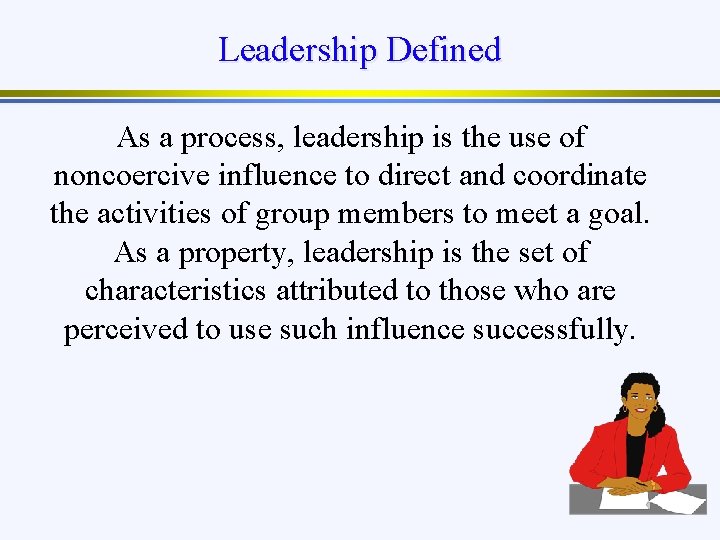
Leadership Defined As a process, leadership is the use of noncoercive influence to direct and coordinate the activities of group members to meet a goal. As a property, leadership is the set of characteristics attributed to those who are perceived to use such influence successfully.
The Importance of Leadership From an organizational viewpoint, leadership is vital because it has such a powerful influence on individual and group behavior.
Leadership versus Management • Leadership and management are related, but they are not the same. • Organizations need both management and leadership if they are to be effective.
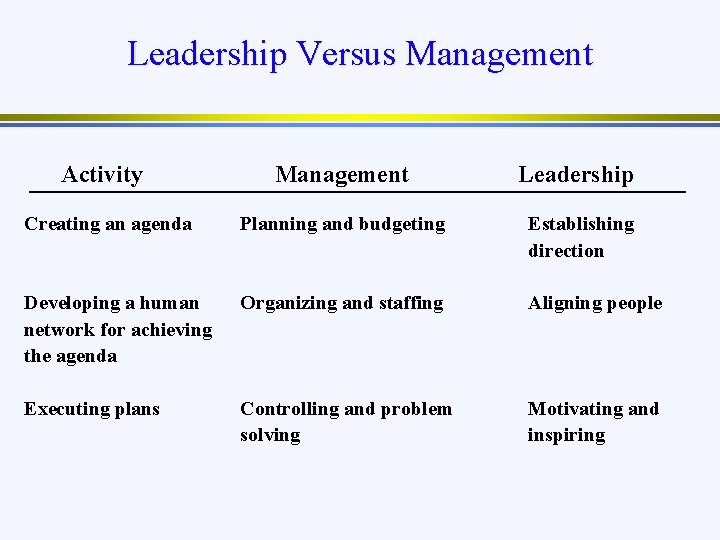
Leadership Versus Management Activity Management Leadership Creating an agenda Planning and budgeting Establishing direction Developing a human network for achieving the agenda Organizing and staffing Aligning people Executing plans Controlling and problem solving Motivating and inspiring
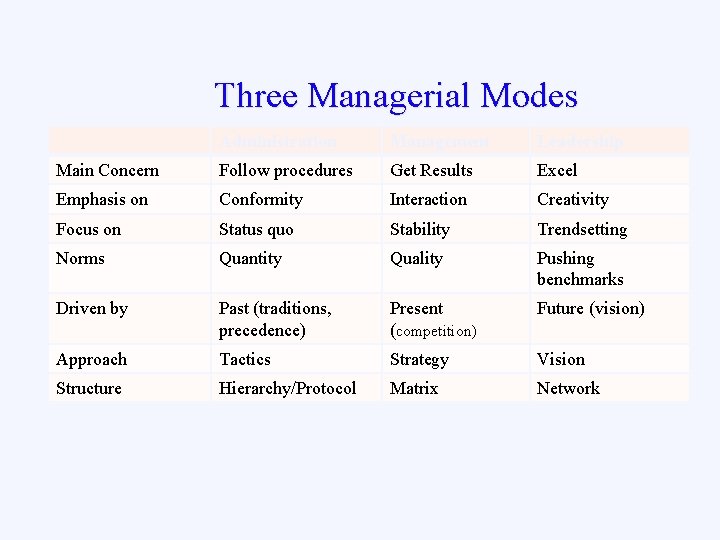
Three Managerial Modes Administration Management Leadership Main Concern Follow procedures Get Results Excel Emphasis on Conformity Interaction Creativity Focus on Status quo Stability Trendsetting Norms Quantity Quality Pushing benchmarks Driven by Past (traditions, precedence) Present (competition) Future (vision) Approach Tactics Strategy Vision Structure Hierarchy/Protocol Matrix Network
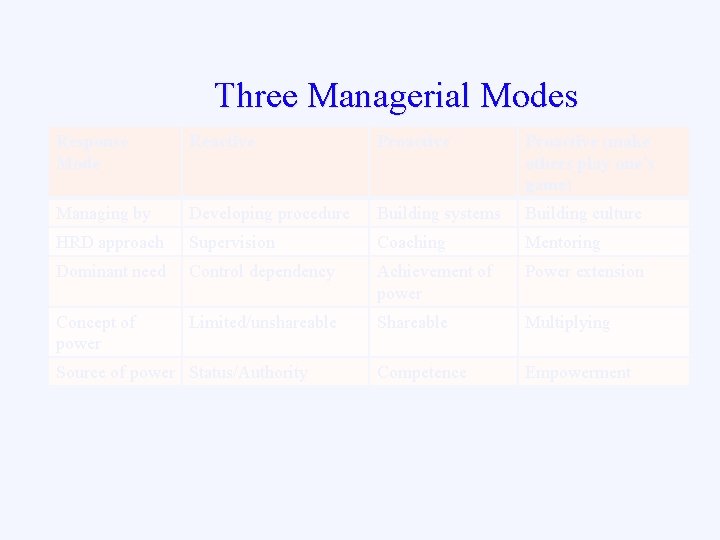
Three Managerial Modes Response Mode Reactive Proactive (make others play one’s game) Managing by Developing procedure Building systems Building culture HRD approach Supervision Coaching Mentoring Dominant need Control dependency Achievement of power Power extension Concept of power Limited/unshareable Shareable Multiplying Competence Empowerment Source of power Status/Authority
Influencing: Concepts Influencing is the process of guiding the activities of organisation members in appropriate directions. Appropriate directions are those that lead to attainment of organisational goals.
Influencing Process: Basic Elements 1. 2. 3. 4. 5. Communicating Motivating Leading Encouraging creativity and innovation Building corporate culture
Concepts of Communication and Motivation • Communication: Process of sharing information with other individuals. • Motivation: Set of forces that initiates, directs, and makes people persist in their efforts to accomplish a goal.
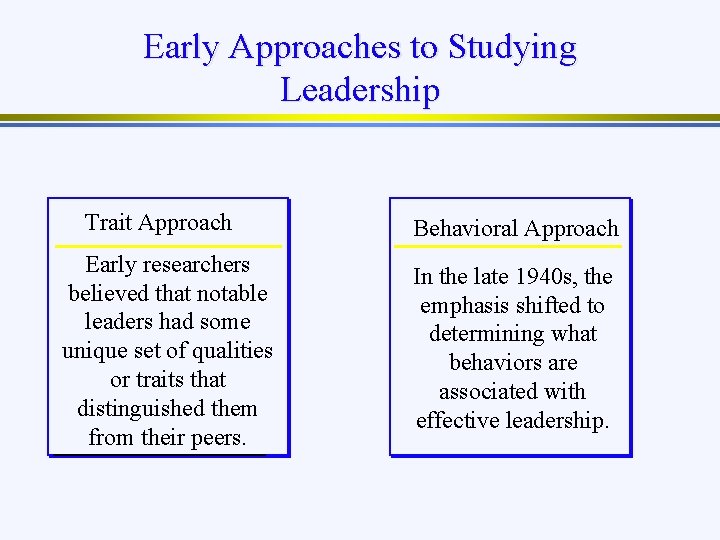
Early Approaches to Studying Leadership Trait Approach Early researchers believed that notable leaders had some unique set of qualities or traits that distinguished them from their peers. Behavioral Approach In the late 1940 s, the emphasis shifted to determining what behaviors are associated with effective leadership.
The Trait Approach • Trait researchers have focused on identifying leadership traits, developing methods for measuring them, and using the methods to select leaders. • Although the trait approach has been largely unsuccessful, in recent years it has received renewed interest. Researchers have found that drive, motivation, integrity, and other traits are common among effective leaders.
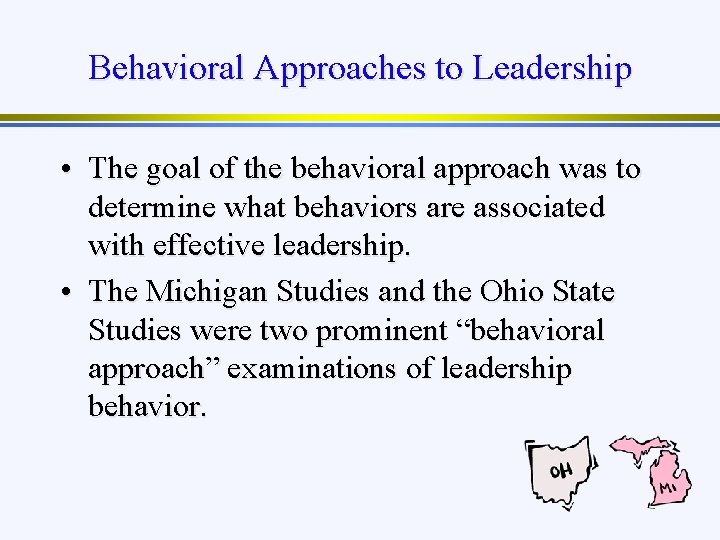
Behavioral Approaches to Leadership • The goal of the behavioral approach was to determine what behaviors are associated with effective leadership. • The Michigan Studies and the Ohio State Studies were two prominent “behavioral approach” examinations of leadership behavior.
The Michigan Studies • The Michigan Studies were conducted to determine the pattern of leadership behavior that result in effective group performance. • The researchers found that leadership consists of two separate dimensions: – Job-centered leader behavior. – Employee-centered leader behavior.
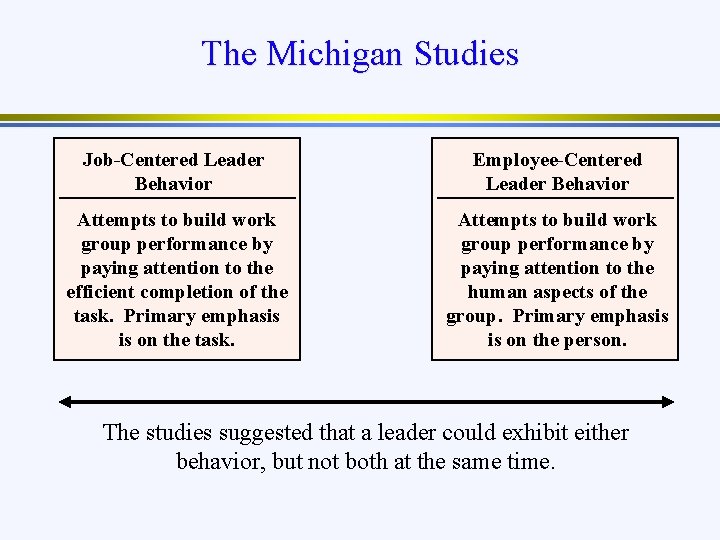
The Michigan Studies Job-Centered Leader Behavior Employee-Centered Leader Behavior Attempts to build work group performance by paying attention to the efficient completion of the task. Primary emphasis is on the task. Attempts to build work group performance by paying attention to the human aspects of the group. Primary emphasis is on the person. The studies suggested that a leader could exhibit either behavior, but not both at the same time.
The Ohio State Studies • The Ohio State Studies were conducted at about the same time as the Michigan Studies. • The Ohio State Studies found that leaders engaged in two separate sets of leadership behaviors, referred to as consideration and initiating structure.
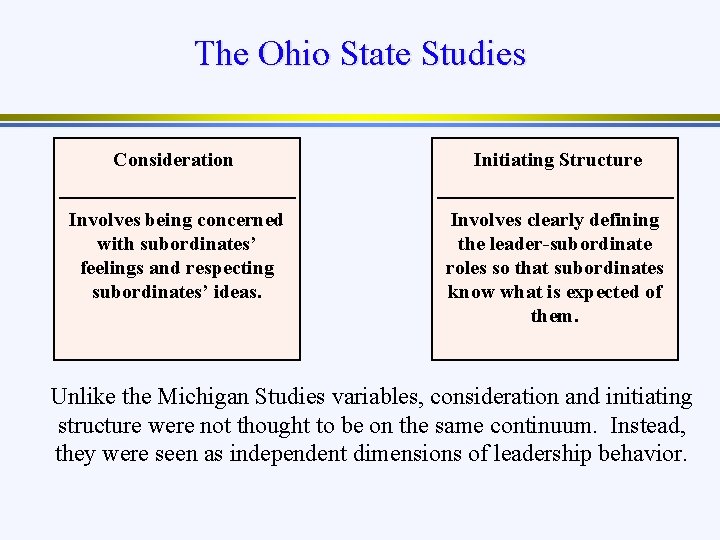
The Ohio State Studies Consideration Initiating Structure Involves being concerned with subordinates’ feelings and respecting subordinates’ ideas. Involves clearly defining the leader-subordinate roles so that subordinates know what is expected of them. Unlike the Michigan Studies variables, consideration and initiating structure were not thought to be on the same continuum. Instead, they were seen as independent dimensions of leadership behavior.
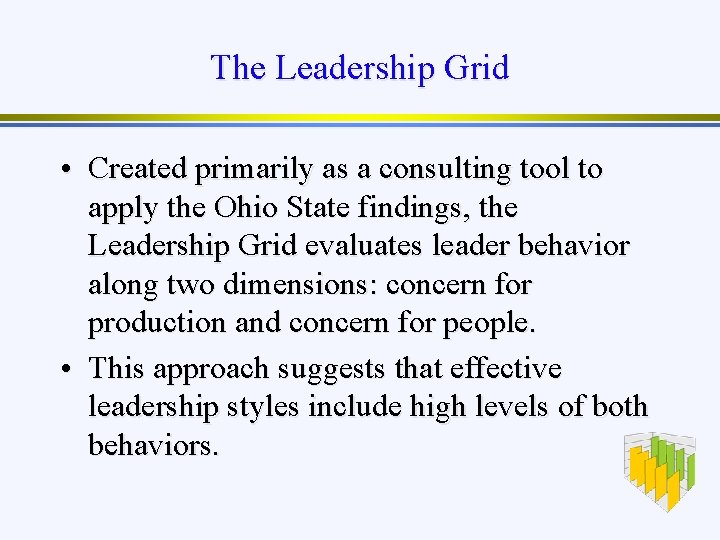
The Leadership Grid • Created primarily as a consulting tool to apply the Ohio State findings, the Leadership Grid evaluates leader behavior along two dimensions: concern for production and concern for people. • This approach suggests that effective leadership styles include high levels of both behaviors.
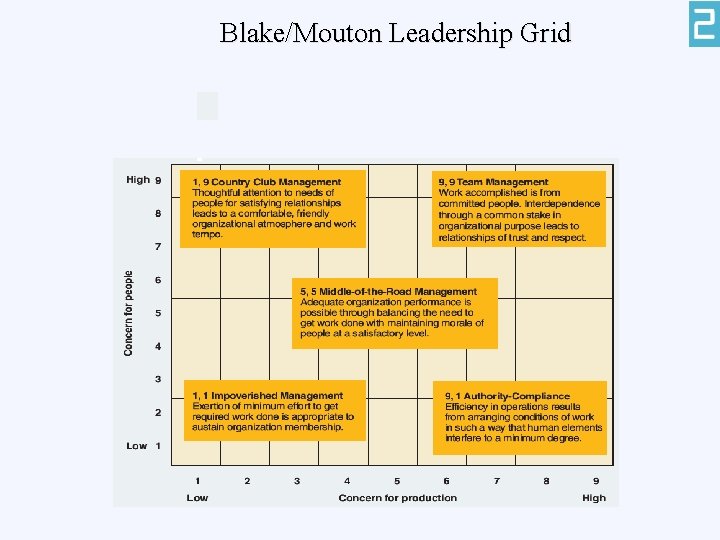
Blake/Mouton Leadership Grid
Other Approaches to Leadership In addition to the trait and behavioral approaches to understanding leadership effectiveness, several additional models of leadership have emerged over the years.
The LPC Theory of Leadership • The LPC theory of leadership suggests that a leader’s effectiveness depends on the situation. • According to theory, leadership effectiveness depends on the match between the leader’s personality and the situation.
The LPC Theory of Leadership • The LPC theory of leadership is a complex theory that assesses leadership potential by examining the relationship between task structure, position power, and a leader’s behavior. • The following slide summarizes the essence of the LPC theory of leadership.
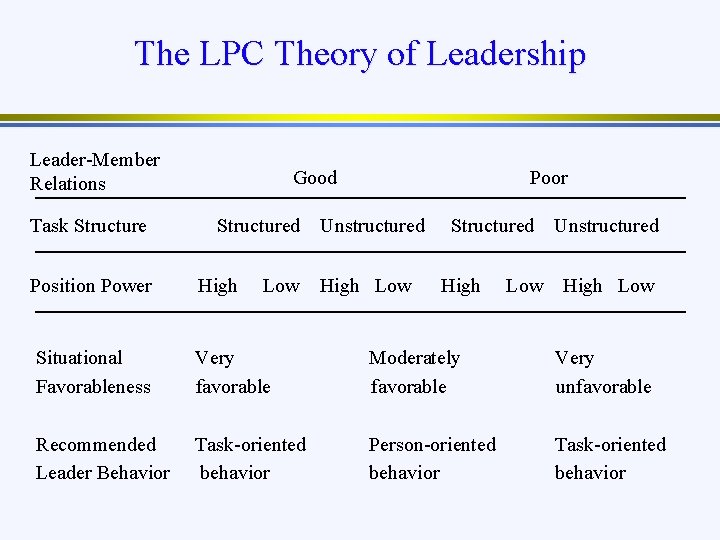
The LPC Theory of Leadership Leader-Member Relations Task Structure Good Structured Low Poor Unstructured High Low Structured High Unstructured Position Power High Low Situational Favorableness Very favorable Moderately favorable Very unfavorable Recommended Leader Behavior Task-oriented behavior Person-oriented behavior Task-oriented behavior
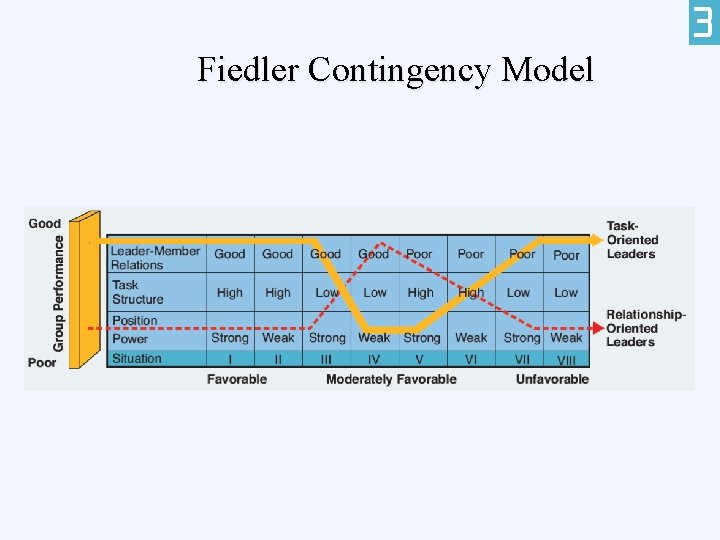
Fiedler Contingency Model
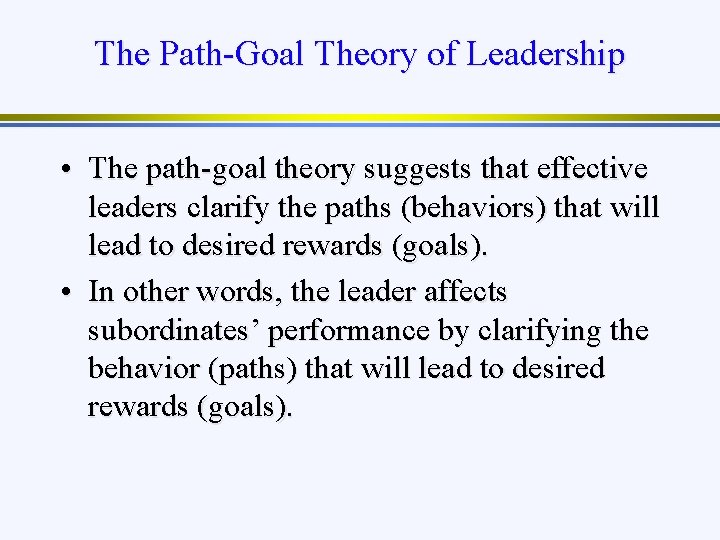
The Path-Goal Theory of Leadership • The path-goal theory suggests that effective leaders clarify the paths (behaviors) that will lead to desired rewards (goals). • In other words, the leader affects subordinates’ performance by clarifying the behavior (paths) that will lead to desired rewards (goals).
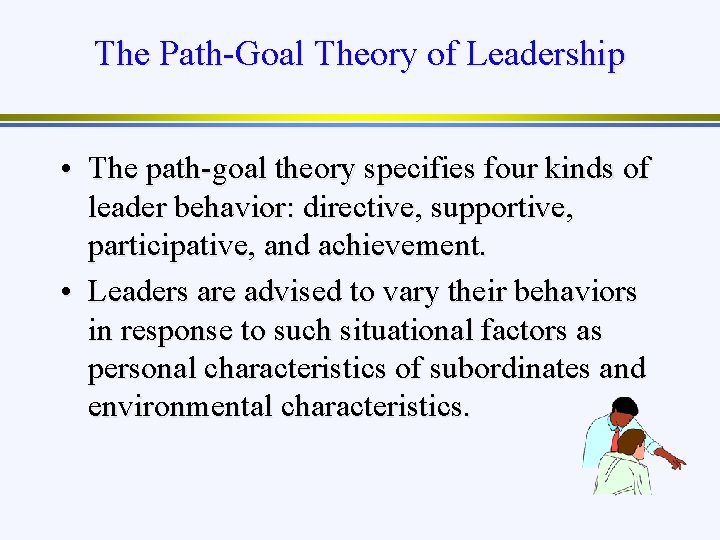
The Path-Goal Theory of Leadership • The path-goal theory specifies four kinds of leader behavior: directive, supportive, participative, and achievement. • Leaders are advised to vary their behaviors in response to such situational factors as personal characteristics of subordinates and environmental characteristics.
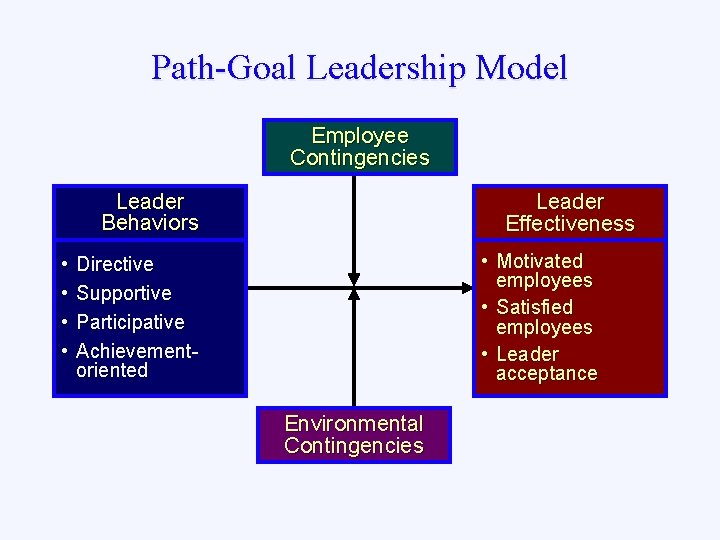
Path-Goal Leadership Model Employee Contingencies Leader Effectiveness Leader Behaviors • • • Motivated employees • Satisfied employees • Leader acceptance Directive Supportive Participative Achievementoriented Environmental Contingencies
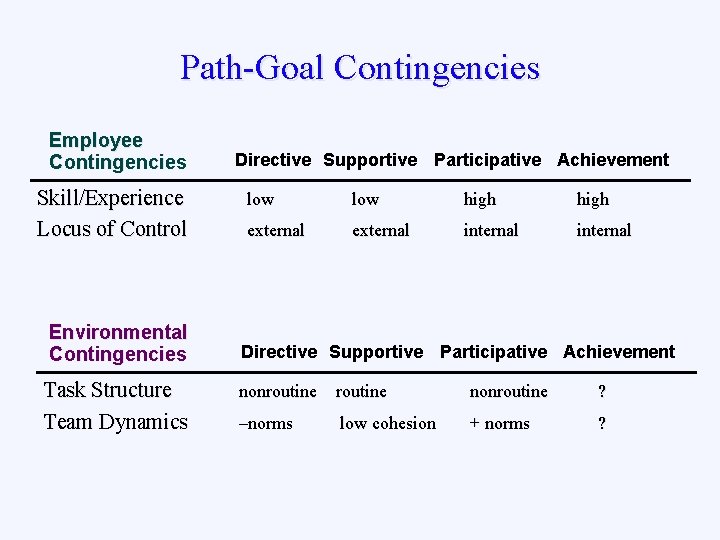
Path-Goal Contingencies Employee Contingencies Skill/Experience Locus of Control Environmental Contingencies Task Structure Team Dynamics Directive Supportive Participative Achievement low high external internal Directive Supportive Participative Achievement nonroutine ? –norms low cohesion + norms ?
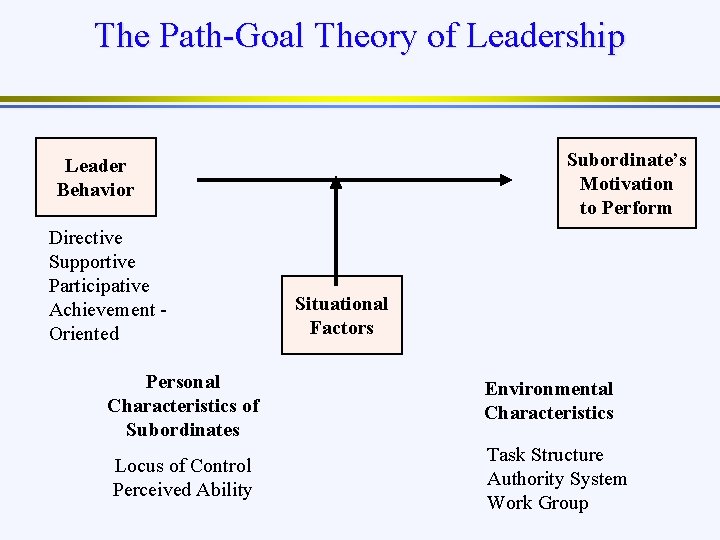
The Path-Goal Theory of Leadership Subordinate’s Motivation to Perform Leader Behavior Directive Supportive Participative Achievement Oriented Situational Factors Personal Characteristics of Subordinates Environmental Characteristics Locus of Control Perceived Ability Task Structure Authority System Work Group
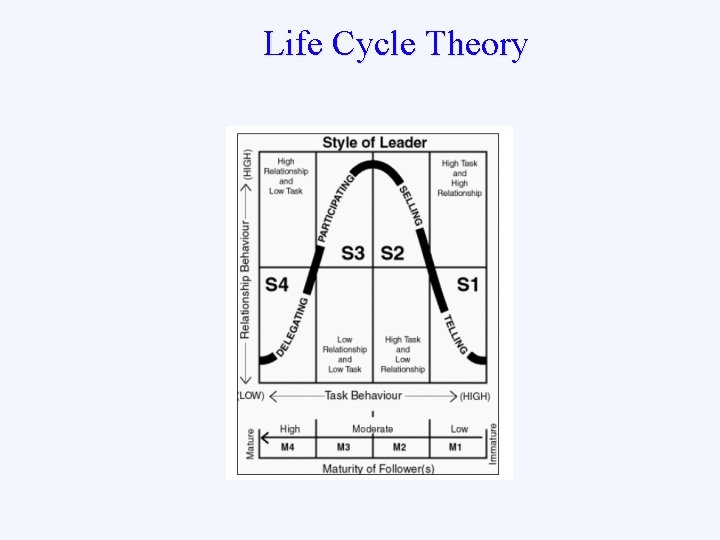
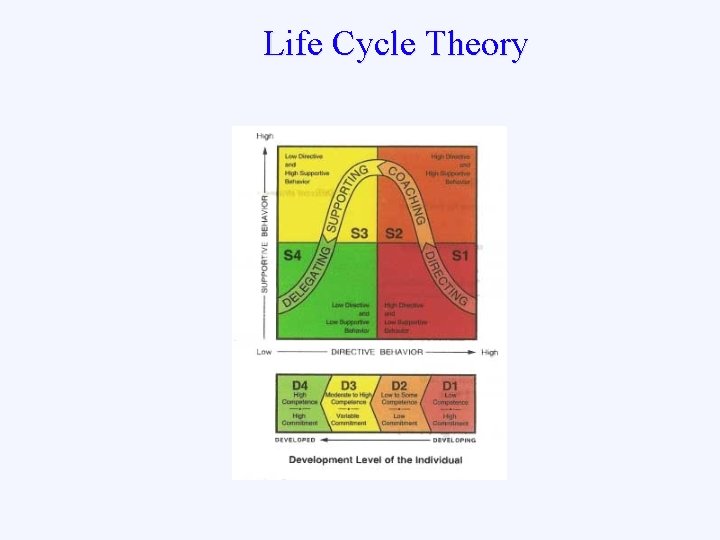
Hersey and Blanchard’s Situational Theory A life-cycle theory of leadership postulating that a manager should consider an employee’s psychological and job maturity before deciding whether task performance or maintenance behaviors are more important. 12 -32
Hersey and Blanchard’s Life Cycle Theory of Situational Leadership Leader’s effectiveness depends upon curvilinear relationship among three situational variables: 1. Task Behaviour: Task related formal instructions issued by the leader. 2. Relationship Behaviour: Socio-emotional support provided by leader. 3. Maturity of Followers: Readiness level exhibited by followers in assuming responsibility.
Life Cycle Theory
Life Cycle Theory
- Slides: 35