
Leadership Management Level Paper E 2 Project and
- Slides: 45
Leadership & Management Level – Paper E 2 Project and Relationship Management Lecture - 014 Vidya Rajawasam ACMA CGMA MBA
Leadership & Management In Previous lecture, we have discuss about § Leadership & Management § Concepts in Management
Leadership & Management In this lecture, we will discuss about the § Classical theories of management § Contemporary theories of management
Leadership & Management Theories of Management The study of management theory and development of ideas related to effective management practice helps to improve the understanding of process of management.
Leadership & Management Theories of Management The schools of management thinking and management theories can be listed below; § Classical management theories § Human relations § Systems theories § Contingency theories
Leadership & Management Classical Management Theories The classical approach to management focuses on technical and economic aspects of organizations. The theory assumes that behaviour in organizations are rational and logical. There are different approaches to management within the classical school
Leadership & Management Classical Management Theories The different approaches under claciscal theory of management are; § Scientific Management (Taylor) § Administrative Management (Fayol) § Bureaucracy (Weber)
Leadership & Management Classical Management Theories The classical theories are developed in an era when mass production and economies of scale were viewed as central to the business success. Although these theories were developed a century ago, they continue to support the management practice today.
Leadership & Management Classical Management Theories There are some common similarities and interests which these theories focuses on; § The purpose and structure of organizations and planning of work. § The technical requirements of each job § The principles of management
Leadership & Management Scientific Management (Taylor) The objective of the management is to secure and deliver the maximum prosperity to the employer and employee. § Using work study methods, find out what is the best approach to carry out a job.
Leadership & Management Scientific Management (Taylor) § Once employees are trained the best approach to pay them should be based on the piece rate. § Believed money as a motivating factor. § Well trained employees deliver higher levels of productivity. § Creates win-win situation for both the parties.
Leadership & Management Scientific Management (Taylor) Taylor recognized that if the employer trained the employees with specialized skills and knowledge, there will be an improvement in productivity. Based on this argument, he broke the jobs down into separate functions and gave each function to an individual.
Leadership & Management Administrative Management (Fayol) Fayol specifically analyzed the work of management, stressing that the most management features have universal application. Fayol identified five main functions of management and he also proposed 14 principles of management.
Leadership & Management Administrative Management (Fayol) Fayols’ Principles of management; § Division of work, encourage specialization since it leads to greater productivity. § Authority , the authority to issue commands should be accompanied by responsibility.
Leadership & Management Fayols’ Principles of management; § Leadership, good leadership should be provided. § Unity of command, there should be one superior person responsible for a group of people. Excessive delegation could lead to complications. § Unity of direction, a single plan should be laid out for all employees who are engaged in same performing same activites.
Leadership & Management Fayols’ Principles of management; § Unity of direction, a single plan should be laid out for all employees who are engaged in performing same work activities. § Remuneration, the system of reward/ remuneration should be related to individuals’ wants and needs where possible. The pay should be fair for both employee and the organization.
Leadership & Management Fayols’ Principles of management; § Centralization, should always be present to greater or lesser degree. The degree of centralization or decentralization should be based according to the circumstances faced by the organization. § Equity, a combination of kindness and justice is required in dealing with employees.
Leadership & Management Fayols’ Principles of management; § Initiative, all employees should be given the opportunity to use their initiative. All staff needs to be encouraged to show their initiative within their limits of authority. § Stability of tenure of personnel, people needs to be given time to settle down into their jobs and the management should avoid ‘hire and fire’ mentality.
Leadership & Management Review MCQs The following are part of main schools of management theories? a. b. c. d. Classical theories Human relations school Systems management Administrative management
Leadership & Management Review MCQs The following are part of main schools of management theories? a. b. c. d. Classical theories Human relations school Systems management Administrative management
Leadership & Management Review MCQs What is true related to scientific management theory? a. Focus on managers role. b. Provides win-win situation for employees and firm. c. Focus on employees specialized knowledge and skills. d. Non of the above.
Leadership & Management Review MCQs What is true related to scientific management theory? a. Focus on managers role. b. Provides win-win situation for employees and firm. c. Focus on employees specialized knowledge and skills. d. Non of the above.
Leadership & Management Bureaucratic Management (Weber) Max Weber developed an ideal type model of bureaucracy. He explored the characteristics of a rational organization. In today’s context, the term has negative connotations. But he believed that his model is potentially the most efficient form of organization.
Leadership & Management Bureaucratic Management (Weber) Weber’s bureaucracy theory is based on formalization and standardization. § Based on hierarchy of authority § Strict rules and regulations govern decision making § Specialization of duties, segregated offices and levels.
Leadership & Management Bureaucratic Management (Weber) The disadvantages are; § Slow response to change, many rules have to be changed. § Lack of speedy communication owing to the segregated offices and levels. § Little need for involving staff in decision making.
Leadership & Management Bureaucratic Management (Weber) The disadvantages are; § Rules stifle initiative and innovative ideas, preventing development § Very important informal relationships are ignored or not recognized.
Leadership & Management The Human relations school In 1930 s, researchers and management theorists started studying the behavior of people in groups. The classical theorists viewed workers as components of a system and focused on procedures and processes.
Leadership & Management The Human relations school The human relations theorists started focusing on the effects of social interaction on motivation and productivity. Mayo, Herzberg are some of the human relations school management theorists.
Leadership & Management Mayo Elton Mayo and his colleagues carried out the famous Hawthorne investigations for the Western Electric Company in 1920 - 1930. They have changed the working conditions of workers and monitored how it affected the workers’ motivation and productivity.
Leadership & Management Mayo The changes in working conditions included; working hours, rest breaks, lighting, humidity and temperatures. The changes were communicated to the workers before the implementation. At the end of the experiment period, the working conditions were revert back.
Leadership & Management Mayo The outcome of the experiment are; § There is an unwritten understanding between the workers and the employer regarding what is expected from each other. This scenario is called the psychological contract.
Leadership & Management Mayo The outcome of the experiment are; § The workers motivation can be increased by showing some interest in them. § Workers working as a team provides a base for development of strong working relationships and increased trust among them. This is another motivating factor.
Leadership & Management Mayo The outcome of the experiment are; § The workers can be motivated by social aspects of the work. Example, workers socializing during and outside work. § The communication between management and workers influences the workers’ moral and productivity. A good working relationship is a motivating factor.
Leadership & Management Herzberg Frederick Herzberg carried forward the Mayo’s motivational theories. He came up with a two factor theory related to motivation. The theory describes motivational and hygiene factors.
Leadership & Management Herzberg Frederick Herzberg carried forward the Mayo’s motivational theories. He came up with a two factor theory related to motivation. The theory describes motivational and hygiene factors.
Leadership & Management Herzberg Hygiene factors, Certain workplace factors can cause job satisfaction, while some factors can cause dissatisfaction. The job dissatisfaction cause unpleasantness and should be avoided. The lack of satisfaction of hygiene factors can cause employee de motivation.
Leadership & Management Herzberg § § Hygiene factors, In order to avoid dissatisfaction, the firm should have; Policies and procedures for treatment of staff. Suitable level and quality of staff supervision Pleasant working conditions. Appropriate levels of salaries and job status
Leadership & Management Herzberg Motivator factors, These factors satisfy the need for growth. The satisfaction of motivator factors encourages the workers to work harder. Herzberg believes that only motivator factors can move employees into action.
Leadership & Management Herzberg Motivator factors, These factors satisfy the need for growth. The satisfaction of motivator factors encourages the workers to work harder. Herzberg believes that only motivator factors can move employees into action.
Leadership & Management Herzberg In order to motivate staff, the firm should ; § Set targets to promote sense of accomplishment. § System to recognize good work § Increase levels of responsibility § Opportunities for Career advancement
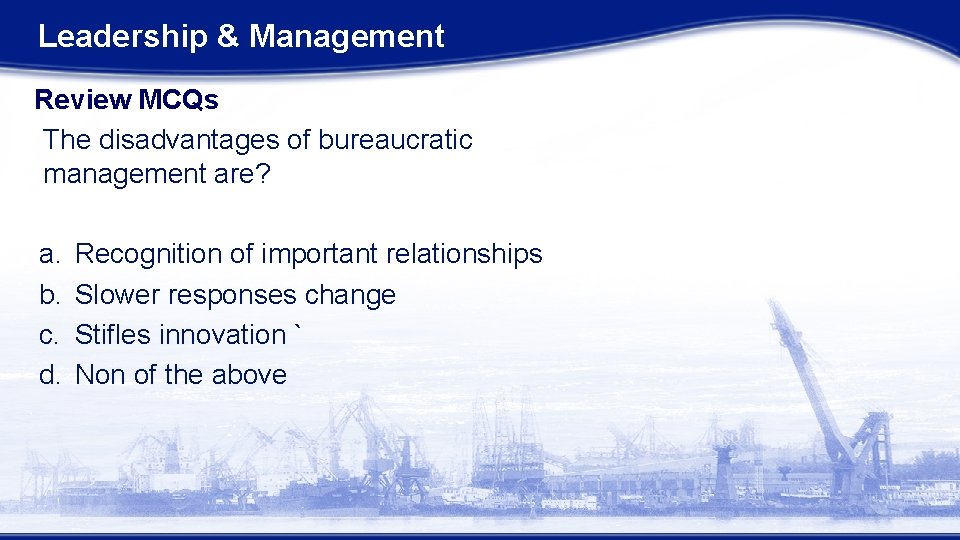
Leadership & Management Review MCQs The disadvantages of bureaucratic management are? a. b. c. d. Recognition of important relationships Slower responses change Stifles innovation ` Non of the above
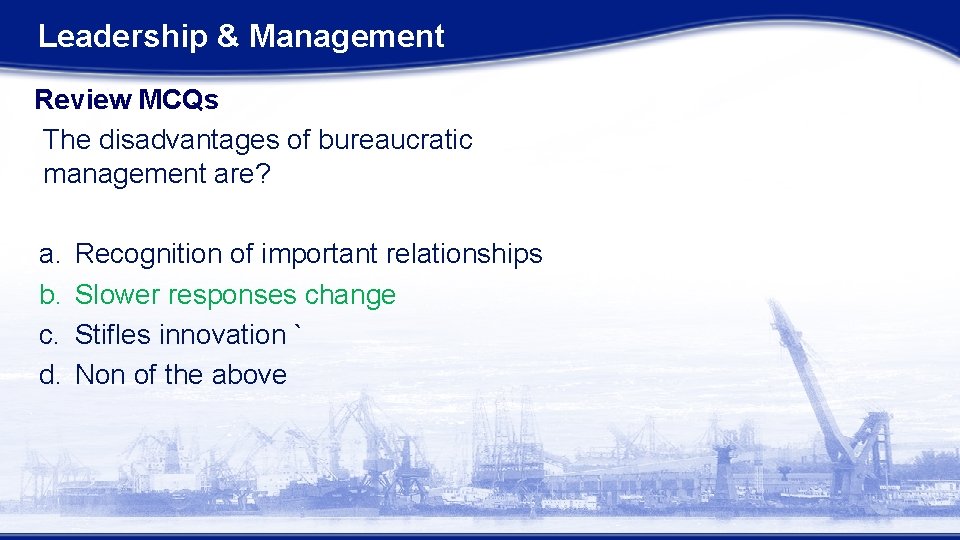
Leadership & Management Review MCQs The disadvantages of bureaucratic management are? a. b. c. d. Recognition of important relationships Slower responses change Stifles innovation ` Non of the above
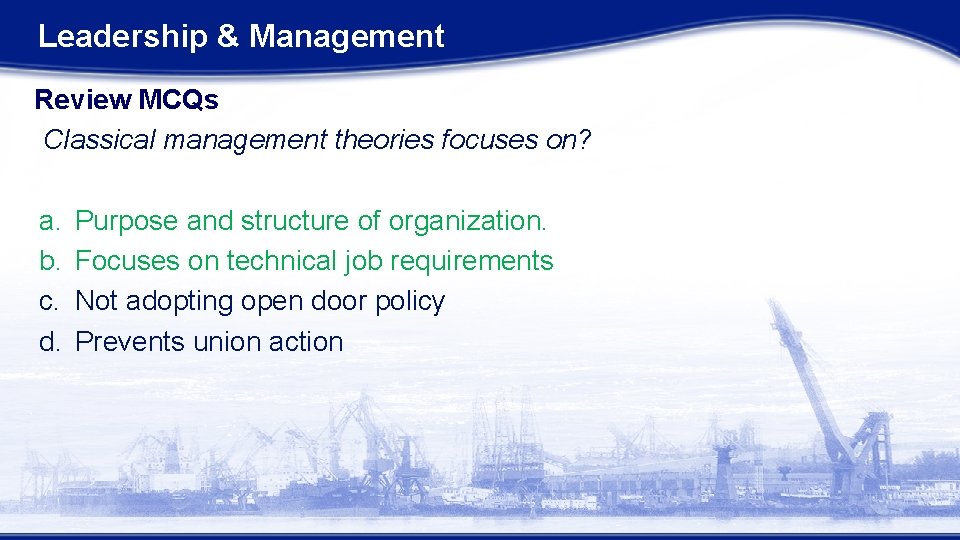
Leadership & Management Review MCQs Classical management theories focuses on? a. b. c. d. Purpose and structure of organization. Focuses on technical job requirements Not adopting open door policy Prevents union action
Leadership & Management Lecture Summary We have discussed the § Classical theories of management § Contemporary theories of management
Leadership & Management Level – Paper E 2 Project and Relationship Management Lecture - 014 Vidya Rajawasam ACMA CGMA MBA