
Leadership Management Dr Bagus Nurcahyo Program Studi Manajemen
Leadership & Management Dr. Bagus Nurcahyo Program Studi Manajemen Pemasaran Direktorat Program D 3 Bisnis & Kewirausahaan Bn. R-Peng. Manajemen-chap-07 1
Definitions of Leadership ØText 2000: An influence relationship among leaders and followers who intend real changes that reflect their shared purposes. Bn. R-Peng. Manajemen-chap-07 2
Components of Leadership ØLeader ØInfluence ØFollower ØShared Purpose ØDesire for Change ØPersonal Responsibility ØIntention Bn. R-Peng. Manajemen-chap-07 3
Five Paradigm Transformations • From: Industrial Age – – – Stability Control Competition Things Uniformity • To: Information Age – – Change Empowerment Collaboration People and Relationships – Diversity Bn. R-Peng. Manajemen-chap-07 4
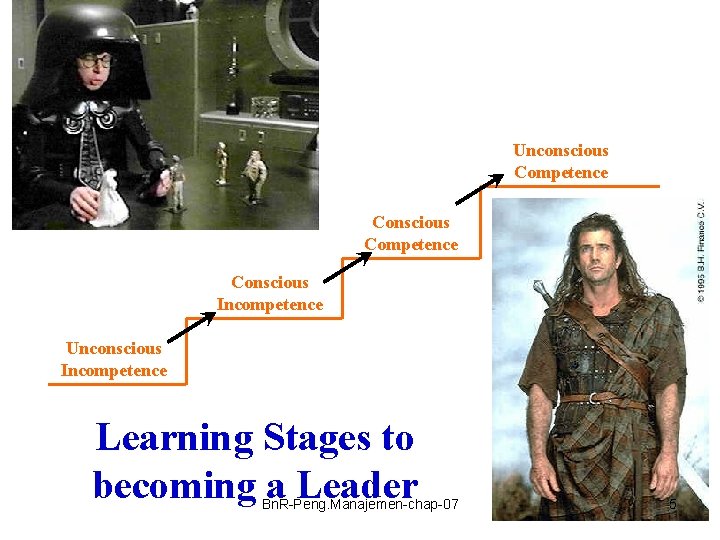
Unconscious Competence Conscious Incompetence Unconscious Incompetence Learning Stages to becoming a Leader Bn. R-Peng. Manajemen-chap-07 5
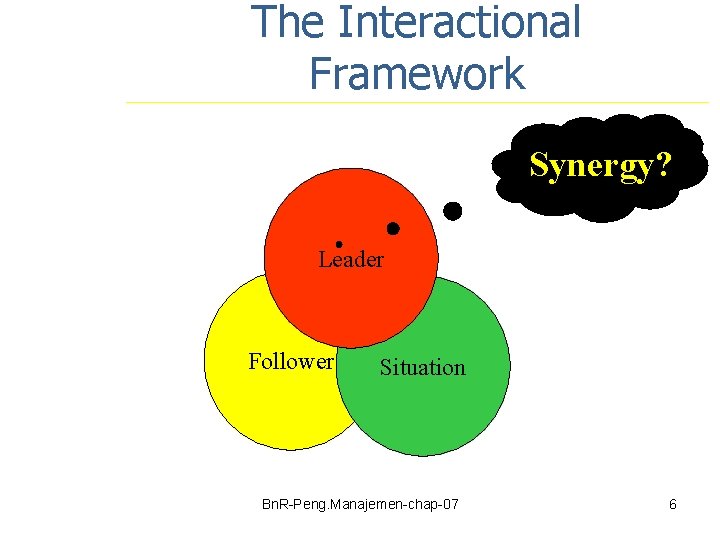
The Interactional Framework Synergy? Leader Follower Situation Bn. R-Peng. Manajemen-chap-07 6
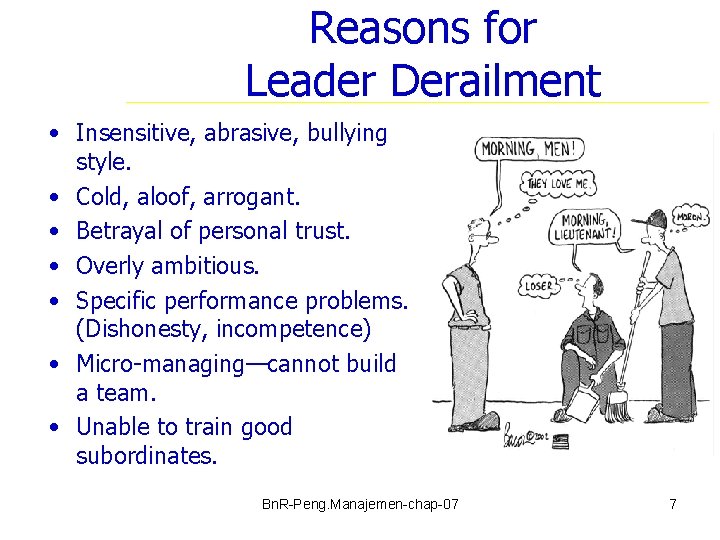
Reasons for Leader Derailment • Insensitive, abrasive, bullying style. • Cold, aloof, arrogant. • Betrayal of personal trust. • Overly ambitious. • Specific performance problems. (Dishonesty, incompetence) • Micro-managing—cannot build a team. • Unable to train good subordinates. Bn. R-Peng. Manajemen-chap-07 7
Leadership vs. Management • Leadership: The art of forging a team from individuals with a disparate set of backgrounds who serve a common goal greater than themselves that may or may not conflict with their personal goals and beliefs. • Management: The art of attaining organizational goals in an effective and efficient manner through planning, organizing, leading, and controlling organizational resources. These are the four management functions. Bn. R-Peng. Manajemen-chap-07 8

Bounded Rationality • Behavior that is rational within the parameters of a simplified model that captures the essential features of the problem. • Making a decision that is “good enough. ” • This is how decisions are made in the real world. Bn. R-Peng. Manajemen-chap-07 9
Intuitive Decision Making • An unconscious process of making decisions on the basis of experience and accumulated judgment. – Making decisions on the basis of gut feeling doesn't happen independently of rational analysis. The two complement each other. – Although intuitive decision making will not replace the rational decision-making process, it does play an important role in managerial decision making. Bn. R-Peng. Manajemen-chap-07 10
Decision-Making Styles - Problem Avoider - - Problem Solver - - Reactive vice proactive Problem Seekers - - Inactive leaders Proactive leader All three approaches have their place in decision making Bn. R-Peng. Manajemen-chap-07 11
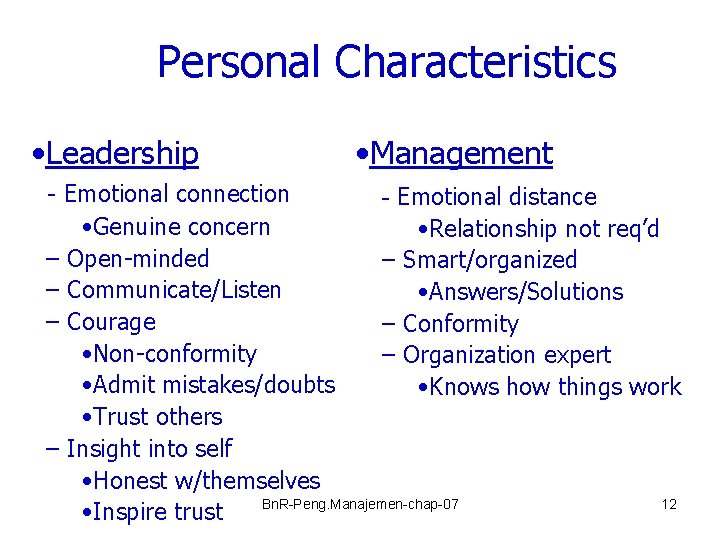
Personal Characteristics • Leadership - Emotional connection – – • Management - Emotional distance • Relationship not req’d – Smart/organized • Answers/Solutions – Conformity – Organization expert • Knows how things work • Genuine concern Open-minded Communicate/Listen Courage • Non-conformity • Admit mistakes/doubts • Trust others Insight into self • Honest w/themselves Bn. R-Peng. Manajemen-chap-07 • Inspire trust 12
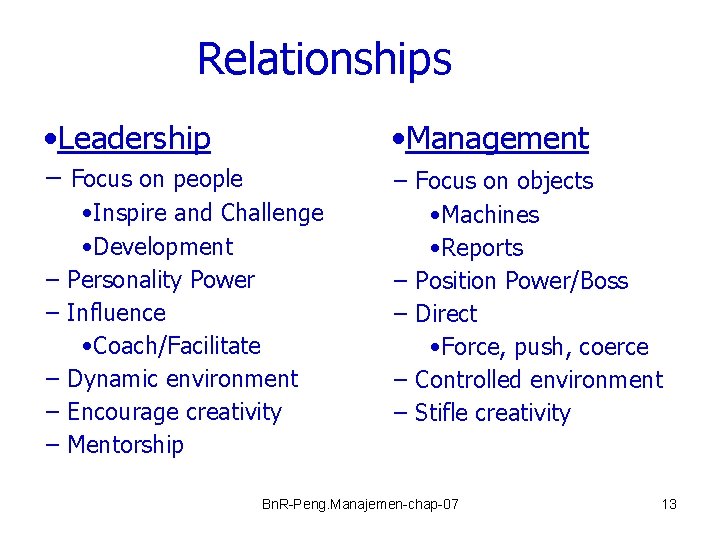
Relationships • Leadership • Management – Focus on people – Focus on objects • Machines • Reports – Position Power/Boss – Direct • Force, push, coerce – Controlled environment – Stifle creativity – – – • Inspire and Challenge • Development Personality Power Influence • Coach/Facilitate Dynamic environment Encourage creativity Mentorship Bn. R-Peng. Manajemen-chap-07 13
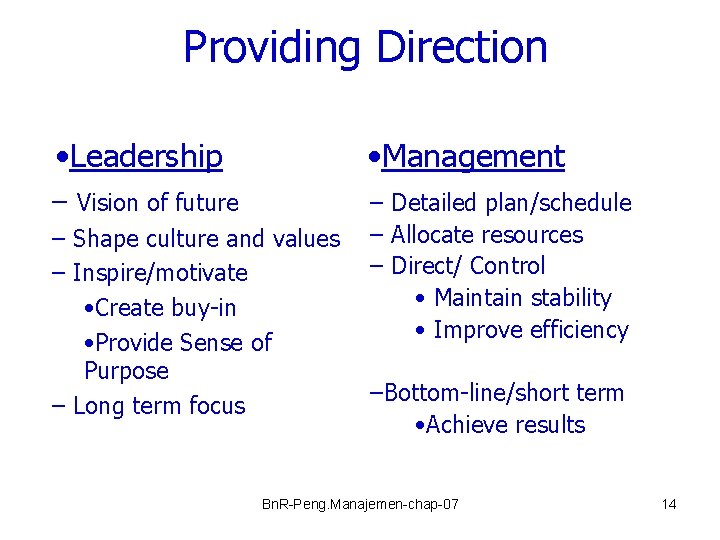
Providing Direction • Leadership • Management – Vision of future – Detailed plan/schedule – Allocate resources – Direct/ Control • Maintain stability • Improve efficiency – Shape culture and values – Inspire/motivate • Create buy-in • Provide Sense of Purpose – Long term focus –Bottom-line/short term • Achieve results Bn. R-Peng. Manajemen-chap-07 14

Alignment • Leadership • Management – Communicate vision – Organize • Staff and structure – Direct and Control • Policies/Procedures – Create boundaries – Contributes • Answers • Solutions • Guidance – Develop culture and values – Help others grow • Question, listen, facilitate –Reduce boundaries • Create Teamwork Bn. R-Peng. Manajemen-chap-07 15

Outcomes • Leadership • Management – Greatest possible outcome – Create change? • Sometimes radical – Challenge status quo/Adapt – Effective and efficient – Future outcomes • Self Sustaining – Maintains: • Stability • Predictability • Order – Effective • Efficient? – Consistently meets shortterm expectations • Day-to day OPS Bn. R-Peng. Manajemen-chap-07 16
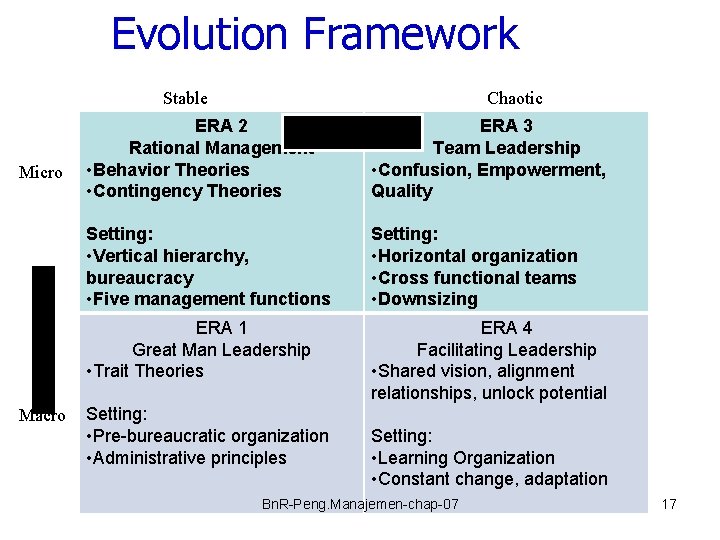
Evolution Framework Stable Micro S c o p e Macro Chaotic ERA 2 ERA 3 Environment Rational Management Team Leadership • Behavior Theories • Confusion, Empowerment, • Contingency Theories Quality Setting: • Vertical hierarchy, bureaucracy • Five management functions Setting: • Horizontal organization • Cross functional teams • Downsizing ERA 1 Great Man Leadership • Trait Theories ERA 4 Facilitating Leadership • Shared vision, alignment relationships, unlock potential Setting: • Pre-bureaucratic organization • Administrative principles Setting: • Learning Organization • Constant change, adaptation Bn. R-Peng. Manajemen-chap-07 17
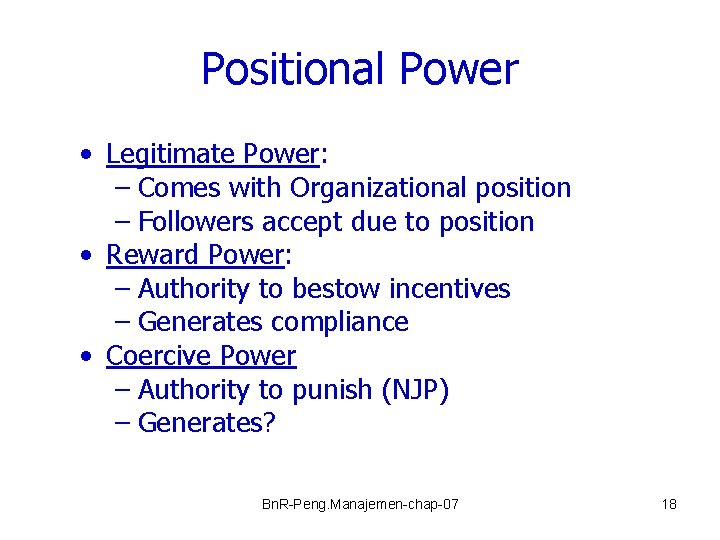
Positional Power • Legitimate Power: – Comes with Organizational position – Followers accept due to position • Reward Power: – Authority to bestow incentives – Generates compliance • Coercive Power – Authority to punish (NJP) – Generates? Bn. R-Peng. Manajemen-chap-07 18
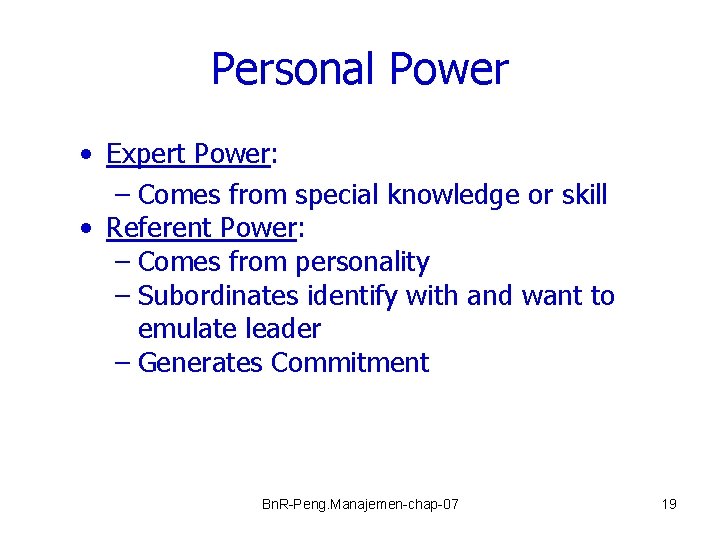
Personal Power • Expert Power: – Comes from special knowledge or skill • Referent Power: – Comes from personality – Subordinates identify with and want to emulate leader – Generates Commitment Bn. R-Peng. Manajemen-chap-07 19
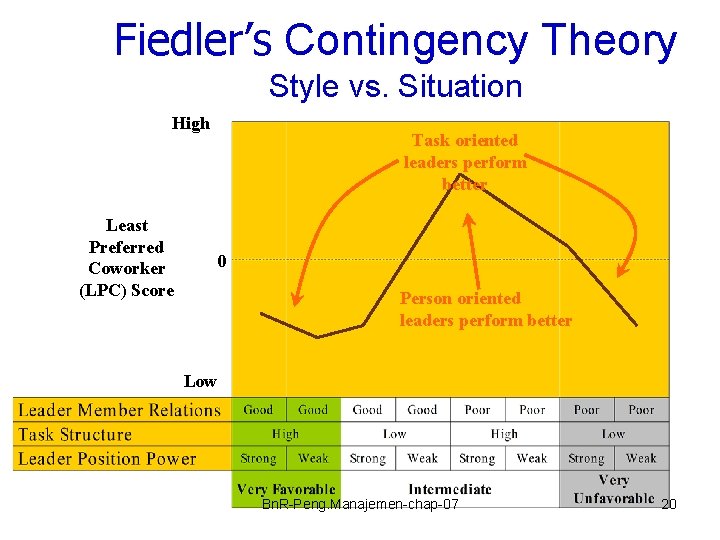
Fiedler’s Contingency Theory Style vs. Situation High Least Preferred Coworker (LPC) Score Task oriented leaders perform better 0 Person oriented leaders perform better Low Bn. R-Peng. Manajemen-chap-07 20
Hersey and Blanchard’s Situational Theory • Adopt style appropriate to subordinate abilities – Low level of task readiness: • Tell them what to do • How to do it • When to do it – High level of task readiness: • Provide general direction • Delegate sufficient authority to do the task • Expect followers to complete the task as they see fit Bn. R-Peng. Manajemen-chap-07 21
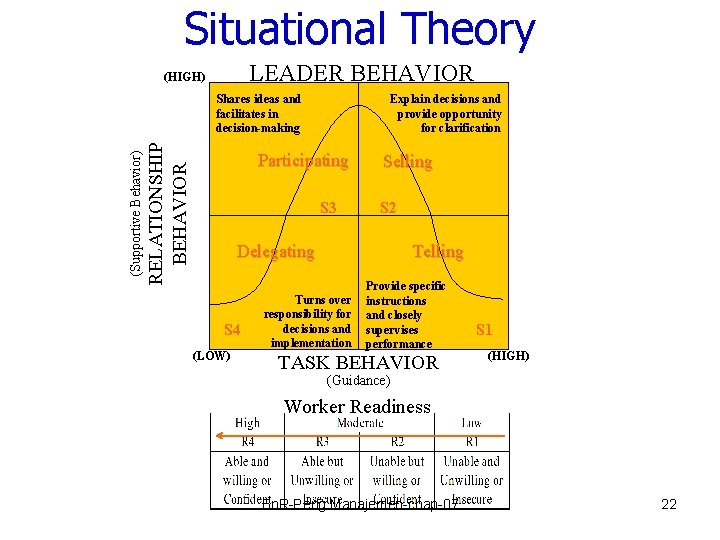
Situational Theory LEADER BEHAVIOR (HIGH) RELATIONSHIP BEHAVIOR (Supportive Behavior) Shares ideas and facilitates in decision-making Explain decisions and provide opportunity for clarification Participating S 3 Selling S 2 Delegating S 4 (LOW) Telling Turns over responsibility for decisions and implementation Provide specific instructions and closely supervises performance TASK BEHAVIOR S 1 (HIGH) (Guidance) Worker Readiness Bn. R-Peng. Manajemen-chap-07 22
Vision • …an ideal future that is credible yet not readily attainable – What we aspire to become – Make it worth the effort/sacrifice/hardship • Link present action to the future goals – Motivate/Inspire – Challenge/Energize – Give direction/Provide meaning – Focus effort Bn. R-Peng. Manajemen-chap-07 23
Mission Statement • Describes purpose of the organization – WHAT – is expected to be achieved – HOW – it can be done • Encompasses Core Values • Mission is basis; Vision brings it “to life”… – Why we want to achieve it Bn. R-Peng. Manajemen-chap-07 24
Definitions • Goal: . . . t a h W – Desired future state; The Ends – Define the organizations’ purpose • Plan: . . . w o H – Blueprint for goal achievement – Specifies necessary resources, schedules, tasks and other actions; The Means Bn. R-Peng. Manajemen-chap-07 25
Organizational Mission • Mission - states organization’s values, aspirations, and reason for existence • Mission Statement – formal pronouncement of the mission – Basis for all goals and plans – Without a clear mission, goals and plans may be developed haphazardly causing organizational failure Bn. R-Peng. Manajemen-chap-07 26
Strategic Goals and Plans • Strategic Goals – Pertain to entire organization – Stated intentions of organization – Longer term • Strategic Plans – Action steps toward attaining organizational goals – Activities and resources required Bn. R-Peng. Manajemen-chap-07 27
Tactical Goals and Plans • Tactical Goals – Apply to “middle” management – Describe what major sub units must do to enable organization to meet strategic goals – Enabling objectives/intermediate goals • Tactical Plans: – Subsets of overall plan – Cover a shorter period of time Bn. R-Peng. Manajemen-chap-07 28
Operational Goals and Plans • Operational Goals – – Specific results expected of small units, workgroups, and individuals – Enable organization to meet operational and strategic goals • Operational Plans - developed at the lower levels of an organization to specify actions required to achieve operational goals/support operational plans Bn. R-Peng. Manajemen-chap-07 29
- Slides: 29