
Leadership Leadership is the art or process of
- Slides: 34
Leadership • Leadership is the art or process of influencing people so that they perform assigned tasks willingly and in an efficient and effective manner. • It is crucial to motivating and inspiring the workforce
Manager v Leader • Managers have legitimate power as a result of being appointed. • Leaders may be appointed, but often emerge.
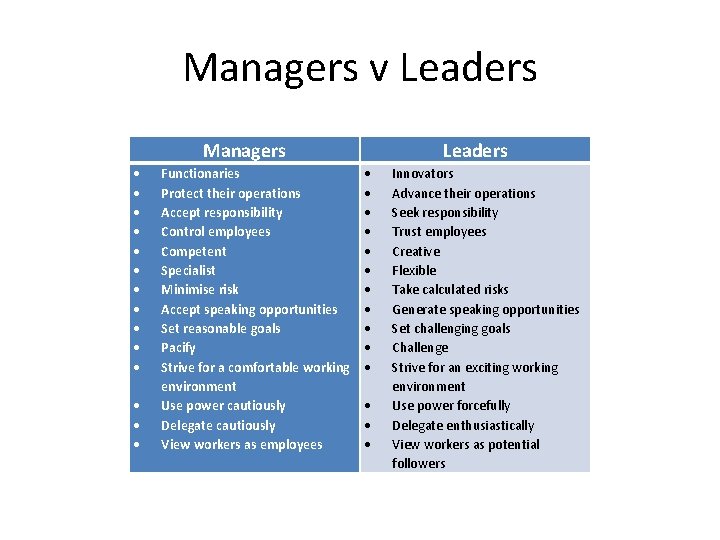
Managers v Leaders Managers Functionaries Protect their operations Accept responsibility Control employees Competent Specialist Minimise risk Accept speaking opportunities Set reasonable goals Pacify Strive for a comfortable working environment Use power cautiously Delegate cautiously View workers as employees Leaders Innovators Advance their operations Seek responsibility Trust employees Creative Flexible Take calculated risks Generate speaking opportunities Set challenging goals Challenge Strive for an exciting working environment Use power forcefully Delegate enthusiastically View workers as potential followers
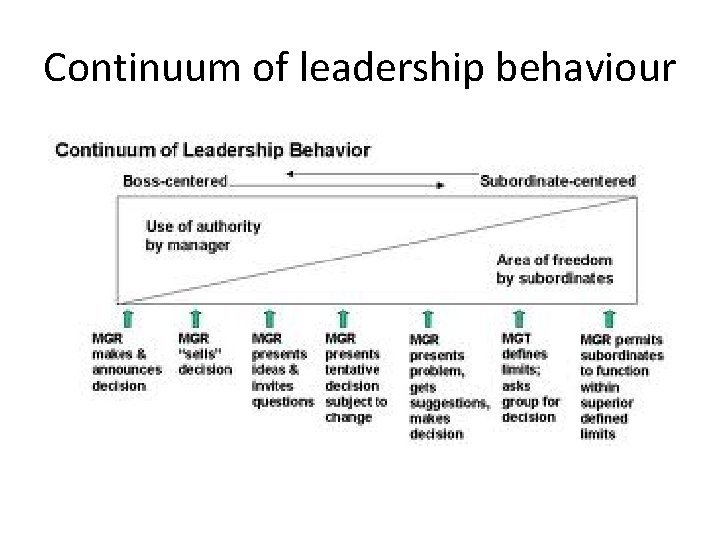
Continuum of leadership behaviour
Rangatiratanga In Maori business organisations are expected to lead, use their influence and be guardians of resources they oversee. Often there is multiple ownership so those in governance are charged with protecting the rights of many owners.
Concepts • Relationships – requiring these to be developed and managed with all stakeholders (people, or bodies with a vested interest in the business operation); • Problem solving, conflict resolution and peace making – so solutions are found so an enterprise is sustainable and can move forward.
Concepts • Risk evaluation and management – so resources are protected and used wisely. • Strategy development and management – that adapts to the environment and changing times.
Rangatiratanga - Leadership With multiple bottom lines those in Rangatiratanga (the leaders) must take into account of current and future needs: • Economic • Social • Cultural and spiritual needs • The consequences of the operation • The effect on the natural environment
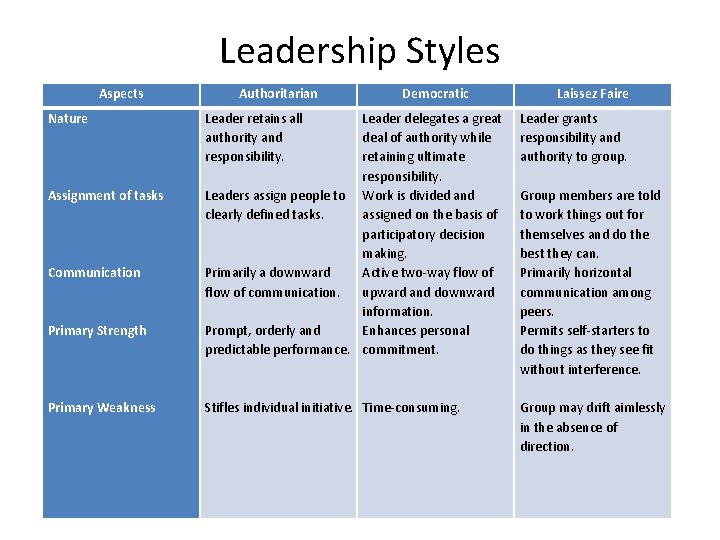
Autocratic Leadership The autocratic leader is authoritarian and assumes responsibility for all aspects of the operation. Communication is one way with little or no scope for feedback. The autocrat demands total compliance from the workforce. The autocrat is seen as efficient and (in some circumstances) essential (armed services)
Autocratic Leader The autocratic leader can produce quick decisions, however, they can also create frustration, and resentment. The group becomes dependent on the leader and will be unable to act independently. An autocratic style can work well, but much will depend on the qualities of the leader and the compliance of the group.
Democratic Leadership • The democratic (participative) leader seeks the opinion of subordinates and strives for mutual understanding. “Democratic “ implies acceptance of group decisions, but most democratic managers consult, yet retain the ultimate responsibility for decision making. • Perhaps ‘consultative’ is a more apt description of style.
Laissez Faire (Free rein) The lassez faire style of leader sets goals for subordinates and clear parameters to work within. Once objectives have been established the reins of control are dropped and the subordinate is left alone to achieve their objectives. This style only works when the subordinate is willing to accept responsibility. There are risks associated with this style as it is dependant on competence and integrity of subordinates.
Leadership Styles Aspects Nature Assignment of tasks Communication Primary Strength Primary Weakness Authoritarian Democratic Leader retains all authority and responsibility. Laissez Faire Leader delegates a great deal of authority while retaining ultimate responsibility. Leaders assign people to Work is divided and clearly defined tasks. assigned on the basis of participatory decision making. Primarily a downward Active two-way flow of communication. upward and downward information. Prompt, orderly and Enhances personal predictable performance. commitment. Leader grants responsibility and authority to group. Stifles individual initiative. Time-consuming. Group may drift aimlessly in the absence of direction. Group members are told to work things out for themselves and do the best they can. Primarily horizontal communication among peers. Permits self-starters to do things as they see fit without interference.
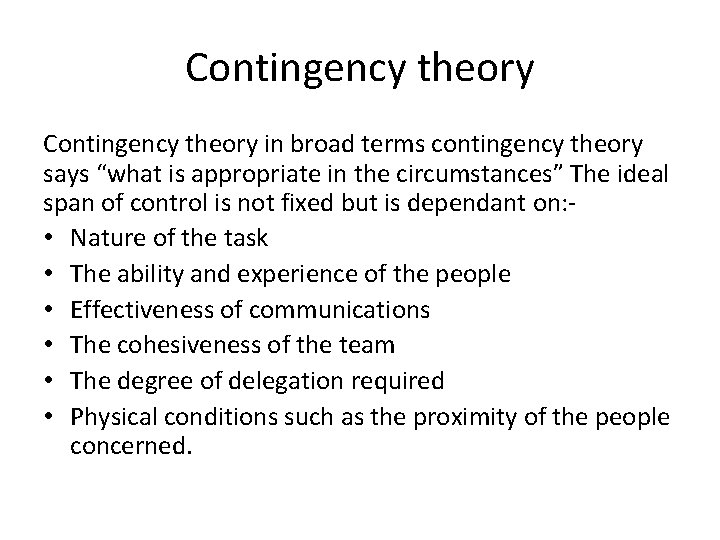
Contingency theory in broad terms contingency theory says “what is appropriate in the circumstances” The ideal span of control is not fixed but is dependant on: • Nature of the task • The ability and experience of the people • Effectiveness of communications • The cohesiveness of the team • The degree of delegation required • Physical conditions such as the proximity of the people concerned.
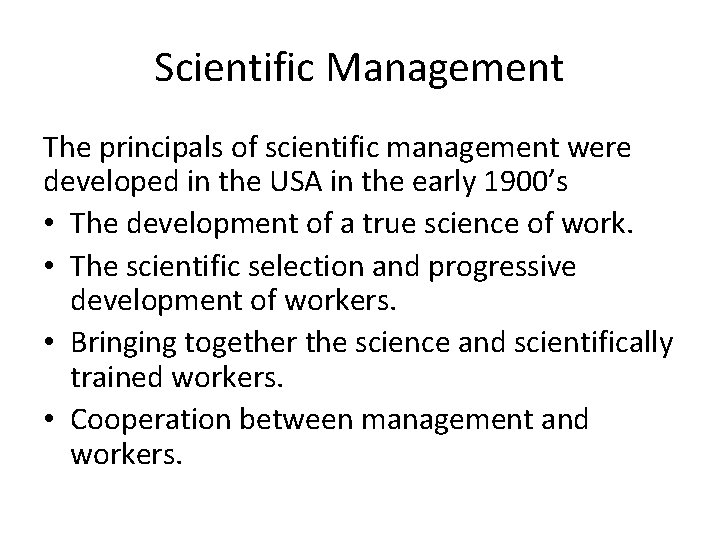
Scientific Management The principals of scientific management were developed in the USA in the early 1900’s • The development of a true science of work. • The scientific selection and progressive development of workers. • Bringing together the science and scientifically trained workers. • Cooperation between management and workers.
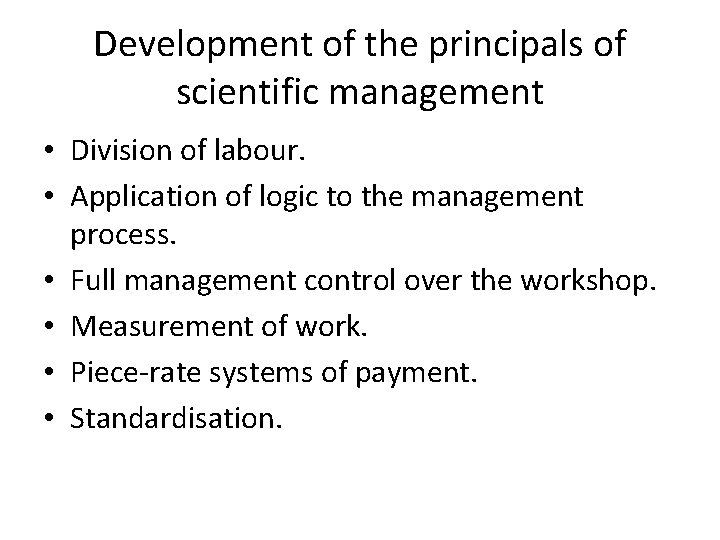
Development of the principals of scientific management • Division of labour. • Application of logic to the management process. • Full management control over the workshop. • Measurement of work. • Piece-rate systems of payment. • Standardisation.
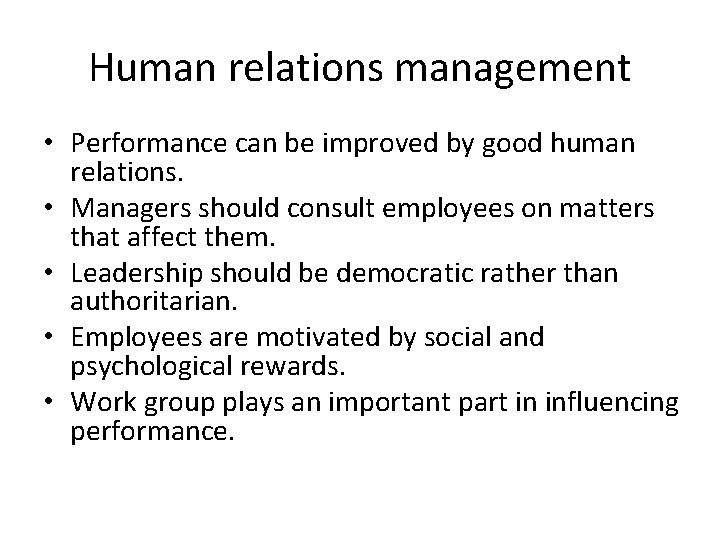
Human relations management • Performance can be improved by good human relations. • Managers should consult employees on matters that affect them. • Leadership should be democratic rather than authoritarian. • Employees are motivated by social and psychological rewards. • Work group plays an important part in influencing performance.
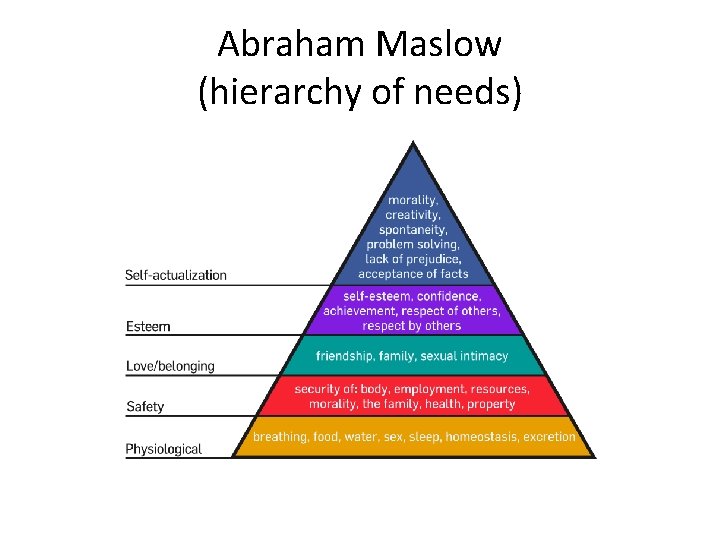
Abraham Maslow (hierarchy of needs)
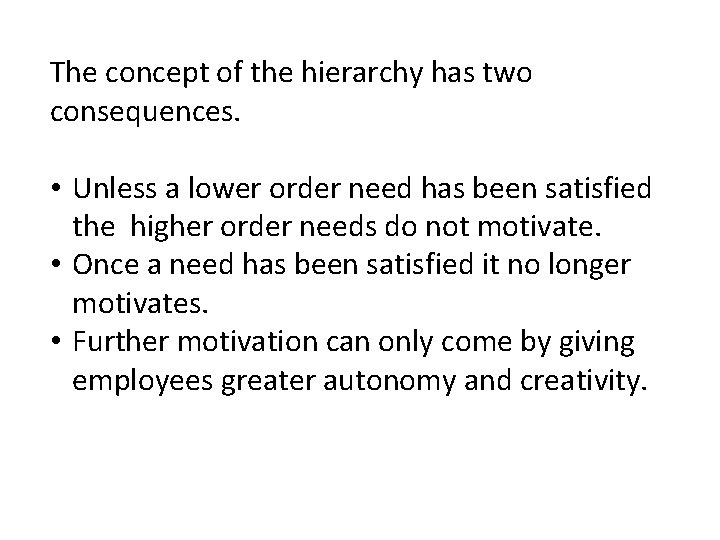
The concept of the hierarchy has two consequences. • Unless a lower order need has been satisfied the higher order needs do not motivate. • Once a need has been satisfied it no longer motivates. • Further motivation can only come by giving employees greater autonomy and creativity.
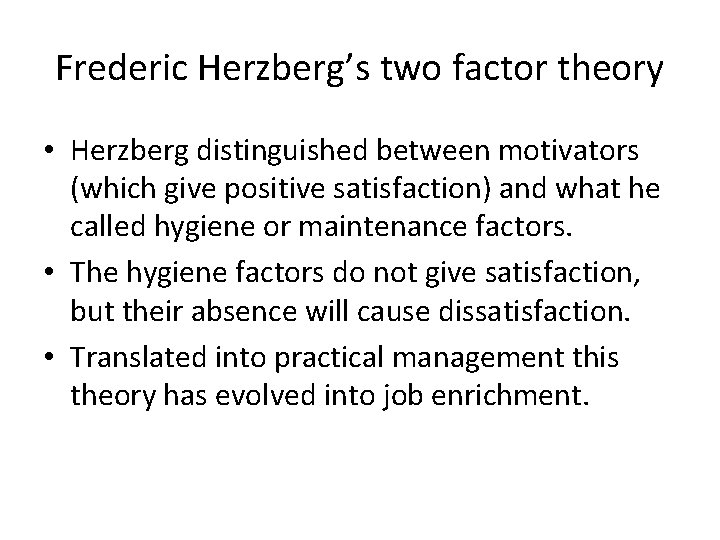
Frederic Herzberg’s two factor theory • Herzberg distinguished between motivators (which give positive satisfaction) and what he called hygiene or maintenance factors. • The hygiene factors do not give satisfaction, but their absence will cause dissatisfaction. • Translated into practical management this theory has evolved into job enrichment.
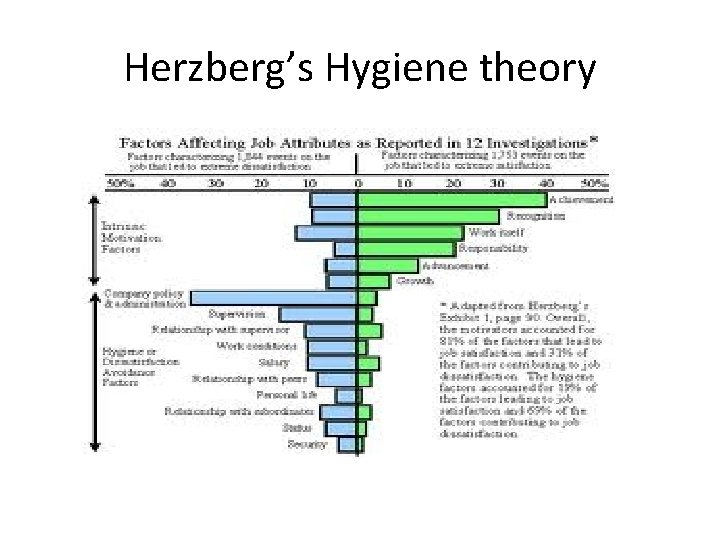
Herzberg’s Hygiene theory
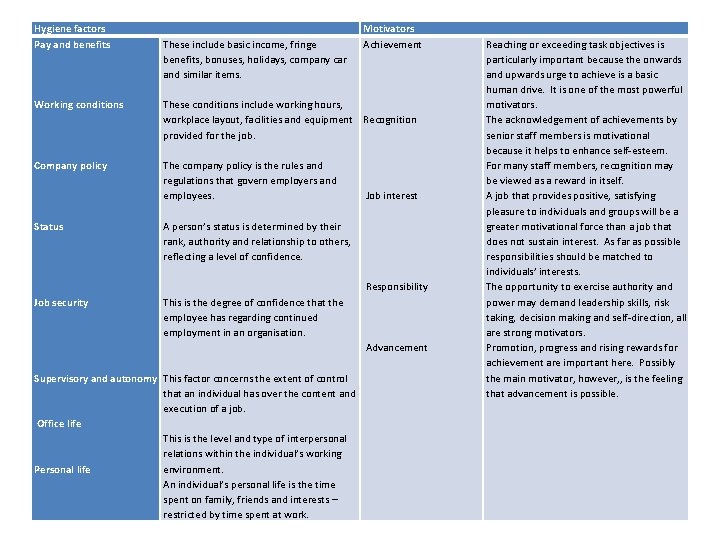
Hygiene factors Pay and benefits These include basic income, fringe benefits, bonuses, holidays, company car and similar items. Motivators Achievement Working conditions These conditions include working hours, workplace layout, facilities and equipment Recognition provided for the job. Company policy The company policy is the rules and regulations that govern employers and employees. Status Job interest A person’s status is determined by their rank, authority and relationship to others, reflecting a level of confidence. Responsibility Job security This is the degree of confidence that the employee has regarding continued employment in an organisation. Advancement Supervisory and autonomy This factor concerns the extent of control that an individual has over the content and execution of a job. Office life This is the level and type of interpersonal relations within the individual’s working Personal life environment. An individual’s personal life is the time spent on family, friends and interests – restricted by time spent at work. Reaching or exceeding task objectives is particularly important because the onwards and upwards urge to achieve is a basic human drive. It is one of the most powerful motivators. The acknowledgement of achievements by senior staff members is motivational because it helps to enhance self-esteem. For many staff members, recognition may be viewed as a reward in itself. A job that provides positive, satisfying pleasure to individuals and groups will be a greater motivational force than a job that does not sustain interest. As far as possible responsibilities should be matched to individuals’ interests. The opportunity to exercise authority and power may demand leadership skills, risk taking, decision making and self-direction, all are strong motivators. Promotion, progress and rising rewards for achievement are important here. Possibly the main motivator, however, , is the feeling that advancement is possible.
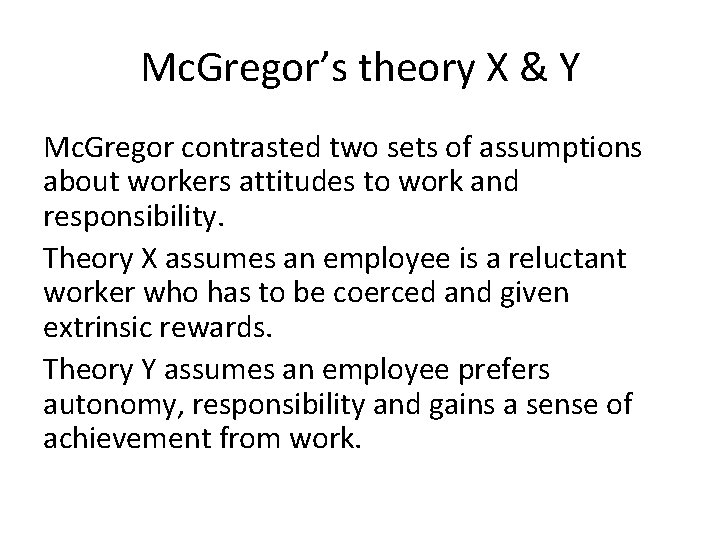
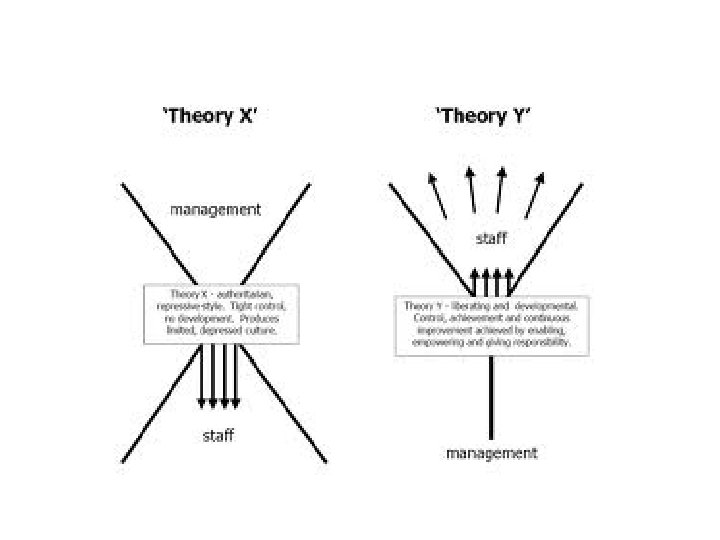
Mc. Gregor’s theory X & Y Mc. Gregor contrasted two sets of assumptions about workers attitudes to work and responsibility. Theory X assumes an employee is a reluctant worker who has to be coerced and given extrinsic rewards. Theory Y assumes an employee prefers autonomy, responsibility and gains a sense of achievement from work.
Mc. Gregor argued there are not two types of workers, but managers have two contrasting assumptions and this conditions their treatment of the workforce. Acceptance of a negative Theory X view of workers results in: • Autocratic leadership. • Traditional organisational structures. • Centralisation of decision making. • Scientific management. • A stress on extrinsic factors (pay and punishment). Acceptance of the more positive Theory Y results in: • Democratic or free rein style of leadership. • More flexible structures. • Decentralisation of decision making. • A search for appropriate ways of motivating the workforce. • A stress on factors intrinsic to the work itself.
David Mc. Clelland’s needs theory Mc. Clelland was concerned with differences between individuals more than understanding common factors in motivation. He identified: • n – Ach the need for achievement • n – Pow the need for power • n - Aff the needs for affiliation or belonging
The dominance or otherwise of these needs influences the behaviour of the individual. n – Ach is developed by cultural or environmental factors suggesting with appropriate training schemes it can be fostered within the work place. Mc. Clelland identified four steps to develop achievement. • Strive to attain feedback on performance – reinforcement of success serves to strengthen the desire to attain higher performance; • Develop models of achievement by seeking to emulate people who have performed well; • Attempt to modify their self-image and see themselves as needing challenges and success; • Control day-dreaming and think about themselves in more positive terms.
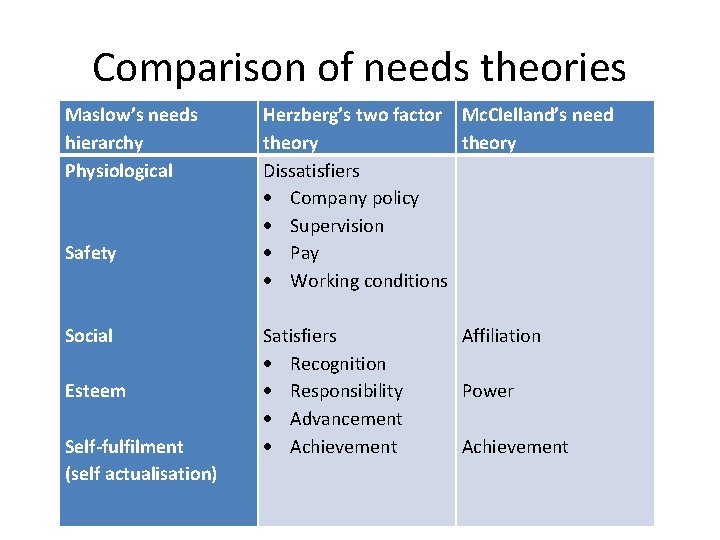
Comparison of needs theories Maslow’s needs hierarchy Physiological Safety Social Esteem Self-fulfilment (self actualisation) Herzberg’s two factor Mc. Clelland’s need theory Dissatisfiers Company policy Supervision Pay Working conditions Satisfiers Recognition Responsibility Advancement Achievement Affiliation Power Achievement
Expectancy theory (Vroom) To understand expectancy theory we need to consider why athletes train so hard. • There is a link between amount and type of training and performance. (training improves performance) • There is a link between performance and rewards (there is a gold medal for first across the line)
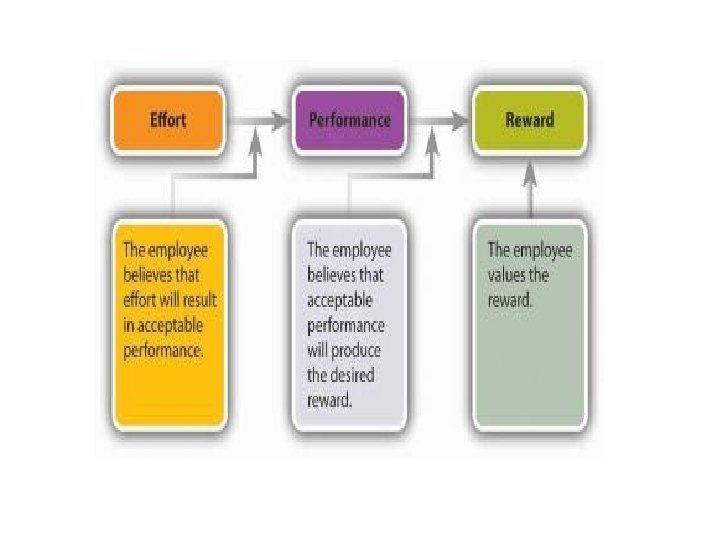
In expectancy theory effort is linked not just to the desire for a particular outcome, but is moderated by an evaluation (expectancy) that, if a particular course of action is followed, a particular outcome will be attained. The conclusions can be drawn are: - • Individuals will only act when they have a reasonable expectation that their behaviour will lead to the desired outcome. • Effort alone is insufficient – it has to be accompanied by ability and skills. • Performance (a sense of achievement) rather than the other way around. • Job design is, therefore, of crucial importance.
Key Concepts • Autocratic/authoritarian leader. A leader who makes all the decisions and then informs others. • Autonomy/independence. Employee autonomy is having the freedom and authority to make decisions • Democratic leader. One who accepts the decision of the majority. In business organisations it is rare that decisions are left to a majority of the workforce. IN practice, leaders might consult and allow limited scope for majority decisions, but retain ultimate control over key decisions.
Equity/fairness. Equity theory of motivation concerns subjective assessments of fairness of rewards in relation to input of effort. Expectancy theory. A theory of motivation that forces in the employees expectations of the outcome of effort. Free Rein/lassez faire leader. One who sets targets but leaves subordinates to determine how they are to be achieved.