
Leadership Is it important to have good leaders





- Slides: 21
Leadership • Is it important to have good leaders? • What makes a good leader? • What is the difference between leaders and managers? • What types of power do leaders utilize?
Leadership • Managers do things Right – Leaders do the Right Things • The act of influencing others to act toward the achievement of a goal • Process of providing direction, energizing, others, and obtaining commitment to the leaders cause • Leadership involves informal power rather than formal power
Power • Ability to influence others ideas, thoughts, or behaviors • Types of power – Legitimate – Reward – Coercive – Referent – Expert
15. 2 Consequences of Using 5 Types of Power Type of power used by leader n Expert n Referent n Reward n Legitimate n Coercive Most likely response from followers Commitment Compliance Resistance
Leadership Models • Trait models-focus on what characteristics make for good leaders • Behavioral models-what behaviors do good leaders demonstrate • Contingency models-matching of the followers with the right type of leader
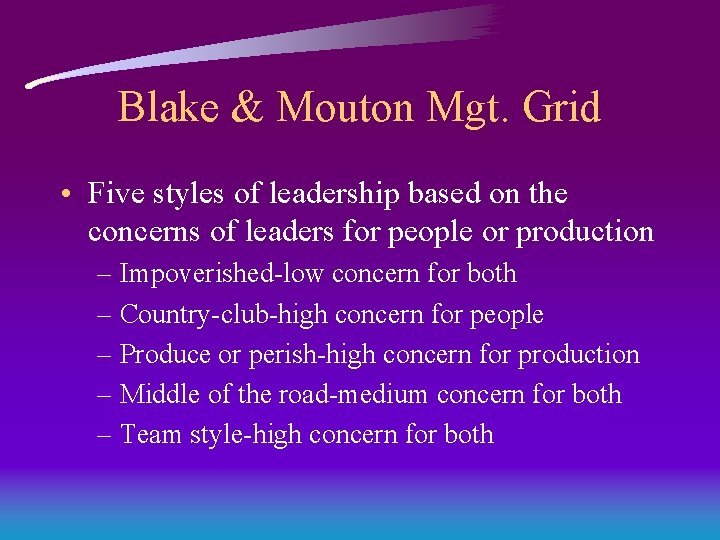
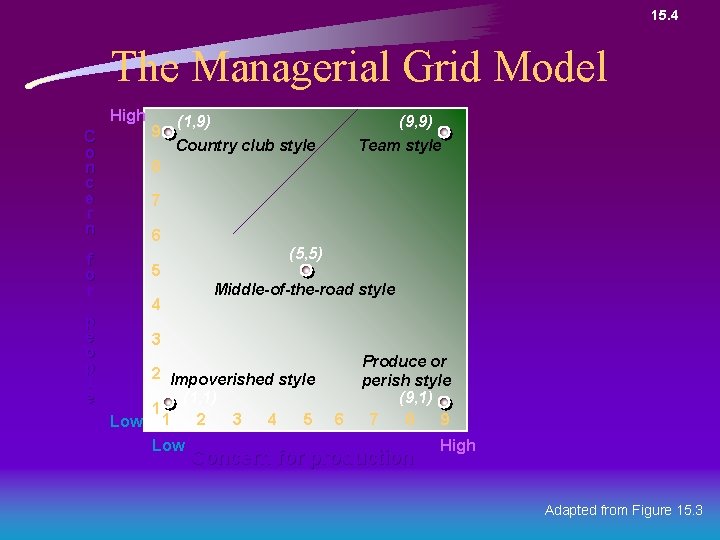
Blake & Mouton Mgt. Grid • Five styles of leadership based on the concerns of leaders for people or production – Impoverished-low concern for both – Country-club-high concern for people – Produce or perish-high concern for production – Middle of the road-medium concern for both – Team style-high concern for both
15. 4 The Managerial Grid Model High C o n c e r n f o r p e o p l e 9 (1, 9) (9, 9) Country club style Team style 8 7 6 5 4 (5, 5) Middle-of-the-road style 3 2 Impoverished style (1, 1) 1 2 3 4 5 Low 1 Low 6 Produce or perish style (9, 1) 7 8 9 Concern for production High Adapted from Figure 15. 3
Contingency Models-how leader acts w/various situational factors • Fiedler’s Contingency Model • Hersey and Blanchard’s Situational Leadership Model • Transactional versus Charismatic
15. 5 Situational Factors Influencing a Leader’s Effectiveness Maturity of followers Employee’s needs Traits Core Competencies Task structure Decision making Types and uses of power Leaderfollower relations Adapted from Figure 15. 4
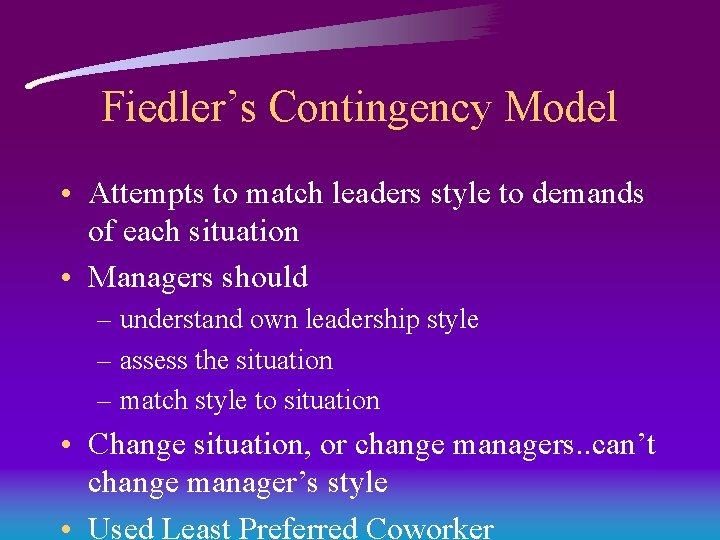
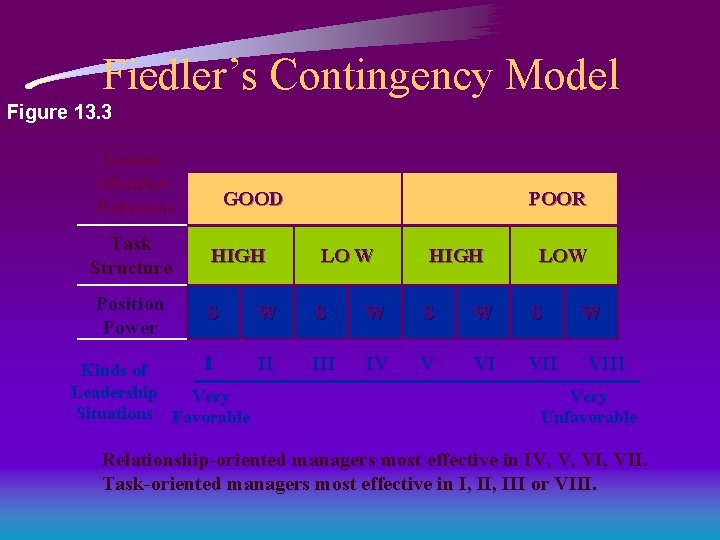
Fiedler’s Contingency Model • Attempts to match leaders style to demands of each situation • Managers should – understand own leadership style – assess the situation – match style to situation • Change situation, or change managers. . can’t change manager’s style • Used Least Preferred Coworker
Fiedler’s Contingency Model Figure 13. 3 Leader. Member Relations GOOD POOR Task Structure HIGH LO W HIGH Position Power S S W S III IV V VI VII W 1 I II Kinds of Leadership Very Situations Favorable LOW W VIII Very Unfavorable Relationship-oriented managers most effective in IV, V, VII. Task-oriented managers most effective in I, III or VIII.
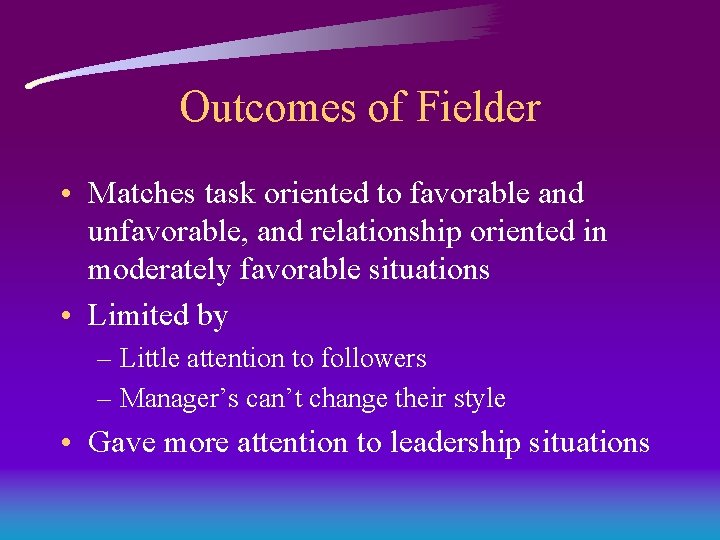
Outcomes of Fielder • Matches task oriented to favorable and unfavorable, and relationship oriented in moderately favorable situations • Limited by – Little attention to followers – Manager’s can’t change their style • Gave more attention to leadership situations
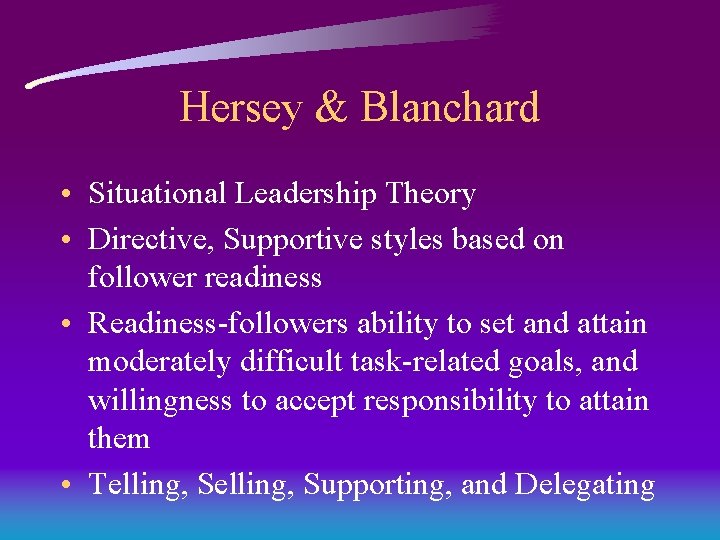
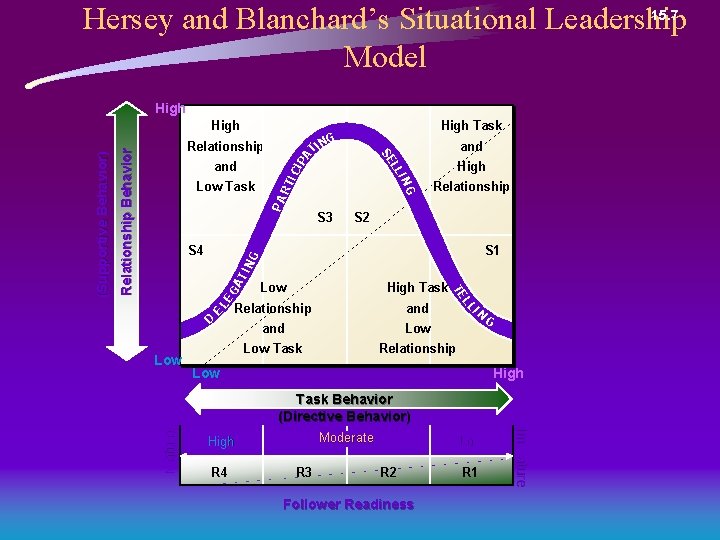
Hersey & Blanchard • Situational Leadership Theory • Directive, Supportive styles based on follower readiness • Readiness-followers ability to set and attain moderately difficult task-related goals, and willingness to accept responsibility to attain them • Telling, Supporting, and Delegating
15. 7 Hersey and Blanchard’s Situational Leadership Model High CI P AT PA Low Task RT I and S 3 High Relationship S 2 S 1 GA TI LE E High Task Relationship and Low Task Relationship D Low I LL TE Low and NG S 4 NG Relationship Behavior Relationship High Task G IN I LL SE N Low G High Task Behavior (Directive Behavior) Moderate High R 4 R 3 Low R 2 Follower Readiness R 1 Immature Mature (Supportive Behavior) High
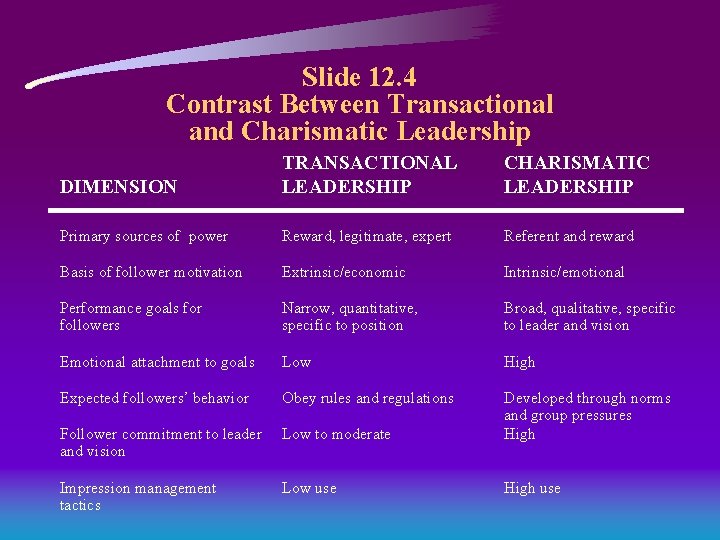
Slide 12. 4 Contrast Between Transactional and Charismatic Leadership DIMENSION TRANSACTIONAL LEADERSHIP CHARISMATIC LEADERSHIP Primary sources of power Reward, legitimate, expert Referent and reward Basis of follower motivation Extrinsic/economic Intrinsic/emotional Performance goals for followers Narrow, quantitative, specific to position Broad, qualitative, specific to leader and vision Emotional attachment to goals Low High Expected followers’ behavior Obey rules and regulations Follower commitment to leader and vision Low to moderate Developed through norms and group pressures High Impression management tactics Low use High use
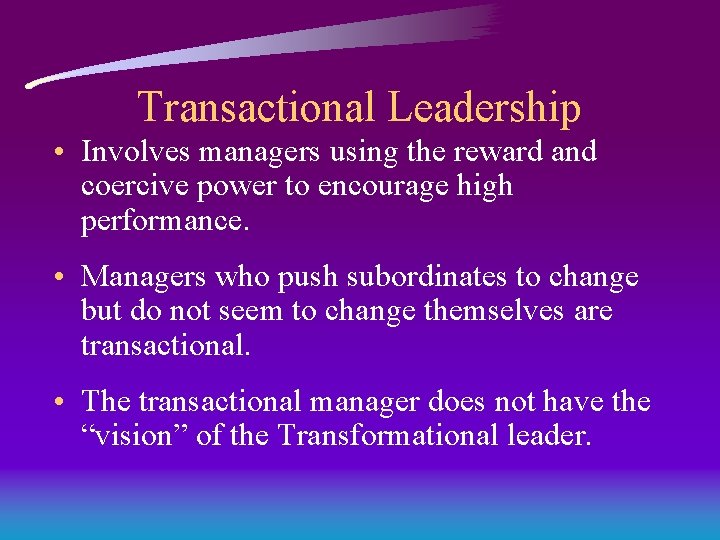
Transactional Leadership • Involves managers using the reward and coercive power to encourage high performance. • Managers who push subordinates to change but do not seem to change themselves are transactional. • The transactional manager does not have the “vision” of the Transformational leader.
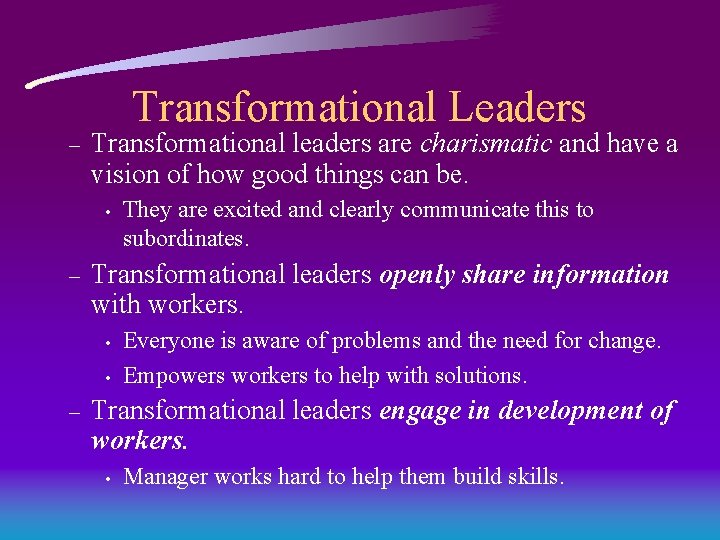
Transformational Leaders – Transformational leaders are charismatic and have a vision of how good things can be. • – Transformational leaders openly share information with workers. • • – They are excited and clearly communicate this to subordinates. Everyone is aware of problems and the need for change. Empowers workers to help with solutions. Transformational leaders engage in development of workers. • Manager works hard to help them build skills.
Slide 12. 5 Components of the Transformational Leadership Model * Idealized influence * Inspirational motivation * Intellectual stimulation * Individualized consideration Transactional Leadership Model Charismatic Leadership Model Attribution Leadership Model
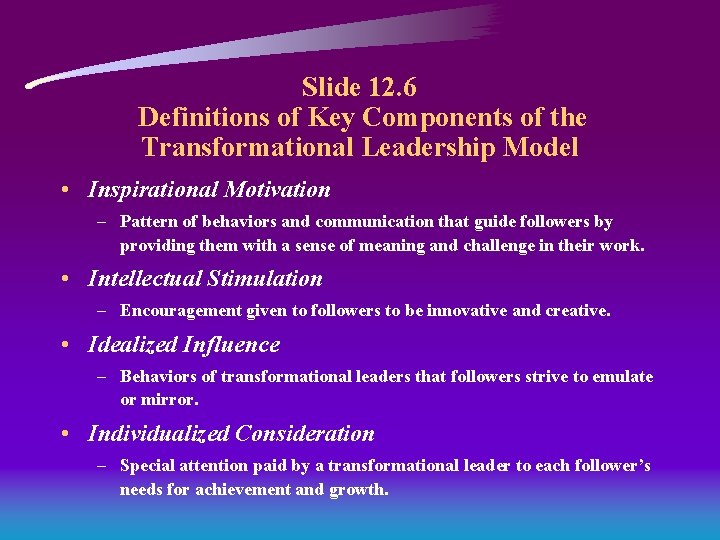
Slide 12. 6 Definitions of Key Components of the Transformational Leadership Model • Inspirational Motivation – Pattern of behaviors and communication that guide followers by providing them with a sense of meaning and challenge in their work. • Intellectual Stimulation – Encouragement given to followers to be innovative and creative. • Idealized Influence – Behaviors of transformational leaders that followers strive to emulate or mirror. • Individualized Consideration – Special attention paid by a transformational leader to each follower’s needs for achievement and growth.
Slide 12. 8 Do Leaders Matter? • Leadership Irrelevance – Leadership may be irrelevant for many organizational outcomes. • Leadership Substitutes – Leader success depends on the characteristics of the followers, team, situation, and organization. Each can act as a substitute for leader behavior.
Leader-Substitute Model – Leadership substitute: acts in the place of a leader and makes leadership unnecessary. Possible substitutes can be found: • • • – Characteristics of Subordinates: their skills, experience, motivation. Characteristics of context: the extent to which work is interesting and fun. Worker empowerment or Self-managed work teams reduce leadership needs. Managers need to be aware that they do not always need to directly exert influence over workers.