
LEADERSHIP IN LTC MODULE 4 PRESENTED BY OBJECTIVES

LEADERSHIP IN LTC MODULE 4 PRESENTED BY:
OBJECTIVES: MODULE 4 • Understand sources and consequences of conflict in the long-term care (LTC) workplace • Understand apply principles of conflict resolution to effective communication strategies • Reflect on personal conflict response behaviours • Generate solutions to LTC-specific scenarios using the principles of conflict resolution and negotiation 2 | CLRI-LTC. CA
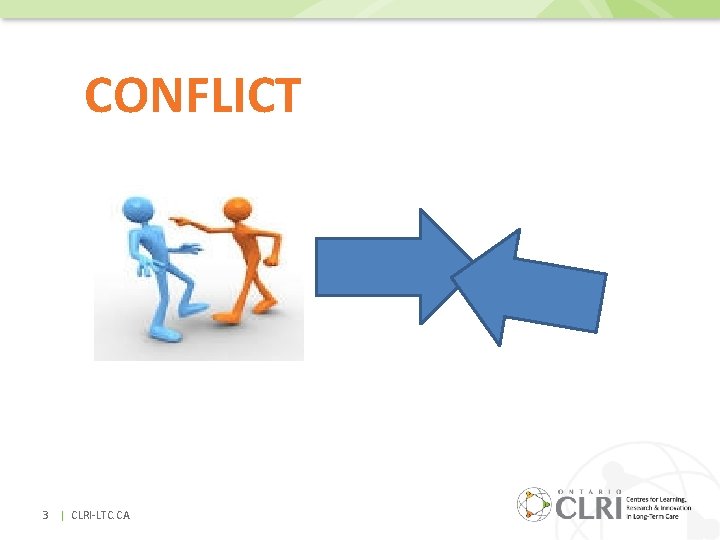
CONFLICT 3 | CLRI-LTC. CA
EVERY DAY YOU MANAGE CONFLICT “Conflict is a universal human experience, something that every single one of us works with and addresses in our lives far beyond the workplace. In that sense, we are all practitioners when it comes to working with conflict…” (Gary T. Furlong, 2005) 4 | CLRI-LTC. CA
WHAT MATTERS MOST “What matters most is how you think, feel and respond to conflict situations. Acknowledging how you perceive conflict and how you feel when in conflict is a part of self-awareness and leads to opportunities for personal and professional growth. ” (Beebe, Beebe & Ivy, 2013) 5 | CLRI-LTC. CA
INTERPERSONAL SOURCES OF CONFLICT IN THE WORKPLACE 1. Different expectations 2. Threats to self 3. Differences in role hierarchy 4. Clinical situation constraints (Arnold & Boggs, 2014) 6 | CLRI-LTC. CA
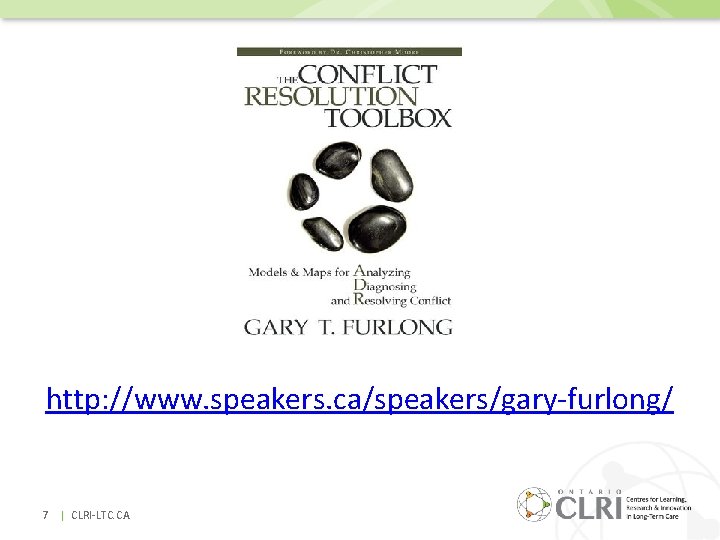
http: //www. speakers. ca/speakers/gary-furlong/ 7 | CLRI-LTC. CA
COST OF CONFLICT • • • Loss of productivity Loss of focus Draining of emotional energy Stress Strained or terminated relationships Lower morale Damaged reputation More time spent on the conflict More money and other resources spent on the conflict 8 | CLRI-LTC. CA
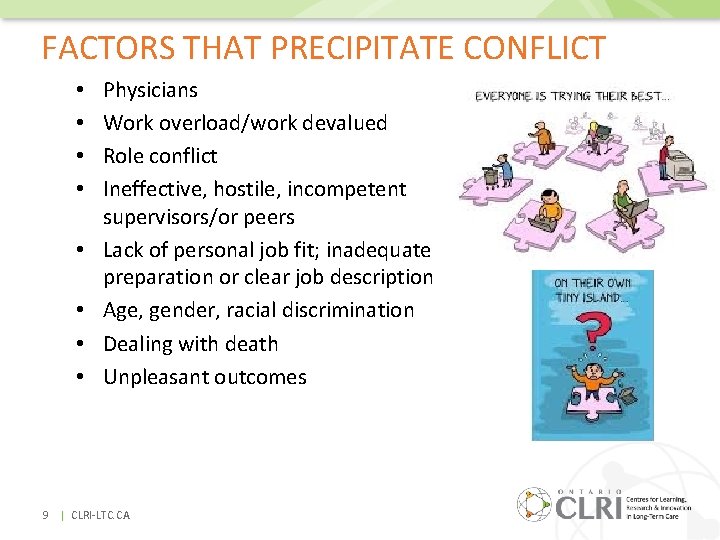
FACTORS THAT PRECIPITATE CONFLICT • • Physicians Work overload/work devalued Role conflict Ineffective, hostile, incompetent supervisors/or peers Lack of personal job fit; inadequate preparation or clear job description Age, gender, racial discrimination Dealing with death Unpleasant outcomes 9 | CLRI-LTC. CA
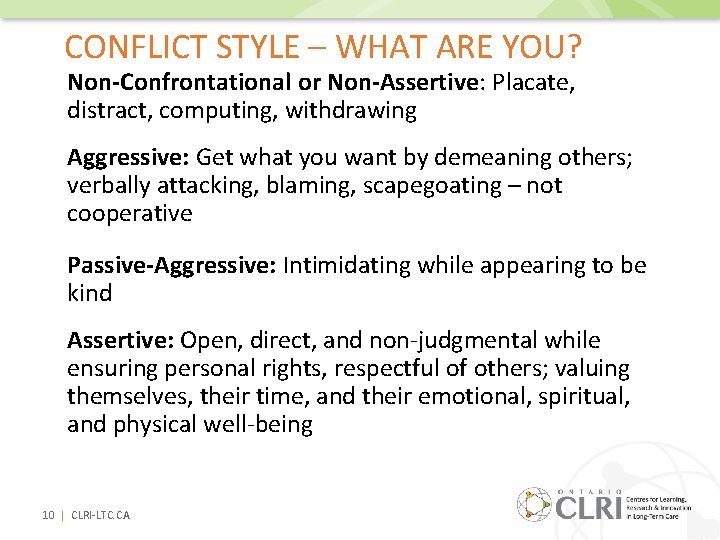
CONFLICT STYLE – WHAT ARE YOU? Non-Confrontational or Non-Assertive: Placate, distract, computing, withdrawing Aggressive: Get what you want by demeaning others; verbally attacking, blaming, scapegoating – not cooperative Passive-Aggressive: Intimidating while appearing to be kind Assertive: Open, direct, and non-judgmental while ensuring personal rights, respectful of others; valuing themselves, their time, and their emotional, spiritual, and physical well-being 10 | CLRI-LTC. CA
ACTIVITY: BEING ASSERTIVE 11 | CLRI-LTC. CA
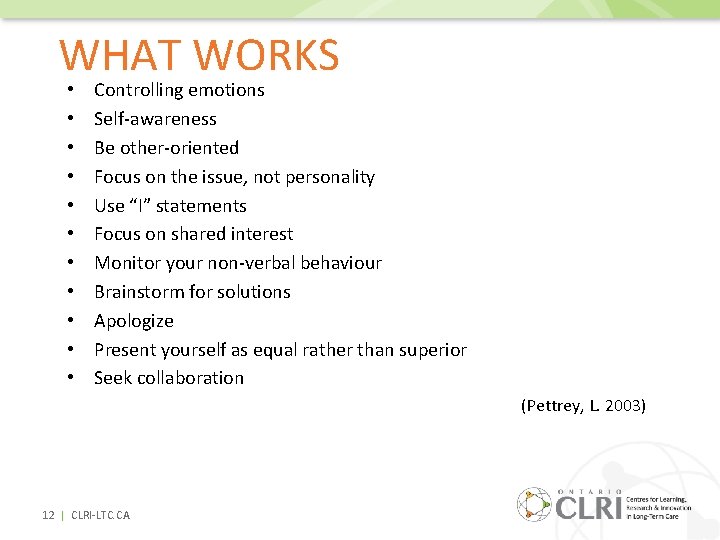
WHAT WORKS • • • Controlling emotions Self-awareness Be other-oriented Focus on the issue, not personality Use “I” statements Focus on shared interest Monitor your non-verbal behaviour Brainstorm for solutions Apologize Present yourself as equal rather than superior Seek collaboration (Pettrey, L. 2003) 12 | CLRI-LTC. CA
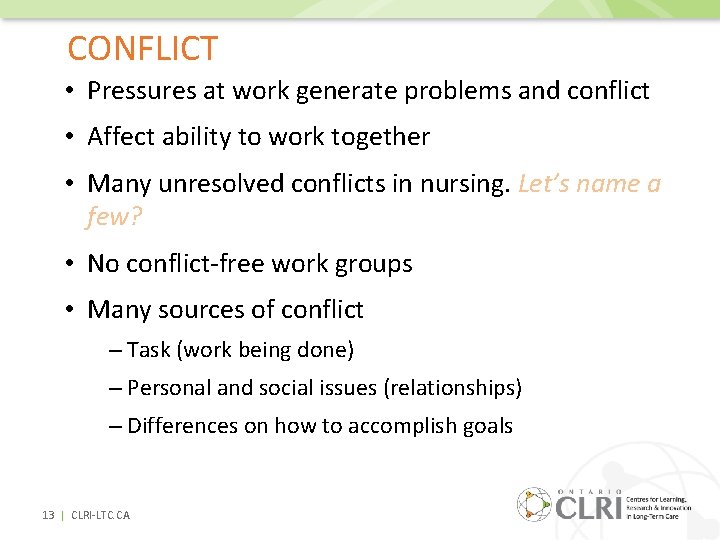
CONFLICT • Pressures at work generate problems and conflict • Affect ability to work together • Many unresolved conflicts in nursing. Let’s name a few? • No conflict-free work groups • Many sources of conflict – Task (work being done) – Personal and social issues (relationships) – Differences on how to accomplish goals 13 | CLRI-LTC. CA
INTERPERSONAL CONFLICT Different Expectations: – Putting a patient in an unsafe situation because of something you are asked to do – Not being listened to – Told to spend more time with one over another – Asked to provide a patient with information you are not supposed to give Threats to Self: – Maintaining a sense of self 14 | CLRI-LTC. CA
Interpersonal Conflict Differences in Role Hierarchy: – Differences in education or experience – RN/RPN degree versus diploma prepared – Differences in responsibility – financial rewards or incentives not perceived as equal Clinical Situation Constraints: – Need to make immediate decisions – critical thinking – ‘what do I let go of? ’ – Complexity and acuity levels – currently on rise 15 | CLRI-LTC. CA
CAUSES OF CONFLICT WITH RESIDENTS Nurse Factors: – Judges or labels residents – Threatening tone of voice – Expectations based on incorrect perceptions of cultural or other differences – Does not listen to concerns of family – Does not provide sufficient health information – Does not reflect on the impact of personal behaviour on the resident 16 | CLRI-LTC. CA
• Respect in the work place – role model • Understand stress of new nurse – mentor and support • Critical self-reflection: o o What was it like for me? What helped me? What hindered me? How do I want to be treated? • Are you stressed? o Back to reflection – why am I acting the way I am? PREVENTION 17 | CLRI-LTC. CA
RESOLVING CONFLICTS • Effective communication • Remember aim: effective work environment and not to defeat the other party • Win-win situation - consensus • Requires compromise o One side gets everything – then other side loses o Checks and balances – what can you give up? o Negotiation o Try to find a solution where people feel heard and respected 18 | CLRI-LTC. CA
![CONFLICT RESOLUTION (S. T. A. B. E. N. ] SOURCE TIME AND PLACE AMICABLE](http://slidetodoc.com/presentation_image_h/3799f5d4aa80c87afdb027cd6fe97762/image-19.jpg "CONFLICT RESOLUTION (S. T. A. B. E. N. ] SOURCE TIME AND PLACE AMICABLE")
CONFLICT RESOLUTION (S. T. A. B. E. N. ] SOURCE TIME AND PLACE AMICABLE APPROACH BEHAVIOUR EMOTION NEED 19 | CLRI-LTC. CA
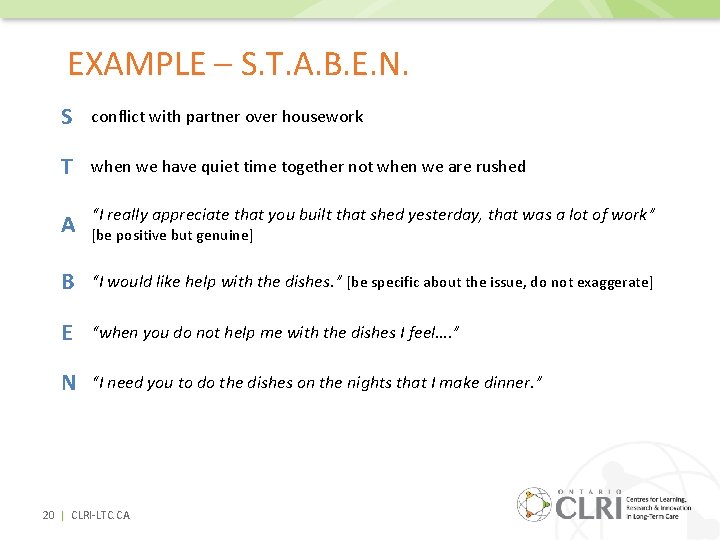
EXAMPLE – S. T. A. B. E. N. S conflict with partner over housework T when we have quiet time together not when we are rushed A “I really appreciate that you built that shed yesterday, that was a lot of work” B “I would like help with the dishes. ” [be specific about the issue, do not exaggerate] E “when you do not help me with the dishes I feel…. ” N “I need you to do the dishes on the nights that I make dinner. ” [be positive but genuine] 20 | CLRI-LTC. CA
INTERFERENCE WITH COMMUNICATION • • • Accusations Making interpretations “you always…. ”, “you never…”, “you make me…” Psychiatric word describing behaviour: paranoid, psychotic, acting-out, depressed, obsessive Poor eye contact (culturally specific) Non-committal facial expression Invasion of personal space Continuing with activity while the other is speaking Obvious impatience 21 | CLRI-LTC. CA
POSITIVE EFFECTS OF CONFLICT 1. Energizes people 2. Involves searching for a resolution 3. Conflict is a form of communication 4. Provides an outlet for pent up tensions and possible healing 5. Can be an educational experience 22 | CLRI-LTC. CA
GENERATE POSSIBLE SOLUTIONS • Try to generate new solutions – focus on change • People may try to repeat what is old • Encourage everyone to come up with at least one solution to discuss • Brainstorm – individually and then as a group • Everyone needs to hear all ideas and listen actively • Evaluate 23 | CLRI-LTC. CA
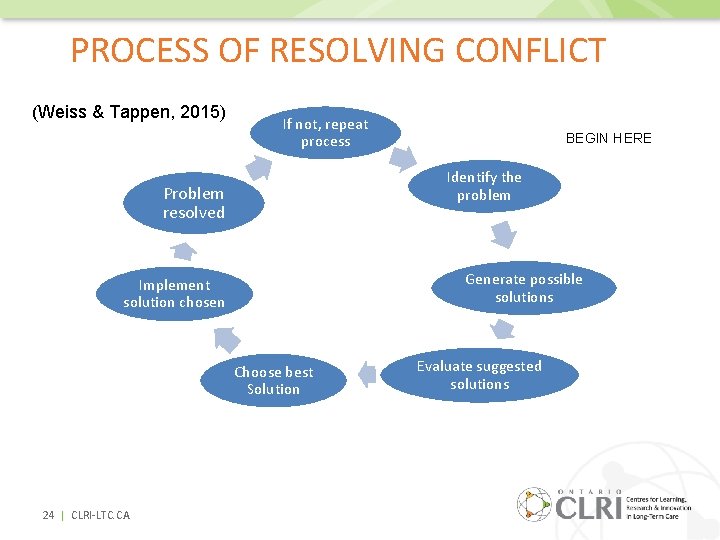
PROCESS OF RESOLVING CONFLICT (Weiss & Tappen, 2015) If not, repeat process Identify the problem Problem resolved Generate possible solutions Implement solution chosen Choose best Solution 24 | CLRI-LTC. CA BEGIN HERE Evaluate suggested solutions
NEGOTIATING AN AGREEMENT Scope the Situation – What am I trying to achieve? – What is the environment in which I am operating? – What problems am I likely to encounter? – What does the other side want? 25 | CLRI-LTC. CA
NEGOTIATING AN AGREEMENT Set the Stage – Confront with direct statements that open the communication – Avoid blame Conduct the Negotiation – – – Manage the emotions Set ground rules Clarification of the problem Opening move Continue the negotiation 26 | CLRI-LTC. CA
CASE STUDY At your table there is a case study on conflict. Take 15 minutes to identify/discuss the key issues of the conflict. 27 | CLRI-LTC. CA
REFERENCES Arnold, E. C. , & Boggs, K. U. (2014). Interpersonal Relationships: Professional Communication Skills for Nurses. (7 th ed. ). St. Louis, Missouri: Elsevier. Beebe, S. A. , Beebe, S. J. , & Ivy, D. (2013). Communication principles for a lifetime (5 th ed. ) Toronto, ON: Pearson, Allyn & Bacon. Furlong, G. T. (2005). The conflict resolution toolbox. Models & maps for analyzing, diagnosing, and resolving conflict. Mississauga, Ontario: John Wiley & Sons Canada, Ltd. 28 | CLRI-LTC. CA
REFERENCES Lazoritz & Carlson, (2008). In Weiss, S. A. , & Tappen, R. M. (2015). Essentials of Nursing Leadership and Management. (6 th ed. ). Philadelphia: F. A. Davis Company. Pettrey, L. (2003). Who let the dogs out? Managing conflict with courage and skill. Critical Care Nursing, 23, 21 -24. http: //ccn. aacnjournals. org Weiss, S. A. , & Tappen, R. M. (2015). Essentials of Nursing Leadership and Management. (6 th ed. ). Philadelphia: F. A. Davis Company. 29 | CLRI-LTC. CA
- Slides: 29