
Leadership in LTC Module 2 Define the five

- Slides: 26
Leadership in LTC Module 2
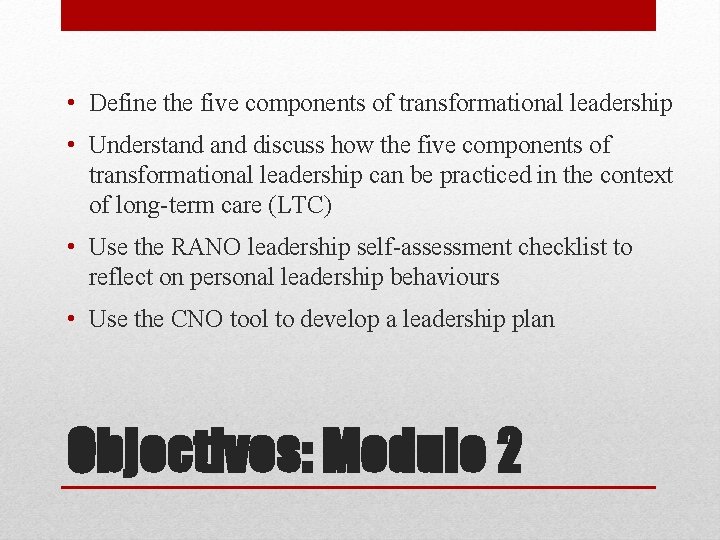
• Define the five components of transformational leadership • Understand discuss how the five components of transformational leadership can be practiced in the context of long-term care (LTC) • Use the RANO leadership self-assessment checklist to reflect on personal leadership behaviours • Use the CNO tool to develop a leadership plan Objectives: Module 2
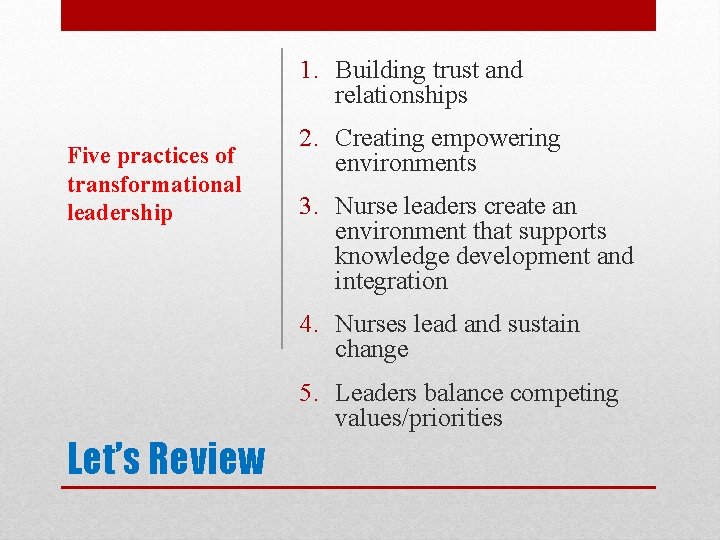
1. Building trust and relationships Five practices of transformational leadership 2. Creating empowering environments 3. Nurse leaders create an environment that supports knowledge development and integration 4. Nurses lead and sustain change 5. Leaders balance competing values/priorities Let’s Review
• What type of leader are you? • What type of leader have you worked with? • How do you adapt to different leaders styles? • Why do you have to adapt?
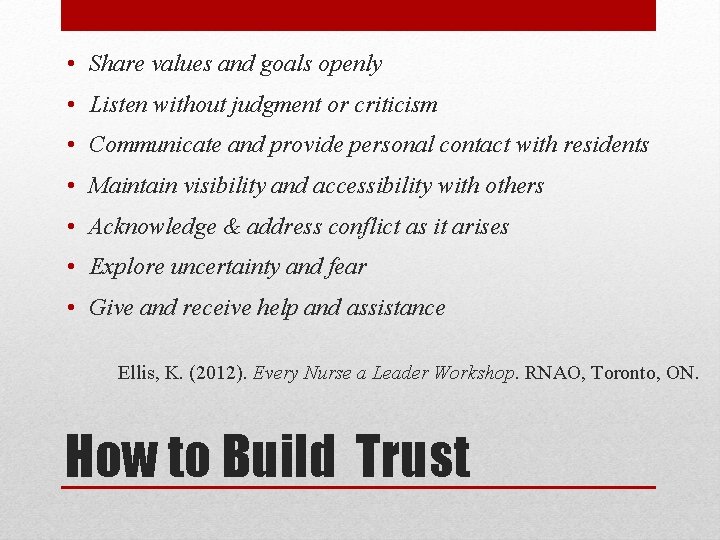
• Share values and goals openly • Listen without judgment or criticism • Communicate and provide personal contact with residents • Maintain visibility and accessibility with others • Acknowledge & address conflict as it arises • Explore uncertainty and fear • Give and receive help and assistance Ellis, K. (2012). Every Nurse a Leader Workshop. RNAO, Toronto, ON. How to Build Trust
• Act/speak inconsistently • Seek personal not shared gain • Withhold information • Lie or tell half-truths • Be close-minded (Lewicki & Bunker, 1996) How Trust is Lost
• Acknowledge trust been broken • Admit incident/error occurred • Accept responsibility for incident • Offer to make amends: • “What can I do to make it right? ” • “What can I do to gain your trust back? ” How to Repair Lost Trust
• Identify three things you do to instill trust with clients/families. • Identify three things you do to instill trust with colleagues. • When was trust lost? • How did you repair it? Or, did you? ACTIVITY: How Do YOU Build Trust?
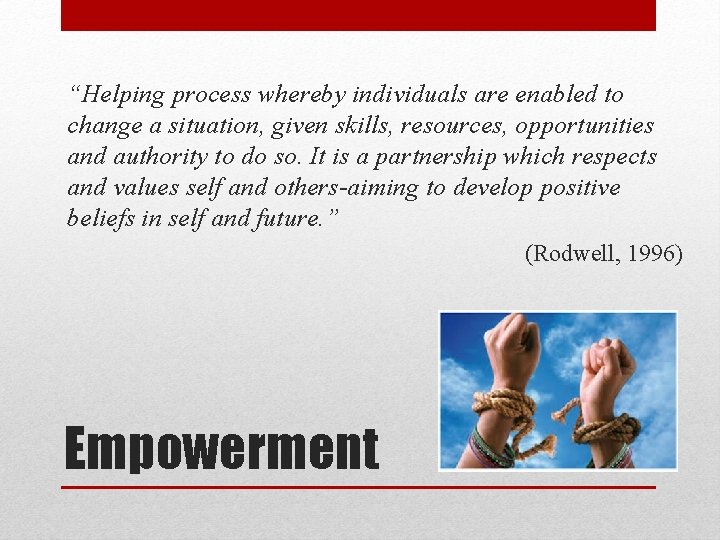
“Helping process whereby individuals are enabled to change a situation, given skills, resources, opportunities and authority to do so. It is a partnership which respects and values self and others-aiming to develop positive beliefs in self and future. ” (Rodwell, 1996) Empowerment
• Fear of risk • Change in self-perception • Not everyone will be the same • Thoughts of nothing to add • Limitation of resources • Not having administrative support Barriers to Empowerment
• Encourage individual growth • Reward work well done • Mediate disputes quickly and fairly • Communicate clearly and listen actively • Accept input and ideas from everyone • Use guidelines rather than regulations • Train and coach for excellence • Settle differences rather than stifle opposition • Lead by example and foster mutual respect Become a Builder of People
• Each table has two “guides to empowerment scenarios” • Divide into two teams at your table and read one scenario • Each team is responsible to empower the other team at the table using the principles identified in Practice # 2 of Transformational leadership • You will have 5 minutes to brainstorm • You will then have 5 minutes each to empower each other using the scenario ACTIVITY
NURSES LEAD AND SUPPORT CHANGE Successful change occurs when: • Staff are engaged • Leaders are committed • Change is able to meet intended goals • There’s effective communication • Staff are supported throughout http: //rnao. ca/bpg/guidelines/developing-and-sustaining-nursing-leadership
Can you think of a time when… • You wanted to implement a change of some kind in the workplace? • What helped to facilitate the change? • What might have hindered the change? • Or what stopped you from trying? • What would you do in the future to implement change? ACTIVITY
Nurse leaders create an environment that supports knowledge development and integration • Environments conducive and committed to knowledge, creating, sharing, and use • Atmosphere of openness & psychological safety
Leaders balance competing values/priorities • Recognize demands of environment • Promote balance • Understand competing realities for time
Does your institution have transformational leadership? • IF YES: write down and share with your group what components your institution has • IF NO: reflect on what is missing in your organization and propose suggestions for change What can your organization build upon? ACTIVITY: Flip Charts
Now let’s reflect on YOU as a leader
• Complete the leadership selfassessment check lists provided as a handout • Use them to identify practices that you would like to enhance or develop. RNAO Leadership Self-Assessment http: //rnao. ca/sites/rnao-ca/files/LEADERSHIP_16. 5_x_8. 5_WEB_0. pdf ACTIVITY: Personal Reflection
STRENGTHS-BASED NURSING LEADERSHIP (GOTTLIEB, SHAMIAN, 2012)
• Strengths-based nursing care (SBC) is about “mobilizing, capitalizing, and developing a person’s strengths to promote health and facilitate healing. ” (Gottlieb, Gottlieb & Shamian, 2012, p. 38) • Shift of SBC lends itself to strengths-based nursing leadership (SBNL) • Focus today is on primary health care, health promotion, and inter-professional care • Shift from the “shame/blame” approach to empower those within to make change Strengths-Based Nursing Care
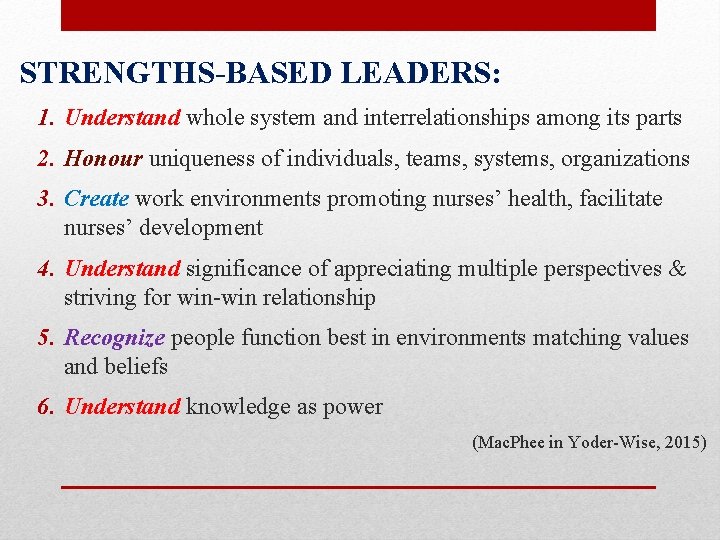
STRENGTHS-BASED LEADERS: 1. Understand whole system and interrelationships among its parts 2. Honour uniqueness of individuals, teams, systems, organizations 3. Create work environments promoting nurses’ health, facilitate nurses’ development 4. Understand significance of appreciating multiple perspectives & striving for win-win relationship 5. Recognize people function best in environments matching values and beliefs 6. Understand knowledge as power (Mac. Phee in Yoder-Wise, 2015)
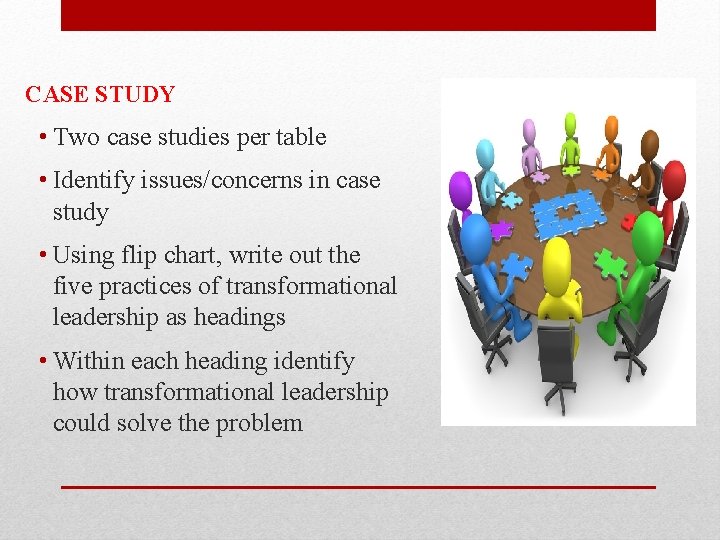
CASE STUDY • Two case studies per table • Identify issues/concerns in case study • Using flip chart, write out the five practices of transformational leadership as headings • Within each heading identify how transformational leadership could solve the problem
Using the Canadian Nurses’ Organization (CNO) tool, develop a leadership plan to review with your administrator. CNO resources for developing SMART learning goals: https: //www. cno. org/globalassets/docs/qa/developingsmartgoals. pdf http: //www. cno. org/en/myqa/qa-resources/are-your-learning-goals-smart/ Leadership Plan
Canadian Nurses Organization, (2014). Developing SMART Learning Goals. Retrieved: from https: //www. cno. org/globalassets/docs/qa/developingsmartgoals. pdf Ellis, K. (2012). Registered Nurses’ Association of Ontario : Every Nurse a Leader Workshop. Toronto, ON. Gottlieb, L. N. , Gottlieb, B. , & Shamian, J. (2012). Principles of strengthsbased nursing leadership for strengths-based nursing care: a new paradigm for nursing and healthcare for the 21 st century. Nursing Leadership (Toronto, Ont. ), 25(2), 38 -50. Retrieved from: http: //www. longwoods. com/content/22960 Mac. Phee, M. (2015). Leading, Managing, and Following. In Yoder-Wise, P. Leading and Managing in Canadian Nursing, pp. 5 -22. Toronto: Elsevier. References
Lewicki, R. , & Bunker, B. (1996). Developing and maintaining trust in work relationships. In Kramer, R. N. , Tyler T. R. (Eds. ), Trust in organizations: Frontiers in theory and research, pp. 114 -139. Thousand Oaks, CA: Sage. Rodwell, C. M. (1996). An analysis of the concept of empowerment. Journal of Advanced Nursing, 23(2), 215 -421. Registered Nurses’ Association of Ontario, (2013). Developing and Sustaining Nursing Leadership Best Practice Guidelines. Retrieved from: http: //rnao. ca/bpg/guidelines/developing-and-sustaining-nursing-leadership Registered Nurses’ Association of Ontario, (2014). Developing and Sustaining Nursing Leadership: Tips and Tools. Retrieved from: http: //rnao. ca/sites/rnao-ca/files/LEADERSHIP_16. 5_x_8. 5_WEB_0. pdf References