
Leadership Development Series Training Module 2 Handout Intermediate


- Slides: 40
Leadership Development Series Training: Module 2: Handout Intermediate I – Leading People Managing Culture
Program Overview Essential II Intermediate II Advanced II Managing People Leading Teams Reflecting Leadership Leading Strategy Module 1 Welcome to your new Role and the Leadership Development Series Module 1 Leadership Tools & Communication Module 1 Leadership Styles & Models Building High Performance Teams Reflection on Leadership Style Leadership Vision Module 2 tbd Module 2 Talent Management & Enhancing Performance Module 2 Managing Culture Coaching & Mentoring Inspirational Leadership/ Empowerment/ Exemplary Behavior Strategic Management Module 3 Conflict Management Leading Change Impression Management/ Convincing & Influencing Henkel Leadership Brand Work-Life-Balance/ Mental Health Organizational Leadership Challenges Module 3 Your first 100 days as a leader Part I & II Module 4 Foundations for Operational Leadership @ Henkel 2 Leadership Development Series
Contents 1. Introduction 2. Intercultural Competence 3. Cultural Differences and Challenges 4. Intercultural Communication – Verbal 5. Intercultural Communication – Nonverbal 6. Multicultural and Virtual Teams 3 Leadership Development Series
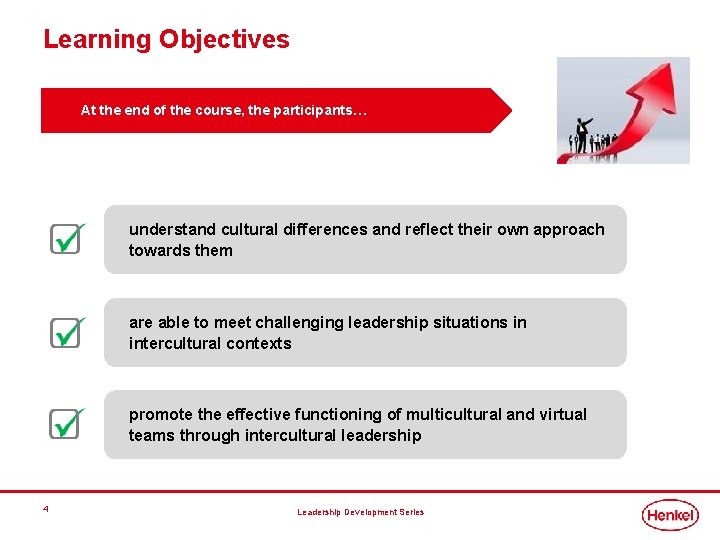
Learning Objectives At the end of the course, the participants… understand cultural differences and reflect their own approach towards them are able to meet challenging leadership situations in intercultural contexts promote the effective functioning of multicultural and virtual teams through intercultural leadership 4 Leadership Development Series
Contents 1. Introduction 2. Intercultural Competence 3. Cultural Differences and Challenges 4. Intercultural Communication – Verbal 5. Intercultural Communication – Nonverbal 6. Multicultural and Virtual Teams 5 Leadership Development Series
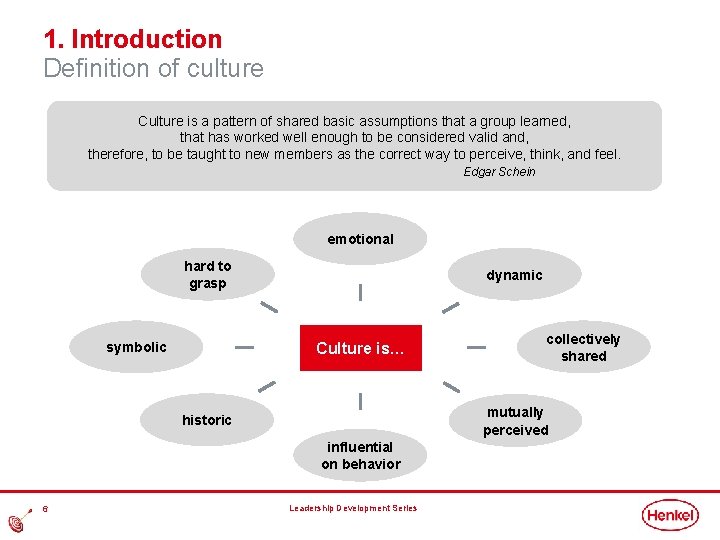
1. Introduction Definition of culture Culture is a pattern of shared basic assumptions that a group learned, that has worked well enough to be considered valid and, therefore, to be taught to new members as the correct way to perceive, think, and feel. Edgar Schein emotional hard to grasp symbolic dynamic Culture is… mutually perceived historic influential on behavior 6 collectively shared Leadership Development Series
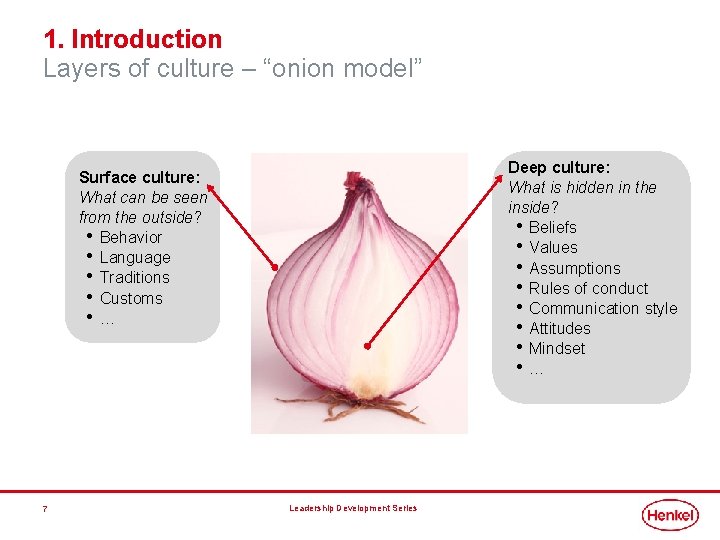
1. Introduction Layers of culture – “onion model” Deep culture: What is hidden in the inside? • Beliefs • Values • Assumptions • Rules of conduct • Communication style • Attitudes • Mindset • … Surface culture: What can be seen from the outside? • Behavior • Language • Traditions • Customs • … 7 Leadership Development Series
1. Introduction Contexts of cultural imprint – what forms us? Individual dispositions Region Language Rules of conduct Family Individual culture Religion, worldview Values Peers Nationality Traditions, habits Rituals Media 8 Gender Insight into other cultures Leadership Development Series
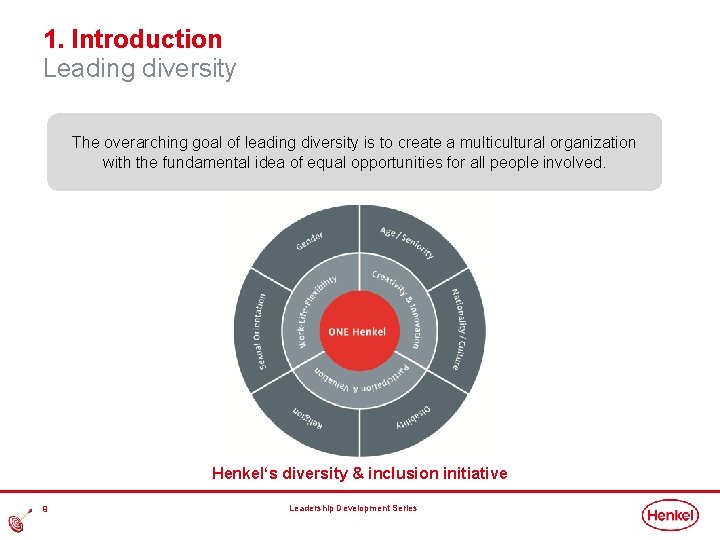
1. Introduction Leading diversity The overarching goal of leading diversity is to create a multicultural organization with the fundamental idea of equal opportunities for all people involved. Henkel‘s diversity & inclusion initiative 9 Leadership Development Series
Contents 1. Introduction 2. Intercultural Competence 3. Cultural Differences and Challenges 4. Intercultural Communication – Verbal 5. Intercultural Communication – Nonverbal 6. Multicultural and Virtual Teams 10 Leadership Development Series
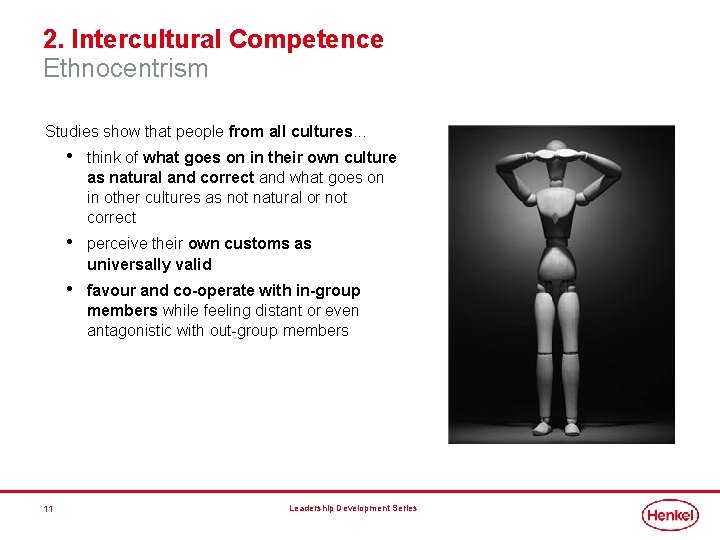
2. Intercultural Competence Ethnocentrism Studies show that people from all cultures. . . • think of what goes on in their own culture as natural and correct and what goes on in other cultures as not natural or not correct • perceive their own customs as universally valid • favour and co-operate with in-group members while feeling distant or even antagonistic with out-group members 11 Leadership Development Series
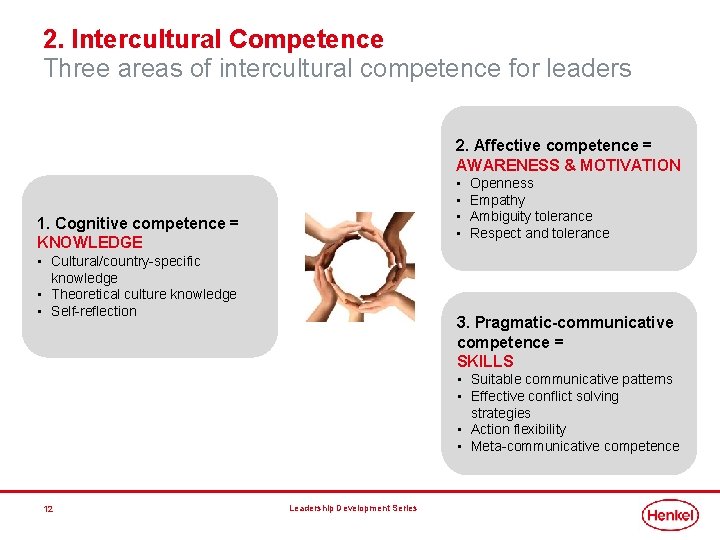
2. Intercultural Competence Three areas of intercultural competence for leaders 2. Affective competence = AWARENESS & MOTIVATION • • 1. Cognitive competence = KNOWLEDGE • Cultural/country-specific knowledge • Theoretical culture knowledge • Self-reflection Openness Empathy Ambiguity tolerance Respect and tolerance 3. Pragmatic-communicative competence = SKILLS • Suitable communicative patterns • Effective conflict solving strategies • Action flexibility • Meta-communicative competence 12 Leadership Development Series
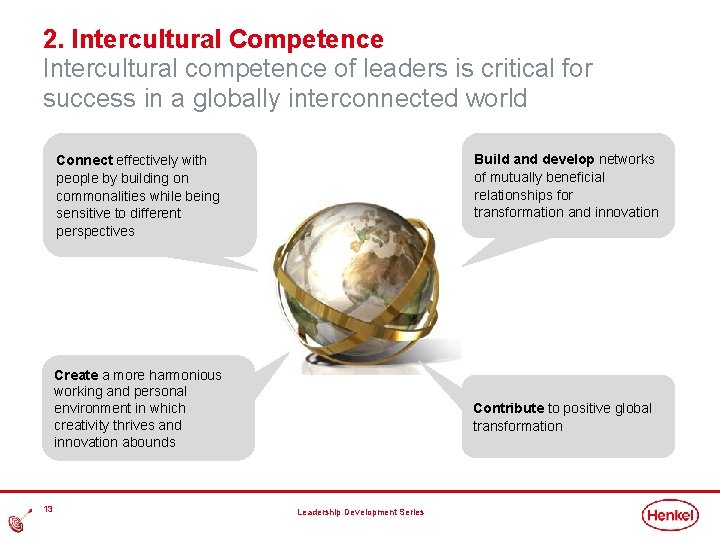
2. Intercultural Competence Intercultural competence of leaders is critical for success in a globally interconnected world Build and develop networks of mutually beneficial relationships for transformation and innovation Connect effectively with people by building on commonalities while being sensitive to different perspectives Create a more harmonious working and personal environment in which creativity thrives and innovation abounds 13 Contribute to positive global transformation Leadership Development Series
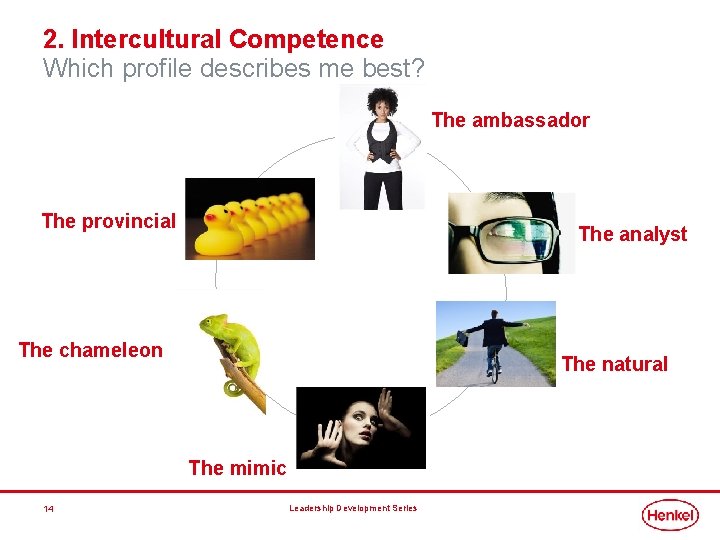
2. Intercultural Competence Which profile describes me best? The ambassador The provincial The analyst The chameleon The natural The mimic 14 Leadership Development Series
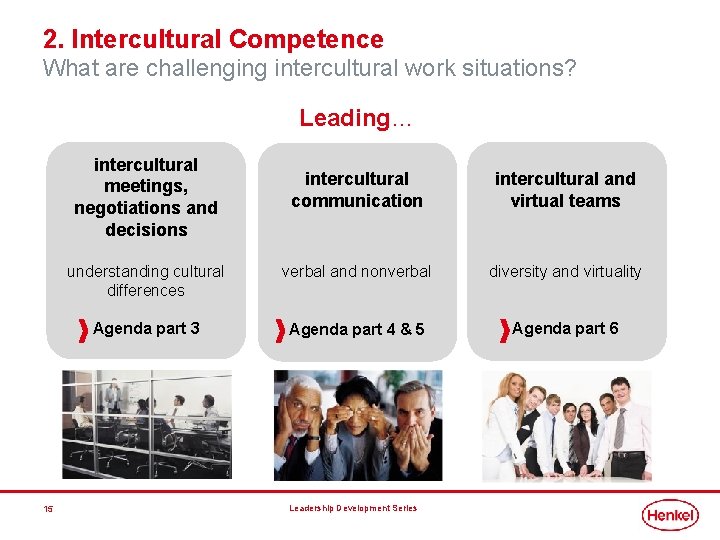
2. Intercultural Competence What are challenging intercultural work situations? Leading… intercultural meetings, negotiations and decisions 15 intercultural communication intercultural and virtual teams understanding cultural differences verbal and nonverbal diversity and virtuality Agenda part 3 Agenda part 4 & 5 Agenda part 6 Leadership Development Series
Contents 1. Introduction 2. Intercultural Competence 3. Cultural Differences and Challenges 4. Intercultural Communication – Verbal 5. Intercultural Communication – Nonverbal 6. Multicultural and Virtual Teams 16 Leadership Development Series
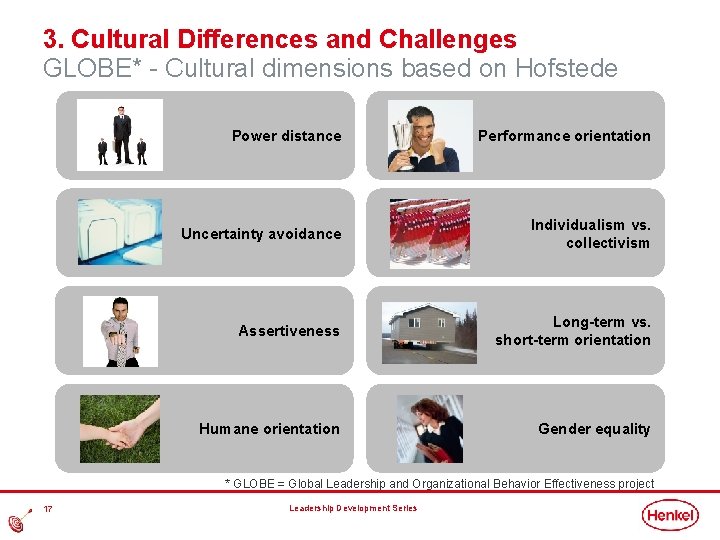
3. Cultural Differences and Challenges GLOBE* - Cultural dimensions based on Hofstede Power distance Performance orientation Uncertainty avoidance Individualism vs. collectivism Assertiveness Long-term vs. short-term orientation Humane orientation Gender equality * GLOBE = Global Leadership and Organizational Behavior Effectiveness project 17 Leadership Development Series
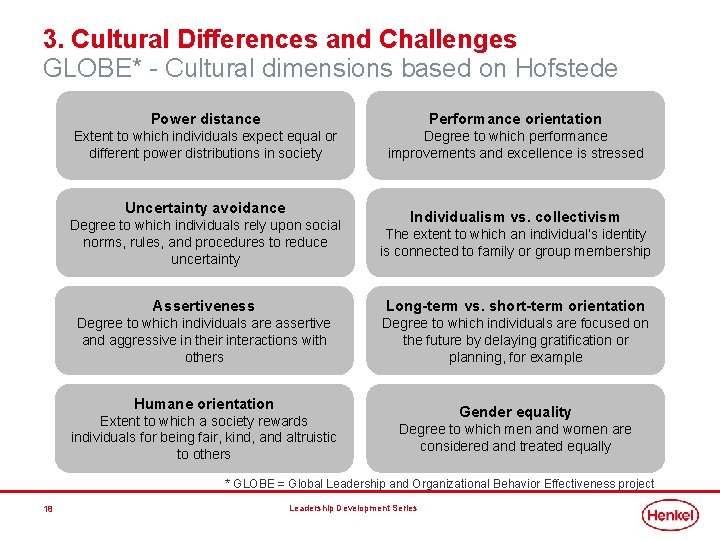
3. Cultural Differences and Challenges GLOBE* - Cultural dimensions based on Hofstede Power distance Performance orientation Extent to which individuals expect equal or different power distributions in society Degree to which performance improvements and excellence is stressed Uncertainty avoidance Individualism vs. collectivism Degree to which individuals rely upon social norms, rules, and procedures to reduce uncertainty The extent to which an individual’s identity is connected to family or group membership Assertiveness Long-term vs. short-term orientation Degree to which individuals are assertive and aggressive in their interactions with others Degree to which individuals are focused on the future by delaying gratification or planning, for example Humane orientation Extent to which a society rewards individuals for being fair, kind, and altruistic to others Gender equality Degree to which men and women are considered and treated equally * GLOBE = Global Leadership and Organizational Behavior Effectiveness project 18 Leadership Development Series
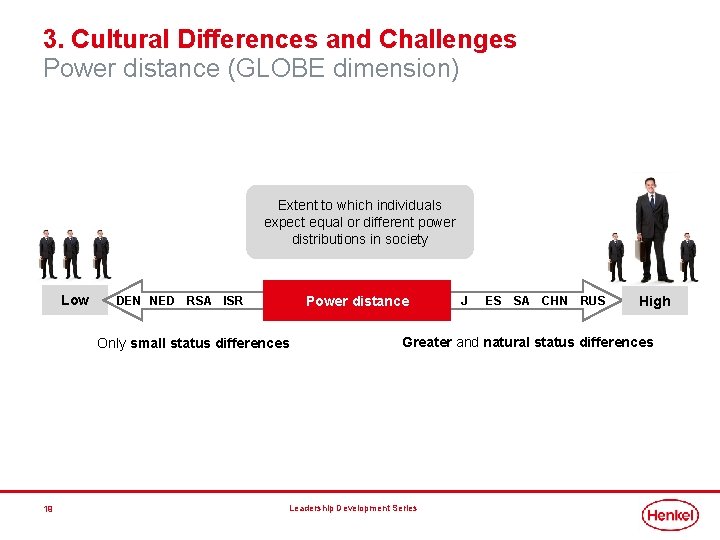
3. Cultural Differences and Challenges Power distance (GLOBE dimension) Extent to which individuals expect equal or different power distributions in society Low DEN NED RSA ISR Only small status differences 19 Power distance J ES SA CHN RUS High Greater and natural status differences Leadership Development Series
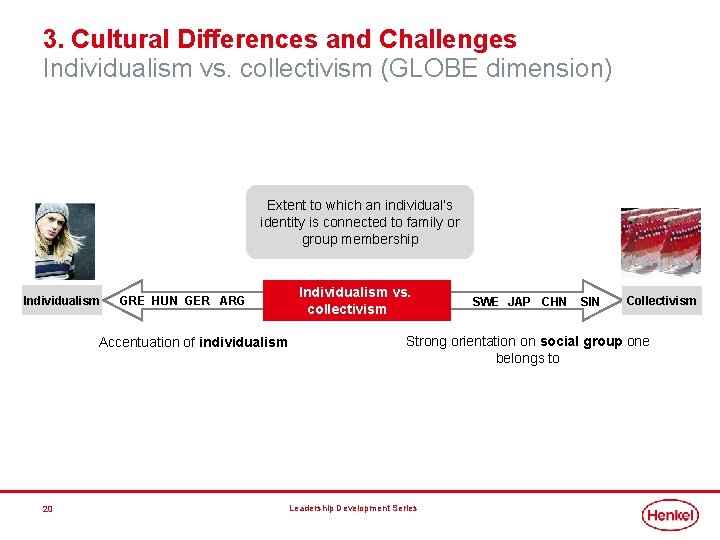
3. Cultural Differences and Challenges Individualism vs. collectivism (GLOBE dimension) Extent to which an individual’s identity is connected to family or group membership Individualism GRE HUN GER ARG Accentuation of individualism 20 Individualism vs. collectivism SWE JAP CHN SIN Collectivism Strong orientation on social group one belongs to Leadership Development Series
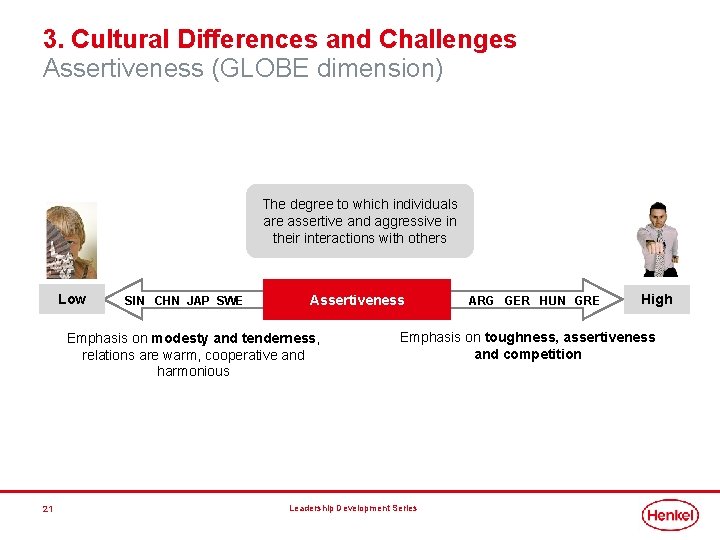
3. Cultural Differences and Challenges Assertiveness (GLOBE dimension) The degree to which individuals are assertive and aggressive in their interactions with others Low SIN CHN JAP SWE Assertiveness Emphasis on modesty and tenderness, relations are warm, cooperative and harmonious 21 ARG GER HUN GRE High Emphasis on toughness, assertiveness and competition Leadership Development Series
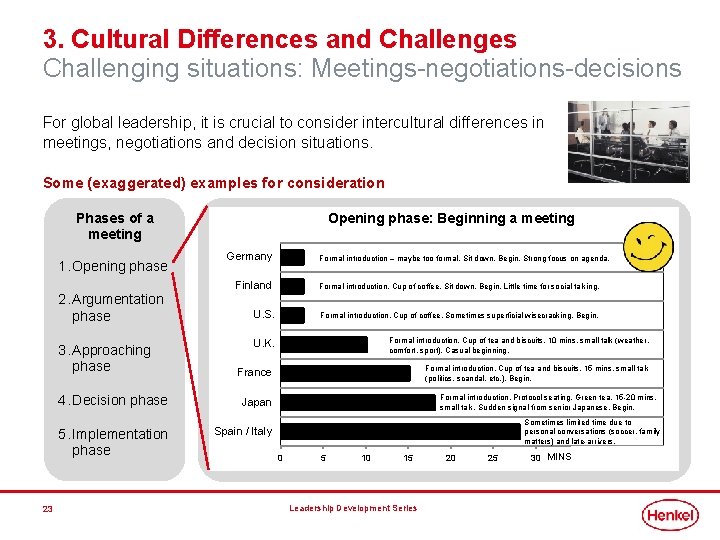
3. Cultural Differences and Challenges Challenging situations: Meetings-negotiations-decisions For global leadership, it is crucial to consider intercultural differences in meetings, negotiations and decision situations. Some (exaggerated) examples for consideration Phases of a meeting 1. Opening phase 2. Argumentation phase 3. Approaching phase 23 Opening phase: Beginning a meeting Germany Formal introduction – maybe too formal. Sit down. Begin. Strong focus on agenda. Finland Formal introduction. Cup of coffee. Sit down. Begin. Little time for social talking. U. S. Formal introduction. Cup of coffee. Sometimes superficial wisecracking. Begin. Formal introduction. Cup of tea and biscuits. 10 mins. small talk (weather, comfort, sport). Casual beginning. U. K. Formal introduction. Cup of tea and biscuits. 15 mins. small talk (politics, scandal, etc. ). Begin. France 4. Decision phase Japan 5. Implementation phase Spain / Italy Formal introduction. Protocol seating. Green tea. 15 -20 mins. small talk. Sudden signal from senior Japanese. Begin. Sometimes limited time due to personal conversations (soccer, family matters) and late-arrivers. 0 5 10 15 Leadership Development Series 20 25 30 MINS 35 40 45
Contents 1. Introduction 2. Intercultural Competence 3. Cultural Differences and Challenges 4. Intercultural Communication – Verbal 5. Intercultural Communication – Nonverbal 6. Multicultural and Virtual Teams 26 Leadership Development Series
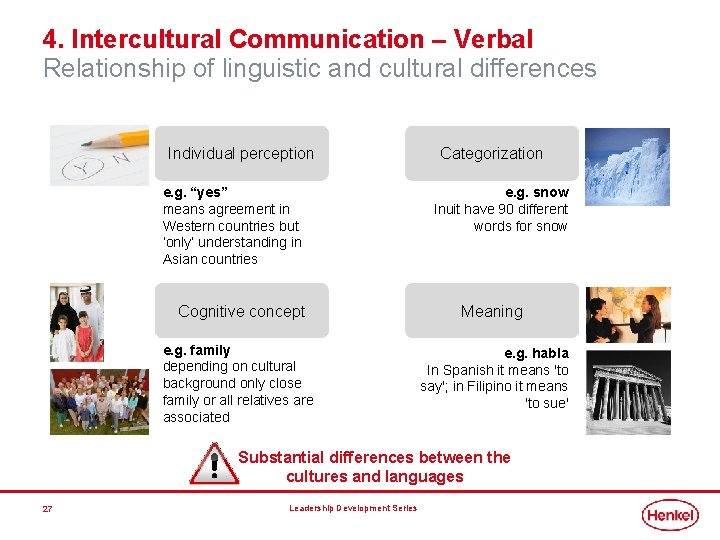
4. Intercultural Communication – Verbal Relationship of linguistic and cultural differences Individual perception e. g. “yes” means agreement in Western countries but ‘only’ understanding in Asian countries Categorization e. g. snow Inuit have 90 different words for snow Cognitive concept Meaning e. g. family depending on cultural background only close family or all relatives are associated e. g. habla In Spanish it means 'to say'; in Filipino it means 'to sue' Substantial differences between the cultures and languages 27 Leadership Development Series
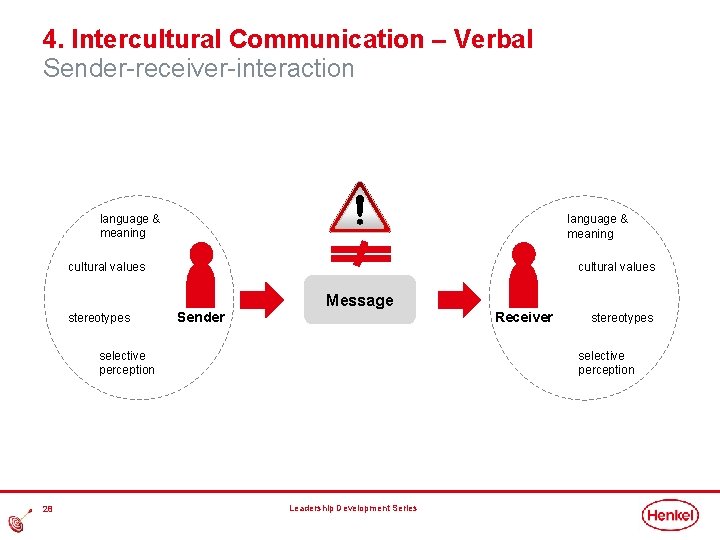
4. Intercultural Communication – Verbal Sender-receiver-interaction language & meaning cultural values stereotypes cultural values Sender Message selective perception 28 Receiver stereotypes selective perception Leadership Development Series
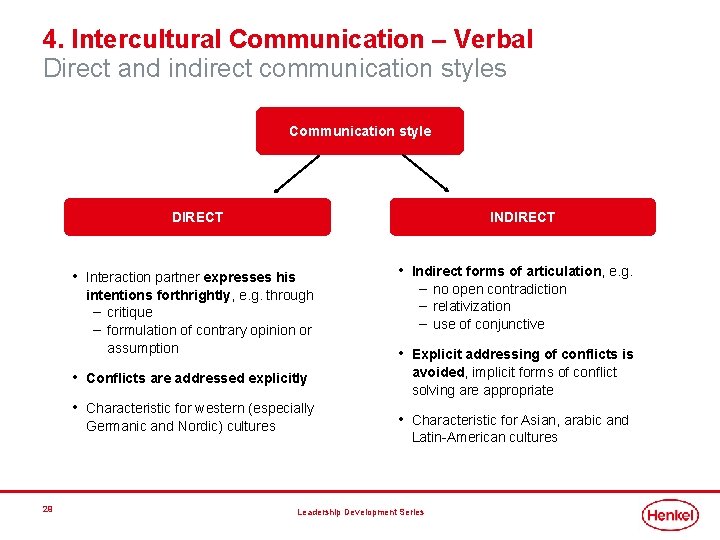
4. Intercultural Communication – Verbal Direct and indirect communication styles Communication style DIRECT INDIRECT • Interaction partner expresses his intentions forthrightly, e. g. through - critique - formulation of contrary opinion or assumption • Conflicts are addressed explicitly • Characteristic for western (especially Germanic and Nordic) cultures 29 • Indirect forms of articulation, e. g. - no open contradiction - relativization - use of conjunctive • Explicit addressing of conflicts is avoided, implicit forms of conflict solving are appropriate • Characteristic for Asian, arabic and Latin-American cultures Leadership Development Series
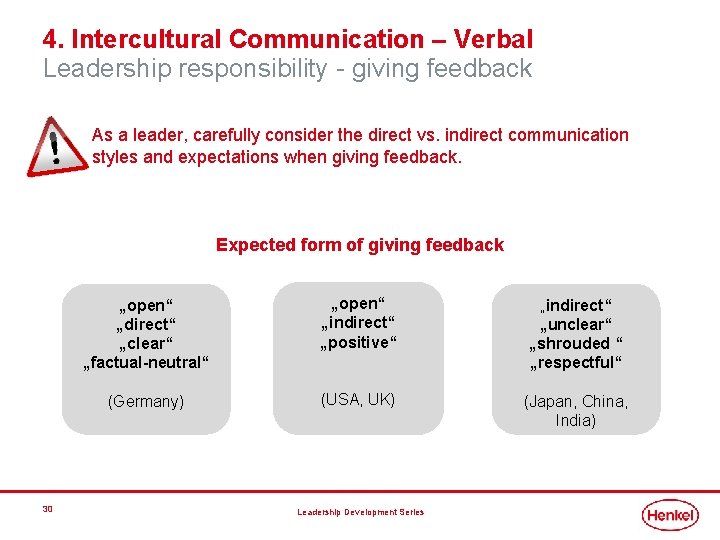
4. Intercultural Communication – Verbal Leadership responsibility - giving feedback As a leader, carefully consider the direct vs. indirect communication styles and expectations when giving feedback. Expected form of giving feedback 30 „open“ „direct“ „clear“ „factual-neutral“ „open“ „indirect“ „positive“ „indirect“ „unclear“ „shrouded “ „respectful“ (Germany) (USA, UK) (Japan, China, India) Leadership Development Series
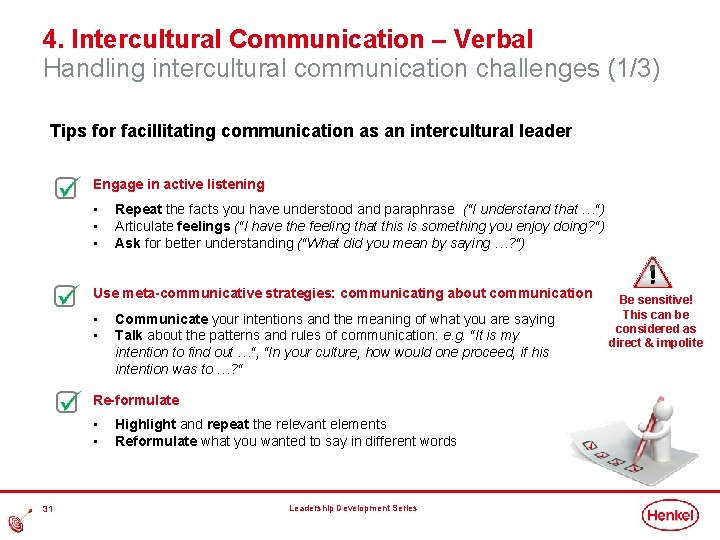
4. Intercultural Communication – Verbal Handling intercultural communication challenges (1/3) Tips for facillitating communication as an intercultural leader Engage in active listening • • • Repeat the facts you have understood and paraphrase (“I understand that …“) Articulate feelings (“I have the feeling that this is something you enjoy doing? “) Ask for better understanding (“What did you mean by saying …? “) Use meta-communicative strategies: communicating about communication • • Communicate your intentions and the meaning of what you are saying Talk about the patterns and rules of communication: e. g. “It is my intention to find out …“, “In your culture, how would one proceed, if his intention was to …? “ Re-formulate • • 31 Highlight and repeat the relevant elements Reformulate what you wanted to say in different words Leadership Development Series Be sensitive! This can be considered as direct & impolite
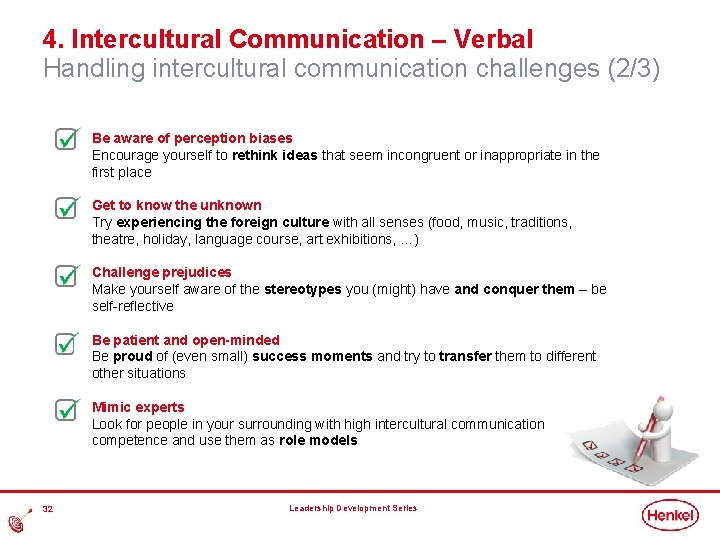
4. Intercultural Communication – Verbal Handling intercultural communication challenges (2/3) Be aware of perception biases Encourage yourself to rethink ideas that seem incongruent or inappropriate in the first place Get to know the unknown Try experiencing the foreign culture with all senses (food, music, traditions, theatre, holiday, language course, art exhibitions, …) Challenge prejudices Make yourself aware of the stereotypes you (might) have and conquer them – be self-reflective Be patient and open-minded Be proud of (even small) success moments and try to transfer them to different other situations Mimic experts Look for people in your surrounding with high intercultural communication competence and use them as role models 32 Leadership Development Series
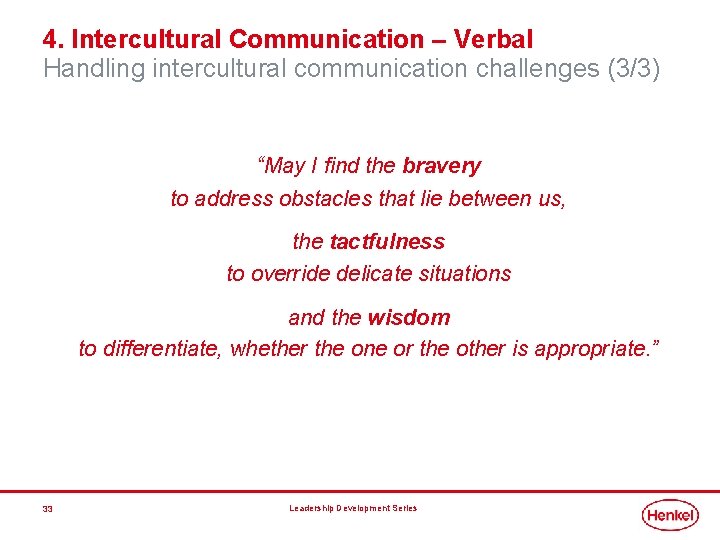
4. Intercultural Communication – Verbal Handling intercultural communication challenges (3/3) “May I find the bravery to address obstacles that lie between us, the tactfulness to override delicate situations and the wisdom to differentiate, whether the one or the other is appropriate. ” 33 Leadership Development Series
Contents 1. Introduction 2. Intercultural Competence 3. Cultural Differences and Challenges 4. Intercultural Communication – Verbal 5. Intercultural Communication – Nonverbal 6. Multicultural and Virtual Teams 34 Leadership Development Series
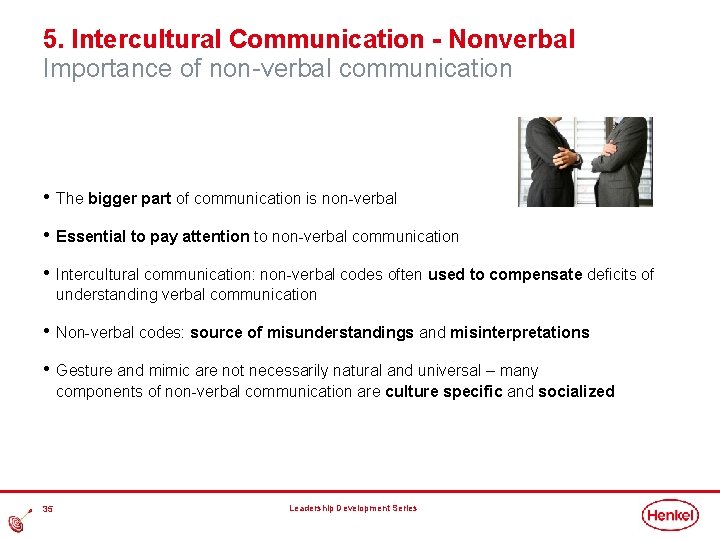
5. Intercultural Communication - Nonverbal Importance of non-verbal communication • The bigger part of communication is non-verbal • Essential to pay attention to non-verbal communication • Intercultural communication: non-verbal codes often used to compensate deficits of understanding verbal communication • Non-verbal codes: source of misunderstandings and misinterpretations • Gesture and mimic are not necessarily natural and universal – many components of non-verbal communication are culture specific and socialized 35 Leadership Development Series
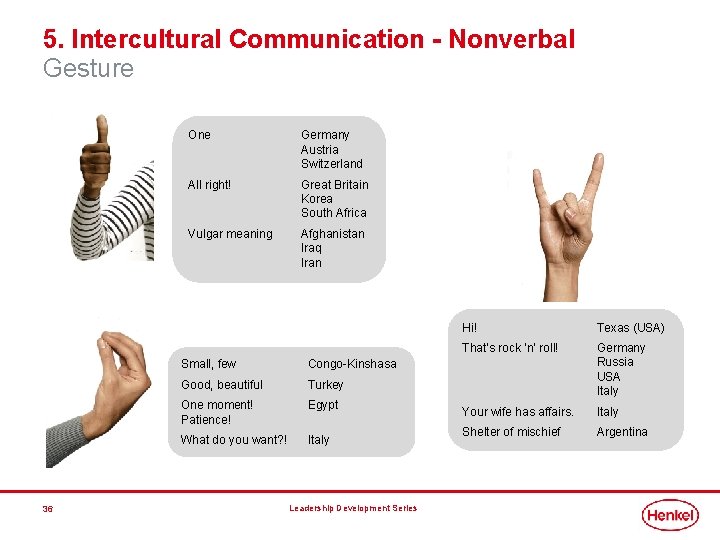
5. Intercultural Communication - Nonverbal Gesture 36 One Germany Austria Switzerland All right! Great Britain Korea South Africa Vulgar meaning Afghanistan Iraq Iran Small, few Congo-Kinshasa Good, beautiful Turkey One moment! Patience! Egypt What do you want? ! Italy Leadership Development Series Hi! Texas (USA) That’s rock ’n’ roll! Germany Russia USA Italy Your wife has affairs. Italy Shelter of mischief Argentina
Contents 1. Introduction 2. Intercultural Competence 3. Cultural Differences and Challenges 4. Intercultural Communication – Verbal 5. Intercultural Communication – Nonverbal 6. Multicultural and Virtual Teams 37 Leadership Development Series
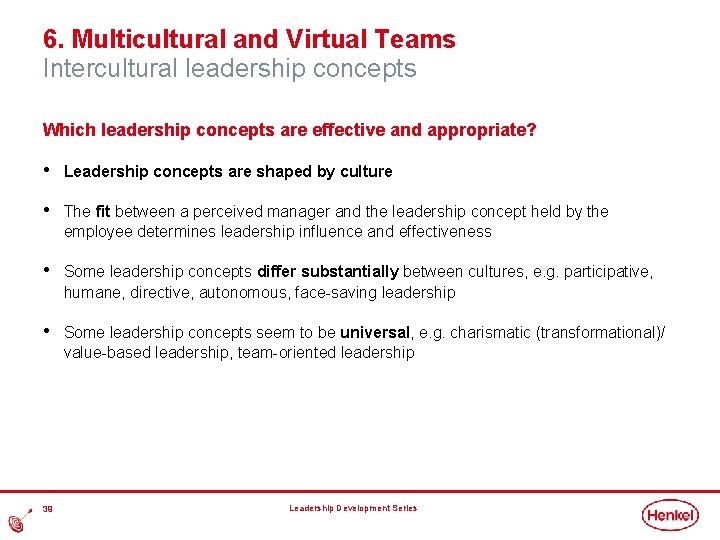
6. Multicultural and Virtual Teams Intercultural leadership concepts Which leadership concepts are effective and appropriate? • Leadership concepts are shaped by culture • The fit between a perceived manager and the leadership concept held by the employee determines leadership influence and effectiveness • Some leadership concepts differ substantially between cultures, e. g. participative, humane, directive, autonomous, face-saving leadership • Some leadership concepts seem to be universal, e. g. charismatic (transformational)/ value-based leadership, team-oriented leadership 39 Leadership Development Series
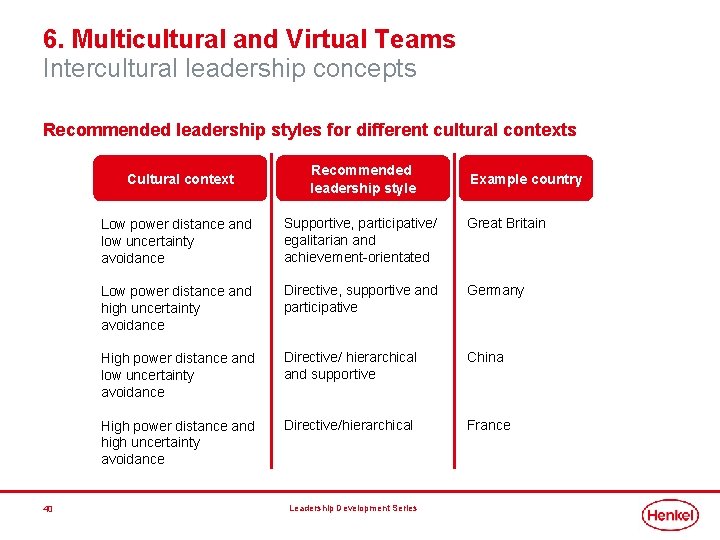
6. Multicultural and Virtual Teams Intercultural leadership concepts Recommended leadership styles for different cultural contexts 40 Cultural context Recommended leadership style Low power distance and low uncertainty avoidance Supportive, participative/ egalitarian and achievement-orientated Great Britain Low power distance and high uncertainty avoidance Directive, supportive and participative Germany High power distance and low uncertainty avoidance Directive/ hierarchical and supportive China High power distance and high uncertainty avoidance Directive/hierarchical France Leadership Development Series Example country
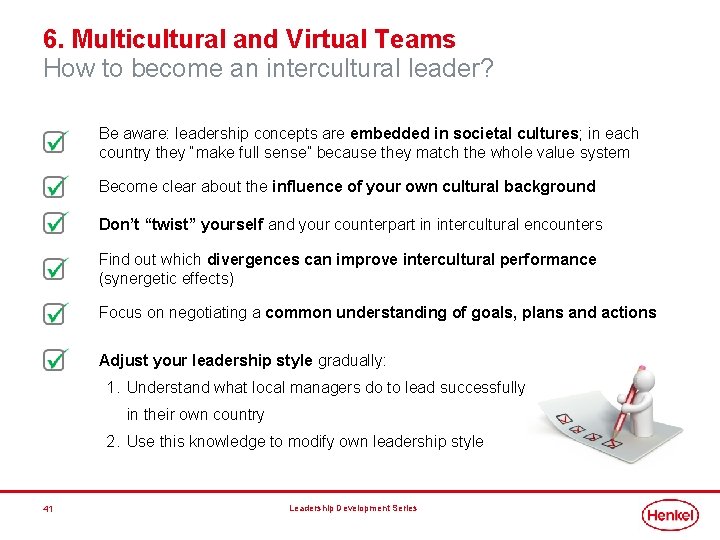
6. Multicultural and Virtual Teams How to become an intercultural leader? Be aware: leadership concepts are embedded in societal cultures; in each country they “make full sense” because they match the whole value system Become clear about the influence of your own cultural background Don’t “twist” yourself and your counterpart in intercultural encounters Find out which divergences can improve intercultural performance (synergetic effects) Focus on negotiating a common understanding of goals, plans and actions Adjust your leadership style gradually: 1. Understand what local managers do to lead successfully in their own country 2. Use this knowledge to modify own leadership style 41 Leadership Development Series
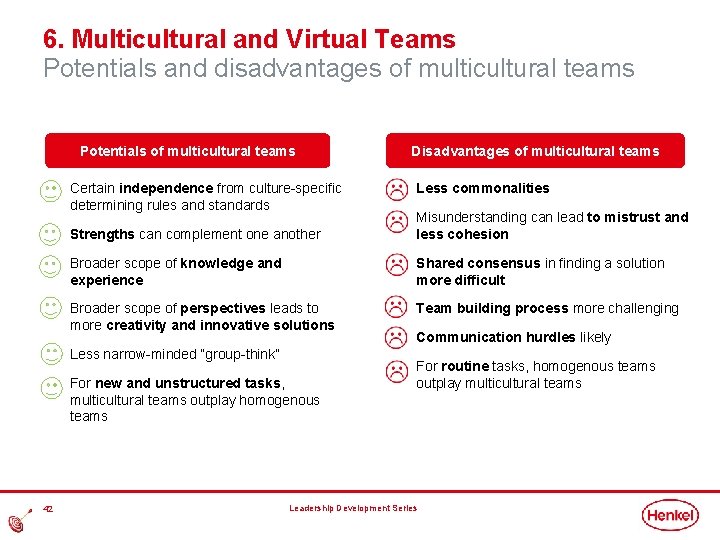
6. Multicultural and Virtual Teams Potentials and disadvantages of multicultural teams Potentials of multicultural teams • Certain independence from culture-specific determining rules and standards Disadvantages of multicultural teams • Less commonalities • Misunderstanding can lead to mistrust and less cohesion • Strengths can complement one another • Broader scope of knowledge and experience • Shared consensus in finding a solution more difficult • Broader scope of perspectives leads to more creativity and innovative solutions • Team building process more challenging • Communication hurdles likely • For routine tasks, homogenous teams outplay multicultural teams • Less narrow-minded “group-think” • For new and unstructured tasks, multicultural teams outplay homogenous teams 42 Leadership Development Series
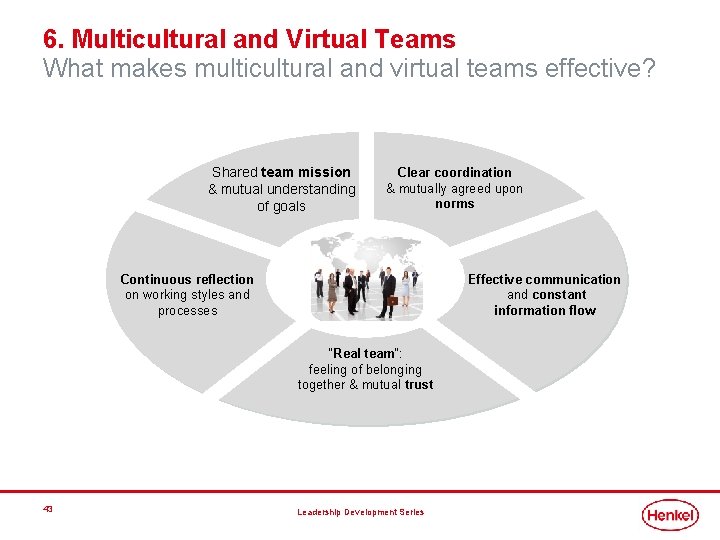
6. Multicultural and Virtual Teams What makes multicultural and virtual teams effective? Shared team mission & mutual understanding of goals Clear coordination & mutually agreed upon norms Effective communication and constant information flow Continuous reflection on working styles and processes “Real team“: feeling of belonging together & mutual trust 43 Leadership Development Series
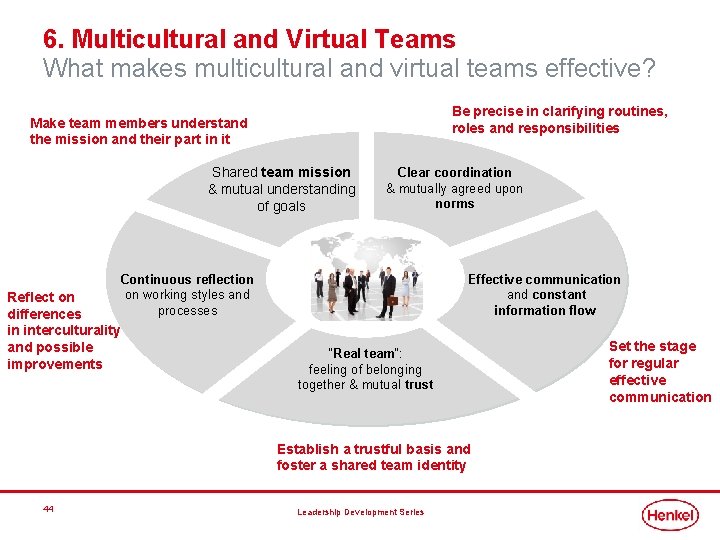
6. Multicultural and Virtual Teams What makes multicultural and virtual teams effective? Be precise in clarifying routines, roles and responsibilities Make team members understand the mission and their part in it Shared team mission & mutual understanding of goals Clear coordination & mutually agreed upon norms Effective communication and constant information flow Continuous reflection on working styles and processes Reflect on differences in interculturality and possible improvements “Real team“: feeling of belonging together & mutual trust Establish a trustful basis and foster a shared team identity 44 Leadership Development Series Set the stage for regular effective communication