
Leadership Definition Types of leadership Chapter 9 Copyright

- Slides: 9
Leadership Definition Types of leadership Chapter 9 Copyright © 2007 by South-Western, a division of Thomson Learning. All rights reserved
Leadership § Is generally defined as the art and science of influencing people so that they willingly move toward the achievement of the group goals. § Is a process of influencing the activities of members of a group in performing their tasks of goal setting or goal achievement. Chapter 9 Copyright © 2007 by South-Western, a division of Thomson Learning. All rights reserved
“All Managers Must Be Good Leaders, But Not All Leaders Could Be Good Managers” Chapter 9 Copyright © 2007 by South-Western, a division of Thomson Learning. All rights reserved
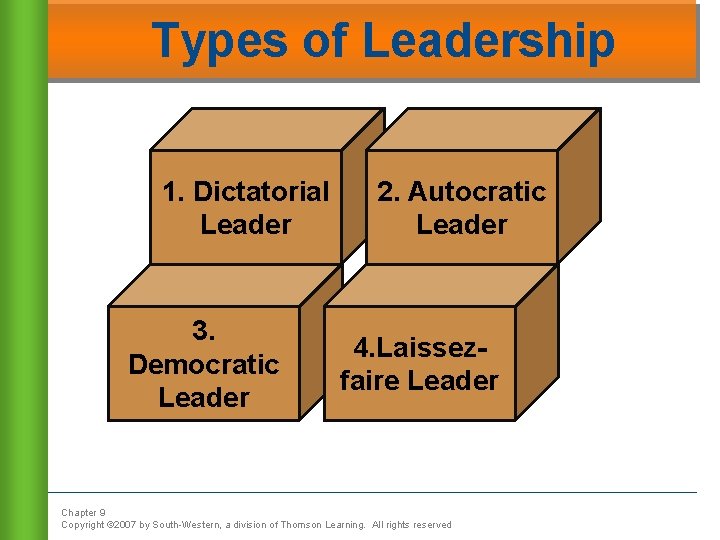
Types of Leadership 1. Dictatorial Leader 3. Democratic Leader 2. Autocratic Leader 4. Laissezfaire Leader Chapter 9 Copyright © 2007 by South-Western, a division of Thomson Learning. All rights reserved
1. Dictatorial Leader § Accomplishes tasks through fear of penalties, and maintains a highly critical and negative attitude in relations with subordinates. § At times this approach is apparently is effective in the short run, but it DOES NOT provide a solid foundation for continued performance; because it DOES NOT give lasting satisfaction for those being led. Chapter 9 Copyright © 2007 by South-Western, a division of Thomson Learning. All rights reserved
2. Autocratic Leader § Assumes a paternalistic role which forces subordinates to rely on the leader for their satisfaction. § This type results in dependency on the continued presence of the leader, and work deteriorates when the person is absent. Chapter 9 Copyright © 2007 by South-Western, a division of Thomson Learning. All rights reserved
3. Democratic Leader § Depends not only on their own capabilities but encourage consultation of subordinates. § This type of leadership results in a cooperative spirit and the development of managerial abilities on the part of the subordinates. Satisfaction is gained through the feeling of group accomplishment. § Chapter 9 Copyright © 2007 by South-Western, a division of Thomson Learning. All rights reserved
4. Laissez-faire Leader § Depends completely on subordinates to establish their own goals and to make their own decision. § Under this conditions, members of the group are permitted to act individually and, therefore, may easily head in different directions. Chapter 9 Copyright © 2007 by South-Western, a division of Thomson Learning. All rights reserved
The End … Chapter 9 Copyright © 2007 by South-Western, a division of Thomson Learning. All rights reserved