
Leadership Competencies USCG Auxiliary Training Directorate 1 Overview
- Slides: 21
Leadership Competencies USCG Auxiliary Training Directorate 1
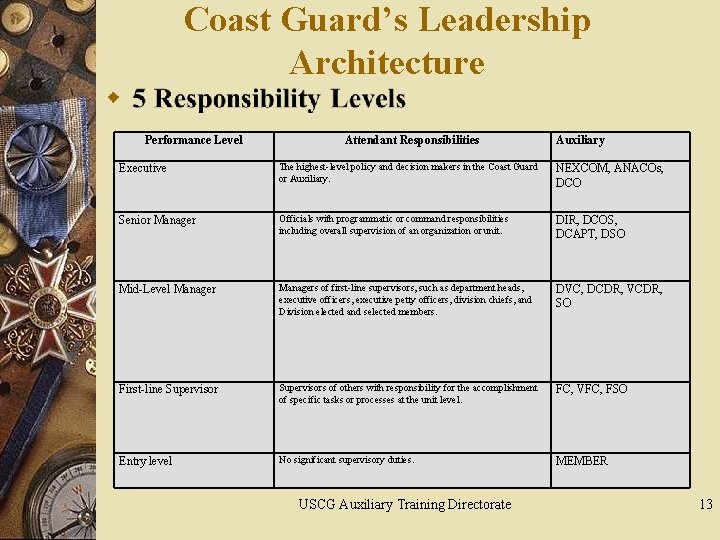
Overview w This module examines the following topics: – Defining Management • Formal Definition – Defining Leadership • Formal Definition – The Coast Guard and Auxiliary Leadership Architecture • 4 Broad Categories • 28 Leadership Competencies • 5 Responsibility Levels USCG Auxiliary Training Directorate 2
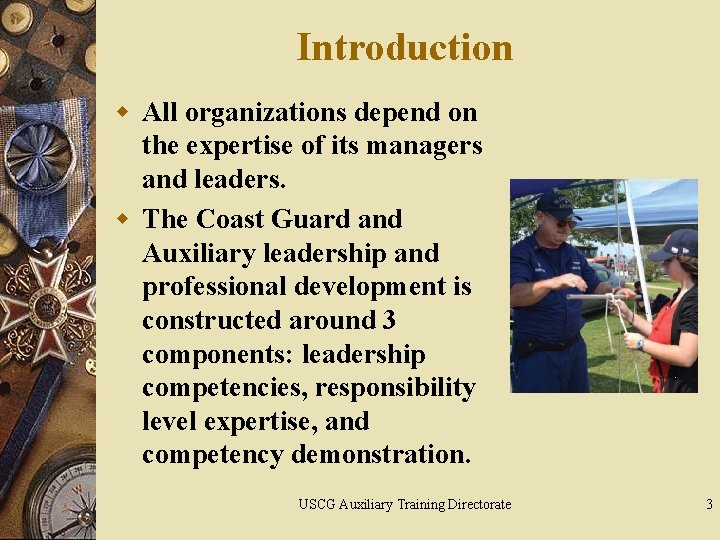
Introduction w All organizations depend on the expertise of its managers and leaders. w The Coast Guard and Auxiliary leadership and professional development is constructed around 3 components: leadership competencies, responsibility level expertise, and competency demonstration. USCG Auxiliary Training Directorate 3
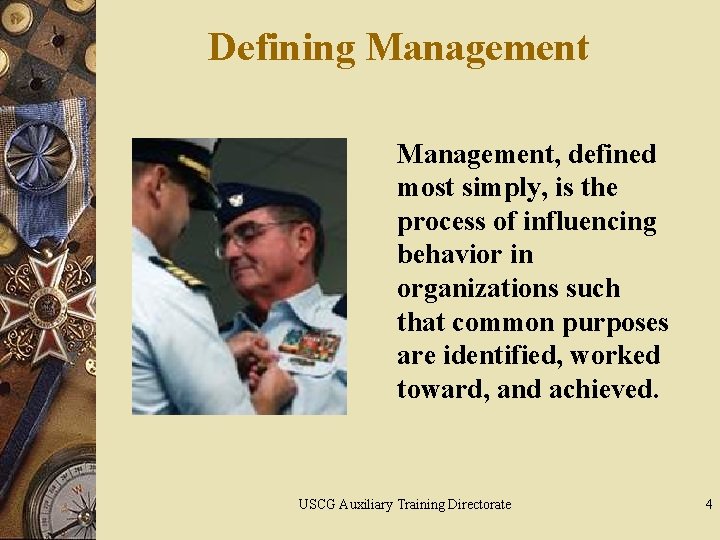
Defining Management, defined most simply, is the process of influencing behavior in organizations such that common purposes are identified, worked toward, and achieved. USCG Auxiliary Training Directorate 4
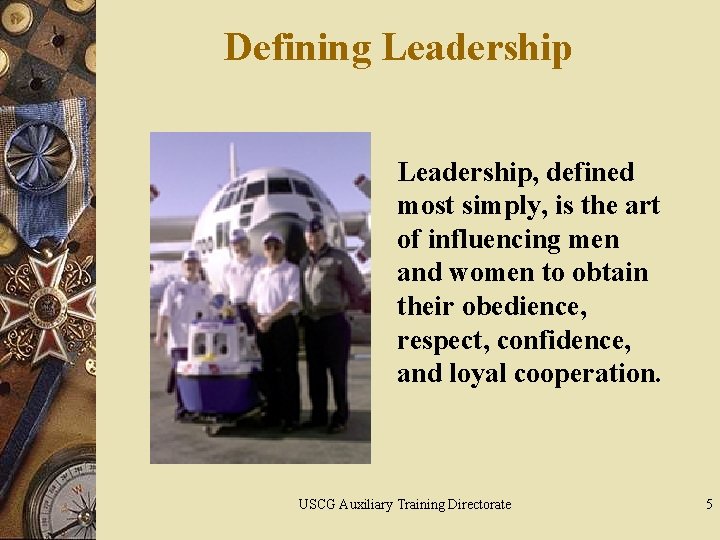
Defining Leadership, defined most simply, is the art of influencing men and women to obtain their obedience, respect, confidence, and loyal cooperation. USCG Auxiliary Training Directorate 5
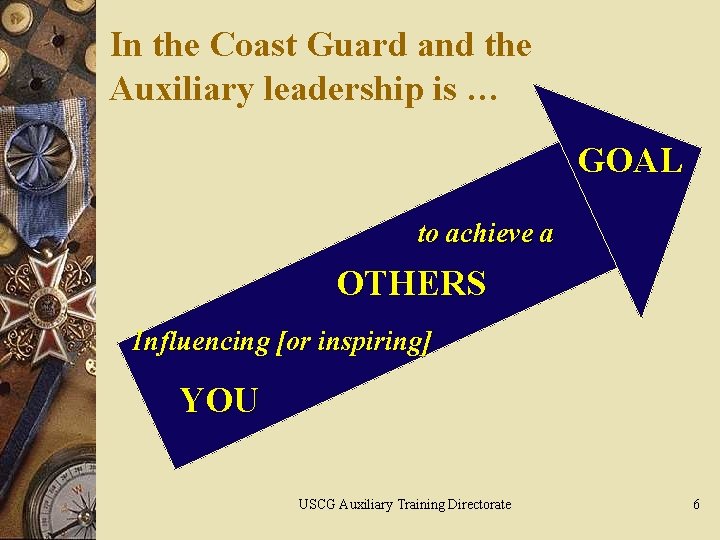
In the Coast Guard and the Auxiliary leadership is … GOAL to achieve a OTHERS Influencing [or inspiring] YOU USCG Auxiliary Training Directorate 6
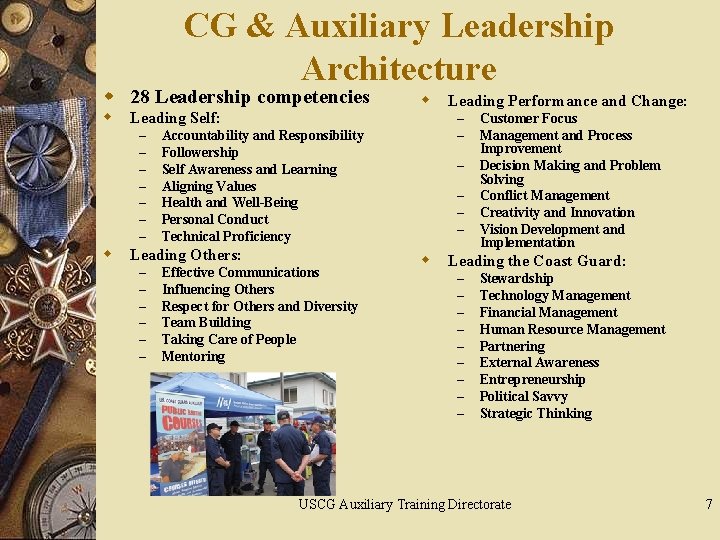
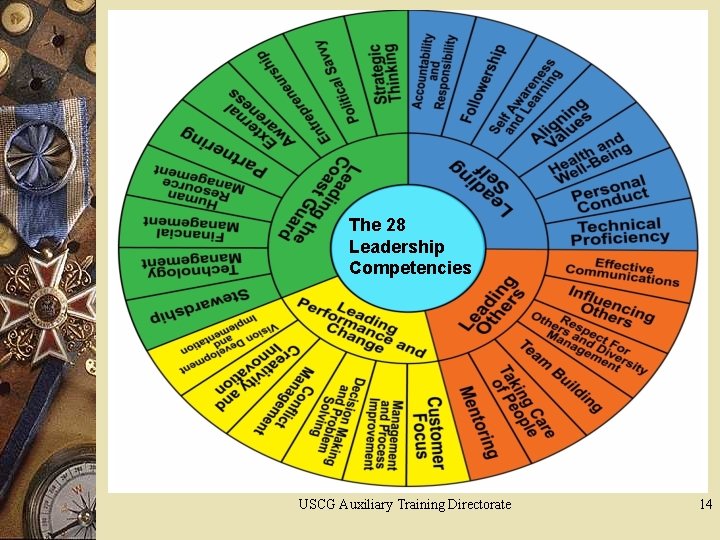
CG & Auxiliary Leadership Architecture w 28 Leadership competencies w Leading Self: – – – – w Effective Communications Influencing Others Respect for Others and Diversity Team Building Taking Care of People Mentoring Leading Performance and Change: – – Accountability and Responsibility Followership Self Awareness and Learning Aligning Values Health and Well-Being Personal Conduct Technical Proficiency Leading Others: – – – w Customer Focus Management and Process Improvement Decision Making and Problem Solving Conflict Management Creativity and Innovation Vision Development and Implementation Leading the Coast Guard: – – – – – Stewardship Technology Management Financial Management Human Resource Management Partnering External Awareness Entrepreneurship Political Savvy Strategic Thinking USCG Auxiliary Training Directorate 7
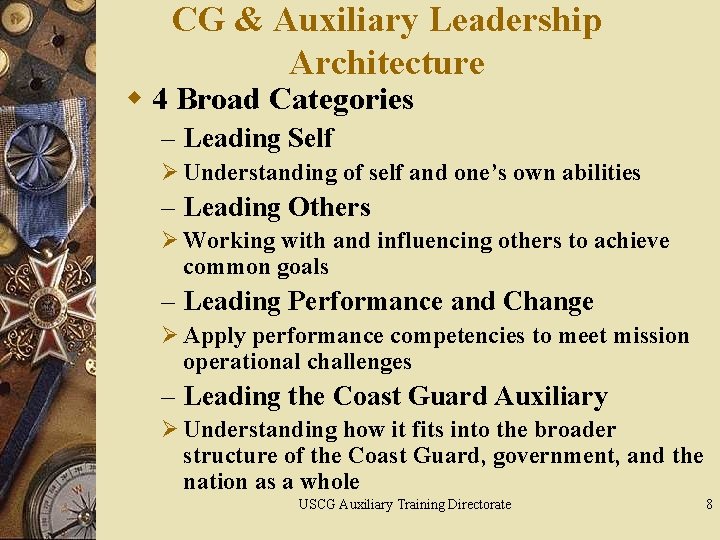
CG & Auxiliary Leadership Architecture w 4 Broad Categories – Leading Self Ø Understanding of self and one’s own abilities – Leading Others Ø Working with and influencing others to achieve common goals – Leading Performance and Change Ø Apply performance competencies to meet mission operational challenges – Leading the Coast Guard Auxiliary Ø Understanding how it fits into the broader structure of the Coast Guard, government, and the nation as a whole USCG Auxiliary Training Directorate 8
Leading Self Fundamental to successful development as a leader is an understanding of self and one’s own abilities. This includes understanding one’s personality, values, and preferences, while simultaneously recognizing one’s potential as a member of the Coast Guard team. Personal conduct, health and well-being, character, technical proficiency, lifelong learning, followership, and organizational commitment are elements to consider when setting short and long-term goals focused upon the leadership development of “self. ” USCG Auxiliary Training Directorate 9
Leading Others Leadership involves working with and influencing others to achieve common goals and to foster a positive workplace climate. Auxiliarists interact with others in many ways, whether as supervisor, mentor, manager, team member, team leader, peer or worker. Positive professional relationships provide a foundation for the success of our Service. Showing respect for others, using effective communications, influencing others, working in teams, and taking care of one’s people are elements to consider when evaluating one’s capacity for leading others. Developing these qualities will increase capacity to serve. USCG Auxiliary Training Directorate 10
Leading Performance and Change Members of the Coast Guard team constantly face challenges in mission operations. To meet these challenges, leaders must apply performance competencies to their daily duties. Performance competencies include developing a vision, managing conflict, quality and daily management of projects, appraising performance, problem solving, creativity, innovation, decision making, and customer focus. Having these competencies enables each leader—and the Service—to perform to the utmost in any situation. USCG Auxiliary Training Directorate 11
Leading the Auxiliary As leaders gain experience in the Coast Guard Auxiliary, they must understand how it fits into a broader structure of the Coast Guard, government, and the nation as a whole. At a local level, leaders often develop partnerships with public and private sector organizations in order to accomplish the mission. The Coast Guard "plugs in" via its key systems: money, people, and technology and the Auxiliary supports Coast Guard activities. A leader must thoroughly understand these systems and how they interact with similar systems outside the Coast Guard. An awareness of the Coast Guard's value to the nation, and promoting that using a deep understanding of the political system in which we operate becomes more important as one gets more senior. Leaders must develop coalitions and partnerships with allies inside and outside the Auxiliary and the Coast Guard. USCG Auxiliary Training Directorate 12
Coast Guard’s Leadership Architecture Performance Level Attendant Responsibilities Auxiliary Executive The highest-level policy and decision makers in the Coast Guard or Auxiliary. NEXCOM, ANACOs, DCO Senior Manager Officials with programmatic or command responsibilities including overall supervision of an organization or unit. DIR, DCOS, DCAPT, DSO Mid-Level Managers of first-line supervisors, such as department heads, executive officers, executive petty officers, division chiefs, and Division elected and selected members. DVC, DCDR, VCDR, SO First-line Supervisors of others with responsibility for the accomplishment of specific tasks or processes at the unit level. FC, VFC, FSO Entry level No significant supervisory duties. MEMBER USCG Auxiliary Training Directorate 13
The 28 Leadership Competencies USCG Auxiliary Training Directorate 14
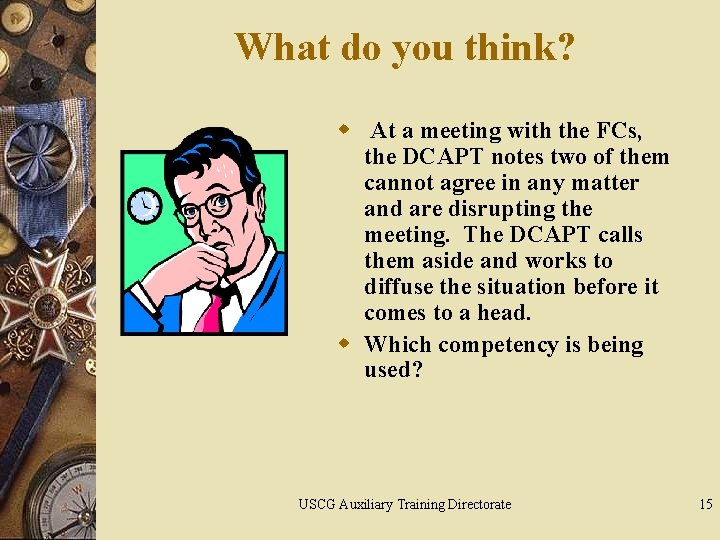
What do you think? w At a meeting with the FCs, the DCAPT notes two of them cannot agree in any matter and are disrupting the meeting. The DCAPT calls them aside and works to diffuse the situation before it comes to a head. w Which competency is being used? USCG Auxiliary Training Directorate 15
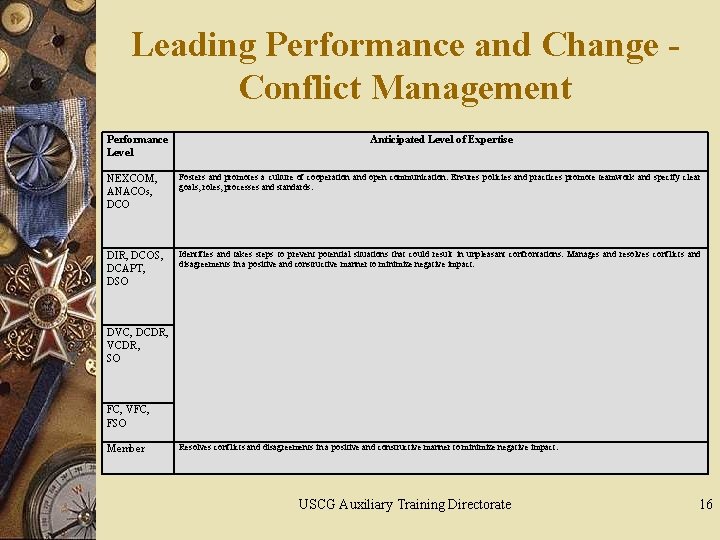
Leading Performance and Change Conflict Management Performance Level Anticipated Level of Expertise NEXCOM, ANACOs, DCO Fosters and promotes a culture of cooperation and open communication. Ensures policies and practices promote teamwork and specify clear goals, roles, processes and standards. DIR, DCOS, DCAPT, DSO Identifies and takes steps to prevent potential situations that could result in unpleasant confrontations. Manages and resolves conflicts and disagreements in a positive and constructive manner to minimize negative impact. DVC, DCDR, VCDR, SO FC, VFC, FSO Member Resolves conflicts and disagreements in a positive and constructive manner to minimize negative impact. USCG Auxiliary Training Directorate 16
What do you think? w The DCO has established a Districtwide policy and has set up a specific email address for any member who finds regulations out of date or confusing to notify the District Staff of these findings. This policy was established so that members can improve their performance in their specific missions working to understandable and updated requirements. w Which competency is being used? USCG Auxiliary Training Directorate 17
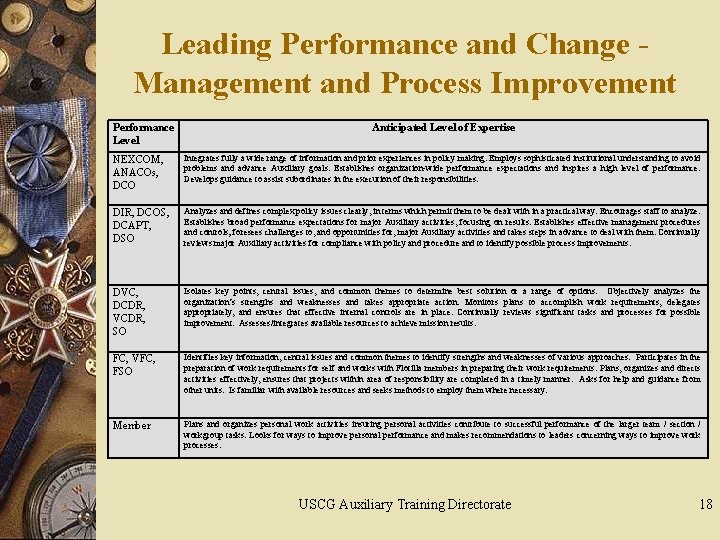
Leading Performance and Change Management and Process Improvement Performance Level Anticipated Level of Expertise NEXCOM, ANACOs, DCO Integrates fully a wide range of information and prior experiences in policy making. Employs sophisticated institutional understanding to avoid problems and advance Auxiliary goals. Establishes organization-wide performance expectations and inspires a high level of performance. Develops guidance to assist subordinates in the execution of their responsibilities. DIR, DCOS, DCAPT, DSO Analyzes and defines complex policy issues clearly, in terms which permit them to be dealt with in a practical way. Encourages staff to analyze. Establishes broad performance expectations for major Auxiliary activities, focusing on results. Establishes effective management procedures and controls; foresees challenges to, and opportunities for, major Auxiliary activities and takes steps in advance to deal with them. Continually reviews major Auxiliary activities for compliance with policy and procedure and to identify possible process improvements. DVC, DCDR, VCDR, SO Isolates key points, central issues, and common themes to determine best solution or a range of options. Objectively analyzes the organization’s strengths and weaknesses and takes appropriate action. Monitors plans to accomplish work requirements, delegates appropriately, and ensures that effective internal controls are in place. Continually reviews significant tasks and processes for possible improvement. Assesses/integrates available resources to achieve mission results. FC, VFC, FSO Identifies key information, central issues and common themes to identify strengths and weaknesses of various approaches. Participates in the preparation of work requirements for self and works with Flotilla members in preparing their work requirements. Plans, organizes and directs activities effectively, ensures that projects within area of responsibility are completed in a timely manner. Asks for help and guidance from other units. Is familiar with available resources and seeks methods to employ them where necessary. Member Plans and organizes personal work activities insuring personal activities contribute to successful performance of the larger team / section / workgroup tasks. Looks for ways to improve personal performance and makes recommendations to leaders concerning ways to improve work processes. USCG Auxiliary Training Directorate 18
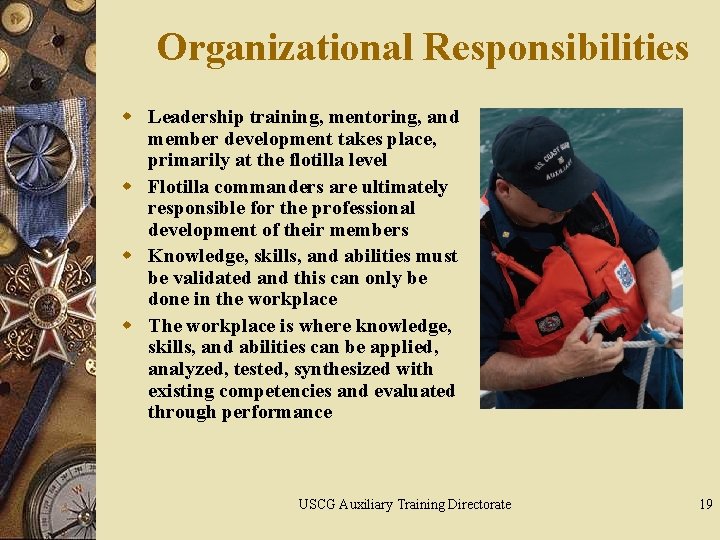
Organizational Responsibilities w Leadership training, mentoring, and member development takes place, primarily at the flotilla level w Flotilla commanders are ultimately responsible for the professional development of their members w Knowledge, skills, and abilities must be validated and this can only be done in the workplace w The workplace is where knowledge, skills, and abilities can be applied, analyzed, tested, synthesized with existing competencies and evaluated through performance USCG Auxiliary Training Directorate 19
Summary w This module examined the following topics: – Defining Management • Management is a process of planning, organizing, directing, and controlling organizational behaviors to accomplish a mission through the division of labor – Defining Leadership • Leadership is the ability to influence, lead, or guide others to accomplish a missions in the manner desired by providing purpose, direction, and motivation – The Coast Guard’s Leadership Architecture • 4 Broad Categories • 28 Leadership Competencies • 5 Responsibility Levels USCG Auxiliary Training Directorate 20
References • COMMANDANT INSTRUCTION M 5351. 3 LEADERSHIP DEVELOPMENT FRAMEWORK 9 May 2006 • Improved Auxiliary Leadership Training, The Way Forward, Report of the Leadership Guidance Team (LGT) 16 August 2007 • Appendix A, The Coast Guard’s Leadership and Professional Development Framework: Auxiliary Edition, Revision 1, August 2011 USCG Auxiliary Training Directorate 21