
Leadership Chapter 2 Trait Approach Northouse 5 th


- Slides: 11
Leadership Chapter 2 - Trait Approach Northouse, 5 th edition
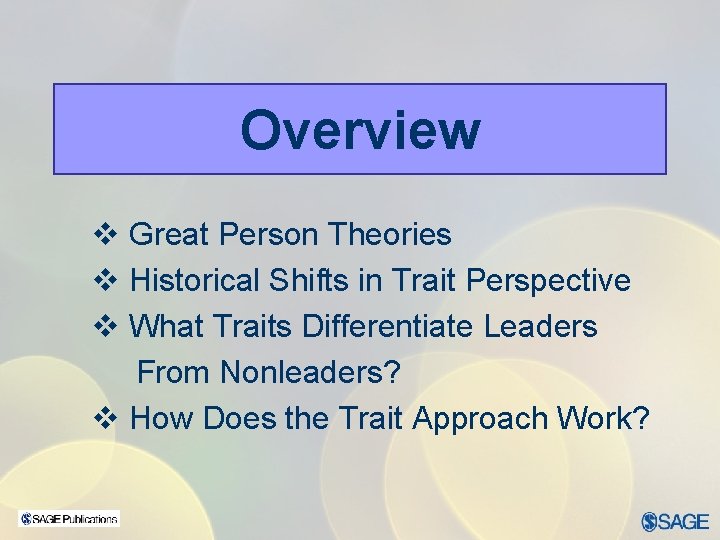
Overview v Great Person Theories v Historical Shifts in Trait Perspective v What Traits Differentiate Leaders From Nonleaders? v How Does the Trait Approach Work?
Great Person Theories Trait Approach: one of the first systematic attempts to study leadership v“Great Man” Theories (early 1900 s) – Focused on identifying innate qualities and characteristics possessed by great social, political, & military leaders
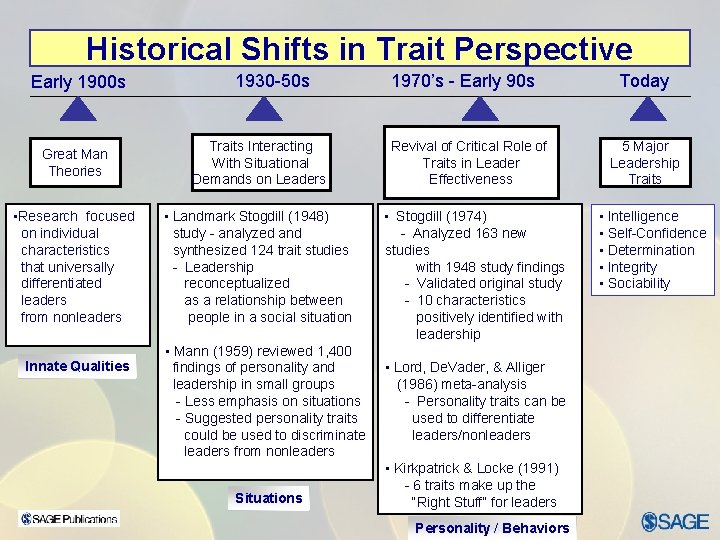
Historical Shifts in Trait Perspective Early 1900 s Great Man Theories • Research focused on individual characteristics that universally differentiated leaders from nonleaders Innate Qualities 1930 -50 s Traits Interacting With Situational Demands on Leaders • Landmark Stogdill (1948) study - analyzed and synthesized 124 trait studies - Leadership reconceptualized as a relationship between people in a social situation • Mann (1959) reviewed 1, 400 findings of personality and leadership in small groups - Less emphasis on situations - Suggested personality traits could be used to discriminate leaders from nonleaders Situations 1970’s - Early 90 s Revival of Critical Role of Traits in Leader Effectiveness • Stogdill (1974) - Analyzed 163 new studies with 1948 study findings - Validated original study - 10 characteristics positively identified with leadership • Lord, De. Vader, & Alliger (1986) meta-analysis - Personality traits can be used to differentiate leaders/nonleaders • Kirkpatrick & Locke (1991) - 6 traits make up the “Right Stuff” for leaders Personality / Behaviors Today 5 Major Leadership Traits • Intelligence • Self-Confidence • Determination • Integrity • Sociability
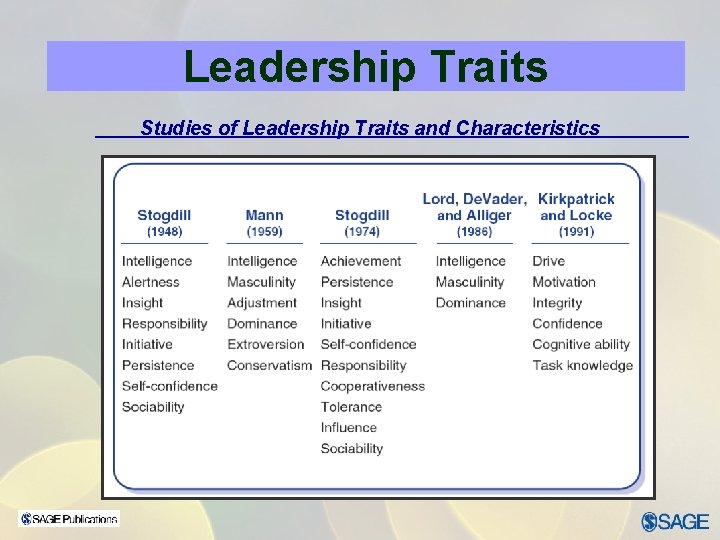
Leadership Traits Studies of Leadership Traits and Characteristics
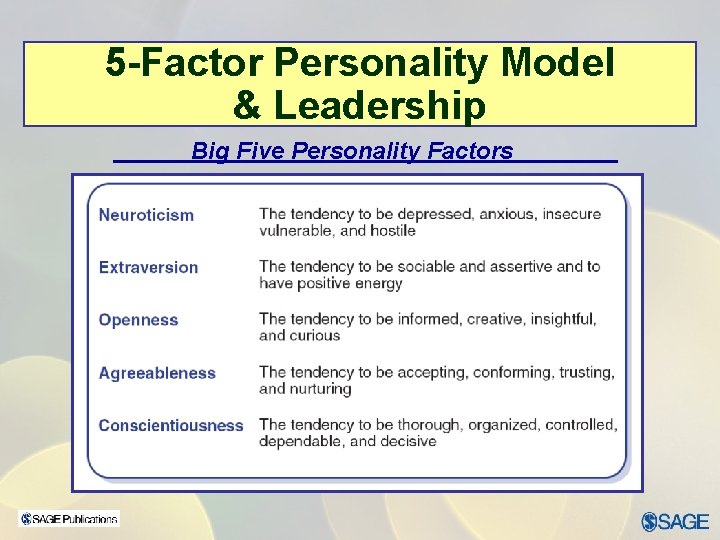
5 -Factor Personality Model & Leadership Big Five Personality Factors
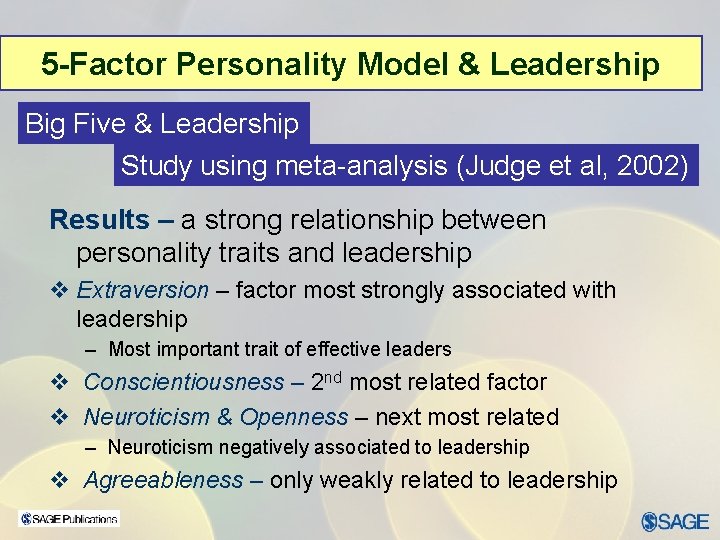
5 -Factor Personality Model & Leadership Big Five & Leadership Study using meta-analysis (Judge et al, 2002) Results – a strong relationship between personality traits and leadership v Extraversion – factor most strongly associated with leadership – Most important trait of effective leaders v Conscientiousness – 2 nd most related factor v Neuroticism & Openness – next most related – Neuroticism negatively associated to leadership v Agreeableness – only weakly related to leadership
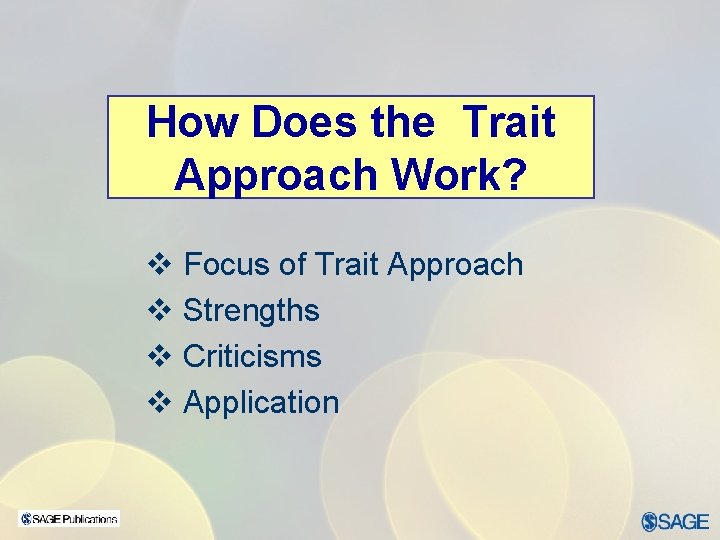
How Does the Trait Approach Work? v Focus of Trait Approach v Strengths v Criticisms v Application
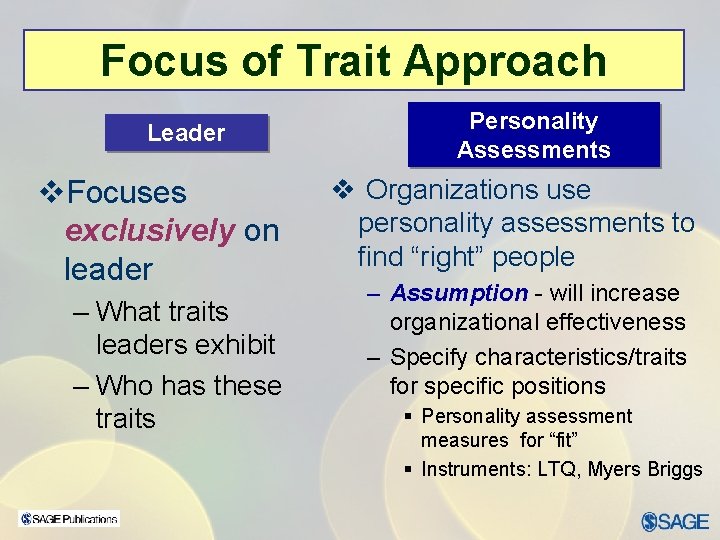
Focus of Trait Approach Leader v. Focuses exclusively on leader – What traits leaders exhibit – Who has these traits Personality Assessments v Organizations use personality assessments to find “right” people – Assumption - will increase organizational effectiveness – Specify characteristics/traits for specific positions § Personality assessment measures for “fit” § Instruments: LTQ, Myers Briggs
Strengths v Intuitively appealing – Perception that leaders are different in that they possess special traits – People “need” to view leaders as gifted v Credibility due to a century of research support v Highlights leadership component in the leadership process – Deeper level understanding of how leader/personality related to leadership process v Provides benchmarks for what to look for in a leader
Criticisms v Fails to delimit a definitive list of leadership traits – Endless lists have emerged v Doesn’t take into account situational effects – Leaders in one situation may not be leaders in another situation v List of most important leadership traits is highly subjective – Much subjective experience & observations serve as basis for identified leadership traits v Research fails to look at traits in relationship to leadership outcomes v Not useful for training & development