
Leadership Chapter 13 Women and Leadership Northouse 5

- Slides: 31
Leadership Chapter 13 – Women and Leadership Northouse, 5 th edition
Overview v Women and Leadership Perspective v Gender and Leadership Styles v Gender and Leadership Effectiveness v The Glass Ceiling v Breaking the Glass Ceiling v Women and Leadership Approach
Women and Leadership Approach Description Historical View v Gender and Leadership – Popular press reported differences between women and men § Women inferior to men (1977) • Women lacked skills & traits necessary for managerial success § Superiority of women in leadership positions (1990) – Researchers ignored issues related to gender & leadership until the 1970 s
Women and Leadership Approach Description Historical View v Gender and Leadership – Scholars started asking “Can women lead? ” – Changed by women in leadership § Presence of women in corporate & political leadership § Highly effective female leaders – e. Bay’s CEO, Avon’s CEO, N. Y. Senator, Secretary of State, etc. – Current research primary questions § “What are the leadership style and effectiveness differences between women and men? ” § “Why are women starkly underrepresented in elite leadership roles? ”
Gender and Leadership Styles v. Meta-analysis (Eagly & Johnson, 1990) – Women were not found to lead in a more interpersonally oriented & less task-oriented manner than men in organizations – Only gender difference - women use a more participative or democratic style than men – Additional meta-analysis (van Egen, 2001) examining research between 1987 -2000 found similar results
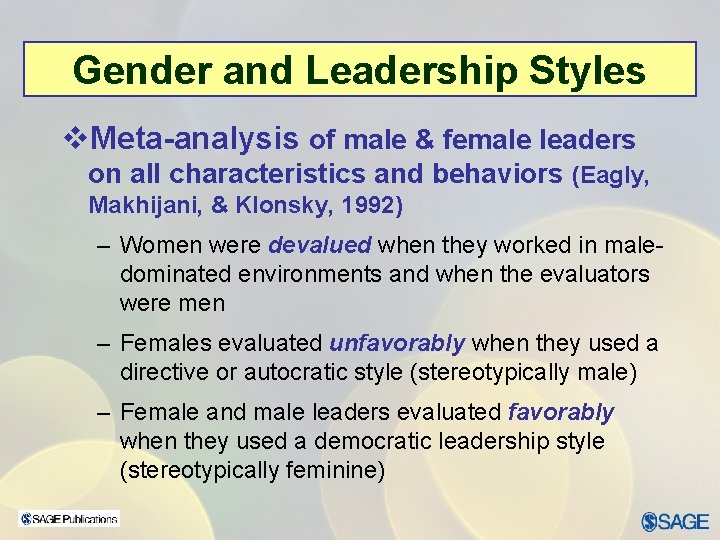
Gender and Leadership Styles v. Meta-analysis of male & female leaders on all characteristics and behaviors (Eagly, Makhijani, & Klonsky, 1992) – Women were devalued when they worked in maledominated environments and when the evaluators were men – Females evaluated unfavorably when they used a directive or autocratic style (stereotypically male) – Female and male leaders evaluated favorably when they used a democratic leadership style (stereotypically feminine)
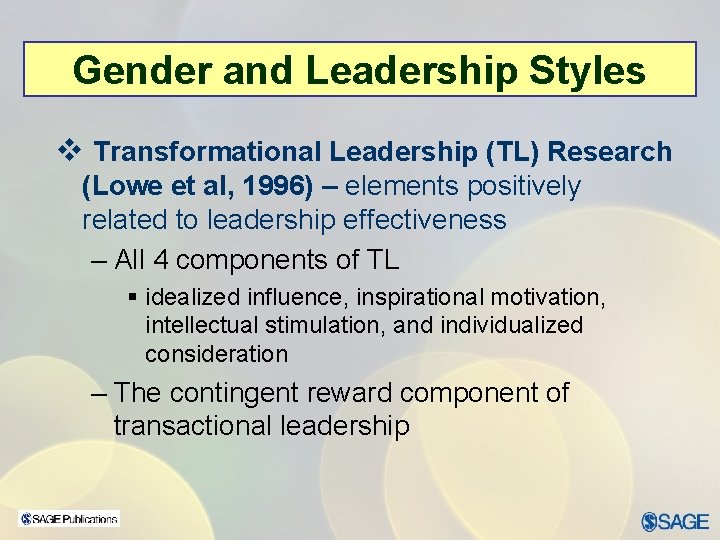
Gender and Leadership Styles v Transformational Leadership (TL) Research (Lowe et al, 1996) – elements positively related to leadership effectiveness – All 4 components of TL § idealized influence, inspirational motivation, intellectual stimulation, and individualized consideration – The contingent reward component of transactional leadership
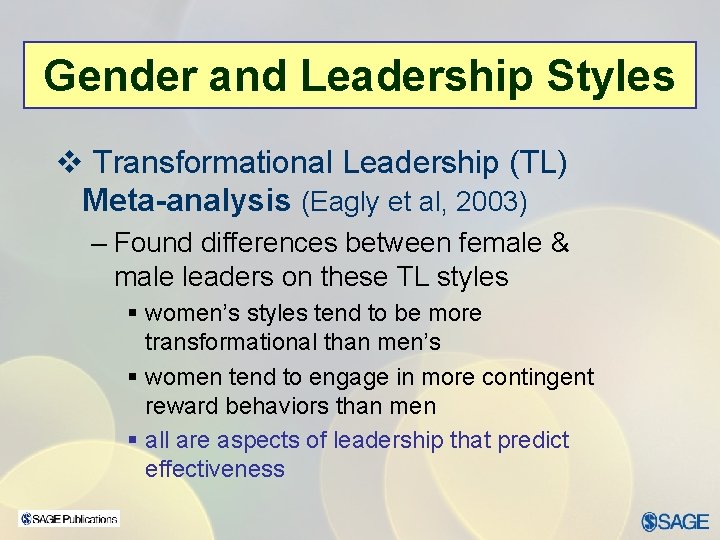
Gender and Leadership Styles v Transformational Leadership (TL) Meta-analysis (Eagly et al, 2003) – Found differences between female & male leaders on these TL styles § women’s styles tend to be more transformational than men’s § women tend to engage in more contingent reward behaviors than men § all are aspects of leadership that predict effectiveness
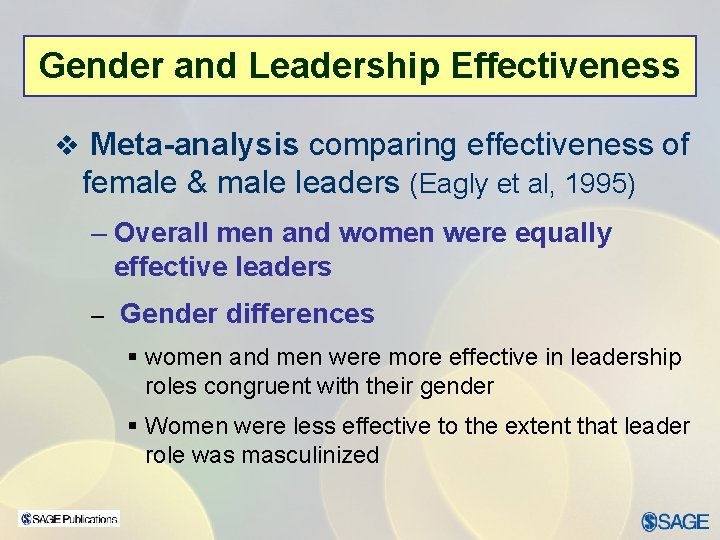
Gender and Leadership Effectiveness v Meta-analysis comparing effectiveness of female & male leaders (Eagly et al, 1995) – Overall men and women were equally effective leaders – Gender differences § women and men were more effective in leadership roles congruent with their gender § Women were less effective to the extent that leader role was masculinized
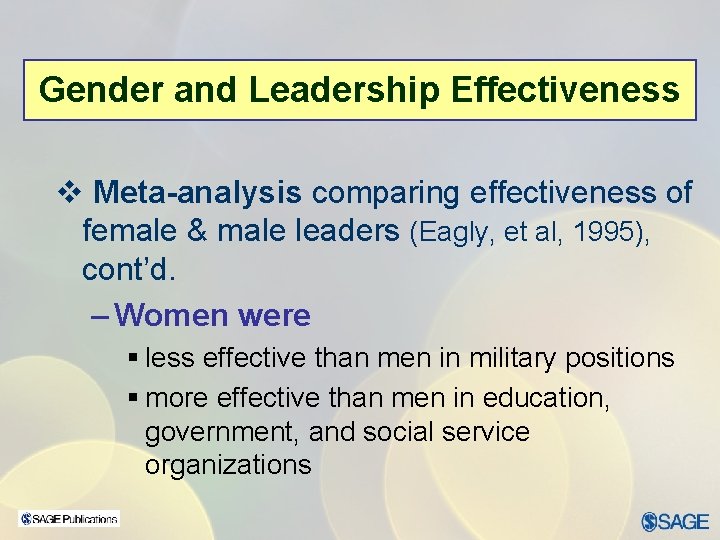
Gender and Leadership Effectiveness v Meta-analysis comparing effectiveness of female & male leaders (Eagly, et al, 1995), cont’d. – Women were § less effective than men in military positions § more effective than men in education, government, and social service organizations
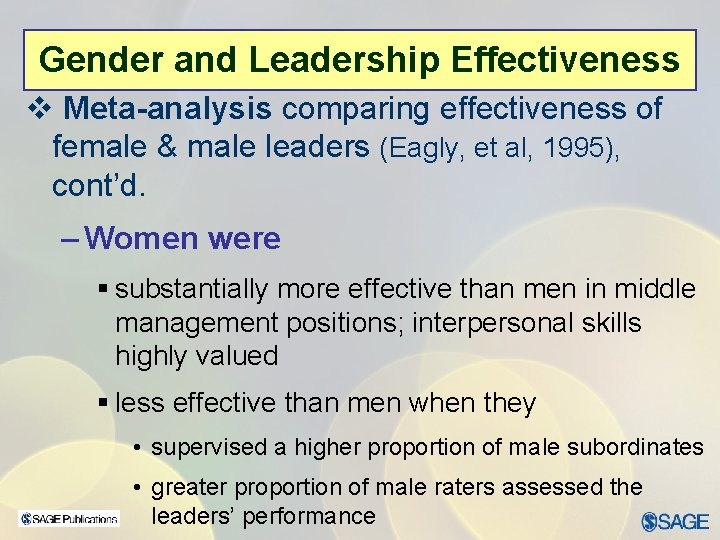
Gender and Leadership Effectiveness v Meta-analysis comparing effectiveness of female & male leaders (Eagly, et al, 1995), cont’d. – Women were § substantially more effective than men in middle management positions; interpersonal skills highly valued § less effective than men when they • supervised a higher proportion of male subordinates • greater proportion of male raters assessed the leaders’ performance
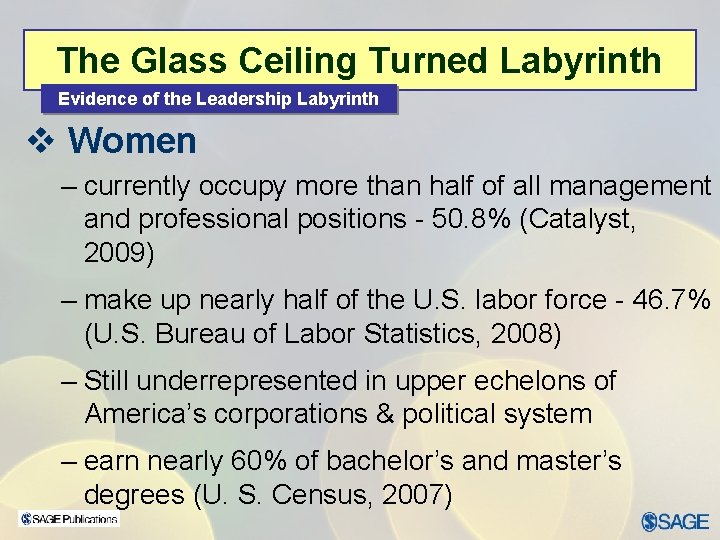
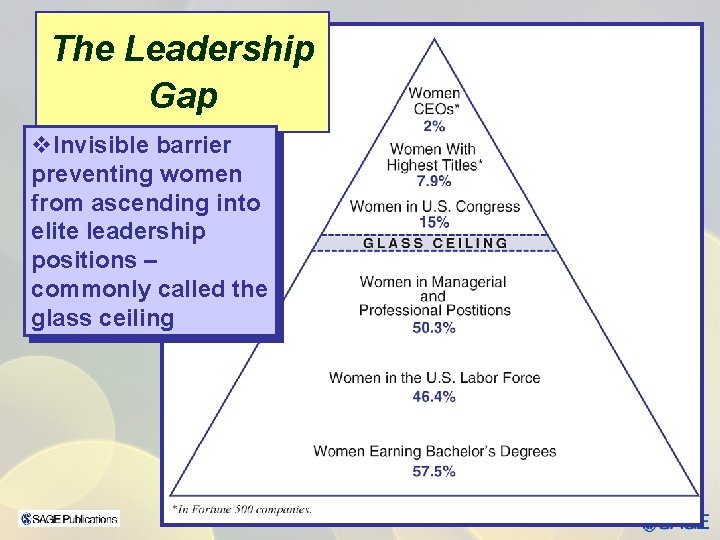
The Glass Ceiling Turned Labyrinth Evidence of the Leadership Labyrinth v Women – currently occupy more than half of all management and professional positions - 50. 8% (Catalyst, 2009) – make up nearly half of the U. S. labor force - 46. 7% (U. S. Bureau of Labor Statistics, 2008) – Still underrepresented in upper echelons of America’s corporations & political system – earn nearly 60% of bachelor’s and master’s degrees (U. S. Census, 2007)
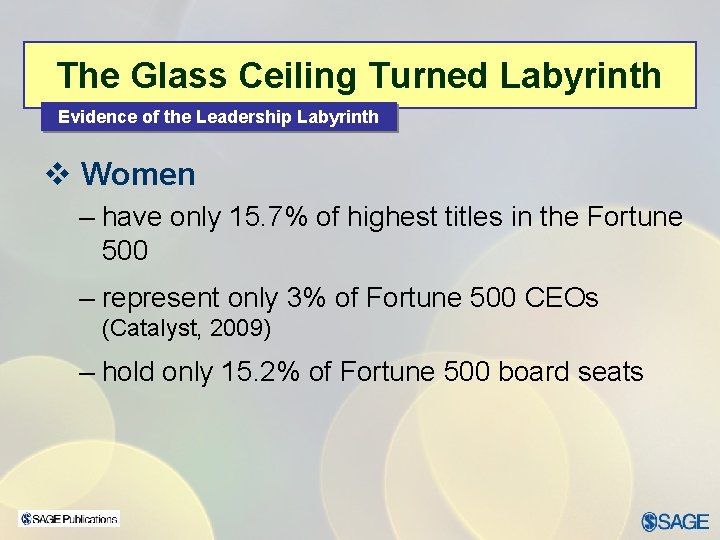
The Glass Ceiling Turned Labyrinth Evidence of the Leadership Labyrinth v Women – have only 15. 7% of highest titles in the Fortune 500 – represent only 3% of Fortune 500 CEOs (Catalyst, 2009) – hold only 15. 2% of Fortune 500 board seats
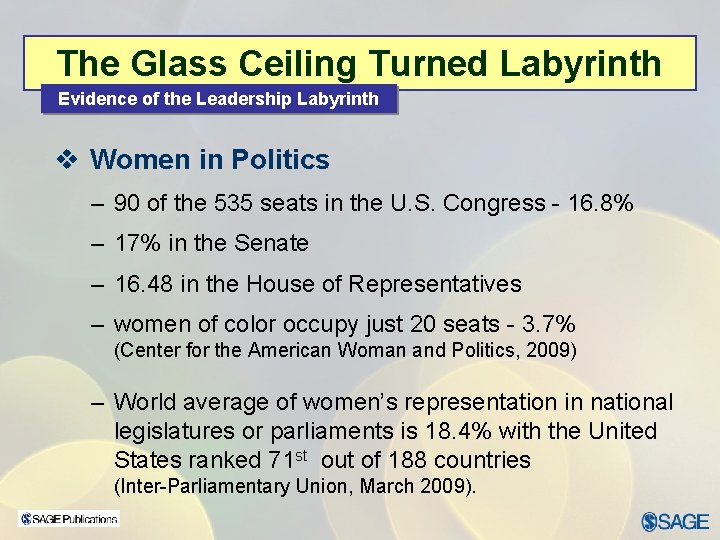
The Glass Ceiling Turned Labyrinth Evidence of the Leadership Labyrinth v Women in Politics – 90 of the 535 seats in the U. S. Congress - 16. 8% – 17% in the Senate – 16. 48 in the House of Representatives – women of color occupy just 20 seats - 3. 7% (Center for the American Woman and Politics, 2009) – World average of women’s representation in national legislatures or parliaments is 18. 4% with the United States ranked 71 st out of 188 countries (Inter-Parliamentary Union, March 2009).
The Leadership Gap v. Invisible barrier preventing women from ascending into elite leadership positions – commonly called the glass ceiling
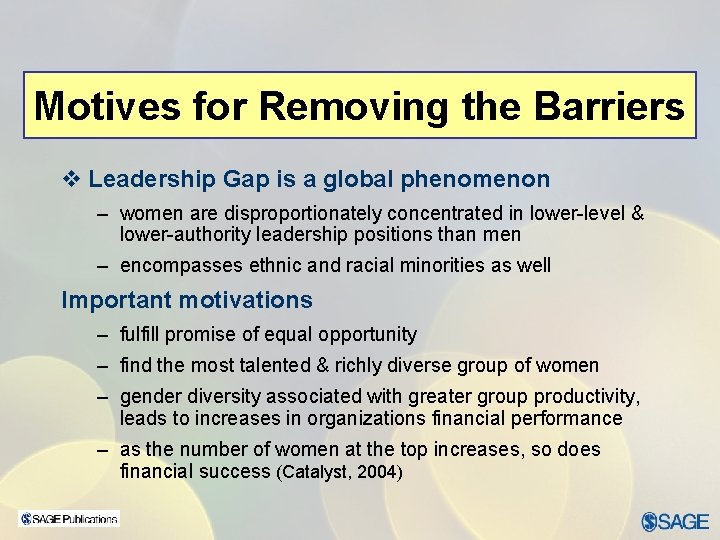
Motives for Removing the Barriers v Leadership Gap is a global phenomenon – women are disproportionately concentrated in lower-level & lower-authority leadership positions than men – encompasses ethnic and racial minorities as well Important motivations – fulfill promise of equal opportunity – find the most talented & richly diverse group of women – gender diversity associated with greater group productivity, leads to increases in organizations financial performance – as the number of women at the top increases, so does financial success (Catalyst, 2004)
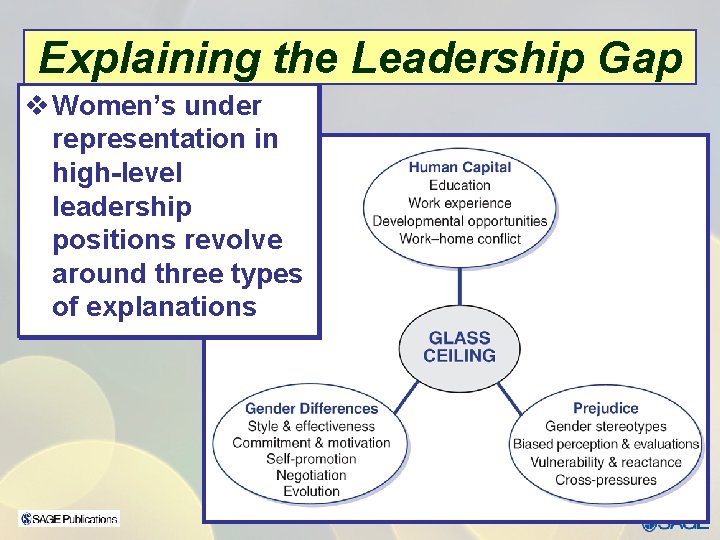
Explaining the Leadership Gap v Women’s under representation in high-level leadership positions revolve around three types of explanations
Understanding the Labyrinth v. Human Capital Differences – Pipeline Theory - Women have not been in managerial positions long enough for natural career progression to occur (Heilman, 1997) – not supported by research – Division of labor leads women to self-select out of leadership tracks by choosing “mommy track” positions that do not funnel into leadership positions (Belkin, 2003; Ehrlich, 1989; Wadman, 1992); research does not support this argument (Eagly & Carli, 2004)
Understanding the Labyrinth Human Capital Differences v Women – occupy more than half of all management & professional positions (Catalyst, 2009), but have fewer developmental opportunities – fewer responsibilities in the same jobs as men – are less likely to receive encouragement, be included in key networks, and receive formal job training than their male counterparts – confront greater barriers to establishing informal mentor relationships
Understanding the Labyrinth Gender Differences v. Women – show the same level of identification with & commitment to paid employment roles as men – are less likely to promote themselves for leadership positions than men – were less likely than men to emerge as group leaders, more likely to serve as social facilitators
Understanding the Labyrinth Gender Differences v Women – face significant gender biases and social disincentives when they self-promote – are less likely than men to ask for what they want – are less likely to negotiate than men v Psychological differences on traits often seen as related to effective leadership – men showing slightly more assertiveness than women – women showing somewhat higher levels of integrity than men (Feingold, 1994; Franke, Crowne, & Spake, 1997) – But effective leadership marked by androgynous mixture of traits (Eagly & Carli, 2007)
The Leadership Gap Prejudice v. Explanation for the leadership gap – gender bias stemming from stereotyped expectations – “women take care and men take charge” v. Survey of women executives from Fortune 1000 companies on reason for the leadership gap - 33% of the respondents cited – stereotyping – preconceptions of women’s roles & abilities as a major contributor (Catalyst, 2003)
The Leadership Gap Prejudice v Gender Stereotypes – pervasive, well documented, and highly resistant to change (Dodge, Gilroy & Fenzel, 1995; Heilman, 2001) – men are stereotyped with agentic characteristics § confidence, assertiveness, independence, rationality, & decisiveness – Stereotypical attributes of women include communal characteristics § concern for others, sensitivity, warmth, helpfulness, & nurturance (Deaux & Kite, 1993; Heilman, 2001)
The Leadership Gap Prejudice v Gender stereotypes explain numerous findings – – Penalties for violating one’s gender stereotype – Stereotypes are easily activated and can lead to biased judgments – greater difficulty for women to attain top leadership roles – Women facing cross pressures to be tough but not too “manly” – greater difficulty for women to be viewed as effective in top leadership roles (Eagly & Karau, 2002)
The Leadership Gap v How stereotypes affect women themselves - Pressure of tokenism (Kanter, 1977) - Assimilation to stereotype Less likely to desire leadership position Underperform in negotiations More likely for women who lack confidence - Counter the stereotype When blatant stereotype is activated (Kray et al. , 2001) Heightened desire to assume leadership position More likely for women who are confident
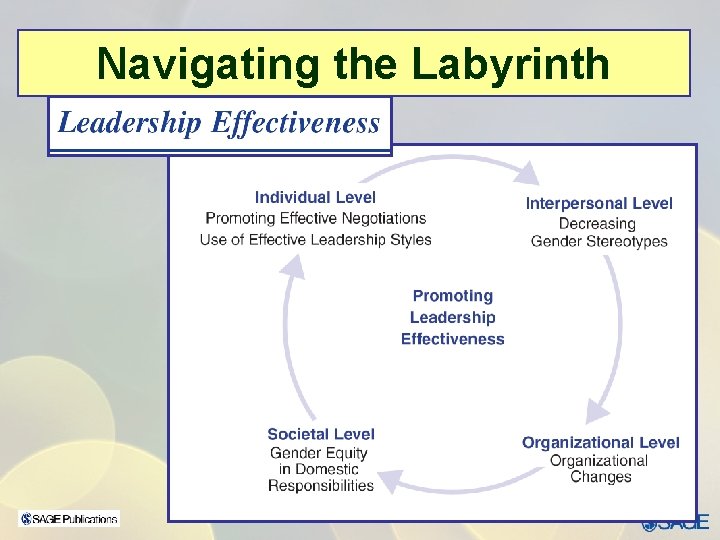
Navigating the Labyrinth
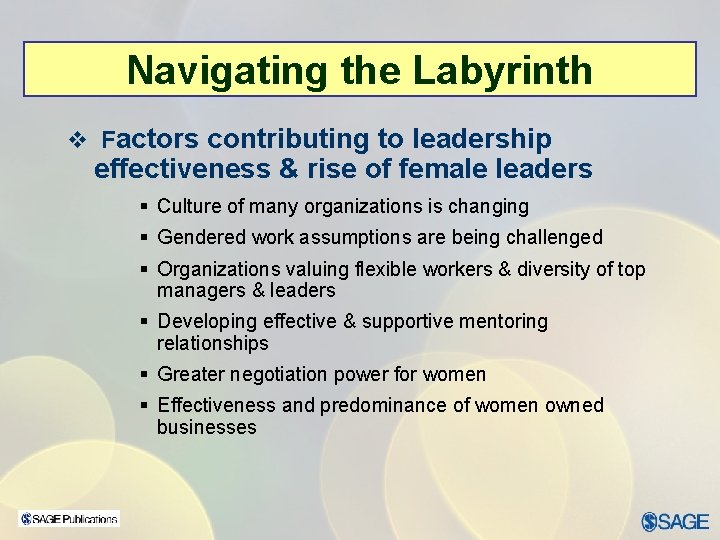
Navigating the Labyrinth v Factors contributing to leadership effectiveness & rise of female leaders § Culture of many organizations is changing § Gendered work assumptions are being challenged § Organizations valuing flexible workers & diversity of top managers & leaders § Developing effective & supportive mentoring relationships § Greater negotiation power for women § Effectiveness and predominance of women owned businesses
Women and Leadership Approach v Strengths v Criticisms v Application
Strengths v Developing a more androgynous conception of leadership will enhance leadership effectiveness by giving people opportunity to engage in the best leadership practices v Research on gender and leadership is productive in both dispelling myths about the gender gap and shining a light on aspects of the gender barrier that are difficult to see and therefore are overlooked v Understanding many components of the glass ceiling will give us the tools necessary to combat this inequality from many perspectives v Research addresses larger, more significant considerations about gender and social systems
Criticisms v Leadership researchers should put a greater emphasis on understanding the role of race and ethnicity (and other types of diversity) in leadership processes v Researchers should examine the differences in the impact of race or ethnicity and gender on leadership v Research into gender issues and leadership is predominantly in Western contexts and should be expanded into other global regions v Research on gender and leadership should be expanded to include closing the gender gap at home
Application v Make it easier for women to reach top positions by – Understanding obstacles that make up the glass ceiling – Initiating tactics to eradicate inequality v Effective way to overcome biased expectations, is continued use of – transformational behaviors – contingent reward behaviors v Use of effective negotiation techniques aid in procuring resources necessary at work/at home to augment leadership advancement v Increase presence of women in prominent leadership roles by – Changes in organizational culture – women’s career development – mentoring opportunities for women – increased numbers of women in strategic positions