
LEADERSHIP ATTRIBUTES 1 PERSONAL LEADERSHIP STYLE Democratic Leadership
LEADERSHIP ATTRIBUTES 1
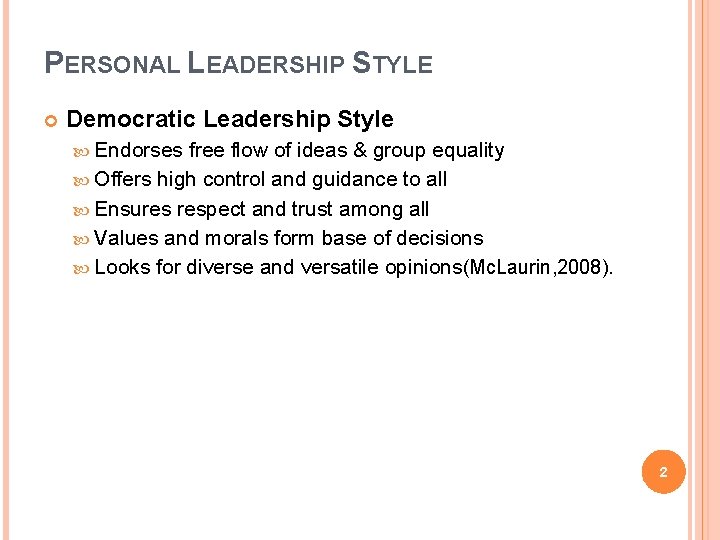
PERSONAL LEADERSHIP STYLE Democratic Leadership Style Endorses free flow of ideas & group equality Offers high control and guidance to all Ensures respect and trust among all Values and morals form base of decisions Looks for diverse and versatile opinions(Mc. Laurin, 2008). 2
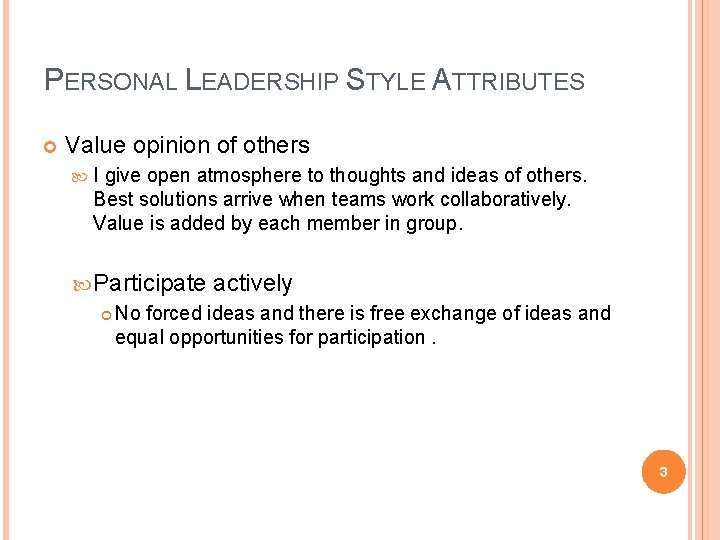
PERSONAL LEADERSHIP STYLE ATTRIBUTES Value opinion of others I give open atmosphere to thoughts and ideas of others. Best solutions arrive when teams work collaboratively. Value is added by each member in group. Participate actively No forced ideas and there is free exchange of ideas and equal opportunities for participation. 3
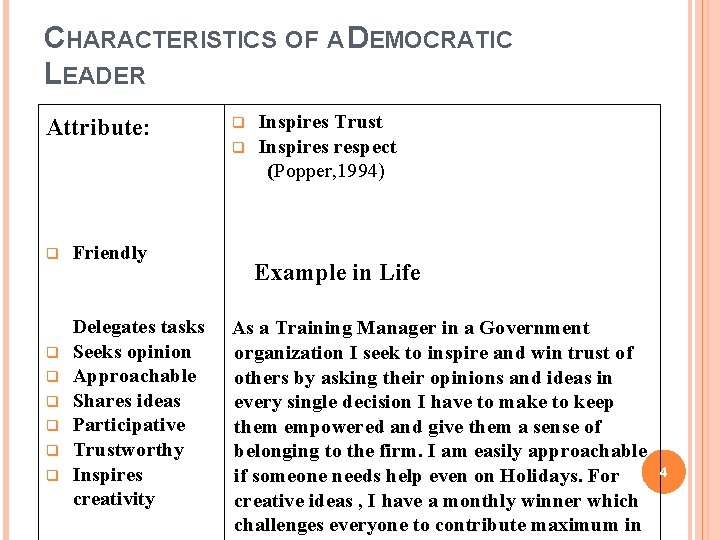
CHARACTERISTICS OF A DEMOCRATIC LEADER Attribute: Friendly Delegates tasks Seeks opinion Approachable Shares ideas Participative Trustworthy Inspires creativity Inspires Trust Inspires respect (Popper, 1994) Example in Life As a Training Manager in a Government organization I seek to inspire and win trust of others by asking their opinions and ideas in every single decision I have to make to keep them empowered and give them a sense of belonging to the firm. I am easily approachable if someone needs help even on Holidays. For creative ideas , I have a monthly winner which challenges everyone to contribute maximum in 4
CHARISMATIC LEADERSHIP STYLE Skilled Communicators Possess clear vision Experts in their areas Committed to bigger cause Engage massive audiences Focus is on their personality and actions Possible Drawbacks: May lack clarity Individuals or followers may not fulfill the vision Extra dependence on leader by followers Overconfidence of leader 5
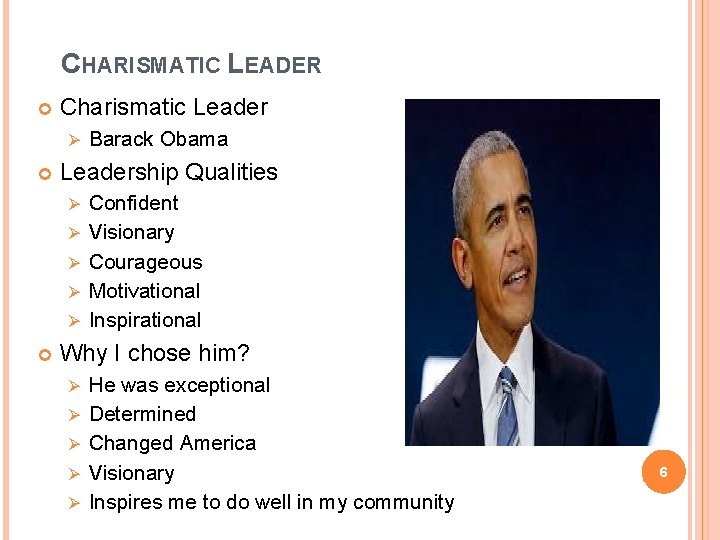
CHARISMATIC LEADER Charismatic Leadership Qualities Barack Obama Confident Visionary Courageous Motivational Inspirational Why I chose him? He was exceptional Determined Changed America Visionary Inspires me to do well in my community 6
TRANSFORMATIONAL LEADERSHIP STYLE Possesses optimistic future Aids followers to increase Inspires and empowers others Stimulates intellectually Individualized focus and consideration High inspirational commitment Influence is idealized (Van Wart, 2015) Possible Drawbacks May exercise Abuse of Power Backfiring of Influence Employee Burn out Prioritization factor 7
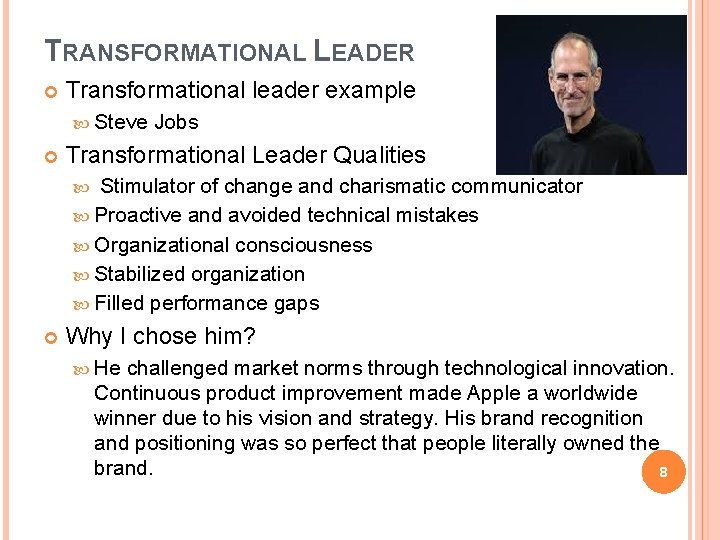
TRANSFORMATIONAL LEADER Transformational leader example Steve Jobs Transformational Leader Qualities Stimulator of change and charismatic communicator Proactive and avoided technical mistakes Organizational consciousness Stabilized organization Filled performance gaps Why I chose him? He challenged market norms through technological innovation. Continuous product improvement made Apple a worldwide winner due to his vision and strategy. His brand recognition and positioning was so perfect that people literally owned the brand. 8
CAN A TRANSFORMATIONAL LEADER BE DETRIMENTAL TO ORGANIZATION OR SOCIETY? Unlikely possible Such leaders have positive outlook Optimistic projection on followers Inspire knowledge creation and sharing Inspire creativity and growth Instil individual growth to align to organizational growth (Yukl, 1994). 9
REFLECTION This assignment helped me gain deeper understanding of various types and styles of leaderships and traits of leaders. I could analyze my own leadership traits and those of the leaders that I aspire to be. It also helped understand difference between charismatic and transformational leaderships. It is entirely upon the leader how he inspires his followers and motivates them to act. 10
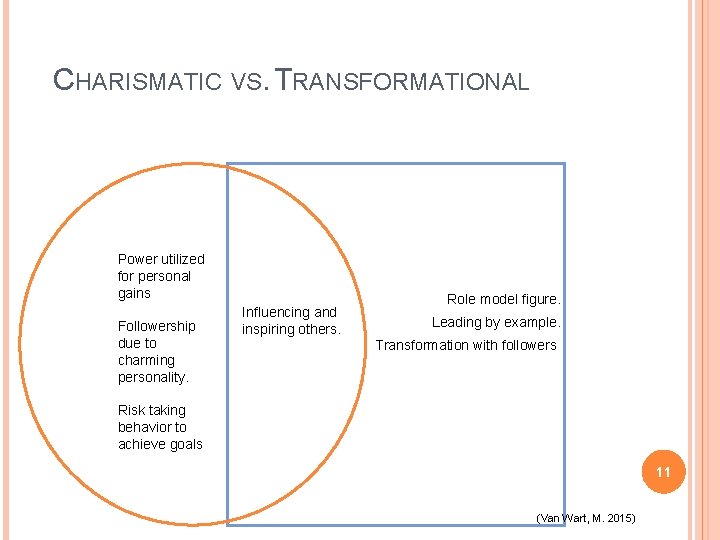
CHARISMATIC VS. TRANSFORMATIONAL Power utilized for personal gains Followership due to charming personality. Influencing and inspiring others. Role model figure. Leading by example. Transformation with followers Risk taking behavior to achieve goals 11 (Van Wart, M. 2015)
REFERENCES Mc. Laurin, J. R. , & Al Amri, M. B. (2008, July). Developing an understanding of charismatic and transformational leadership. In Allied Academies International Conference. Academy of Organizational Culture, Communications and Conflict. Proceedings (Vol. 13, No. 2, p. 15). Jordan Whitney Enterprises, Inc. Popper, M. , & Zakkai, E. (1994). Transactional, charismatic and transformational leadership. Leadership & Organization Development Journal. Van Wart, M. (2015). Evaluating transformational leaders: The challenging case of Eric Shinseki and the US Department of Veterans Yukl, G. (1999). An evaluation of conceptual weaknesses in transformational and charismatic leadership theories. The leadership quarterly, 10(2), 285 -305. Affairs. Public Administration Review, 75(5), 760 -769. 12
- Slides: 12