
Leadership and Management Best Practices in Academic Public
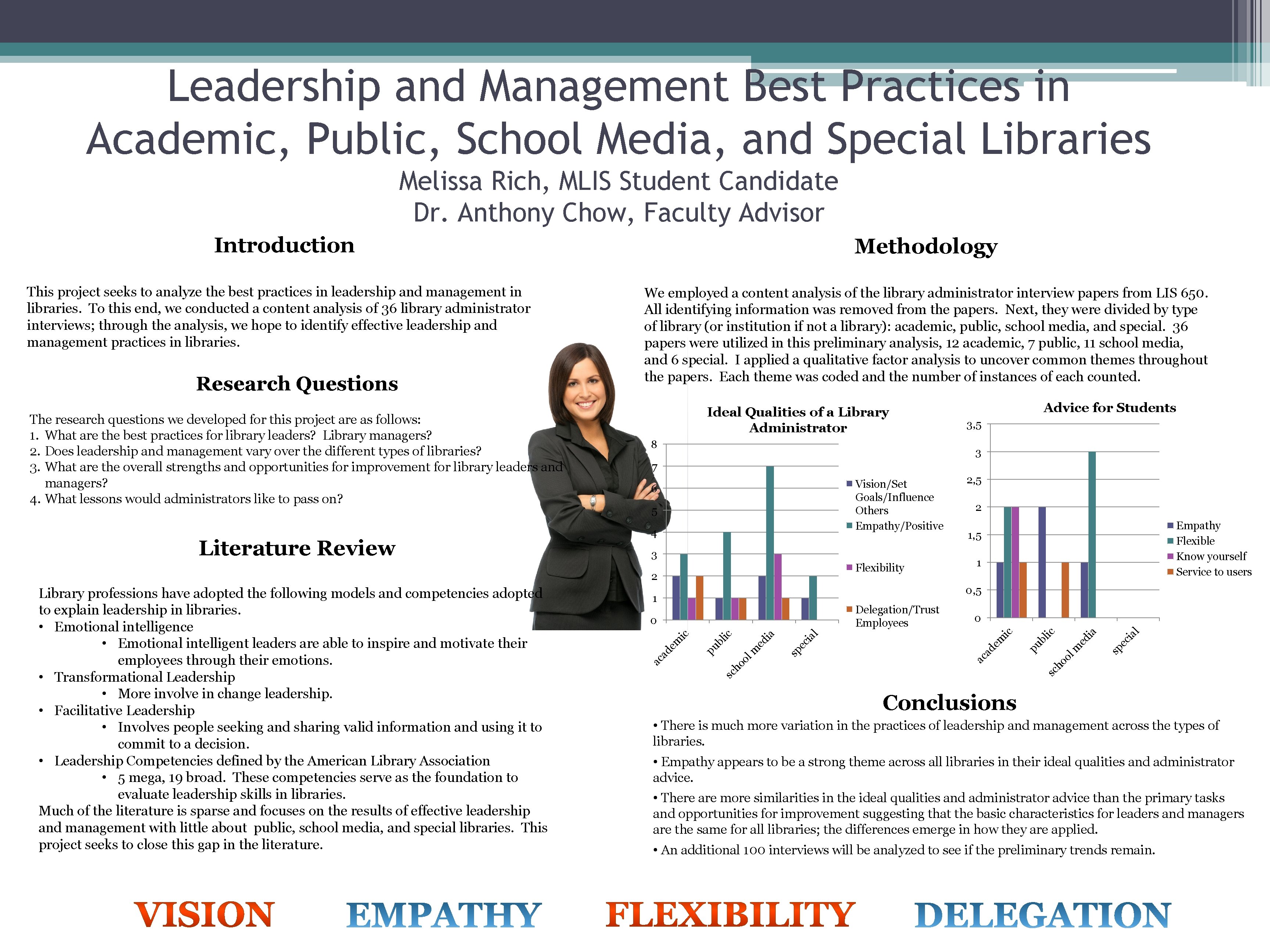
Leadership and Management Best Practices in Academic, Public, School Media, and Special Libraries Melissa Rich, MLIS Student Candidate Dr. Anthony Chow, Faculty Advisor Introduction 3 7 Vision/Set Goals/Influence Others Empathy/Positive 6 5 4 3 Flexibility 2 2, 5 2 Empathy Flexible Know yourself Service to users 1, 5 1 0, 5 al ci sp e al ci ed ia lm sc h m ol ho 0 sc sp e ed ia bl ic pu ad em ic 0 oo Delegation/Trust Employees bl ic 1 ac Library professions have adopted the following models and competencies adopted to explain leadership in libraries. • Emotional intelligence • Emotional intelligent leaders are able to inspire and motivate their employees through their emotions. • Transformational Leadership • More involve in change leadership. • Facilitative Leadership • Involves people seeking and sharing valid information and using it to commit to a decision. • Leadership Competencies defined by the American Library Association • 5 mega, 19 broad. These competencies serve as the foundation to evaluate leadership skills in libraries. Much of the literature is sparse and focuses on the results of effective leadership and management with little about public, school media, and special libraries. This project seeks to close this gap in the literature. 3, 5 pu Literature Review 8 Advice for Students ic The research questions we developed for this project are as follows: 1. What are the best practices for library leaders? Library managers? 2. Does leadership and management vary over the different types of libraries? 3. What are the overall strengths and opportunities for improvement for library leaders and managers? 4. What lessons would administrators like to pass on? Ideal Qualities of a Library Administrator ad em Research Questions We employed a content analysis of the library administrator interview papers from LIS 650. All identifying information was removed from the papers. Next, they were divided by type of library (or institution if not a library): academic, public, school media, and special. 36 papers were utilized in this preliminary analysis, 12 academic, 7 public, 11 school media, and 6 special. I applied a qualitative factor analysis to uncover common themes throughout the papers. Each theme was coded and the number of instances of each counted. ac This project seeks to analyze the best practices in leadership and management in libraries. To this end, we conducted a content analysis of 36 library administrator interviews; through the analysis, we hope to identify effective leadership and management practices in libraries. Methodology Conclusions • There is much more variation in the practices of leadership and management across the types of libraries. • Empathy appears to be a strong theme across all libraries in their ideal qualities and administrator advice. • There are more similarities in the ideal qualities and administrator advice than the primary tasks and opportunities for improvement suggesting that the basic characteristics for leaders and managers are the same for all libraries; the differences emerge in how they are applied. • An additional 100 interviews will be analyzed to see if the preliminary trends remain.
- Slides: 1