
Leadership and Change Dr Susan Cramer Ed L

- Slides: 12
Leadership and Change Dr. Susan Cramer Ed. L 714 Leadership for Curriculum Development
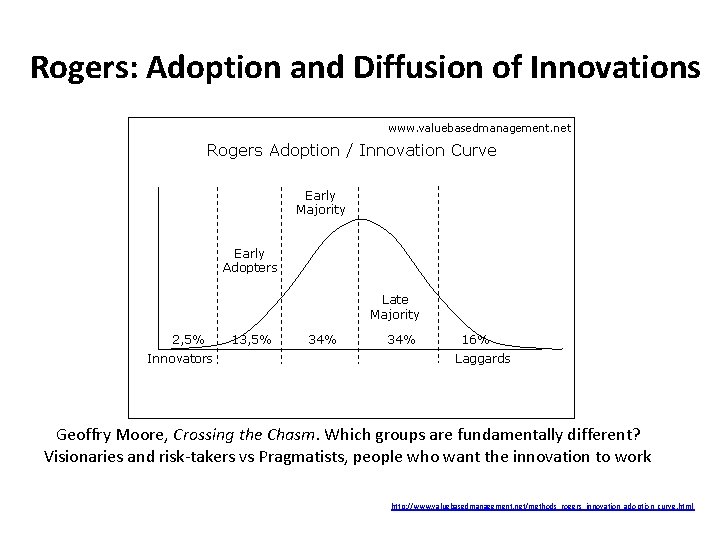
Rogers: Adoption and Diffusion of Innovations Geoffry Moore, Crossing the Chasm. Which groups are fundamentally different? Visionaries and risk-takers vs Pragmatists, people who want the innovation to work http: //www. valuebasedmanagement. net/methods_rogers_innovation_adoption_curve. html
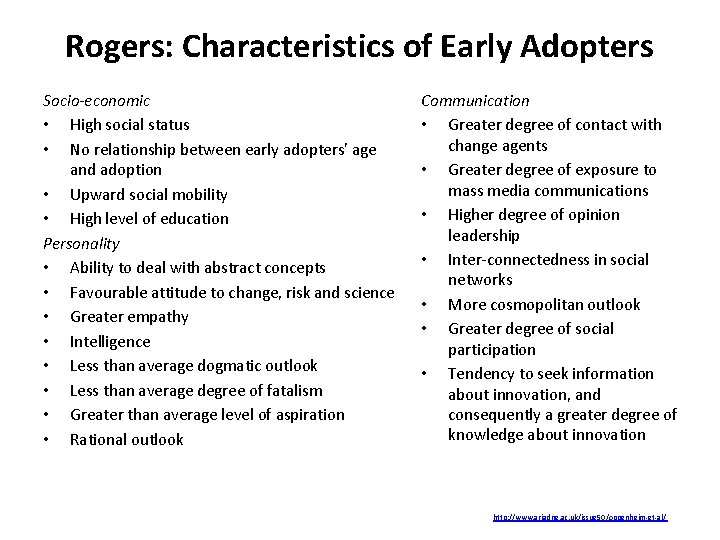
Rogers: Characteristics of Early Adopters Socio-economic • High social status • No relationship between early adopters' age and adoption • Upward social mobility • High level of education Personality • Ability to deal with abstract concepts • Favourable attitude to change, risk and science • Greater empathy • Intelligence • Less than average dogmatic outlook • Less than average degree of fatalism • Greater than average level of aspiration • Rational outlook Communication • Greater degree of contact with change agents • Greater degree of exposure to mass media communications • Higher degree of opinion leadership • Inter-connectedness in social networks • More cosmopolitan outlook • Greater degree of social participation • Tendency to seek information about innovation, and consequently a greater degree of knowledge about innovation http: //www. ariadne. ac. uk/issue 50/oppenheim-et-al/
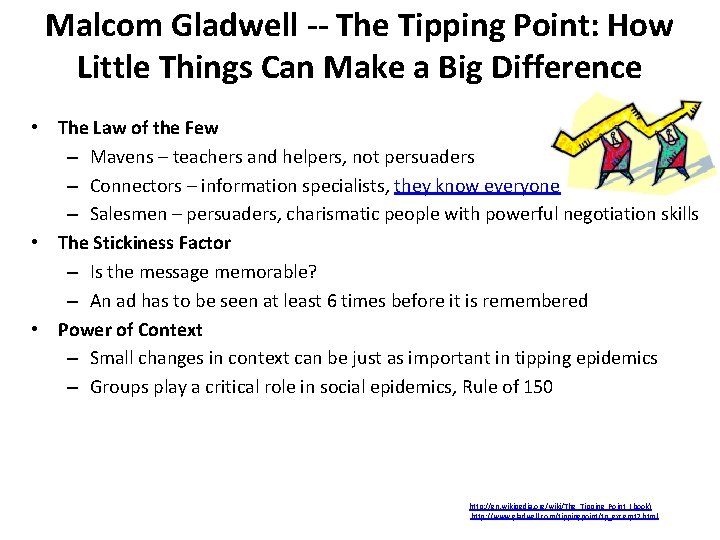
Malcom Gladwell -- The Tipping Point: How Little Things Can Make a Big Difference • The Law of the Few – Mavens – teachers and helpers, not persuaders – Connectors – information specialists, they know everyone – Salesmen – persuaders, charismatic people with powerful negotiation skills • The Stickiness Factor – Is the message memorable? – An ad has to be seen at least 6 times before it is remembered • Power of Context – Small changes in context can be just as important in tipping epidemics – Groups play a critical role in social epidemics, Rule of 150 http: //en. wikipedia. org/wiki/The_Tipping_Point_( book) http: //www. gladwell. com/tippingpoint/tp_excerpt 2. html
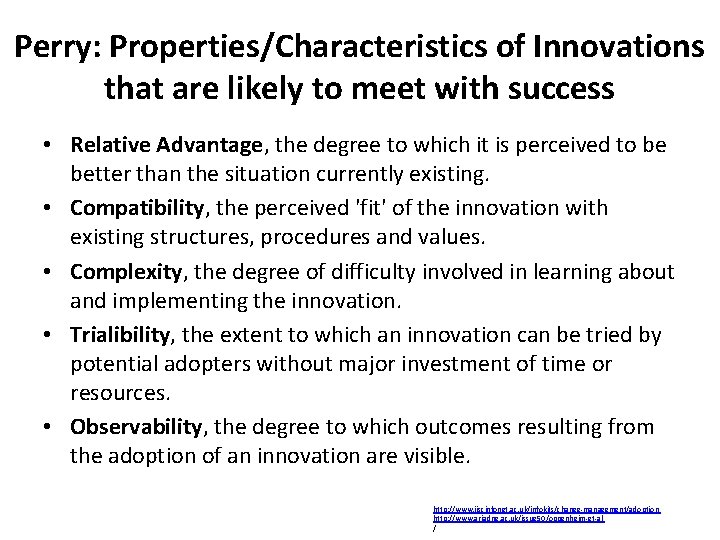
Perry: Properties/Characteristics of Innovations that are likely to meet with success • Relative Advantage, the degree to which it is perceived to be better than the situation currently existing. • Compatibility, the perceived 'fit' of the innovation with existing structures, procedures and values. • Complexity, the degree of difficulty involved in learning about and implementing the innovation. • Trialibility, the extent to which an innovation can be tried by potential adopters without major investment of time or resources. • Observability, the degree to which outcomes resulting from the adoption of an innovation are visible. http: //www. jiscinfonet. ac. uk/infokits/change-management/adoption http: //www. ariadne. ac. uk/issue 50/oppenheim-et-al /
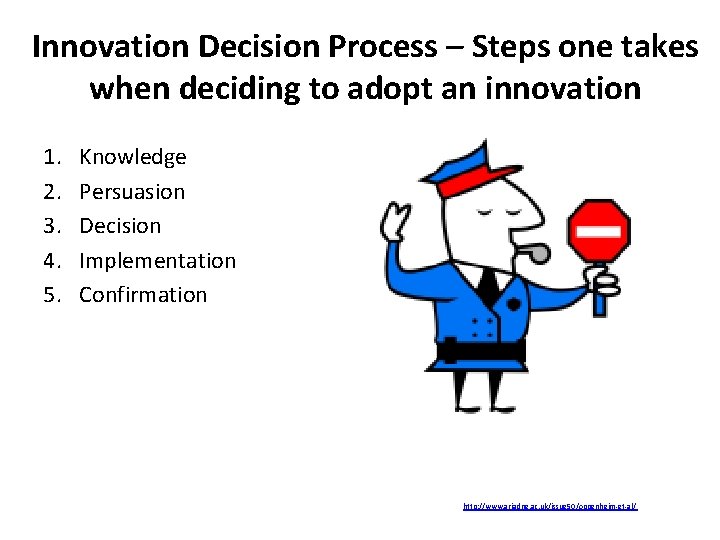
Innovation Decision Process – Steps one takes when deciding to adopt an innovation 1. 2. 3. 4. 5. Knowledge Persuasion Decision Implementation Confirmation http: //www. ariadne. ac. uk/issue 50/oppenheim-et-al/
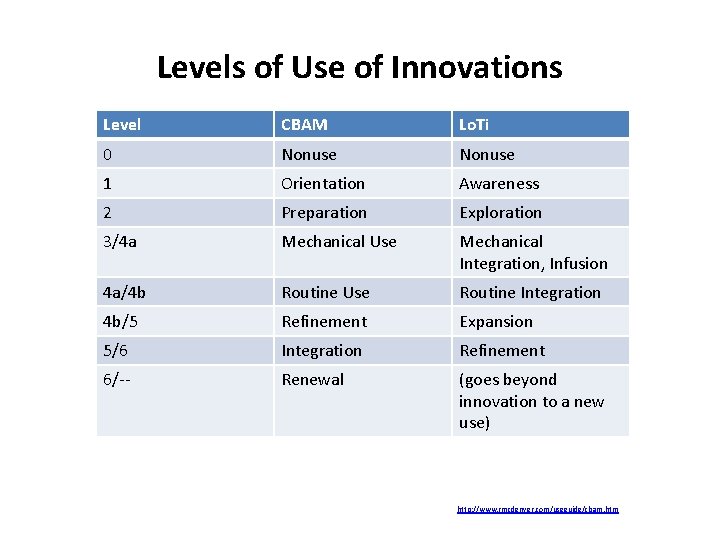
Levels of Use of Innovations Level CBAM Lo. Ti 0 Nonuse 1 Orientation Awareness 2 Preparation Exploration 3/4 a Mechanical Use Mechanical Integration, Infusion 4 a/4 b Routine Use Routine Integration 4 b/5 Refinement Expansion 5/6 Integration Refinement 6/-- Renewal (goes beyond innovation to a new use) http: //www. rmcdenver. com/useguide/cbam. htm
Adoption of Change (3 phases) • Unfreezing: Creating the motivation to change by disconfirmation of the present state, creation of survival anxiety, creating of psychological safety to overcome learning anxiety • Moving: Learning new concepts, new meanings, and new standards by imitation of and identification with role models, scanning for solutions and trial-and-error learning • Refreezing: Internalising new concepts, meanings, and standards by incorporating into self-concept and identity and into ongoing relationships and groups http: //www. jiscinfonet. ac. uk/infokits/change-management/adoption
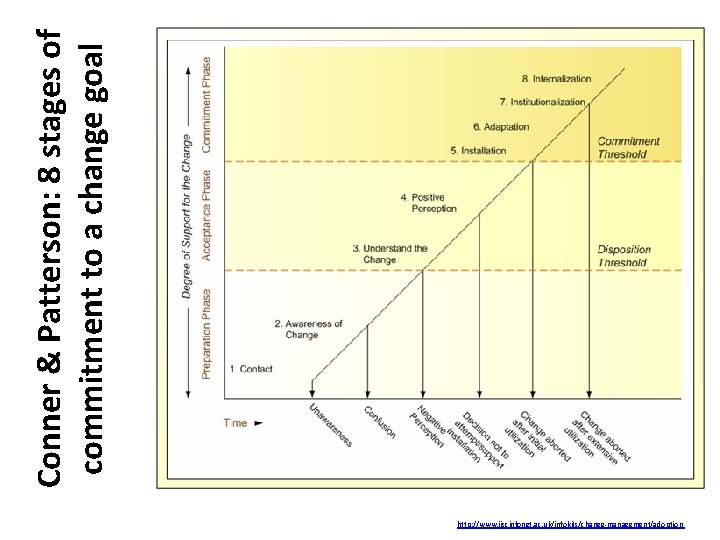
Conner & Patterson: 8 stages of commitment to a change goal http: //www. jiscinfonet. ac. uk/infokits/change-management/adoption
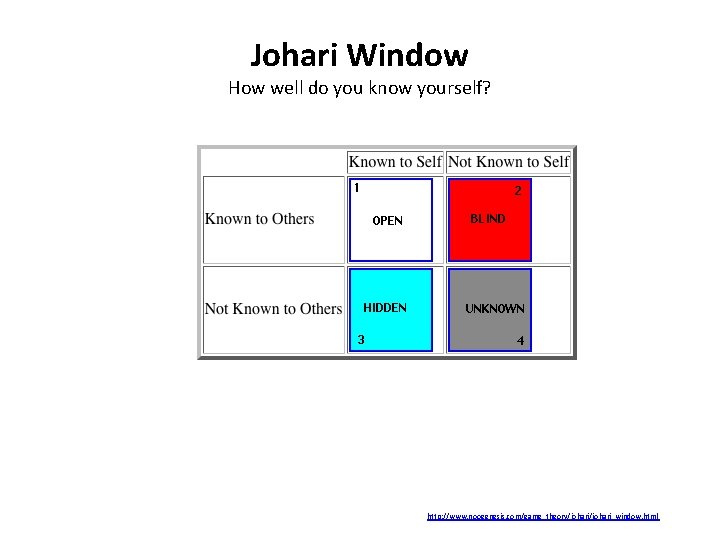
Johari Window How well do you know yourself? http: //www. noogenesis. com/game_theory/johari_window. html
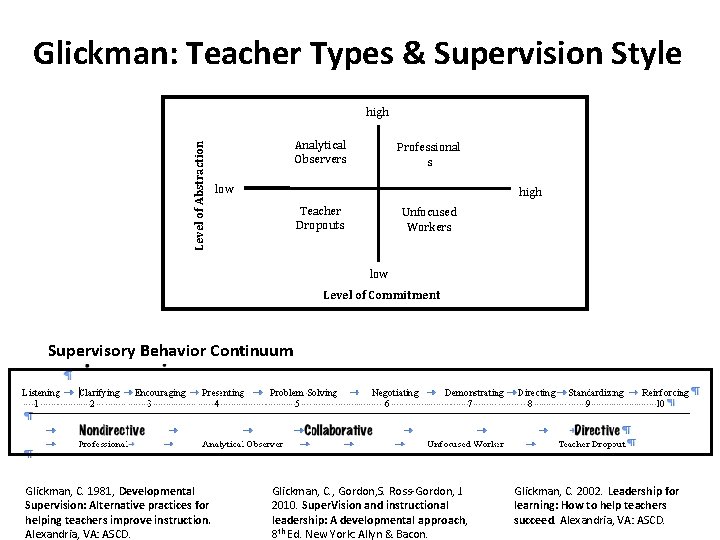
Glickman: Teacher Types & Supervision Style Level of Abstraction high Analytical Observers Professional s low high Teacher Dropouts Unfocused Workers low Level of Commitment Supervisory Behavior Continuum Glickman, C. 1981, Developmental Supervision: Alternative practices for helping teachers improve instruction. Alexandria, VA: ASCD. Glickman, C. , Gordon, S. Ross-Gordon, J. 2010. Super. Vision and instructional leadership: A developmental approach, 8 th Ed. New York: Allyn & Bacon. Glickman, C. 2002. Leadership for learning: How to help teachers succeed. Alexandria, VA: ASCD.
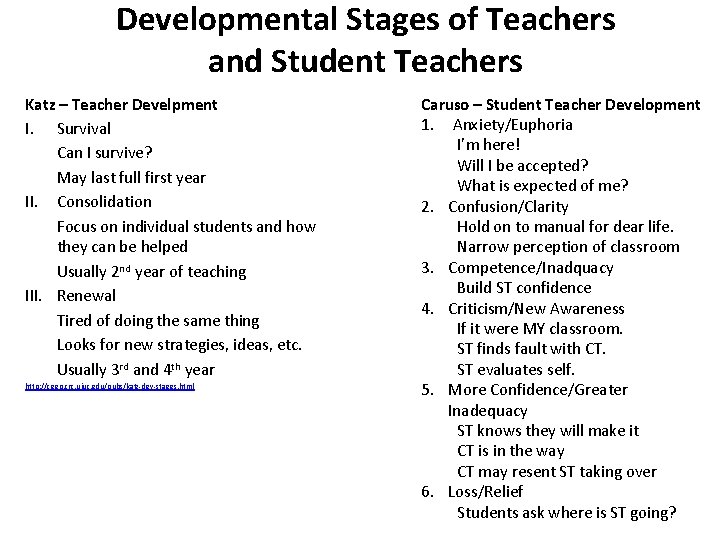
Developmental Stages of Teachers and Student Teachers Katz – Teacher Develpment I. Survival Can I survive? May last full first year II. Consolidation Focus on individual students and how they can be helped Usually 2 nd year of teaching III. Renewal Tired of doing the same thing Looks for new strategies, ideas, etc. Usually 3 rd and 4 th year http: //ceep. crc. uiuc. edu/pubs/katz-dev-stages. html Caruso – Student Teacher Development 1. Anxiety/Euphoria I’m here! Will I be accepted? What is expected of me? 2. Confusion/Clarity Hold on to manual for dear life. Narrow perception of classroom 3. Competence/Inadquacy Build ST confidence 4. Criticism/New Awareness If it were MY classroom. ST finds fault with CT. ST evaluates self. 5. More Confidence/Greater Inadequacy ST knows they will make it CT is in the way CT may resent ST taking over 6. Loss/Relief Students ask where is ST going?