
Leadership 3 models to consider Week 6 Management
- Slides: 30
Leadership – 3 models to consider Week 6 – Management in Practice
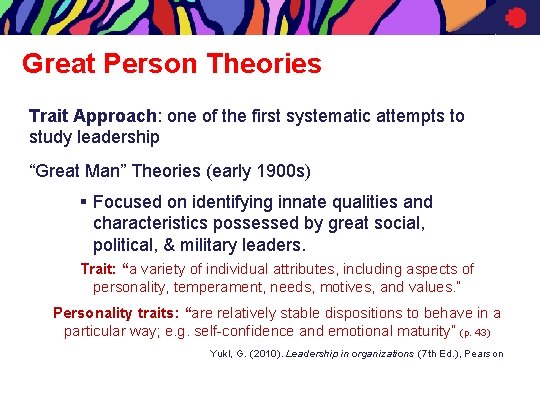
Great Person Theories Trait Approach: one of the first systematic attempts to study leadership “Great Man” Theories (early 1900 s) § Focused on identifying innate qualities and characteristics possessed by great social, political, & military leaders. Trait: “a variety of individual attributes, including aspects of personality, temperament, needs, motives, and values. ” Personality traits: “are relatively stable dispositions to behave in a particular way; e. g. self-confidence and emotional maturity” (p. 43) Yukl, G. (2010). Leadership in organizations (7 th Ed. ), Pearson 2
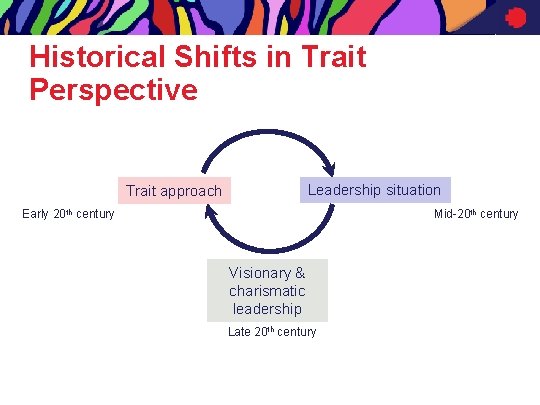
Historical Shifts in Trait Perspective Leadership situation Trait approach Early 20 th century Mid-20 th century Visionary & charismatic leadership Late 20 th century 3
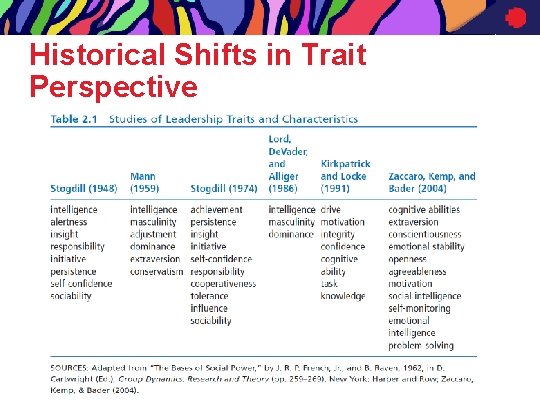
Historical Shifts in Trait Perspective 4
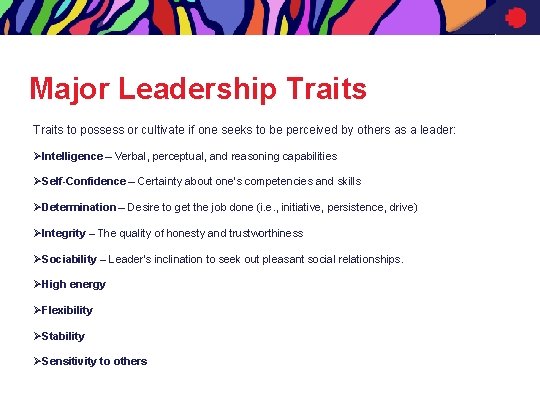
Major Leadership Traits to possess or cultivate if one seeks to be perceived by others as a leader: ØIntelligence – Verbal, perceptual, and reasoning capabilities ØSelf-Confidence – Certainty about one’s competencies and skills ØDetermination – Desire to get the job done (i. e. , initiative, persistence, drive) ØIntegrity – The quality of honesty and trustworthiness ØSociability – Leader’s inclination to seek out pleasant social relationships. ØHigh energy ØFlexibility ØStability ØSensitivity to others 5
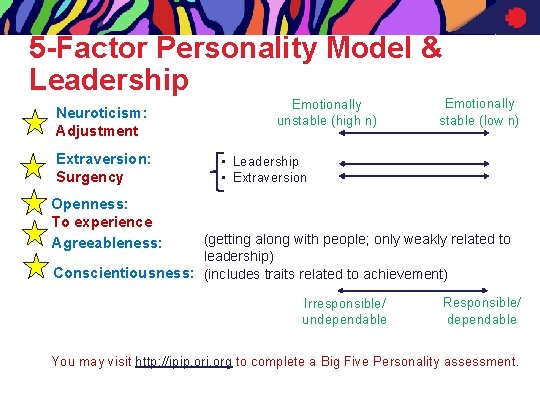
5 -Factor Personality Model & Leadership Neuroticism: Adjustment Extraversion: Surgency Emotionally unstable (high n) Emotionally stable (low n) • Leadership • Extraversion Openness: To experience Agreeableness: (getting along with people; only weakly related to leadership) Conscientiousness: (includes traits related to achievement) Irresponsible/ undependable Responsible/ dependable You may visit http: //ipip. ori. org to complete a Big Five Personality assessment. 6
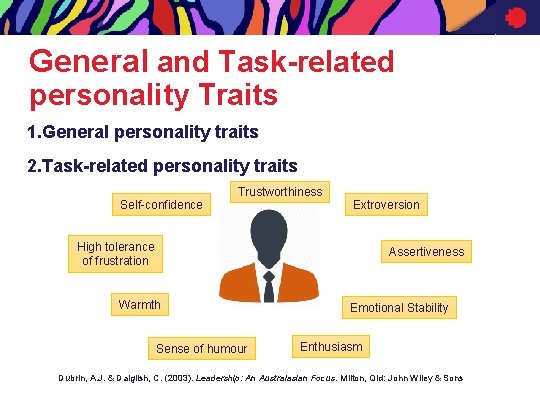
General and Task-related personality Traits 1. General personality traits 2. Task-related personality traits Self-confidence Trustworthiness Extroversion High tolerance of frustration Assertiveness Warmth Sense of humour Emotional Stability Enthusiasm Dubrin, A. J. & Dalglish, C. (2003). Leadership: An Australasian Focus. Milton, Qld: John Wiley & Sons 7
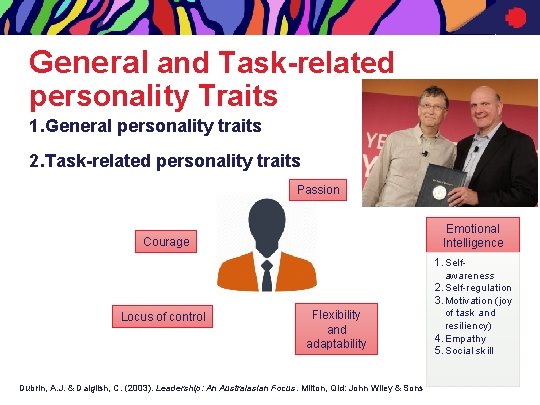
General and Task-related personality Traits 1. General personality traits 2. Task-related personality traits Passion Emotional Intelligence Courage Locus of control Flexibility and adaptability Dubrin, A. J. & Dalglish, C. (2003). Leadership: An Australasian Focus. Milton, Qld: John Wiley & Sons 1. Selfawareness 2. Self-regulation 3. Motivation (joy of task and resiliency) 4. Empathy 5. Social skill 8
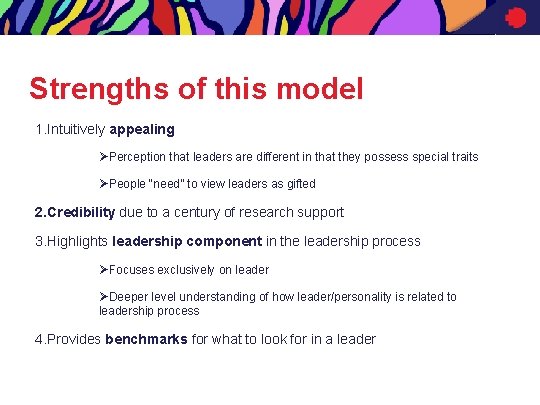
Strengths of this model 1. Intuitively appealing ØPerception that leaders are different in that they possess special traits ØPeople “need” to view leaders as gifted 2. Credibility due to a century of research support 3. Highlights leadership component in the leadership process ØFocuses exclusively on leader ØDeeper level understanding of how leader/personality is related to leadership process 4. Provides benchmarks for what to look for in a leader 9
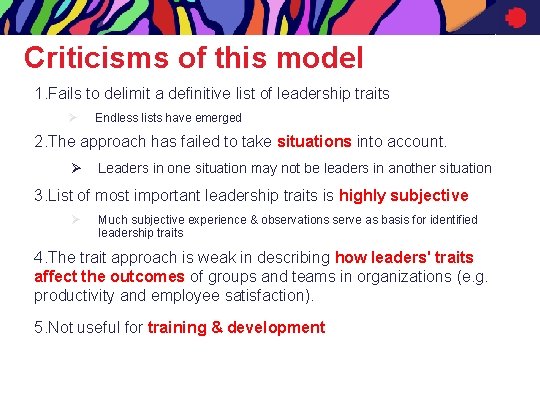
Criticisms of this model 1. Fails to delimit a definitive list of leadership traits Ø Endless lists have emerged 2. The approach has failed to take situations into account. Ø Leaders in one situation may not be leaders in another situation 3. List of most important leadership traits is highly subjective Ø Much subjective experience & observations serve as basis for identified leadership traits 4. The trait approach is weak in describing how leaders' traits affect the outcomes of groups and teams in organizations (e. g. productivity and employee satisfaction). 5. Not useful for training & development 10
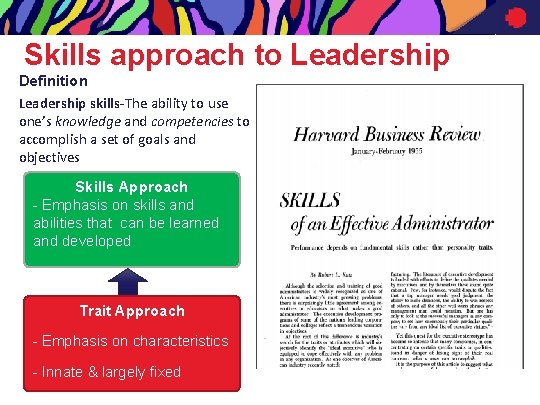
Skills approach to Leadership Definition Leadership skills-The ability to use one’s knowledge and competencies to accomplish a set of goals and objectives Skills Approach - Emphasis on skills and abilities that can be learned and developed Trait Approach - Emphasis on characteristics - Innate & largely fixed 11
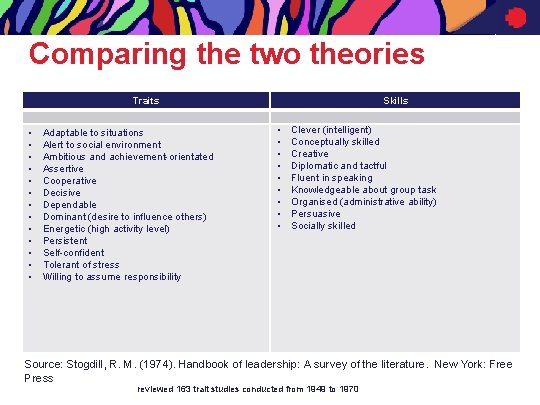
Comparing the two theories Traits • • • • Adaptable to situations Alert to social environment Ambitious and achievement-orientated Assertive Cooperative Decisive Dependable Dominant (desire to influence others) Energetic (high activity level) Persistent Self-confident Tolerant of stress Willing to assume responsibility Skills Approach Description Skills • • • Clever (intelligent) Conceptually skilled Creative Diplomatic and tactful Fluent in speaking Knowledgeable about group task Organised (administrative ability) Persuasive Socially skilled Source: Stogdill, R. M. (1974). Handbook of leadership: A survey of the literature. New York: Free Press reviewed 163 trait studies conducted from 1949 to 1970 12
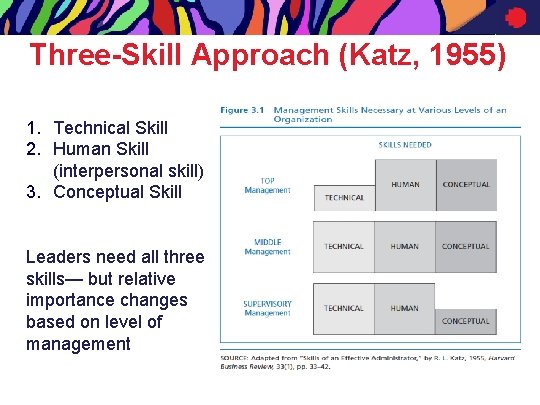
Three-Skill Approach (Katz, 1955) 1. Technical Skill 2. Human Skill (interpersonal skill) 3. Conceptual Skill Leaders need all three skills— but relative importance changes based on level of management 13
Three-Skill Approach (Katz, 1955) 1. Technical Skills: Having knowledge about and being proficient in a specific type of work or activity. § Specialized competencies § Analytical ability § Use of appropriate tools and techniques Technical skills involve hands-on ability with a product or process Most important at lower levels of management 14
Three-Skill Approach (Katz, 1955) 2. Human Skill: Having knowledge about and being able to work with people. § Being aware of one’s own perspective and others’ perspectives at the same time § Assisting group members in working cooperatively to achieve common goals § Creating an atmosphere of trust and empowerment of members § Important at all levels of the organization 15
Three-Skill Approach (Katz, 1955) 3. Conceptual Skill: The ability to see the organization as a whole. The ability to do the mental work of shaping meaning of organizational policy or issues (what company stands for and where it’s going) § Works easily with abstraction and hypothetical notions § Central to creating and articulating a vision and strategic plan for an organization § Most important at top management levels 16
Focus is primarily descriptive – it describes leadership from skills perspective Ø Provides structure for understanding the nature of effective leadership Principal Research Perspectives • Katz (1955) suggests importance of particular leadership skills varies depending where leaders reside in management hierarchy • Mumford, Campion, & Morgeson, (2007) suggest higher levels of all skills needed at higher levels of hierarchy • Mumford, Zaccaro, Harding et al. (2000) suggest leadership outcomes are direct result of leader’s skilled competency in problem solving, social judgment, & knowledge 17
Strengths of the Skills Approach • First approach to conceptualize and create a structure of the process of leadership around skills • Describing leadership in terms of skills makes leadership available to everyone • Provides an expansive view of leadership that incorporates wide variety of components (i. e. , problem-solving skills, social judgment skills) • Provides a structure consistent with leadership education programs 18
Criticisms of the Skills Approach • Breadth of the skills approach appears to extend beyond the boundaries of leadership, making it more general, less precise • Weak in predictive value; does not explain how skills lead to effective leadership performance • Not claimed to be a trait model: Skills model includes individual attributes that are trait-like • May not be generalizable 19
Applying the Skills Approach • The Skills Approach provides a way to delineate the skills of a leader • It is applicable to leaders at all levels within the organization • The skills inventory can provide insights into the individual’s leadership competencies • Test scores allow leaders to learn about areas in which they may wish to seek further training 20
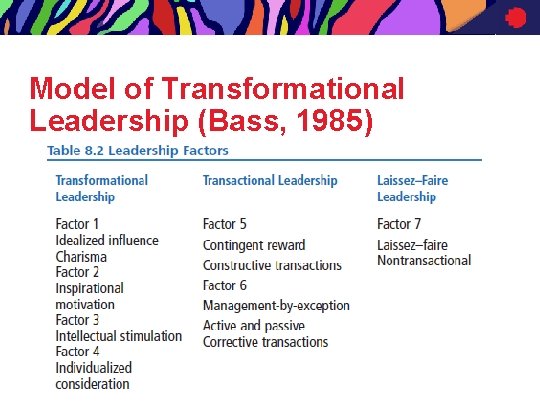
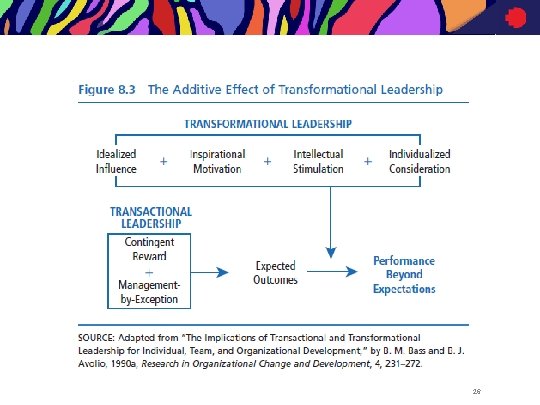
Model of Transformational Leadership (Bass, 1985) 21
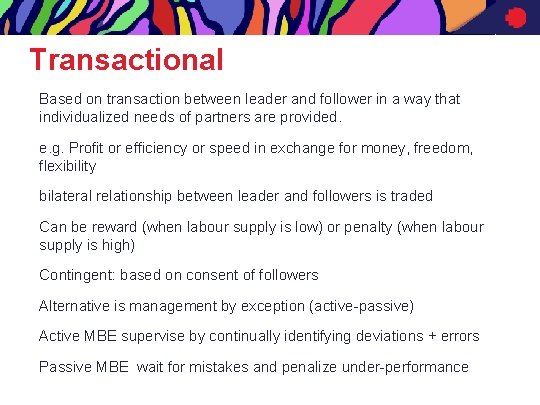
Transactional Based on transaction between leader and follower in a way that individualized needs of partners are provided. e. g. Profit or efficiency or speed in exchange for money, freedom, flexibility bilateral relationship between leader and followers is traded Can be reward (when labour supply is low) or penalty (when labour supply is high) Contingent: based on consent of followers Alternative is management by exception (active-passive) Active MBE supervise by continually identifying deviations + errors Passive MBE wait for mistakes and penalize under-performance 22
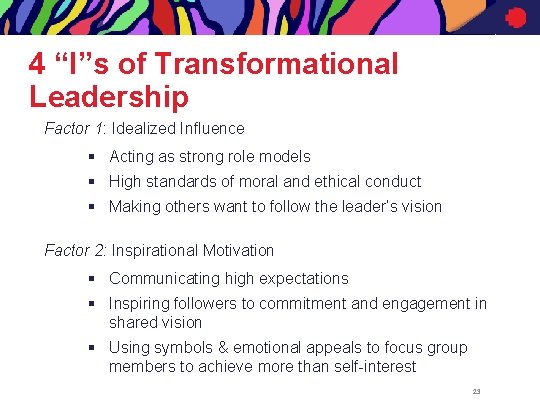
4 “I”s of Transformational Leadership Factor 1: Idealized Influence § Acting as strong role models § High standards of moral and ethical conduct § Making others want to follow the leader’s vision Factor 2: Inspirational Motivation § Communicating high expectations § Inspiring followers to commitment and engagement in shared vision § Using symbols & emotional appeals to focus group members to achieve more than self-interest 23
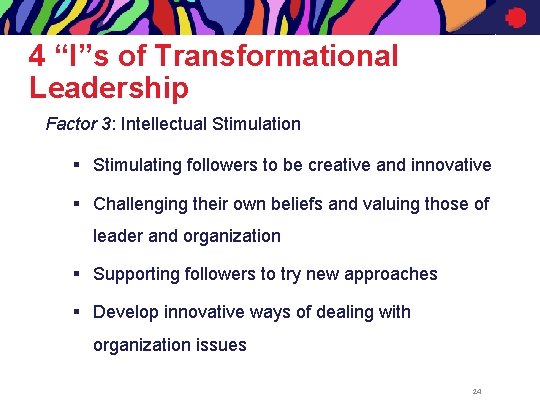
4 “I”s of Transformational Leadership Factor 3: Intellectual Stimulation § Stimulating followers to be creative and innovative § Challenging their own beliefs and valuing those of leader and organization § Supporting followers to try new approaches § Develop innovative ways of dealing with organization issues 24
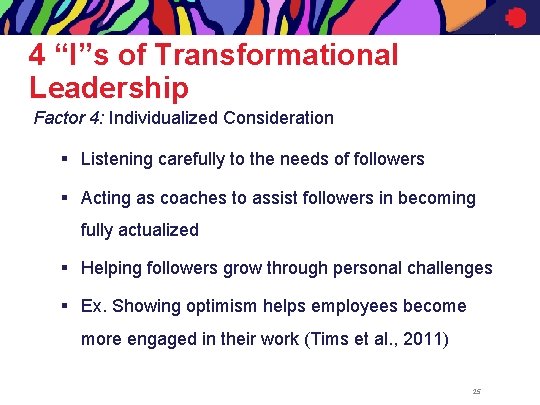
4 “I”s of Transformational Leadership Factor 4: Individualized Consideration § Listening carefully to the needs of followers § Acting as coaches to assist followers in becoming fully actualized § Helping followers grow through personal challenges § Ex. Showing optimism helps employees become more engaged in their work (Tims et al. , 2011) 25
26
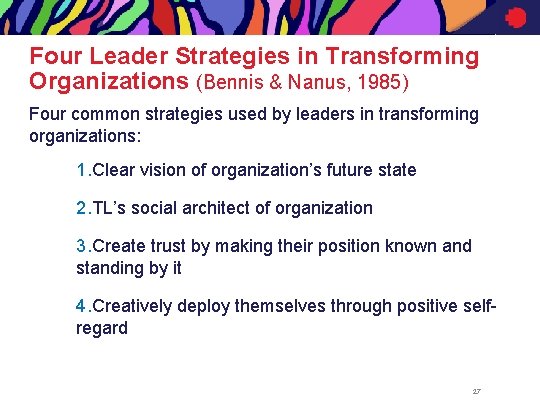
Four Leader Strategies in Transforming Organizations (Bennis & Nanus, 1985) Four common strategies used by leaders in transforming organizations: 1. Clear vision of organization’s future state 2. TL’s social architect of organization 3. Create trust by making their position known and standing by it 4. Creatively deploy themselves through positive selfregard 27
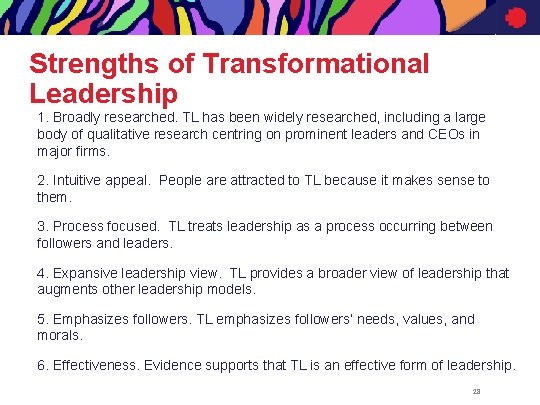
Strengths of Transformational Leadership 1. Broadly researched. TL has been widely researched, including a large body of qualitative research centring on prominent leaders and CEOs in major firms. 2. Intuitive appeal. People are attracted to TL because it makes sense to them. 3. Process focused. TL treats leadership as a process occurring between followers and leaders. 4. Expansive leadership view. TL provides a broader view of leadership that augments other leadership models. 5. Emphasizes followers. TL emphasizes followers’ needs, values, and morals. 6. Effectiveness. Evidence supports that TL is an effective form of leadership. 28
Criticisms of Transformational Approach 1. Lacks conceptual clarity § Dimensions are not clearly delimited § Parameters of TL overlap with similar conceptualizations of leadership 2. Measurement questioned § Validity of MLQ not fully established § Some transformational factors are not unique solely to the transformational model 3. TL treats leadership more as a personality trait or predisposition than a behaviour that can be taught 4. No causal link shown between transformational leaders and changes in followers or organizations 5. TL is elitist and antidemocratic 6. Suffers from heroic leadership bias 7. Has the potential to be abused 29
Applications of Transformational Approach § Provides a general way of thinking about leadership that stresses ideals, inspiration, innovations, and individual concerns § Can be taught to individuals at all levels of the organization § Able to positively impact a firm’s performance § May be used as a tool in recruitment, selection, promotion, and training development § Can be used to improve team development, decision-making groups, quality initiatives, and reorganizations § The MLQ and Sosik and Jung (2010) guide help leaders to target areas of leadership improvement 30