
LEADERSHI P A presentation by NAJMA KAZI Principal
LEADERSHI P A presentation by NAJMA KAZI Principal, Anjuman-I-Islam’s Saif Tyabji Girls High School & Junior College Email: najmakazi@gmail. com
THE BACKGROUND • Changing Economic Environment • Globalization • Growing Competition • Employability (only 26% MBAs are employable) • Parents desire to give best education as their legacy
WHAT IS LEADERSHIP ? • Leadership is the power to influence people for performing a task that leads to the achievement of given objectives and goals • It is concerned with: • Leading People • Influencing People • Commanding People • Guiding People
CONCEPT OF LEADERSHIP • To be an effective leader, a leader needs to know and understand the following: • People paradoxically need security & independence at the same time • People are sensitive to external rewards & punishments & yet are also strongly self motivated • People like to hear a kind of praise • Please can process only a few facts at a time, this a leader needs to keep things simple • Please trust their gut reactions more than statistical tools • People distrust a leader’s rhetoric if the words are
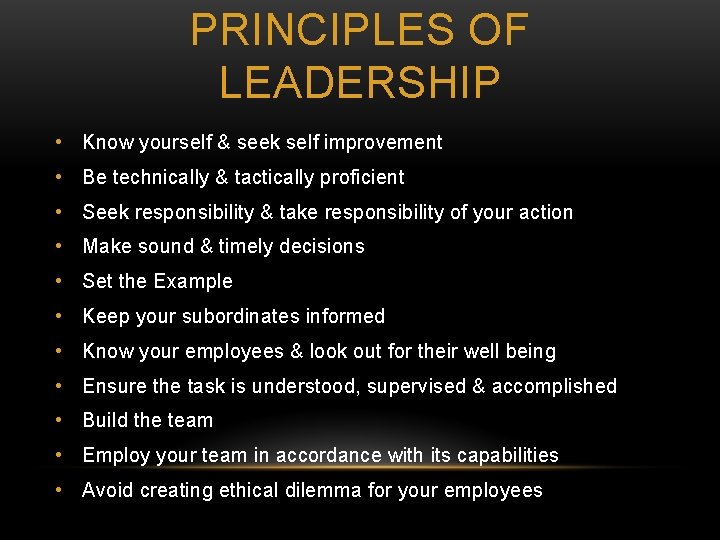
PRINCIPLES OF LEADERSHIP • Know yourself & seek self improvement • Be technically & tactically proficient • Seek responsibility & take responsibility of your action • Make sound & timely decisions • Set the Example • Keep your subordinates informed • Know your employees & look out for their well being • Ensure the task is understood, supervised & accomplished • Build the team • Employ your team in accordance with its capabilities • Avoid creating ethical dilemma for your employees
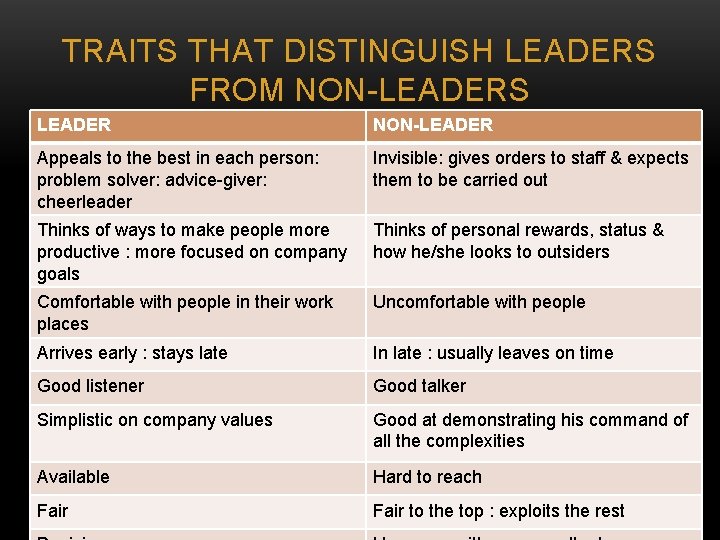
TRAITS THAT DISTINGUISH LEADERS FROM NON-LEADERS LEADER NON-LEADER Appeals to the best in each person: problem solver: advice-giver: cheerleader Invisible: gives orders to staff & expects them to be carried out Thinks of ways to make people more productive : more focused on company goals Thinks of personal rewards, status & how he/she looks to outsiders Comfortable with people in their work places Uncomfortable with people Arrives early : stays late In late : usually leaves on time Good listener Good talker Simplistic on company values Good at demonstrating his command of all the complexities Available Hard to reach Fair to the top : exploits the rest
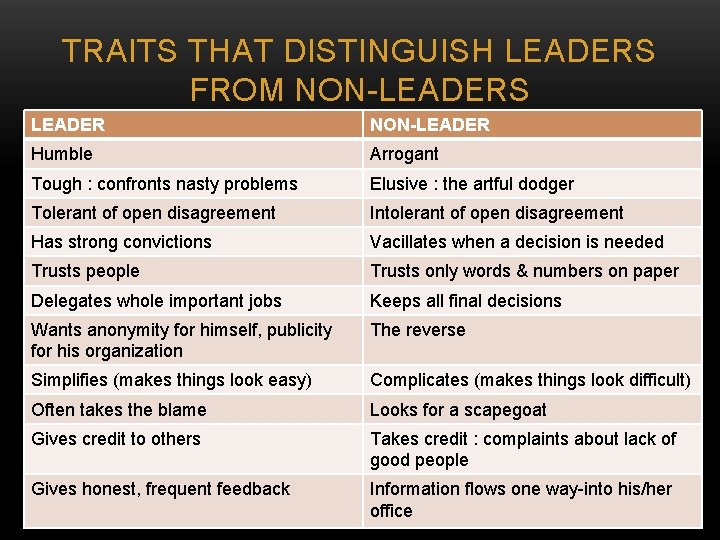
TRAITS THAT DISTINGUISH LEADERS FROM NON-LEADERS LEADER NON-LEADER Humble Arrogant Tough : confronts nasty problems Elusive : the artful dodger Tolerant of open disagreement Intolerant of open disagreement Has strong convictions Vacillates when a decision is needed Trusts people Trusts only words & numbers on paper Delegates whole important jobs Keeps all final decisions Wants anonymity for himself, publicity for his organization The reverse Simplifies (makes things look easy) Complicates (makes things look difficult) Often takes the blame Looks for a scapegoat Gives credit to others Takes credit : complaints about lack of good people Gives honest, frequent feedback Information flows one way-into his/her office
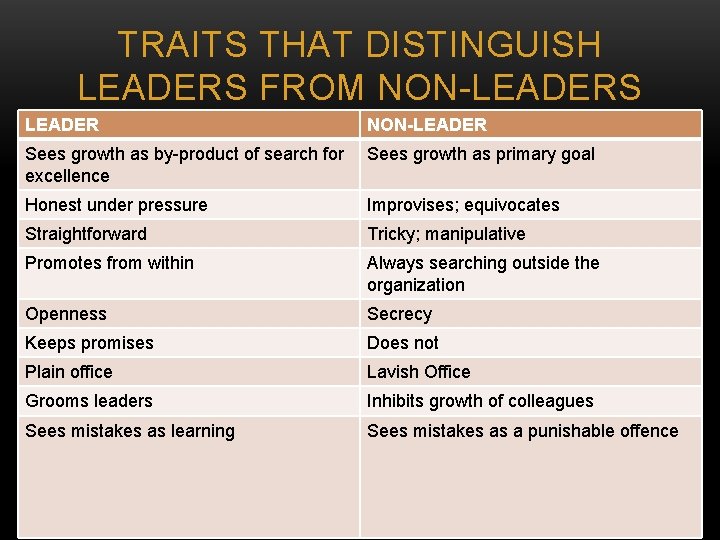
TRAITS THAT DISTINGUISH LEADERS FROM NON-LEADERS LEADER NON-LEADER Sees growth as by-product of search for excellence Sees growth as primary goal Honest under pressure Improvises; equivocates Straightforward Tricky; manipulative Promotes from within Always searching outside the organization Openness Secrecy Keeps promises Does not Plain office Lavish Office Grooms leaders Inhibits growth of colleagues Sees mistakes as learning Sees mistakes as a punishable offence
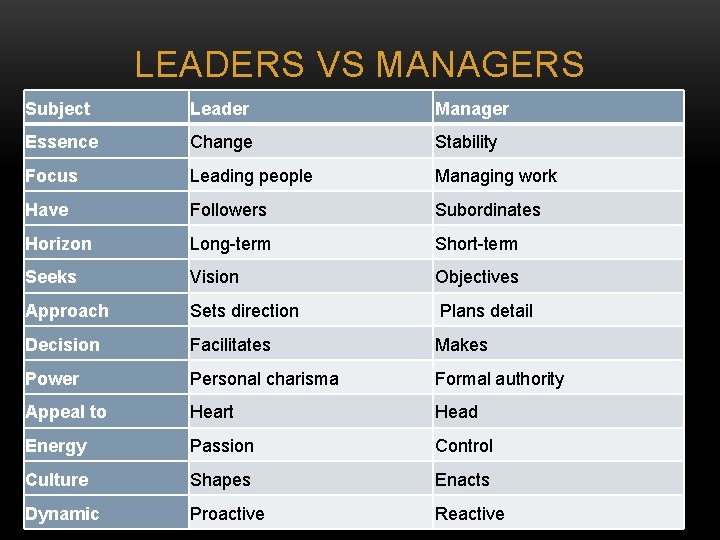
LEADERS VS MANAGERS Subject Leader Manager Essence Change Stability Focus Leading people Managing work Have Followers Subordinates Horizon Long-term Short-term Seeks Vision Objectives Approach Sets direction Plans detail Decision Facilitates Makes Power Personal charisma Formal authority Appeal to Heart Head Energy Passion Control Culture Shapes Enacts Dynamic Proactive Reactive
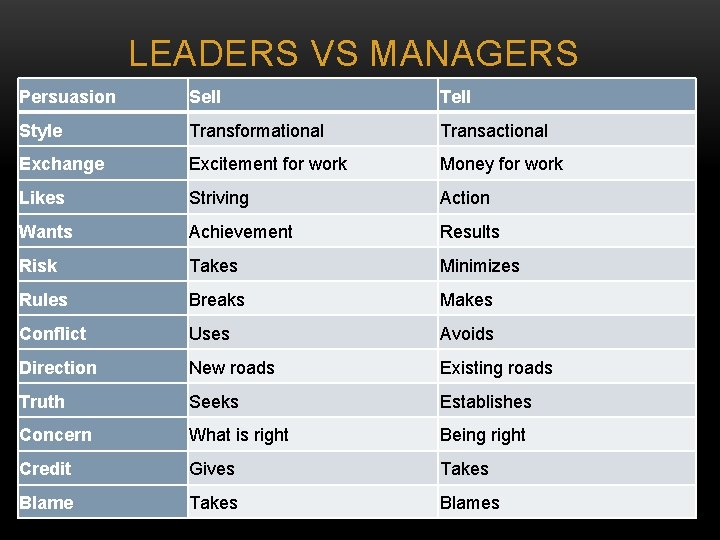
LEADERS VS MANAGERS Persuasion Sell Tell Style Transformational Transactional Exchange Excitement for work Money for work Likes Striving Action Wants Achievement Results Risk Takes Minimizes Rules Breaks Makes Conflict Uses Avoids Direction New roads Existing roads Truth Seeks Establishes Concern What is right Being right Credit Gives Takes Blames
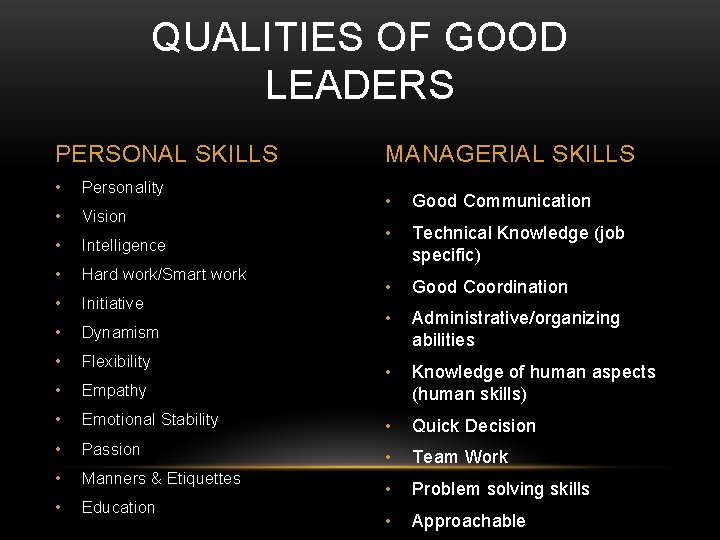
QUALITIES OF GOOD LEADERS PERSONAL SKILLS • Personality • Vision • Intelligence • Hard work/Smart work • Initiative • Dynamism • Flexibility • Empathy • MANAGERIAL SKILLS • Good Communication • Technical Knowledge (job specific) • Good Coordination • Administrative/organizing abilities • Knowledge of human aspects (human skills) Emotional Stability • Quick Decision • Passion • Team Work • Manners & Etiquettes • Education • Problem solving skills • Approachable
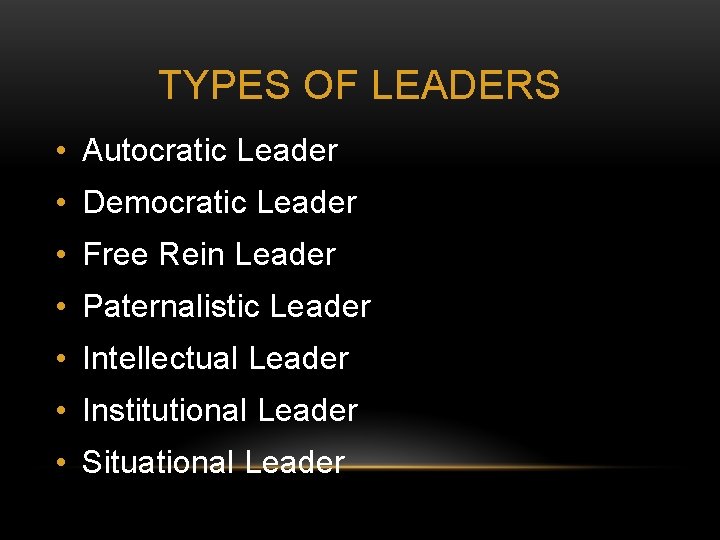
TYPES OF LEADERS • Autocratic Leader • Democratic Leader • Free Rein Leader • Paternalistic Leader • Intellectual Leader • Institutional Leader • Situational Leader
THEORIES OF LEADERSHIP • TRAIT APPROACH THEORY • Leaders are born, not made • BEHAVIOUR APPROACH THEORY • Leaders are not born, but made • SITUATIONAL APPROACH THEORY • Leaders adopt the style best suited to the situation
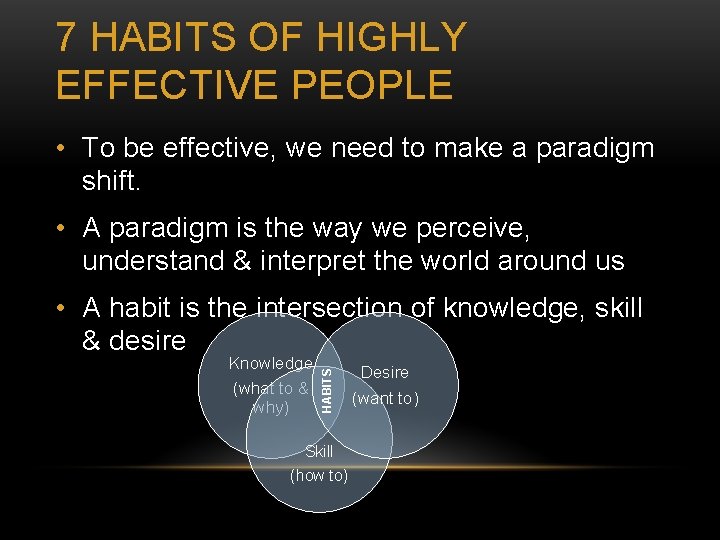
7 HABITS OF HIGHLY EFFECTIVE PEOPLE • To be effective, we need to make a paradigm shift. • A paradigm is the way we perceive, understand & interpret the world around us Knowledge (what to & why) HABITS • A habit is the intersection of knowledge, skill & desire Desire (want to) Skill (how to)
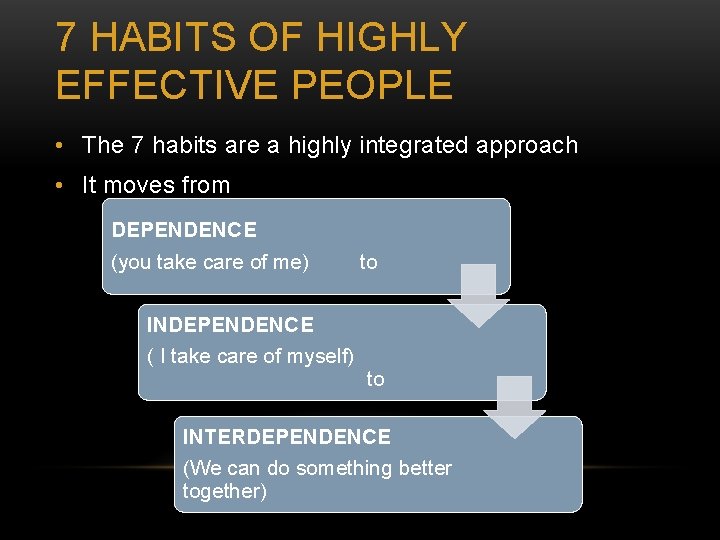
7 HABITS OF HIGHLY EFFECTIVE PEOPLE • The 7 habits are a highly integrated approach • It moves from DEPENDENCE (you take care of me) to INDEPENDENCE ( I take care of myself) to INTERDEPENDENCE (We can do something better together)
7 HABITS OF HIGHLY EFFECTIVE PEOPLE • Be Proactive • Begin with the End in mind • Put First Thing First • Think Win • Seek First to Understand, then to be Understood • Synergy • Sharpen the saw
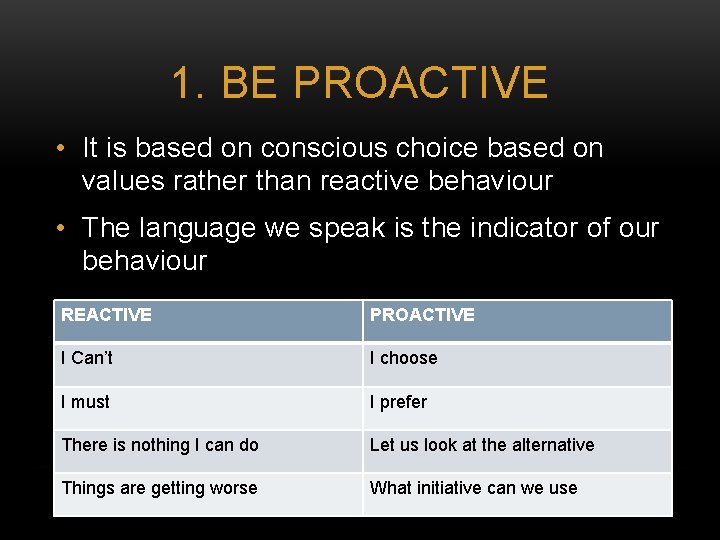
1. BE PROACTIVE • It is based on conscious choice based on values rather than reactive behaviour • The language we speak is the indicator of our behaviour REACTIVE PROACTIVE I Can’t I choose I must I prefer There is nothing I can do Let us look at the alternative Things are getting worse What initiative can we use
2. BEGIN WITH THE END IN MIND • Leadership is creation & management • Leadership is doing right things & management is doing things right • In order to begin with the end in mind, create personal philosophy like: • Never compromise with honesty • Maintain positive attitude • Keep a sense of humour • Do not fear mistakes • Facilitate success of subordinate • Remember the people involved
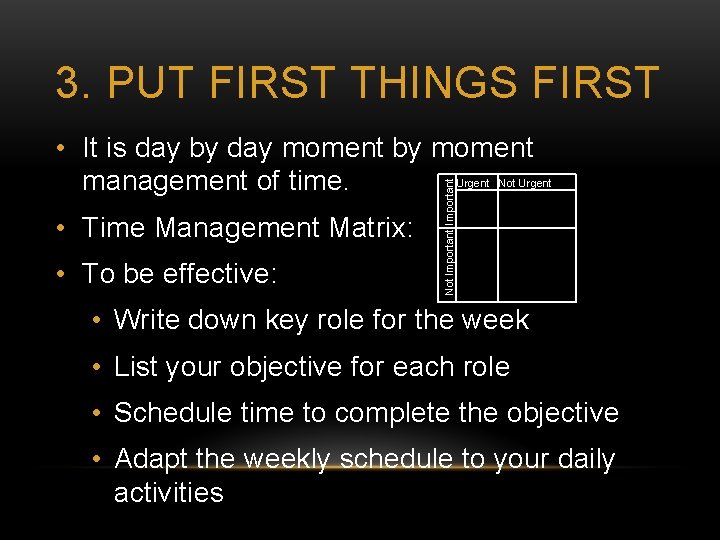
3. PUT FIRST THINGS FIRST • Time Management Matrix: • To be effective: Not Important • It is day by day moment by moment management of time. Urgent Not Urgent • Write down key role for the week • List your objective for each role • Schedule time to complete the objective • Adapt the weekly schedule to your daily activities
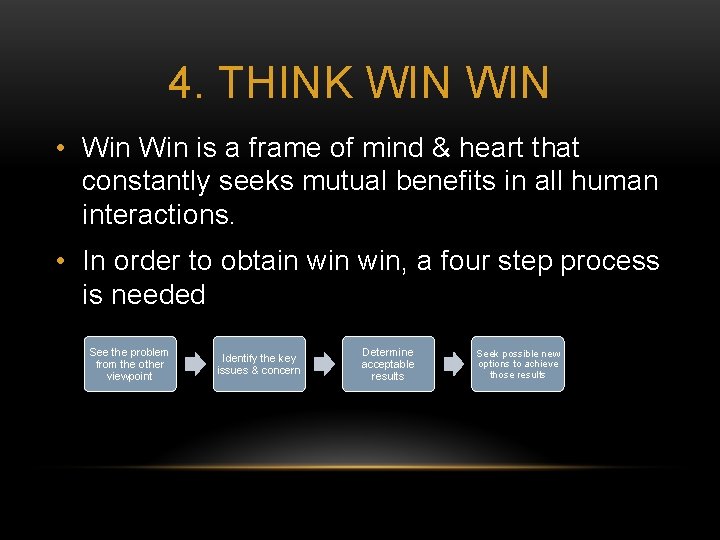
4. THINK WIN • Win is a frame of mind & heart that constantly seeks mutual benefits in all human interactions. • In order to obtain win, a four step process is needed See the problem from the other viewpoint Identify the key issues & concern Determine acceptable results Seek possible new options to achieve those results
5. FIRST TO UNDERSTAND, THEN BE UNDERSTOOD • Seek first to understand involves a paradigm shift since we usually try to be understood first • Empathic listening is the key to effective communication • It focuses on learning how the other person sees the world, how they feel • The essence of empathic listening is not that you agree with someone but you
6. SYNERGY • It means that the whole is greater than the parts • The first 5 habits build towards habit 6 • Synergy occurs when people reach solutions that are better than they could have achieved acting alone
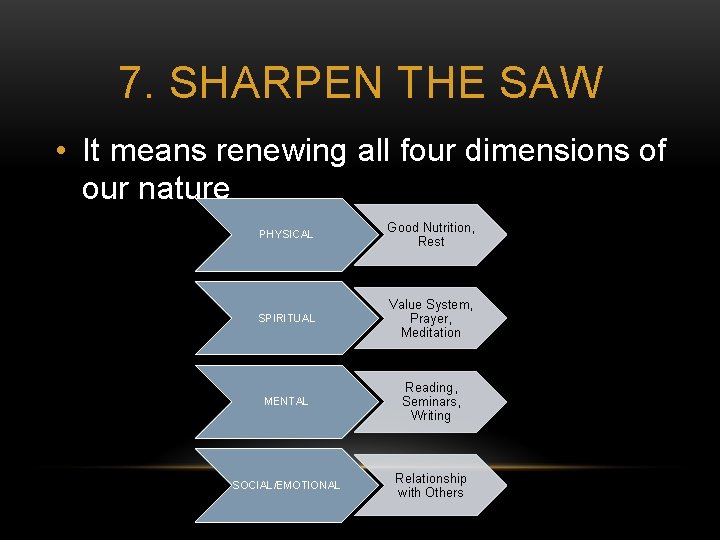
7. SHARPEN THE SAW • It means renewing all four dimensions of our nature PHYSICAL Good Nutrition, Rest SPIRITUAL Value System, Prayer, Meditation MENTAL Reading, Seminars, Writing SOCIAL/EMOTIONAL Relationship with Others
EXPECTATIONS FROM LEADERSHIP IN TQM • Develop the core values, vision statement, mission statement & quality policy statements • Design the strategic short/long term plans with goals & the annual quality improvement program with objectives • Create the total educational & training plan • Prepare check list of all activities • Devise a functional system for all programs • Communicate in detail to all concerned • Delegate & empower • Supervise/Monitor • SWOT Analysis for each programme • Recognize/ Acknowledge / Reward the success
ACTION PLAN FOR QUALITY IMPROVEMENT Ø Work towards achieving an ideal physical infrastructure Ø Hiring qualified, efficient, dedicated staff Ø Training staff in professional competencies and personality development Ø Encouraging Excellence/Innovation in teaching learning process Ø Decentralize authority for making decisions about curriculum, instructions, staffing & resource allocations Ø Greater use of technology in all areas Ø Emphasis on co-curricular & extra-curricular activities Ø Involvement of Alumni & Society
ACTION PLAN FOR QUALITY IMPROVEMENT Ø Ø Ø Ø Inclusive Education Ensuring Academic Norms & Standards Aligned assessment of student performance Regular follow-ups & feed backs Motivating students for Public/Competitive Exams Counseling of Students & Parents Develop and Implement standard operating procedures for all activities Ø Sustained investments in strategies in school improvements
EXPECTED OUTCOMES v Brand Building & Image v Excellent Academic Results v Empowerment of Employees v Higher Efficiency v Motivated Staff v Conducive learning Environment v Good Citizens & leaders v Satisfaction of Social obligation
STUMBLING BLOCKS FOR TQM • Lack of commitment from top management • Authoritarian behaviour, hierarchical thinking • Fuzzy vision or mission • Unattainable goals • Goals that do not solve core problems • Not listening to stake holders • Press of current routines • Too many unproductive meetings • Lack of meaningful measures • Impatience, looking for a quick fix • Obsession with the bottom line, seeing quality as overhead • Skepticism, fear, resistance to change
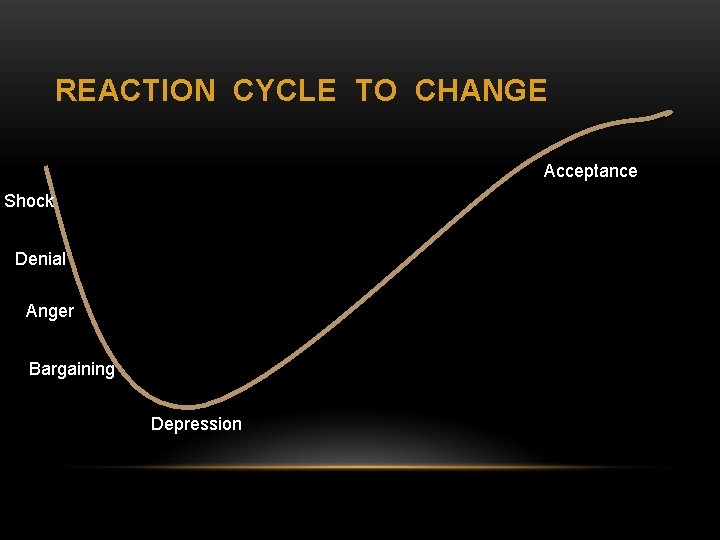
REACTION CYCLE TO CHANGE Acceptance Shock Denial Anger Bargaining Depression
ROLE OF LEADER IN CHANGE MANAGEMENT DO’S : - DON’T’S : - • Clearly define Change in quantitative / qualitative terms • Under-communication • Develop/find experts at all levels to implement change • Measure/Update the steps that lead to achieving the change • Ensure that both leaders & employees(agents & drivers of change) are wellequipped & skilled to bring effective change • Focus on efforts of getting all (leader/employees) to • Fail to involve people who are impacted • Forget that people’s first reactions are emotional rather than logical • Disheartened by fear of failure • Stop/Revert Decision by victim mentality
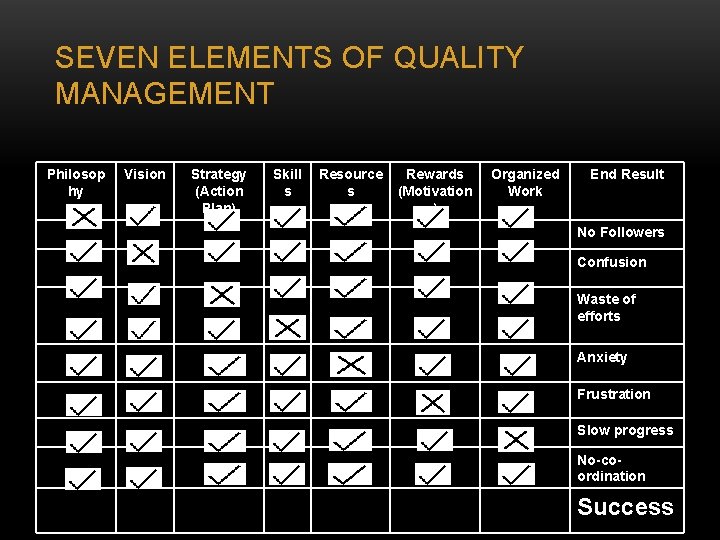
SEVEN ELEMENTS OF QUALITY MANAGEMENT Philosop hy Vision Strategy (Action Plan) Skill s Resource s Rewards (Motivation ) Organized Work End Result No Followers Confusion Waste of efforts Anxiety Frustration Slow progress No-coordination Success
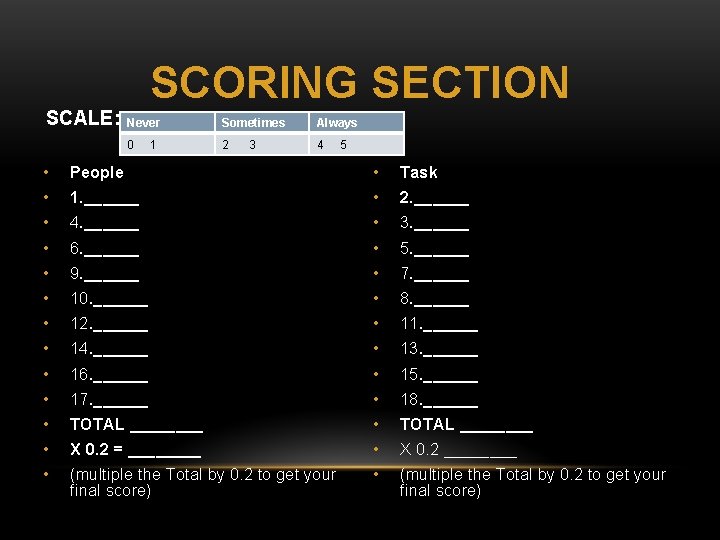
SURVEY • Questionnaire 1. I encourage my team to participate when it comes decision making time and I try to implement their ideas and suggestions. 2. Nothing is more important than accomplishing a goal or task 3. I closely monitor the schedule to ensure a task or project will be completed in time. 4. I enjoy coaching people on new tasks and procedures. 5. The more challenging a task is, the more I enjoy it. 6. I encourage my employees to be creative about their job. 7. When seeing a complex task through to completion, I ensure that every detail is accounted for. 8. I find it easy to carry out several complicated tasks at the same time. 9. I enjoy reading articles, books, and journals about training, leadership, and psychology; and then putting what I have read into action. 10. When correcting mistakes, I do not worry about jeopardizing relationships. 11. I manage my time very efficiently. 12. I enjoy explaining the intricacies and details of a complex task or project to my employees. 13. Breaking large projects into small manageable tasks is second nature to me. 14. Nothing is more important than building a great team. 15. I enjoy analyzing problems. 16. I honor other people's boundaries. 17. Counseling my employees to improve their performance or behavior is second nature to me.
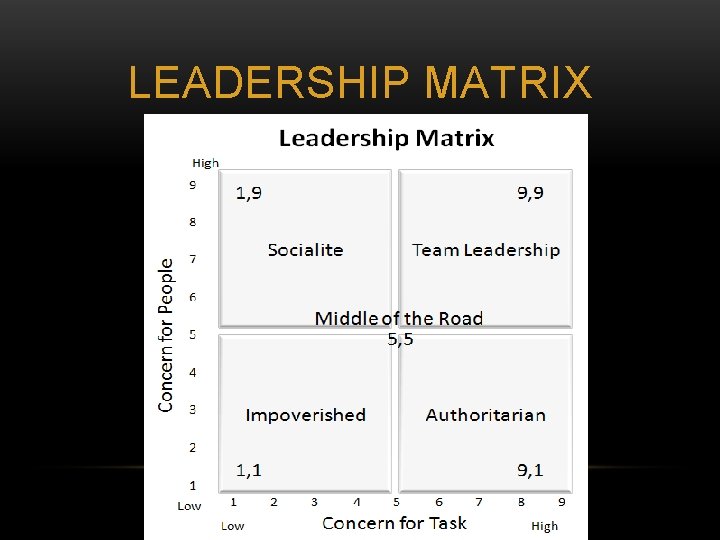
LEADERSHIP MATRIX
THANK YOU
- Slides: 35