
LEAD WORKPLACE VIOLENCE PREVENTION UNC CHARLOTTE POLICE DEPT

- Slides: 35
LEAD WORKPLACE VIOLENCE PREVENTION UNC CHARLOTTE POLICE DEPT 2012 JERRY LECOMTE
TOPICS OF DISCUSSION �Define and promote awareness and better understanding �Identify possible contributing circumstances and situations �Recognize warning signs �Identify strategies to prevent and reduce �Become familiar with your agency’s Workplace Violence Policy, understanding their responsibilities under the policy
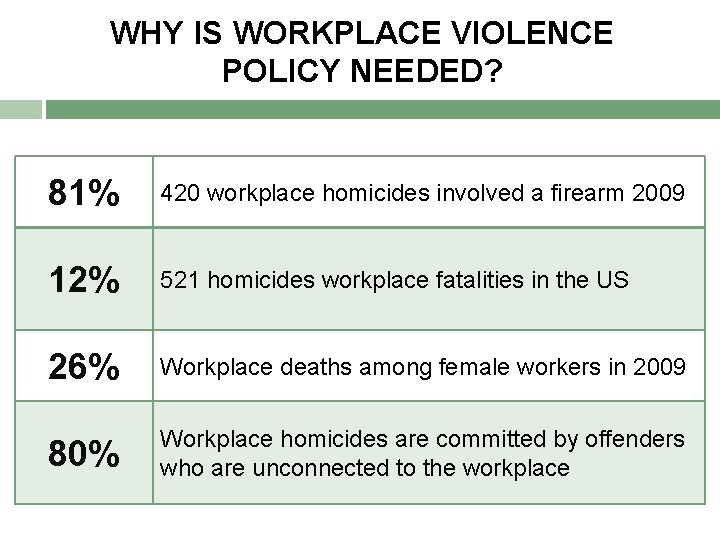
WHY IS WORKPLACE VIOLENCE POLICY NEEDED? 81% 420 workplace homicides involved a firearm 2009 12% 521 homicides workplace fatalities in the US 26% Workplace deaths among female workers in 2009 80% Workplace homicides are committed by offenders who are unconnected to the workplace
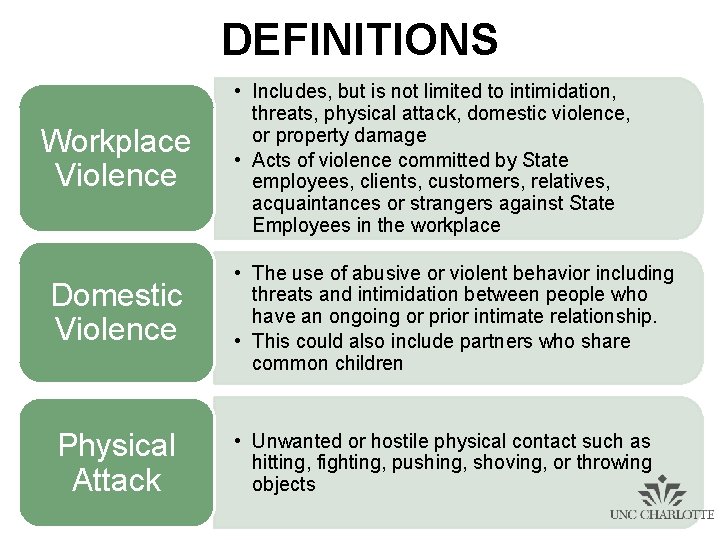
DEFINITIONS Workplace Violence Domestic Violence Physical Attack • Includes, but is not limited to intimidation, threats, physical attack, domestic violence, or property damage • Acts of violence committed by State employees, clients, customers, relatives, acquaintances or strangers against State Employees in the workplace • The use of abusive or violent behavior including threats and intimidation between people who have an ongoing or prior intimate relationship. • This could also include partners who share common children • Unwanted or hostile physical contact such as hitting, fighting, pushing, shoving, or throwing objects
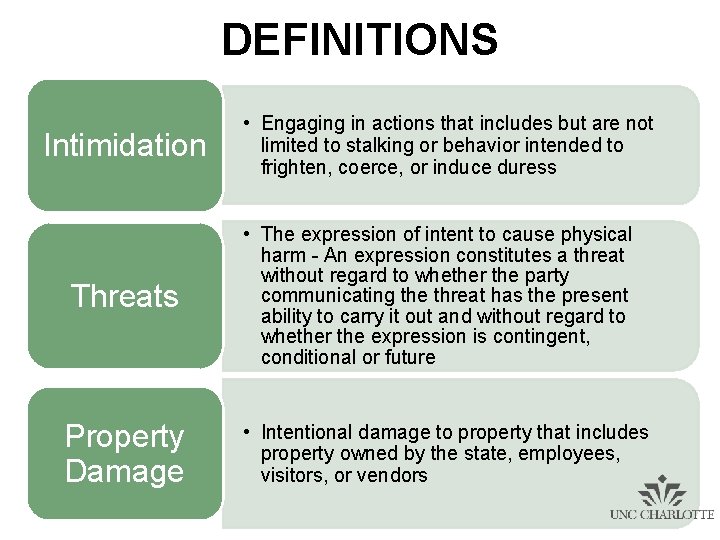
DEFINITIONS Intimidation Threats Property Damage • Engaging in actions that includes but are not limited to stalking or behavior intended to frighten, coerce, or induce duress • The expression of intent to cause physical harm - An expression constitutes a threat without regard to whether the party communicating the threat has the present ability to carry it out and without regard to whether the expression is contingent, conditional or future • Intentional damage to property that includes property owned by the state, employees, visitors, or vendors
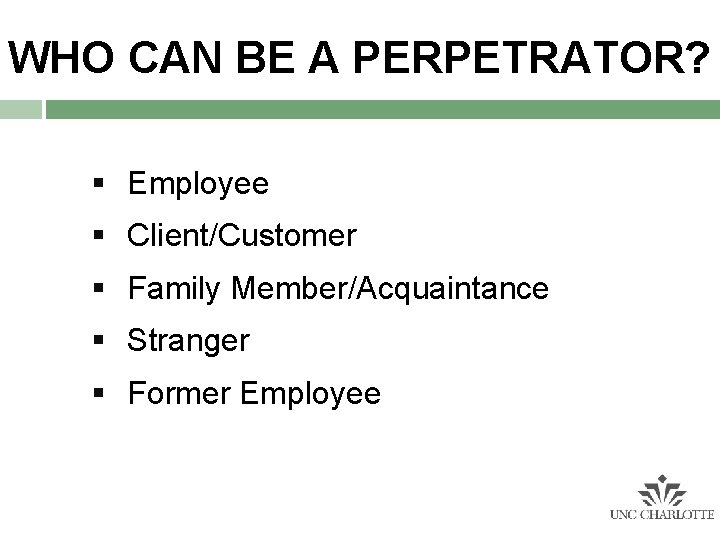
WHO CAN BE A PERPETRATOR? § Employee § Client/Customer § Family Member/Acquaintance § Stranger § Former Employee
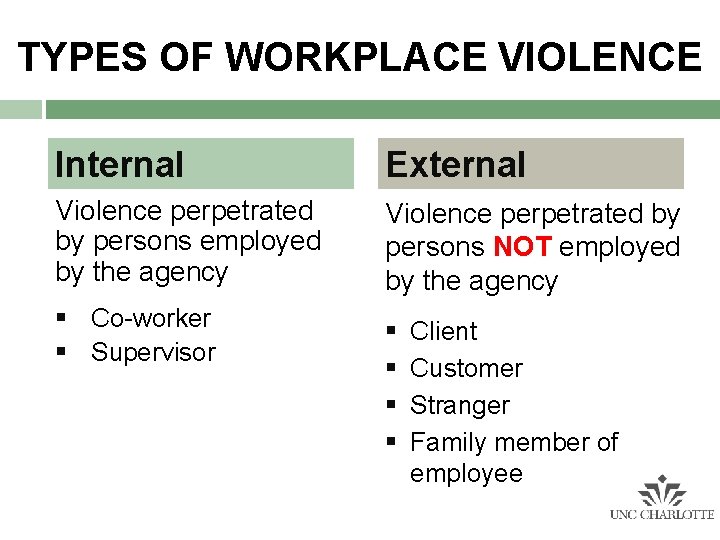
TYPES OF WORKPLACE VIOLENCE Internal External Violence perpetrated by persons employed by the agency Violence perpetrated by persons NOT employed by the agency § Co-worker § Supervisor § § Client Customer Stranger Family member of employee
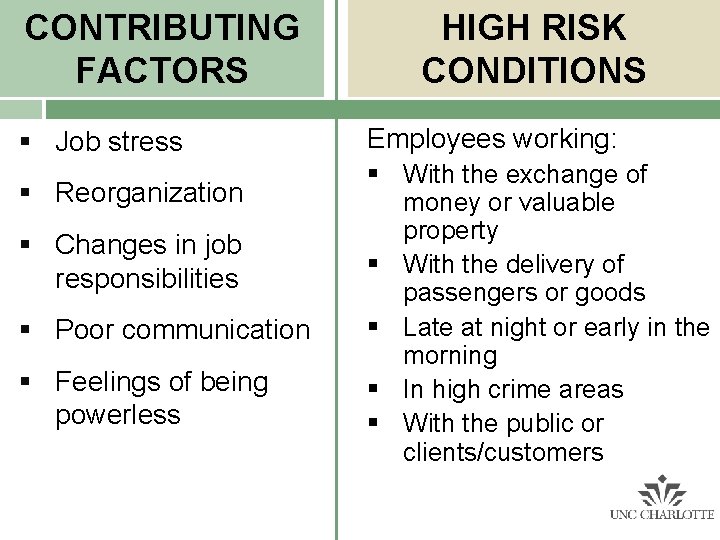
CONTRIBUTING FACTORS § Job stress § Reorganization § Changes in job responsibilities § Poor communication § Feelings of being powerless HIGH RISK CONDITIONS Employees working: § With the exchange of money or valuable property § With the delivery of passengers or goods § Late at night or early in the morning § In high crime areas § With the public or clients/customers
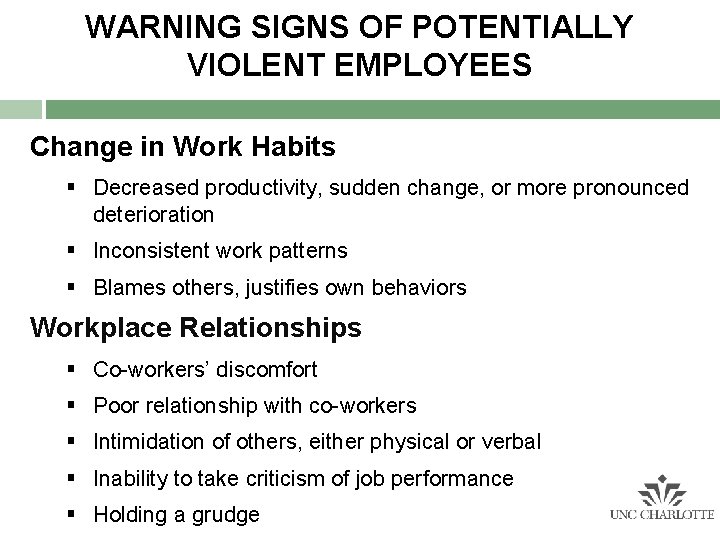
WARNING SIGNS OF POTENTIALLY VIOLENT EMPLOYEES Change in Work Habits § Decreased productivity, sudden change, or more pronounced deterioration § Inconsistent work patterns § Blames others, justifies own behaviors Workplace Relationships § Co-workers’ discomfort § Poor relationship with co-workers § Intimidation of others, either physical or verbal § Inability to take criticism of job performance § Holding a grudge
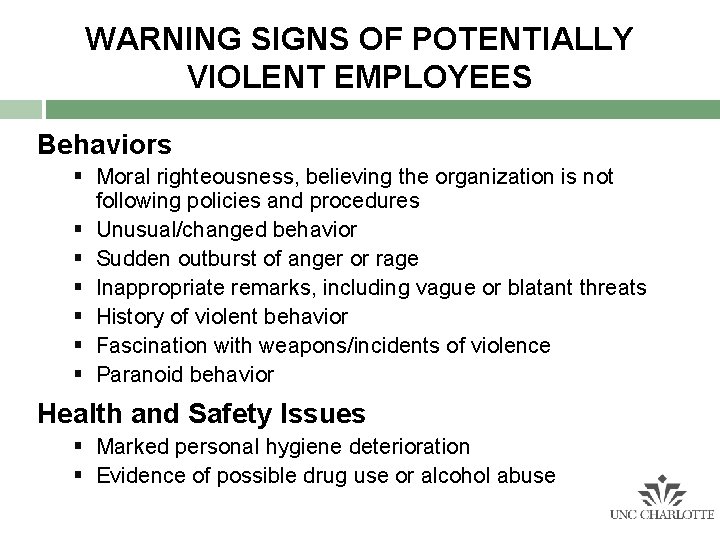
WARNING SIGNS OF POTENTIALLY VIOLENT EMPLOYEES Behaviors § Moral righteousness, believing the organization is not following policies and procedures § Unusual/changed behavior § Sudden outburst of anger or rage § Inappropriate remarks, including vague or blatant threats § History of violent behavior § Fascination with weapons/incidents of violence § Paranoid behavior Health and Safety Issues § Marked personal hygiene deterioration § Evidence of possible drug use or alcohol abuse
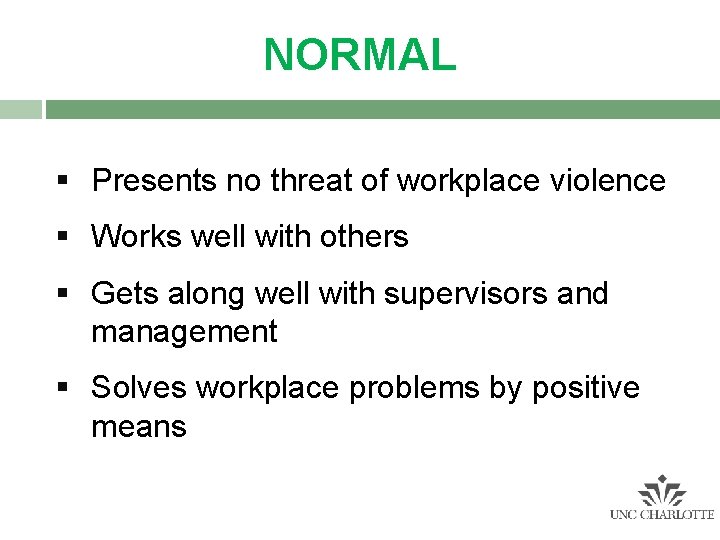
NORMAL § Presents no threat of workplace violence § Works well with others § Gets along well with supervisors and management § Solves workplace problems by positive means
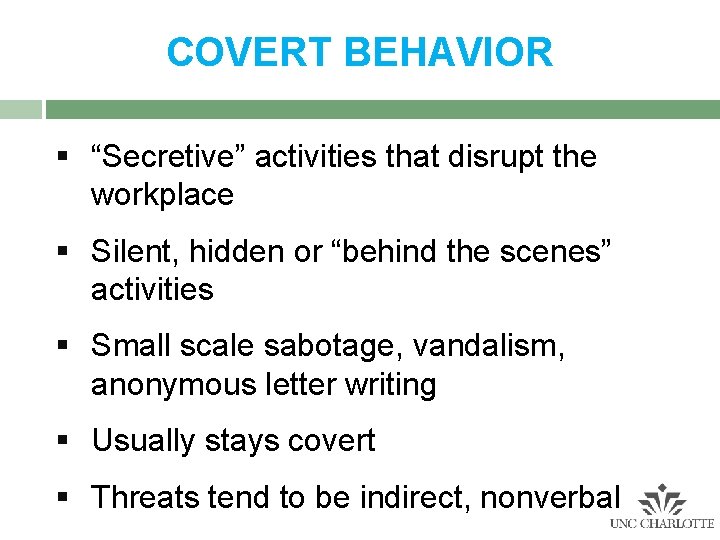
COVERT BEHAVIOR § “Secretive” activities that disrupt the workplace § Silent, hidden or “behind the scenes” activities § Small scale sabotage, vandalism, anonymous letter writing § Usually stays covert § Threats tend to be indirect, nonverbal
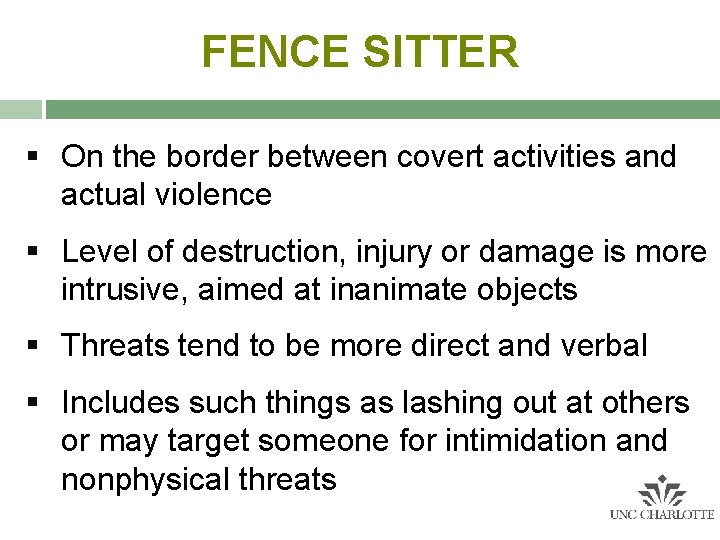
FENCE SITTER § On the border between covert activities and actual violence § Level of destruction, injury or damage is more intrusive, aimed at inanimate objects § Threats tend to be more direct and verbal § Includes such things as lashing out at others or may target someone for intimidation and nonphysical threats
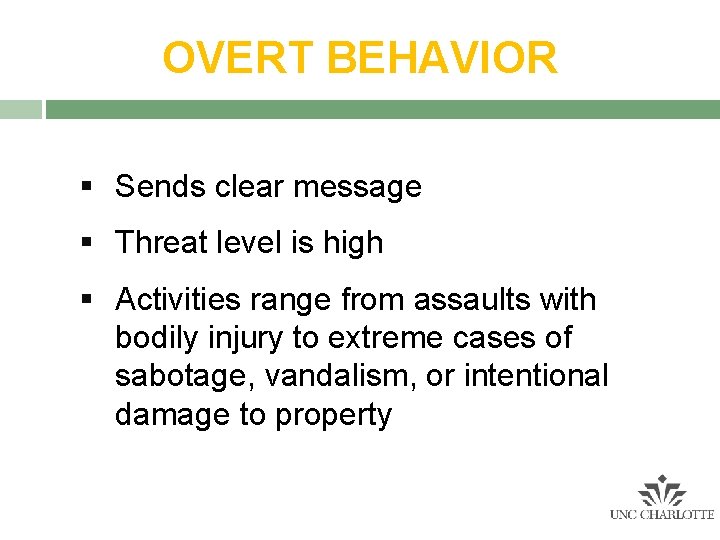
OVERT BEHAVIOR § Sends clear message § Threat level is high § Activities range from assaults with bodily injury to extreme cases of sabotage, vandalism, or intentional damage to property
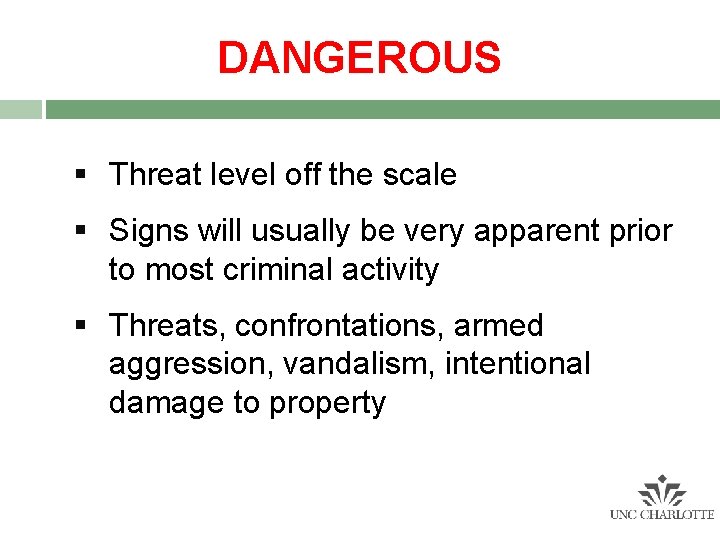
DANGEROUS § Threat level off the scale § Signs will usually be very apparent prior to most criminal activity § Threats, confrontations, armed aggression, vandalism, intentional damage to property
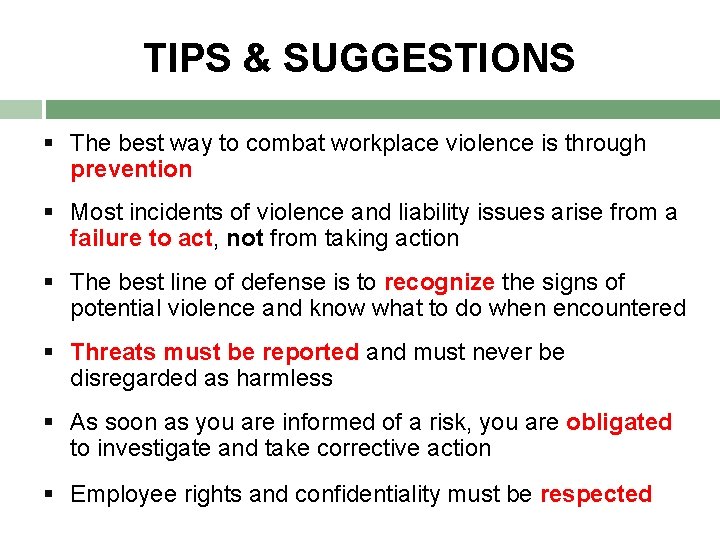
TIPS & SUGGESTIONS § The best way to combat workplace violence is through prevention § Most incidents of violence and liability issues arise from a failure to act, not from taking action § The best line of defense is to recognize the signs of potential violence and know what to do when encountered § Threats must be reported and must never be disregarded as harmless § As soon as you are informed of a risk, you are obligated to investigate and take corrective action § Employee rights and confidentiality must be respected
TIPS & SUGGESTIONS § Evaluate existing physical surroundings and current security measures § Be attentive to morale and employee relations issues § Identify and try to resolve issues that are causing workplace stress § Reasonable diligence must be shown so that an employee does not present a danger to others while they are on the job
WORKPLACE VIOLENCE POLICY Provide a workplace for employees that is free from violence by: § Establishing preventative measures § Providing assistance and support to victims § Holding perpetrators of violence accountable UNC Charlotte’s policy on workplace violence http: //www. legal. uncc. edu/policies/ps-107. html
PROHIBITED ACTIONS AND SANCTIONS It is a violation of this policy to: § Engage in Workplace Violence as defined § Use, possess, or threaten to use an unauthorized weapon § Misuse authority vested to any employee of the State of NC in such a way that violates this policy
OFF-DUTY VIOLENT CONDUCT § An act of off-duty violence may be grounds for disciplinary action, which may include DISMISSAL § The agency must demonstrate that the disciplinary action is supported by the existence of a rational nexus between the type of violent conduct committed and the potential impact on the employee’s ability to perform their job
RISK OF DANGER ASSESSMENT Management may require an employee to undergo an assessment to determine the risk of danger The State EAP (Employees Assistance Program) will assist by facilitating a referral to an appropriate resource for this assessment
LEGAL OBLIGATIONS AND RESPONSIBILITIES
OCCUPATIONAL SAFETY AND HEALTH ACT (OSHA) § An employer has an obligation to provide its employees with a safe and healthy place to work. § An employer must take reasonable steps to protect the life, safety, and health of employees. § Supervisors/managers are obligated to take action to protect employees in the workplace, if they are aware of threats of violence against their employees.
LIABILITY § As an employee, once on notice, you must make a reasonable effort to protect that employee. § Failure to protect an employee may result in personal liability. § Most liability issues arise from a failure to act and not from an overreaction.
NORTH CAROLINA CASE 2011 - Zoua "Vivian" Xiong, 25, was working as a cashier at a Lowe's in Kannapolis when her husband came in just after 5 p. m. Monday. He was upset, said Concord police, who have jurisdiction in the area. The couple got into an argument, but police said they're not sure why they were fighting. Por Ye Lor, 31, pulled out a gun and shot his wife, then turned the gun on himself near the registers at the front of the store. "A lot of companies are not aware of the ramifications of domestic violence until something like this happens, " said Karen Parker Thompson, chief advancement officer of United Family Services. "Maybe this will open people's eyes. "
RECOGNIZING AND RESPONDING TO WORKPLACE VIOLENCE
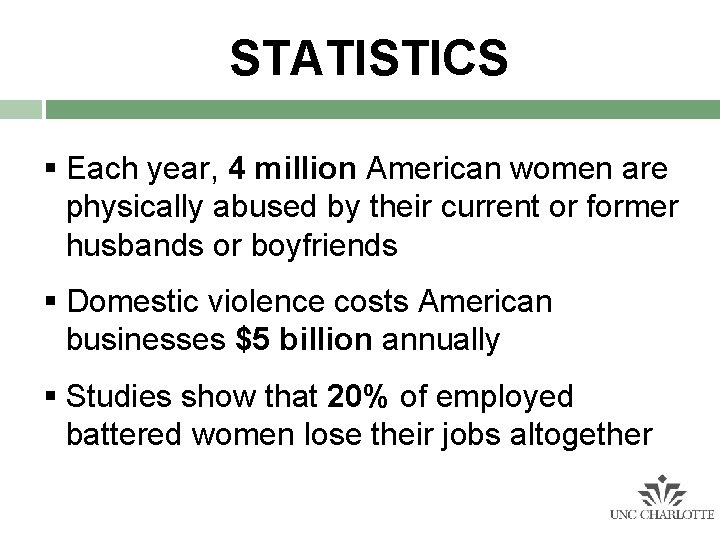
STATISTICS § Each year, 4 million American women are physically abused by their current or former husbands or boyfriends § Domestic violence costs American businesses $5 billion annually § Studies show that 20% of employed battered women lose their jobs altogether
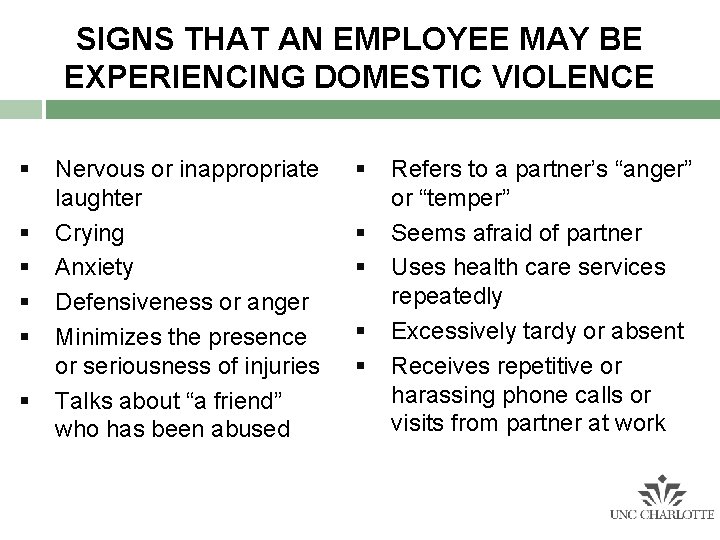
SIGNS THAT AN EMPLOYEE MAY BE EXPERIENCING DOMESTIC VIOLENCE § § § Nervous or inappropriate laughter Crying Anxiety Defensiveness or anger Minimizes the presence or seriousness of injuries Talks about “a friend” who has been abused § § § Refers to a partner’s “anger” or “temper” Seems afraid of partner Uses health care services repeatedly Excessively tardy or absent Receives repetitive or harassing phone calls or visits from partner at work
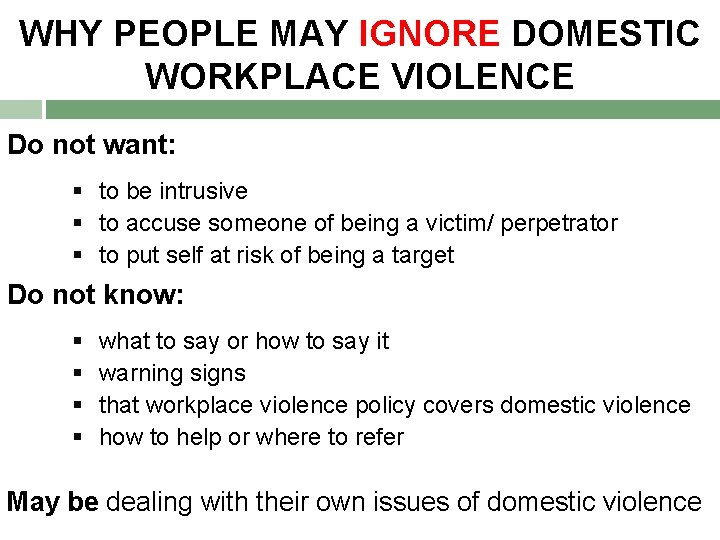
WHY PEOPLE MAY IGNORE DOMESTIC WORKPLACE VIOLENCE Do not want: § to be intrusive § to accuse someone of being a victim/ perpetrator § to put self at risk of being a target Do not know: § § what to say or how to say it warning signs that workplace violence policy covers domestic violence how to help or where to refer May be dealing with their own issues of domestic violence
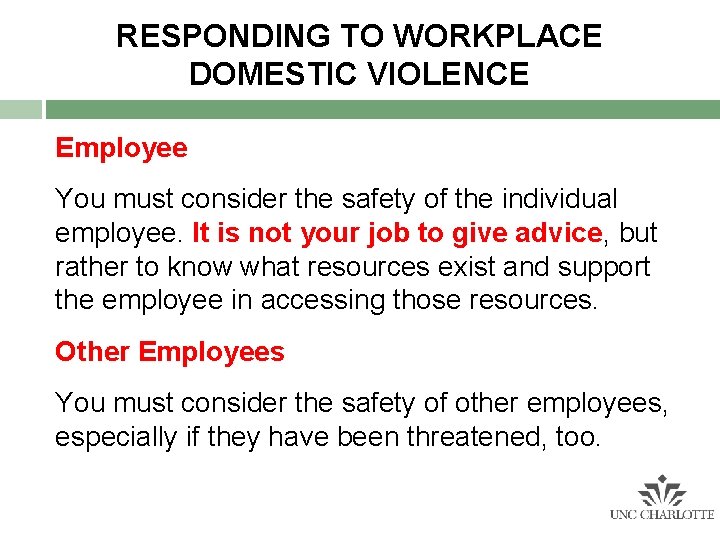
RESPONDING TO WORKPLACE DOMESTIC VIOLENCE Employee You must consider the safety of the individual employee. It is not your job to give advice, but rather to know what resources exist and support the employee in accessing those resources. Other Employees You must consider the safety of other employees, especially if they have been threatened, too.
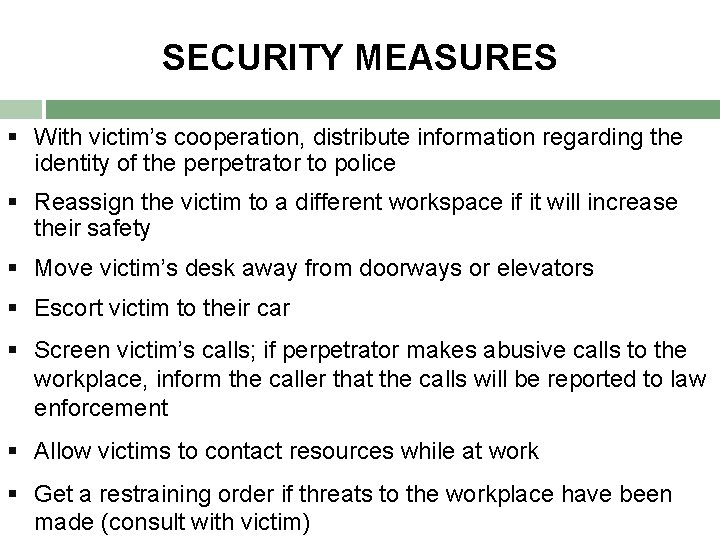
SECURITY MEASURES § With victim’s cooperation, distribute information regarding the identity of the perpetrator to police § Reassign the victim to a different workspace if it will increase their safety § Move victim’s desk away from doorways or elevators § Escort victim to their car § Screen victim’s calls; if perpetrator makes abusive calls to the workplace, inform the caller that the calls will be reported to law enforcement § Allow victims to contact resources while at work § Get a restraining order if threats to the workplace have been made (consult with victim)
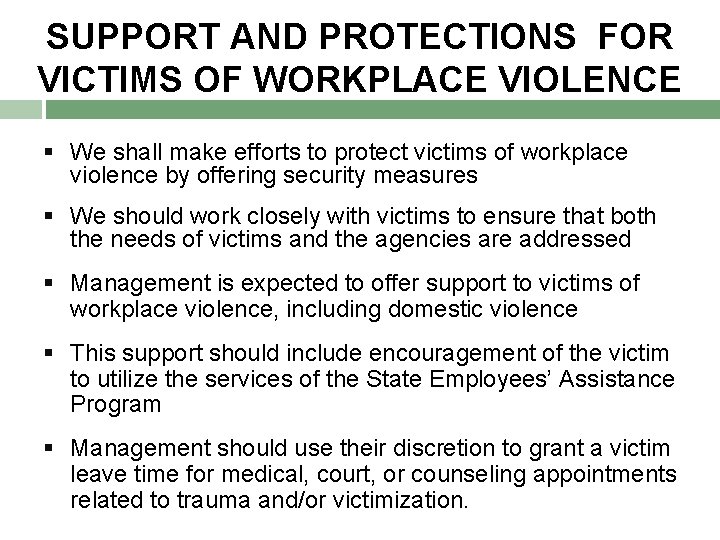
SUPPORT AND PROTECTIONS FOR VICTIMS OF WORKPLACE VIOLENCE § We shall make efforts to protect victims of workplace violence by offering security measures § We should work closely with victims to ensure that both the needs of victims and the agencies are addressed § Management is expected to offer support to victims of workplace violence, including domestic violence § This support should include encouragement of the victim to utilize the services of the State Employees’ Assistance Program § Management should use their discretion to grant a victim leave time for medical, court, or counseling appointments related to trauma and/or victimization.
UNC CHARLOTTE RESOURCES For additional information, right click and open the hyperlinks below: Human Resources (704 -687 -0669) Employee Relations (704 -687 -3239) UNC Charlotte Legal Counsel (704 -687 -5732) Safety and Health Personnel (704 -687 -1111) UNC Charlotte Police Dept. Emergency 911 Non-Emergency 704 -687 -8300
STATE RESOURCES Contact information: State Employees’ Assistance Program 1 -877 -603 -8259 Applicable personnel policies and procedures NC Office Of Personnel http: //www. nctraining. ncgov. com/wpviolence
RESOURCES State Employees’ Assistance Program § § § Confidential Offered at no cost to the employee Provides services to victims Evaluates potential for lethality Makes appropriate referrals to community resources Consults with and advises management Law Enforcement § § Respond to emergency situations Have 24 hour emergency response Can help negotiate with the perpetrator Can arrest the perpetrator