
Lead facilitators Clint Alexander Marc Porter Darcy Pickard




- Slides: 58
Lead facilitators: Clint Alexander, Marc Porter, Darcy Pickard Support: Natascia Tamburello, Cedar Morton Winter/Spring 2020 Jan 30 2020 Confluence of the salmon and Klamath RIversr, USFWS Klamath Basin Integrated Fisheries Restoration and Monitoring Plan Phase 3 Restoration Action Prioritization Methods
Attendance: If anyone new to IFRMP, WELCOME! 2
1 Recap on Recent Events
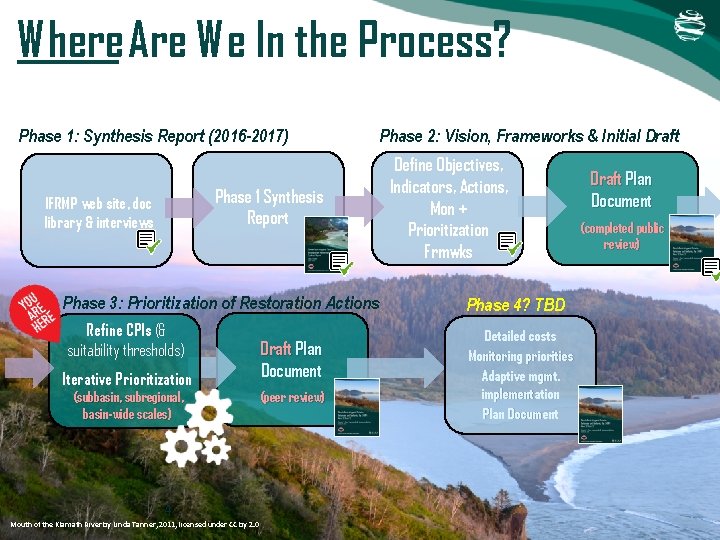
Where Are We In the Process? Phase 1: Synthesis Report (2016 -2017) Phase 1 Synthesis Report IFRMP web site, doc library & interviews Phase 3: Prioritization of Restoration Actions Refine CPIs (& suitability thresholds) Iterative Prioritization (subbasin, subregional, basin-wide scales) 4 Mouth of the Klamath River by Linda Tanner, 2011, licensed under CC by 2. 0 Draft Plan Document (peer review) Phase 2: Vision, Frameworks & Initial Draft Define Objectives, Indicators, Actions, Mon + Prioritization Frmwks Phase 4? TBD Detailed costs Monitoring priorities Adaptive mgmt. implementation Plan Document Draft Plan Document (completed public review)
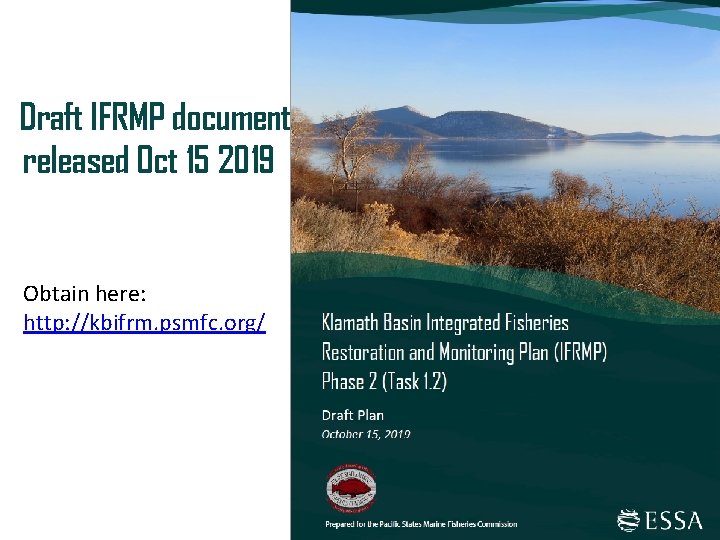
Draft IFRMP document released Oct 15 2019 Obtain here: http: //kbifrm. psmfc. org/ 5
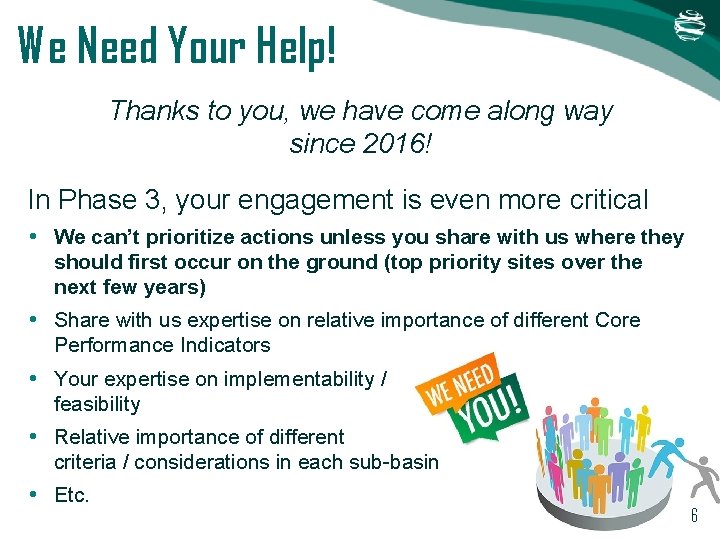
We Need Your Help! Thanks to you, we have come along way since 2016! In Phase 3, your engagement is even more critical • We can’t prioritize actions unless you share with us where they should first occur on the ground (top priority sites over the next few years) • Share with us expertise on relative importance of different Core Performance Indicators • Your expertise on implementability / feasibility • Relative importance of different criteria / considerations in each sub-basin • Etc. 6
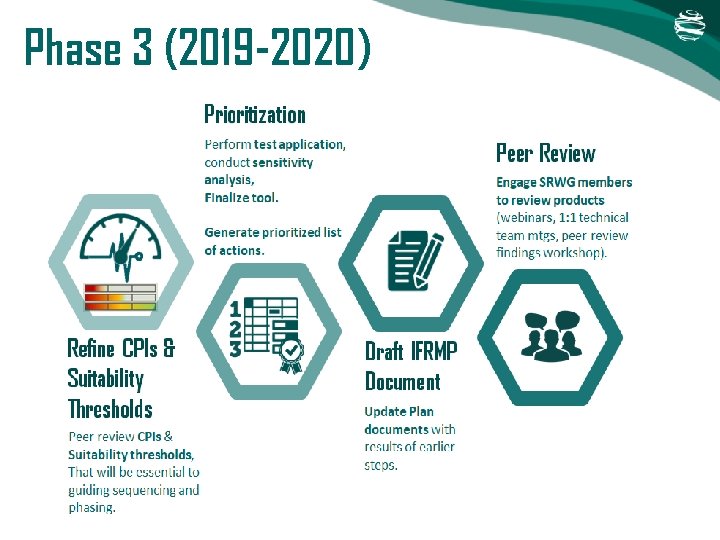
Phase 3 (2019 -2020) Lorem ipsum dolor sit amet, nibh est. A magna maecenas, quam magna nec quis, lorem nunc. Suspendisse viverra sodales mauris, cras pharetra proin.
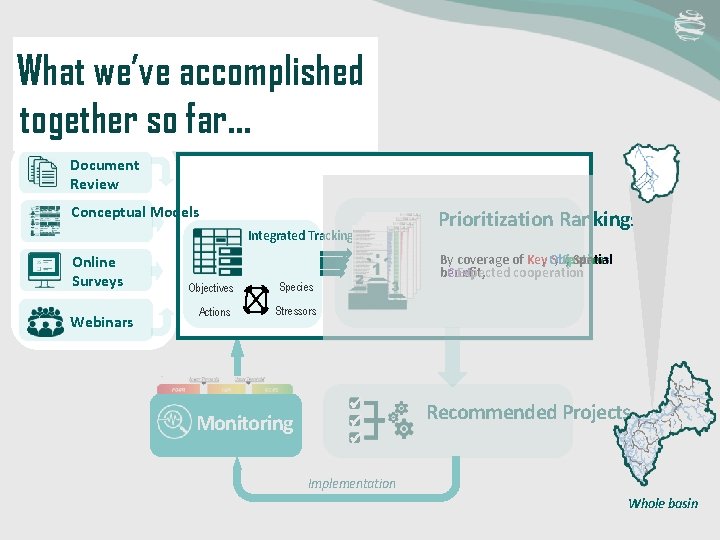
What we’ve accomplished together so far… Document Review Conceptual Models Integrated Tracking Inventory Online Surveys Webinars Objectives Species Actions Stressors Monitoring Prioritization Rankings By coverage of Key, Objectives Stressors , Species , Spatial benefit, Cost, Expected cooperation Recommended Projects Implementation Whole basin
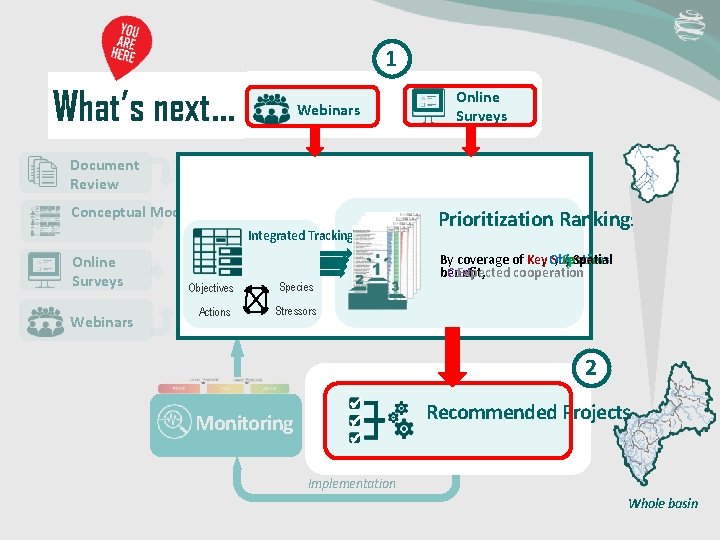
1 What’s next… Webinars Online Surveys Document Review Conceptual Models Integrated Tracking Inventory Online Surveys Webinars Objectives Species Actions Stressors Prioritization Rankings By coverage of Key, Objectives Stressors , Species , Spatial benefit, Cost, Expected cooperation 2 Monitoring Recommended Projects Implementation Whole basin
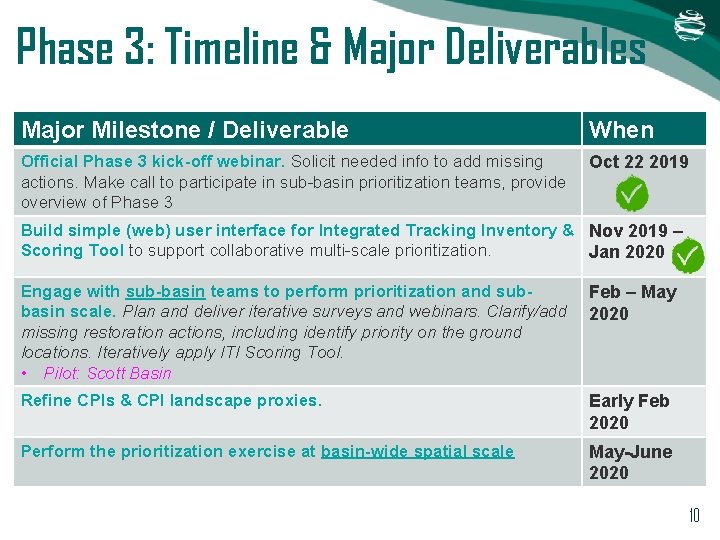
Phase 3: Timeline & Major Deliverables Major Milestone / Deliverable When Official Phase 3 kick-off webinar. Solicit needed info to add missing actions. Make call to participate in sub-basin prioritization teams, provide overview of Phase 3 Oct 22 2019 Build simple (web) user interface for Integrated Tracking Inventory & Nov 2019 – Scoring Tool to support collaborative multi-scale prioritization. Jan 2020 Engage with sub-basin teams to perform prioritization and subbasin scale. Plan and deliver iterative surveys and webinars. Clarify/add missing restoration actions, including identify priority on the ground locations. Iteratively apply ITI Scoring Tool. • Pilot: Scott Basin Feb – May 2020 Refine CPIs & CPI landscape proxies. Early Feb 2020 Perform the prioritization exercise at basin-wide spatial scale May-June 2020 10
2 Overview of Approach to Prioritization & Engagement Plan
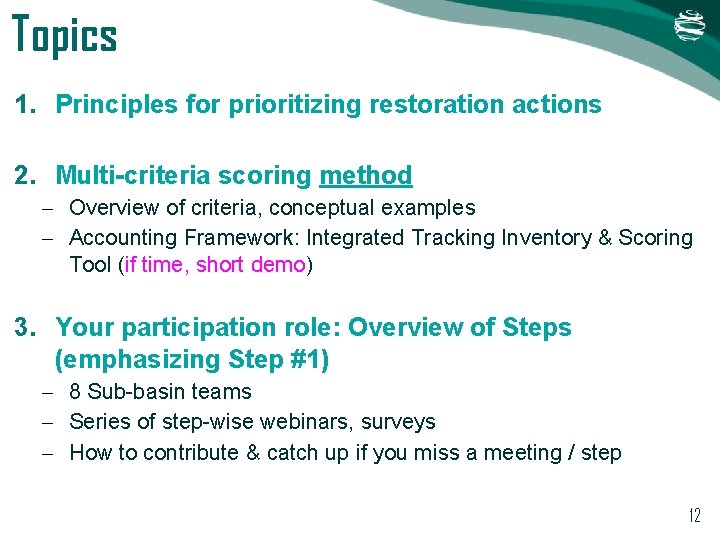
Topics 1. Principles for prioritizing restoration actions 2. Multi-criteria scoring method – Overview of criteria, conceptual examples – Accounting Framework: Integrated Tracking Inventory & Scoring Tool (if time, short demo) 3. Your participation role: Overview of Steps (emphasizing Step #1) – 8 Sub-basin teams – Series of step-wise webinars, surveys – How to contribute & catch up if you miss a meeting / step 12
Life out prioritization with 13
Life with prioritization 14
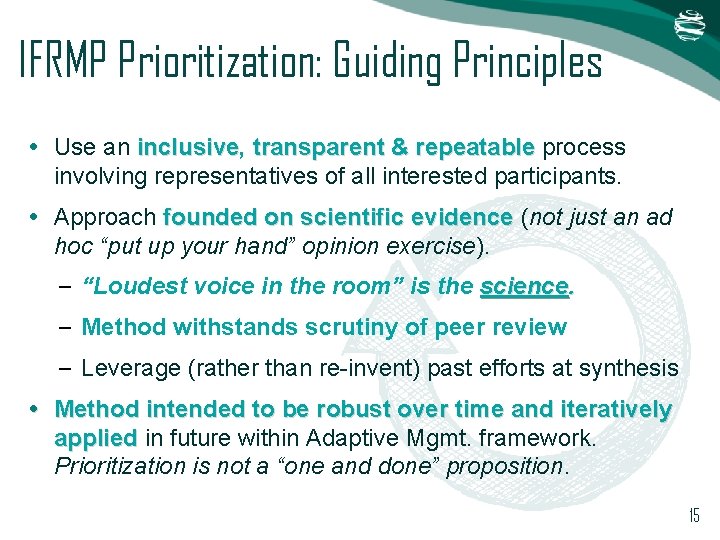
IFRMP Prioritization: Guiding Principles • Use an inclusive, inclusive transparent & repeatable process involving representatives of all interested participants. • Approach founded on scientific evidence (not just an ad hoc “put up your hand” opinion exercise). – “Loudest voice in the room” is the science. – Method withstands scrutiny of peer review – Leverage (rather than re-invent) past efforts at synthesis • Method intended to be robust over time and iteratively applied in future within Adaptive Mgmt. framework. Prioritization is not a “one and done” proposition. 15
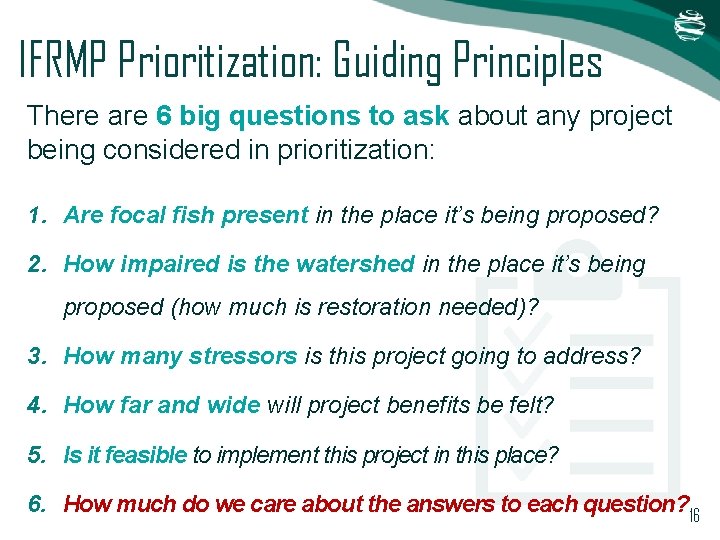
IFRMP Prioritization: Guiding Principles There are 6 big questions to ask about any project being considered in prioritization: 1. Are focal fish present in the place it’s being proposed? 2. How impaired is the watershed in the place it’s being proposed (how much is restoration needed)? 3. How many stressors is this project going to address? 4. How far and wide will project benefits be felt? 5. Is it feasible to implement this project in this place? 6. How much do we care about the answers to each question? 16
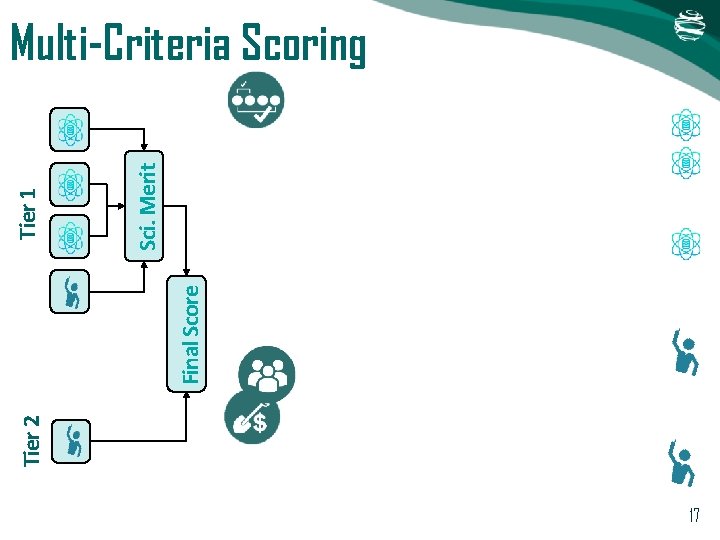
Tier 2 Final Score Sci. Merit Tier 1 Multi-Criteria Scoring 17
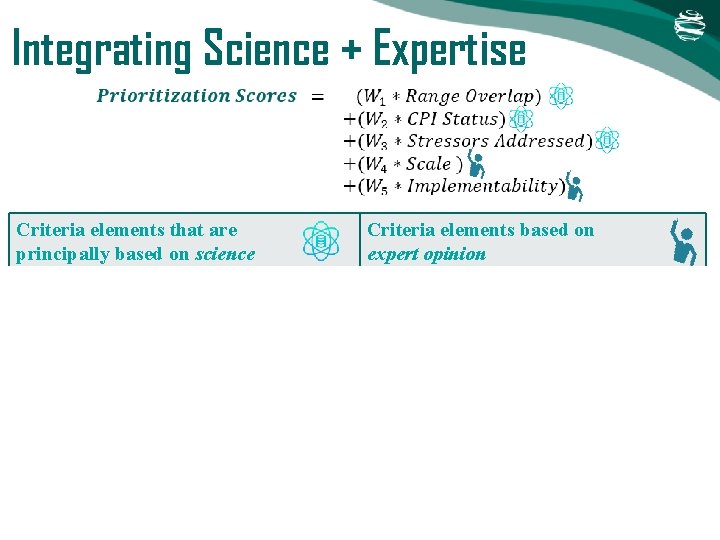
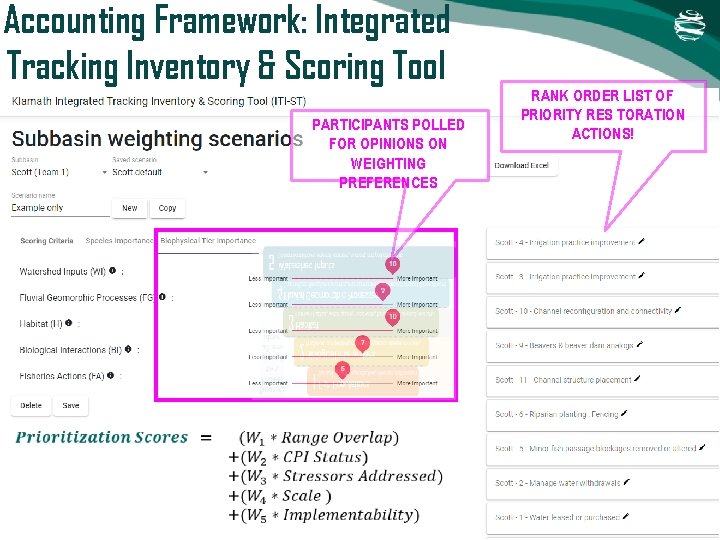
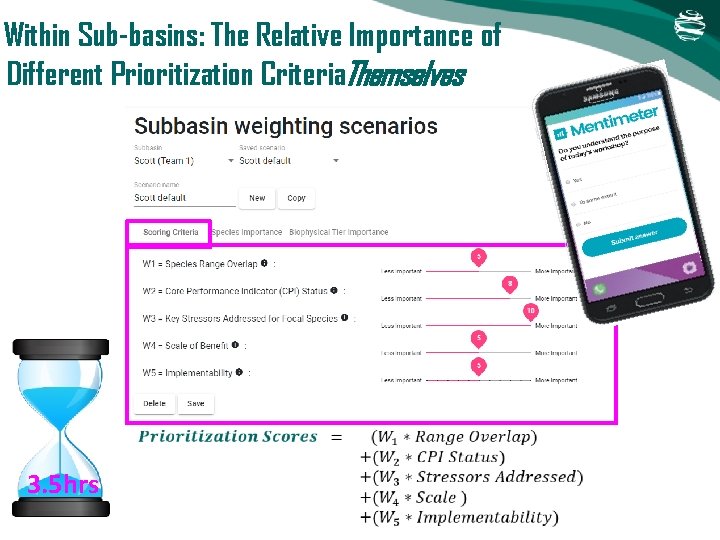
Integrating Science + Expertise Criteria elements that are principally based on science • • • Criteria elements based on expert opinion Range overlap score for focal species • CPI status score (restoration ‘need’) • No. stressors addressed by action (a compound score) • Perceived scale of benefit of action Implementability (feasibility) of action Weighting factors (W 1, W 2…W 5) Range overlap based on range maps from USFWS, ODFW, CDWF, and UC Davis These factors depend on expert opinion of sub -basin team members Default CPI scores based on landscape-scale data from the EPA, USGS, and other sources. Some differences in opinion handled by creating alternative weighting ‘scenarios’ (management contexts). E. g. , Dams in/out. Primarily based on IFRMP Phase 1 and 2 information synthesis, conceptual modelling. 18
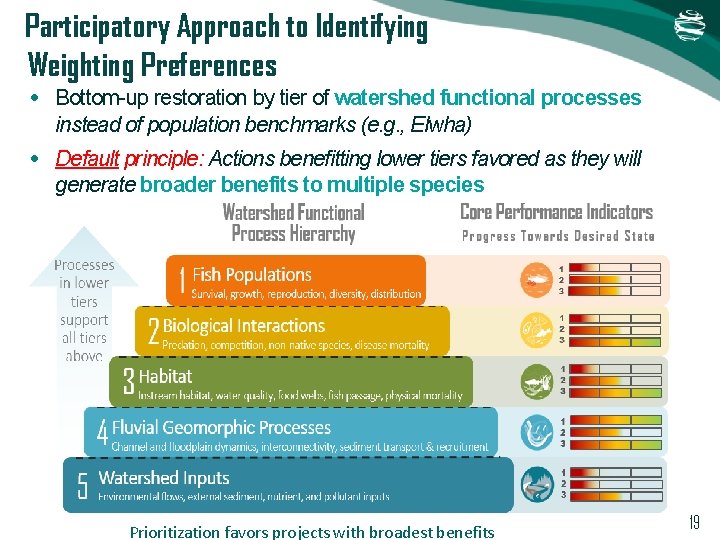
Participatory Approach to Identifying Weighting Preferences • Bottom-up restoration by tier of watershed functional processes instead of population benchmarks (e. g. , Elwha) • Default principle: Actions benefitting lower tiers favored as they will generate broader benefits to multiple species Prioritization favors projects with broadest benefits 19
Accounting Framework: Integrated Tracking Inventory & Scoring Tool PARTICIPANTS POLLED FOR OPINIONS ON WEIGHTING PREFERENCES RANK ORDER LIST OF PRIORITY RES TORATION ACTIONS!
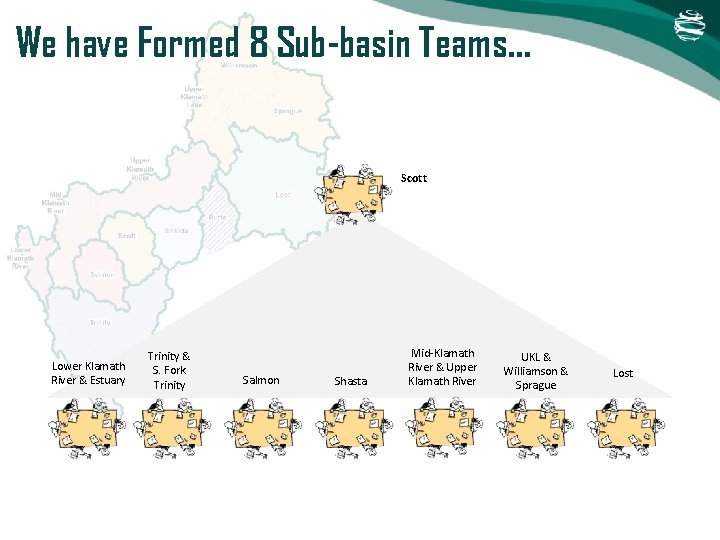
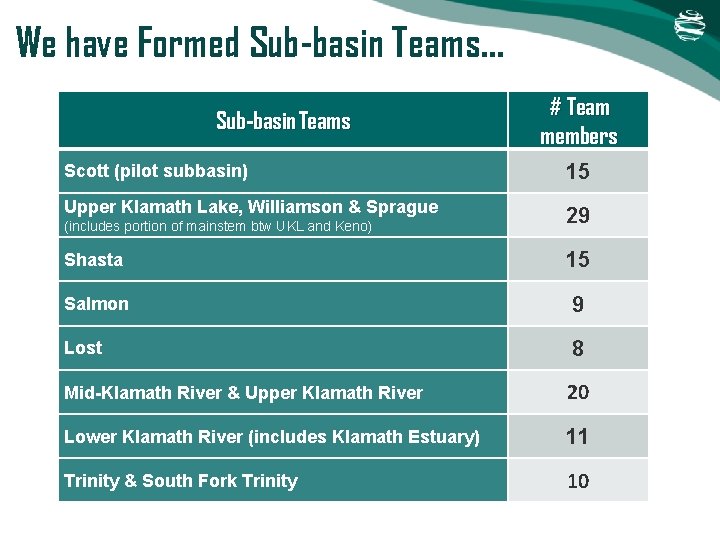
We have Formed 8 Sub-basin Teams… Scott Lower Klamath River & Estuary Trinity & S. Fork Trinity Salmon Shasta Mid-Klamath River & Upper Klamath River UKL & Williamson & Sprague Lost
We have Formed Sub-basin Teams… Sub-basin Teams # Team members Scott (pilot subbasin) 15 Upper Klamath Lake, Williamson & Sprague (includes portion of mainstem btw UKL and Keno) 29 Shasta 15 Salmon 9 Lost 8 Mid-Klamath River & Upper Klamath River 20 Lower Klamath River (includes Klamath Estuary) 11 Trinity & South Fork Trinity 10
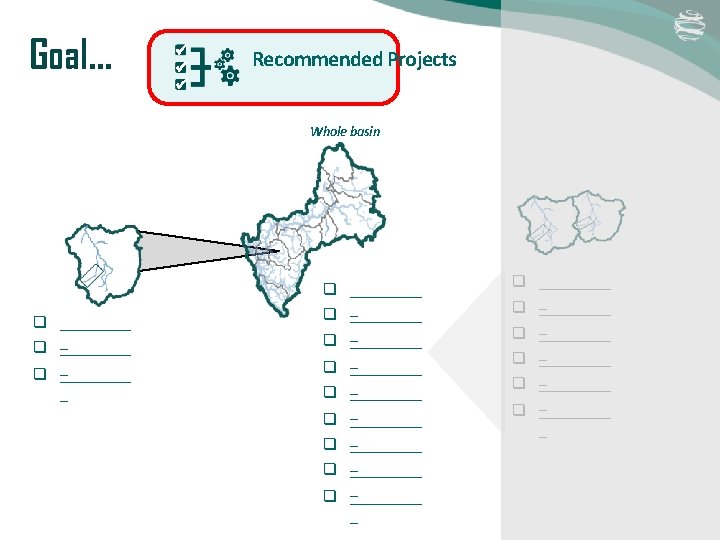
Goal… Recommended Projects Whole basin q __________ q _____ _ q __________ q __________ q __________ _
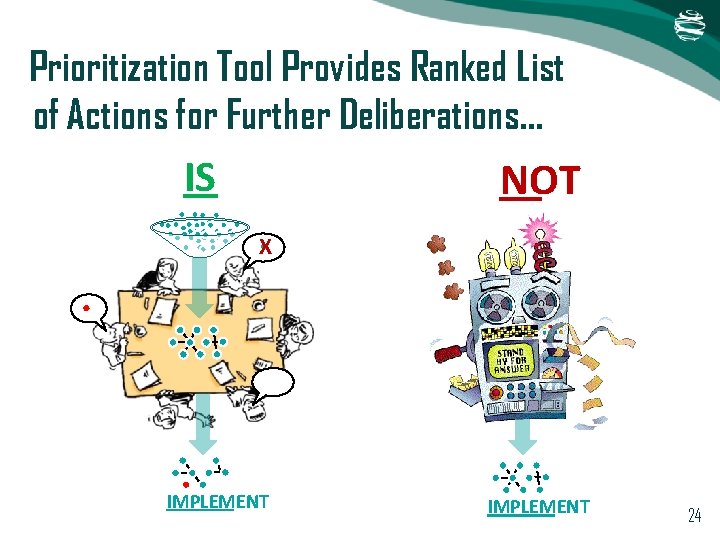
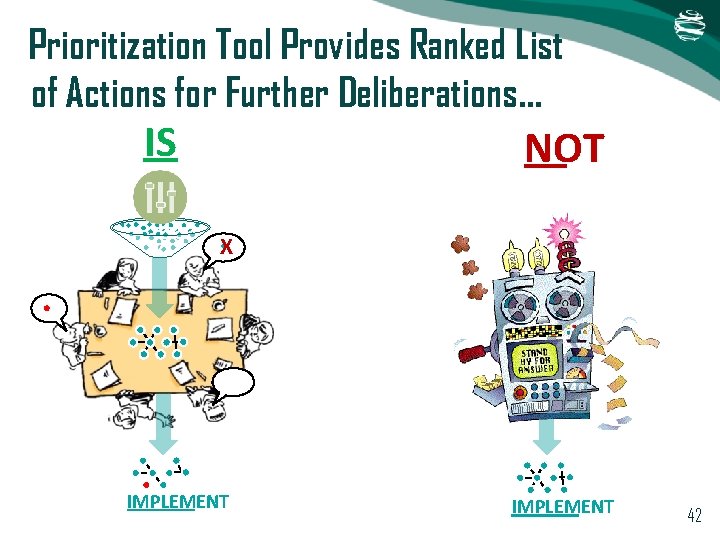
Prioritization Tool Provides Ranked List of Actions for Further Deliberations… IS NOT X IMPLEMENT 24
Questions? 25
3 Criteria & Scoring (Brief Refresher!)
27
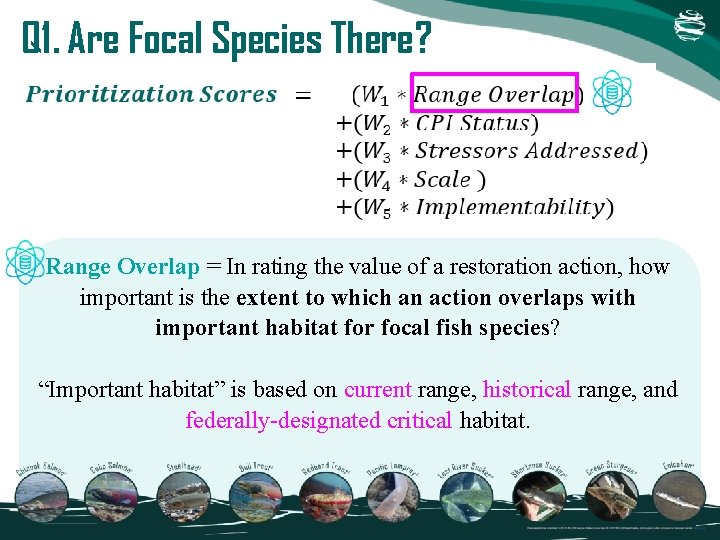
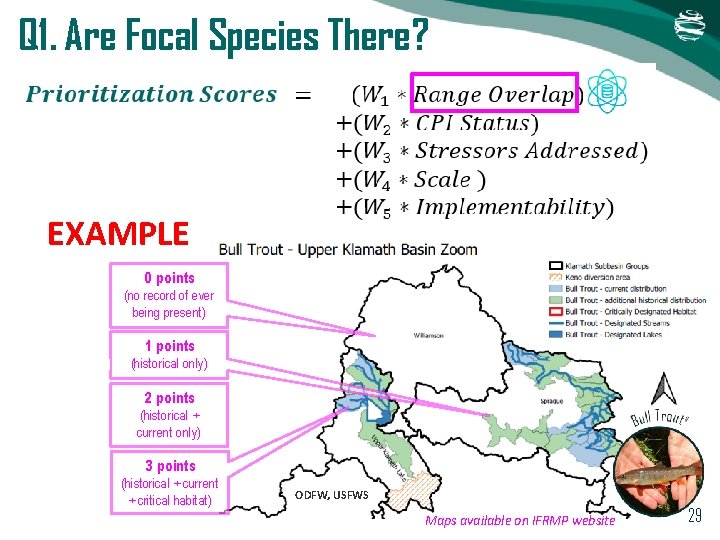
Q 1. Are Focal Species There? Range Overlap = In rating the value of a restoration action, how important is the extent to which an action overlaps with important habitat for focal fish species? “Important habitat” is based on current range, historical range, and federally-designated critical habitat. 28
Q 1. Are Focal Species There? EXAMPLE 0 points (no record of ever being present) 1 points (historical only) 2 points (historical + current only) 3 points (historical + current + critical habitat) ODFW, USFWS Maps available on IFRMP website 29
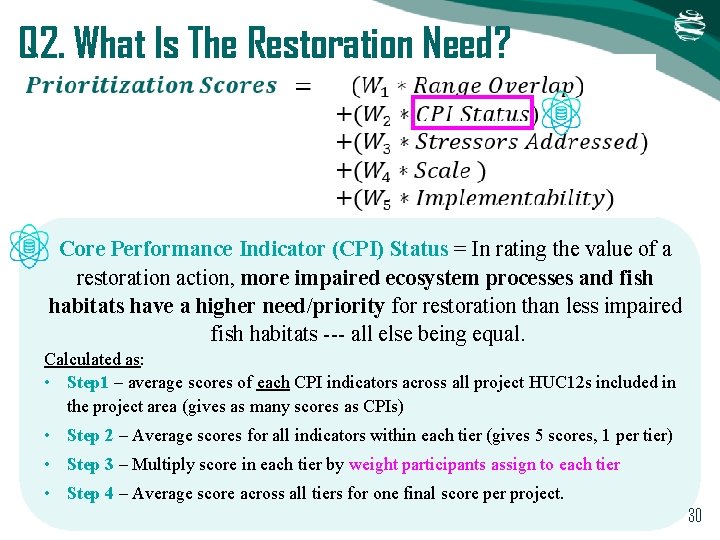
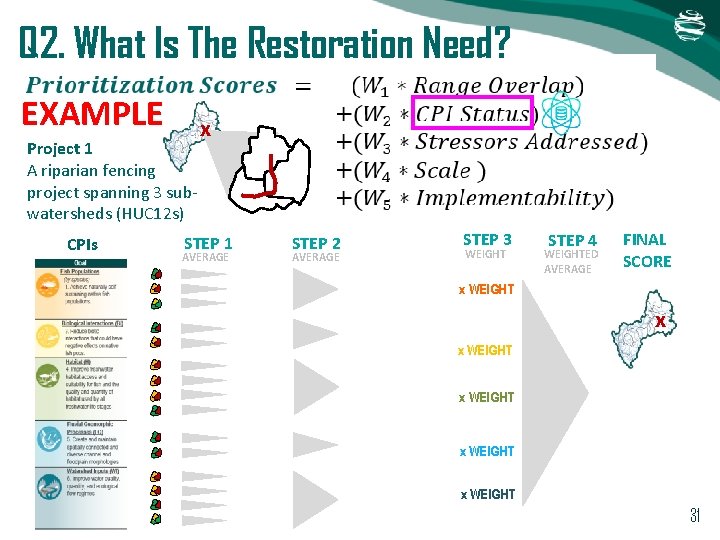
Q 2. What Is The Restoration Need? Core Performance Indicator (CPI) Status = In rating the value of a restoration action, more impaired ecosystem processes and fish habitats have a higher need/priority for restoration than less impaired fish habitats --- all else being equal. Calculated as: • Step 1 – average scores of each CPI indicators across all project HUC 12 s included in the project area (gives as many scores as CPIs) • Step 2 – Average scores for all indicators within each tier (gives 5 scores, 1 per tier) • Step 3 – Multiply score in each tier by weight participants assign to each tier • Step 4 – Average score across all tiers for one final score per project. 30
Q 2. What Is The Restoration Need? EXAMPLE Project 1 A riparian fencing project spanning 3 subwatersheds (HUC 12 s) CPIs x STEP 1 AVERAGE STEP 2 AVERAGE STEP 3 WEIGHT STEP 4 WEIGHTED AVERAGE FINAL SCORE x WEIGHT x WEIGHT 31
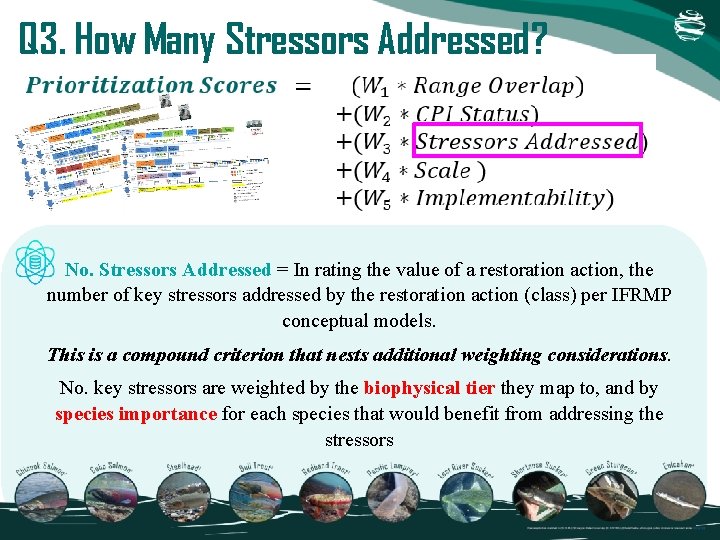
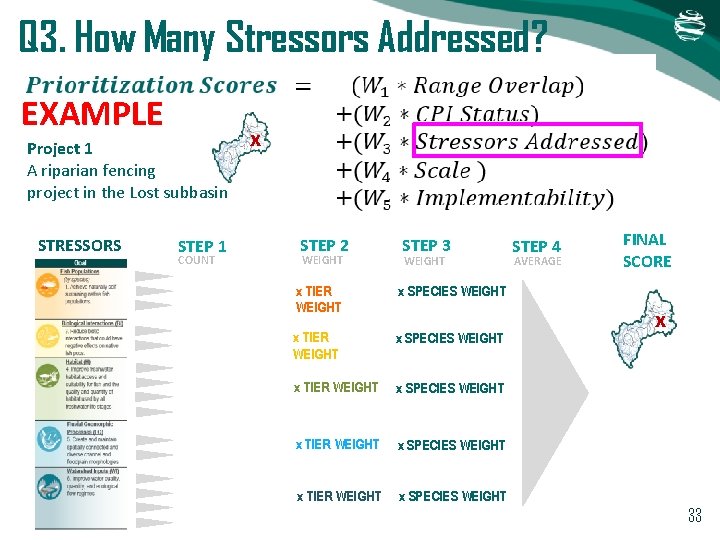
Q 3. How Many Stressors Addressed? No. Stressors Addressed = In rating the value of a restoration action, the number of key stressors addressed by the restoration action (class) per IFRMP conceptual models. This is a compound criterion that nests additional weighting considerations. No. key stressors are weighted by the biophysical tier they map to, and by species importance for each species that would benefit from addressing the stressors 32
Q 3. How Many Stressors Addressed? EXAMPLE Project 1 A riparian fencing project in the Lost subbasin STRESSORS STEP 1 COUNT x STEP 2 STEP 3 x TIER WEIGHT x SPECIES WEIGHT x TIER WEIGHT x SPECIES WEIGHT STEP 4 AVERAGE FINAL SCORE x 33
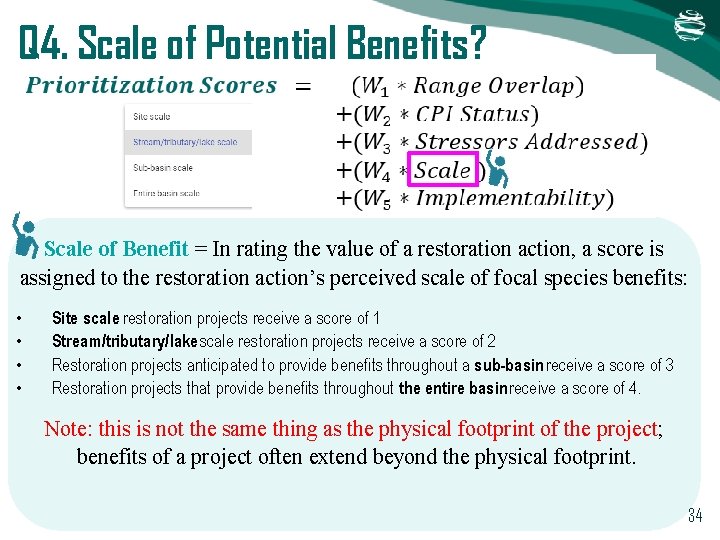
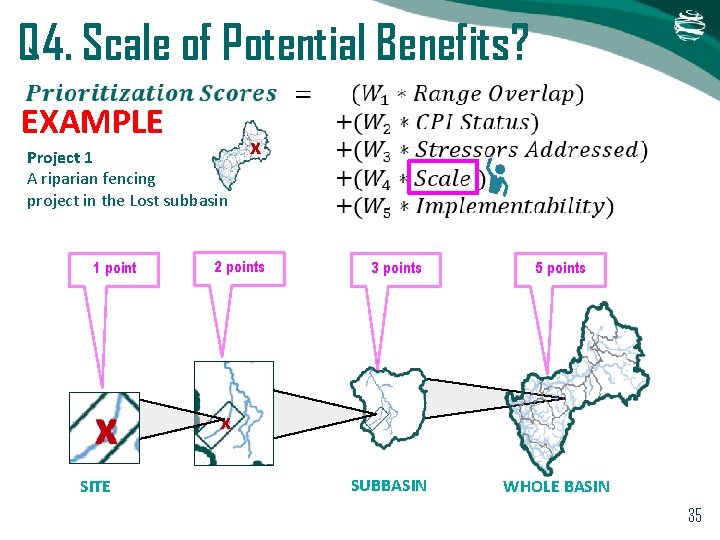
Q 4. Scale of Potential Benefits? Scale of Benefit = In rating the value of a restoration action, a score is assigned to the restoration action’s perceived scale of focal species benefits: • • Site scale restoration projects receive a score of 1 Stream/tributary/lake scale restoration projects receive a score of 2 Restoration projects anticipated to provide benefits throughout a sub-basin receive a score of 3 Restoration projects that provide benefits throughout the entire basin receive a score of 4. Note: this is not the same thing as the physical footprint of the project; benefits of a project often extend beyond the physical footprint. 34
Q 4. Scale of Potential Benefits? EXAMPLE Project 1 A riparian fencing project in the Lost subbasin 1 point x 2 points 3 points 5 points x SITE SUBBASIN WHOLE BASIN 35
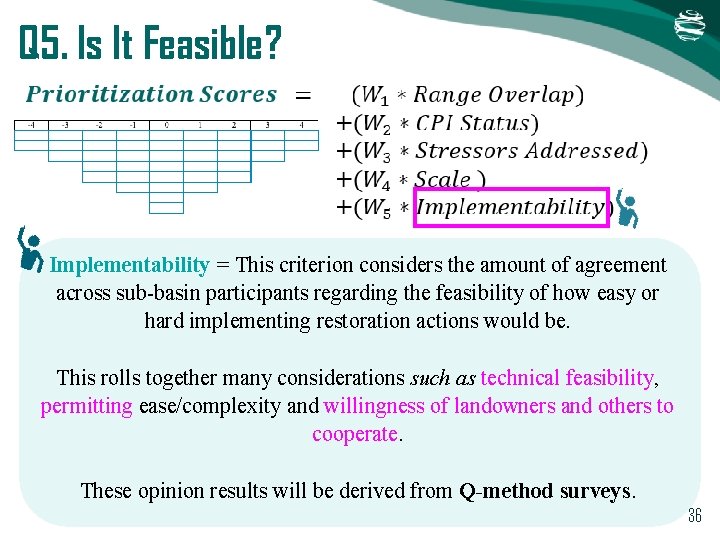
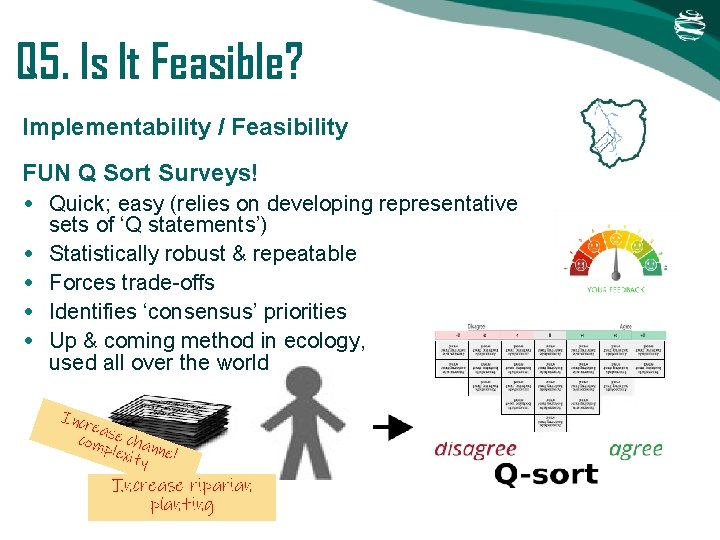
Q 5. Is It Feasible? Implementability = This criterion considers the amount of agreement across sub-basin participants regarding the feasibility of how easy or hard implementing restoration actions would be. This rolls together many considerations such as technical feasibility, permitting ease/complexity and willingness of landowners and others to cooperate. These opinion results will be derived from Q-method surveys. 36
Q 5. Is It Feasible? Implementability / Feasibility FUN Q Sort Surveys! • Quick; easy (relies on developing representative sets of ‘Q statements’) • Statistically robust & repeatable • Forces trade-offs • Identifies ‘consensus’ priorities • Up & coming method in ecology, used all over the world Incr ease com chan plex ity nel Increase riparian planting
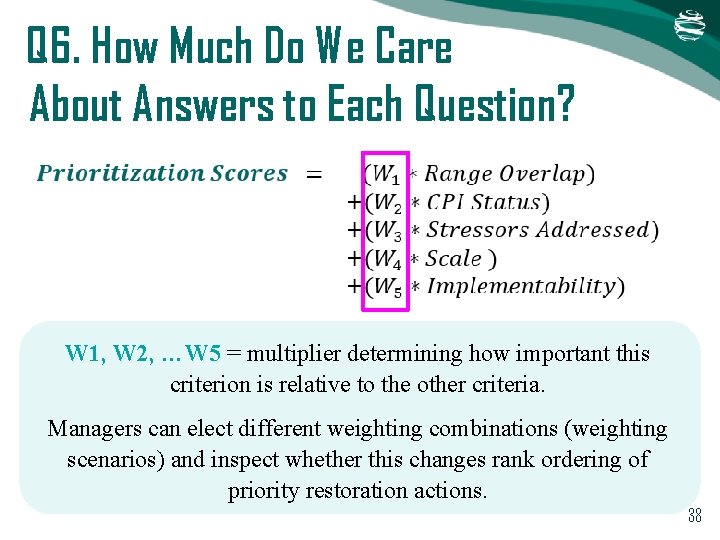
Q 6. How Much Do We Care About Answers to Each Question? W 1, W 2, …W 5 = multiplier determining how important this criterion is relative to the other criteria. Managers can elect different weighting combinations (weighting scenarios) and inspect whether this changes rank ordering of priority restoration actions. 38
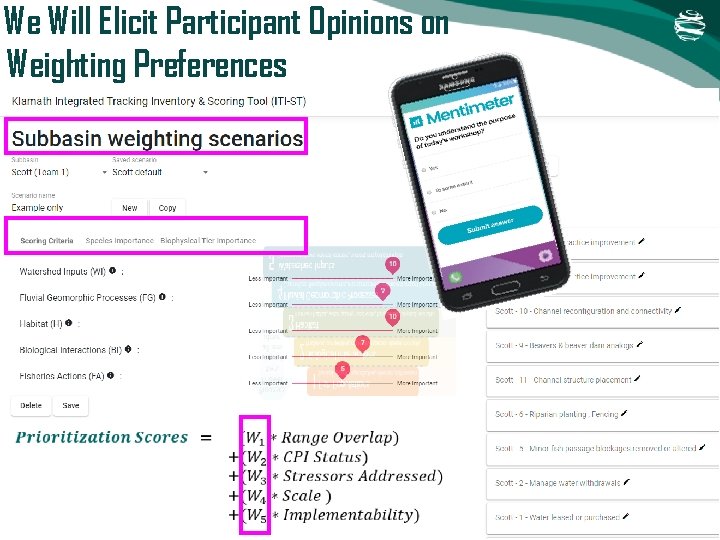
We Will Elicit Participant Opinions on Weighting Preferences
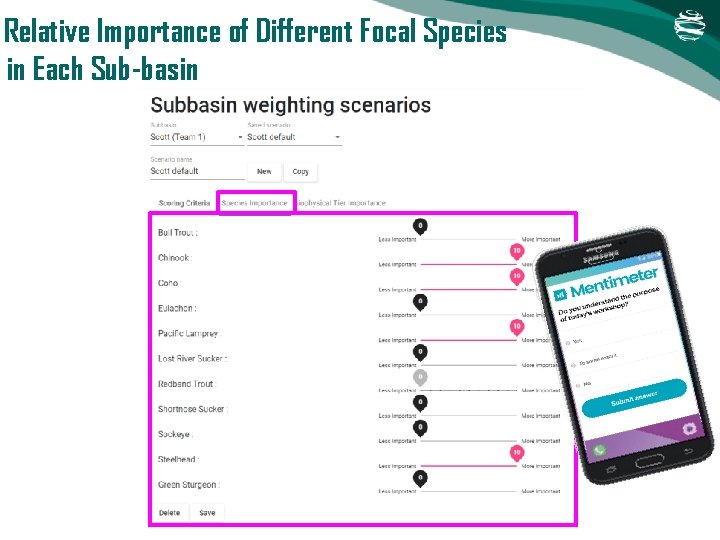
Relative Importance of Different Focal Species in Each Sub-basin
Within Sub-basins: The Relative Importance of Different Prioritization Criteria. Themselves 3. 5 hrs
Prioritization Tool Provides Ranked List of Actions for Further Deliberations… IS NOT X IMPLEMENT 42
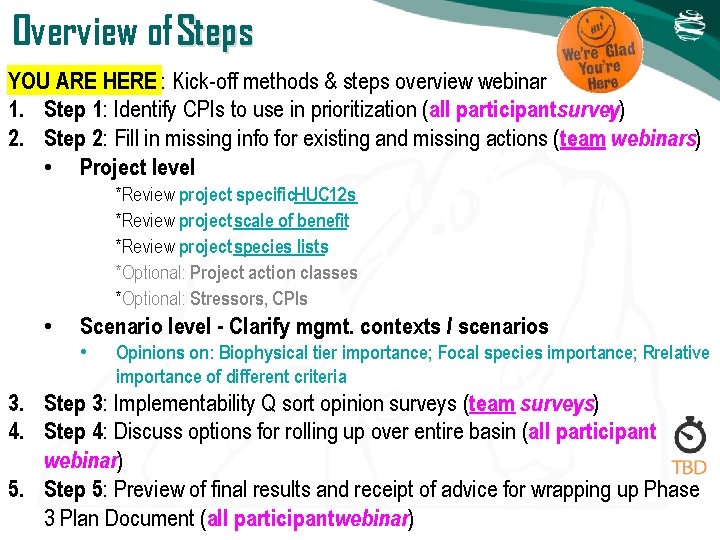
Overview of Steps YOU ARE HERE : Kick-off methods & steps overview webinar 1. Step 1: Identify CPIs to use in prioritization (all participantsurvey) 2. Step 2: Fill in missing info for existing and missing actions (team webinars) • Project level *Review project specific. HUC 12 s *Review project scale of benefit *Review project species lists *Optional: Project action classes *Optional: Stressors, CPIs • Scenario level - Clarify mgmt. contexts / scenarios • Opinions on: Biophysical tier importance; Focal species importance; Rrelative importance of different criteria 3. Step 3: Implementability Q sort opinion surveys (team surveys) 4. Step 4: Discuss options for rolling up over entire basin (all participant webinar) 5. Step 5: Preview of final results and receipt of advice for wrapping up Phase 3 Plan Document (all participantwebinar)
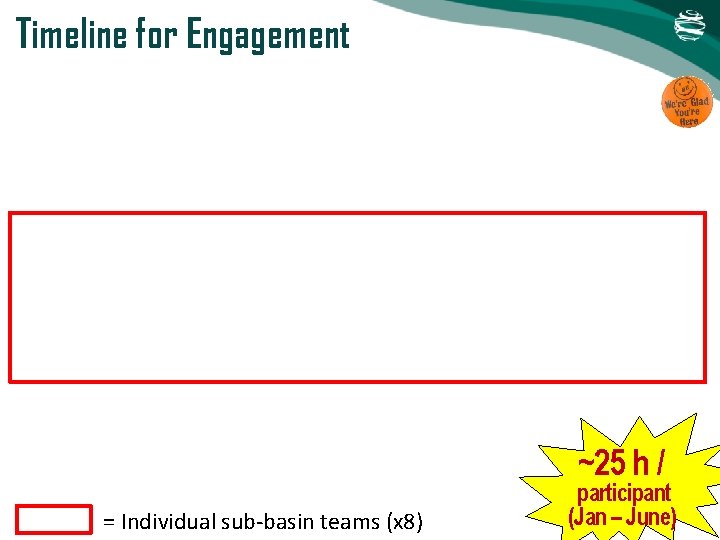
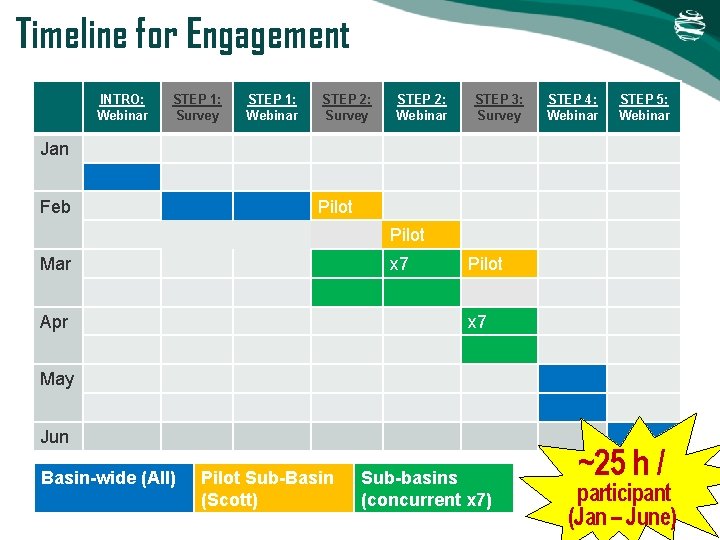
Timeline for Engagement ~25 h / = Individual sub-basin teams (x 8) participant (Jan – June)
Timeline for Engagement INTRO: Webinar STEP 1: Survey STEP 1: Webinar STEP 2: Survey STEP 2: Webinar STEP 3: Survey STEP 4: Webinar STEP 5: Webinar Jan Feb Pilot Mar x 7 Apr Pilot x 7 May Jun Basin-wide (All) Pilot Sub-Basin (Scott) Sub-basins (concurrent x 7) ~25 h / participant (Jan – June)
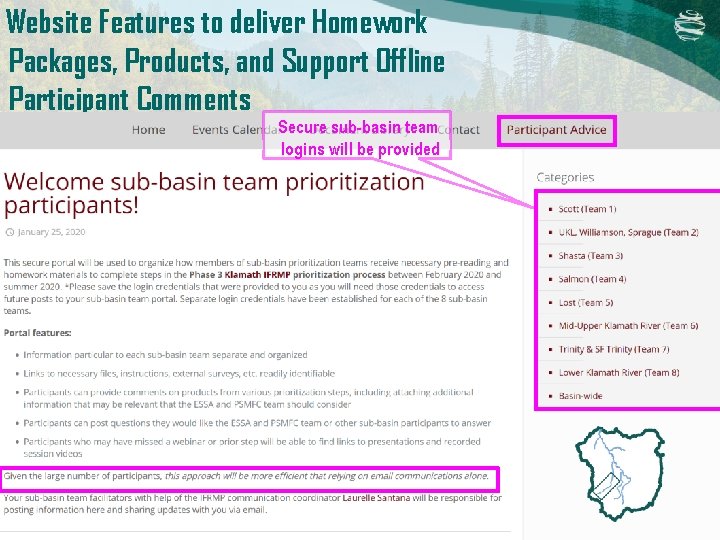
Website Features to deliver Homework Packages, Products, and Support Offline Participant Comments Secure sub-basin team logins will be provided
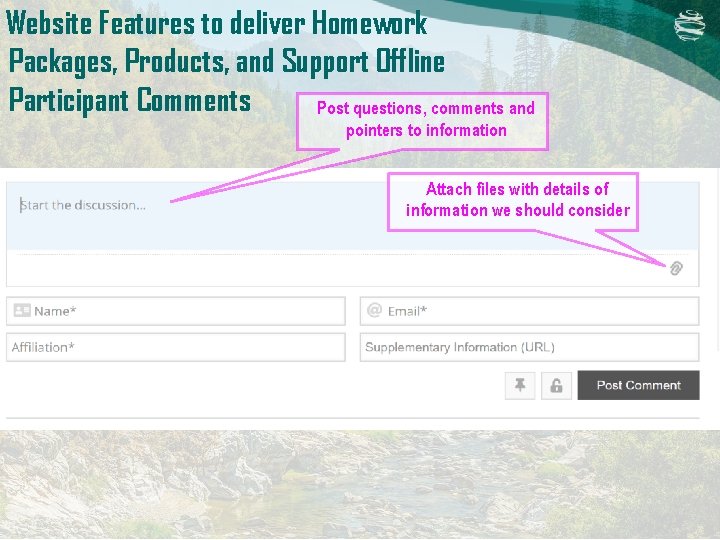
Website Features to deliver Homework Packages, Products, and Support Offline Participant Comments Post questions, comments and pointers to information Attach files with details of information we should consider
Questions? 48
4 Step 1 of 5: Core Performance Indicators – How They Fit In
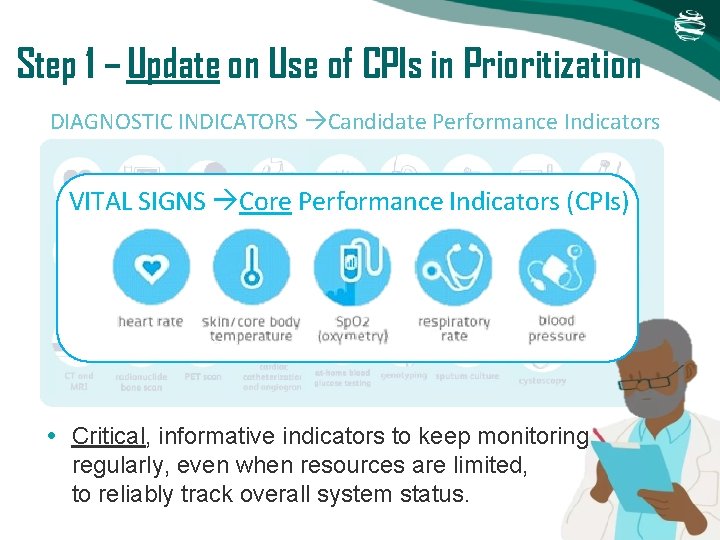
Step 1 – Update on Use of CPIs in Prioritization DIAGNOSTIC INDICATORS Candidate Performance Indicators VITAL SIGNS Core Performance Indicators (CPIs) • Critical, informative indicators to keep monitoring regularly, even when resources are limited, to reliably track overall system status. 50
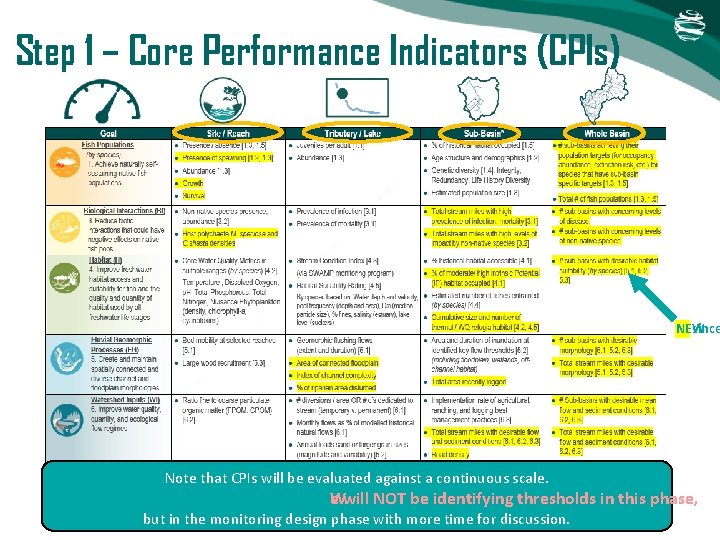
Step 1 – Core Performance Indicators (CPIs) NEW since Note that CPIs will be evaluated against a continuous scale. e will NOT be identifying thresholds in this phase, W but in the monitoring design phase with more time for discussion.
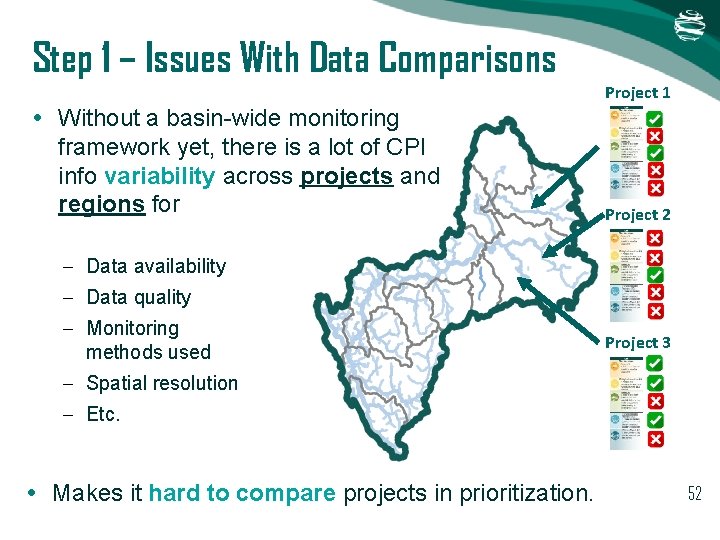
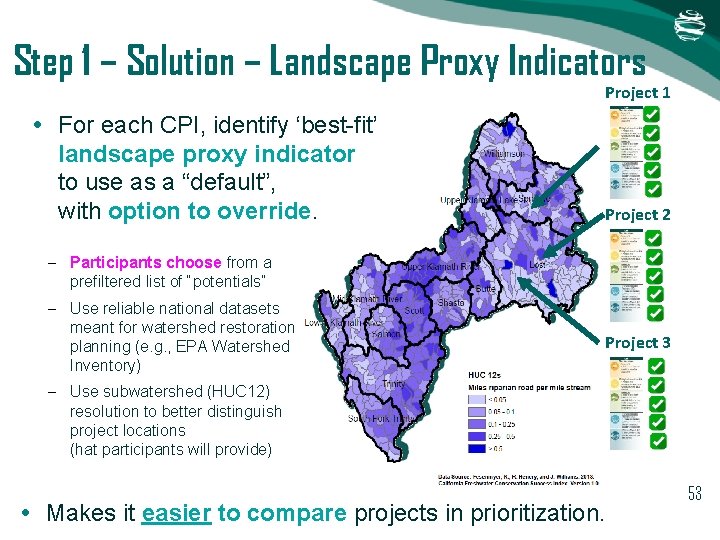
Step 1 – Issues With Data Comparisons • Without a basin-wide monitoring framework yet, there is a lot of CPI info variability across projects and regions for Project 1 Project 2 – Data availability – Data quality – Monitoring methods used Project 3 – Spatial resolution – Etc. • Makes it hard to compare projects in prioritization. 52
Step 1 – Solution – Landscape Proxy Indicators Project 1 • For each CPI, identify ‘best-fit’ landscape proxy indicator to use as a “default”, with option to override. Project 2 – Participants choose from a prefiltered list of “potentials” – Use reliable national datasets meant for watershed restoration planning (e. g. , EPA Watershed Inventory) Project 3 – Use subwatershed (HUC 12) resolution to better distinguish project locations (hat participants will provide) • Makes it easier to compare projects in prioritization. 53
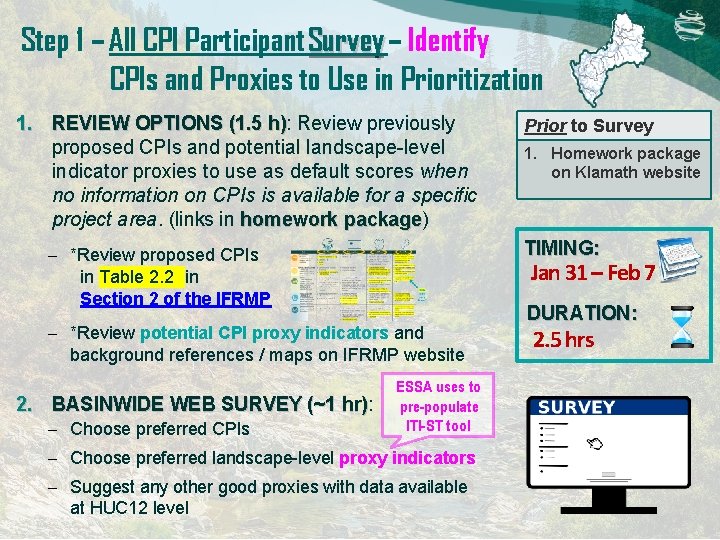
Step 1 – All CPI Participant Survey – Identify CPIs and Proxies to Use in Prioritization 1. REVIEW OPTIONS (1. 5 h): h) Review previously proposed CPIs and potential landscape-level indicator proxies to use as default scores when no information on CPIs is available for a specific project area. (links in homework package) package Jan 31 – Feb 7 – *Review potential CPI proxy indicators and background references / maps on IFRMP website – Choose preferred CPIs 1. Homework package on Klamath website TIMING: – *Review proposed CPIs in Table 2. 2 in Section 2 of the IFRMP 2. BASINWIDE WEB SURVEY (~1 hr): hr) Prior to Survey ESSA uses to pre-populate ITI-ST tool – Choose preferred landscape-level proxy indicators – Suggest any other good proxies with data available at HUC 12 level DURATION: 2. 5 hrs
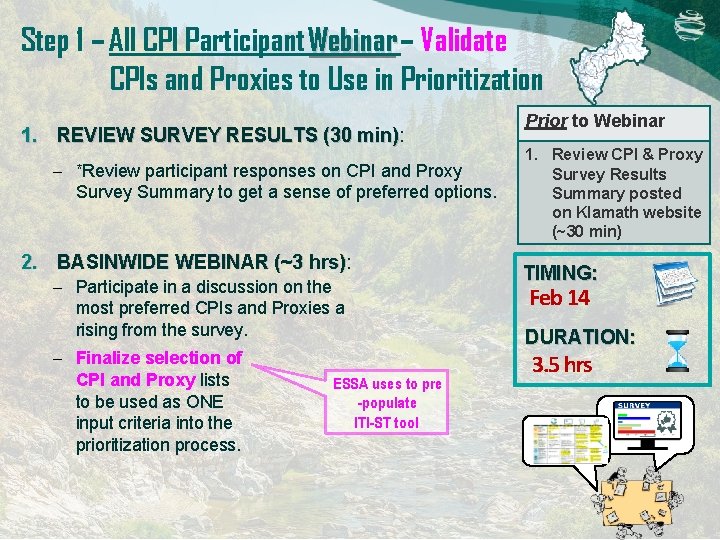
Step 1 – All CPI Participant Webinar – Validate CPIs and Proxies to Use in Prioritization 1. REVIEW SURVEY RESULTS (30 min): min) – *Review participant responses on CPI and Proxy Survey Summary to get a sense of preferred options. 2. BASINWIDE WEBINAR (~3 hrs): hrs) – Participate in a discussion on the most preferred CPIs and Proxies a rising from the survey. – Finalize selection of CPI and Proxy lists to be used as ONE input criteria into the prioritization process. ESSA uses to pre -populate ITI-ST tool Prior to Webinar 1. Review CPI & Proxy Survey Results Summary posted on Klamath website (~30 min) TIMING: Feb 14 DURATION: 3. 5 hrs
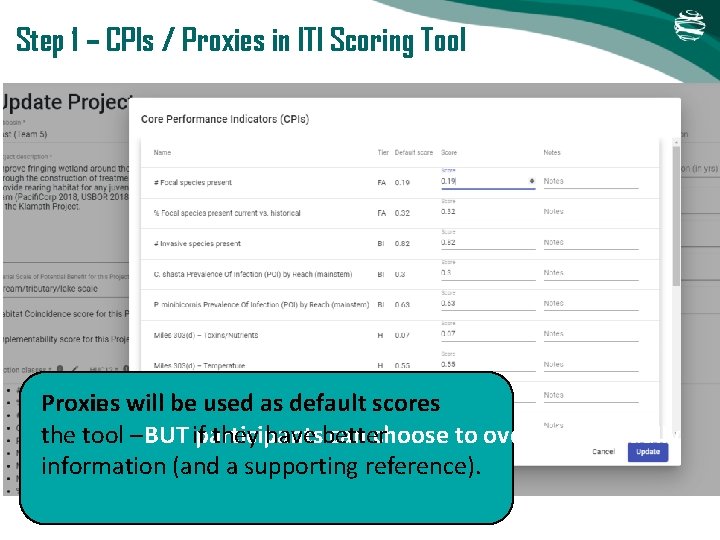
Step 1 – CPIs / Proxies in ITI Scoring Tool Proxies in will be used as default scores the tool – BUT ifparticipants they have better can choose to override manually information (and a supporting reference).
Questions? 57
Contacts Chris (cwheaton@psmfc. org) Wheaton – lead PSMFC Clint (calexander@essa. com) Alexander – lead ESSA Laurelle (lsantana@essa. com) Santana – communication coordinator, mailing lists, etc. Mouth of the Klamath River by Linda Tanner, 2011, licensed under CC by 2. 0 Thank-you! Further Information Visit the IFRMP website at: http: //kbifrm. psmfc. org/ Where you can also see the Phase 3 schedule, read the latest plan documents, download homework and supporting resources for the webinars, and see and comment on interim webinar products. 58