
LEAD Competency Making Intentional Impact Deliberately Developmental Organization
LEAD Competency: Making Intentional Impact
Deliberately Developmental Organization “Deep alignment with people’s motive to grow means fashioning an organizational culture in which support to people’s ongoing development is woven into the daily fabric of working life, visible in the company’s regular operations, day-to-day routines, and conversations. ”
1. Can you tell me a personal-growth goal, or self-improvement issue, you are working on at this time? (For shorthand, we’ll call this your OBT, your “one big thing”) 2. Can you tell me how making progress on your OBT would make a big difference for you personally, for the company, and for your life outside the company? 3. Can you name others in the company who are aware of your OBT, whom you talk with about it, who might give you feedback about it, who care whether you make progress on it? 4. Can you tell me how regularly you have the chance to be “at work” on your OBT during the normal flow of your work activities? When was the last time you were aware you were working on your OBT? 5. Can you tell me—when you do make progress on your OBT—how is this noticed or acknowledged in the company? Does it “register, ” and, if so, how?
Deliberately Developmental Organization 1. Running on Principles 2. Adults Can Grow 3. Weakness is Strength; Error is an Opportunity 4. The ‘Interdependent Bottom-Line’
1. Running on Principles “A DDO’s principles share a common fundamental belief in the power of individual growth for members of the organization. ” “In a strongly woven developmental culture, principles are discussed, debated, applied, revised, posted; in short they are ever-present and play an active role in daily life. ”
2. Adults Can Grow “The DDO’s principles are rooted in the possibility of…emergence, new capability, and evolution at the individual and collective level—in short, guided by the possibility of development. ” “From the ground up, have we designed our organization so that it supports the development of its members—which both they and the organization need in order to thrive? ”
3. Weakness is Strength; Error is an Opportunity “In ordinary organizations—even high performing organizations—people waste inordinate amounts of physical and mental energy preserving or enhancing their reputations, putting their best selves forward, and hiding their limitations and inadequacies—from others and themselves. ” “Being vulnerable on a regular basis is not always comfortable. ”
4. The ‘Interdependent Bottom-Line’ “In a DDO, the goals of profitability and fostering development are not a ‘both/and’; and they are not an ‘either/or. ’ Rather a DDO looks at the way very bold institutional aspirations, on the one hand, and furtherdeveloped human capabilities, on the other, are part of a single whole. They each depend on the other. ”
Deliberately Developmental Organization 5. Destabilization Can Be Constructive 6. Closing the Gaps 7. Timescale for Growth, Not Closure 8. ‘Interior Life’ is Part of What is Managed
5. Destabilization Can Be Constructive “…’Good fit’ does not actuaally mean, as it is likely to mean in most organizations, ‘She can do the job as described. ’ ‘Good fit’ is more likely to mean, ‘She will run into plenty of useful trouble and she will know how to use her trouble to learn and grow from it. ’” “‘Constructive destabilization’—both words are very important. ” “People in both organizations talk about the difference between ‘destructive pain’ and ‘labor pains, ’ the latter— however excruciating—leading to new life. ”
6. Closing the Gap • “what we do and what we say, • What we feel and what we say, • The water-cooler conversation and the meeting-room conversation, • The rea-time occasion of performance and the feedback on performance, • Knowledge of the organization’s principles and the application of those principles. ’ “In other words, members of a DDO come to trust the organization as an ongoing engine for growth of its members. Perhaps a truer statement of the critical equation would be, ‘Pain + Reflection (in a sufficiently safe and trustworthy community) = Progress. ”
6. Closing the Gap • “what we do and what we say, • What we feel and what we say, • The water-cooler conversation and the meeting-room conversation, • The rea-time occasion of performance and the feedback on performance, • Knowledge of the organization’s principles and the application of those principles. ’ “In other words, members of a DDO come to trust the organization as an ongoing engine for growth of its members. Perhaps a truer statement of the critical equation would be, ‘Pain + Reflection (in a sufficiently safe and trustworthy community) = Progress. ”
7. Timescale for Growth, Not Closure “If our fundamental goal is greater vitality (rather than minimizing discomfort), regular exercise is a good choice, even granting it can be uncomfortable at times. ”
8. “Interior Life” is Part of What is Managed” “Admitting the ‘interior’ to the world of what is managed does not mea that leadership aspires to a form of mind control. It means that the culture as a whole, and each individual within it, places inner experience ‘in bounds’ rather than ‘out of bounds’ in the life of work. ”
Deliberately Developmental Organization 9. Rank Does Not Have Its Usual Privileges 10. Everyone is HR 11. Everyone Needs a Crew 12. Everyone Builds the Culture
9. Rank Does Not Have It’s Usual Privileges “Ordinary organizations tend to protect their most senior members from ongoing challenge. They take each other to task only rarely, for extreme violations that put the organization at risk, as if senior leaders are completely grown, finished products, and the only necessary accountability is to punish wrongdoing. ”
10. Everyone is HR “…the ‘people development’ side of HR in a DDO is everyone’s responsibility. In most organizations when something is everyone’s responsibility, it means that no one is doing it, and it isn’t getting done; but in a DDO, it is everyone’s responsibility and it is getting done every day. ”
11. Everyone Needs a Crew “If people must be willing to be vulnerable in order to grow, they then need a community that will support them in—and through—their vulnerability. In a DDO everyone (from entrylevel to CEO) has a ‘crew, ’ and ongoing group that can be counted on not only to be an instrument of your vulnerability —calling you on your own blindspots and reactivity—but a support to your own growth as a result of that vulnerability. Consider how this dramatically departs from business-asusual in even the most supportive and productive workteams. ”
LEAD Competency: Making Intentional Impact
Evolve in Professional Capability Commit to being better Culture of Connection Build bridges between people and partners Develop Potential in Others Help people grow and lead Thinking and Acting Strategically Making good decisions and acting on them
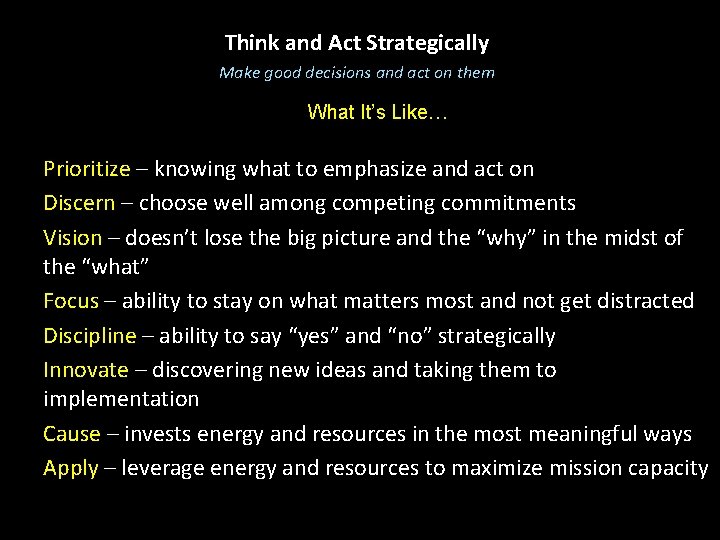
Think and Act Strategically Make good decisions and act on them What It’s Like… Prioritize – knowing what to emphasize and act on Discern – choose well among competing commitments Vision – doesn’t lose the big picture and the “why” in the midst of the “what” Focus – ability to stay on what matters most and not get distracted Discipline – ability to say “yes” and “no” strategically Innovate – discovering new ideas and taking them to implementation Cause – invests energy and resources in the most meaningful ways Apply – leverage energy and resources to maximize mission capacity
1 To think and act strategically… Put first things first instead of the easy or urgent
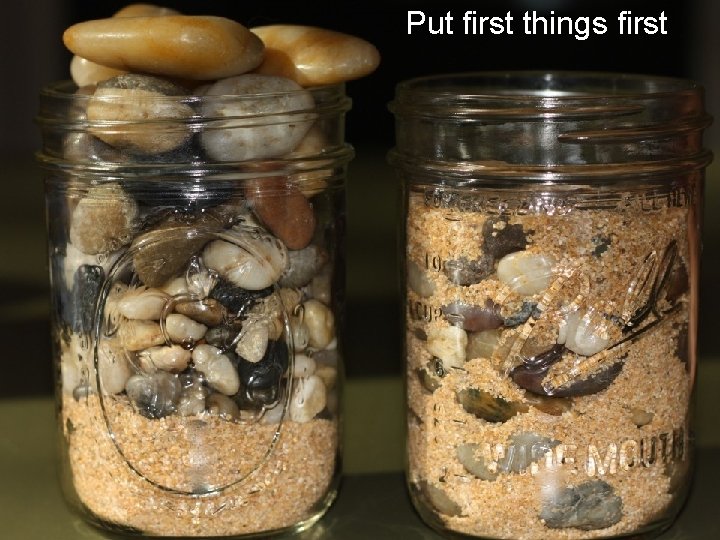
Put first things first
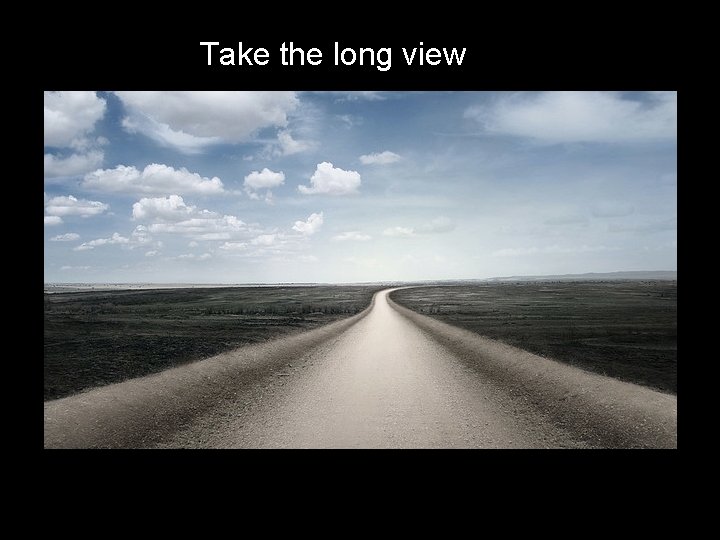
2 To think and act strategically… Take the long view instead of focusing simply on the immediate
Take the long view
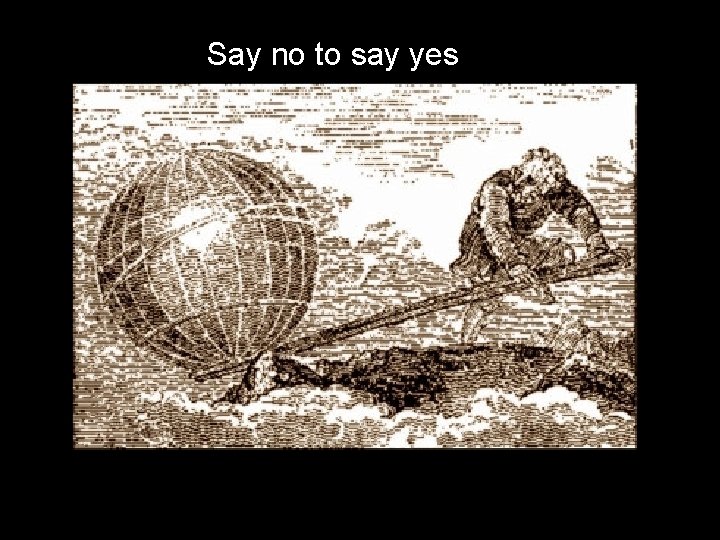
3 To think and act strategically… Say no to say yes instead of trying to say yes to everything
Say no to say yes
4 To think and act strategically… Create “blue ocean” value instead of just doing what you are already doing, only slightly better
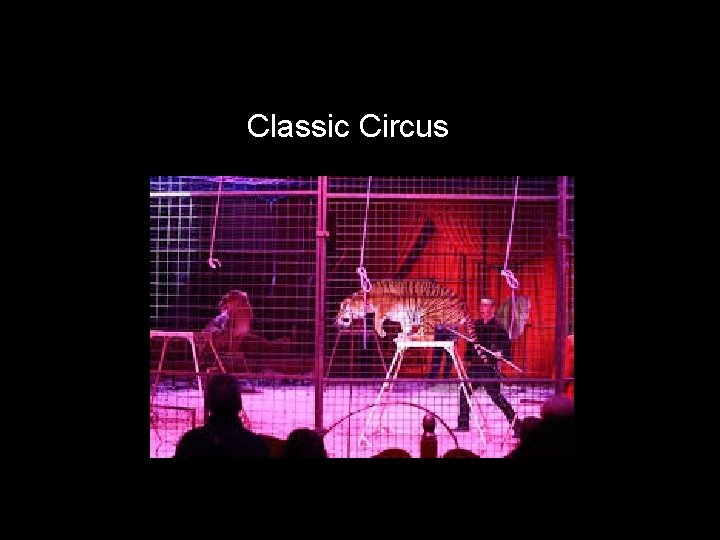
Classic Circus
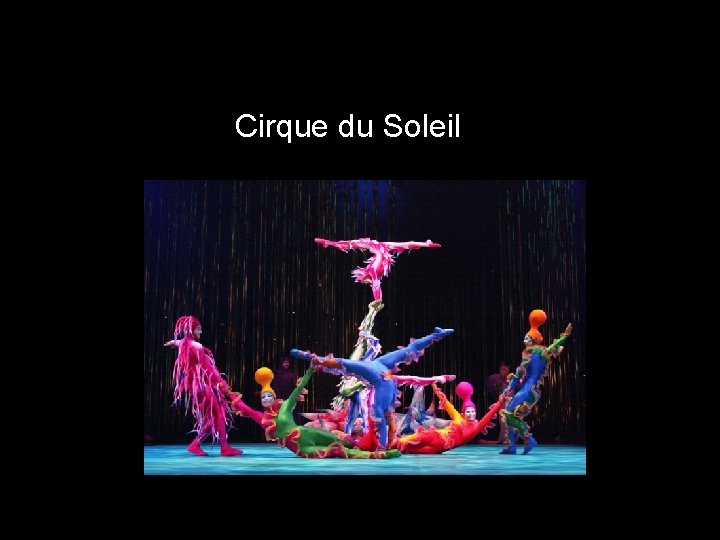
Cirque du Soleil
5 To think and act strategically… Act, don’t react instead of reactive or preemptive, think proactive
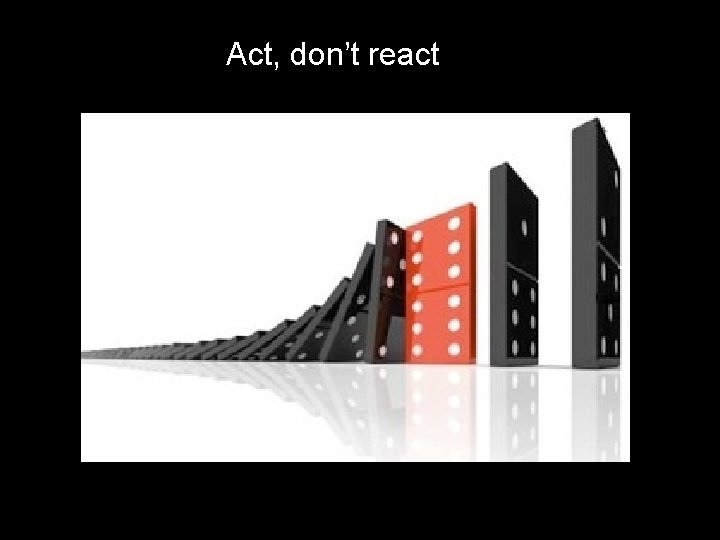
Act, don’t react
6 To think and act strategically… Get on the balcony instead of focusing only on your own space
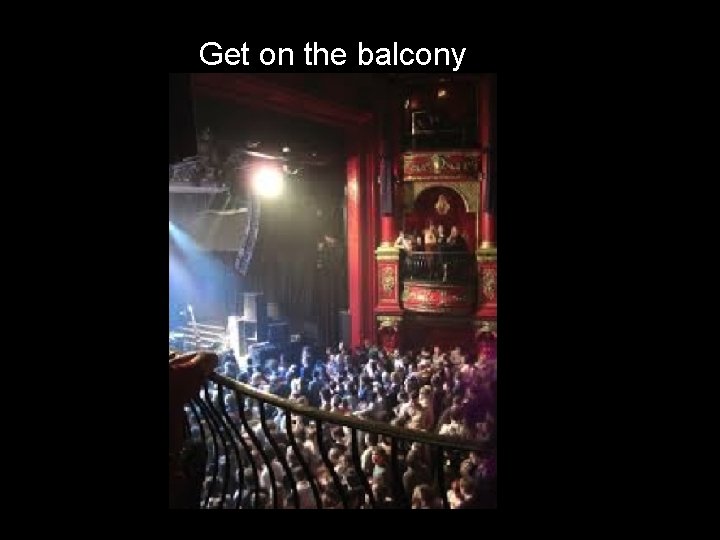
Get on the balcony
Action Steps for Me Take one area of your responsibility. How might you think and act more strategically? Put first things first Take the long view Say no to say yes Create “blue ocean” value Act, don’t react Get on the balcony
Action Steps for My Team Take one area of their responsibility. How might you help them think and act more strategically? Put first things first Take the long view Say no to say yes Create “blue ocean” value Act, don’t react Get on the balcony
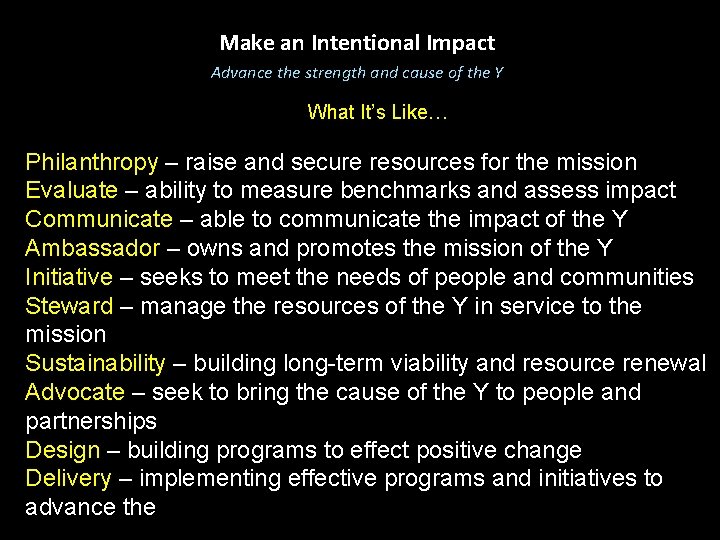
Make an Intentional Impact Advance the strength and cause of the Y What It’s Like… Philanthropy – raise and secure resources for the mission Evaluate – ability to measure benchmarks and assess impact Communicate – able to communicate the impact of the Y Ambassador – owns and promotes the mission of the Y Initiative – seeks to meet the needs of people and communities Steward – manage the resources of the Y in service to the mission Sustainability – building long-term viability and resource renewal Advocate – seek to bring the cause of the Y to people and partnerships Design – building programs to effect positive change Delivery – implementing effective programs and initiatives to advance the
Guiding Premises
Guiding Premises Evaluating impact is an act of leadership
Guiding Premises Watch effect, not just effort.
Guiding Premises The story we tell ourselves is often just that.
Guiding Premises All evaluation is educative.
Guiding Premises Beware of vanity metrics.
Guiding Premises Participation is powerful.
Guiding Premises Making people critics of themselves is better than making them critics of us.
Guiding Premises Metrics are people too.
Guiding Premises Evaluating impact is a human endeavor.
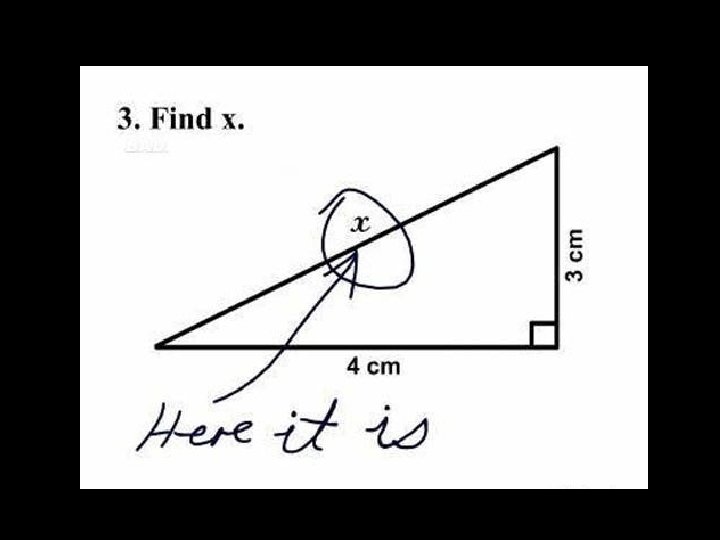

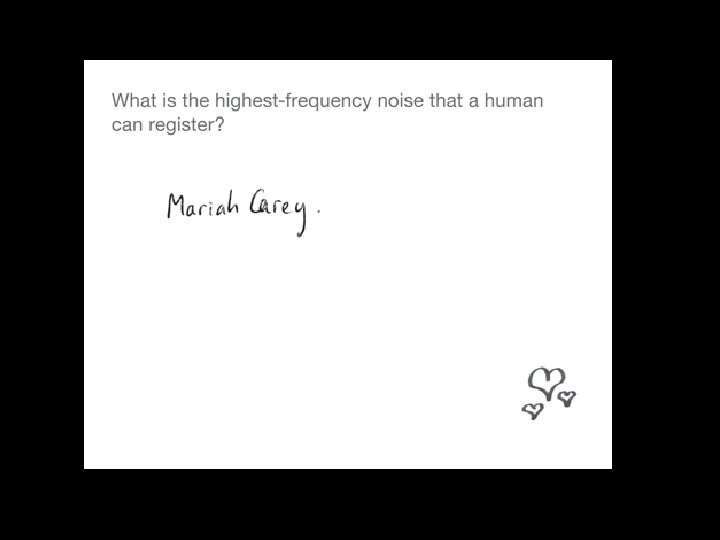
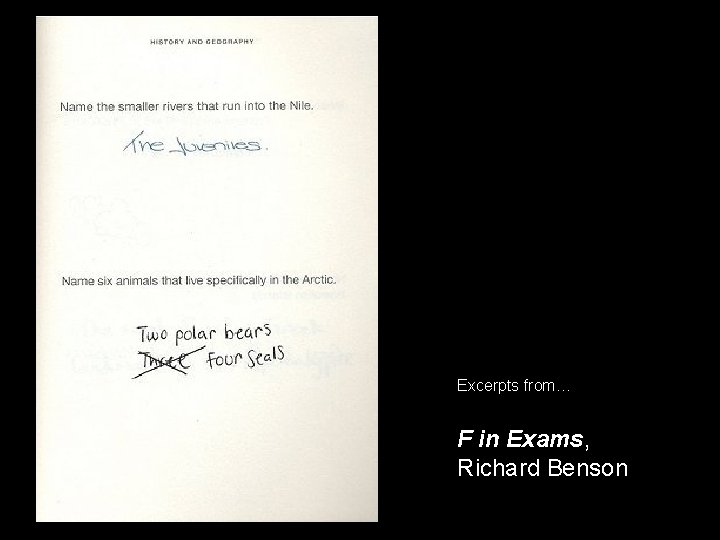
Excerpts from… F in Exams, Richard Benson
Evaluation is leadership Watch effect, not just effort The story we tell ourselves is often just that All evaluation educative Beware of vanity metrics Participation is powerful Making people critics of themselves is better Metrics are people too Evaluating impact is a human endeavor
Key Idea #1 Why do we evaluate? To Prove To Improve
Key Idea #2 Two Modes of Evaluation
Modes of Evaluation Quantitative Anecdote
Modes of Evaluation Quantitative data instrument method purpose application limitations Anecdote
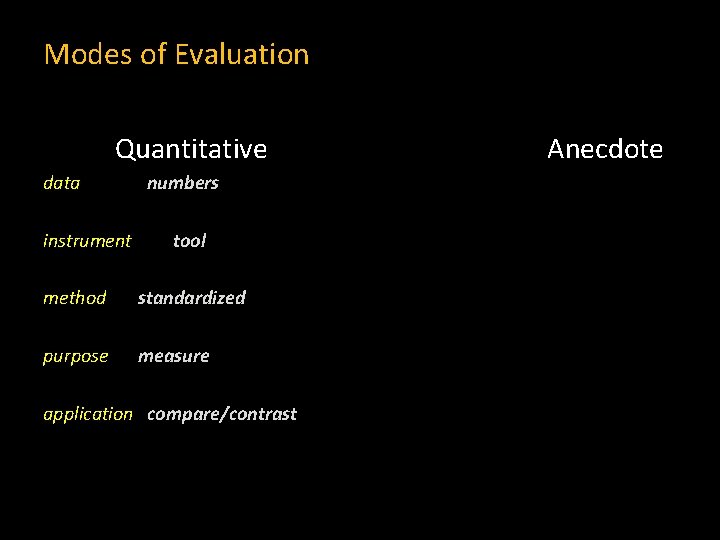
Modes of Evaluation Quantitative data instrument numbers tool method standardized purpose measure application compare/contrast Anecdote
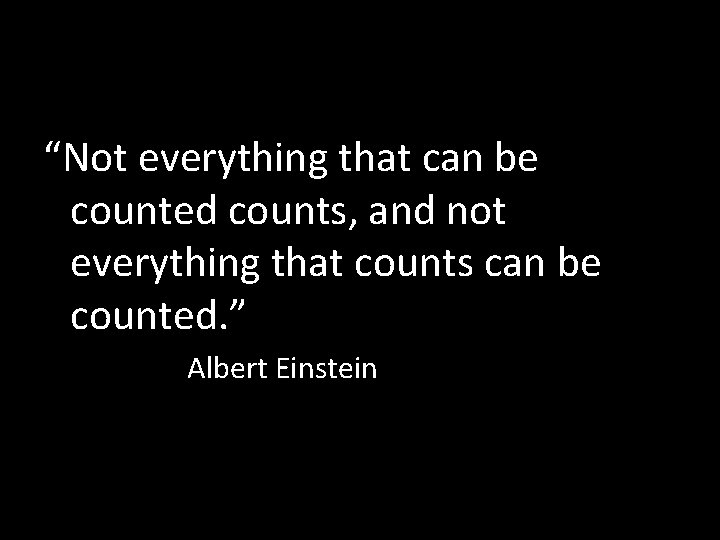
“Not everything that can be counted counts, and not everything that counts can be counted. ” Albert Einstein
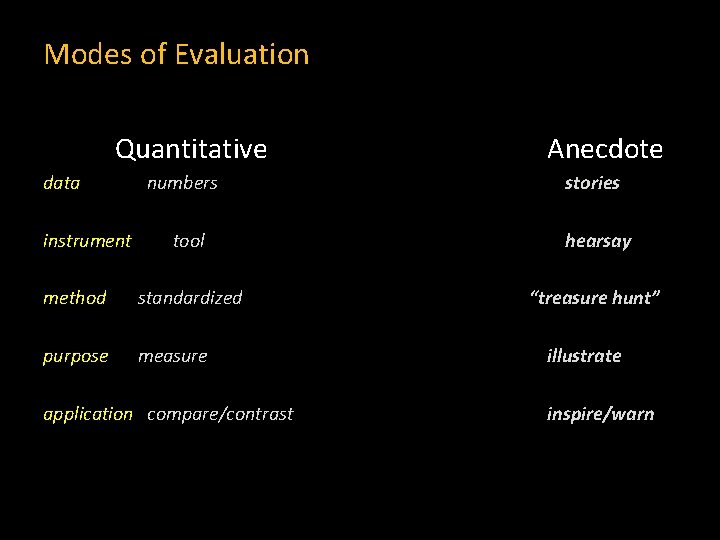
Modes of Evaluation Quantitative data instrument numbers Anecdote stories tool hearsay method standardized “treasure hunt” purpose measure application compare/contrast illustrate inspire/warn
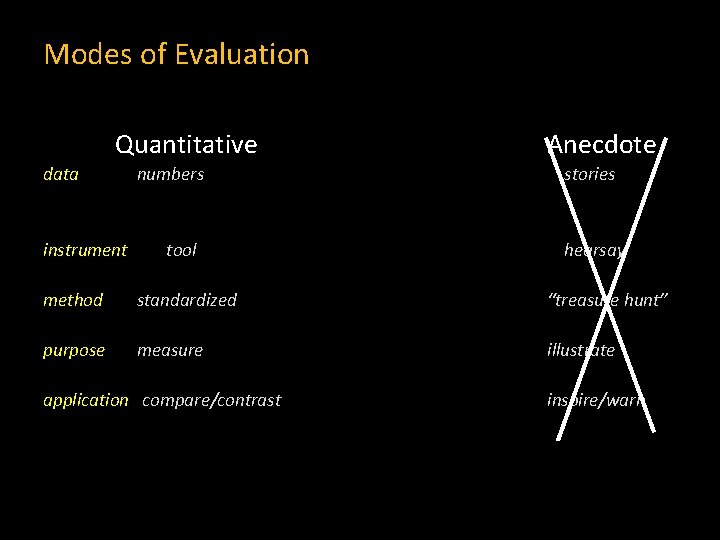
Modes of Evaluation Quantitative data instrument numbers tool Anecdote stories hearsay method standardized “treasure hunt” purpose measure illustrate application compare/contrast inspire/warn
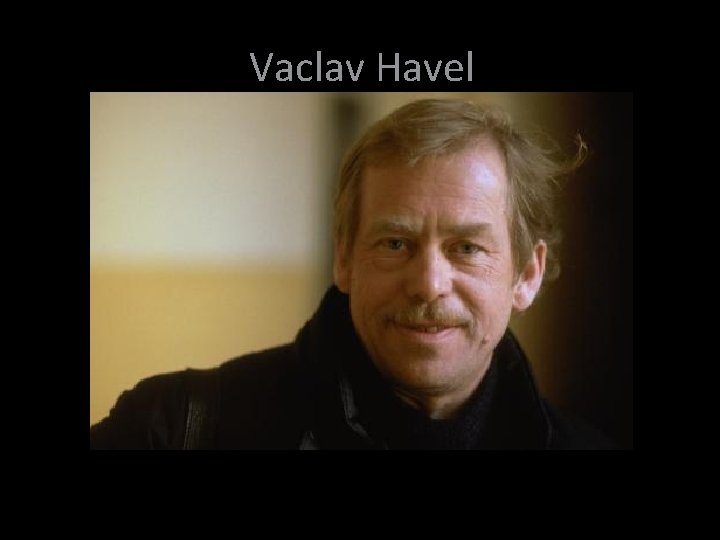
Vaclav Havel
(April 1975) Letter addressed to Dr. Gustav Husak, who was then the general secretary of the Czechoslovak Communist Party--Vaclav Havel’s first major public statement after being blacklisted in 1969. “Dear Dr. Husak”-Vaclav Havel
“One must ask seriously, at this point, whether all this does not confirm your success in achieving the tasks your team set itself— those of winning the public’s support and consolidating the situation in the country. The answer must depend on what we mean by consolidation. Havel
Insofar as it is to be measured solely by statistical returns of various kinds, by official statements and police accounts of the public’s political involvement, and so forth, then we can hardly feel any doubt that consolidation has been achieved. Havel (cont. )
But what if we take consolidation to mean something more, a genuine state of mind in society? Supposing we start to inquire about more durable, perhaps subtler and more imponderable, but nonetheless significant factors, such as what, by way of genuine personal, human experience lies hidden behind all figures? Havel (cont. )
Supposing we ask, for example, what has been done for the moral and spiritual revival of society, for the enhancement of the truly human dimensions of life, for the elevation of man to a higher degree of dignity, for his truly free and authentic assertion in this world? Havel (cont. )
What do we find when we thus turn our attention from the mere outward manifestations to their inner causes and consequences, their connections and meanings, in a word, to that less obvious plane of reality where those manifestations might actually acquire a general human meeting? Havel (cont. )
Can we, even then, consider our society ‘consolidated’? I make so bold as to answer, No. ” Havel (cont. )
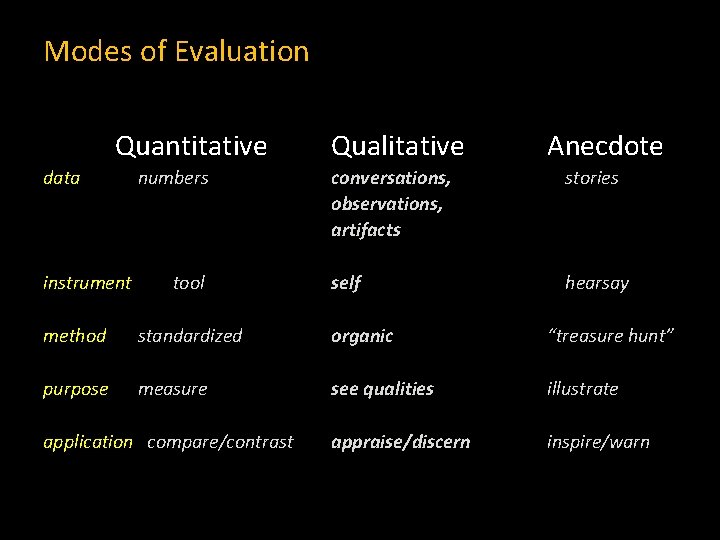
Modes of Evaluation Quantitative data instrument numbers tool Qualitative Anecdote conversations, observations, artifacts stories self hearsay method standardized organic “treasure hunt” purpose measure see qualities illustrate appraise/discern inspire/warn application compare/contrast
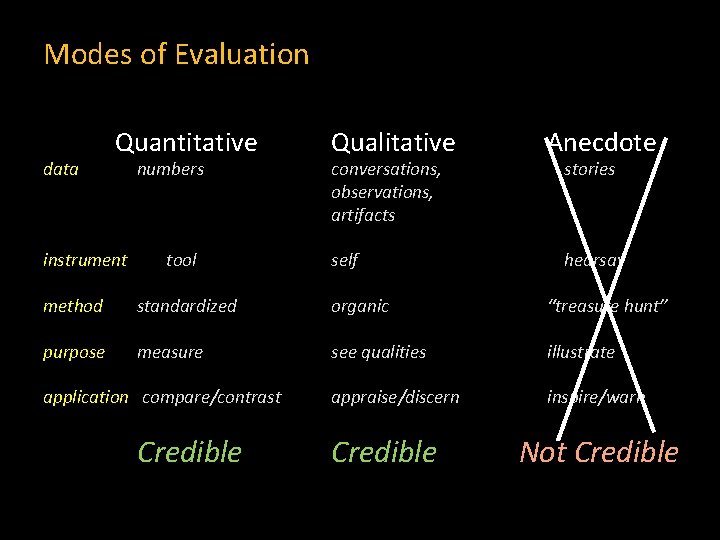
Modes of Evaluation data Quantitative instrument numbers tool Qualitative conversations, observations, artifacts self Anecdote stories hearsay method standardized organic “treasure hunt” purpose measure see qualities illustrate appraise/discern inspire/warn application compare/contrast Credible Not Credible
Key Idea #3 Heart Triangle
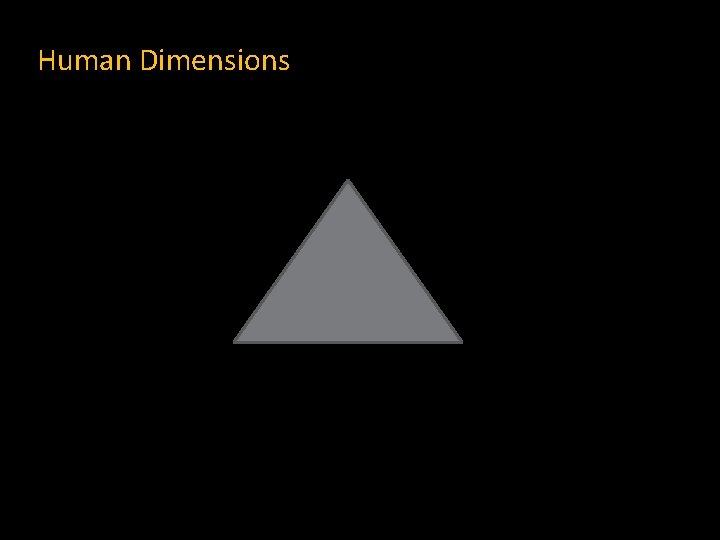
Human Dimensions
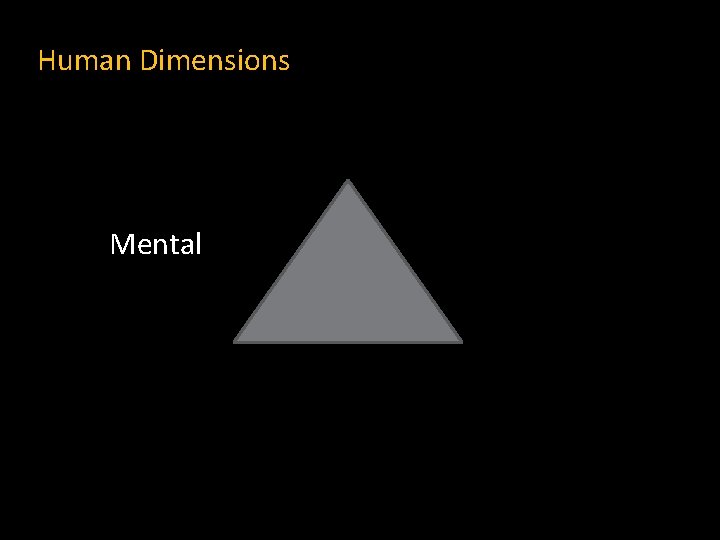
Human Dimensions Mental
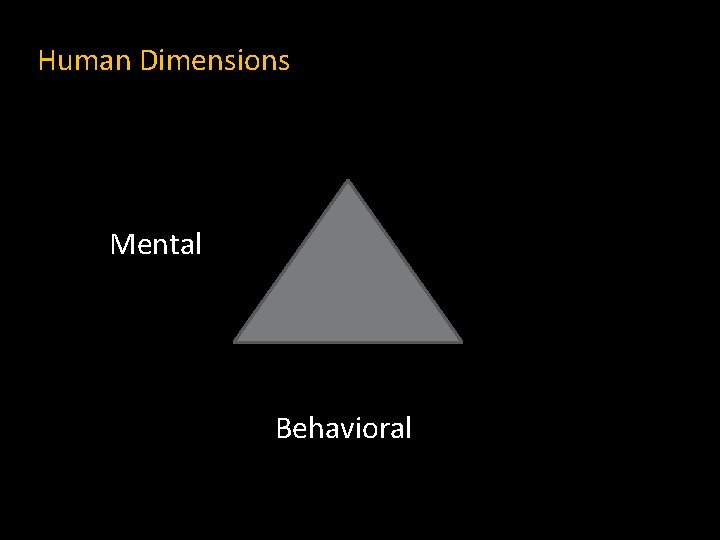
Human Dimensions Mental Behavioral
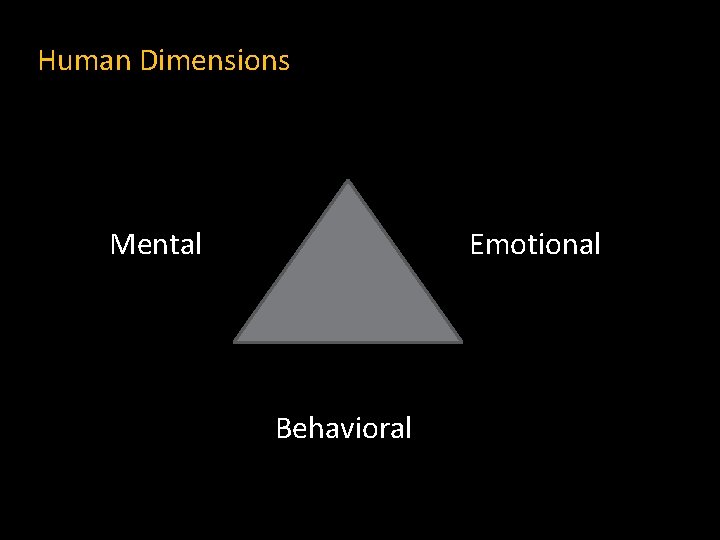
Human Dimensions Mental Emotional Behavioral
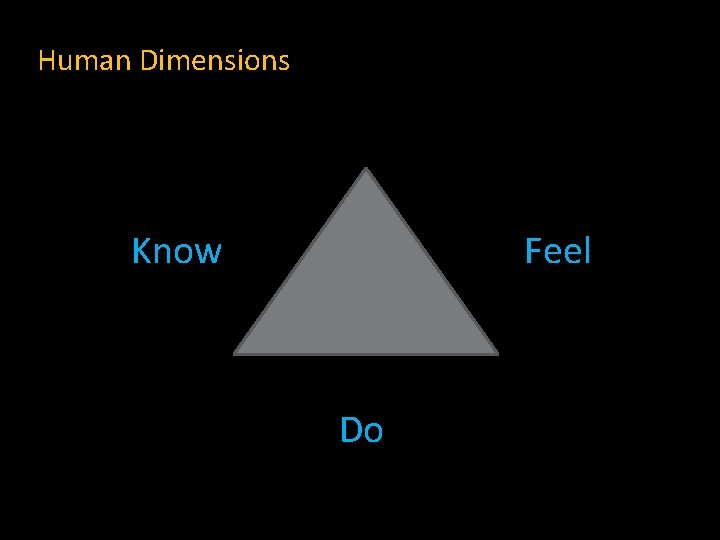
Human Dimensions Know Feel Do
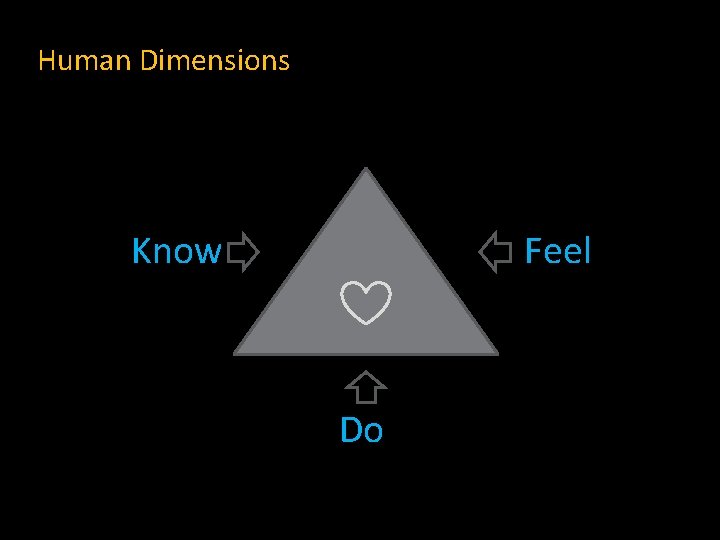
Human Dimensions Know Feel Do
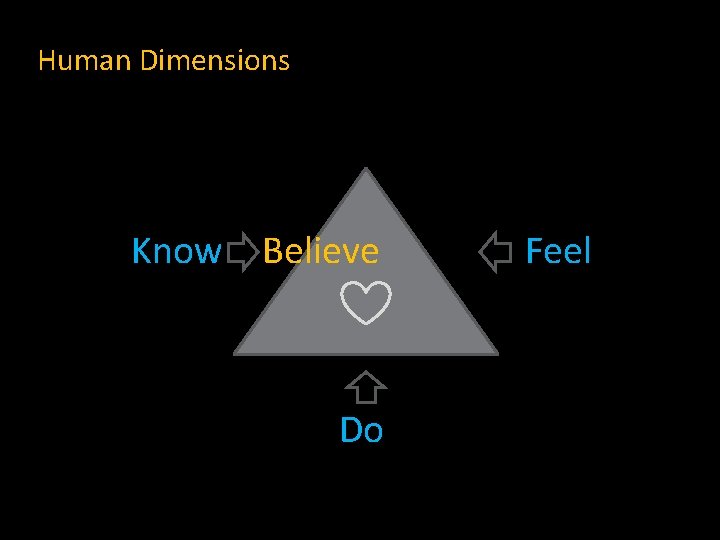
Human Dimensions Know Believe Do Feel
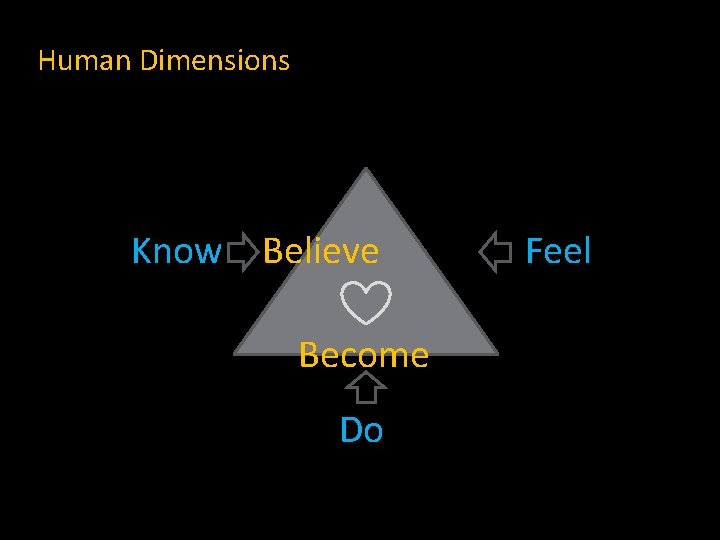
Human Dimensions Know Believe Become Do Feel
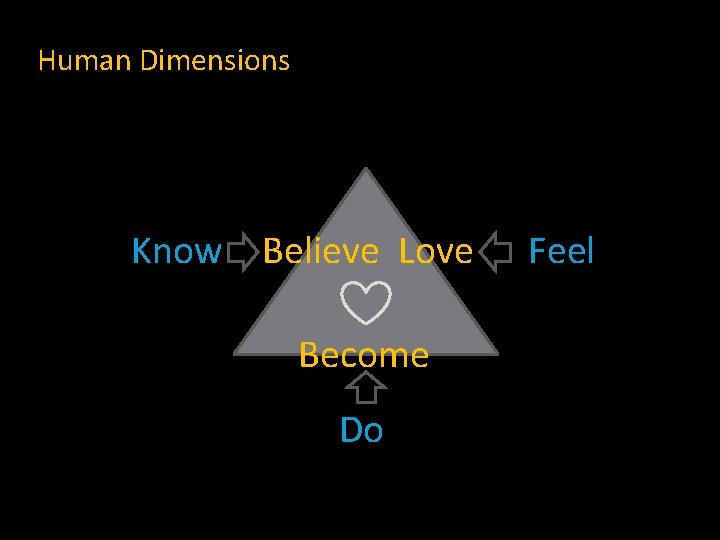
Human Dimensions Know Believe Love Become Do Feel
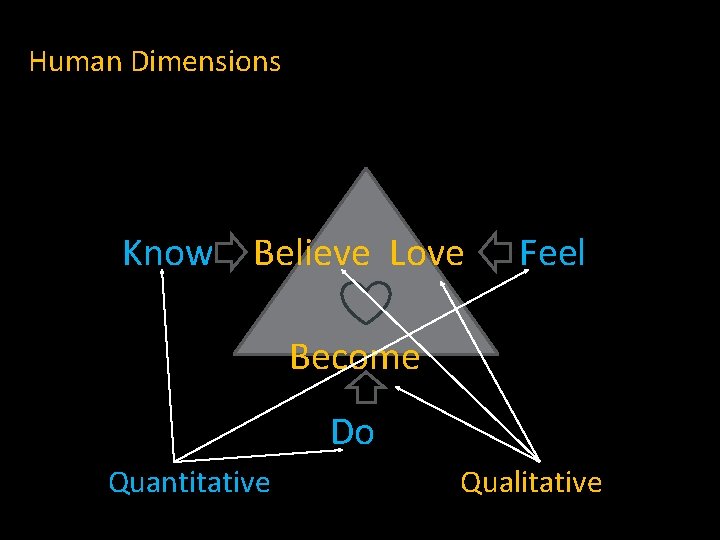
Human Dimensions Know Believe Love Feel Become Do Quantitative Qualitative
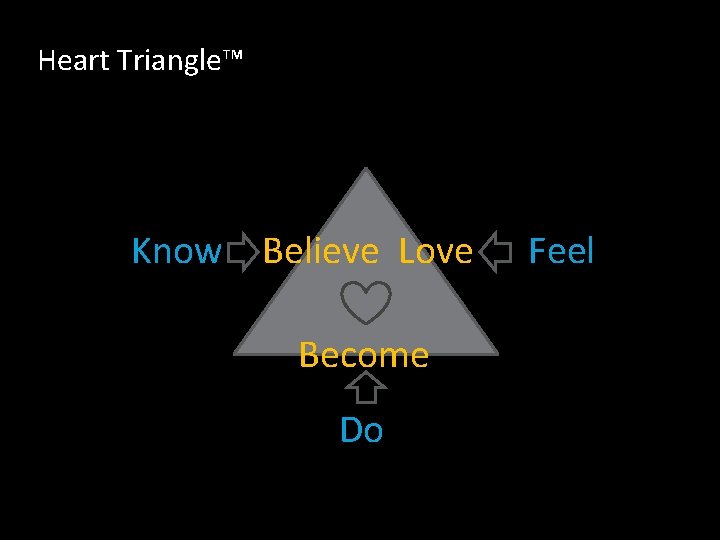
Heart Triangle™ Know Believe Love Become Do Feel
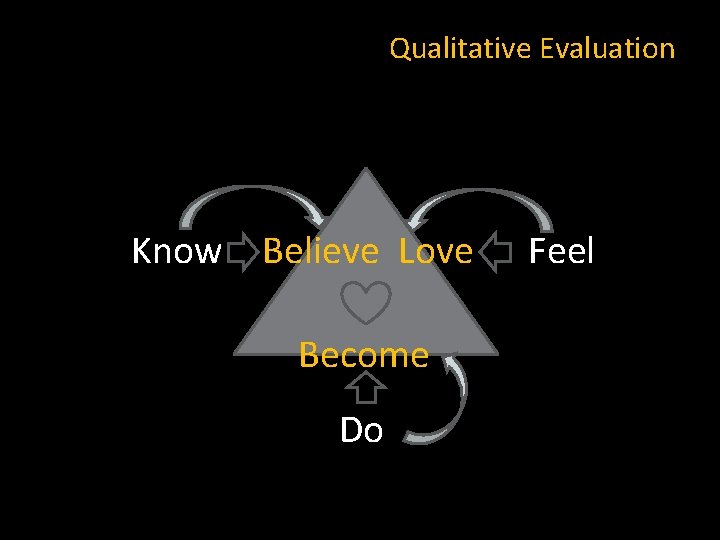
Qualitative Evaluation Know Believe Love Become Do Feel
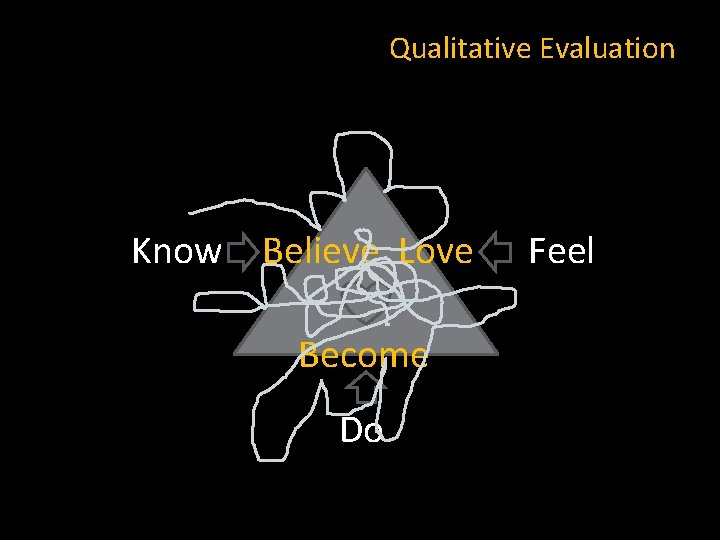
Qualitative Evaluation Know Believe Love Become Do Feel
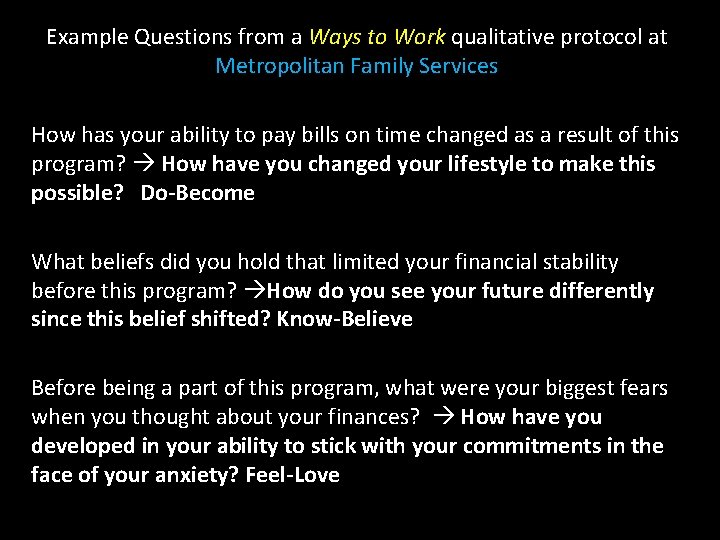
Example Questions from a Ways to Work qualitative protocol at Metropolitan Family Services How has your ability to pay bills on time changed as a result of this program? How have you changed your lifestyle to make this possible? Do-Become What beliefs did you hold that limited your financial stability before this program? How do you see your future differently since this belief shifted? Know-Believe Before being a part of this program, what were your biggest fears when you thought about your finances? How have you developed in your ability to stick with your commitments in the face of your anxiety? Feel-Love
BACI Staff Know Believe What are the key principles/ideas that drive our work here? What personal values of yours have found expression in this work? What have you learned during your time with us? How do you see the world/people/your own life differently because of your time working here? As a staff member, what do you find perplexing or confusing about our work? How have your beliefs and values been challenged through this work? In your mind, what is our strength of our strategy for service delivery? How do these expectations resonate with you personally as a leader? What have you learned most from our staff development opportunities (whatever you call these in your program)? How has this influence the way you approach your work?
BACI Staff Feel Love What makes you feel most successful in your work? How has this shaped or influenced what you want your life to be about? What is most exciting about your work here? What about this work do you love? What is most annoying or frustrating to you about your job? What keeps you committed to this even when it’s hard to do? What is your most frequently experienced emotion you feel in this work? How has that affected your heart for the work over time? When did you feel most excited last week? When did you feel most vulnerable? What continues to inspire you? What keeps you coming back to work? What makes your feel most frustrated in your work? How have you stayed focused and engaged through these frustrations and challenges?
BACI Staff Do Become What skills have you developed since being here? How have these been applied in other areas of your life and work? What tasks have you struggled with the most (or found most challenging) in your role here? What needs to grow and develop in you to be able to thrive in this work/organization? What new approaches have been trying out recently in your role here? What changes in you have others noticed and commented on, inside or outside of work? How have you been stretched professionally during your time here? What strengths or resources within yourself have you drawn on to serve well here? In what ways do you desire to grow? What do you consider to be your greatest achievement/accomplishment this past year? What changes do you see in yourself as a result of working here?
Calgary Middle Years (10 -15 yrs old) YMCA, Big Brothers/Big Sisters, Bridge Foundation for Youth What have you learned about making good and healthy friendships? How do you see people differently now that you’ve been through this program? (Know Believe) In what ways have you felt supported in this program? How are connected to people who care about you? (Feel Love) What did someone help you with this year? What have you done to help someone else during this program? How have you become a more of a role model? (Do Become)
Calgary Middle Years (cont. ) YMCA, Big Brothers/Big Sisters, Bridge Foundation for Youth What have you learned about solving problems and facing challenges through this program? What’s the most important part of this to you and to your life? (Know Believe) What excites you most about this next year? How has your time in this program made a difference in what kinds of things you’ll commit your life to? (Feel Love) What has this program made you look forward to in the future? What kind of person do you want to be as you grow up? (Do Become)
Key Idea #4 Evaluation Windows
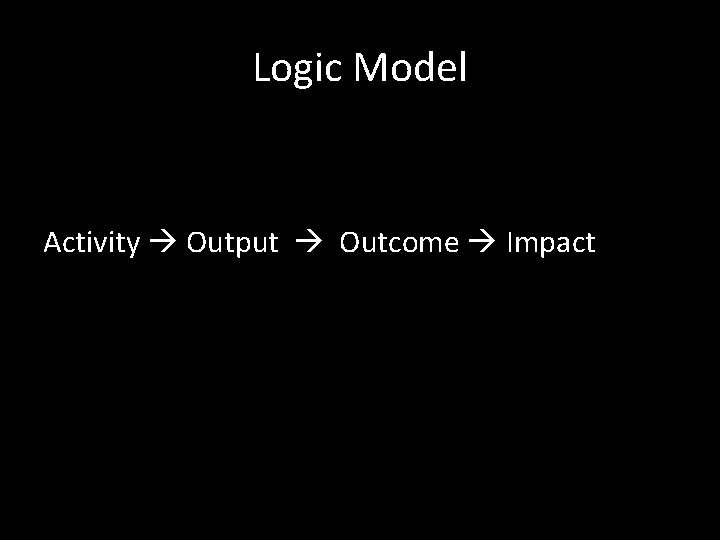
Logic Model Activity Output Outcome Impact
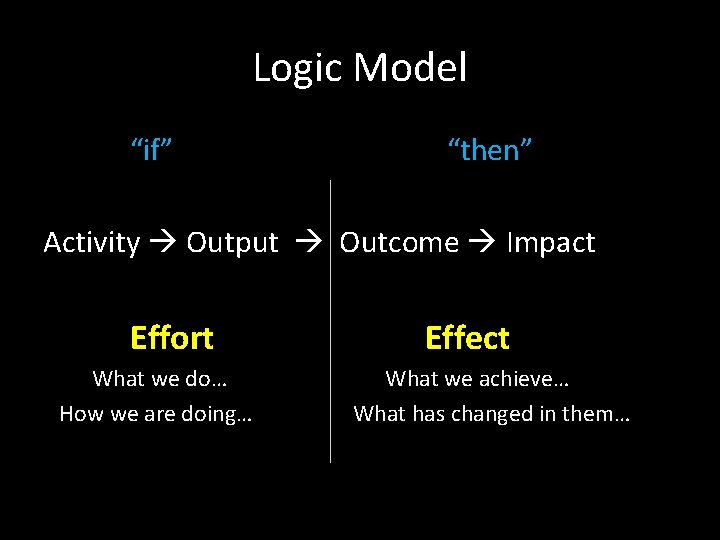
Logic Model “if” “then” Activity Output Outcome Impact Effort What we do… How we are doing… Effect What we achieve… What has changed in them…
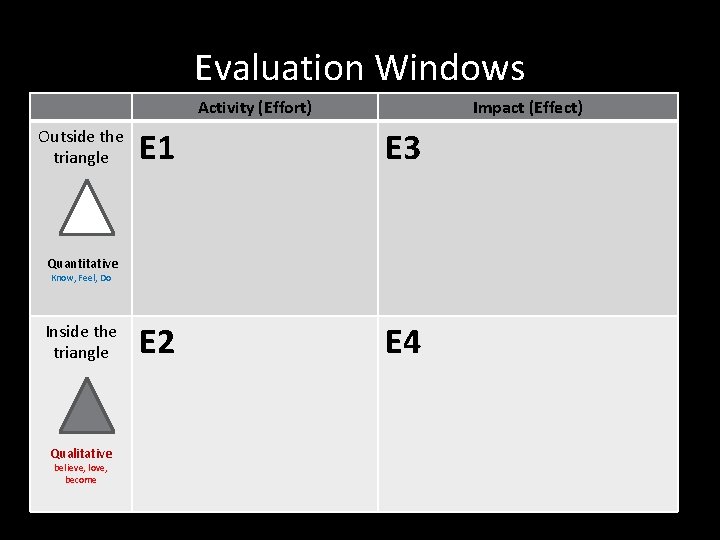
Evaluation Windows Activity (Effort) Outside the triangle Impact (Effect) E 1 E 3 E 2 E 4 Quantitative Know, Feel, Do Inside the triangle Qualitative believe, love, become
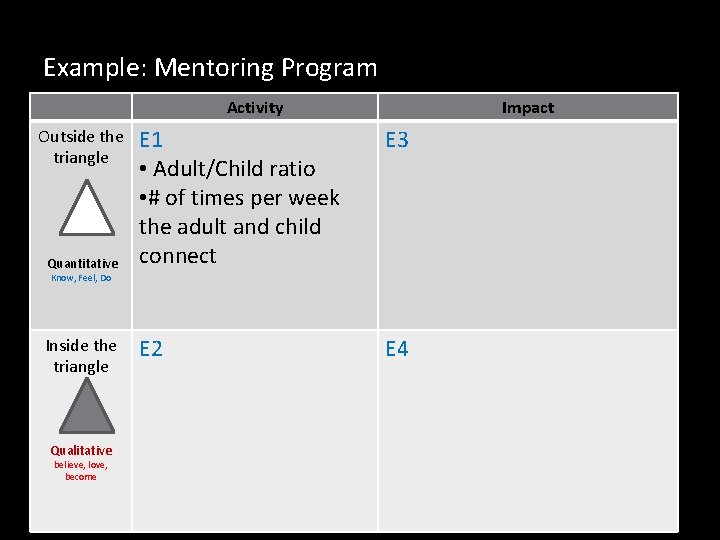
Example: Mentoring Program Activity Outside the triangle Quantitative Impact E 1 • Adult/Child ratio • # of times per week the adult and child connect E 3 E 2 E 4 Know, Feel, Do Inside the triangle Qualitative believe, love, become
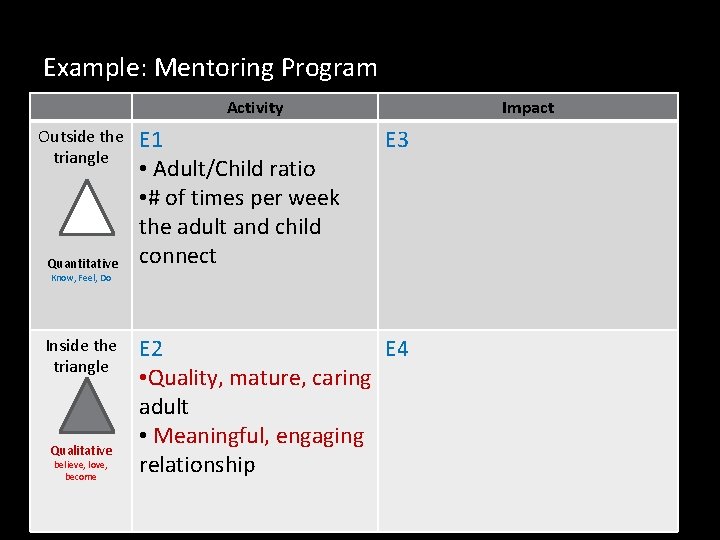
Example: Mentoring Program Activity Outside the triangle Quantitative E 1 • Adult/Child ratio • # of times per week the adult and child connect Impact E 3 Know, Feel, Do Inside the triangle Qualitative believe, love, become E 2 E 4 • Quality, mature, caring adult • Meaningful, engaging relationship
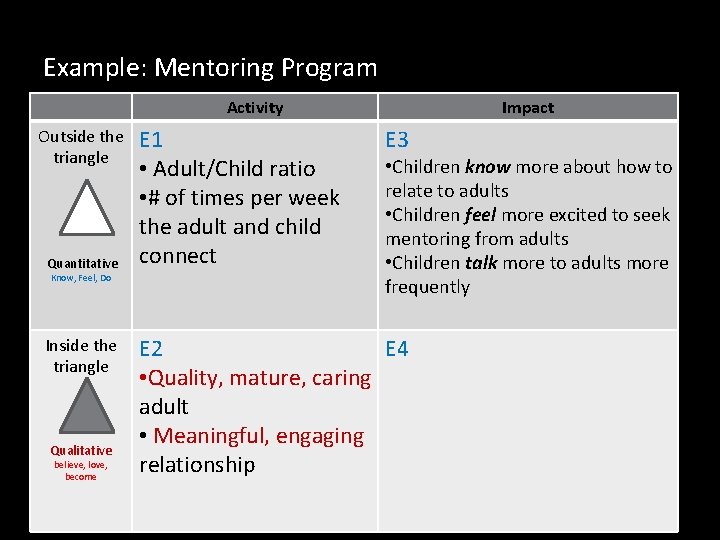
Example: Mentoring Program Activity Outside the triangle Quantitative Know, Feel, Do Inside the triangle Qualitative believe, love, become E 1 • Adult/Child ratio • # of times per week the adult and child connect Impact E 3 • Children know more about how to relate to adults • Children feel more excited to seek mentoring from adults • Children talk more to adults more frequently E 2 E 4 • Quality, mature, caring adult • Meaningful, engaging relationship
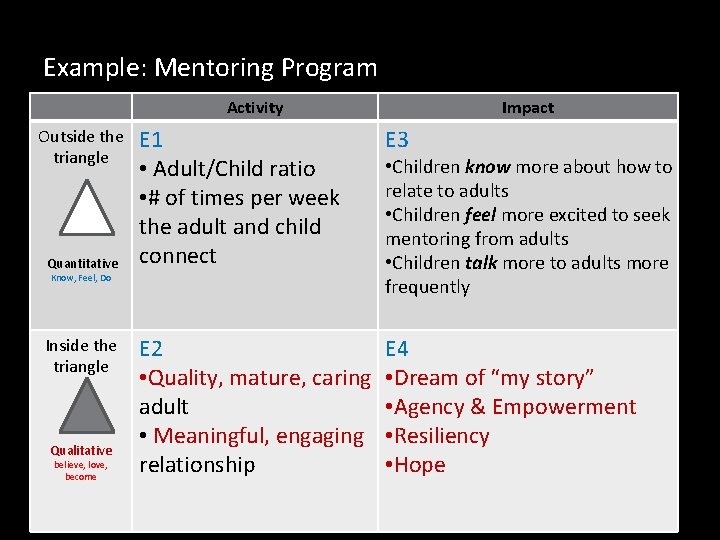
Example: Mentoring Program Activity Outside the triangle Quantitative E 1 • Adult/Child ratio • # of times per week the adult and child connect E 3 E 2 • Quality, mature, caring adult • Meaningful, engaging relationship E 4 • Dream of “my story” • Agency & Empowerment • Resiliency • Hope Know, Feel, Do Inside the triangle Qualitative believe, love, become Impact • Children know more about how to relate to adults • Children feel more excited to seek mentoring from adults • Children talk more to adults more frequently
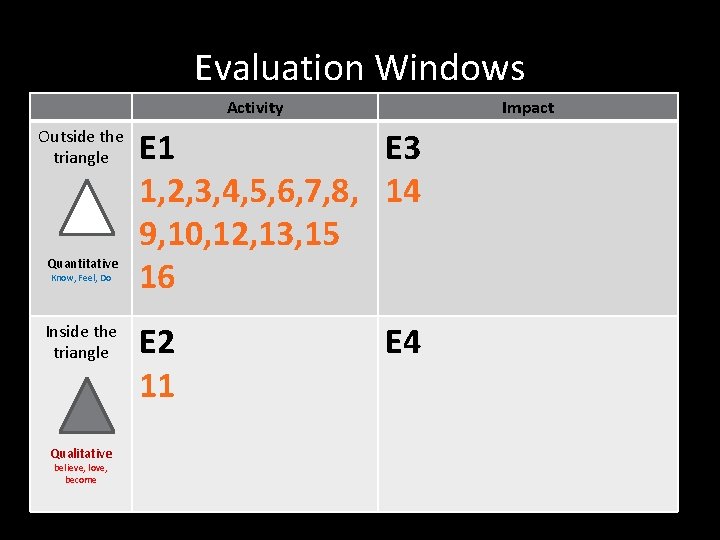
Evaluation Windows Activity Outside the triangle Quantitative Know, Feel, Do Inside the triangle Qualitative believe, love, become Impact E 1 E 3 1, 2, 3, 4, 5, 6, 7, 8, 14 9, 10, 12, 13, 15 16 E 2 11 E 4
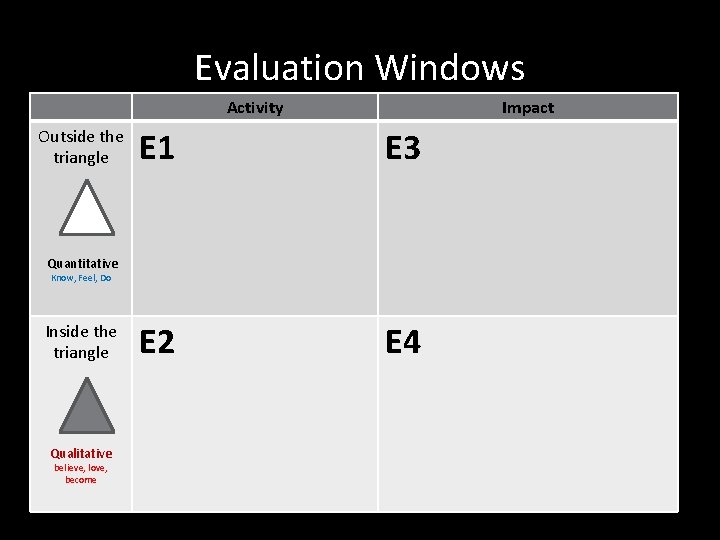
Evaluation Windows Activity Outside the triangle Impact E 1 E 3 E 2 E 4 Quantitative Know, Feel, Do Inside the triangle Qualitative believe, love, become
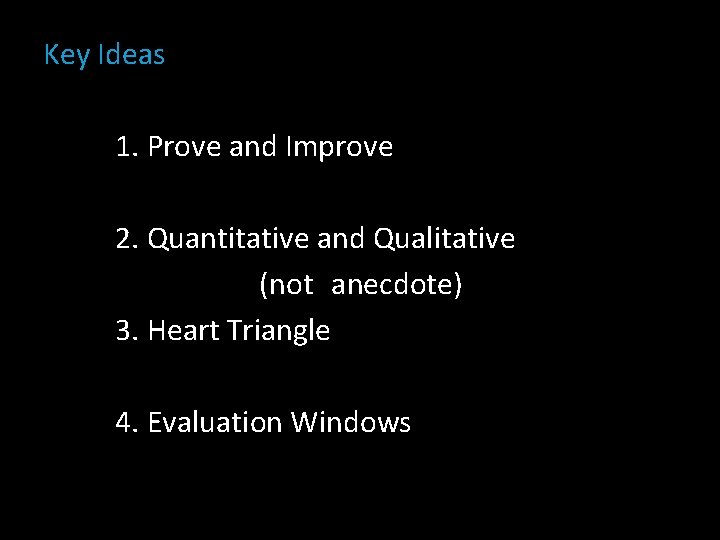
Key Ideas 1. Prove and Improve 2. Quantitative and Qualitative (not anecdote) 3. Heart Triangle 4. Evaluation Windows
Steve@Dialogues. In. Action. com 503. 329. 4816 Getting to What Matters: How to Design and Develop Evaluation
- Slides: 102