
Lead 208 Pb Radius Experiment PREX Elastic Scattering
Lead ( 208 Pb) Radius Experiment : PREX Elastic Scattering Parity Violating Asymmetry E = 1 Ge. V, electrons on lead Spokespersons • Paul Souder • Krishna Kumar • Guido Urciuoli • Robert Michaels R. Michaels MSU Seminar, Nov 2008 208 Pb PREX at
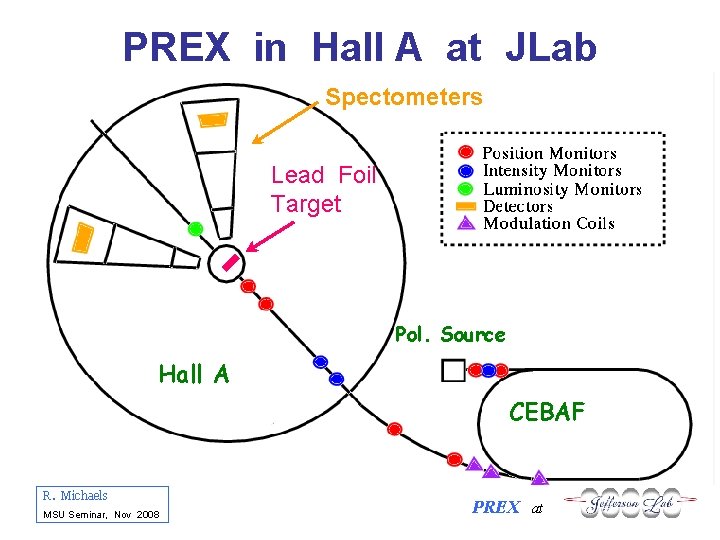
PREX in Hall A at JLab Spectometers Lead Foil Target Pol. Source Hall A CEBAF R. Michaels MSU Seminar, Nov 2008 PREX at
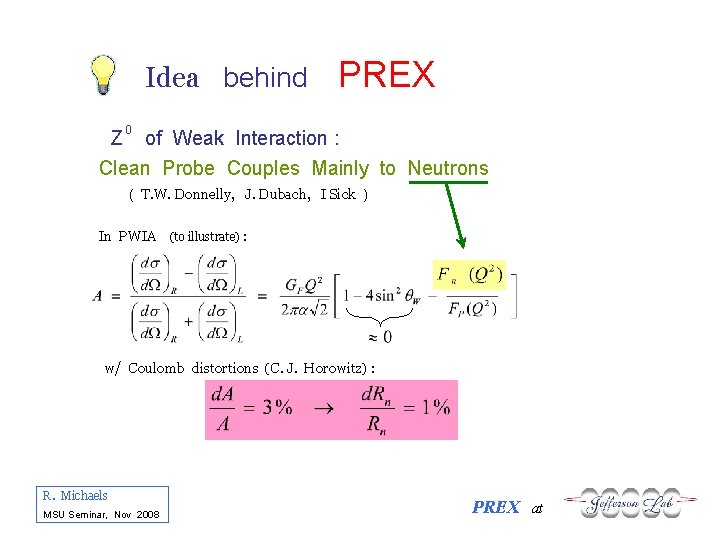
Idea behind Z 0 PREX of Weak Interaction : Clean Probe Couples Mainly to Neutrons ( T. W. Donnelly, J. Dubach, I Sick ) In PWIA (to illustrate) : w/ Coulomb distortions (C. J. Horowitz) : R. Michaels MSU Seminar, Nov 2008 PREX at
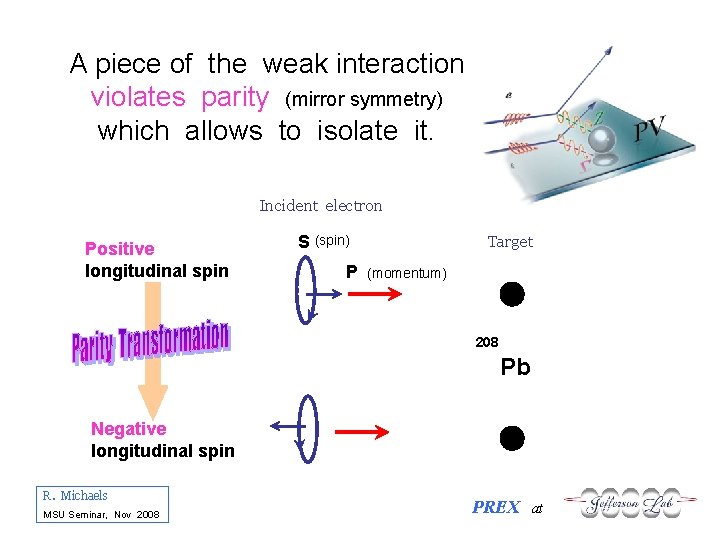
A piece of the weak interaction violates parity (mirror symmetry) which allows to isolate it. Incident electron Positive longitudinal spin S (spin) P Target (momentum) 208 Pb Negative longitudinal spin R. Michaels MSU Seminar, Nov 2008 PREX at
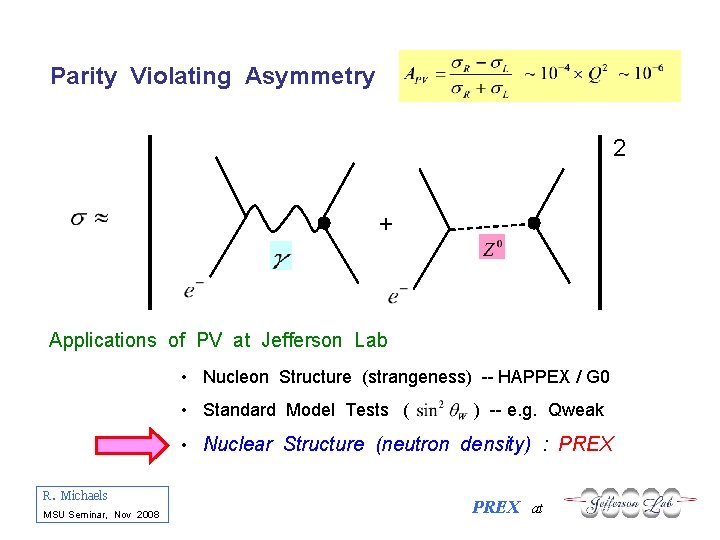
Parity Violating Asymmetry 2 + Applications of PV at Jefferson Lab • Nucleon Structure (strangeness) -- HAPPEX / G 0 • Standard Model Tests ( ) -- e. g. Qweak • Nuclear Structure (neutron density) : PREX R. Michaels MSU Seminar, Nov 2008 PREX at
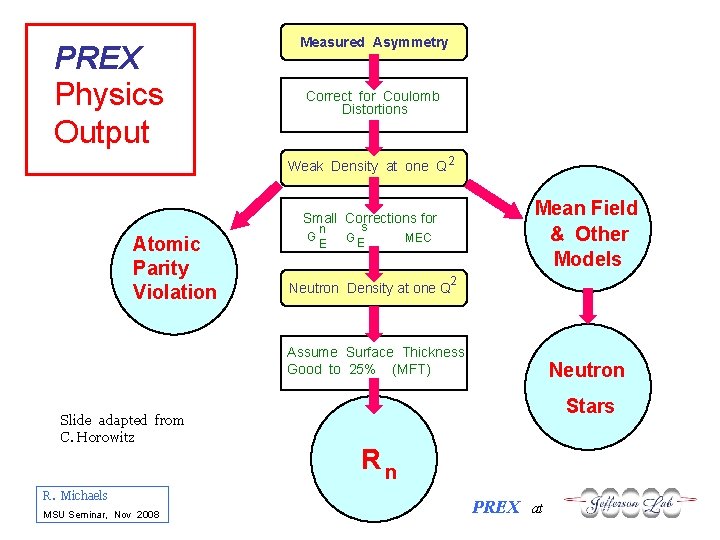
PREX Physics Output Measured Asymmetry Correct for Coulomb Distortions Weak Density at one Q 2 Mean Field & Other Models Small Corrections for Atomic Parity Violation G n E s GE MEC 2 Neutron Density at one Q Assume Surface Thickness Good to 25% (MFT) Slide adapted from C. Horowitz R. Michaels MSU Seminar, Nov 2008 Neutron Stars Rn PREX at
Fundamental Nuclear Physics : What is the size of a nucleus ? Neutrons are thought to determine the size of heavy nucleus like 208 Pb. Can theory predict it ? R. Michaels MSU Seminar, Nov 2008 PREX at
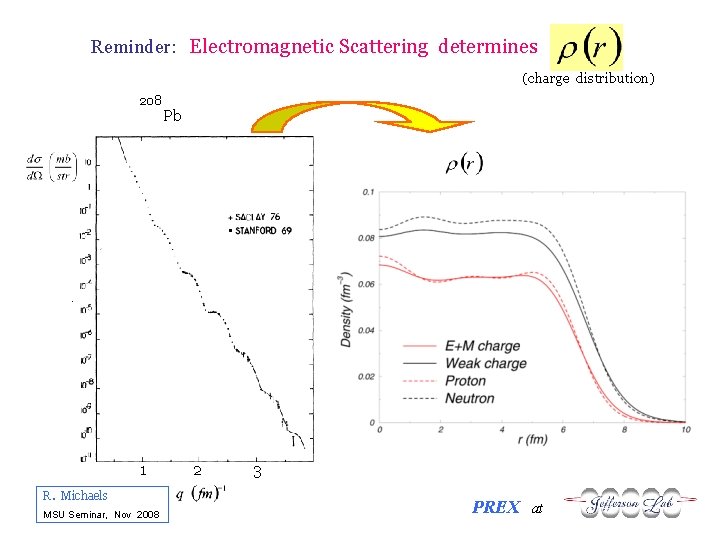
Reminder: Electromagnetic Scattering determines (charge distribution) 208 1 R. Michaels MSU Seminar, Nov 2008 Pb 2 3 PREX at
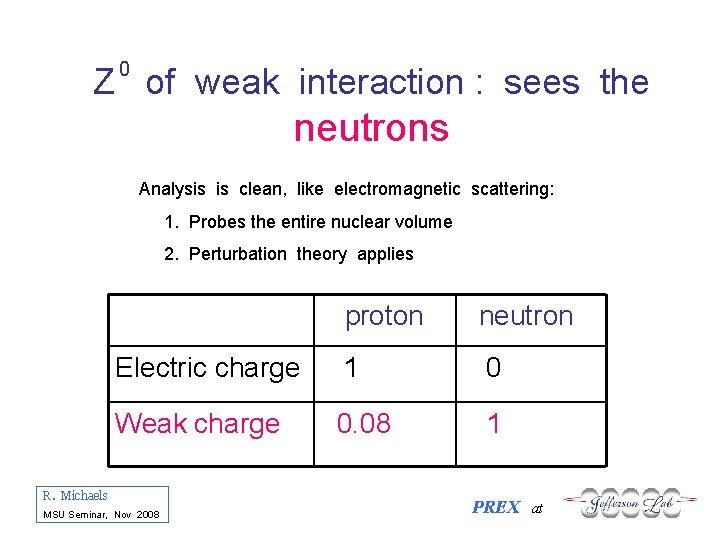
0 Z of weak interaction : sees the neutrons Analysis is clean, like electromagnetic scattering: 1. Probes the entire nuclear volume 2. Perturbation theory applies proton neutron Electric charge 1 0 Weak charge 0. 08 1 R. Michaels MSU Seminar, Nov 2008 PREX at
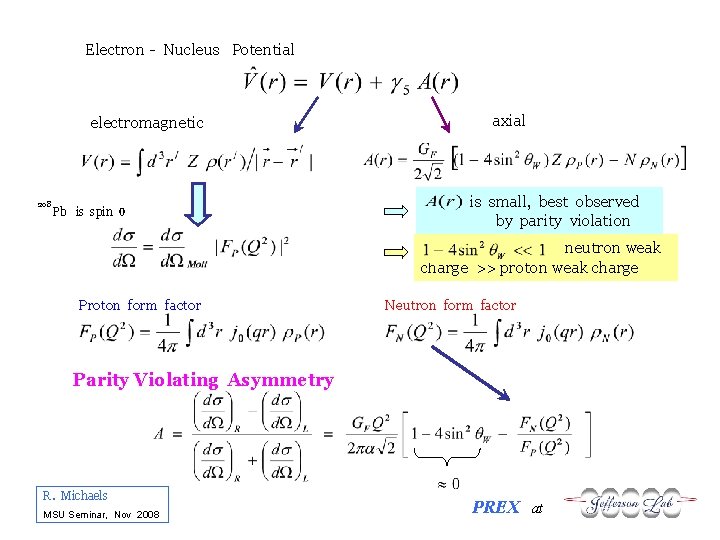
Electron - Nucleus Potential electromagnetic 208 Pb is spin 0 axial is small, best observed by parity violation neutron weak charge >> proton weak charge Proton form factor Neutron form factor Parity Violating Asymmetry R. Michaels MSU Seminar, Nov 2008 PREX at
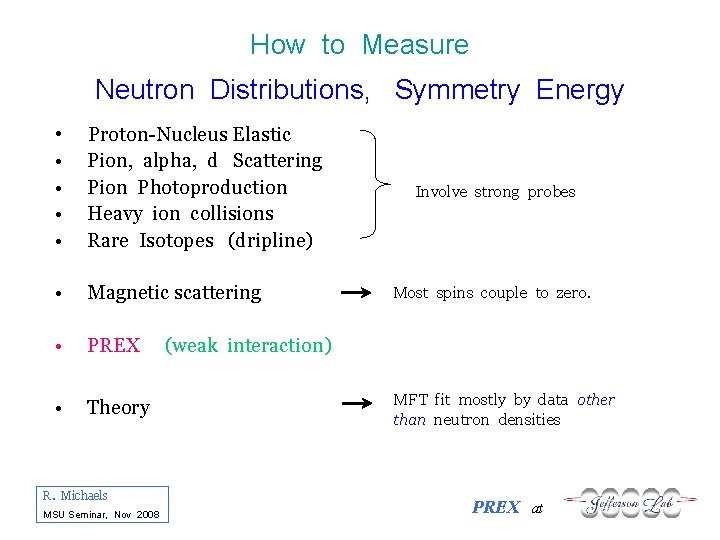
How to Measure Neutron Distributions, Symmetry Energy • • • Proton-Nucleus Elastic Pion, alpha, d Scattering Pion Photoproduction Heavy ion collisions Rare Isotopes (dripline) • Magnetic scattering • PREX • Theory R. Michaels MSU Seminar, Nov 2008 Involve strong probes Most spins couple to zero. (weak interaction) MFT fit mostly by data other than neutron densities PREX at
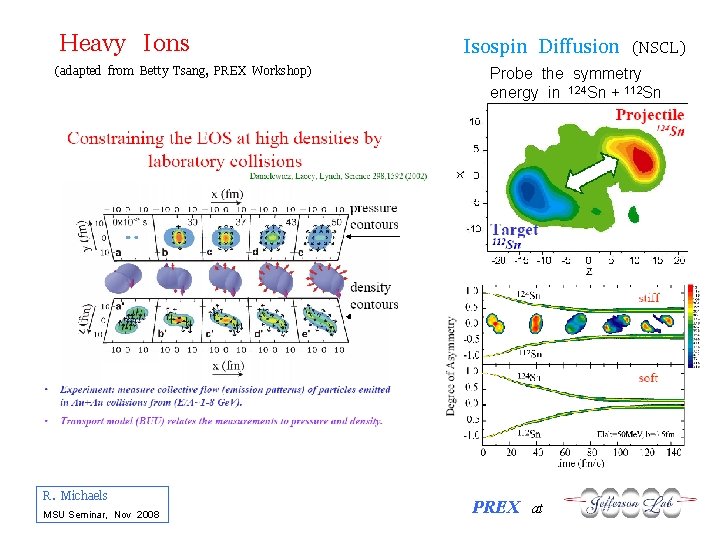
Heavy Ions (adapted from Betty Tsang, PREX Workshop) R. Michaels MSU Seminar, Nov 2008 Isospin Diffusion (NSCL) Probe the symmetry energy in 124 Sn + 112 Sn PREX at
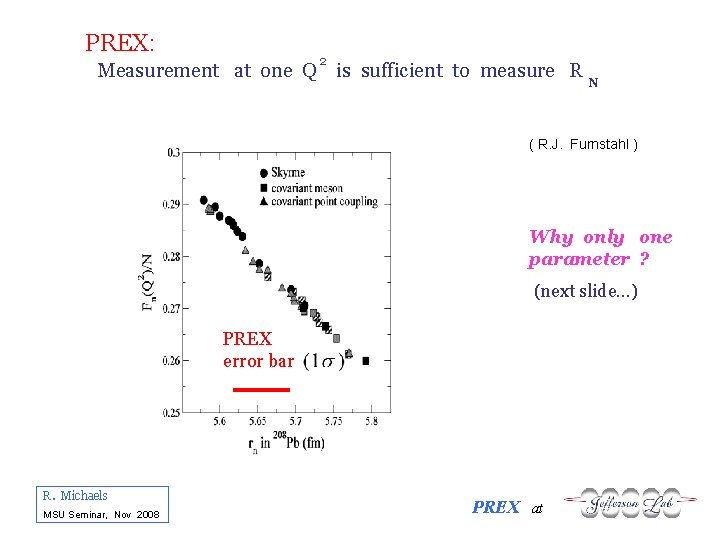
PREX: 2 Measurement at one Q is sufficient to measure R N ( R. J. Furnstahl ) Why only one parameter ? (next slide…) PREX error bar R. Michaels MSU Seminar, Nov 2008 PREX at
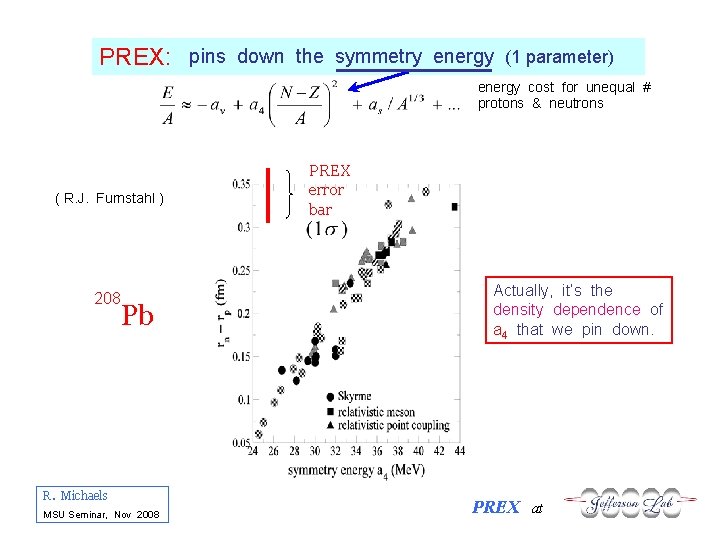
PREX: pins down the symmetry energy (1 parameter) energy cost for unequal # protons & neutrons ( R. J. Furnstahl ) 208 PREX error bar Actually, it’s the density dependence of a 4 that we pin down. Pb PREX R. Michaels MSU Seminar, Nov 2008 PREX at
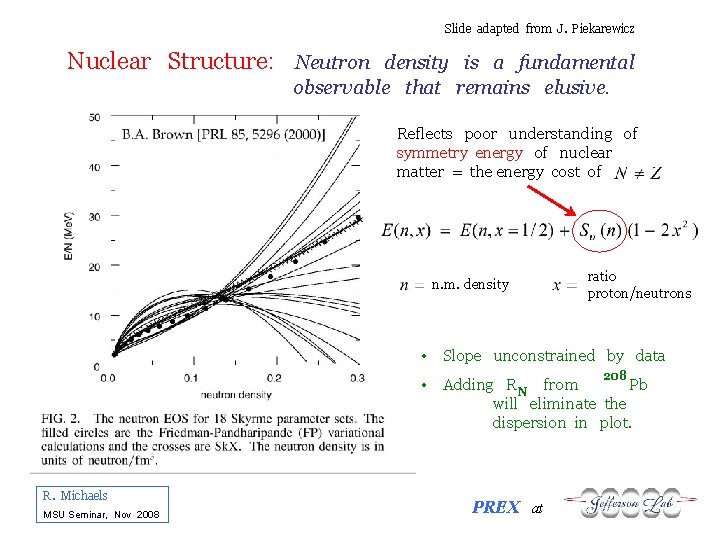
Slide adapted from J. Piekarewicz Nuclear Structure: Neutron density is a fundamental observable that remains elusive. Reflects poor understanding of symmetry energy of nuclear matter = the energy cost of ratio proton/neutrons n. m. density • Slope unconstrained by data 208 • Adding R N from Pb will eliminate the dispersion in plot. R. Michaels MSU Seminar, Nov 2008 PREX at
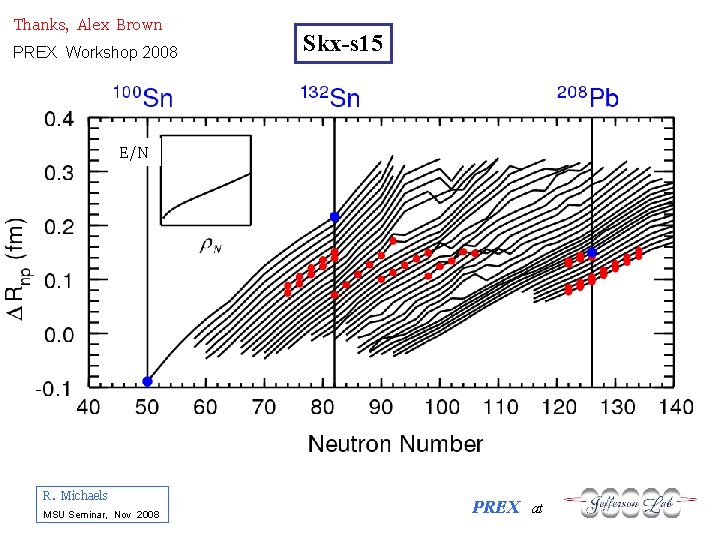
Thanks, Alex Brown PREX Workshop 2008 Skx-s 15 E/N R. Michaels MSU Seminar, Nov 2008 PREX at
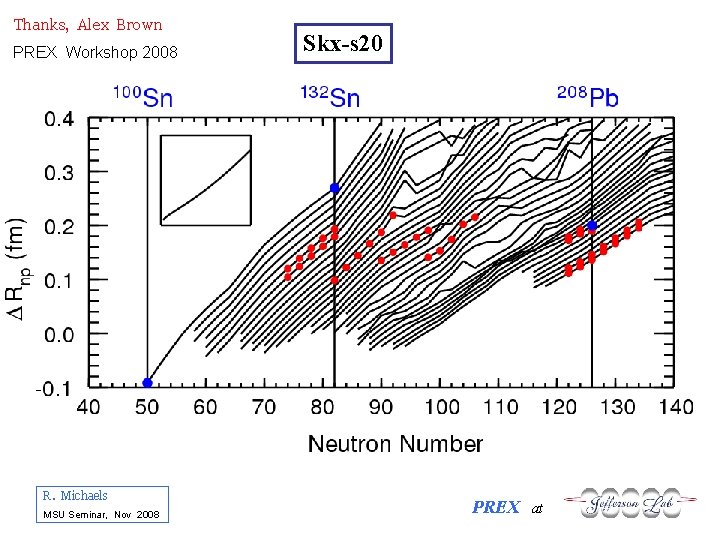
Thanks, Alex Brown PREX Workshop 2008 R. Michaels MSU Seminar, Nov 2008 Skx-s 20 PREX at
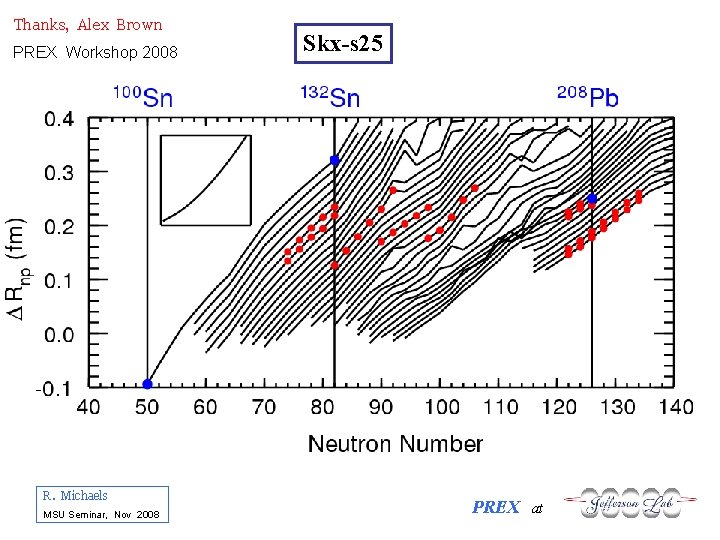
Thanks, Alex Brown PREX Workshop 2008 R. Michaels MSU Seminar, Nov 2008 Skx-s 25 PREX at
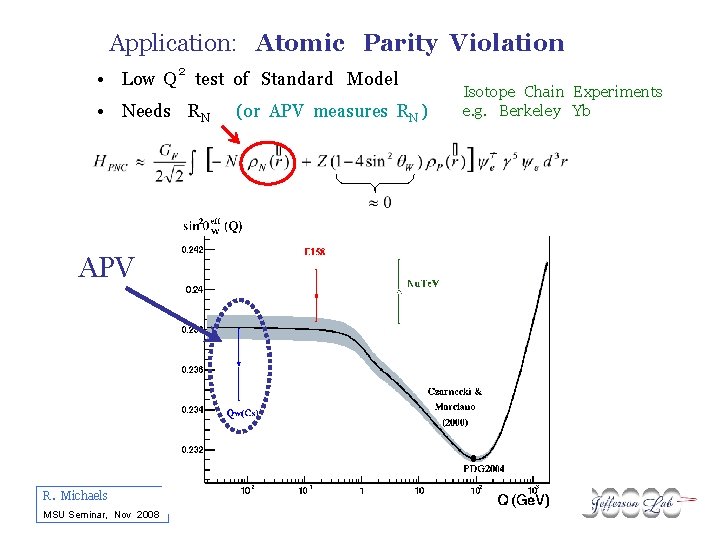
Application: Atomic Parity Violation • Low Q 2 test of Standard Model • Needs RN (or APV measures RN ) Isotope Chain Experiments e. g. Berkeley Yb APV R. Michaels MSU Seminar, Nov 2008 PREX at
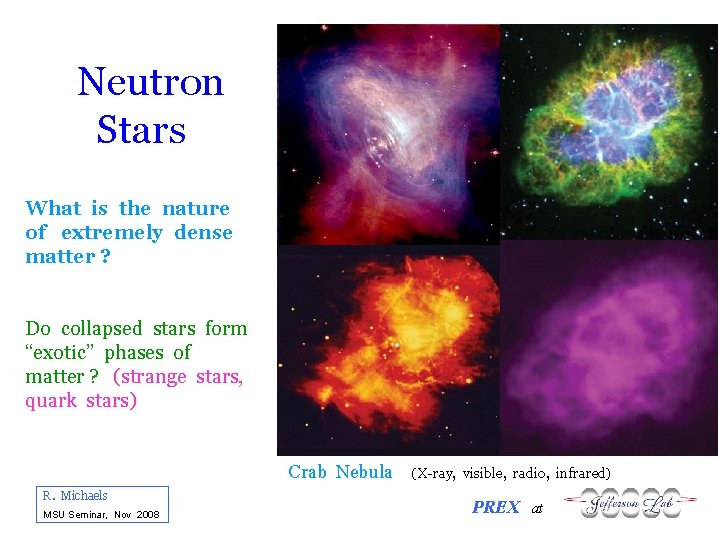
Neutron Stars What is the nature of extremely dense matter ? Do collapsed stars form “exotic” phases of matter ? (strange stars, quark stars) Crab Nebula R. Michaels MSU Seminar, Nov 2008 (X-ray, visible, radio, infrared) PREX at
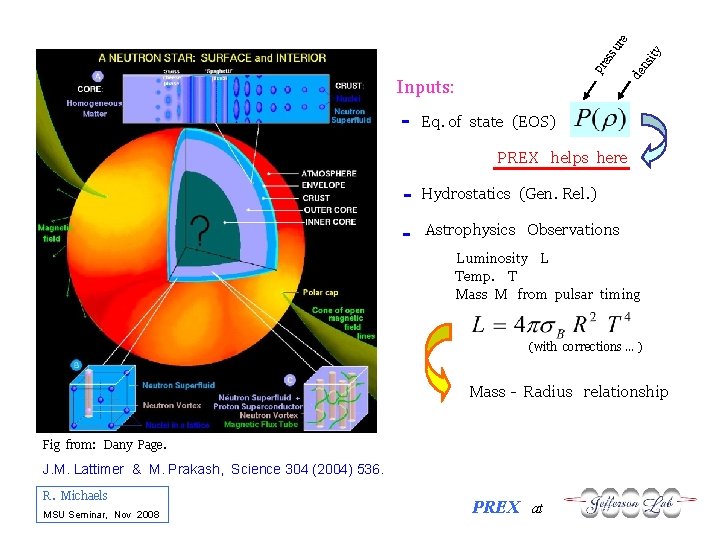
re ity su de ns es pr Inputs: Eq. of state (EOS) PREX helps here Hydrostatics (Gen. Rel. ) Astrophysics Observations Luminosity L Temp. T Mass M from pulsar timing (with corrections … ) Mass - Radius relationship Fig from: Dany Page. J. M. Lattimer & M. Prakash, Science 304 (2004) 536. R. Michaels MSU Seminar, Nov 2008 PREX at
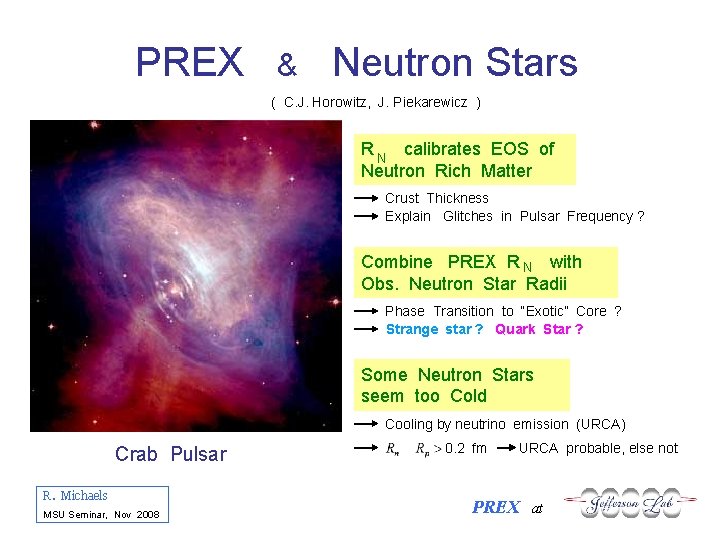
PREX & Neutron Stars ( C. J. Horowitz, J. Piekarewicz ) R N calibrates EOS of Neutron Rich Matter Crust Thickness Explain Glitches in Pulsar Frequency ? Combine PREX R N with Obs. Neutron Star Radii Phase Transition to “Exotic” Core ? Strange star ? Quark Star ? Some Neutron Stars seem too Cold Cooling by neutrino emission (URCA) Crab Pulsar R. Michaels MSU Seminar, Nov 2008 0. 2 fm URCA probable, else not PREX at
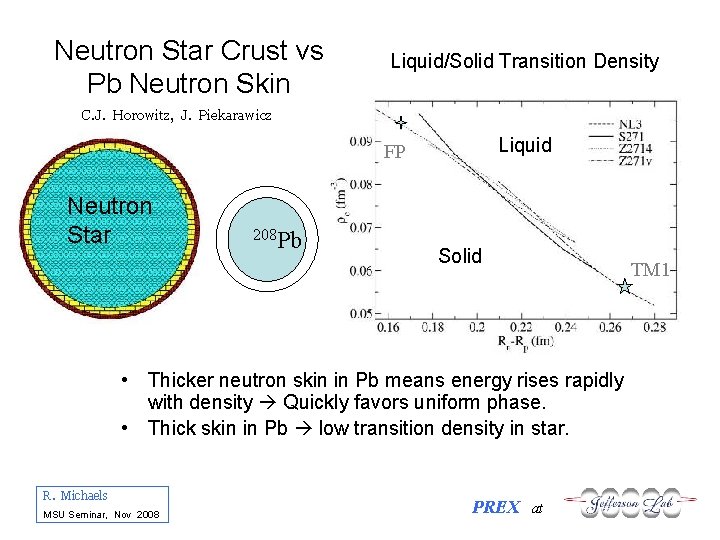
Neutron Star Crust vs Pb Neutron Skin Liquid/Solid Transition Density C. J. Horowitz, J. Piekarawicz Liquid FP Neutron Star 208 Pb Solid TM 1 • Thicker neutron skin in Pb means energy rises rapidly with density Quickly favors uniform phase. • Thick skin in Pb low transition density in star. R. Michaels MSU Seminar, Nov 2008 PREX at
(slide from C. Horowitz) Pb Radius vs Neutron Star Radius • The 208 Pb radius constrains the pressure of neutron matter at subnuclear densities. • The NS radius depends on the pressure at nuclear density and above. • Most interested in density dependence of equation of state (EOS) from a possible phase transition. • Important to have both low density and high density measurements to constrain density dependence of EOS. – If Pb radius is relatively large: EOS at low density is stiff with high P. If NS radius is small than high density EOS soft. – This softening of EOS with density could strongly suggest a transition to an exotic high density phase such as quark matter, strange matter, color superconductor, kaon condensate… R. Michaels MSU Seminar, Nov 2008 PREX at
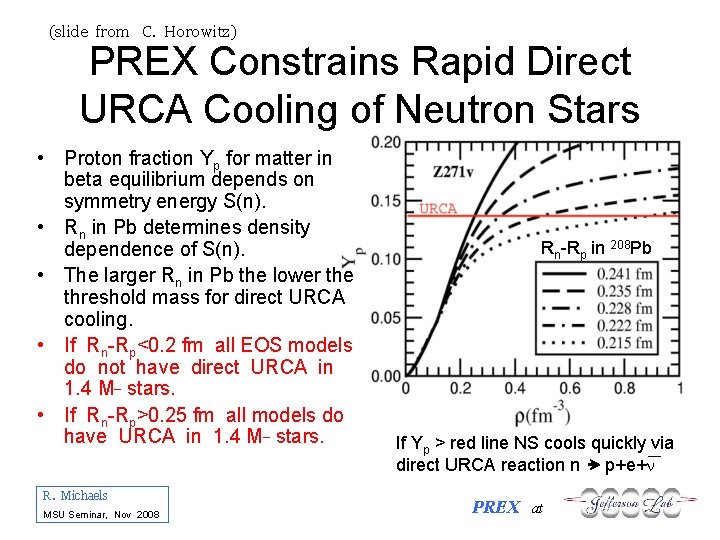
(slide from C. Horowitz) PREX Constrains Rapid Direct URCA Cooling of Neutron Stars • Proton fraction Yp for matter in beta equilibrium depends on symmetry energy S(n). • Rn in Pb determines density dependence of S(n). • The larger Rn in Pb the lower the threshold mass for direct URCA cooling. • If Rn-Rp<0. 2 fm all EOS models do not have direct URCA in 1. 4 M¯ stars. • If Rn-Rp>0. 25 fm all models do have URCA in 1. 4 M¯ stars. R. Michaels MSU Seminar, Nov 2008 Rn-Rp in 208 Pb If Yp > red line NS cools quickly via direct URCA reaction n p+e+ PREX at
PREX: Experiment Design Spokespersons: K. Kumar Univ. Mass. P. A. Souder Syracuse U. G. M. Urciuoli INFN Rome R. Michaels JLab Hall A Collaboration Experiment R. Michaels MSU Seminar, Nov 2008 PREX at
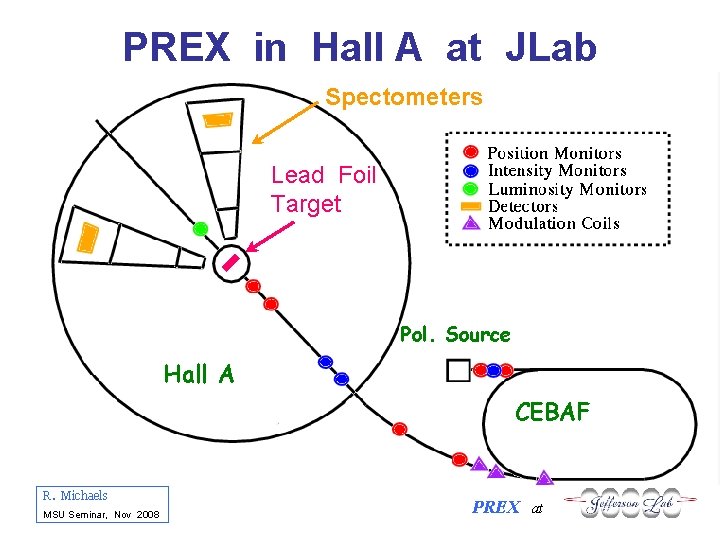
PREX in Hall A at JLab Spectometers Lead Foil Target Pol. Source Hall A CEBAF R. Michaels MSU Seminar, Nov 2008 PREX at
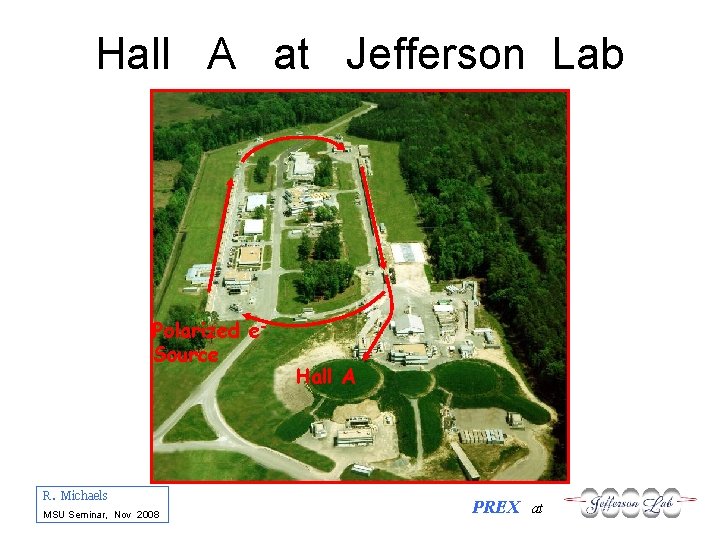
Hall A at Jefferson Lab Polarized e. Source R. Michaels MSU Seminar, Nov 2008 Hall A PREX at
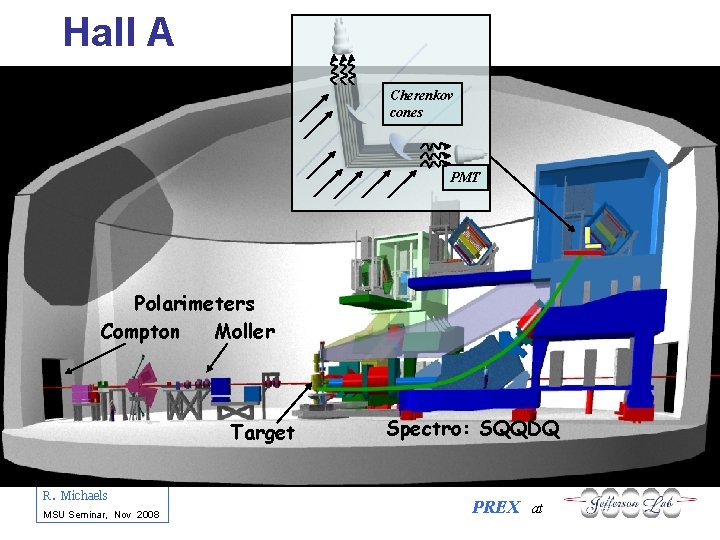
Hall A Cherenkov cones PMT Polarimeters Compton Moller Target R. Michaels MSU Seminar, Nov 2008 Spectro: SQQDQ PREX at
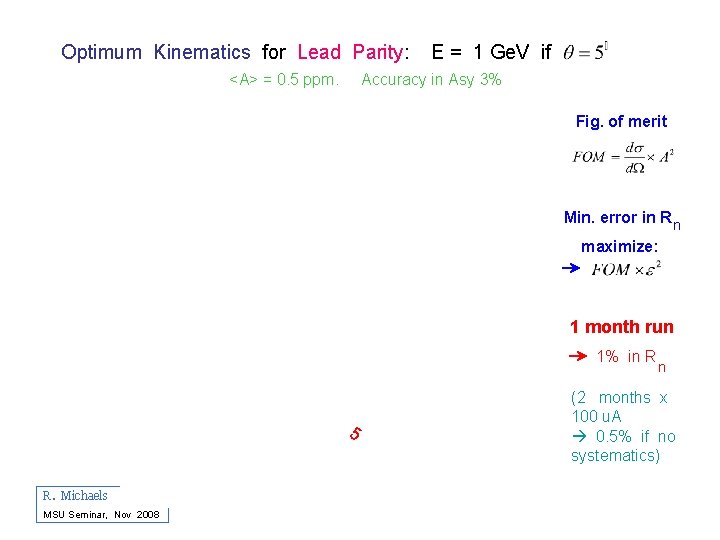
Optimum Kinematics for Lead Parity: <A> = 0. 5 ppm. E = 1 Ge. V if Accuracy in Asy 3% Fig. of merit Min. error in R n maximize: 1 month run 1% in R (2 months x 100 u. A 0. 5% if no systematics) 5 R. Michaels MSU Seminar, Nov 2008 n PREX at
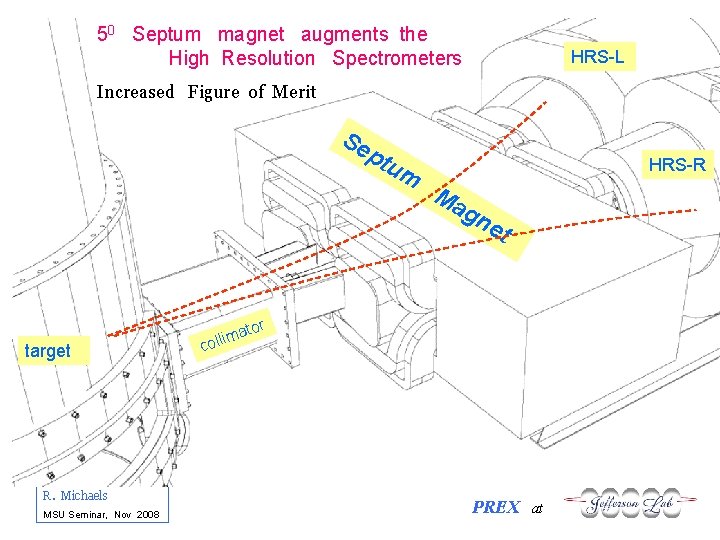
50 Septum magnet augments the High Resolution Spectrometers HRS-L Increased Figure of Merit Se ptu m HRS-R Ma gn et or target R. Michaels MSU Seminar, Nov 2008 at m i l l co PREX at
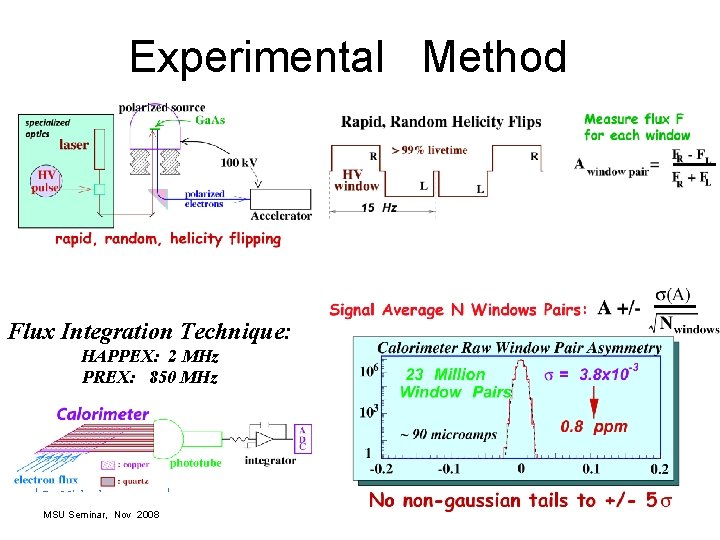
Experimental Method Flux Integration Technique: HAPPEX: 2 MHz PREX: 850 MHz R. Michaels MSU Seminar, Nov 2008 PREX at
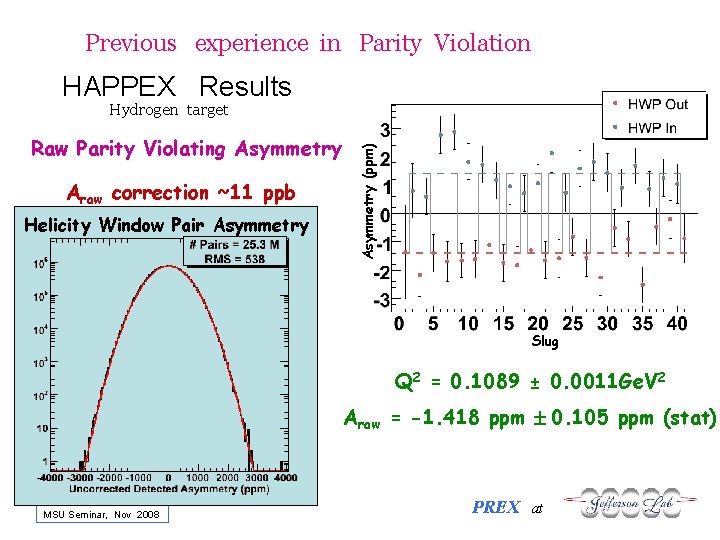
Previous experience in Parity Violation HAPPEX Results Raw Parity Violating Asymmetry Araw correction ~11 ppb Helicity Window Pair Asymmetry (ppm) Hydrogen target Slug Q 2 = 0. 1089 ± 0. 0011 Ge. V 2 Araw = -1. 418 ppm 0. 105 ppm (stat) R. Michaels MSU Seminar, Nov 2008 PREX at
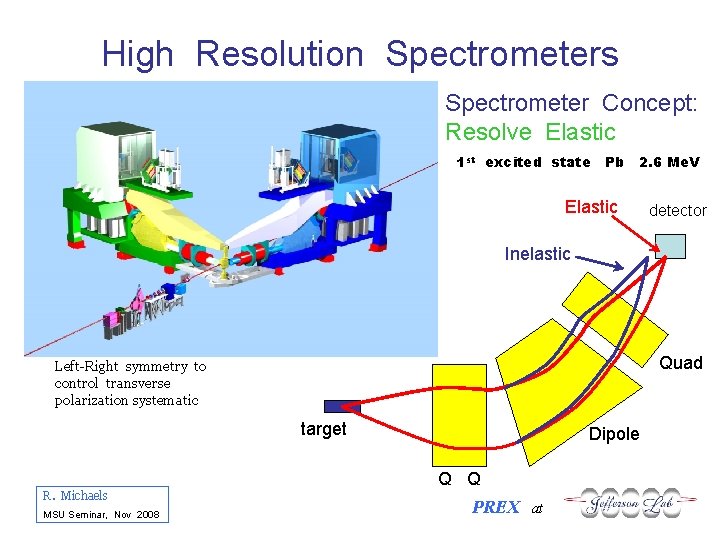
High Resolution Spectrometers Spectrometer Concept: Resolve Elastic 1 st excited state Pb 2. 6 Me. V Elastic detector Inelastic Quad Left-Right symmetry to control transverse polarization systematic target Dipole Q Q R. Michaels MSU Seminar, Nov 2008 PREX at
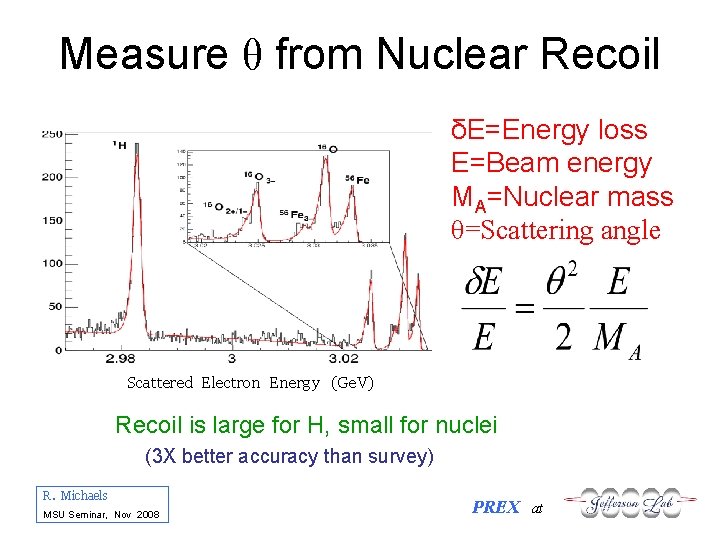
Measure θ from Nuclear Recoil δE=Energy loss E=Beam energy MA=Nuclear mass θ=Scattering angle Scattered Electron Energy (Ge. V) Recoil is large for H, small for nuclei (3 X better accuracy than survey) R. Michaels MSU Seminar, Nov 2008 PREX at
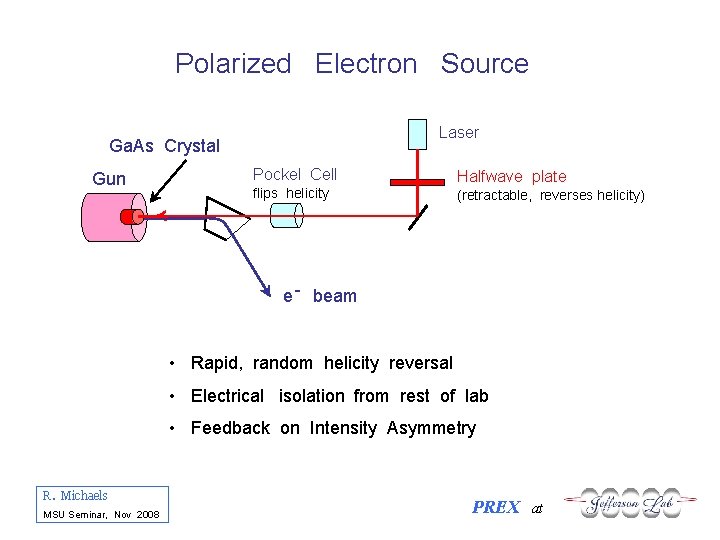
Polarized Electron Source Laser Ga. As Crystal Gun Pockel Cell flips helicity Halfwave plate (retractable, reverses helicity) e - beam • Rapid, random helicity reversal • Electrical isolation from rest of lab • Feedback on Intensity Asymmetry R. Michaels MSU Seminar, Nov 2008 PREX at
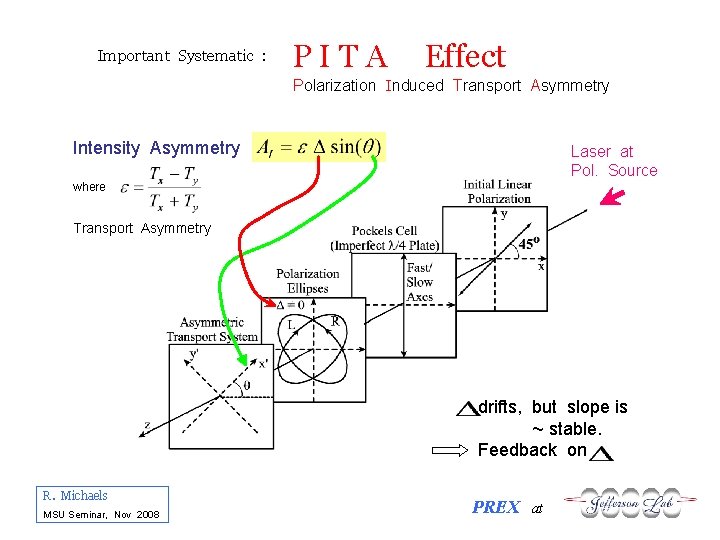
Important Systematic : PITA Effect Polarization Induced Transport Asymmetry Intensity Asymmetry Laser at Pol. Source where Transport Asymmetry drifts, but slope is ~ stable. Feedback on R. Michaels MSU Seminar, Nov 2008 PREX at
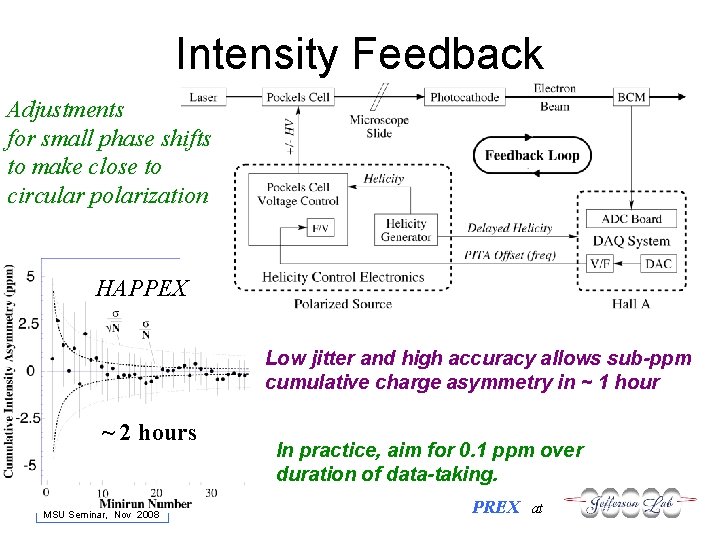
Intensity Feedback Adjustments for small phase shifts to make close to circular polarization HAPPEX Low jitter and high accuracy allows sub-ppm cumulative charge asymmetry in ~ 1 hour ~ 2 hours R. Michaels MSU Seminar, Nov 2008 In practice, aim for 0. 1 ppm over duration of data-taking. PREX at
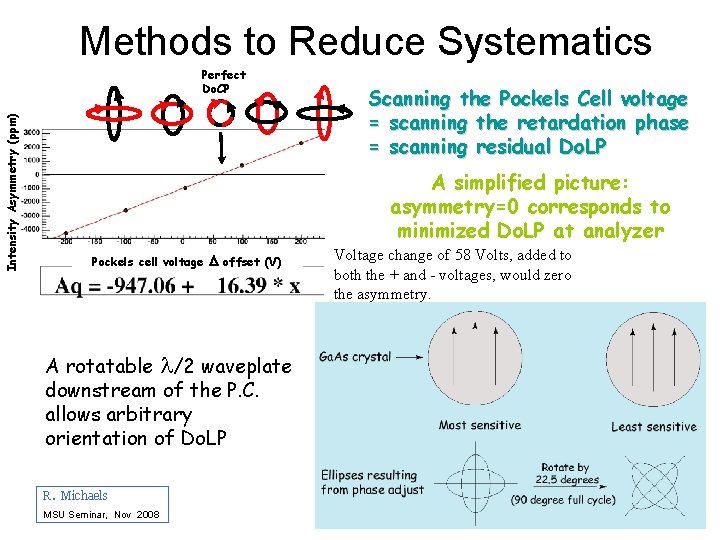
Methods to Reduce Systematics Intensity Asymmetry (ppm) Perfect Do. CP Scanning the Pockels Cell voltage = scanning the retardation phase = scanning residual Do. LP A simplified picture: asymmetry=0 corresponds to minimized Do. LP at analyzer Pockels cell voltage D offset (V) Voltage change of 58 Volts, added to both the + and - voltages, would zero the asymmetry. A rotatable l/2 waveplate downstream of the P. C. allows arbitrary orientation of Do. LP R. Michaels MSU Seminar, Nov 2008 PREX at
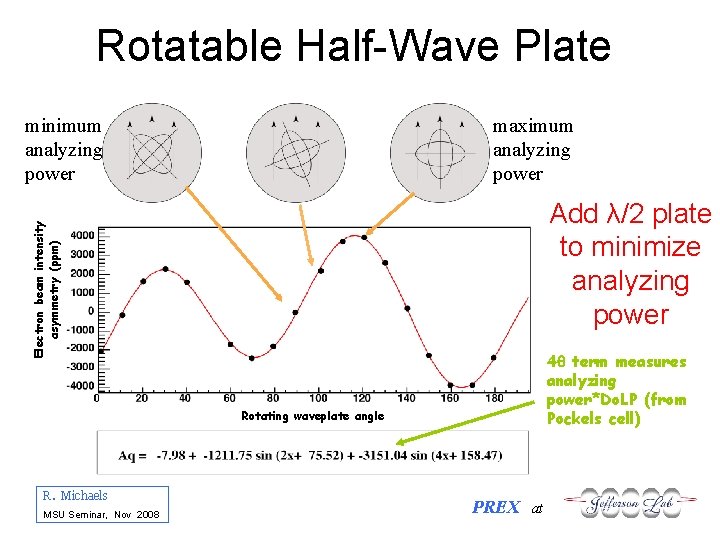
Rotatable Half-Wave Plate minimum analyzing power maximum analyzing power Electron beam intensity asymmetry (ppm) Add λ/2 plate to minimize analyzing power 4 q term measures analyzing power*Do. LP (from Pockels cell) Rotating waveplate angle R. Michaels MSU Seminar, Nov 2008 PREX at
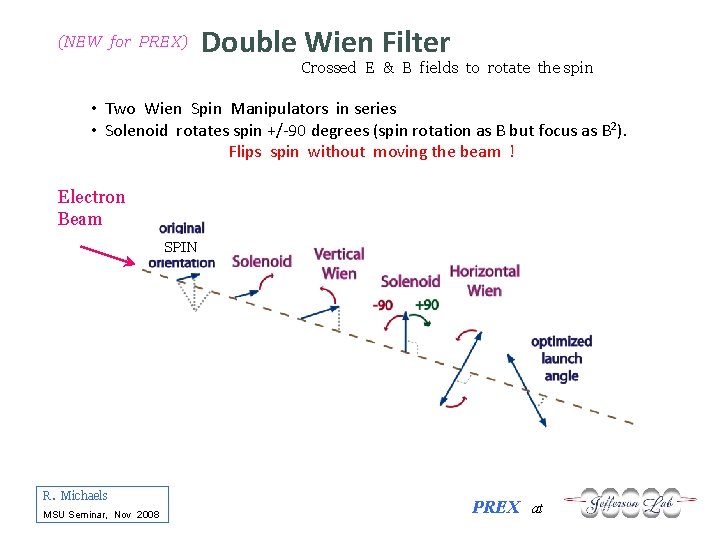
(NEW for PREX) Double Wien Filter Crossed E & B fields to rotate the spin • Two Wien Spin Manipulators in series • Solenoid rotates spin +/-90 degrees (spin rotation as B but focus as B 2). Flips spin without moving the beam ! Electron Beam SPIN R. Michaels MSU Seminar, Nov 2008 PREX at
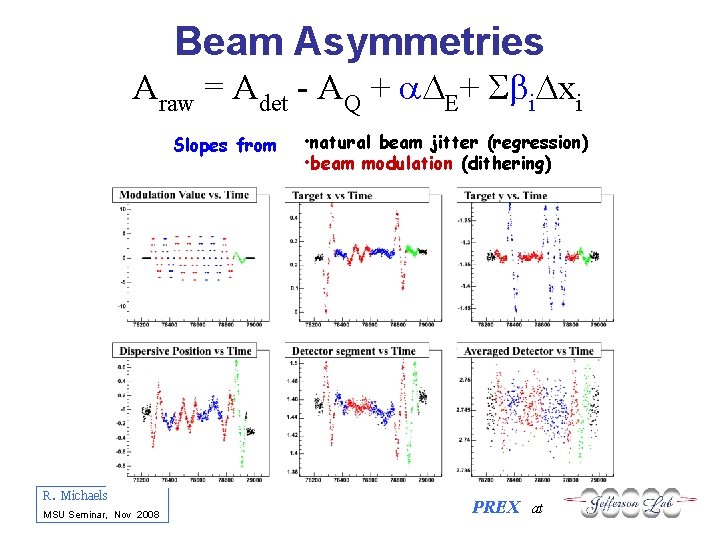
Beam Asymmetries Araw = Adet - AQ + E+ i xi Slopes from R. Michaels MSU Seminar, Nov 2008 • natural beam jitter (regression) • beam modulation (dithering) PREX at
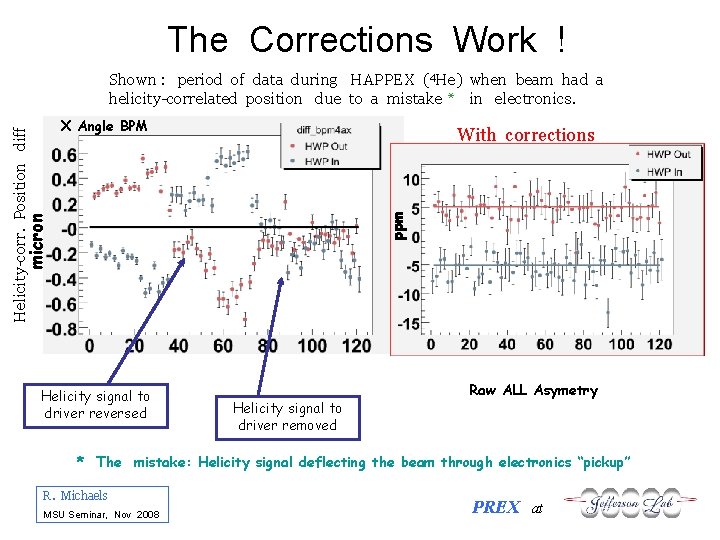
The Corrections Work ! X Angle BPM ppm With corrections micron Helicity-corr. Position diff Shown : period of data during HAPPEX (4 He) when beam had a helicity-correlated position due to a mistake * in electronics. Helicity signal to driver reversed Helicity signal to driver removed Raw ALL Asymetry * The mistake: Helicity signal deflecting the beam through electronics “pickup” R. Michaels MSU Seminar, Nov 2008 PREX at
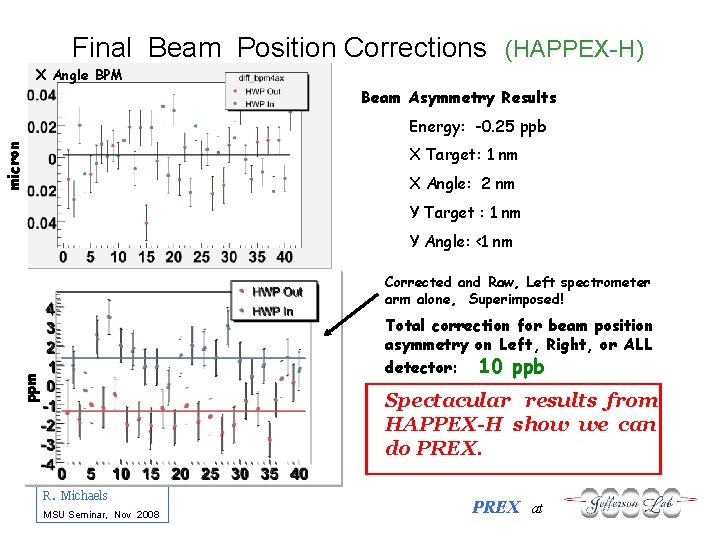
Final Beam Position Corrections (HAPPEX-H) X Angle BPM Beam Asymmetry Results micron Energy: -0. 25 ppb X Target: 1 nm X Angle: 2 nm Y Target : 1 nm Y Angle: <1 nm Corrected and Raw, Left spectrometer arm alone, Superimposed! ppm Total correction for beam position asymmetry on Left, Right, or ALL detector: 10 ppb Spectacular results from HAPPEX-H show we can do PREX. R. Michaels MSU Seminar, Nov 2008 PREX at
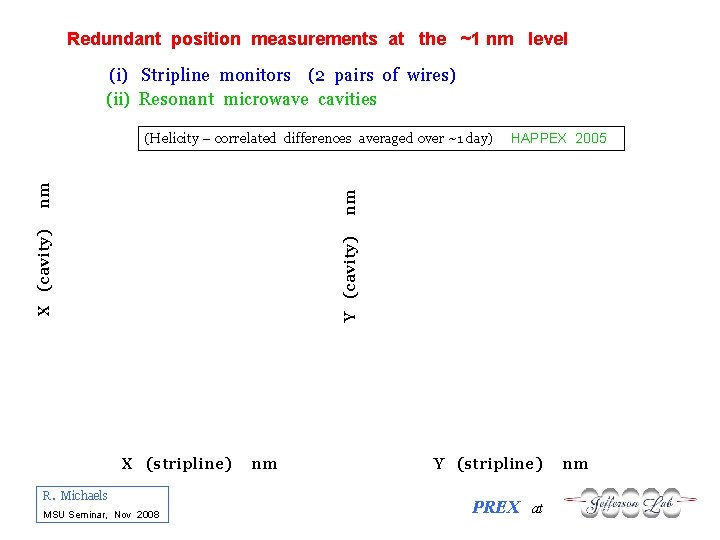
Redundant position measurements at the ~1 nm level (i) Stripline monitors (2 pairs of wires) (ii) Resonant microwave cavities HAPPEX 2005 Y (cavity) X (cavity) nm nm (Helicity – correlated differences averaged over ~1 day) X (stripline) R. Michaels MSU Seminar, Nov 2008 nm Y (stripline) PREX at nm
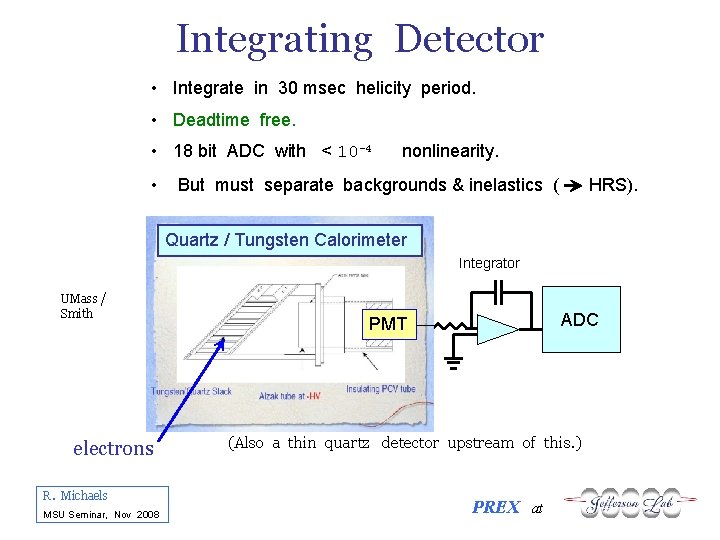
Integrating Detector • Integrate in 30 msec helicity period. • Deadtime free. • 18 bit ADC with < 10 -4 • nonlinearity. But must separate backgrounds & inelastics ( HRS). Quartz / Tungsten Calorimeter Integrator UMass / Smith electrons R. Michaels MSU Seminar, Nov 2008 ADC PMT (Also a thin quartz detector upstream of this. ) PREX at
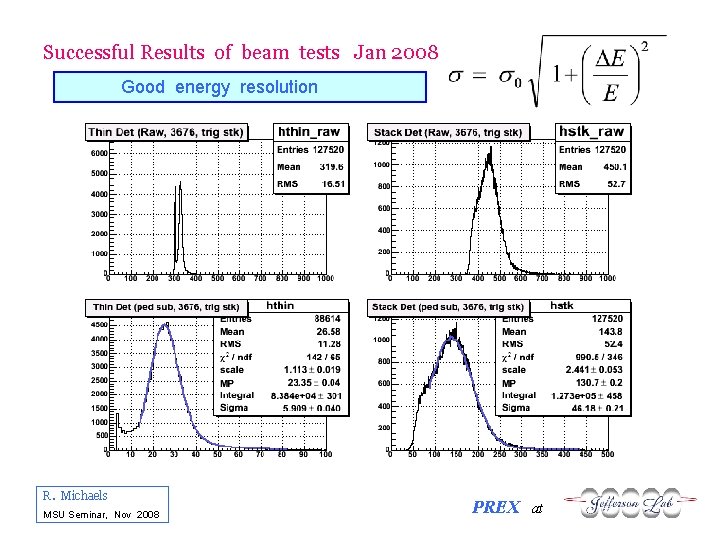
Successful Results of beam tests Jan 2008 Good energy resolution R. Michaels MSU Seminar, Nov 2008 PREX at
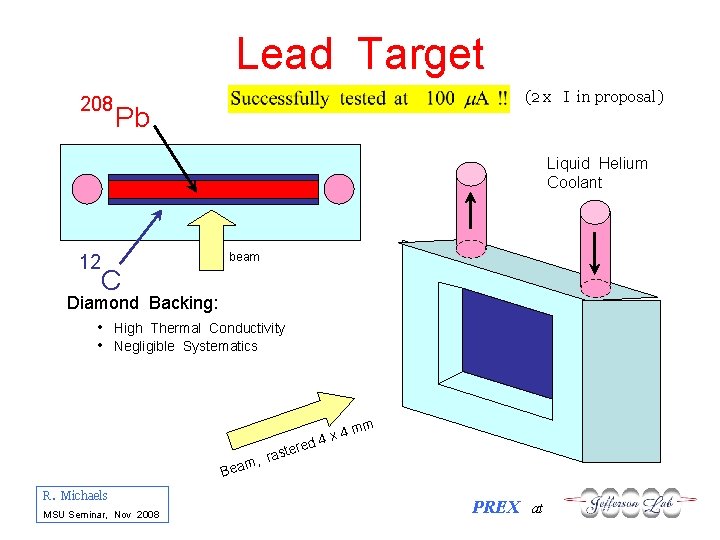
Lead Target 208 (2 x I in proposal) Pb Liquid Helium Coolant 12 beam C Diamond Backing: • High Thermal Conductivity • Negligible Systematics m red e rast , m Bea R. Michaels MSU Seminar, Nov 2008 m 4 x 4 PREX at
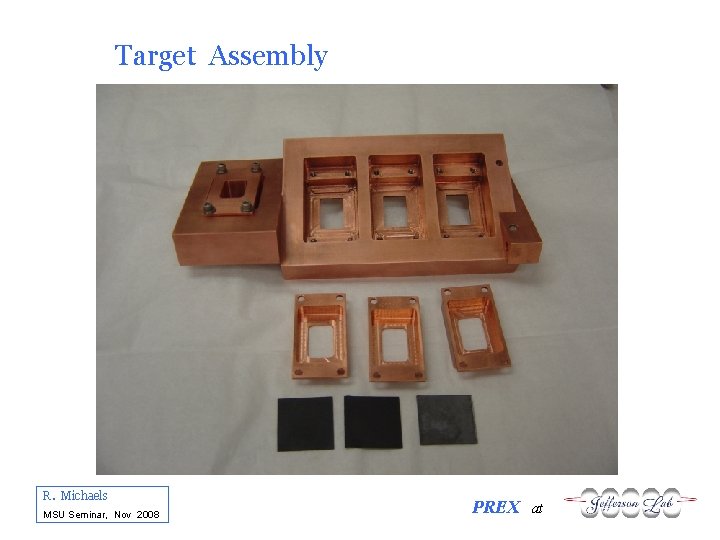
Target Assembly R. Michaels MSU Seminar, Nov 2008 PREX at
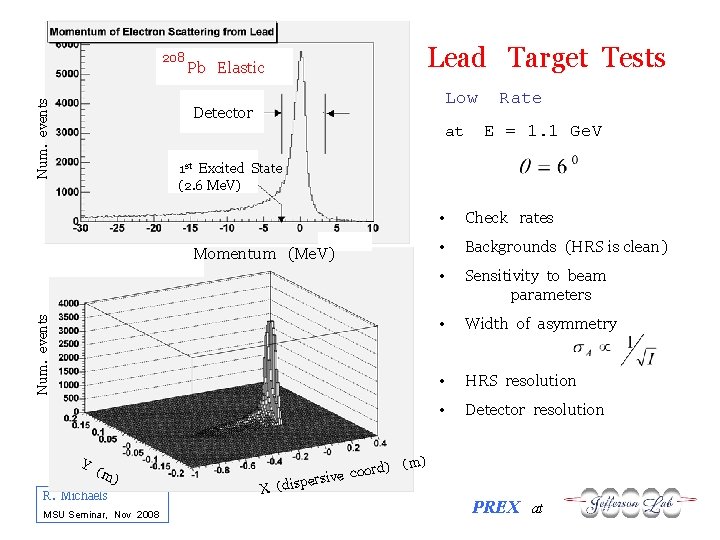
Num. events 208 Lead Target Tests Pb Elastic Low Detector at Rate E = 1. 1 Ge. V 1 st Excited State (2. 6 Me. V) Num. events Momentum (Me. V) Y (m ) R. Michaels MSU Seminar, Nov 2008 X d) e coor v i s r e p (dis • Check rates • Backgrounds (HRS is clean) • Sensitivity to beam parameters • Width of asymmetry • HRS resolution • Detector resolution (m) PREX at
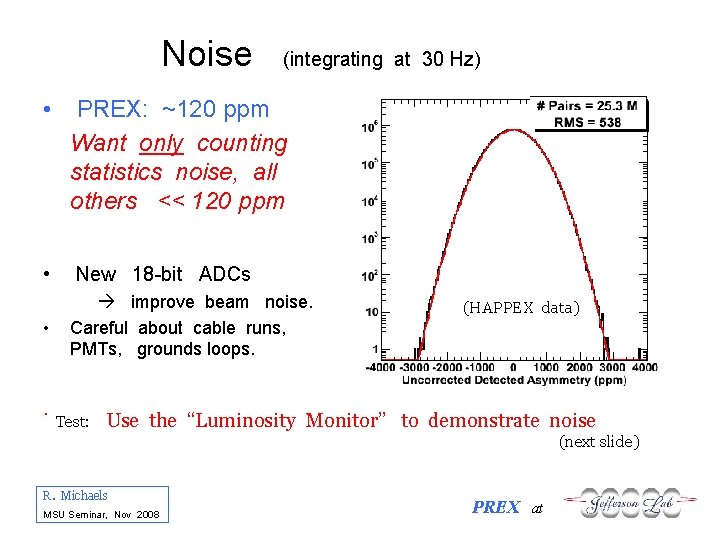
Noise (integrating at 30 Hz) • PREX: ~120 ppm Want only counting statistics noise, all others << 120 ppm • New 18 -bit ADCs • . improve beam noise. Careful about cable runs, PMTs, grounds loops. Test: (HAPPEX data) Use the “Luminosity Monitor” to demonstrate noise (next slide) R. Michaels MSU Seminar, Nov 2008 PREX at
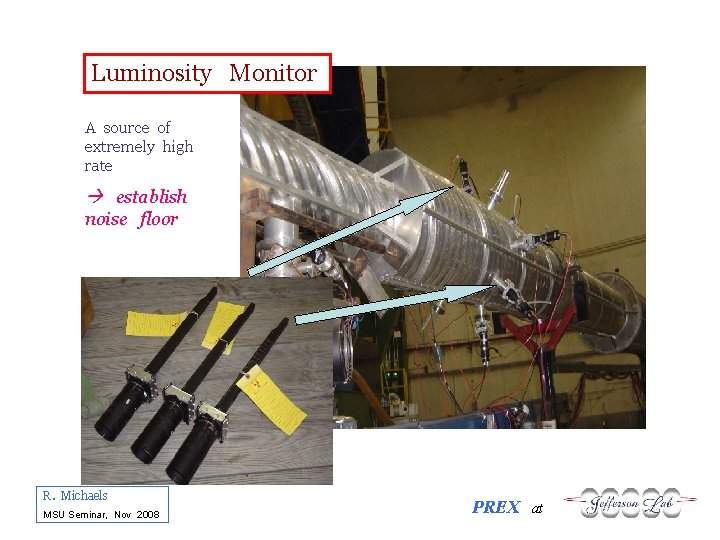
Luminosity Monitor A source of extremely high rate establish noise floor R. Michaels MSU Seminar, Nov 2008 PREX at
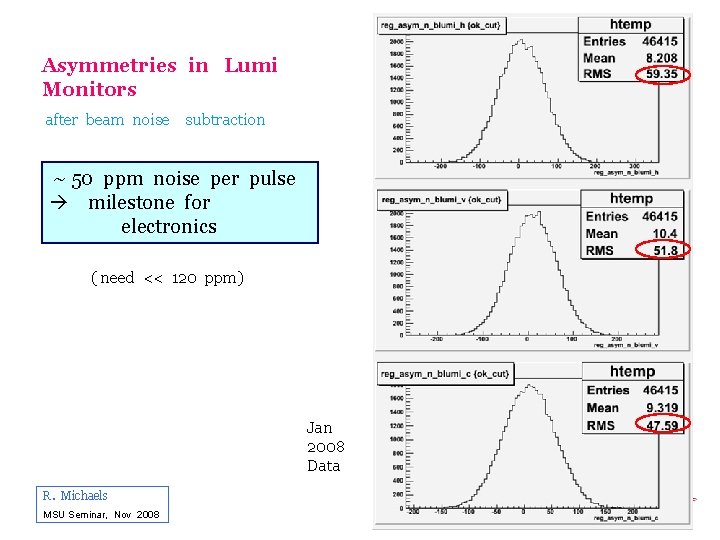
Asymmetries in Lumi Monitors after beam noise subtraction ~ 50 ppm noise per pulse milestone for electronics ( need << 120 ppm) Jan 2008 Data R. Michaels MSU Seminar, Nov 2008 PREX at
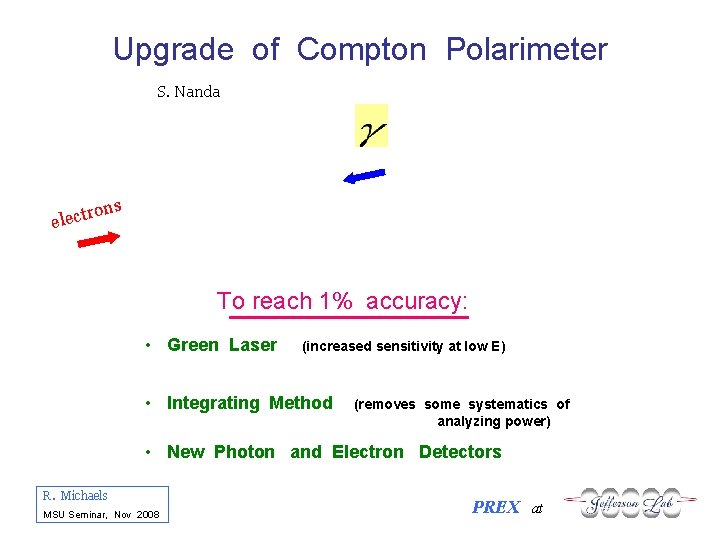
Upgrade of Compton Polarimeter S. Nanda ron t c e l e s To reach 1% accuracy: • Green Laser (increased sensitivity at low E) • Integrating Method (removes some systematics of analyzing power) • New Photon and Electron Detectors R. Michaels MSU Seminar, Nov 2008 PREX at
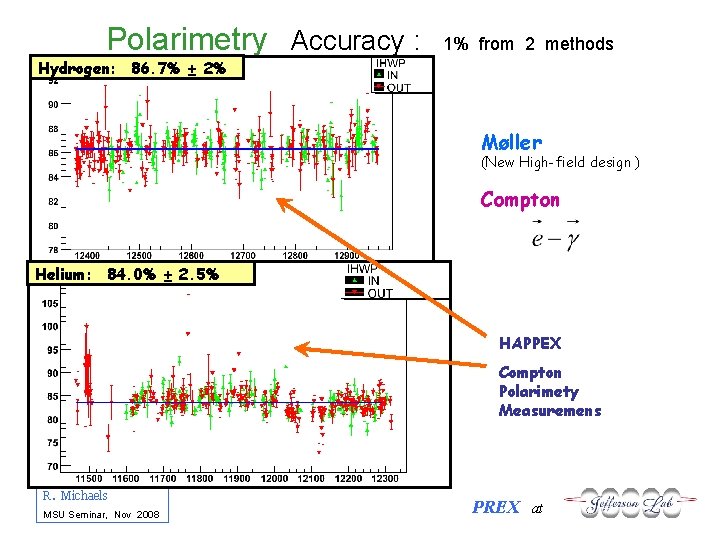
Polarimetry Accuracy : 1% from 2 methods Hydrogen: 86. 7% ± 2% Møller (New High-field design ) Compton Helium: 84. 0% ± 2. 5% HAPPEX Compton Polarimety Measuremens R. Michaels MSU Seminar, Nov 2008 PREX at
PREX : Summary • Fundamental Nuclear Physics with many applications • HAPPEX & test runs have demonstrated technical aspects • Polarimetry Upgrade critical • 1 month run in early 2010 R. Michaels MSU Seminar, Nov 2008 PREX at
Extra Slides R. Michaels MSU Seminar, Nov 2008 PREX at
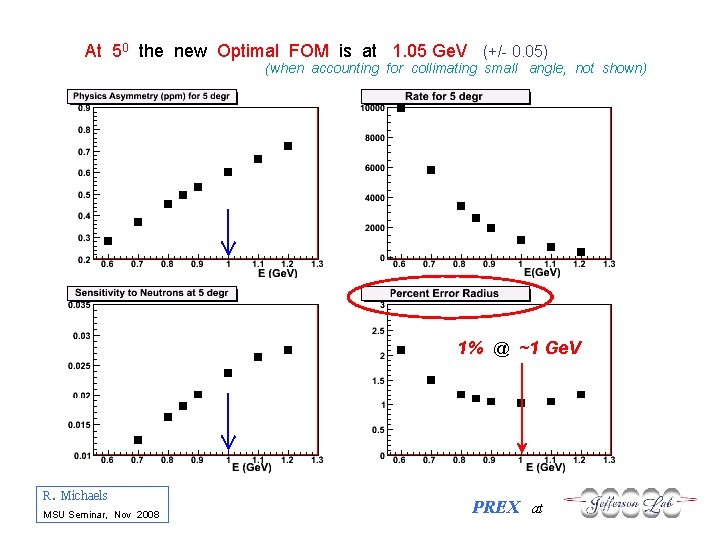
At 50 the new Optimal FOM is at 1. 05 Ge. V (+/- 0. 05) (when accounting for collimating small angle, not shown) 1% @ ~1 Ge. V R. Michaels MSU Seminar, Nov 2008 PREX at
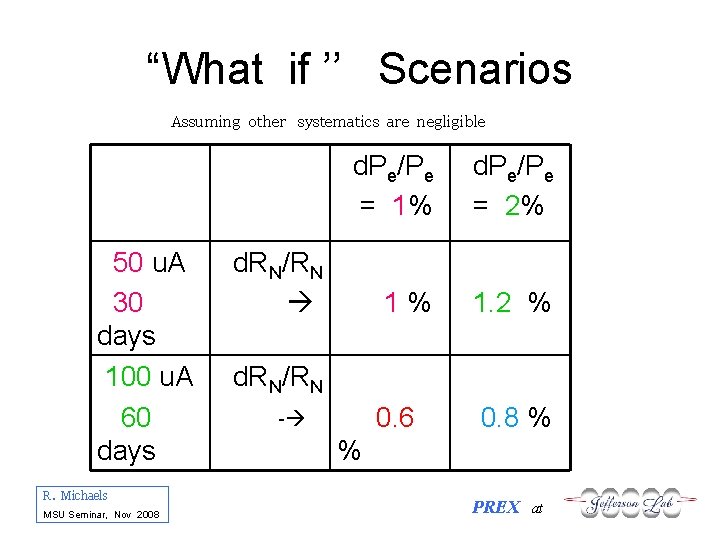
“What if ’’ Scenarios Assuming other systematics are negligible 50 u. A 30 days 100 u. A 60 days R. Michaels MSU Seminar, Nov 2008 d. Pe/Pe = 1% d. Pe/Pe = 2% 1% 1. 2 % 0. 6 0. 8 % d. RN/RN - % PREX at
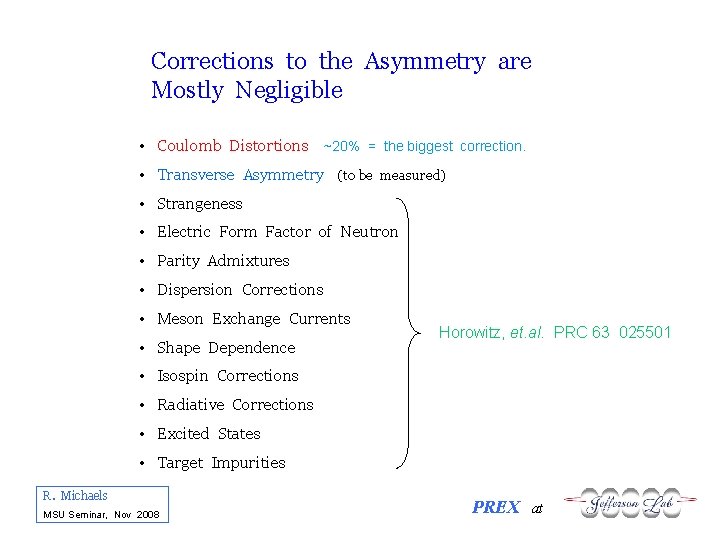
Corrections to the Asymmetry are Mostly Negligible • Coulomb Distortions ~20% = the biggest correction. • Transverse Asymmetry (to be measured) • Strangeness • Electric Form Factor of Neutron • Parity Admixtures • Dispersion Corrections • Meson Exchange Currents • Shape Dependence Horowitz, et. al. PRC 63 025501 • Isospin Corrections • Radiative Corrections • Excited States • Target Impurities R. Michaels MSU Seminar, Nov 2008 PREX at
Optimization for Barium -- of possible direct use for Atomic PV 1 Ge. V optimum R. Michaels MSU Seminar, Nov 2008 PREX at
Warm Septum Existing superconducting septum won’t work at high L Warm low energy (1 Ge. V) magnet designed. Grant proposal in preparation (~100 k$) [Syracuse / Smith College] TOSCA design P resolution ok R. Michaels MSU Seminar, Nov 2008 PREX at
- Slides: 62